Quick Answer
The wall is the detail owners remember. A dog who has used the same kitchen for eleven years stops in the middle of it, faces the cupboard, and waits for something to happen. Dog dementia, called canine cognitive dysfunction syndrome (CCDS) by vets, is a progressive brain disease of older dogs that changes orientation, social behaviour, sleep, house training, activity and anxiety levels. It cannot be reversed. It can often be slowed, and the earliest signs are the ones worth acting on, because veterinary reviews published in 2026 found the best results when treatment starts while impairment is still mild. Six categories of early signs, summarised by the DISHAA assessment tool, are what your vet will ask about first.
Key Takeaways: Dog Dementia
- Dog dementia is a diagnosis of exclusion. Pain, deafness, vision loss, kidney disease, thyroid disease and brain tumours can all look like confusion, so bloodwork and a physical exam come before any label.
- The six early sign categories are DISHAA: Disorientation, altered Interactions, Sleep wake disruption, House soiling, Activity changes, and Anxiety.
- Night-time pacing and “sundowning” are among the most reported early changes, and they are also among the hardest on households.
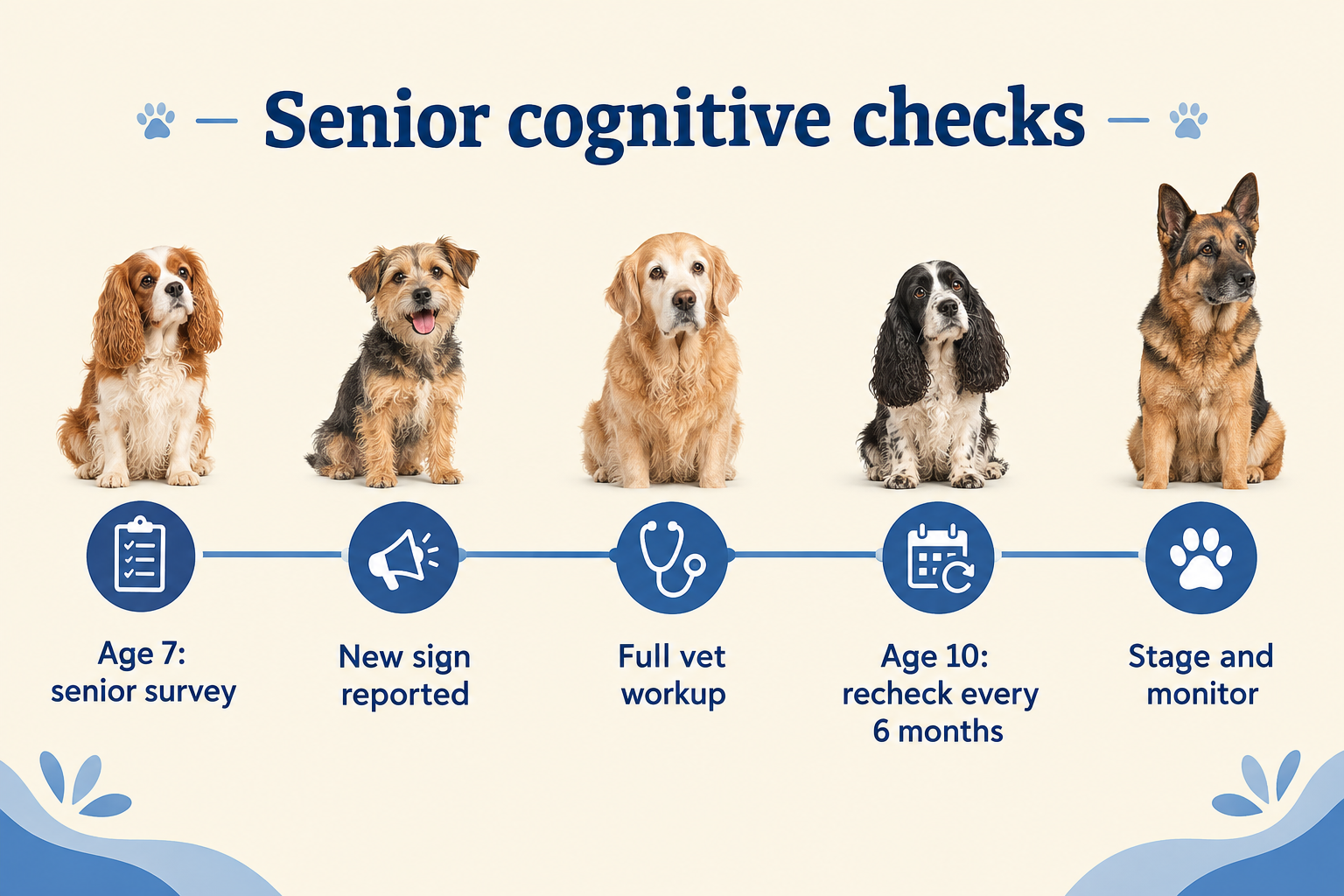
- Routine cognitive screening is now recommended from about age 7, with a formal cognitive scale repeated every six months from age 10, according to diagnostic guidelines published in January 2026.
- Treatment is multimodal: veterinary medication where appropriate, targeted nutrition, enrichment, sleep hygiene and a predictable environment.
- Selegiline (Anipryl, Zoetis) is the main licensed medication, and nutrition and supplement evidence is thinner than the packaging suggests.
- There is no reliable published survival figure for dogs with CCDS, and quality of life, not the diagnosis itself, usually drives end-of-life decisions.
- Owners often spot it before the vet does. A 2025 survey of 318 US veterinarians found most had diagnosed CCDS but few referred cases onward, so your written notes carry real weight.
What is dog dementia (canine cognitive dysfunction)?
Dog dementia is an age-related, progressive degeneration of the brain in older dogs, with changes that include loss of neurons and the build-up of beta-amyloid protein. It produces behaviour changes, not just slowness. The veterinary name is canine cognitive dysfunction syndrome, and Cornell’s Riney Canine Health Center describes it as a syndrome affecting memory, learning, awareness and the ability to respond to familiar surroundings.
)
Is my dog just getting old, or is this dog dementia?
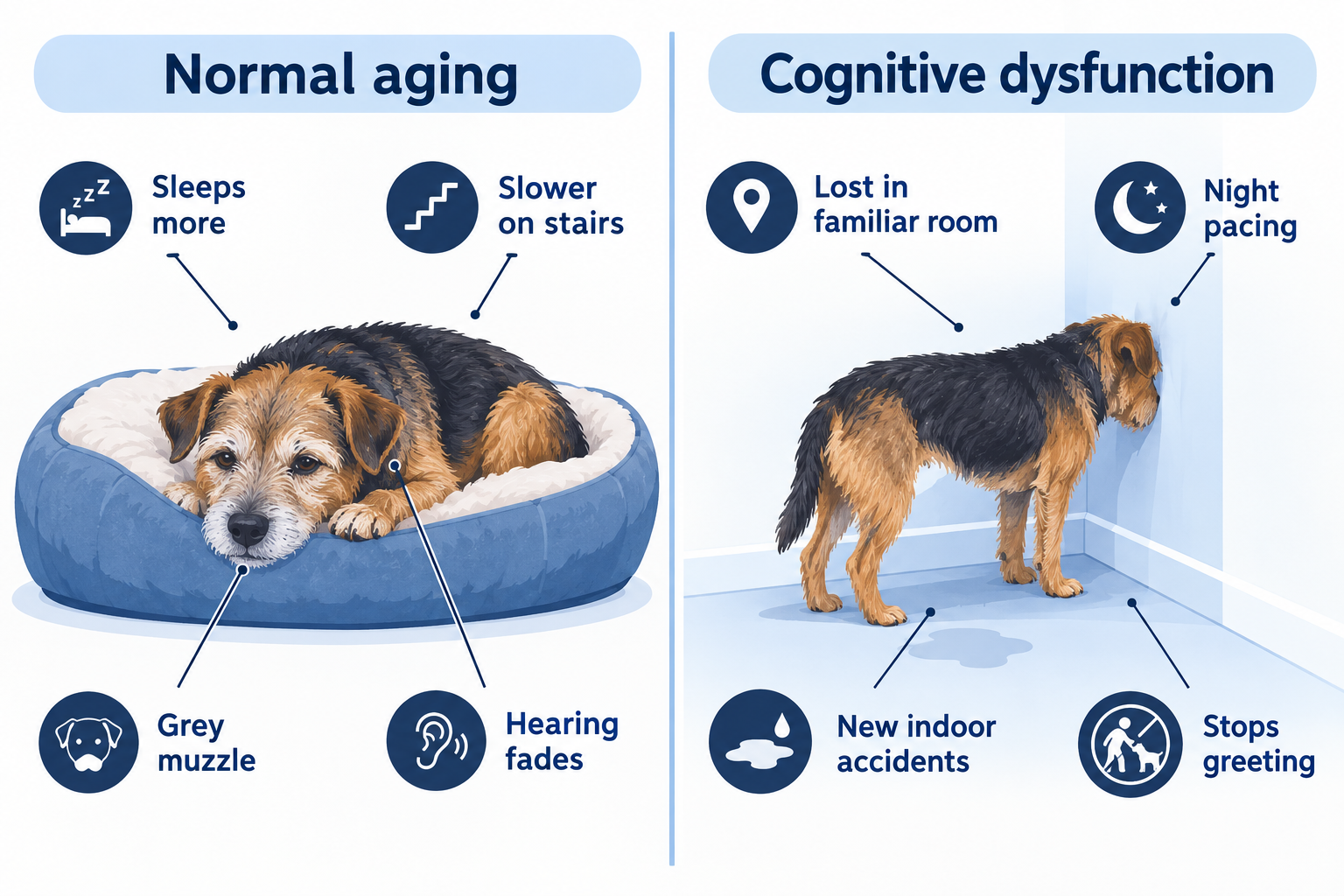
Normal aging slows a dog down. Dementia changes what the dog understands. That distinction is the single most useful filter you have at home.
| Looks like normal aging | Worth a vet visit |
|---|---|
| Sleeps more but settles at night | Sleeps all day, paces and vocalises at night |
| Slower on stairs, still finds them | Stands at the wrong side of a door, or at the hinge |
| Takes longer to hear you, then responds | Does not greet you at all, or seems not to know you |
| Less interested in long walks | Circles, wanders aimlessly, or stares at walls |
| One accident after a long sleep | Repeated indoor soiling with no attempt to signal |
Senior dogs genuinely do sleep more, and extra napping on its own is not a red flag. If you want the background on that, our explainer on why dogs sleep so much and what the research found covers normal adult and senior sleep patterns.
What is the difference between dog dementia and other cognitive issues?
Plenty of conditions imitate dementia, which is why guessing at home is a poor substitute for an exam. A dog who stops responding to cues may be losing hearing. A dog who hesitates in doorways may have failing vision or sore hips. A dog drinking and urinating more at night may have kidney disease, diabetes or Cushing’s disease. A dog with sudden circling, head pressing or seizures may have a brain lesion rather than diffuse decline.
The 2025 practice survey picked up exactly this problem: 63.8% of responding veterinarians wanted standardised criteria or better guidance for separating CCDS from other diseases. That is a profession asking for clearer rules, not a reason to skip the appointment. It is a reason to arrive with good notes.
What are the 6 early signs of dog dementia? (DISHAA)
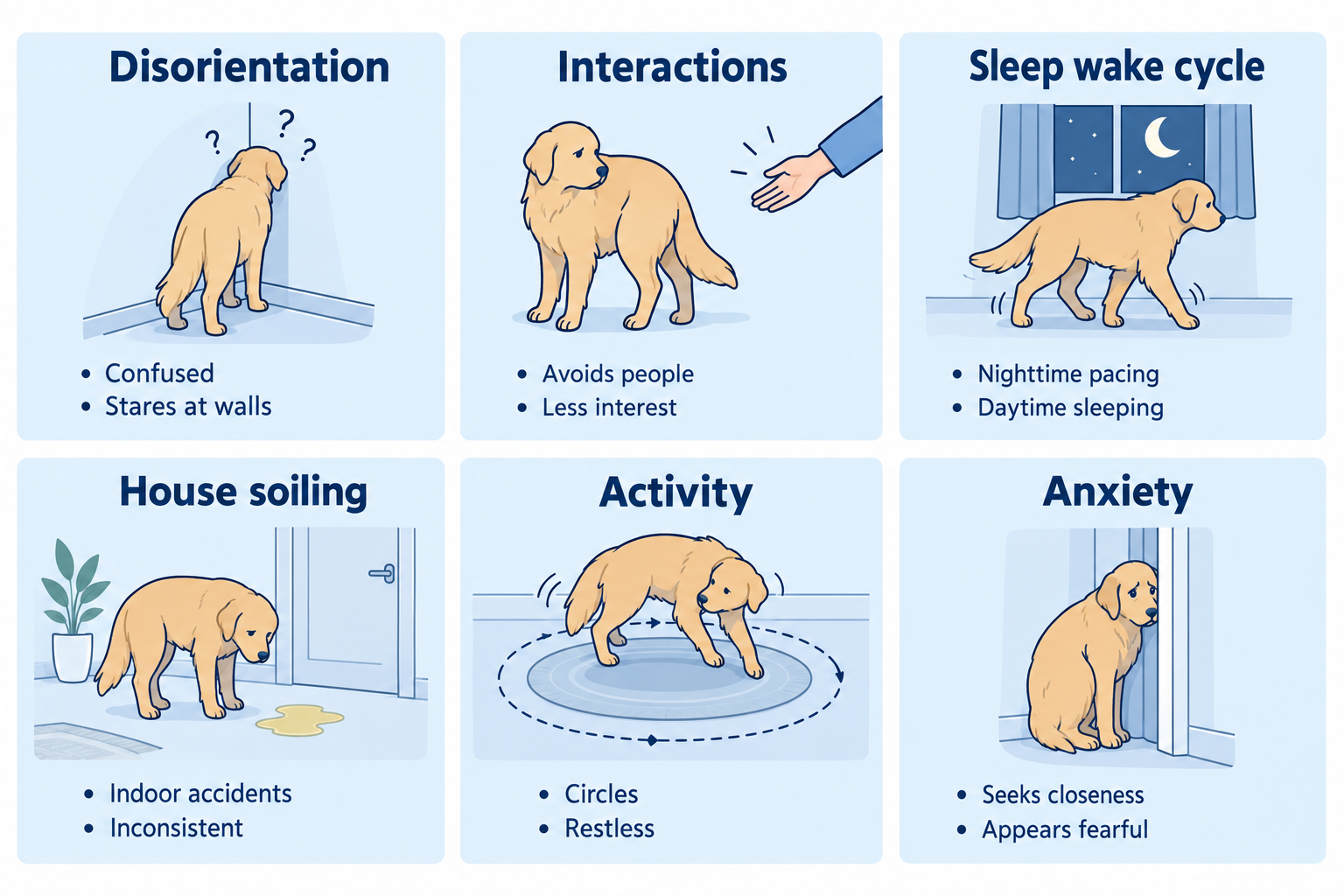
The six early sign categories are disorientation, changed interactions, sleep wake disruption, house soiling, activity changes and anxiety. Vets group them with the DISHAA assessment tool, a structured questionnaire that scores each category so change can be tracked over time rather than argued about from memory.
)
1. Disorientation. The clearest early sign, and the one owners describe most vividly. Dogs get wedged behind furniture or stuck in corners, stare at walls or into space, lose their way in a room they have known for a decade, go to the hinge side of a door, or cannot find bowls that have never moved.
2. Altered interactions. This goes in either direction. An independent dog becomes unusually clingy and follows you from room to room. A sociable dog withdraws, stops greeting people at the door, flinches from touch, or appears not to recognise a household member. Both directions count.
3. Sleep wake disruption. Especially characteristic. More daytime sleeping, then pacing, wandering, barking, howling or panting in the evening and overnight. AAHA’s senior care guidance notes vets often call this evening worsening “sundowning.”
4. House soiling. A previously reliable dog urinates or defecates indoors, forgets how to ask to go out, or goes outside, comes back in, and then goes on the rug. Loss of other learned behaviour fits here too: cues that worked for years stop landing.
5. Activity changes. Either apathy or repetition. Some dogs lose interest in walks, toys and sniffing. Others pace, circle, vocalise, or repeat the same action over and over with no apparent goal.
6. Anxiety. New fearfulness, irritability, separation distress or reactivity. Texas A&M’s veterinary team listed wandering, house accidents, trouble with stairs and doorways, increased vocalising and reduced responsiveness as signs that warrant an evaluation. Anxiety is the least specific of the six, because pain, deafness, blindness and broken sleep all produce it.
One sign in one category on one bad week is not a diagnosis. Signs that are new, progressive and present in two or more categories are what moves this conversation forward.
How common is dog dementia, and which dogs are at risk?
Risk climbs steeply with age, and the dogs most affected are in the final quarter of their expected lifespan. The Dog Aging Project published an analysis of cognitive dysfunction in Scientific Reports in 2022, drawing on owner-reported data from more than 15,000 dogs. Two patterns stood out: the odds of cognitive dysfunction rose with each additional year of life in older dogs, and dogs described by their owners as inactive had substantially higher odds than dogs described as very active. That second finding is an association from a survey, not proof that exercise prevents dementia. Dogs already declining may move less because of the decline.
)
At what age do dogs typically get dog dementia?
Most diagnoses happen after age 9 or 10, with signs appearing earlier in large and giant breeds because they reach senior status sooner. Diagnostic guidance from researchers associated with North Carolina State University, reported in January 2026, recommends senior-dog cognitive surveys from about age 7, a fuller CCDS assessment whenever an abnormality is reported, and a formal cognitive scale repeated every 6 months from age 10.
Breed size shifts the calendar more than breed personality does, so a mastiff at 7 may need the same screening as a terrier at 10. Our guide to dog size categories and what counts as a giant breed is useful if you are not sure where your dog sits.
97.2%
of 318 surveyed US vets had diagnosed CCDS at some point (Frontiers in Veterinary Science, 2025)
~80%
rarely or never referred a suspected case to a specialist (Frontiers in Veterinary Science, 2025)
63.8%
wanted standardised criteria to tell CCDS apart from other diseases (Frontiers in Veterinary Science, 2025)
Age 7 / 10
screening from about 7, cognitive scale every 6 months from 10 (NC State guidance, 2026)
Can dog dementia be reversed or slowed down?
No treatment reverses dog dementia, and no product on the market has been shown to restore lost cognition. What the evidence supports is slowing functional decline and reducing distress. An evidence-based management review published in Animals in April 2026 by Maurizio Dondi and colleagues at the University of Parma recommended a multimodal plan: veterinary treatment, targeted nutrition, environmental enrichment, behavioural support, and early intervention while impairment is still mild.
Early is the operative word. A dog who already cannot find the back door has less function left to protect.
What supplements or medications help with dog dementia?
Here is how the main named options compare. None of these are affiliate links, and none of them is right for every dog.
| Option | What it is | Who it suits | Evidence level |
|---|---|---|---|
| Anipryl (selegiline, Zoetis) | Prescription MAO-B inhibitor tablet | Dogs with a veterinary CCDS diagnosis and no conflicting medication | Strongest of the group: licensed for canine cognitive dysfunction, response varies by dog |
| Purina Pro Plan Veterinary Diets NC NeuroCare | Therapeutic diet with medium-chain triglycerides | Dogs who will eat a full diet change and have no pancreatitis or fat-restriction issues | Moderate, mostly manufacturer-funded trials showing modest behavioural gains |
| Hill’s Prescription Diet b/d | Antioxidant and omega-3 enriched senior brain-health diet | Older dogs starting early, where a long-term diet switch is realistic | Moderate, same limitation: largely company-sponsored studies |
| Senilife (Ceva) | Supplement with phosphatidylserine, ginkgo, vitamin E and resveratrol | Owners wanting a soft-gel add-on alongside vet care | Limited, small short-term studies, not a substitute for diagnosis |
| Neutricks | Chewable containing apoaequorin | Owners who want a palatable daily chew and realistic expectations | Weak, little independent peer-reviewed support in dogs |
| SAMe (S-adenosylmethionine) | Supplement also used for liver support | Dogs where a vet is already considering it for another reason | Weak to limited, and much of the dog-specific material is sponsored |
| Enrichment plus a fixed sleep routine | Daily sniffing walks, food puzzles, reward-based cue practice, consistent bedtime and light cues | Every dog with early signs, at no cost | Recommended across 2026 veterinary guidance as part of a multimodal plan |
| Snuggle Puppy | Weighted plush toy with a pulsing heartbeat unit | Dogs who settle better with contact and sound at night, if they do not chew plush | No dementia-specific evidence, comfort item only |
Decision rule: if your dog has two or more DISHAA categories marked “often,” start with a veterinary exam and bloodwork, not with a supplement. Buying a chew before ruling out a urinary tract infection is a common and expensive detour.
How much does it cost to treat dog dementia?
Costs vary too much by country and clinic to quote a figure honestly, so here is what actually drives the bill: the senior exam, full blood panel and urinalysis, blood pressure, and sometimes thyroid testing. Then optional imaging. MRI sits at the top end and is usually reserved for suspected lesions or for the Level 2 diagnostic standard described in the 2026 guidance. Ongoing costs are the prescription medication, any therapeutic diet (compare the price per kilogram against your current food, not the bag price), and recheck visits roughly every six months.
Ask the clinic for a written estimate before the workup, and ask which tests change the plan. Some do. Some are just reassurance you may not need twice.
What foods are best for a dog with dementia?
The diets with the most support are therapeutic foods built around medium-chain triglycerides, antioxidants and omega-3 fatty acids, fed consistently rather than sampled. MCTs give the aging brain an alternative fuel source to glucose, which is the mechanism behind NC NeuroCare. Antioxidant-enriched senior formulas such as b/d take a different route.
Three practical notes. Dogs with dementia sometimes forget they have eaten, so measure portions and keep a feeding log. Split the daily ration into smaller meals if your dog paces at night on an empty stomach. And check with your vet before adding fish oil on top of a diet that already contains it. If you want to read the label yourself, start with our guides to reading a dog food label and what AAFCO means and what changes in food for puppies, adults and seniors.
Can you prevent dog dementia before it starts?
No. Nothing has been shown to prevent canine cognitive dysfunction. The Dog Aging Project’s association between inactivity and higher odds of cognitive dysfunction is a reason to keep senior dogs moving and mentally busy, and physical activity, weight control and dental care are worth doing on their own merits. That is where the facts end. Treating lifelong enrichment as insurance against dementia overstates what anyone has measured.
How is dog dementia diagnosed?
Dog dementia is diagnosed clinically, by documenting progressive DISHAA signs and ruling out other causes. There is no blood test for it. The 2026 framework from NC State researchers uses stages rather than a yes-or-no label: Level 1 rests on progressive DISHAA signs plus physical, orthopedic, neurological and laboratory evaluation, while Level 2 adds MRI evidence of cortical atrophy with appropriate cerebrospinal fluid findings.
What to expect at the appointment:
- A completed cognitive questionnaire. Fill it in at home, not in the waiting room. Note the month each sign began.
- A physical, orthopedic and neurological exam. Pain and limb weakness explain a surprising number of “confused” behaviours.
- Bloodwork, urinalysis and blood pressure. Kidney disease, liver disease, diabetes, thyroid disorders and infection all need excluding.
- Hearing and vision checks. A dog who ignores you may simply not hear you. Head tilting and other orienting behaviours can be sensory, as our piece on why dogs tilt their heads and what it can really mean explains.
- A plan with a recheck date. Staging only works if someone repeats the scale.
Two practical tips. Film a 30-second clip of the night-time pacing, because the dog who paces at 2am will nap politely in the consult room. And if your dog finds the clinic frightening, ask whether the practice uses Fear Free handling methods, which are designed to reduce stress during exams. Specialist referral is an option worth raising yourself, since the 2025 survey found around 80% of vets rarely or never referred suspected CCDS cases.
How do you care for a dog with dementia at home?
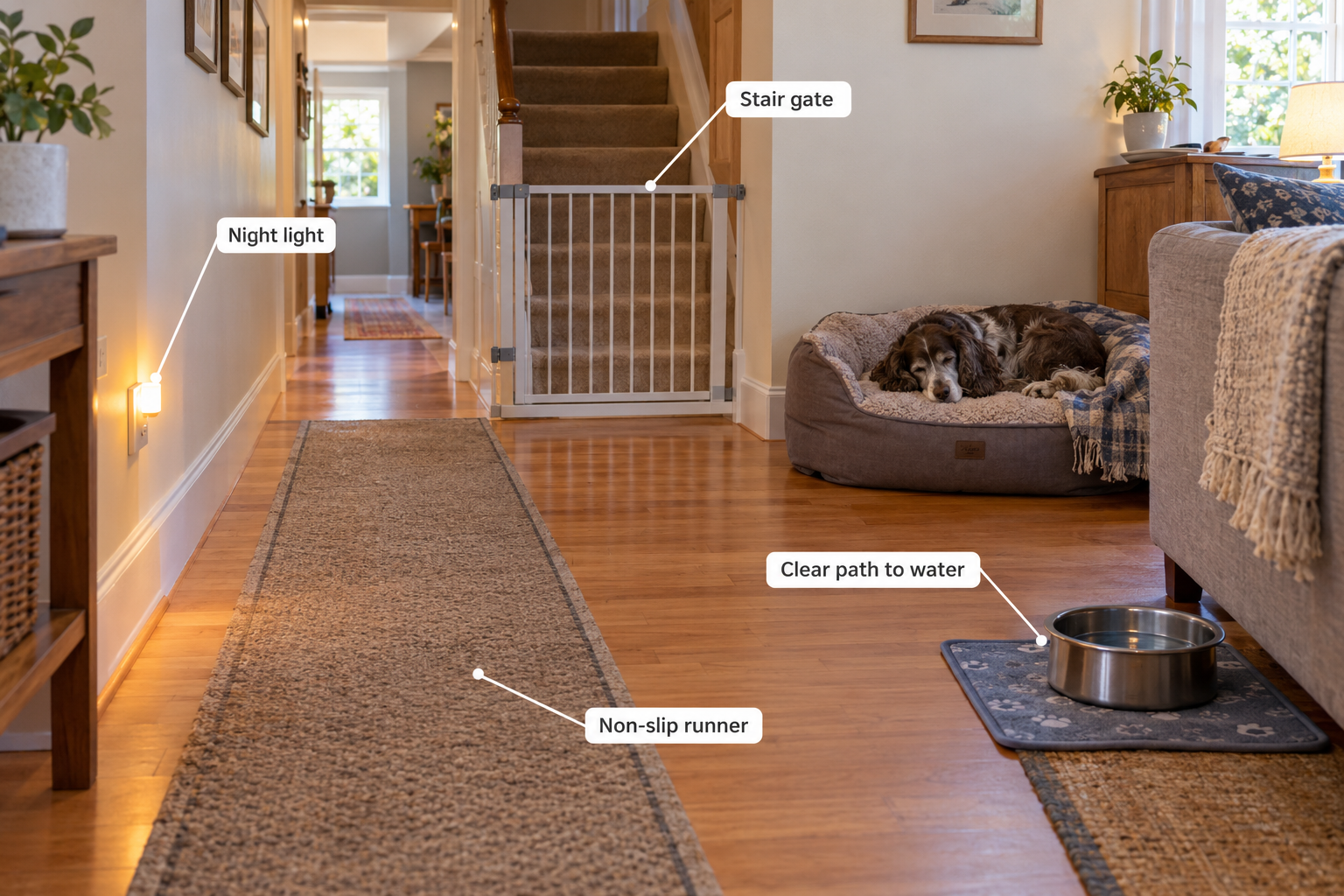
Keep the environment predictable, keep the routine on the clock, and remove the hazards your dog can no longer judge. Texas A&M’s guidance stressed stable routines, exercise, interactive play, environmental safety and veterinarian-supervised medication over any search for a cure.
)
The night setup
- Plug-in night lights along the route from bed to door and bed to water.
- Non-slip runners on hard floors, especially at turns.
- A stair gate top and bottom, and furniture gaps blocked so your dog cannot get wedged.
- Feeding, walking and bedtime at the same clock times every day, including weekends.
- Daylight exposure in the morning, dim and quiet in the evening, to support the sleep wake cycle.
- A bed tucked into a corner with two open sides, rather than a nest your dog has to reverse out of.
What activities keep a senior dog’s mind sharp?
Short and often beats long and ambitious. Scatter-feed part of a meal in the grass. Use a snuffle mat or a simple food puzzle. Run two-minute reward-based sessions on cues your dog still knows well, because success is the point, not difficulty. Take the same sniffing route at a pace the dog sets. Rotate three toys rather than offering all nine.
Keep the training humane and pressure-free. A dog with cognitive decline cannot be corrected out of confusion, and punishment reliably makes night-time anxiety worse. If the accidents are the hardest part, change the management rather than the dog: more frequent toilet breaks, a washable floor covering, and no scolding for something your dog no longer controls. Readers interested in what “smart” means across breeds may like our piece on the most intelligent dog breeds and what smart really means, which also explains why individual variation beats breed averages.
How long can a dog live with dementia, and when is it time to talk about quality of life?
There is no reliable published average survival time for dogs with canine cognitive dysfunction, and any confident number you read online is likely invented. CCDS is progressive, it usually advances over months to years, and it is rarely the direct cause of death. Most dogs with dementia also carry other age-related conditions, and quality of life, not the brain disease alone, is what ends up driving decisions.
When should euthanasia be considered for a dog with dementia?
The question is not whether your dog remembers you. It is whether your dog’s days contain more comfort than distress, and whether the household can keep providing care safely. Signs that it is time for a frank conversation with your vet:
- Distress most nights, not occasional restlessness, with no response to treatment.
- Refusing food consistently, or losing weight despite help eating.
- Frequent falls or getting stuck in ways that cause injury or panic.
- Loss of recognisable pleasure: no interest in food, sniffing, greeting, or contact.
- Incontinence combined with skin sores, or care needs the family genuinely cannot meet.
- Aggression or panic that makes basic handling unsafe.
Ask your vet to walk you through a written quality-of-life scale (many clinics use a scored tool such as the HHHHHMM scale) and to score it with you at two separate visits a few weeks apart. Scoring is kinder than remembering, because grief edits memory toward the good days. Ask about in-home euthanasia if car travel distresses your dog.
There is no prize for waiting until it is obvious. Caring for a dog whose mind is changing is its own kind of loyalty, and the deciding is part of the human-dog bond rather than a failure of it.
FAQ
How do I know if my dog has dementia?
You cannot know at home, but you can gather the right evidence. Record which of the six DISHAA categories apply, how often, and when each sign started, then ask your vet to rule out pain, sensory loss and metabolic disease. Progressive signs in two or more categories in a dog over 8 make CCDS a realistic consideration.
Is dog dementia painful?
The brain changes themselves are not thought to be painful, but the confusion and broken sleep are distressing, and many affected dogs also have untreated arthritis. Pain control often improves behaviour that looked purely cognitive.
Does selegiline work for every dog?
No. Anipryl (selegiline, Zoetis) is licensed for canine cognitive dysfunction and helps some dogs noticeably, while others show little change. It needs a veterinary diagnosis, a review of other medications, and a few weeks before judging the result.
Can a young dog get dementia?
It is a disease of aging, so true CCDS in a young dog is not expected. Sudden confusion, circling or seizures in a younger dog points toward other neurological causes and needs prompt veterinary attention.
Will a new puppy help my dog with dementia?
Usually not, and it can make things worse. Dogs with cognitive decline often cope poorly with change, noise and unpredictable social pressure. Add enrichment and routine instead.
Are over-the-counter dog dementia supplements worth buying?
Some may help modestly as part of a vet-supervised plan, and the independent evidence behind most of them is thin. Compare the options with your vet, start one at a time, and keep a two-week behaviour log so you can tell whether anything actually changed.
Does dog dementia progress quickly?
Progression varies widely between dogs. The 2026 diagnostic guidance recommends repeating a formal cognitive scale every six months from age 10, which is the practical way to see the rate of change in your own dog rather than guessing.
Conclusion
One next step, tonight: fill in the DISHAA tracker above with the signs you have actually seen, add the month each one started, and book a senior exam with bloodwork. Take the notes and a 30-second video of the night-time behaviour with you.
Early matters here more than almost anywhere else in senior care, because the 2026 veterinary reviews point to better outcomes when a multimodal plan starts while impairment is still mild. You cannot stop dog dementia. You can make your dog’s nights calmer, their days more predictable, and the next six months easier to judge. Guidance checked October 2026. That is the sort of answer this publication exists to give.