
Most recall failures happen in the same two seconds. The dog hears the cue, lifts its head, scans, and then the grass wins. Nothing about that moment is defiance, and knowing how to teach a dog recall properly starts with accepting that your word is competing with a smell that is far more interesting than you are.
Quick Answer
Teach the hand target as its own small behavior first, then attach it to your recall cue. Present an open flat palm near your dog’s nose, mark the nose touch the instant it happens, reward, then add the word “touch” before the palm appears. Once the touch is solid, build distance, pair it with your dog’s name plus a recall cue, and proof it on a long line in gradually harder places. The hand target gives the dog a clear finish line, which fixes the common problem of a dog who runs most of the way back and then veers off.
Key Takeaways: How to Teach a Dog Recall
- A hand target is a behavior (nose touches palm), not a magic signal. It works because it tells the dog exactly where to end up.
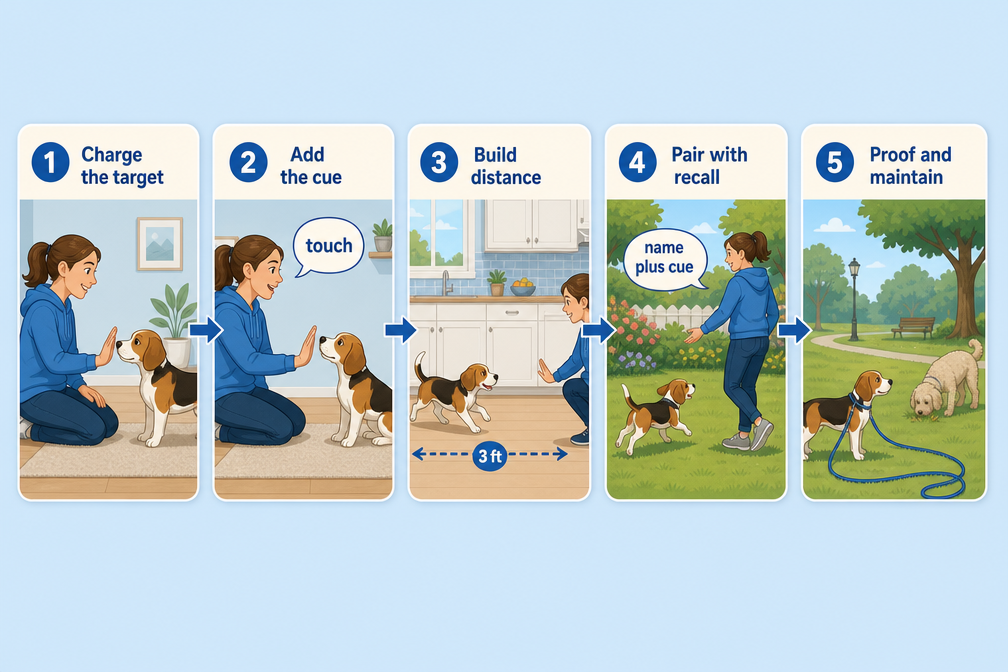
- The five-step order matters: charge the target, add the cue, build distance, pair with recall, then proof and maintain.
- Reward-based methods are the standard in current professional guidance. The American Veterinary Society of Animal Behavior recommends reward-based training for all dog training and rejects electronic collars, prong collars, choke chains and leash corrections (page updated August 12, 2026).
- No controlled study found through October 2026 shows that hand-target recall beats a verbal cue, a whistle, or a toy recall. Pick the one you can deliver consistently.
- Distraction is the whole game. Work a ladder: house, garden, quiet field, quiet park, busier park, with a long line attached until the dog is reliable at that level.
- An emergency recall is a separate cue, trained separately, rewarded extravagantly, and used rarely.
- Recall is maintained, not finished. Expect regression in adolescence and after any long gap in practice.
What is dog recall training, and why is it important?
Recall training teaches a dog to stop what it is doing and come all the way back to you when you give a specific cue. It matters because recall is the skill that buys you back control at a distance, where a leash cannot help you. Roads, cyclists, livestock, wildlife, and other dogs are all situations where coming back fast is the difference between a dull walk and a bad afternoon.
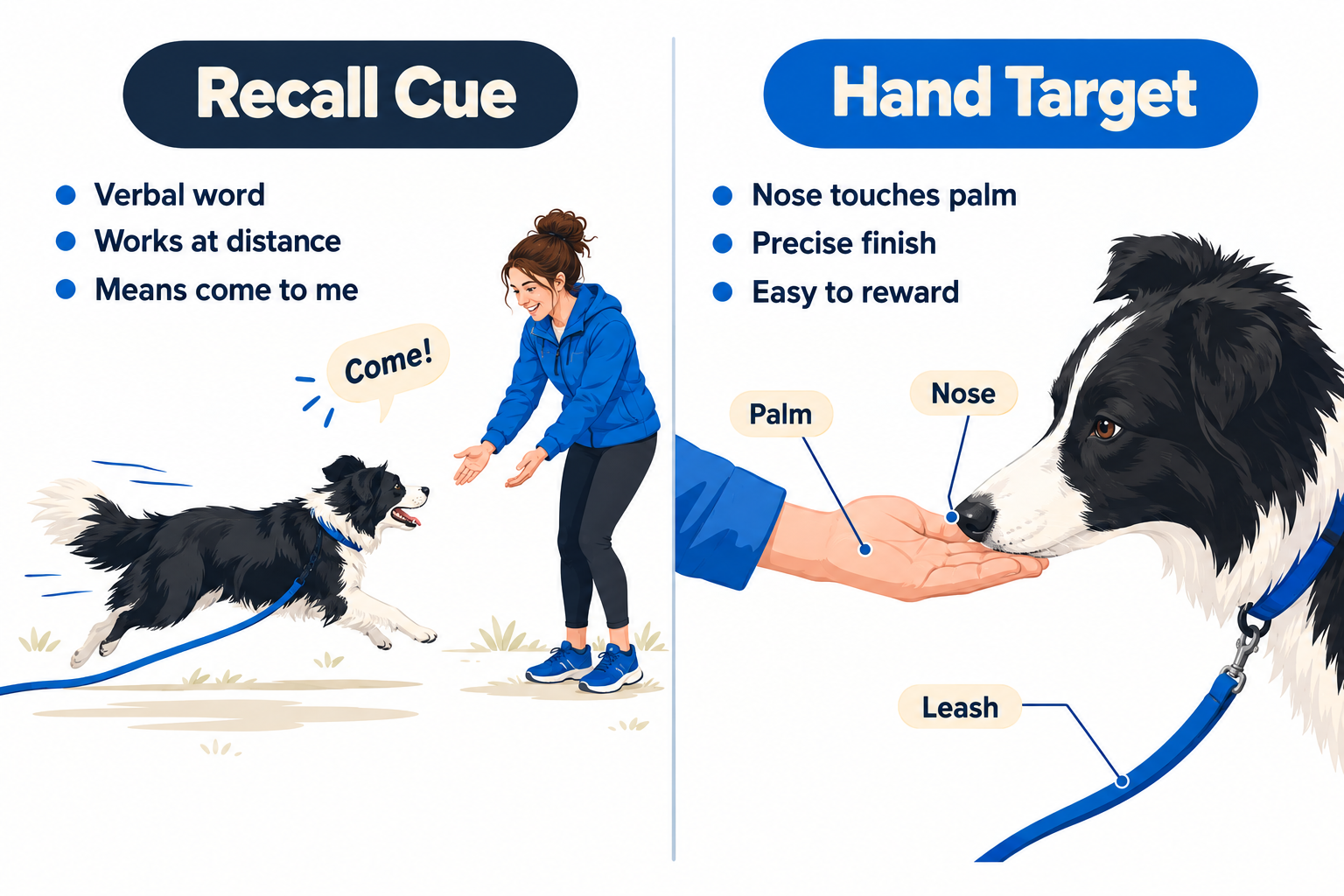
A useful recall has three parts that owners often blur together: the dog disengages from whatever it was doing, travels directly to you, and stays close enough to be touched or clipped. Plenty of dogs manage the first two and fail the third. They arrive, hover at two metres, then spin off when your hand moves. That gap is exactly where a hand target does its work.
Recall also changes the shape of a dog’s week. A dog you can call back gets more off-leash sniffing, more running, more choice. That is real enrichment, not a reward chart. Guidance on recall from sources like the Company of Animals recall training guide and the Canine Journal walkthrough on teaching a dog to come agrees on that trade: the better the recall, the more freedom the dog actually gets.
What’s the difference between recall and hand targeting?
Recall is the behavior of returning to you. Hand targeting is the behavior of touching your open palm with the nose. They are separate skills, and that is the point.
Recall is a long, loose instruction. Hand targeting is short, precise, and easy to reward within half a second. When you teach the target first and then present it as the dog arrives, you give the recall an unambiguous ending. The American Kennel Club’s hand-target guide treats “touch” as a foundation behavior taught close to the nose before it gets used for anything else, including movement and distance.
Think of it as a target the dog can aim at. Dogs are good at aiming at things. They are less good at interpreting your general enthusiasm from forty metres away.
Why do dogs ignore recall?
Dogs ignore recall for three ordinary reasons: the cue has been worn out or made unpleasant, the competing reward is better than yours, or the dog is an adolescent and its brain has temporarily filed your voice under “ambient noise.” Almost every recall problem is one of those, and all three are fixable.
The poisoned cue
A cue becomes poisoned when it reliably predicts something the dog does not want. If “come” has meant the end of the walk, a bath, nail clipping, or being shouted at for taking eleven seconds to arrive, the dog has learned the word accurately. It just learned something you did not intend.
Signs of a poisoned cue: the dog’s body drops or slows when you call, it approaches in a wide arc, or it checks your hands before committing. If that sounds familiar, retire the old word. Start the hand-target work on a brand new cue and keep the old one out of training entirely.
Competing rewards, especially sniffing
Scent is not a distraction in the way a loud noise is. A dog with its nose down is doing something highly reinforcing. When your dog ignores recall while sniffing, you are not being rebelled against, you are being outbid.
Two practical fixes. Raise your payment for hard moments, which means better food, a short game, or a scattered handful of treats in the grass. And pay with permission: after the dog touches your hand, say your release word and send it straight back to the interesting smell. A recall that always ends in freedom stops feeling like a punishment.
Adolescence, roughly six to eighteen months
Adolescent dogs commonly lose recall they appeared to own at four months. Their world has expanded, other dogs have become fascinating, and the reinforcement history you built in the kitchen is suddenly thin. This stage is normal and it passes.
During adolescence, go back to a long line in places where you previously worked off-leash. You are not starting over. You are protecting the cue from failing fifteen times a week, because every ignored recall teaches the dog that the cue is optional.
Recall training for stubborn or independent dogs
Stubborn is usually a description of a dog whose motivations you have not matched yet. Dogs bred to work at a distance, follow scent, or make their own decisions are not refusing instruction, they are weighing your offer against the environment.
For these dogs:
- Train when the dog is slightly hungry, not after a full meal.
- Use short sessions, two to five minutes, several times a day.
- Make the reward unpredictable in value. Sometimes a piece of kibble, sometimes roast chicken.
- Keep the long line on far longer than feels necessary.
- Never call once and then call six more times. Go get the dog instead, calmly, and lower the difficulty next time.
Breed tendencies give you useful hints about what a dog finds reinforcing, but they do not predict an individual. Anyone who has met two spaniels from the same litter knows about individual variation, and the same caution applies to how the popular rankings are built, as explained in this look at how dog intelligence lists are put together.
What should you do in the moment when your dog ignores the recall command?
Stop calling. Repeating the cue into empty air is the fastest way to teach a dog that the word means nothing.
Instead: move away from the dog so your movement becomes interesting, make a short sharp sound (not the recall cue), or walk up and reattach the line without drama. Then make a note of what beat you, and train one step below that difficulty tomorrow.
How to teach a dog recall with a hand target in 5 steps
Work in order and do not skip ahead. Each step should look boringly easy before you move to the next one. The whole sequence below follows the standard target-training progression: build the touch, name it, add distance, attach it to recall, then proof it under distraction.
Step 1: Charge the hand target
Sit or kneel with your dog in a quiet room. Hold an open flat palm, fingers together, a couple of inches from the dog’s nose. Most dogs investigate immediately. The moment the nose makes contact, mark it with a click or a short word like “yes,” then feed a treat from your other hand.
Do ten reps, switch hands, do ten more. If the dog stares at your palm without touching, rub a treat on it once to get the first contact, then stop baiting. You want the touch, not a lick-the-hand habit.
Step 2: Add the cue
Say “touch” once, clearly, then present the palm. Mark and reward the contact. The cue goes before the hand, not at the same time, so the word starts predicting the hand rather than being background chatter.
Common mistake: saying “touch touch touch” while waving. A cue said three times is a cue the dog can safely ignore twice.
Step 3: Build distance
Present the palm one foot away, so the dog takes a step. Then three feet. Then across the room. Reward speed, not just arrival. A fast, direct approach is the behavior you actually want, so pay the quick ones more.
Progression checkpoints:
- Dog moves 1 to 3 feet to touch, 8 times out of 10
- Dog crosses a room to touch
- Dog touches when you are standing, sitting, crouched, or turned slightly away
- Dog touches when you present the hand while walking backward
Step 4: Pair it with your recall cue
Now stack them. Say the dog’s name, then your recall cue, move backward a few steps so you are moving away, and present the open palm as the dog arrives. Nose touches hand, mark, reward, then release the dog back to whatever it was doing.
That release is doing heavy lifting. If every recall ends with the leash and the car, you are training a dog to arrive slowly. Trainer guidance on building reliable recall without an e-collar makes the same point about keeping most recalls consequence-free.
Step 5: Proof and maintain
Take the same routine outside on a long line, starting somewhere dull. A garden, then an empty field, then a quiet corner of a park, then a park with dogs at a distance. Keep sessions short and keep the success rate high, around eight out of ten.
Vary the payment: food most of the time, sometimes a thirty second game, sometimes praise plus permission to go sniff. Mixed, unpredictable rewards keep the behavior strong after the novelty wears off.
How long does it take to teach a dog recall?
Expect a few days for the hand touch indoors, two to six weeks for a solid recall in quiet outdoor spaces, and months of ongoing proofing before a busy park is routine. No published study sets a standard timeline, so treat any fixed promise with suspicion.
What changes the speed:
- Reinforcement history. A dog who has ignored "come" for two years needs a new cue and more repetitions.
- Age. Puppies learn the touch fast and lose it fast. Adolescents need the most patience.
- Environment. A rural field is an easier classroom than a city green with four loose dogs and a picnic.
- Session frequency. Five short daily sessions beat one long weekend push.
Progress markers beat calendars. When your dog touches your hand eight times out of ten at a given distraction level, move up one level. If the rate drops below six out of ten, drop back down.
What are the best treats to use for recall training?
Use small, soft, strong-smelling food that the dog can swallow in under a second: cooked chicken, cheese, sardine, liver treats, or a high-value commercial training treat. The size matters more than the brand, because a recall session needs twenty or thirty payments without filling the dog up.
A simple three-tier system works well:
- Tier 1, everyday: kibble or plain biscuit for indoor reps with no distraction.
- Tier 2, outdoors: soft training treats for garden and quiet field work.
- Tier 3, emergency and hard distractions: chicken, cheese, or something the dog rarely gets.
Keep tier 3 genuinely rare. If roast chicken appears at breakfast, it stops working at the park.
Treat volume is real food. A heavy training week can add a surprising number of calories, so reduce meal portions a little on big training days and keep the overall diet sensible. If you are rethinking what goes in the bowl generally, this three-step method for comparing dog food brands is a practical place to start, and cooks can use these balanced homemade dog food guidelines for the main meals. If a new treat upsets digestion, the same slow-transition logic in this guide to switching dog food without stomach upset applies.
Non-food rewards count too. For many dogs, a two minute tug game or permission to return to a smell outperforms a biscuit.
Is clicker training better for recall?
A clicker is helpful for teaching the hand touch and unnecessary for the recall itself. Its strength is precise timing on a small behavior, which is exactly what step 1 needs.
Use a clicker if you like the precision and can keep it in your pocket. Use a short marker word like "yes" if juggling a clicker, a long line, and a bag of chicken is one object too many. What matters is that the marker always means food is coming, within about half a second.
How do you build recall around distractions?
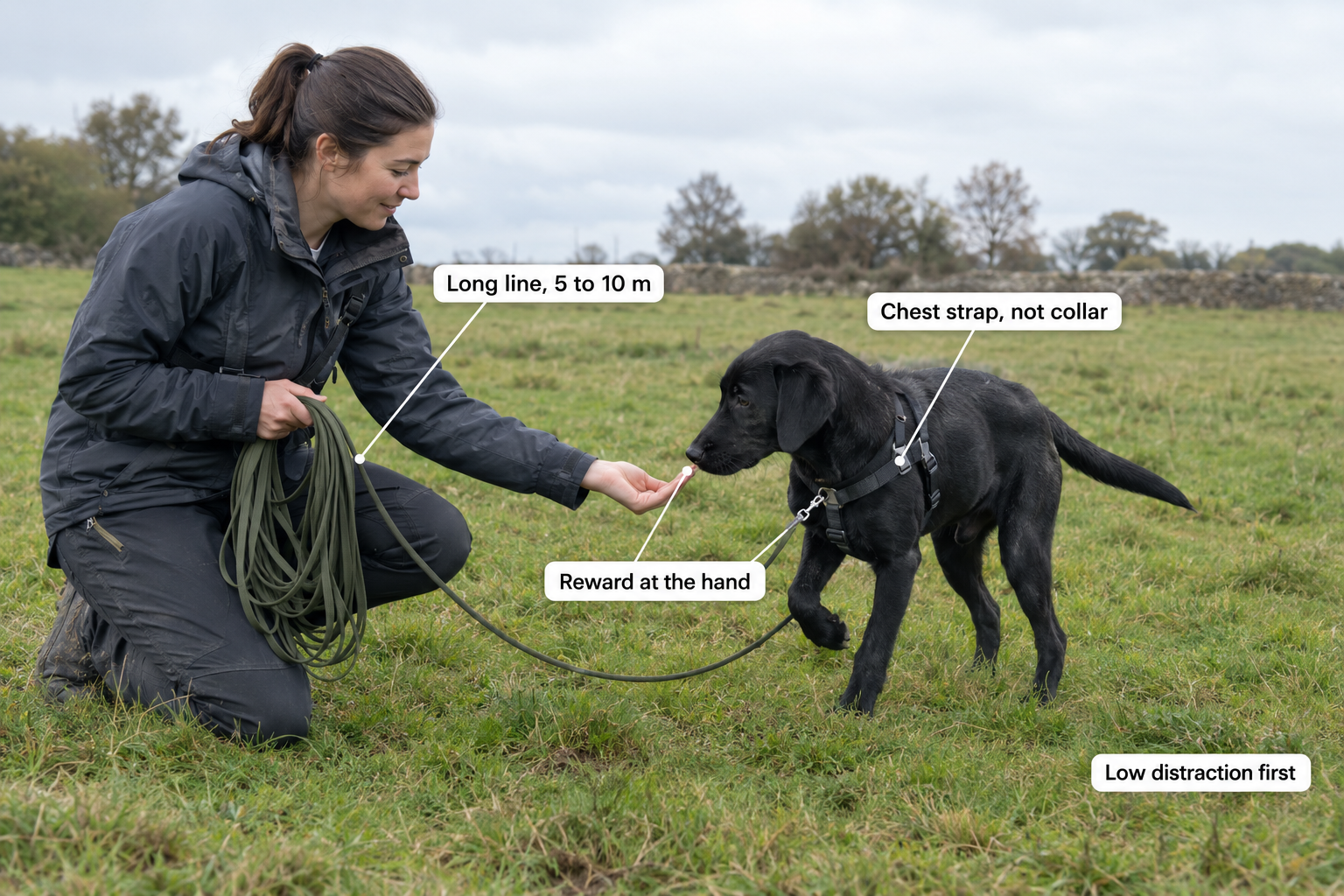
Raise one variable at a time: distance, duration, or distraction. Changing two at once is where most recall training quietly collapses. Keep a long line attached until the dog is succeeding at that level at least eight times out of ten.
A workable distraction ladder:
- House, no distraction
- House with family moving around
- Garden, alone
- Garden with a thrown toy nearby
- Empty field on a long line
- Quiet park, dogs visible at 50 metres
- Quiet park, dogs at 20 metres
- Busier park, dog mid-sniff
- Busier park, dog playing with another dog
Current professional guidance favors a long line clipped to a well-fitted chest strap rather than a neck collar during outdoor proofing. The Marker Method recall guide recommends a 5 to 10 metre line while the dog works up from quiet indoor sessions to gardens, quiet parks, and busier spaces, and this comparison of long training lines for recall covers the handling differences between materials and lengths. Let the line drag loosely. It is a safety net, not a steering wheel.
Compare the options: recall word, whistle, hand target, emergency recall
| Cue | When to use it | Strengths | Drawbacks |
|---|---|---|---|
| Recall word ("here", "come") | Everyday walks and garden practice | Always with you, no equipment, easy for the whole household | Easily poisoned by repetition, tone changes with your mood |
| Whistle | Open ground, wind, long distances, or dogs with hearing loss in the human vocal range | Identical sound every time, carries further than a voice, emotion-free | Needs separate conditioning, and it is useless in your other coat pocket |
| Hand target ("touch") | Closing the last few metres, clipping the leash, vet and grooming handling | Clear finish point, stops the hover-and-dodge habit, easy to reward precisely | Visual, so it needs the dog looking at you, and it is weak on its own at distance |
| Emergency recall | Genuine risk only: roads, livestock, a fast-approaching dog | Kept fresh by scarcity, paid at jackpot level, often the fastest response you own | Degrades fast if used casually, needs monthly top-up practice |
Whistle work suits owners who cover open ground, and the practical conditioning steps are set out in the Company of Animals dog whistle training guide and in this overview of dog training whistles. Many owners end up with two cues: a whistle for distance and a hand target for the final arrival.
Recall training for off-leash dogs
Off-leash reliability is a system, not a single word. A September 2026 guide on off-leash dog training lists recall, an emergency stop, "leave it," "drop it," controlled environments, long-line management, and proofing under distraction as separate components, which is a fair description of what a safe off-leash dog actually has.
Decision rule: stay on a long line if your dog has chased wildlife in the last month, if the area borders a road, if you are in an unfamiliar place, or if your success rate at that distraction level is under eight out of ten. GPS tracking devices can help you find a dog who has already gone, and this look at GPS collars alongside long lines for recall work is clear that tracking is a recovery tool rather than a training one.
Off-leash dogs also meet other dogs, and not every meeting goes well. If that risk is on your mind, the context in this review of what hospital data says about dog attacks on people is worth reading before you decide where to drop the line.
What is an emergency recall, and how do you train one?
An emergency recall is a second, separate cue that means "come here right now, and something extraordinary is waiting." It exists because your everyday recall will occasionally lose to a squirrel, and you need one cue the dog has never once been disappointed by.
How to build one:
- Choose a sound you would never say casually. A long whistle pattern, a loud "HERE HERE HERE," or an unusual word. Emergency recall word ideas that work well: "pronto," "biscuit," "jackpot," or a two-note whistle blast.
- Condition it with no distance at all. Say the cue beside the dog, then deliver something remarkable, perhaps twenty pieces of chicken fed one at a time for fifteen seconds.
- Repeat once or twice a day for a week, still at close range. You are building the association, not the recall.
- Add distance and mild distraction, on a long line, two or three times a week.
- Use it for real emergencies only, and top it up with a practice rep roughly once a month.
Keep the reward enormous and keep the cue rare. An emergency recall used to call the dog in from the garden at bedtime is an everyday recall with a silly name.
Reward-based only
AVSAB recommends reward-based methods for all dog training and rejects electronic collars, prong collars, choke chains and leash corrections. AVSAB position statements, page updated August 12, 2026.
New code, October 3, 2026
Singapore's revised animal welfare code for dog trainers puts positive reinforcement at the foundation of behavior change and follows a least intrusive, minimally aversive approach. Electronic and prong collars are discouraged, not banned. Channel NewsAsia report.
Line length: 5 to 10 metres
Trainer guidance from September 2026 recommends a 5 to 10 metre long line on a well-fitted chest strap while proofing outdoors. Marker Method recall guide.
Where the facts end
No controlled comparison identified through October 2026 shows hand-target recall outperforming a verbal cue, whistle or toy recall. Welfare research on training methods, including work published in Frontiers in Veterinary Science, has focused on reward-based versus aversive approaches rather than on which reward-based cue is fastest.
Guidance checked October 2026.
What age should a dog learn recall?
Start the day the dog arrives. Puppies from about eight weeks can learn a hand touch and a recall cue indoors, and most puppies follow people willingly anyway, which makes the early weeks the cheapest training you will ever get.
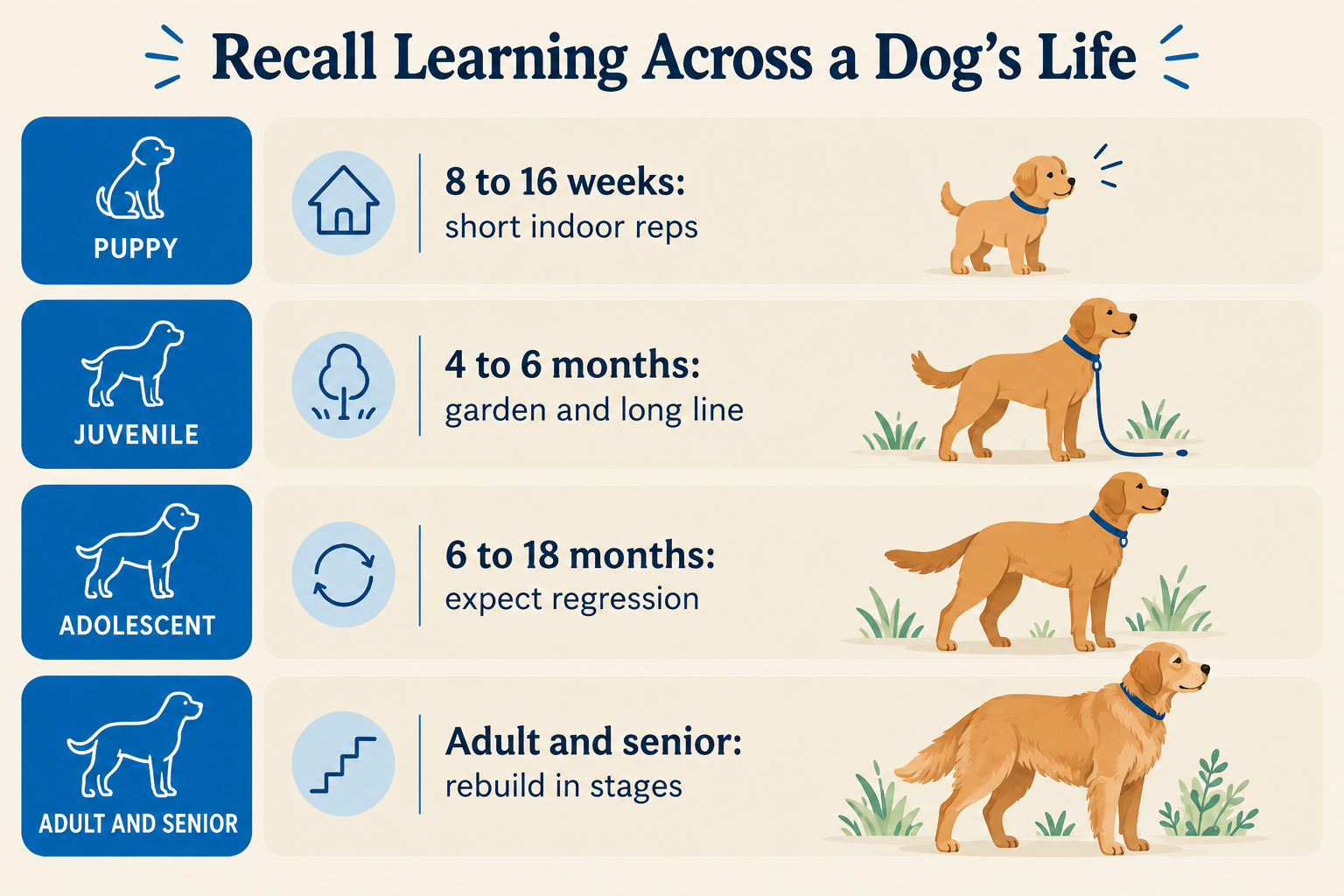
A rough map by stage:
- 8 to 16 weeks: charge the hand target, pair it with a new recall word, reward every single return indoors and in the garden.
- 4 to 6 months: add a long line outdoors, keep distractions low, practice during ordinary walks rather than in special sessions.
- 6 to 18 months: expect regression. Shorten distances, go back on the line, raise the pay rate. This is maintenance, not failure.
- Adults and seniors: fully trainable, with a few adjustments below.
Can you teach an older dog recall?
Yes. Adult and senior dogs learn recall well, and often faster than adolescents because they are less reactive to every passing smell. Two adjustments matter: use a fresh cue if the old one has been ignored for years, and check comfort first.
Older dogs may have joint pain, reduced hearing, or fading vision, any of which changes what a recall should look like. A dog who cannot hear a mid-range voice may respond to a whistle or a hand signal. A dog with sore hips should not be asked for sprint recalls. If a previously reliable dog stops responding suddenly, a veterinary check comes before a training plan.
Early socialization shapes how a dog handles the busy environments where recall gets tested, and some dogs simply find strangers and visitors easier than others, which is part of the picture covered in this guide to the friendliest dog breeds for homes with visitors.
How often should you practice recall, and how do you keep it?
Practice in short bursts, most days: three to five sessions of two to five minutes beats one twenty minute marathon. Recall is a skill that decays, so plan on light maintenance for the dog's whole life rather than a finish date.
A maintenance routine that holds up:
- Daily: five to ten paid recalls on ordinary walks, mixed into normal activity.
- Weekly: one session at the hardest distraction level the dog currently handles.
- Monthly: one emergency recall rep with a jackpot reward.
- After any gap: drop two rungs down the distraction ladder and work back up.
The habit that keeps it alive is paying the dog for returns you did not ask for. Dog comes back on its own, dog gets something. Step-by-step recall routines from sources like this guide to training a dog to come and this recall training walkthrough stress the same loop of frequent, low-pressure repetition.
Common mistakes people make teaching recall
- Calling once, then calling five more times. Teaches the dog that the first cue is a warning.
- Only recalling to end the fun. The cue starts predicting the end of the walk.
- Jumping ahead to the park. The dog fails repeatedly and the cue weakens.
- Punishing a slow return. A telling-off on arrival poisons the whole behavior.
- Grabbing the collar as the dog arrives. This is exactly the move the hand target prevents. Present the palm instead, then clip the leash after the reward.
- Fading the rewards too early. Reduce frequency slowly and keep the occasional jackpot.
- Using aversive equipment to force compliance. Current professional guidance, including AVSAB and Singapore's revised trainer code, puts reward-based methods first and treats shock and prong collars as options to avoid or defer.
FAQ
What are good dog recall words?
Short, distinct sounds the dog has not heard in anger: "here," "close," "pronto," "jackpot," or a whistle pattern. Avoid anything that sounds like the dog's name or another trained cue.
How do you teach a dog recall if it ignores you completely?
Change the cue, shrink the environment, and put the dog on a 5 to 10 metre long line. Go back to step 1 of the hand target indoors and rebuild from a 100 percent success rate. Repeating a cue the dog already ignores makes the problem worse.
My dog comes back but stops just out of reach. What fixes that?
The hand target. Reward the nose touch on your open palm, not the general arrival, and avoid reaching for the collar as the dog closes the last metre.
Is a hand target better than a verbal recall cue?
No published comparison shows it is better. It is more precise about where the dog should end up, which is why it helps with hovering, dodging, and leash-clipping. Most owners use both together.
Can treats be replaced with praise once recall is reliable?
Partly. Praise works best for dogs who clearly value it and in low-distraction settings. Keep real food or a game for hard recalls, because that is what competes with a fresh scent trail.
Why did my dog's recall fall apart at eight months old?
Adolescence. Normal, temporary, and best handled by going back on a long line and raising the reward value rather than increasing pressure.
How do I practice recall in a busy park without losing the dog?
Work at the edge of the park with a long line attached, call the dog before it fixes on a distraction, and leave before the dog gets overwhelmed. Short, early, successful reps beat long sessions that end in a chase.
Does a dog need professional help for recall problems?
Get qualified help if the dog chases livestock or traffic, shows aggression toward dogs or people, or panics when off-leash. A credentialed, reward-based trainer or a veterinary behaviorist is the right call for those cases, not another month of solo practice.
Conclusion
Start today with a palm, ten pieces of cheese, and the quietest room in the house. That is the real answer to how to teach a dog recall: a small, precise behavior taught where nothing can outbid you, then moved outdoors one difficulty level at a time, on a long line, with a reward schedule the dog actually rates.
Your next three steps:
- Tonight: twenty hand-touch reps in two short sessions. Add the word "touch" tomorrow.
- This week: pick a brand new recall cue, pair it with the hand target in the garden, and choose an emergency word you will keep rare.
- This month: buy or borrow a 5 to 10 metre long line, clip it to a well-fitted chest strap, and run the distraction ladder from an empty field upward, tracking eight out of ten before you move up.
Reward-based training is where the current professional guidance sits, and it is also the version that keeps your dog pleased to see you. Recall is not a one-off achievement. It is a habit you pay into, usually in small pieces of chicken.