Quick Answer
There is no WSAVA seal, no certificate, and no official approved brand list. What people mean by WSAVA compliant dog food is a food made by a company that can answer the five manufacturer questions in the WSAVA Global Nutrition Committee’s pet food selection guide: who their nutritionists are, who formulates the recipes, where the food is made and how it is quality controlled, what research they have published, and whether they will send you a full nutrient analysis for the exact product in your cupboard. Any brand can be checked with one email. Guidance checked October 2026.
Key Takeaways: WSAVA Compliant Dog Food
- WSAVA is the World Small Animal Veterinary Association. It writes global guidance for vets and does not approve, certify, or endorse pet food brands.
- The phrase WSAVA compliant dog food is shorthand used by owners and vet clinics. It means the company answers WSAVA’s manufacturer questions satisfactorily, not that a recipe has been inspected or blessed.
- The five questions cover qualified nutritionists, diet formulation, ingredient and finished product quality control, published research, and manufacturing transparency.
- WSAVA’s toolkit describes appropriate nutrition credentials as a PhD in animal nutrition or board certification through the American College of Veterinary Nutrition or the European College of Veterinary Comparative Nutrition.
- No logo on a bag tells you any of this. You check a brand’s website, then you email them.
- Brands most often listed by veterinary-oriented reviewers as answering all or nearly all five questions include Purina Pro Plan, Hill’s Science Diet, Royal Canin, Eukanuba, and Iams. Those are third-party compilations, not WSAVA rulings.
- AAFCO sets nutrient profiles and label rules in the United States. WSAVA asks about the company behind the label. The two answer different questions.
- A food can tick all five questions and still not suit your individual dog. Individual variation outranks any brand list.
What is WSAVA, and what do its pet food guidelines actually say?
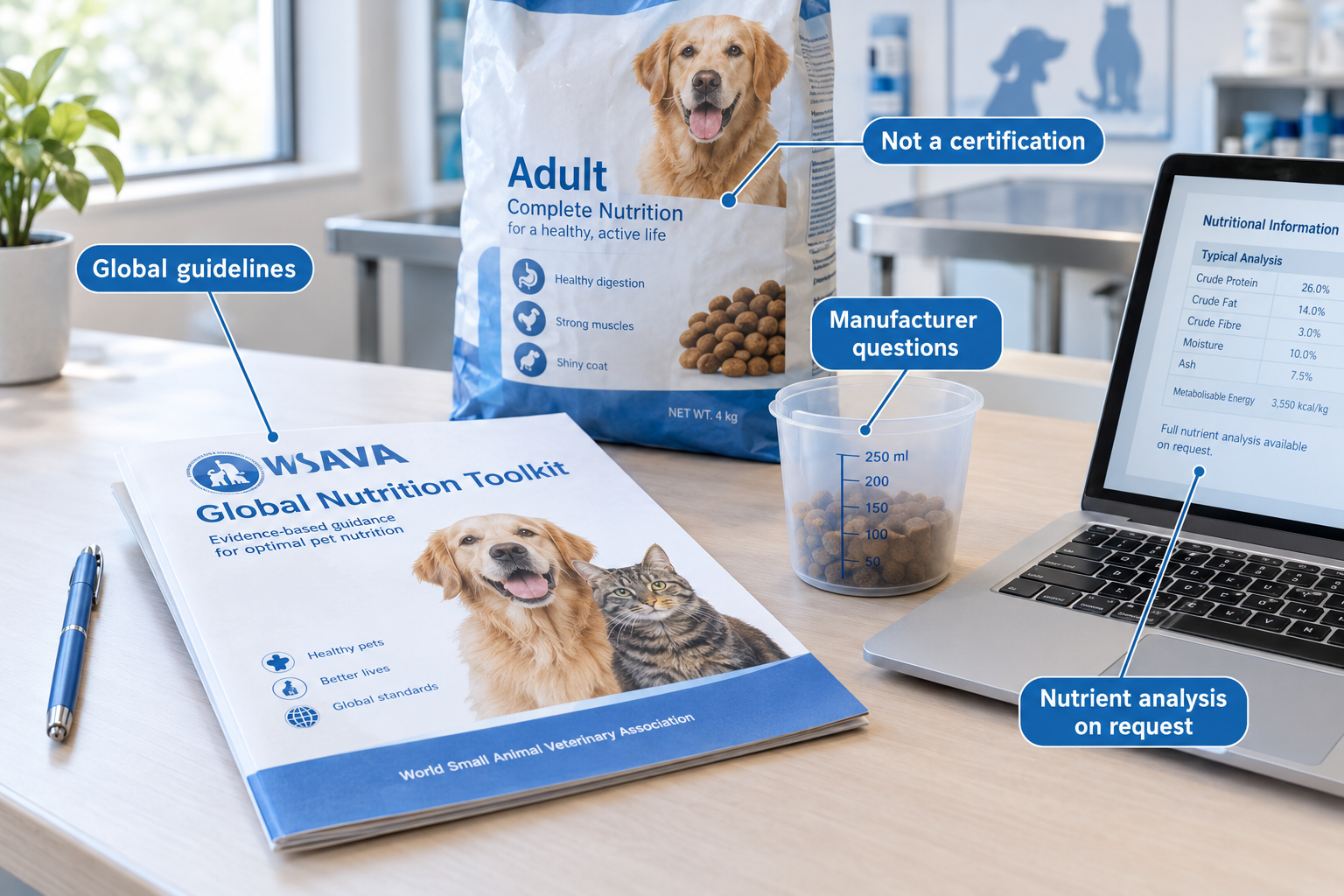
WSAVA is the World Small Animal Veterinary Association, a global body of veterinary associations that publishes clinical guidance for small animal vets. Its Global Nutrition Committee produces a free nutrition toolkit, and one handout inside that toolkit, Selecting a Pet Food for Your Pet, is the document almost everyone is quoting when they say “WSAVA guidelines.”
)
The handout does something slightly unusual for nutrition advice. It spends very little time telling you which ingredients to look for and most of its time telling you what to ask the company. The committee’s position, laid out in that document and in its frequently asked questions and myths sheet, is that an ingredient list is a poor tool for judging a diet. Ingredient panels are ordered by weight before processing, they say nothing about nutrient availability, and they are written by marketing departments who know which words sell.
So the guidance redirects you. Instead of reading the front of the bag, you investigate the people making the food and the systems they run.
WSAVA has even published a short piece called Do You Dare to Ask encouraging owners and vets to put these questions to manufacturers directly. That is the whole mechanism. There is no inspection body, no audit, no annual renewal fee. A company becomes what owners call compliant by being able to answer, in public or by email, without changing the subject.
One thing worth being blunt about. WSAVA guidance is written for a global veterinary audience, and the recommendations lean toward large manufacturers because large manufacturers are the ones with in-house nutritionists, owned factories, and research budgets. That is a real limitation of the framework, not a conspiracy. A small company can make a perfectly good food and still fail question four because nobody has published a feeding trial.
What makes a dog food WSAVA compliant? The 5 questions brands should pass
A food is treated as WSAVA compliant dog food when the manufacturer can answer all five of the WSAVA Global Nutrition Committee’s questions with specifics rather than slogans. Here they are, in plain language, with what a good answer looks like.
)
1. Does the company employ a full time, appropriately qualified nutritionist?
WSAVA’s toolkit defines appropriate qualifications as a PhD in animal nutrition, or board certification through the American College of Veterinary Nutrition (ACVN) or the European College of Veterinary Comparative Nutrition (ECVCN). A good answer names the person or the team and their credentials. A weak answer says “our team of pet lovers and nutrition experts,” which could describe anyone with a strong opinion and a laptop.
2. Who formulates the diets, and what are their credentials?
Employing a nutritionist and letting that nutritionist write the recipes are two different things. Plenty of foods are formulated by a consultant paid for a few hours a year, or by software, then reviewed by nobody. Ask who signs off on the final formula.
3. Where is the food made, and what quality control happens there?
This covers whether the company owns its plants or uses a co-packer, and what testing happens at each stage. WSAVA asks specifically about ingredient validation, finished food nutrient analysis, toxicology, bacteriology, packaging integrity, and shelf life testing. Not whether the chicken was free range. Whether the finished kibble was tested after it came out of the extruder.
4. Does the company conduct and publish research, preferably in peer reviewed journals?
Peer reviewed means other scientists got to pick holes in it before publication. A glossy white paper on the brand’s own website is not the same thing, and WSAVA’s wording is deliberate about the difference.
5. Will the company provide a complete nutrient analysis and caloric density for the specific product, on request?
This one is the owner’s best lever. The guaranteed analysis on a bag gives you four or five numbers. A complete nutrient analysis gives you the full profile on an energy basis, which is what a vet needs if your dog has kidney disease, calcium oxalate stones, or a weight problem. WSAVA also expects immediate contact information and clear manufacturing details to be available.
If you want the mechanics of what those label numbers do and do not tell you, our guide to reading a dog food label and what AAFCO means covers the panel line by line.
How do I know if dog food is WSAVA approved, and how do you read compliance on a label?
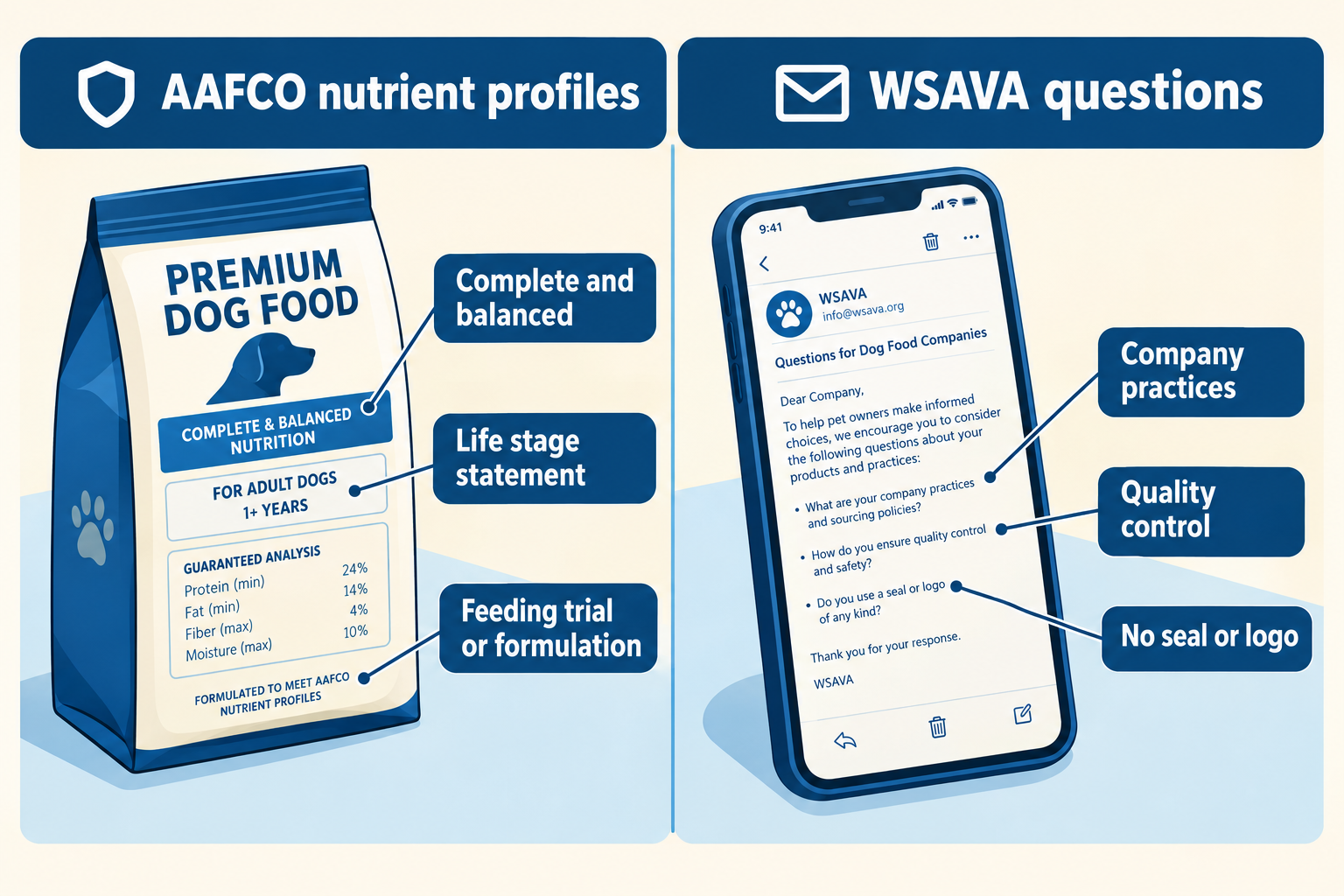
You cannot read it on the label, because compliance is not printed on labels. There is no WSAVA logo, mark, or approval statement for pet food, so any bag claiming a WSAVA endorsement is misrepresenting the organisation.
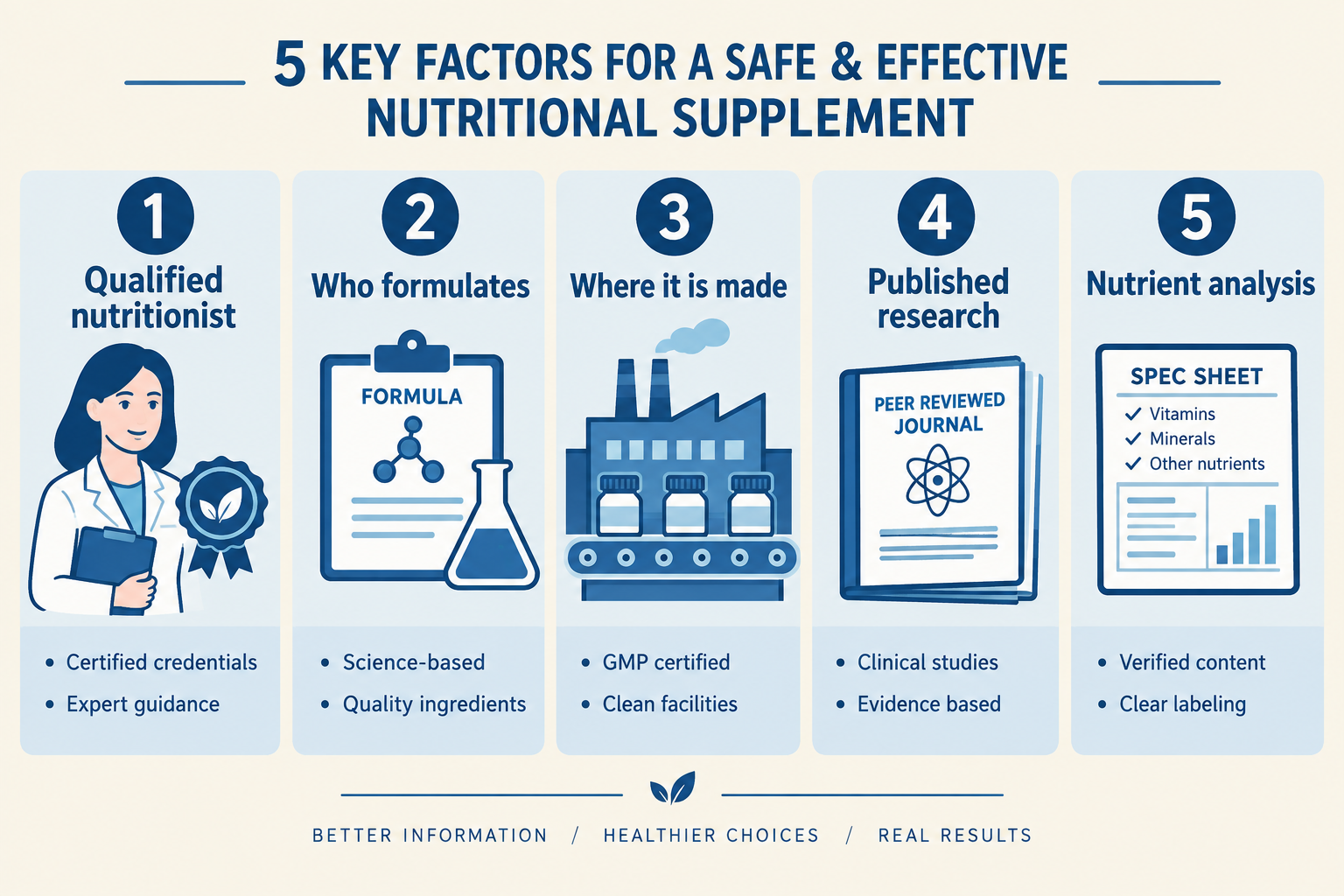
What the label does give you is the starting material for the investigation:
- The manufacturer name and address, which tells you who to contact.
- “Manufactured for” versus “manufactured by”, which hints at whether the brand owns the plant or pays a co-packer. Contract manufacturing is legal and common. It just means question three needs a longer answer.
- The AAFCO nutritional adequacy statement, which tells you the life stage the food was formulated for and whether that was established by formulation or by a feeding trial.
- The guaranteed analysis and calorie content, which is the minimum, not the full picture.
Then you do the part nobody enjoys. You send an email.
A short version that works: “I feed [exact product and bag size] to my dog. Could you tell me whether you employ a full time nutritionist with a PhD in animal nutrition or ACVN/ECVCN board certification, who formulates your recipes, where this product is made, and whether you can send the complete nutrient analysis and calorie content on an energy basis?”
Three things to watch in the reply. A company that answers in two working days with named people and a PDF attachment has effectively answered the questions. A company that replies with a paragraph about their love of animals has not. A company that says the information is proprietary has told you something useful, even if it is not the thing they intended to tell you.
Royal Canin publishes its own public version of these questions under the heading pet food safety questions to ask your manufacturer, which is a reasonable sign that the big manufacturers expect to be asked. If you want a repeatable process for working through two or three shortlisted brands, our three-step method for comparing dog food brands lines up neatly with the five questions.
Is there an official WSAVA approved dog food list?
No. WSAVA does not publish an approved brand list, does not run a certification scheme, and does not rank manufacturers. Every “WSAVA approved dog food list” you find online was written by a vet, a retailer, a blogger, or a tool company that applied the five questions themselves and published their conclusions.
)
That distinction matters more than it sounds. A third-party list can be thoughtful and still be wrong about a specific product line, because companies change plants, buy brands, and reformulate. The list below reflects the brands that veterinary-oriented reviewers most consistently identify as answering all or nearly all five questions, including this 2026 roundup of WSAVA-aligned dog food brands and the long-standing Vetstreet survey of veterinarian recommended dog foods. Treat it as a starting shortlist, not a verdict.
| Brand | How it is usually listed | What to verify yourself |
|---|---|---|
| Purina Pro Plan | Named in third-party reviews as meeting all five questions; in-house nutritionists and published research | Which plant makes your specific range; full nutrient analysis for that formula |
| Hill’s Science Diet | Routinely listed as answering all five; veterinary nutritionists and journal publications | Whether the recipe suits your dog’s life stage and any diagnosed condition |
| Royal Canin | Listed as answering all five; publishes its own manufacturer question set | Calorie density per cup, which varies widely across its breed and size ranges |
| Eukanuba | Commonly listed as meeting all or nearly all five | Current ownership and manufacturing site in your country |
| Iams | Commonly listed as meeting all or nearly all five | Whether the range you buy is formulated for your dog’s life stage |
| Everything else | Varies by company, not by price tier or ingredient story | Send the five questions and keep the written reply |
Availability differs by country, and a brand’s answers in the United States do not automatically describe its operation in the United Kingdom or Australia. If you want our separate take on the biggest manufacturers, we compare them in Purina vs Hill’s vs Royal Canin vs Iams.
Is Blue Buffalo WSAVA approved? No brand is approved, including that one. The honest answer for Blue Buffalo, or any brand not on a reviewer’s list, is to run the five questions yourself and read the reply. Absence from someone’s blog post is not evidence of a bad food.
WSAVA vs AAFCO: what is the difference?
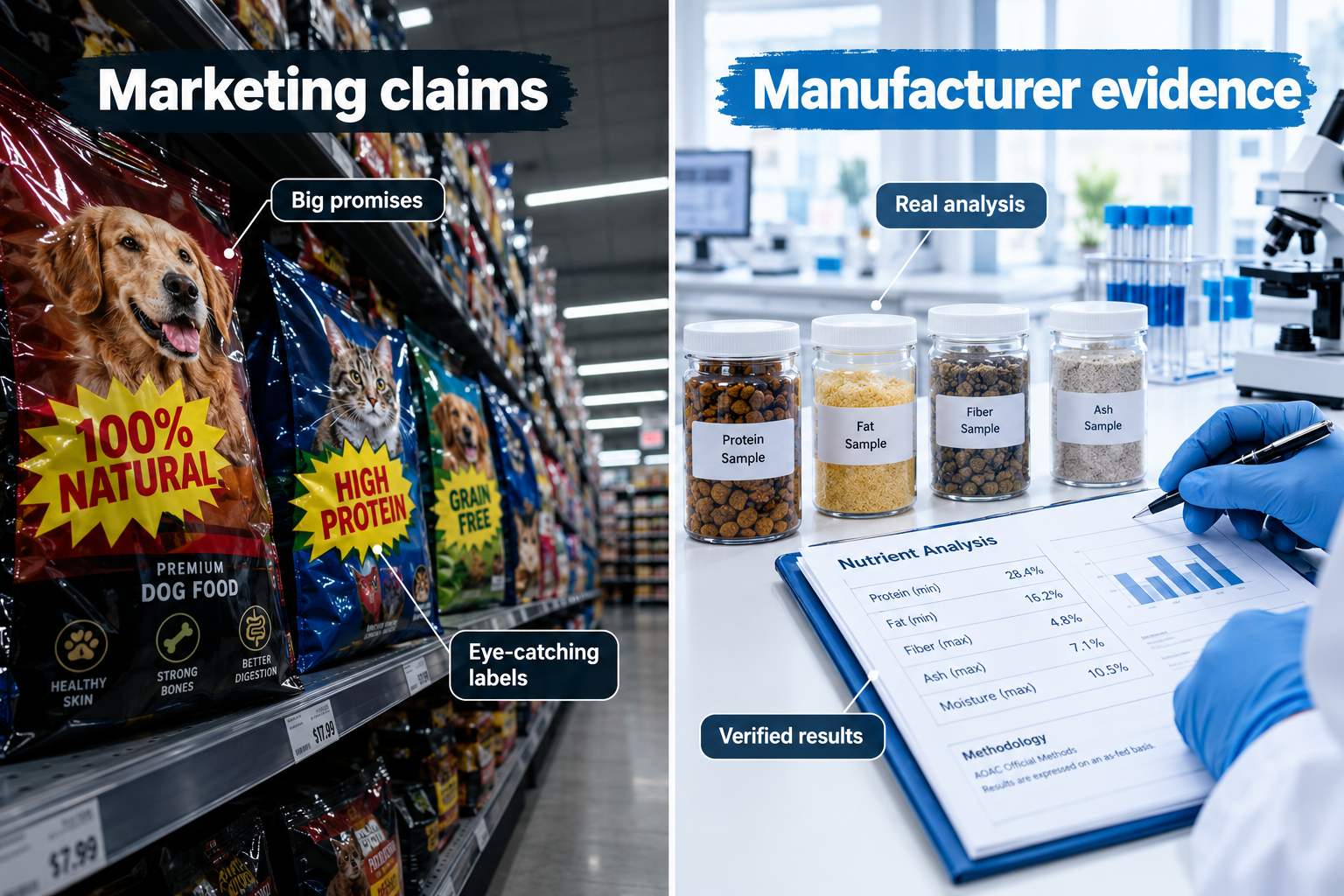
AAFCO regulates what goes on the label. WSAVA asks about the company behind it. A food can carry an AAFCO complete and balanced statement and still fail four of WSAVA’s five questions, because the two systems are measuring different things.
)
AAFCO is the Association of American Feed Control Officials. It publishes nutrient profiles for dog life stages and model label rules that US states adopt. A product that says “formulated to meet the nutritional levels established by the AAFCO Dog Food Nutrient Profiles for growth” is making a verifiable claim about nutrient content. Outside the US, FEDIAF performs a similar role in Europe. Reviewer compilations of AAFCO compliant dog food brands are longer than WSAVA-aligned lists, because clearing a nutrient profile is a lower bar than publishing research.
WSAVA guidance assumes nutritional adequacy as a baseline and then asks who is responsible for it. Think of AAFCO as the exam and WSAVA as the question about who taught the class.
Is WSAVA compliant dog food better than regular dog food, and does my dog need it?
A food from a company that answers all five questions is a lower-risk choice, which is a different claim from “better for your dog.” The five questions predict how carefully a food is formulated and tested. They do not predict whether your dog will digest it, enjoy it, or thrive on it.
Who benefits most from sticking to the shortlist:
- Puppies, especially large breed puppies, where calcium and phosphorus levels during growth have real consequences.
- Dogs with diagnosed disease, where the full nutrient analysis is the point of the exercise.
- Dogs eating one food for years, since small formulation errors compound over time.
- Owners who want fewer decisions. The questions give you a filter that does not depend on packaging.
Who can reasonably look wider: a healthy adult dog doing well on a food from a company that answers three or four questions clearly and will send you the nutrient analysis. That is not failure. That is a smaller company without a research department.
A note on cost. Compliance tracks company infrastructure, not shelf price. Several widely available supermarket and veterinary ranges come from the same manufacturers that answer all five questions, which means a compliant food is not automatically a premium food. Compare cost per day using the calorie content and your dog’s actual daily intake rather than the price on the bag, because a calorie-dense kibble fed in smaller portions can undercut a cheaper bag. Our look at whether premium dog food is actually worth paying more for works through that maths.
WSAVA compliant dog food for sensitive stomachs, allergies, puppies and prescription diets
For sensitive stomachs, allergies, and growth, the five questions matter more than usual, because these are the situations where guesswork gets expensive. The questions still do not tell you which recipe to pick.
Sensitive stomachs. Question three is the one to press on. Consistent ingredient sourcing and finished product testing mean fewer batch-to-batch surprises for a dog whose gut keeps a grudge. Gastrointestinal ranges from the large manufacturers are usually formulated for digestibility and lower fat, and some are available without a prescription. Move slowly whichever food you choose, using our guide to switching dog food without upsetting their stomach, and read dog food for sensitive stomachs and food allergies before you buy three bags of anything.
Allergies. True food allergy in dogs is less common than the internet suggests, and the only reliable way to identify it is an elimination diet run with your vet. Hydrolysed protein and veterinary novel protein diets exist because cross-contamination at the plant can ruin a trial, which is exactly why question three belongs in an allergy conversation. An over-the-counter “limited ingredient” food is not a diagnostic tool, however short its ingredient list.
Puppy food. Check the AAFCO or FEDIAF statement names growth, and for puppies expected to exceed roughly 70 pounds as adults, check that the statement includes large size growth. Calcium control during the first year is the specific reason large breed puppy formulas exist.
Prescription and therapeutic diets. Veterinary therapeutic diets from Hill’s, Royal Canin, and Purina come from the same companies that answer the five questions, so they sit inside the same group rather than outside it. They are not more compliant, they are targeted. A renal diet given to a healthy dog is simply the wrong diet, very carefully made. Use them on veterinary advice, and see our notes on vet recommended dog food for specific health problems.
What happens if dog food isn’t WSAVA compliant?
Nothing happens. There is no penalty, no recall trigger, and no legal consequence, because compliance is not a regulatory status. A food that fails the questions can still be nutritionally adequate, legally sold, and perfectly fine for your dog.
What you lose is information. If a company cannot say who formulated the diet or where it is made, you have no way to judge whether a problem was bad luck or bad process. That matters most in three situations: a recall, a dog with a diagnosed illness, and a growing puppy.
The documented risks associated with poorly formulated foods are nutrient excesses and deficiencies, not a vague lack of quality. Taurine, calcium, vitamin D, and copper have all appeared in reported cases of diet-related problems in dogs over the past decade. The common factor in those reports is formulation and manufacturing oversight, which is precisely what the five questions probe.
Practical rule: if a brand will not send a complete nutrient analysis for the product you feed, treat that as the answer and look at how to judge a dog food brand before you buy it.
Who funds WSAVA, and does it matter?
WSAVA is funded partly by corporate partners, and several of those partners are pet food manufacturers, including companies whose brands appear on third-party compliance lists. WSAVA lists its corporate relationships publicly in its partner news updates. Anyone recommending these guidelines should say that out loud.
Does it invalidate the framework? That depends on what you think the framework is doing.
The questions themselves are not product recommendations. They ask about nutritionist credentials, formulation responsibility, quality control, published research, and disclosure. Those are reasonable things to ask any food manufacturer, and you can apply them to a company that has never given WSAVA a penny. The guidance does not name a single brand to buy.
The fair criticism is structural. Criteria built around in-house nutritionists, owned factories, and peer reviewed publication are easier for large multinationals to satisfy. That tilts the outcome toward big companies regardless of intent, and it means a small manufacturer doing careful work can look worse on paper than it deserves. Worth holding both ideas at once: the questions are good questions, and the scoring favours scale.
What this changes for you is mostly tone. Use the five questions as a checklist you run yourself, not as a brand ranking handed down from an authority. Then weigh the answers alongside your dog’s digestion, your vet’s advice on any diagnosed condition, and what you can afford to feed consistently.
FAQ
Is WSAVA compliant dog food an official certification?
No. WSAVA does not certify, approve, endorse, or test pet foods. The phrase describes a company that answers WSAVA’s five manufacturer questions satisfactorily, and it is used by owners and clinics rather than by WSAVA itself.
Which brands are WSAVA compliant?
Veterinary-oriented reviewers most often list Purina Pro Plan, Hill’s Science Diet, Royal Canin, Eukanuba, and Iams as answering all or nearly all five questions. Those are third-party assessments. Availability and manufacturing details vary by country, so verify for the product you actually buy.
Where can I find the official WSAVA guidelines on dog food?
In the WSAVA Global Nutrition Toolkit on WSAVA.org. The owner-facing handout is called Selecting a Pet Food for Your Pet, last updated in 2021 and checked for this article in October 2026.
Can a grain free or raw food be WSAVA compliant?
Possibly, since the questions are about the manufacturer rather than the recipe style. In practice, few grain free or raw producers employ a full time board certified nutritionist or publish peer reviewed research, so most fall short on questions one and four. Raw diets also carry documented bacterial handling risks worth discussing with your vet.
Is my dog’s food bad if the brand is not on a compliance list?
Not necessarily. Absence from someone’s list is not evidence of a problem. Send the brand the five questions, keep the written reply, and judge the answers rather than the omission.
Does AAFCO approval mean the same as WSAVA compliance?
No. An AAFCO nutritional adequacy statement says the food meets nutrient profiles for a life stage. WSAVA’s questions ask who formulated it, where it was made, and what research supports it. A food can satisfy AAFCO and answer none of WSAVA’s questions.
How long should I wait for a manufacturer to reply?
Two to five working days is a reasonable expectation for a company with a customer care team. A vague reply, or a refusal to share nutrient data, is itself an answer to question five.
Conclusion: what to do with this
WSAVA compliance is a method, not a badge. Nobody is inspecting the bag, which means the work falls to you, and the work is one email and about ten minutes of reading.
Three next steps:
- Open your current bag and note the manufacturer name, the AAFCO or FEDIAF statement, and the calorie content per cup or per 100g. That gives you the baseline.
- Email the company the five questions from the WSAVA Global Nutrition Committee handout, and ask specifically for the complete nutrient analysis for your product. Score the reply in the brand check above.
- Take the reply to your vet if your dog has a diagnosed condition, is under a year old, or has an unresolved gut or skin problem. The nutrient analysis is the document they can actually use.
Feeding WSAVA compliant dog food lowers the odds of a formulation or manufacturing problem. It does not override your individual dog. The dog with the sensitive stomach, the fussy appetite, and strong opinions about anything that arrives in a new bag still gets the final vote, which is how it has always worked.