Quick Answer
The best harness for dachshund backs is a Y-front design with a wide chest panel, a girth strap that sits just behind the elbows, two leash attachment points, and a top handle for stairs and car lifts. Veterinary guidance from VCA Animal Hospitals on cervical disc disease recommends a body harness rather than a neck collar for affected dogs. For dogs with hind-leg weakness, a rear support sling is a separate product used alongside a chest harness, not a replacement for one.
Key Takeaways: Best Harness for Dachshund
- A dachshund’s disc risk is real and well documented. The American College of Veterinary Surgeons reports that dachshunds account for roughly 45 to 70 percent of disc rupture cases seen in chondrodystrophoid breeds.
- Choosing the best harness for dachshund walks is mostly about pressure distribution: wide chest panel, soft edges, no strap cutting across the throat or armpit.
- Y-shaped fronts are preferred over T-shaped fronts during recovery because T-fronts can restrict shoulder movement, according to a rehabilitation handout published by Dachshund IVDD Support Australia.
- A harness is not a back brace. It spreads leash force. It does not stabilise a spine or make jumping safe.
- Support slings and lift harnesses are a different product category from walking harnesses. Current listings for multi-handle lift gear emphasise stairs, toileting and car transfers, per a 2026 lift harness guide from PetPal HQ.
- Measure girth just behind the elbows, then check the neck opening separately. Dachshund chests are deep and narrow, which is why generic small-dog sizing often fails.
- Loose lead walking matters more than the buckle you buy. Dachshund IVDD Support Australia’s risk guidance warns that a harness can simply allow chronic pulling, and that a poor fit can affect gait, shoulders and elbows.
- Price range, checked October 2026: around $36 for a small support sling up to roughly $140 for the largest lift harness size.
Why do dachshunds need a harness instead of a collar?
Because a neck collar concentrates leash force on the exact part of the body most likely to cause a dachshund trouble. Dachshunds are a chondrodystrophoid breed, which means their discs degenerate earlier and more often than those of long-legged dogs, and cervical (neck) discs are a common site. A body harness moves that pulling force onto the chest and ribcage instead.
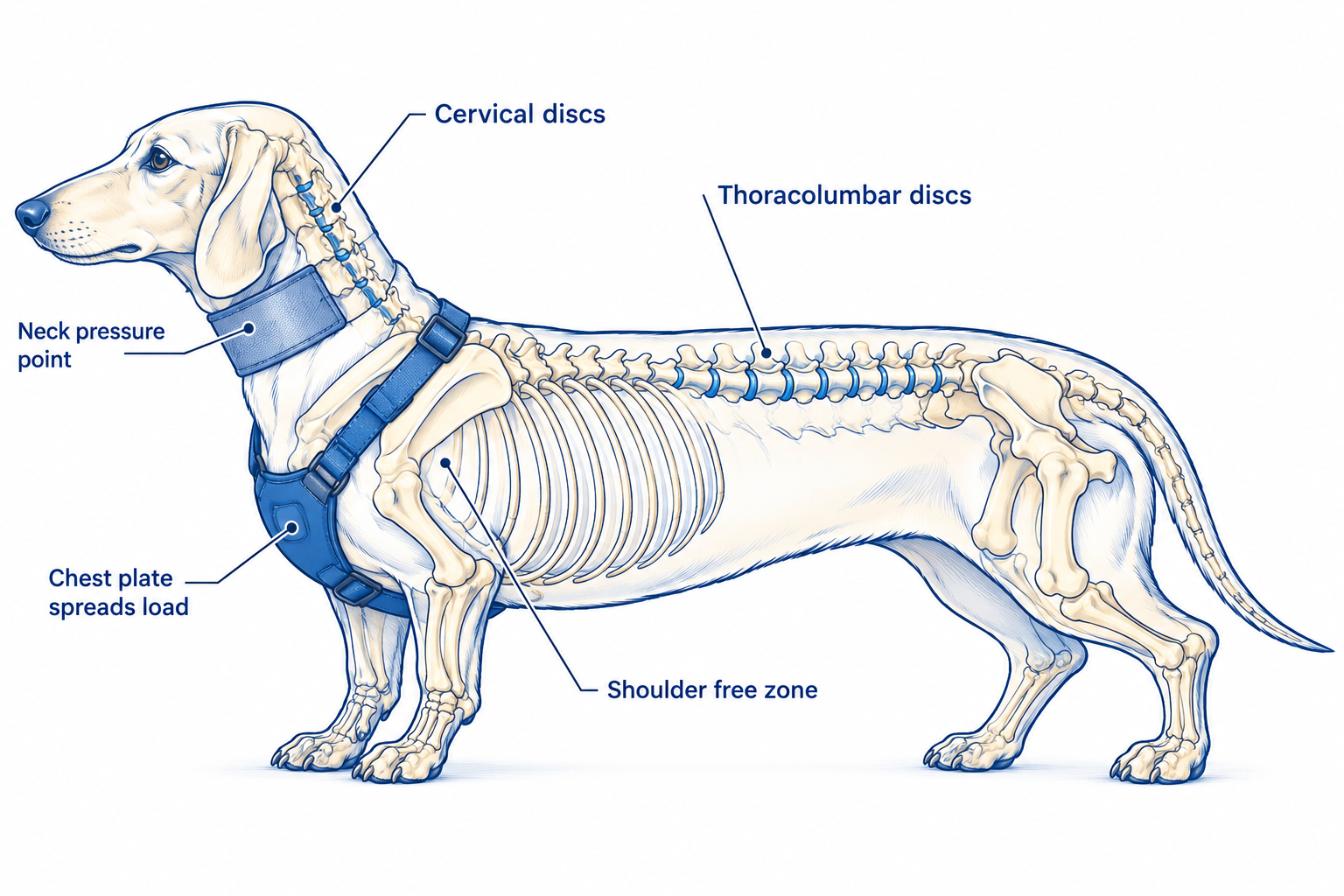
That is the mechanical argument. The veterinary argument is more direct. VCA’s guidance on cervical intervertebral disk disease states that all affected dogs should be fitted with a harness rather than a neck collar, and that activity should be limited during early recovery. The ACVS discussion of postoperative management lists switching from a neck lead to a body harness alongside restricted exercise, rehabilitation and weight control.
Weight control is the quiet half of that sentence. A heavier dachshund puts more load through the same short spine, and extra body condition is one of the few risk factors an owner can actually change. If your dog is carrying a bit too much, the food options built around weight and joint support are worth reading before you spend on gear.
What is IVDD in dachshunds?
IVDD stands for intervertebral disc disease. The discs between the vertebrae act as cushions. In chondrodystrophoid breeds, those discs calcify and harden early, so a sudden movement or ordinary jump can push disc material against the spinal cord. The result ranges from pain and a reluctance to move up to partial or complete hind-leg paralysis.
Signs that need same-day veterinary attention include a hunched back, yelping when picked up, dragging a back foot, wobbly hind legs, or a sudden refusal to jump onto furniture the dog has used for years. IVDD is a medical emergency when there is any loss of leg function. No piece of equipment substitutes for that phone call.
Harness vs collar for dachshunds: which is better?
For walking, a well fitted harness is better for most dachshunds, because it keeps leash pressure off the neck. For identification tags, a flat collar is still useful and harmless as long as the lead is not clipped to it.
The honest caveat comes from the dachshund community itself. Dachshund IVDD Support Australia explicitly rejects the idea that every harness is automatically safer than every collar. Their point: a harness can let a dog lean into the lead all walk long, and an ill-fitting one can change how the dog moves through the shoulders and elbows. The goal they name is a loose lead with no jerking. The hardware is secondary to that.
So the best setup is a good harness plus the loose lead handling you teach with reward based methods. One without the other is half a solution.
Can a regular harness hurt a dachshund’s back?
Yes, a poorly designed or poorly fitted one can cause problems, though the usual damage is to gait and comfort rather than the discs directly. Straps that sit across the front of the shoulder, narrow webbing that digs into the armpit, and girth straps pulled too far forward all interfere with normal shoulder movement.
Three specific designs to approach with caution:
- T-front or “cross-chest” harnesses. A horizontal strap across the front of the shoulders limits reach. The DISA rehabilitation handout recommends Y-fronts instead during recovery.
- Tightening or “no-pull” harnesses that constrict. Anything that squeezes the chest or armpit as a correction belongs nowhere near a dog with disc risk.
- Thin step-in harnesses on a strong puller. A step in harness for dachshund walks is convenient for dogs who dislike having things lifted over their heads, but the narrow straps concentrate force. Fine for a calm senior. Less fine for a nine-month-old who has opinions about squirrels.
What makes the best harness for dachshund backs?
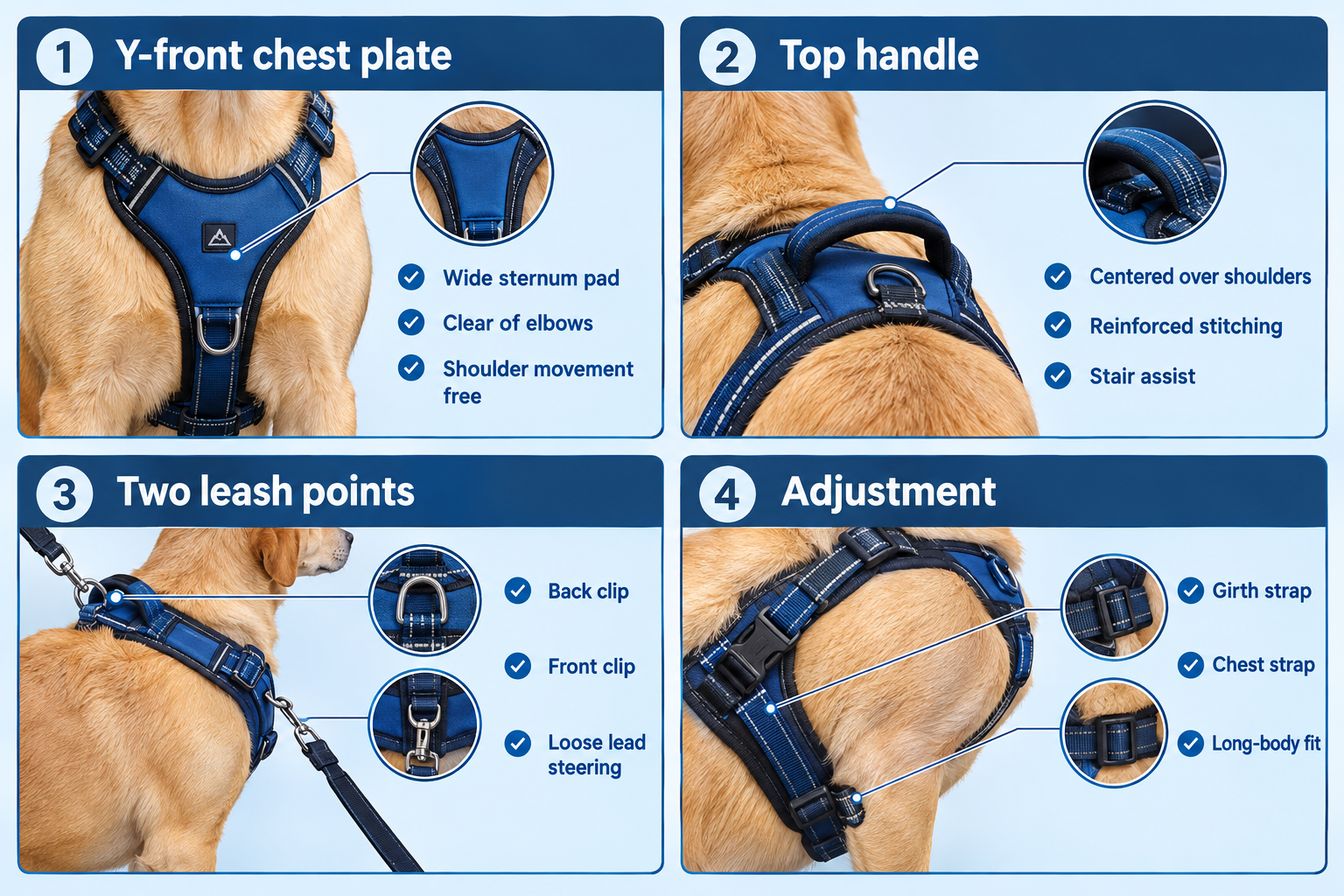
The best harness for dachshund backs spreads leash force across a wide chest plate, leaves the shoulders free, adjusts in at least two places, and gives you a handle you can use on stairs without grabbing a fistful of fur.
Here is the feature list worth paying for, in order of how much it changes the dog’s day:
- Y-shaped front with a wide sternum panel. The Y sits between the shoulder blades and down the breastbone. Force lands on bone and muscle built to take it.
- Girth strap placement behind the elbows. The DISA handout recommends measuring girth just behind the elbows, which is also where the strap should sit. Too far forward and it rubs the armpit.
- A reinforced top handle. This is the feature dachshund owners underrate until the first time they need to steady a dog on a step. A handle lets you support the body rather than hoist from the chest.
- Two leash attachment points. A back clip for normal walking, a front clip for steering a dog who pulls. A dachshund harness no pull setup is really a front clip plus training, not a gadget.
- Length adjustment, not just girth. Dachshund torsos are long. Some harnesses only adjust around the chest, which leaves the chest panel sitting in the wrong place.
- Soft, washable, quick-drying material. Long coats hold damp. So do chest panels.
A note on what to skip: back braces marketed for IVDD. Products like the spinal support brace listings sold for dogs with IVDD and arthritis exist, but there is no clinical guideline in the material reviewed here that establishes a brace as standard treatment for canine disc disease. If your vet or a veterinary rehabilitation practitioner prescribes one for a specific reason, follow that. Do not buy one off a product page and assume it replaces rest.
How much should a dachshund harness cost?
Expect roughly $30 to $60 for a quality everyday walking harness in dachshund sizes, and $80 to $140 for a dedicated two-handle lift harness. Support slings for small dogs sit in between.
Price points checked for this guide: the Ruffwear Front Range official listing showed $59.99 full price and $38.99 on sale on September 20, 2026. GingerLead’s official page listed the Mini sling at $35.95 and Small Male/Female versions at $54.95, checked October 2, 2026. A September 2026 product review from Dog Orthopedic reported Help ‘Em Up direct pricing of $80 for XS through $140 for XL.
Spending more does not buy spinal protection. It buys better padding, better hardware, replaceable parts, and in the case of lift harnesses, the ability to support a dog who cannot stand. If your dog is healthy and walks on a loose lead, the $40 option is genuinely enough.
The 6 picks for IVDD-prone dogs
These six cover three different jobs: everyday walking, pull management, and physical support for a dog with reduced mobility. They are not interchangeable.
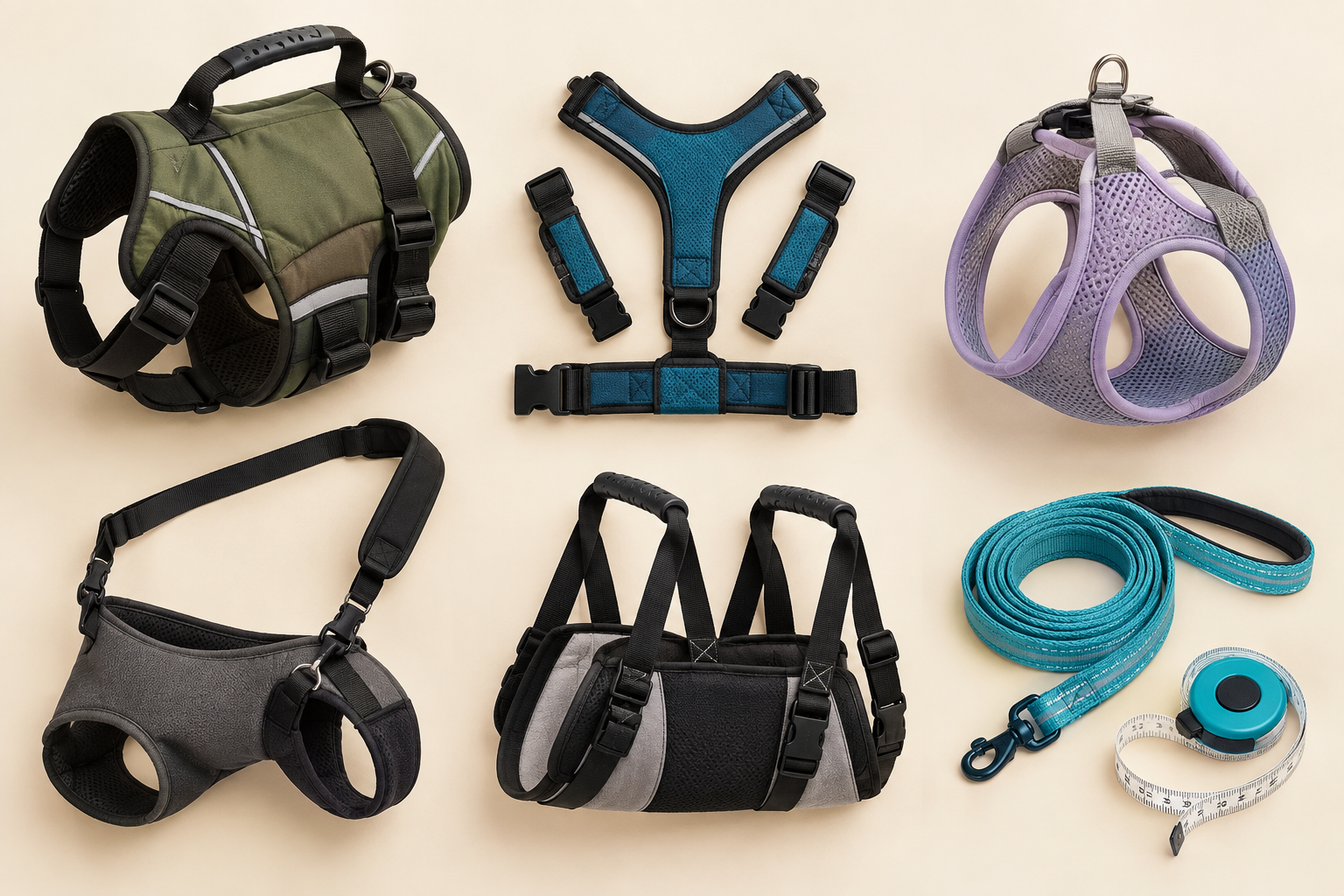
Review method: this is a documented research and specification comparison. Specs and prices come from official product pages and dated product reviews, labelled with the date checked. No hands-on testing is claimed, and no product here is described as safe for every dog. Some links in this article may earn Doggy Rank IQ a commission. The order and the verdicts are based on design, fit evidence and veterinary guidance, not commission.
1. Ruffwear Front Range Everyday Harness
Who it suits: healthy adult dachshunds and dogs at general risk, in XXS or XS, whose owners want one well padded harness for daily walks.
Ruffwear’s official listing shows the Front Range in sizes XXS through medium with both back and front leash attachment points, priced at $59.99 with a $38.99 sale price on the date checked, September 20, 2026. The padded chest and belly panels spread load across a wide area, and the two clip points let you switch between normal walking and gentle redirection.
Strengths: wide padding, four adjustment points, front and back clips, widely stocked.
Drawbacks: it is an everyday walking harness, not a treatment device. The small top handle is for brief assistance, not lifting a dog who cannot bear weight. Deep-chested standards sometimes need to size on girth and accept a longer back panel.
2. Perfect Fit Harness (modular three-piece)
Who it suits: dachshunds whose measurements fall between standard sizes, which is a very large share of them.
Perfect Fit is named in the DISA rehabilitation handout as an example of the Y-front designs preferred over T-fronts during IVDD recovery. It is sold as separate top, front and girth pieces, so you can match a narrow chest to a long body instead of compromising. Fleece lined, which helps on dogs with thin coats over the sternum.
Strengths: genuine Y-front, mix-and-match sizing, replaceable parts.
Drawbacks: ordering three components takes more thought than clicking one size. No price was listed in the sources checked for this guide, so compare the options on the current official listing before you buy.
3. Mekuti Balance Harness
Who it suits: dachshunds who pull, where the owner wants steering without any tightening mechanism.
Mekuti is the other Y-front design named in the DISA rehabilitation handout. It uses a double-ended lead and side attachment points so pressure redirects sideways rather than into the neck or front of the chest. For a dog with disc risk who still thinks the lead is a tow rope, that redirection matters more than padding does.
Strengths: Y-front, no constricting parts, designed around steering.
Drawbacks: the two-point lead takes practice, and it looks more complicated than it is. No price appeared in the sources checked, so verify current pricing on the official listing.
4. DJANGO everyday dachshund harness
Who it suits: owners of small dachshunds who want a lighter, softer daily harness and walk on pavement rather than through brambles.
A September 2026 dachshund harness review from Dog Notebook specifically separates daily harnesses such as DJANGO and Ruffwear from IVDD recovery products such as GingerLead. That distinction is the most useful thing in the current product market, and DJANGO sits firmly on the everyday side.
Strengths: light weight, soft lining, small-dog proportions.
Drawbacks: less structure than the Front Range, and lighter materials give you less to hold in an emergency. Price was not listed in the sources checked here.
5. Help ‘Em Up Harness
Who it suits: dachshunds recovering from surgery or living with ongoing hind-leg weakness, in a household where someone needs to lift the dog several times a day.
This is a two-piece lift harness with front and rear handles, designed to stay on the dog between lifts. The September 2026 review from Dog Orthopedic reported direct pricing of $80 for XS, $95 Small, $110 Medium, $125 Large and $140 XL, and noted that some Amazon variants showed backorder or future-availability status in August and September 2026.
Strengths: proper lifting handles front and rear, stays on for toileting trips and stair assistance, matches the multi-handle category described in current lift harness listings.
Drawbacks: the price, the bulk, and the fact that XS on a lift harness is still a lot of hardware for a five-kilo mini. Availability has been inconsistent. Not a walking harness.
6. GingerLead Dog Support Sling
Who it suits: small dachshunds who need rear-end support for short, vet-approved toilet trips and controlled movement.
GingerLead’s official page lists the Mini at $35.95 and the Small Male and Small Female versions at $54.95, prices checked October 2, 2026. The male and female variants differ in cut to keep the sling clear during toileting, which is a practical detail you only appreciate at 6am in the rain.
Strengths: the most specifically targeted small-dog support product found in current listings, low price, separate male and female cuts.
Drawbacks: it supports the back end only. DISA’s rehabilitation guidance is explicit that a dog needing a sling should also wear a chest harness and lead at the same time, so the neck is not taking the load. Buy both, or you have solved half the problem.
| Product | Style | Handle | Price checked | Best for |
|---|---|---|---|---|
| Ruffwear Front Range | Padded everyday, 2 clips | Yes, light assist | $59.99, $38.99 sale (Sep 20, 2026) | One harness for daily walks |
| Perfect Fit (3-piece) | Modular Y-front | Varies by top piece | Not listed in sources checked | Odd measurements, in-between sizes |
| Mekuti Balance | Y-front, double-ended lead | No | Not listed in sources checked | Pullers, no tightening parts |
| DJANGO everyday | Lightweight daily | Model dependent | Not listed in sources checked | Small minis, pavement walks |
| Help ‘Em Up | Two-piece lift harness | Yes, front and rear | $80 XS to $140 XL (Sep 2026) | Daily lifting, post-op support |
| GingerLead sling | Rear support sling | Shoulder strap | $35.95 Mini, $54.95 Small (Oct 2, 2026) | Hind-leg weakness, toilet trips |
Best harness for long haired dachshunds
For long haired dachshunds, choose a harness with flat, wide, smooth-lined straps and as few rubbing edges as possible, and brush under the harness before every walk. Matting is the main complaint, not fit.
Fleece-lined Y-fronts such as Perfect Fit tend to pull less coat than thin nylon webbing. Avoid harnesses with exposed plastic sliders sitting against the armpit, since that is where long coats knot first. Take the harness off indoors rather than leaving it on all day, and let the coat dry fully after wet walks.
Dachshund harness alternatives worth trying
If a standard harness is not working, there are three legitimate alternatives, and one non-purchase option.
- A two-piece lift harness for dogs who need support several times a day.
- A rear sling worn with a chest harness for temporary hind-leg weakness, which is the combination DISA’s guidance describes.
- A pet stroller or a carried sling bag for dogs on restricted exercise who still need fresh air and sniffing time. Scent work in the garden counts as enrichment when walks are limited.
- Better lead handling with the existing harness. Unglamorous, free, and the thing DISA names as the actual goal.
Ramps also belong in this list, even though they are not worn. For apartment dwellers managing stairs and lifts every day, a ramp onto the sofa removes more jumping than any harness prevents.
How should a harness fit a dachshund’s long body?
A dachshund harness fits correctly when the chest panel sits on the breastbone, the girth strap sits just behind the elbows without rubbing, you can slide two fingers under any strap, and the dog’s front legs swing forward freely with no strap crossing the point of the shoulder.
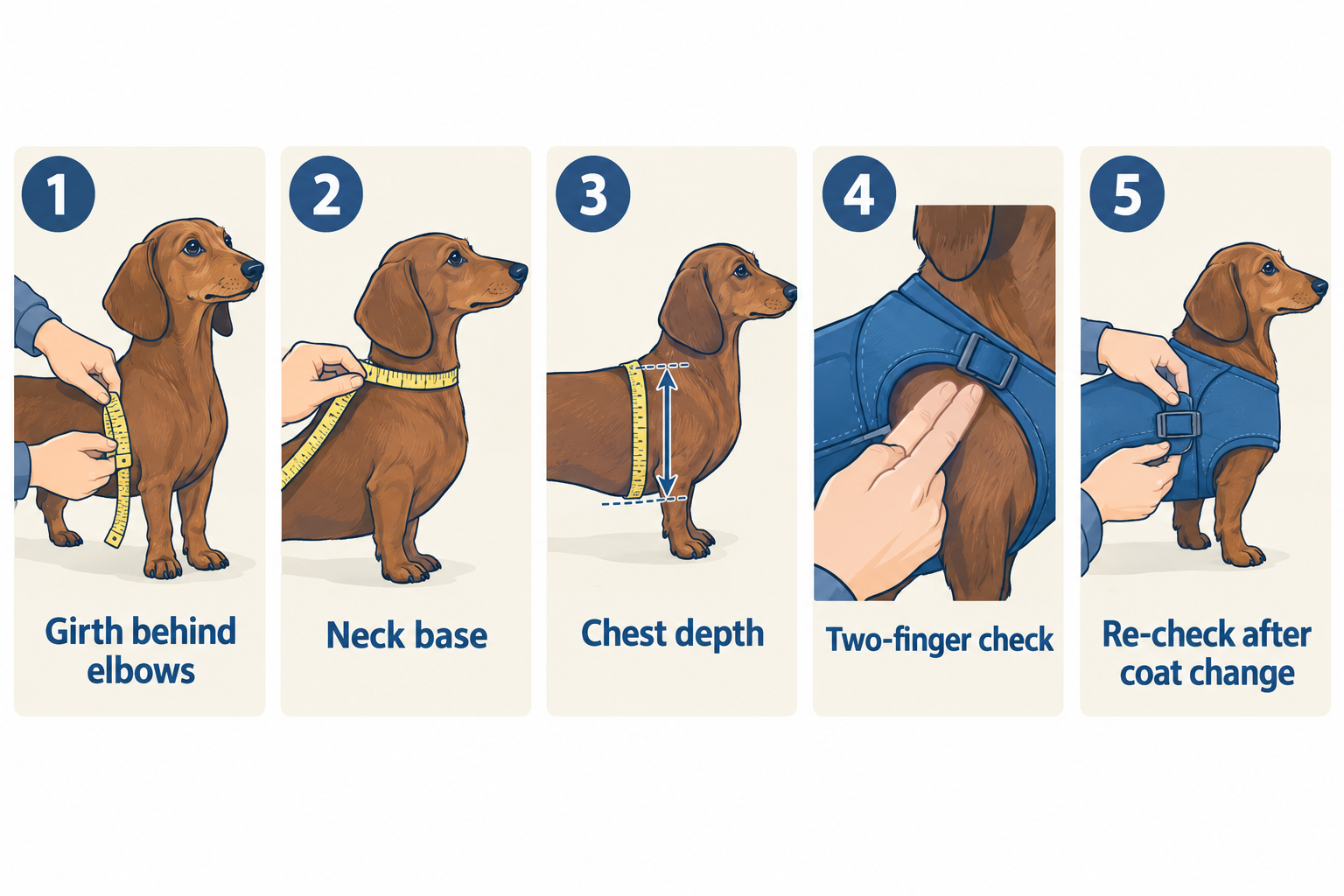
Watch the dog walk away from you in it. If the front feet swing out to the side, or the dog shortens its stride, the harness is interfering with the shoulders. That is a fit problem, and no amount of padding fixes it.
How to measure your dachshund for a harness
- Girth: measure around the chest just behind the front elbows, snug but not tight. This is the number most size charts use, and the measurement the DISA handout points to.
- Neck base: measure where a harness front would sit, low at the base of the neck, not up at the throat.
- Chest depth: note how deep the ribcage is from spine to sternum, since this is where dachshunds differ from other dogs at the same girth.
- Two-finger check: after fitting, slide two fingers flat under each strap.
- Re-measure seasonally. Winter coat, summer coat and any weight change all shift the numbers.
Measure twice. Order once. Mostly.
What size harness does a dachshund wear?
Most miniature dachshunds wear an XXS or XS in brands that make genuinely small sizes, and most standard dachshunds wear a small or medium. Always size on your measured girth, not on the breed name printed in the size chart.
Brand charts vary enough that a mini can be an XS in one range and a small in another. Dachshunds also sit awkwardly between the usual small and medium dog size categories, which is why a long-bodied dog in a correctly sized girth sometimes looks like it is wearing a harness built for a shorter animal. That is normal, as long as the chest panel lands on the sternum.
The harness keeps slipping off: what to do
If a dachshund backs out of a harness, the usual cause is a loose girth strap combined with a front opening that is too wide, since a dachshund’s head is narrower than its neck at the base. Tighten the girth to the two-finger check, then tighten the neck opening, then confirm the dog can still move its shoulders freely.
If it still slips:
- Switch to a harness with a belly strap plus a chest strap, so there are two separate closed loops around the body.
- Check whether the harness is rotating sideways. A rotating chest panel usually means the girth is loose or the back panel is too long.
- Clip the lead to a back-up safety loop or collar with a short coupler on busy streets, so a single escape does not become a road incident.
- Consider the behaviour, not only the buckle. Dogs who reverse out of harnesses are often frightened by something specific. Fix that and the escaping often stops.
When should dachshunds start wearing a harness?
Start harness training in puppyhood, as soon as a dachshund puppy is walking on a lead, using a lightweight adjustable harness and short positive sessions. A best harness for dachshund puppy choice is one you accept replacing, because puppies grow out of sizes faster than the harness wears out.
Let the puppy eat treats beside the harness before it ever goes on. Then on, treat, off. Then a few steps indoors. Dachshund puppies also need the jumping conversation early: off furniture, out of cars, down stairs. Teaching a puppy to wait to be lifted is cheaper than any gear, and it pairs naturally with the growth-stage nutrition puppies need in year one.
Can a harness help a dachshund with IVDD?
A harness helps by keeping leash force off the neck and giving you a safe way to support or lift the dog. It does not treat IVDD, stabilise the spine, or make activity restriction optional. Conservative IVDD management is primarily rest and medical care, not equipment.
VCA’s guidance on exercise restriction in dogs describes short lead walks only where permitted, with no running, stairs, jumping, rough play or furniture access during the restricted period. The ACVS lists at least four weeks of restricted exercise as part of postoperative management, together with rehabilitation and weight control.
A harness changes where the lead pulls. It does not change what the dog is allowed to do.
The location of the spinal problem also changes the right equipment. A chest harness matters most when the neck is involved. A rear sling is what helps a dog with hind-leg weakness, and DISA’s guidance says a chest harness and lead should be used at the same time so the neck is not carrying the dog’s effort.
It is worth saying plainly: owners genuinely struggle to find the right gear for long-backed dogs. An r/DogAdvice thread asking for harness recommendations for dogs at IVDD risk shows the same questions repeating. Owner discussion is useful for spotting fit complaints and failure points. It is not clinical evidence, and nothing in it replaces your own vet’s plan.
Do all dachshunds need a back support harness?
No. Most healthy dachshunds need a well fitted everyday walking harness, not a back support product. Support slings and lift harnesses are for dogs with reduced mobility, post-surgical recovery, or a vet’s specific recommendation.
Buy the support product when the dog needs help standing, walking or toileting, or when your vet asks you to limit how the dog moves through the house. Buy the everyday harness now, regardless. Individual variation is real here: two miniature dachshunds the same age and weight can have very different disc health, and nothing on a product page predicts which is which. If you are still choosing a dog and the disc risk gives you pause, it is a fair factor to weigh when you match a breed to your actual household.
FAQ
Should dachshunds wear a harness?
Yes, for lead walking. Veterinary guidance from VCA recommends a body harness instead of a neck collar for dogs affected by cervical disc disease, and the ACVS lists switching from a neck lead to a body harness in postoperative care. A flat collar for ID tags is fine as long as the lead is not clipped to it.
What is the best harness for dachshund with IVDD?
For walking, a Y-front harness with a wide chest panel, a top handle and no tightening parts. For physical support, a dedicated lift harness or rear sling, chosen with your vet. The two jobs need two different products, and the walking harness alone does not provide lifting support.
Is a no-pull harness safe for a dachshund?
Front-clip no-pull harnesses that redirect are generally reasonable. Tightening or constricting designs are not a good match for a breed with disc risk. DISA’s risk guidance notes that a harness can allow chronic pulling, so pair the hardware with loose lead training rather than relying on the design.
Do dachshunds need a handle on the harness?
A handle is one of the more useful features for the breed, because it lets you steady or support the dog’s body on steps and into cars instead of lifting by the chest. A small handle on an everyday harness is for brief assistance only, not for lifting a dog who cannot bear weight.
Is a step-in harness good for a dachshund?
A step-in harness suits calm walkers and dogs who dislike having gear lifted over their heads. Thin step-in straps concentrate pressure on a strong puller, so check the strap width and whether the front sits clear of the shoulder points before choosing one.
How tight should a dachshund’s harness be?
Snug enough that you can slide two flat fingers under any strap, and no looser. Loose harnesses rotate, rub, and let dogs reverse out. Over-tight harnesses restrict the shoulder and can change the dog’s gait.
Can a harness prevent IVDD in dachshunds?
No. A harness reduces leash pressure on the neck, which is sensible, but no equipment prevents disc degeneration in a chondrodystrophoid breed. Weight control, limiting jumping, ramps and early veterinary attention for any back pain all carry more weight than a purchase.
How often should a dachshund harness be replaced?
Replace it when stitching frays, buckles crack, padding compresses flat, or the dog outgrows the size. For puppies, expect at least one or two replacements in the first year. For adults, inspect the stitching around the leash ring monthly.
Conclusion
The practical answer is less exciting than the product photos. Buy one well fitted Y-front everyday harness with a wide chest panel and a top handle, somewhere in the $35 to $60 range, and learn to walk your dachshund on a loose lead. Add a support sling or lift harness only when a vet tells you the dog needs physical assistance, and keep using the chest harness alongside it.
Your next three steps:
- Measure girth behind the elbows tonight, plus neck base and chest depth, and write the numbers down.
- Compare the options against those numbers, not against the breed name on a size chart. Use the fit finder above to narrow the style first.
- Book the vet conversation if your dog has had any back episode, and ask specifically whether a sling or lift harness fits their recovery plan, and what the activity restrictions are.
Guidance and prices in this article were checked in October 2026. Prices change, availability wobbles, and sizing charts get revised, so verify the current official listing before you buy. The harness is a small decision. How you lift your dog off the sofa, every day, for the next twelve years, is the big one.