
Quick Answer
Refrigerated dog food is gently cooked, high-moisture food sold cold and stored in your fridge, and the two biggest names in the store case are now Freshpet and Hill’s. Hill’s announced Science Diet Single Protein Dog Food Rolls on June 30, 2026, with pet-specialty retail availability starting in July 2026, which put a mainstream veterinary brand directly into Freshpet’s territory. Neither one is automatically healthier than good kibble. The deciding factors are the nutritional adequacy statement on the pack, your dog’s calorie needs, fridge space, and how much you can spend per pound. Guidance checked October 2026.
Key Takeaways: Refrigerated Dog Food
- Refrigerated dog food is cooked, chilled, and perishable. It usually contains around 70 to 80 percent moisture, which is why it costs more per calorie than dry food. Freshpet’s Chicken Recipe with Peas, Carrots & Brown Rice lists 76 percent maximum moisture and 1,363 kcal per kilogram, or 309 kcal per half pound.
- “Fresh” is a storage and processing description, not a health claim. Veterinary nutritionists at Tufts Petfoodology have made the point that there is no general evidence that fresher, home-style food beats a nutritionally complete commercial diet.
- Check the AAFCO nutritional adequacy statement for the exact recipe and your dog’s life stage. AAFCO explains that “complete” means all required nutrients are present and “balanced” means they are in the right proportions. Words like human-grade and minimally processed do not cover that.
- Hill’s new refrigerated rolls are for healthy adult dogs. They are not Prescription Diet products and do not replace a therapeutic diet.
- Freshpet’s advantage is reach. Its 2025 annual report filed with the SEC states its products were available in roughly 30,235 stores at the end of 2025, which means no subscription and no delivery window.
- Freshpet’s last documented recalls were single-lot voluntary actions in 2021 and 2022 over possible salmonella. FDA reported no associated illnesses and later terminated both.
- Mixing refrigerated food with kibble is fine for most healthy dogs if you count the calories from both bowls and switch over slowly.
- Refrigerated dog food suits picky eaters, dogs who need more water in their diet, and dogs whose owners want a palatable topper. It does nothing extra for a healthy dog already thriving on a complete dry food.
What is refrigerated dog food, and is it good for your dog?
Refrigerated dog food is complete dog food that is cooked at lower temperatures than kibble, sealed, and kept cold from the factory to your fridge. It has no shelf-stable packaging, so it lives in a store refrigerator and then in yours. Whether it is good for your dog depends on the recipe’s nutritional adequacy statement and your dog’s needs, not on the temperature it was sold at.
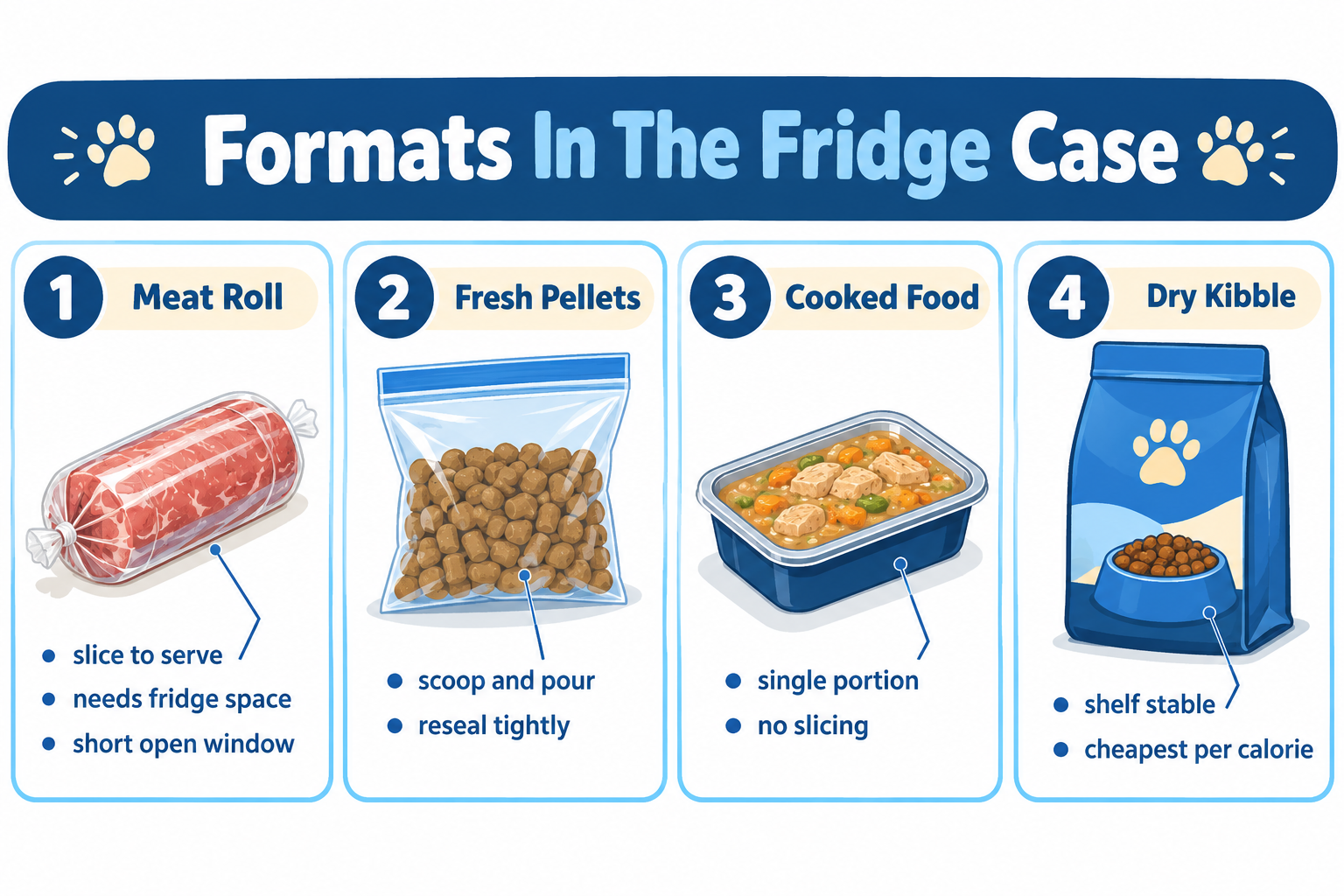
The practical differences from kibble:
- Water content. Refrigerated food runs roughly 70 to 80 percent moisture. Kibble is usually under 12 percent. A pound of refrigerated food therefore carries far fewer calories than a pound of kibble.
- Processing. Kibble is extruded under high heat and pressure. Refrigerated food is typically steamed or gently cooked, which keeps a soft, meat-loaf texture.
- Preservation. Kibble is preserved by low moisture. Refrigerated food is preserved by cold, which is why an opened pack has a days-long window instead of a months-long one.
- Shelf life after opening. Dry food can sit in a sealed bin for weeks. An opened roll or tub has a printed number of days and then goes in the trash.
None of that makes refrigerated food nutritionally superior. The WSAVA Global Nutrition Toolkit suggests judging a company on who formulates its diets, whether it employs qualified nutritionists, its quality control and nutrient analysis, its bacteriological testing, and its published research. Those questions apply the same way to a cold roll and a dry bag. If you want the longer version of that comparison, read our breakdown of air-dried and fresh dog food compared with dry kibble.
The fridge is a storage decision. The adequacy statement is the nutrition decision. They are printed on the same package, and only one of them is a claim about your dog’s health.
Refrigerated dog food brands compared at a glance
Doggy Rank IQ did not independently verify retail prices for this table, because shelf prices for refrigerated food vary by store, pack size, and region. Use the price per pound printed on the shelf tag and the calorie figure on the pack to compare. Brand details below come from manufacturer pages and press materials, checked October 2026.
| Brand | Format | Adequacy statement (per maker) | Where sold | Price check |
|---|---|---|---|---|
| Freshpet (Select, Vital, Nature’s Fresh) | Chilled rolls, resealable bags, tubs | Varies by recipe and life stage. Confirm on the pack. | Branded fridges in grocery, mass and pet retail; about 30,235 stores at end of 2025 | Shelf tag; usually the lowest cost per pound in the fresh category |
| Hill’s Science Diet Single Protein Rolls | Refrigerated roll, three recipes: chicken and brown rice, beef and carrot, lamb and pumpkin | Complete and balanced for healthy adult dogs (adult maintenance) | Pet-specialty retailers from July 2026 | Shelf tag; new launch, so pricing is still settling |
| JustFoodForDogs | Refrigerated and frozen packs, in-store pantries | Varies by recipe. Some are daily diets, some are intended for veterinary use. | Petco locations, own stores, direct shipping | Shelf tag; premium tier |
| The Farmer’s Dog | Pre-portioned fresh packs shipped frozen, then kept in the fridge | Brand states complete and balanced; confirm for your dog’s life stage | Subscription only, no retail fridge | Quoted per day at signup; among the priciest options |
| Ollie | Fresh tubs shipped frozen; baked and mixed plans also offered | Brand states complete and balanced; confirm per recipe | Subscription only | Quoted per day at signup |
| Blue Buffalo | No nationally distributed refrigerated fresh line verified as of October 2026 | Its widely sold wet food is shelf-stable cans and trays | Standard dry and wet aisles | If you see it in a store fridge, read the storage line on the pack |
Affiliate disclosure: Doggy Rank IQ may earn a commission from some retail links. Verdicts follow the dog’s needs and the available evidence. Commission does not decide the order.
How do the 6 refrigerated dog food brands compare?
Short version: Freshpet wins on access and price, Hill’s wins on single-protein simplicity and veterinary channel credibility, JustFoodForDogs sits between retail and clinic, the two subscription brands buy you portioning and convenience, and Blue Buffalo is not actually a refrigerated player.
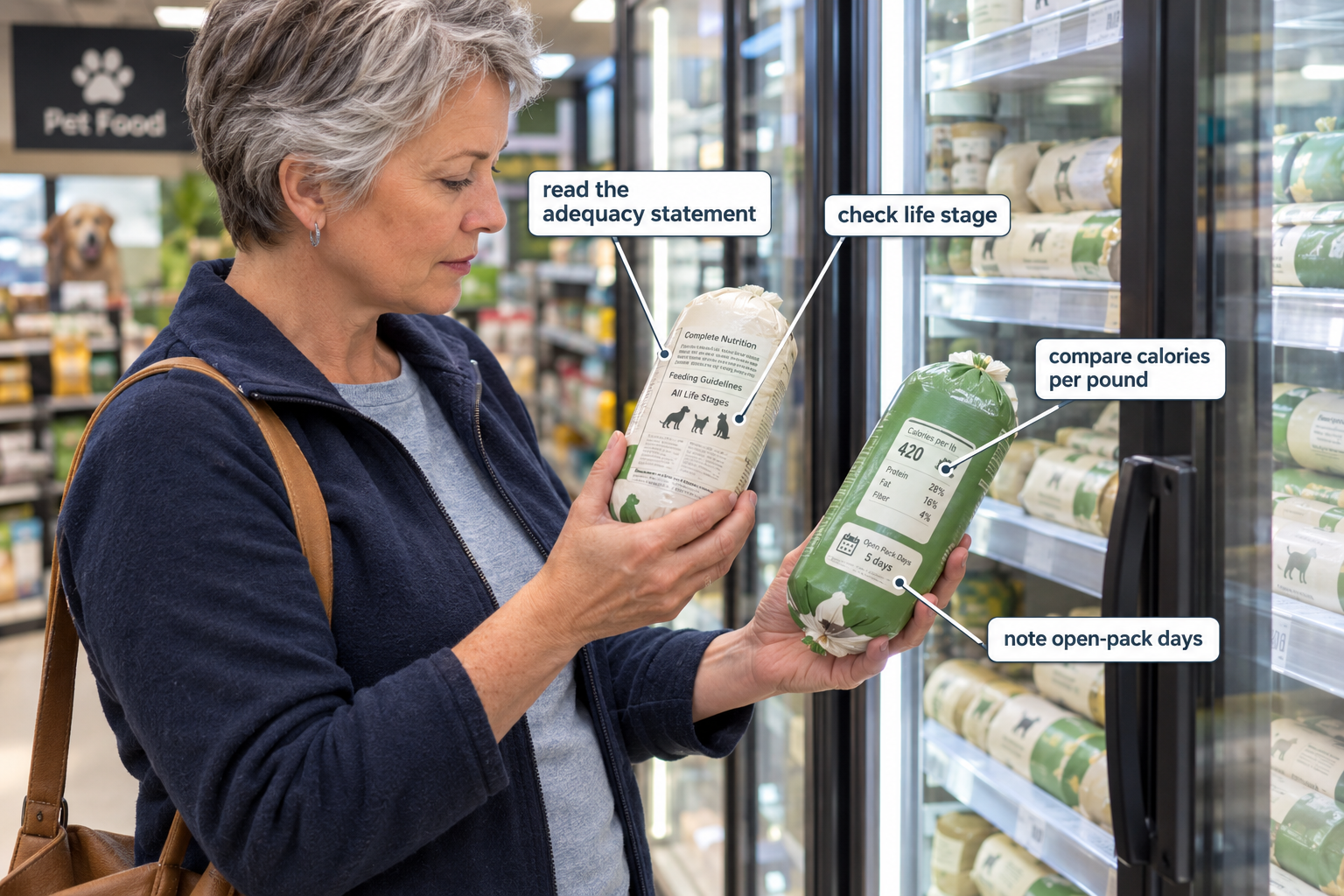
Freshpet. Who it suits: owners who want cooked, high-moisture food tonight without signing up for anything. Strengths are the store footprint, the number of recipes and formats, and the per-pound cost compared with delivery brands. Drawbacks are fridge space, the short open-pack window, and recipe-to-recipe variation in life stage suitability. Forbes Vetted and Business Insider both describe it as the easiest fresh option for people who do not want a subscription.
Hill’s Science Diet Single Protein Rolls. Who it suits: adult dogs whose owners want one named animal protein and a maker with an established veterinary nutrition team. Hill’s describes the rolls as gently steam-cooked, complete and balanced for healthy adult dogs, and usable as a full diet, a topper, or a mix-in, with emphasis on digestibility, omega-6 fatty acids, and vitamin E. Drawbacks: only three recipes at launch, adult-only positioning, and pet-specialty distribution rather than every grocery store.
JustFoodForDogs. Who it suits: owners who want fresh food with a clinical bent and a store they can walk into. Recipes range from everyday diets to formulas intended for use under veterinary direction, so read which is which. Drawbacks: price, and availability tied to specific retail locations.
The Farmer’s Dog. Who it suits: owners who would rather open a labeled daily pack than slice a roll, and who have the budget. Strengths are portioning by the dog’s weight and activity, plus consistency. Drawbacks: cost, freezer and fridge juggling, and no option to grab more at 8pm. Our take on whether that trade works is in fresh dog food delivery: is a subscription worth it.
Ollie. Who it suits: similar household to The Farmer’s Dog, with more format choices including baked and mixed plans. Same core drawback, which is subscription pricing and delivery logistics.
Blue Buffalo. Who it suits: people searching for “Blue Buffalo refrigerated dog food” who will be better served by its canned and tray wet foods. Those are shelf stable until opened, then refrigerated.
Freshpet vs Hill’s refrigerated dog food: which is better?
For a healthy adult dog, Hill’s Single Protein Rolls are the stronger pick if you want one animal protein and a maker with a long veterinary nutrition track record. Freshpet is the stronger pick if you need variety, broad availability, and lower cost per pound.
Use this decision rule:
- Choose Hill’s if your dog is a healthy adult, you are simplifying protein sources, or you already buy Science Diet and want a cold topper that matches the brand’s standards.
- Choose Freshpet if you need a puppy or all-life-stages recipe, you shop at a grocery store rather than a pet chain, or you are feeding more than one dog and price per pound decides it.
- Choose neither if your dog has a diagnosed condition needing a therapeutic diet. The Hill’s rolls are not Prescription Diet products, and no fresh retail food replaces one. For that path, start with our guide to vet recommended dog food for specific health problems.
Common mistake: assuming the Hill’s roll carries the same clinical role as a Prescription Diet product because the name on the pack is familiar. It does not. Hill’s positions the refrigerated rolls for healthy adult maintenance.
Is refrigerated dog food safe?
Refrigerated dog food is safe when it is kept cold, opened on a clean surface, used inside the printed window, and handled like raw-adjacent food rather than like kibble. It is cooked, so it is not a raw diet, but it is still perishable and can support bacterial growth if it warms up.
Recalls. Freshpet’s commitment page states it has no current or pending recalls. That is a manufacturer statement, so cross-check it against the FDA recalls and withdrawals database before you buy, the same way you would for any brand. The documented history is two single-lot voluntary recalls, one in 2021 covering a Select Small Dog Bite Size Beef & Egg lot and one in 2022 covering a Fresh Kitchen Home Cooked Chicken lot, both over possible salmonella. FDA reported no illnesses connected to either and both were later terminated.
What owners actually complain about. Scan retailer reviews and owner forums and the recurring Freshpet complaints are practical: loose stools during a fast switch, smell, packaging that leaks in a grocery bag, fridge space, food going off before the dog finishes the roll, and occasional store fridges that feel warmer than they should. Freshpet’s public response has centered on its food safety program and recall transparency rather than on individual complaints, which is normal for a manufacturer. None of those reports establish a product defect on their own, and none of them are a substitute for the FDA record.
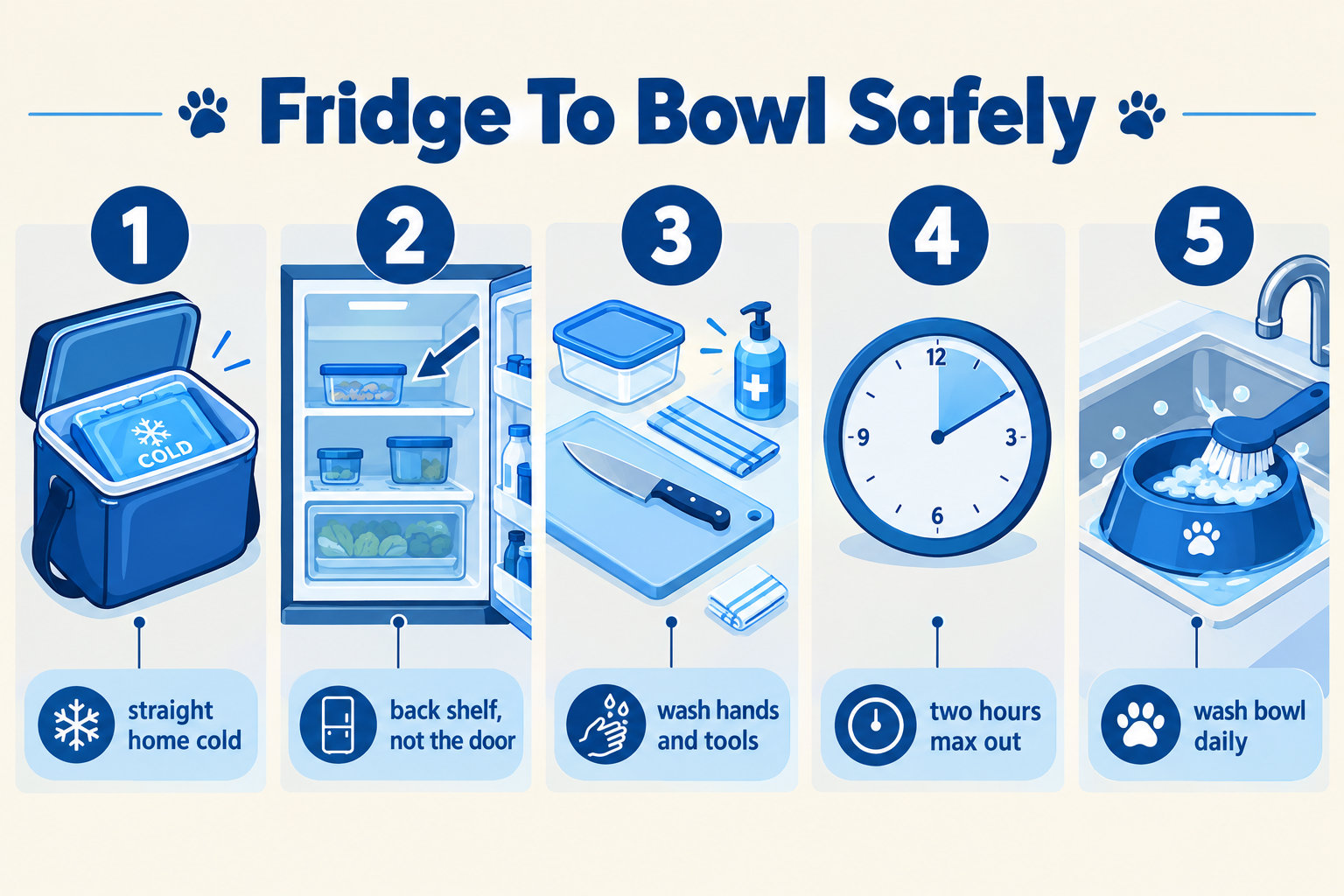
Handling rules worth following. These apply to every brand in the case:
- Put the pack in the coldest part of your cart and get it home cold. A cooler bag helps in summer.
- Store it on a back shelf, not in the door. Door temperature swings every time someone wants milk.
- Wash hands, knife, board, and bowl after serving. Treat the counter as contaminated until wiped.
- Do not leave food in the bowl longer than two hours at room temperature. Toss uneaten portions.
- Write the open date on the pack with a marker. Your memory of “Tuesday, probably” is not a food safety system.
- Wash the bowl daily. Dried fresh food is a bacterial campsite.
Households with infants, older adults, or anyone immune-compromised should be stricter still, because the hazard in perishable pet food is usually the kitchen surfaces, not the dog. Our notes on frozen and raw dog food: storage, safety and cost cover the cold-chain basics in more detail.
How long does refrigerated dog food last after opening?
Follow the number of days printed on your pack, which for most refrigerated dog food is a short window measured in days, not weeks. Brands differ, pack sizes differ, and a roll behaves differently from a resealable bag, so the label on the product in your fridge is the only figure that counts. Unopened, use the best-by date; opened, start counting from the day you cut or unsealed it.
Use the helper below with your own label number. It does not assume any brand’s timeframe.
Signs to throw it out early, regardless of the date: a sour or fermented smell, slime, color change at the cut face, or any pack that was left on the counter overnight. Dogs will often eat food that has turned. That is not a quality assessment.
Sourced numbers worth knowing
What dogs benefit most from refrigerated dog food?
The clearest beneficiaries are dogs who eat poorly on dry food, dogs who need more water in their diet, and dogs recovering appetite after illness or dental work, with a vet’s input. A healthy dog with a shiny coat, good stools, and a steady weight on complete kibble does not gain anything measurable by switching.
Refrigerated dog food for picky eaters
High moisture, strong aroma, and soft texture make refrigerated food an easy sell to dogs who nose at kibble and walk away. The risk is teaching your dog that refusing food produces a better offer. Serve the new food at meal times, give 15 minutes, then pick the bowl up. If the pickiness is new, sudden, or comes with weight loss, that is a vet visit first, not a food purchase. Our comparison of wet vs dry dog food on cost, teeth and fussy eaters covers cheaper ways to raise palatability.
Refrigerated dog food for sensitive stomachs
Some dogs do settle on a cooked, single-protein, lower-ingredient diet. What the evidence supports is narrower than the marketing: controlled single-protein feeding can help identify or avoid a trigger, and higher moisture can help firmer stool consistency in some dogs. What it does not establish is that refrigerated food treats food allergy or chronic gastrointestinal disease. Diagnosis needs a vet-guided elimination trial, often with a therapeutic diet. Start with dog food for sensitive stomachs and food allergies before you spend a month guessing.
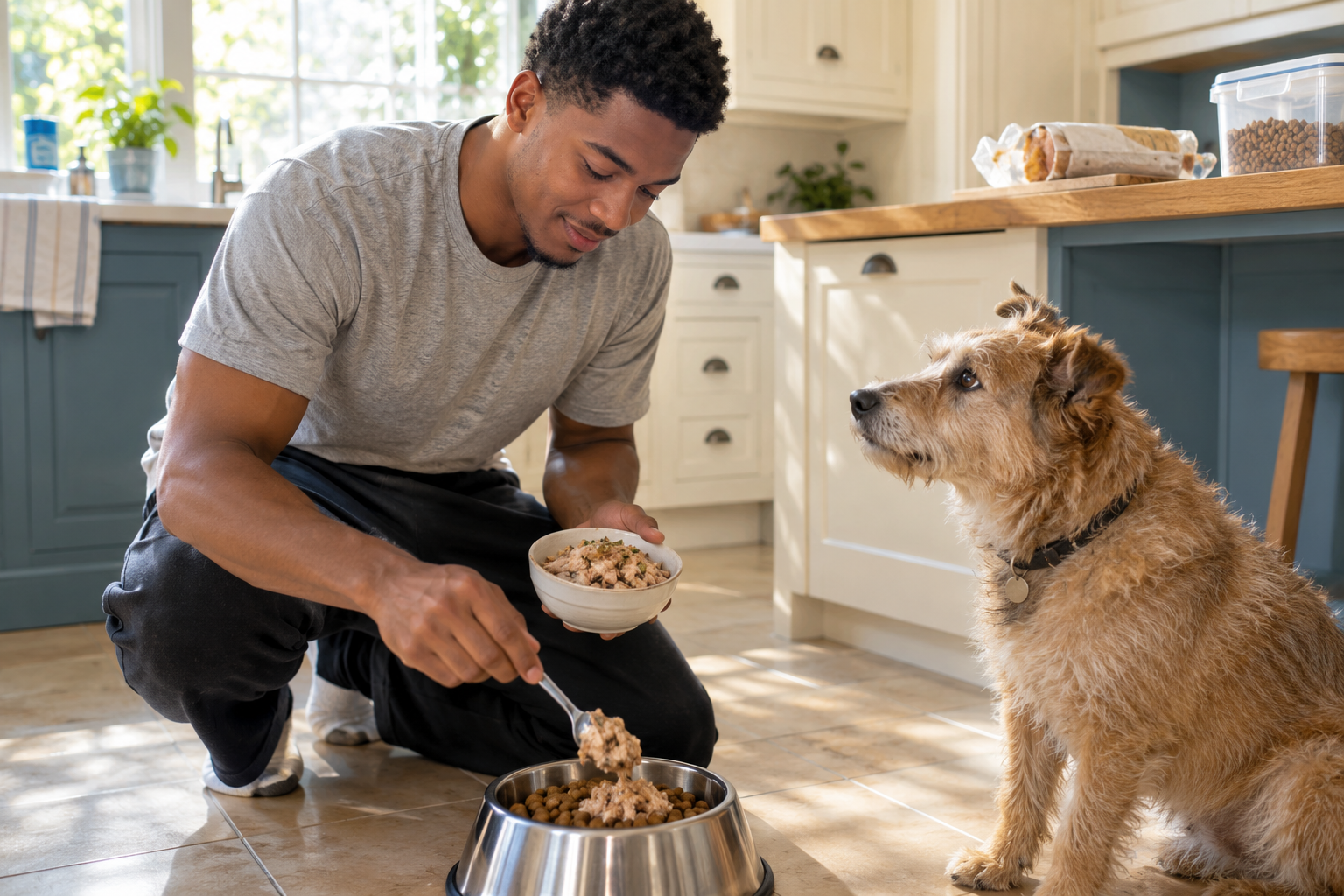
Can I mix refrigerated dog food with dry kibble?
Yes, for most healthy dogs, as long as you count the calories from both and transition over about a week. Hill’s lists its refrigerated rolls as usable as a complete diet, a topper, or a mix-in, and Freshpet is widely used the same way.
Two mistakes to avoid:
- Topping without subtracting. Adding 150 calories of fresh food to a full kibble bowl is a weight gain plan. Reduce the kibble.
- Switching in one meal. Mix in a small amount on day one and build up. Loose stools are usually a pace problem, not a product problem. Our guide to switching dog food without upsetting their stomach has the day-by-day ratios.
Edge case: dogs on a strict veterinary elimination diet should not get a topper of anything without clearance from the vet running the trial. One mix-in can invalidate weeks of work.
Refrigerated dog food pros and cons
Pros
- Higher moisture intake, useful for dogs who drink little
- Strong palatability for fussy or convalescing dogs
- Soft texture suits dogs with poor dentition or jaw discomfort
- Recognizable ingredients and shorter ingredient lists on many recipes
- Freshpet and Hill’s both let you buy in person with no subscription
Cons
- Much higher cost per calorie than dry food
- Takes real fridge space, especially for large dogs
- Short use-by window after opening, with waste if your dog eats slowly
- Requires cold-chain care from store to bowl and clean handling at home
- No evidence that it outperforms a complete dry diet for a healthy dog
- Soft food does nothing for plaque, so dental care still needs attention
Is refrigerated dog food worth the price compared with kibble?
For most healthy dogs, refrigerated dog food is a convenience and palatability purchase rather than a health upgrade, and it costs several times more per calorie than good kibble. It is worth the money when it solves a specific problem: a dog who will not eat, a dog who needs moisture, or an owner who wants a cold topper they can buy at the grocery store.
Work out your own monthly number before you commit. The arithmetic is simple:
- Ask your vet for your dog’s daily calorie target. Do not guess from the bag chart alone.
- Find the kcal figure on the refrigerated pack. Freshpet lists 309 kcal per half pound for its chicken recipe, which is 618 kcal per pound.
- Divide the target by the per-pound figure. A dog needing about 1,000 kcal a day would eat roughly 1.6 pounds of that recipe daily, which is about 48 pounds a month.
- Multiply those pounds by the shelf price per pound at your store. That is your monthly cost, verified by you rather than by a blog.
- Do the same sum for your current kibble. The gap is usually large, because you are paying to ship and chill water.
Cheaper middle options exist. Feeding refrigerated food as 20 percent of the bowl captures most of the palatability benefit at a fraction of the cost. Canned wet food delivers similar moisture with no cold chain. Dry food plus warm water and a spoon of plain cooked meat is cheaper again. If you are weighing the upgrade generally, our piece on premium dog food and whether paying more is actually worth it is the honest version, and how to read a dog food label and what AAFCO means will tell you more about a product than the front of the pack ever does.
FAQ
Do vets recommend Freshpet dog food?
There is no single veterinary position on Freshpet. Many vets are comfortable with complete and balanced commercial diets from companies that employ qualified nutritionists and run quality-control testing, which are the criteria WSAVA recommends. Others prefer brands with published feeding research and a longer clinical record. Ask your own vet about your dog, and avoid treating any retail fresh food as a therapeutic diet.
Does wet dog food need to be refrigerated?
Unopened cans and trays are shelf stable and do not need the fridge. Once opened, refrigerate the leftovers in a covered container and use them within the window printed on the label. Refrigerated dog food from the store fridge is different: it needs cold storage from the moment you buy it.
Is refrigerated dog food sold at Walmart?
Freshpet’s branded fridges are placed in grocery and mass retailers as well as pet stores, with roughly 30,235 stores carrying its products at the end of 2025 according to its annual report. Stocking varies by location, so check the brand’s store locator. Hill’s refrigerated rolls began rolling out through pet-specialty retailers in July 2026.
Can refrigerated dog food be frozen?
Many fresh foods can be frozen, but follow the specific pack instructions, because freezing and thawing can change texture and some brands advise against it. Thaw in the fridge, never on the counter, and treat the thawed pack as opened from that day.
How long can refrigerated dog food sit out in the bowl?
Two hours at room temperature is the usual ceiling, and less in a warm kitchen. Throw away what the dog leaves and wash the bowl instead of topping it up.
Can puppies eat refrigerated dog food?
Only if that exact recipe’s nutritional adequacy statement covers growth or all life stages. Hill’s refrigerated rolls are positioned for healthy adult dogs. Freshpet’s suitability varies by recipe, so read the statement rather than the product name. Large-breed puppies have additional calcium considerations worth discussing with a vet.
Does refrigerated food clean a dog’s teeth?
No. Soft food does not scrape plaque, and dry food’s dental benefit is modest unless it is a product designed and tested for that purpose. Brushing, vet dental checks, and approved dental chews do the work.
Conclusion
The refrigerated case got more interesting in 2026, with Hill’s bringing a single-protein roll into a category Freshpet built through store fridges. For a healthy adult dog, both can work, and neither is a health upgrade on its own. Read the adequacy statement for the exact recipe, note the open-pack window, and run your own monthly cost using the calories per pound on the label and the price on the shelf tag.
Three next steps worth taking this week: check the FDA recall database for whatever brand you are considering, measure the fridge shelf you would actually give it, and if your dog’s eating has changed, book a vet appointment before you buy anything. Refrigerated dog food solves a few specific problems well. It is a poor substitute for a diagnosis.