

A dog spinning after its own tail looks like a cartoon. Sometimes it is just a puppy discovering it has a tail. Sometimes it is a flea bite, a sore anal gland, or a brain that cannot let a thought go. The fun version and the worrying version can look almost identical from the couch.
Quick Answer
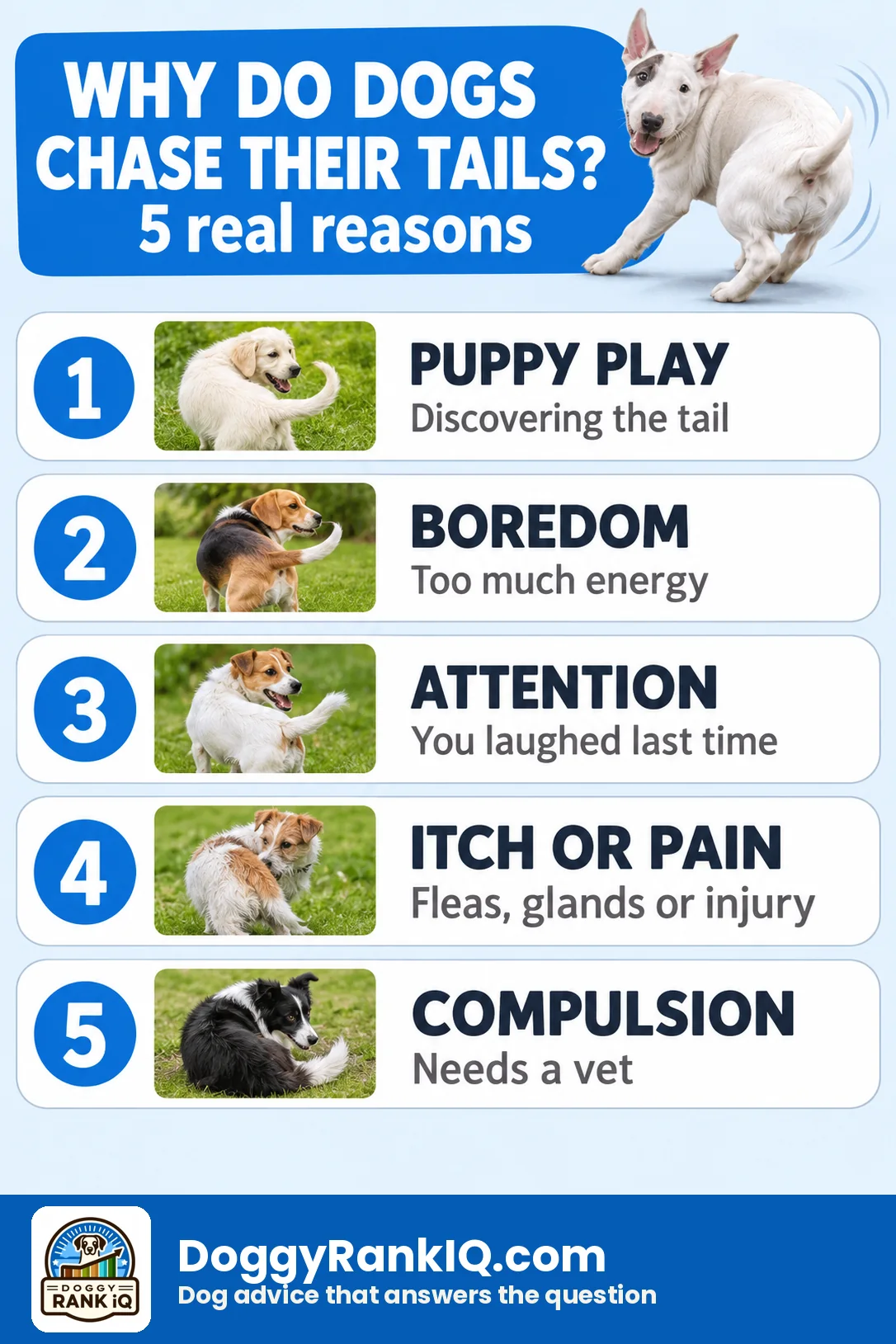
Dogs chase their tails for five main reasons: puppy curiosity and play, boredom or pent-up energy, attention seeking that owners accidentally reward, physical discomfort like fleas or anal gland trouble, and, less often, a compulsive disorder. Why do dogs chase their tails in a way that needs a vet? Watch for daily spinning, biting that breaks skin, hair loss, or a sudden start in an adult dog. Most tail chasing is normal and fades with age, more exercise, and ignoring it when it happens for attention.
Key Takeaways: why do dogs chase their tails
- Puppies often chase their tails simply because the tail moves and is nearby, and most grow out of it.
- Why do dogs chase their tails for attention? Because laughing, chasing, or treating the dog mid-spin teaches the brain that spinning gets a reaction.1
- Fleas, allergies, impacted anal glands, skin infections, and tail injuries can all cause tail-focused chewing or chasing.3
- German Shepherd Dogs and Bull Terriers are mentioned more often in connection with compulsive tail chasing, though no single gene has been confirmed as the cause.9
- Vets treat tail chasing as a diagnosis of exclusion: pain, parasites, and skin disease get ruled out before anyone calls it compulsive.2
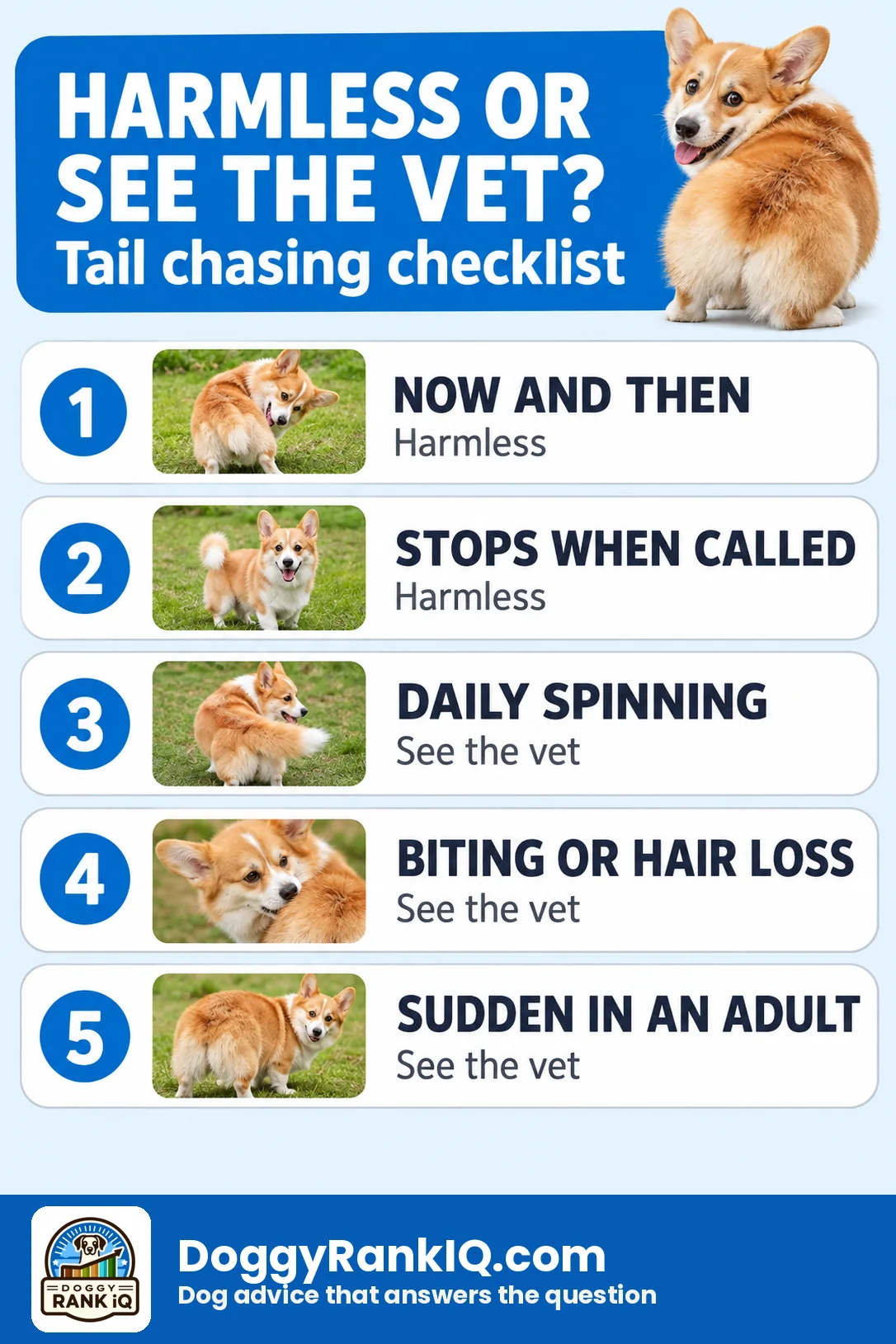
- Spinning that is hard to interrupt, happens daily, or disrupts eating and sleeping needs a veterinary exam, not a wait-and-see approach.
- More exercise, mental work, and calm redirection solve the behavior more often than any product does.

How often does it happen?
Tap an option to see the answer.
The short answer: why do dogs chase their tails?
Why do dogs chase their tails? Most of the time, it is a young dog exploring a body part that moves on its own, or an adult dog burning off energy it has nowhere else to put. The behavior sits on a spectrum from completely normal play to a medical red flag, and the context around the spinning tells you which end you’re on.
A puppy who spins twice, shakes it off, and goes back to chewing a shoe is not the same dog as an adult who spins the same three circles every night before bed and growls if you try to stop it. Same behavior, different story. The rest of this article walks through both ends.
5 real reasons dogs chase their tails
1Puppy play and discovery
Puppies and young dogs chase their tails because the tail is visually interesting and always within reach. It moves when they move, which for a developing brain is basically a toy with no warranty and no off switch. VCA Hospitals notes that a puppy chasing its tail is generally normal exploratory behavior, especially if the dog stays relaxed and stops easily when distracted.
Is it normal for puppies to chase their tails? Yes, in short bursts, without biting hard enough to cause injury. If your puppy chasing tail habit stops the moment you call its name or offer a toy, that is a good sign, not a symptom.
2Boredom or pent-up energy
A dog with nothing to do will often invent something to do, and spinning is cheap entertainment. Insufficient exercise, predictable routines, and few chances to sniff, chew, or problem-solve make repetitive behaviors more likely to show up.2
This is where the connection to dog zoomies comes in. Both are outlets for energy that has nowhere else to go. A tired, mentally worked dog spins far less than a dog who spent the day alone with a bowl of kibble and a closed door.
3Attention seeking (laughing rewards it)
Dogs are quick learners when it comes to what gets a reaction. If a spin earns laughter, a camera phone, excited talking, or a treat, the dog has just been taught that spinning works. VCA’s behavior guidance specifically advises against enthusiastic reinforcement and recommends calm redirection to a toy or a trained cue instead.1
This is a dog chasing tail meaning that has nothing to do with fleas or anxiety and everything to do with the humans in the room. The fix is almost embarrassingly simple: stop clapping.
4Itch or pain
A dog biting tail or chasing it hard enough to yelp is usually telling you something hurts or itches. Fleas, environmental or food allergies, intestinal parasites, impacted anal glands, skin infections, and tail trauma can all cause tail-focused chewing or spinning.3
Can tail chasing mean my dog has fleas or skin problems? Yes, and it’s one of the first things a vet will check. A fine-tooth comb through the coat near the tail base can turn up flea dirt in minutes. The Yumflan Fine Tooth Stainless Steel Flea Comb (rel=”sponsored”) is a cheap first check before assuming anything more complicated.
5Compulsive disorder
Less commonly, tail chasing becomes a compulsive disorder: repetitive, hard to interrupt, triggered by little or nothing, and disruptive to normal life. The Merck Veterinary Manual distinguishes this from a one-off displacement behavior caused by frustration or stress, which fades once the trigger passes.
A 2012 PLOS ONE study of 368 dogs from four breeds looked for a genetic link between tail chasing and the CDH2 gene, which is associated with another compulsive behavior called flank sucking. The study found no such association for tail chasing.9 In other words, breed tendency exists, but no single confirmed gene explains it.
Facts table: harmless spin vs see-the-vet spin
Why do dogs chase their tails at night or when you laugh?
Why do dogs chase their tails at night more than during the day? Evening often means pent-up energy from a quiet day finally has nowhere to go, and a dog’s shadow or tail may be more noticeable under artificial light. It’s rarely a separate phenomenon from daytime tail chasing, just a timing pattern tied to energy and household activity.
As for laughing: dogs read tone and body language closely. A laugh, a gasp, or a phone pointed at them reads as attention, and attention is a reward. If the spinning reliably happens right after you laugh the first time, you may be the trigger without realizing it.
What breed of dog chases its tail most?
Bull Terriers and German Shepherd Dogs are mentioned most often in veterinary literature discussing compulsive tail chasing.9 Why do some dogs chase their tails more than others? Breed tendency, energy level, and individual temperament all play a role, but no confirmed single gene explains it, and individual variation within any breed is significant.
Do all dog breeds chase their tails or just some? Any breed can chase its tail occasionally, especially as a puppy. Compulsive, hard-to-stop spinning is reported more in certain lines, but a Bull Terrier is not guaranteed to spin and a Labrador is not guaranteed to never spin. Check your own dog’s pattern rather than assuming based on breed alone.
🩺 What a vet checks at a tail chasing visit
If the spinning has moved past funny, the appointment usually follows a set order, and knowing it helps you show up with the right information.
The exam starts at the back end. The vet runs hands down the tail feeling for a kink, swelling or a sore spot from an old injury, parts the fur to look for fleas and flea dirt at the tail base, and checks the anal sacs, since full or infected sacs are a common reason a dog suddenly targets that area. Skin comes next: redness, hot spots, hair chewed short. Lower back pain can also make a dog whip around, so expect some gentle pressing along the spine and hips.
If all of that is clean, the questions turn to behavior. When did it start? What happens right before? Can you call the dog out of it? How long does a bout last, and how many a day? Phone video answers half of these better than memory does. Record two or three episodes from start to finish, including the minute before, and note the time of day.
“Three phone videos tell a vet more than a ten-minute description.”
Blood and urine tests rule out problems that change behavior from the inside. A referral for a neurological workup comes up when the dog seems “gone” during episodes (fixed stare, no response to a name, snapping at air), because focal seizures can look like spinning.
🔬 What the Bull Terrier study found
The largest breed-specific data set comes from Tufts University. Alice Moon-Fanelli, Nicholas Dodman and colleagues surveyed the owners of 333 Bull Terriers, 145 with tail chasing and 188 without, and published the results in the Journal of the American Veterinary Medical Association in 2011. Males were at slightly higher risk. Tail chasing also traveled with two other things: trance-like episodes, where the dog freezes with a fixed stare, and sudden bursts of aggression.
That cluster is the reason vets take a spinning Bull Terrier seriously from the first visit. For those dogs a home routine change may need to be paired with prescription medication, and that call belongs to a vet or a veterinary behaviorist who has examined the dog.
🕰️ New tail chasing in an older dog
A puppy discovering a tail is one thing. A nine-year-old who starts circling this month is a different case, and the cause is rarely boredom.
Arthritis in the hips or lower spine, a growth near the tail, nerve pain and anal sac disease all rise with age. So does canine cognitive dysfunction, the dog version of dementia, which can bring pacing and repetitive circling, often in the evening. Any new repetitive behavior in a senior deserves an exam within a week or two, sooner if the dog is also off food, restless at night or having accidents.
🐶 Puppies: when the spinning should fade
A young puppy has only recently learned that the thing following them around is attached. A few spins a day, a grab, a surprised yelp and on to the next toy is ordinary discovery, and it tends to drop off within a few months as fetch, tug and other dogs get more interesting.
Help it along without making a scene. When the spin starts, toss a toy across the floor or scatter a few pieces of kibble, so the puppy practices switching to something else. Count the bouts for a week. A number that falls is what you want. A number that climbs, bouts that run longer than a minute, missing fur or a puppy who will not break off for food are the signs to bring to the vet early, because habits are easier to change at 14 weeks than at 14 months.
🚫 Two things that make it worse
Laser pointers come up again and again in behavior consults. A dot the dog can chase and never catch builds the same frustrated loop as a tail, and some dogs move on to chasing lights and shadows around the house. Swap the laser for a flirt pole or a tug toy the dog gets to grab and win.
The second is the family reaction. Laughing, filming with commentary and shouting “stop” are all attention. If you want to know why do dogs chase their tails more when guests are over, that is usually the reason. Leave the room for the mild version. For the intense version, calmly clip on a leash, walk the dog to another space and hand over a chew.
⭐ Top 5 Features We Love
What tail chasing actually tells you, when you read it correctly:
- It’s an honest energy gauge. A dog that spins right after a nap is telling you it needs a job, not a scolding.
- It flags parasites early. A dog suddenly obsessed with its tail base may be showing you fleas before you spot them yourself.
- It reveals what you’re rewarding. Watching your own reaction to the first spin is a quick lesson in accidental training.
- It can expose anal gland trouble. Scooting plus tail chasing together points straight at a gland issue worth a vet check.
- It’s rarely permanent. Puppy chasing tail behavior almost always fades with age, exercise, and mental work.
⚠️ Things to Look Out For
- Daily spinning that doesn’t ease up with more exercise.
- Biting hard enough to draw blood or remove fur.
- Growling or snapping at the dog’s own tail.
- Sudden onset of spinning in a previously calm adult dog.
- Spinning that interrupts eating, sleeping, or normal play.
- A limp, scooting, or a foul smell near the tail base.
How to stop tail chasing in 5 steps
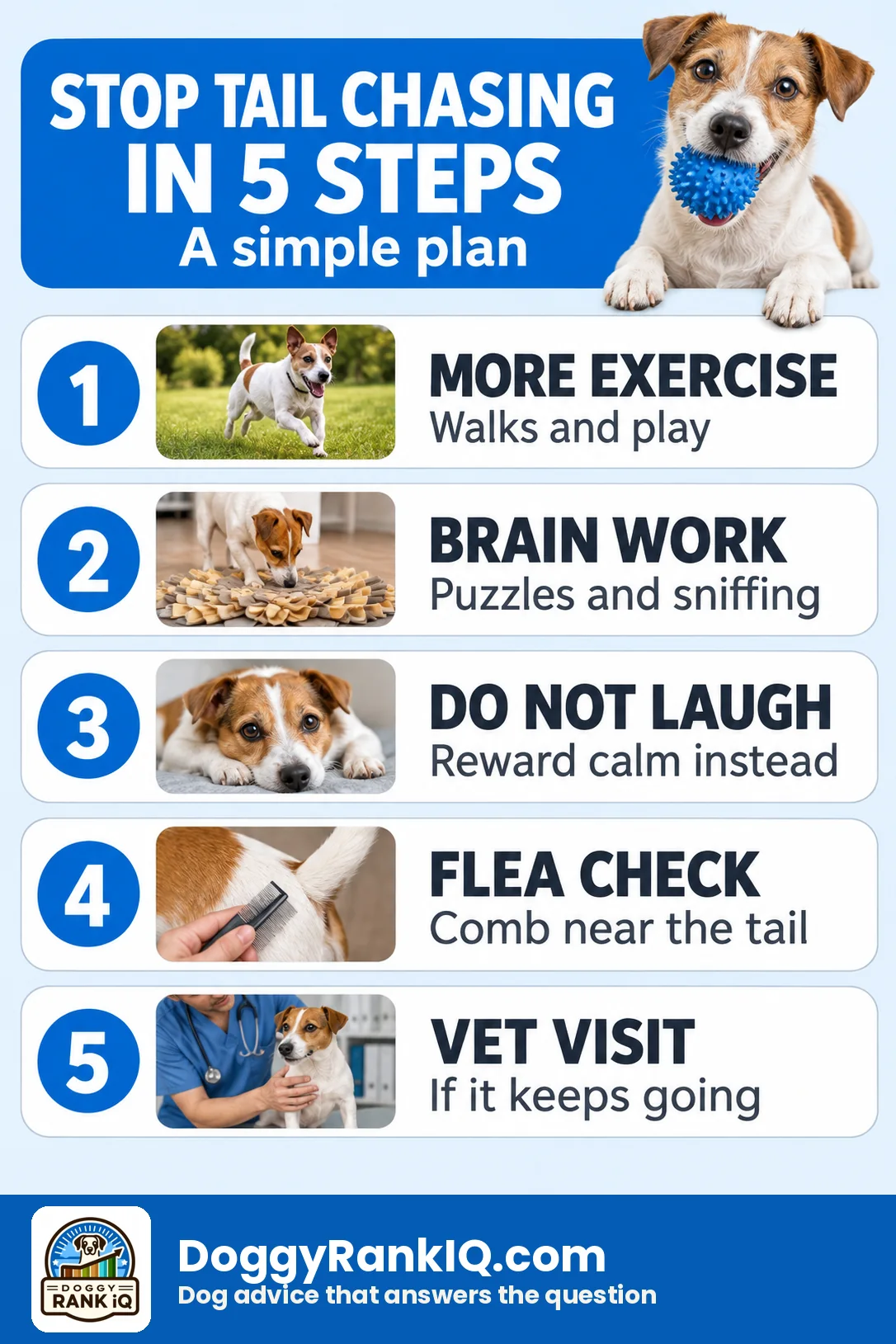
How do I stop excessive tail chasing in dogs? Start with exercise and enrichment, then rule out medical causes, and only consider behavior medication as a last resort under veterinary guidance.
- Increase physical exercise. Match activity to age and breed; a bored adolescent dog needs more than a short yard break.
- Add mental work. Puzzle feeders, training sessions, and scent games tire the brain as much as the body. Our dog zoomies guide covers similar pent-up energy patterns.
- Stop reinforcing it. Ignore the spin completely, no laughing, no phone. Redirect calmly to a toy or a known cue once the dog pauses.
- Check for fleas and skin issues. A visual check plus a flea comb pass rules out the most common itch-driven cause.
- Book a vet exam if it persists. Should I ever punish my dog for chasing their tail? No. Punishment adds stress, which can make compulsive behavior worse rather than better. A veterinary behaviorist is the right next step for persistent cases.
Is tail chasing a sign of anxiety or stress in dogs? It can be. Merck’s behavioral guidance describes tail chasing as a possible displacement behavior during frustration or high arousal, distinct from a true compulsive disorder, which persists even without an obvious trigger.2
Helpful boredom busters and itch checks
A few affordable tools can address the two most common drivers behind tail chasing: boredom and itch.
For energy and play redirection, the Squishy Face Studio Flirt Pole V2 (rel=”sponsored”) gives a dog a chase target that isn’t its own tail. Check the current price (rel=”sponsored”), price checked 2026: $29.99.
For mental work, the Barkwhiz Dog Puzzle Toy, 3 Levels (rel=”sponsored”) gives a bored brain something harder to solve than its own tail. Check the current price (rel=”sponsored”), price checked 2026: $17.99. Our full snuffle mat for dogs guide covers similar foraging options, including the AWOOF Snuffle Mat for Dogs (rel=”sponsored”). Check the current price (rel=”sponsored”), price checked 2026: $11.98.
For itch checks, the Yumflan Fine Tooth Stainless Steel Flea Comb (rel=”sponsored”) is an easy first step before assuming the worst. Check the current price (rel=”sponsored”), price checked 2026: $3.99. If fleas turn up, our oral flea medicine for dogs comparison explains the treatment options. If skin issues or allergies seem likely instead, confirm the cause with your veterinarian before starting any product.
FAQ: why do dogs chase their tails
The bottom line: why do dogs chase their tails?
Why do dogs chase their tails? Almost always because they’re a puppy exploring, a bored adult looking for a job, or a dog who learned that spinning gets attention. Less often, it’s an itch, an injury, or a compulsive pattern that needs a professional look. Watch frequency, whether your dog can stop on cue, and whether the tail itself shows damage. When in doubt, a quick video of an episode and a trip to the vet settles the question faster than another scroll through search results.
Doggy Rank IQ is reader supported. As an Amazon Associate we earn from qualifying purchases, at no extra cost to you.