

Quick Answer
How long is a dog’s memory depends entirely on what kind of memory you mean. Working memory for a random event lasts around 27 seconds to two minutes, which is where the “dogs forget everything in two minutes” line comes from (science.org). Associative memory, the kind that lets a dog recognize an owner, a cue word, or a feared vet office, can last for years. The two-minute figure describes one narrow test, not the whole of how long a dog’s memory actually runs.
Key Takeaways: how long is a dog’s memory
- The 2-minute claim traces back to a 2014 comparative study of short-term memory across 25 species, not a dog-specific finding (science.org).
- How long is a dog’s memory really depends on the task: working memory is short, associative and procedural memory are long.
- Dogs show episodic-like memory, recalling specific past actions even when they didn’t expect to be tested on them (dvm360.com, npr.org).
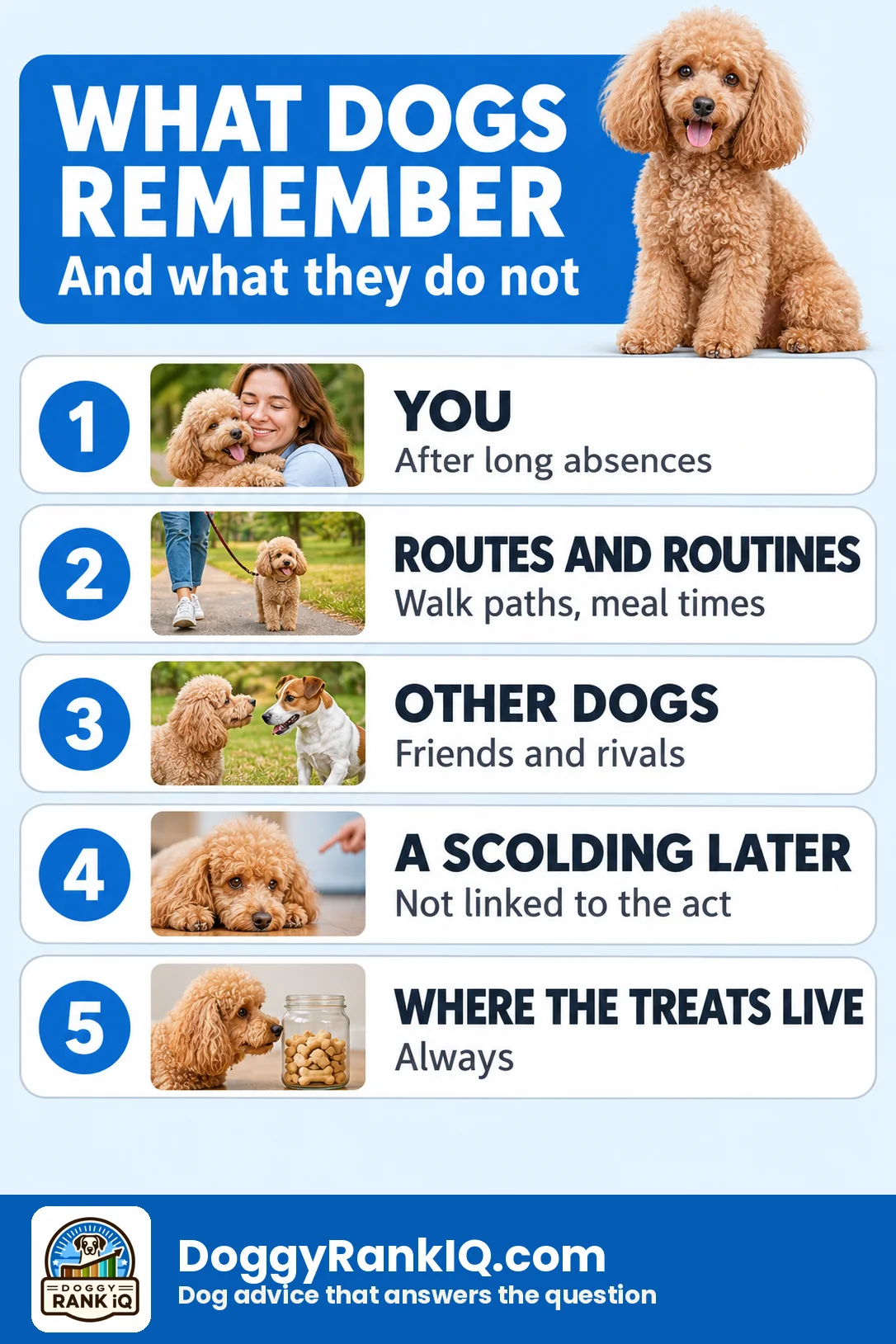
- Dogs recognize owners after long absences through scent, voice, and routine, not through a two-minute window.
- Scolding a dog minutes after an incident does not create a useful link in the dog’s mind.
- Canine cognitive dysfunction can shorten a senior dog’s practical memory and needs a veterinary assessment.
- Puzzle toys and scent games build on memory a dog already has; they don’t need to “create” it from scratch.

What do you want your dog to remember?
Tap an option to see the answer.
The short answer: how long is a dog’s memory?
A dog’s memory is not one number. It splits into working memory (seconds to a couple of minutes), associative memory (months to years), and procedural memory (often a lifetime).
The “two-minute” line that shows up on nearly every page one of search results comes from a single kind of test: matching a random, low-stakes event to a later choice. That test says almost nothing about whether a dog remembers its owner, its name, or the dog down the street.
Picture two very different memory jobs. One is holding a scent cue in mind for a few seconds during a training drill. The other is recognizing the smell, voice, and gait of a person who raised you for five years before you were rehomed. Both involve “memory.” Only one of them disappears in two minutes.

Where the 2-minute myth came from
The two-minute figure comes from a 2014 analysis, not a myth invented by pet forums. Johan Lind at Stockholm University led a review of roughly 100 studies covering 25 animal species, using a method called delayed matching to sample (science.org). Across species, the average short-term memory interval was about 27 seconds. Dogs came in above that average, holding onto an arbitrary event for up to roughly two minutes (science.org).
That is the entire basis for the claim. The test measured memory for a meaningless, low-value stimulus under lab conditions. It did not test:
- Whether a dog remembers an owner’s face or voice
- Whether a dog remembers a frightening event
- Whether a dog remembers a learned command from years earlier
- Whether a dog remembers another dog
A number describing a narrow lab task got flattened into a blanket statement about canine memory, and headlines ran with it. Owners researching “will my dog forget me” or “how long do dogs remember” deserve the full picture, not the compressed version.
Facts table: 3 types of dog memory
This table answers “how long is a dog’s memory” at a glance.
A dog can fail the two-minute working memory test and still greet an owner at the door after a ten-year gap. Those two facts are not in conflict. They’re different systems.
How long does a dog remember what he did wrong?
A dog does not form a lasting link between an action and a punishment delivered minutes later. Scolding a dog for something done five or ten minutes ago attaches the correction to whatever the dog is doing right now, not to the earlier act.
This is the practical cost of the working memory window. If a dog chewed a shoe an hour ago and greets you at the door looking “guilty,” that expression is usually a reaction to your tone and body language in the moment, not a confession.
Common mistake: walking in, finding a mess, and correcting the dog on the spot. By then the dog’s working memory of the actual chewing event has likely already closed. The fix that actually works is catching the behavior as it happens, or managing the environment so it can’t happen (crate, closed door, chew-proofed zone).
Decision rule: if you didn’t catch it within seconds, skip the correction and manage the setup instead. For a related behavior problem that often gets mislabeled as memory, see separation anxiety in dogs.
Will my dog remember me after 10 years? Do dogs remember people, other dogs, previous owners and their parents?
Dogs reliably recognize people after long separations through scent, voice, and visual cues layered together, not through a two-minute memory window. Research into canine episodic-like memory backs this up: dogs trained with “Do as I Do” imitation tasks recalled and reproduced specific actions after a one-hour delay, even when they hadn’t been cued to expect a memory test (dvm360.com, npr.org). That points to something closer to human-style episodic recall than a brief working-memory blip.
A few specifics worth separating out:
- Do dogs remember previous owners? Reports from rehoming and rescue situations describe dogs responding to a previous owner’s voice or scent even after months or years apart (animalso.com). This is anecdotal rather than a controlled study, so treat it as plausible, not guaranteed for every dog.
- Do dogs remember their parents? Littermates and mothers can show recognition behavior if reunited, likely through scent memory, though separation at a young age and long gaps reduce how reliable this is.
- How long do dogs remember other dogs? Familiar dogs met repeatedly (a regular park friend, a former housemate) tend to be recognized through scent and behavior patterns well after a single short-term memory window would predict.
- Do dogs have memories of previous owners? The episodic-memory research suggests yes, in the sense of recalling a specific past experience, not just a learned association (dvm360.com, link.springer.com).
One peer-reviewed memory study involving dogs and olfactory discrimination recorded strong recall performance over delays far longer than two minutes (nature.com). The honest limit here: no single study has tracked the exact outer boundary of “will my dog remember me after 10 years,” so a firm number for every dog does not exist. Individual variation is real. A dog’s age, health, and the strength of the original bond all affect the outcome.
For more on canine thinking generally, see how smart are dogs.
🧠 Dogs who remembered for years: Rico, Chaser and Darwin’s test
The lab numbers get more convincing when you meet the individual dogs behind them.
Rico, a Border Collie in Germany, was tested by Juliane Kaminski and colleagues for a 2004 paper in Science. He knew the names of about 200 toys. When researchers placed one unfamiliar toy among seven familiar ones and asked for it by a name he had never heard, he usually brought the new one, working it out by exclusion. Four weeks later, with no practice in between, he could still pick out some of those new toys by name.
Chaser, another Border Collie, went further. Her owner, the retired psychology professor John Pilley, taught her the names of 1,022 objects over about three years and published the results in 2011. He tested her constantly because he had to. A dog who forgot older names as she learned new ones would have stalled at a few dozen. She did not stall.
The oldest test on record may be Charles Darwin’s. In The Descent of Man he describes a dog of his that disliked strangers. After five years and two days away, Darwin walked to the stable and called him the old way. The dog came out and followed him on a walk as if he had left half an hour earlier. It is one dog and one owner, so it is an anecdote. It is also a careful observer writing down a test he set up on purpose.
“Five years and two days apart, and Darwin’s dog fell in beside him like he had stepped out for half an hour.”
🐕 Does a dog remember their mother and littermates?
Peter Hepper at Queen’s University Belfast looked at this in 1994. Dogs who had been separated from their mothers for about two years still preferred a cloth carrying her scent over one from an unfamiliar female of the same breed and age. The mothers recognized their grown offspring the same way. Siblings were the exception: adult dogs picked out a littermate’s scent only if they had kept living with a brother or sister.
So the answer to how long is a dog’s memory depends on which memory you mean. Smell-based memory for an important individual can last years. A memory for a random event with no meaning attached fades within minutes. The reunion videos people share make sense in that light: nose first, then the whole body catches up.
📌 What sticks after one bad day
A dog does not replay a nail trim the way a person replays an argument. The dog does keep the association: the clippers, the room, the feeling. That is why one rough visit to the groomer can show up as trembling at the door six months later.
The practical lesson is to build the association you want early and repeat it. Five calm visits to the vet lobby for a treat and nothing else write a stronger memory than one long, stressful appointment. Short sessions spaced over days beat one marathon. Dogs who learned a cue in the kitchen often need a refresher in the yard, because the place is part of what they stored.
⭐ Top 5 Features We Love
Five things worth knowing for anyone asking “how long is a dog’s memory”:
- Scent-based recognition. Dogs identify familiar people largely by smell, which is why a worn shirt can calm a dog during a separation.
- Episodic-like recall. The “Do as I Do” studies show dogs can remember a specific recent action without being told in advance they’d need to (dvm360.com, npr.org).
- Long associative memory for routines. Leash by the door, car keys, the sound of a treat bag, all get filed away for the long term.
- Social memory with other dogs. A familiar playmate is often greeted differently than a stranger, even after a gap.
- Memory that supports training longevity. A command taught years ago and rarely used can still resurface with a quick refresher, since procedural memory holds up well over time.
⚠️ Things to Look Out For
A few cautions for anyone asking “how long is a dog’s memory”:
Watch for a drop in a senior dog’s usual recognition and routine behavior, since this can signal canine cognitive dysfunction rather than normal aging. A 2026 clinical review describes the condition as progressive, affecting memory, learning, social interaction, sleep, orientation, and anxiety together, not memory alone.
Warning signs worth tracking:
- Getting lost in familiar rooms or the backyard
- Staring at walls or forgetting why they walked somewhere
- Not recognizing familiar people briefly, then seeming to “catch up”
- Disrupted sleep-wake cycles, including nighttime pacing
- Increased anxiety around previously normal situations
Decision rule: if two or more of these show up consistently over a few weeks, book a veterinary exam rather than assuming it’s “just old age.” The same clinical review recommends a combined approach of veterinary assessment, environmental enrichment, nutrition support, and sometimes medication. A large-scale aging study from the Dog Aging Project tested short-term spatial memory in 6,753 dogs and found age-related cognitive decline beginning in midlife, in both small and large dogs. That means this isn’t only a concern for giant breeds that age fast; it applies broadly.
For a full breakdown of symptoms and what slows the decline, see dog dementia: 6 early signs and what slows it down.
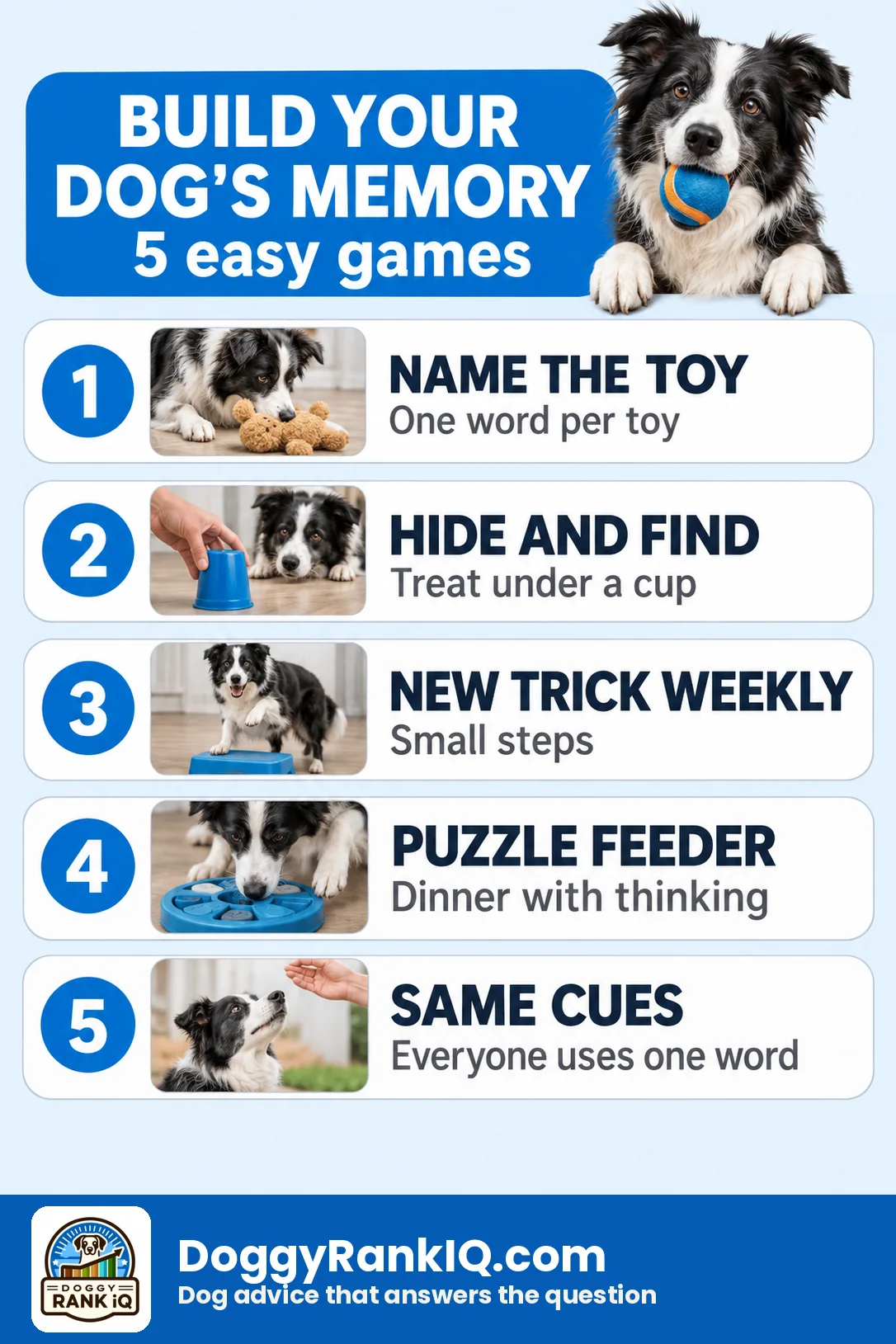
5 ways to build your dog’s memory
- Keep training sessions short and frequent. Five-minute sessions several times a day reinforce procedural memory better than one long weekly session.
- Use consistent cues. Changing a command word resets some of the learning. Stick with one word per behavior.
- Add scent work. Nose games build on a dog’s strongest sense and give the brain a genuine workout; see talking to your dog: 4 real effects research found for how verbal and scent cues interact.
- Rotate enrichment, don’t just repeat it. A dog that solves the same puzzle daily stops being challenged. Swap toys and games on a schedule.
- Watch for a sense of time and routine. Dogs track daily patterns closely; for more on that ability, see do dogs have a sense of time.
Helpful memory games and tools
These products support mental enrichment that uses a dog’s existing memory and problem-solving systems. None of them claim to cure memory loss, and nothing here replaces a veterinary workup for a senior dog showing decline.
- Barkwhiz Dog Puzzle Toy, 3 Levels ($17.99, price checked 2026): a tiered puzzle feeder that makes a dog work through hidden compartments, building on associative problem-solving rather than raw memory. Check the current price
- Outward Hound Fun Feeder Slo Bowl ($7.56, price checked 2026): a maze-pattern bowl that slows fast eaters while turning mealtime into a light problem-solving task. Check the current price
- Amazon Basics Chicken Flavor Training Treats, 2 lb ($16.99, price checked 2026): small, low-calorie treats useful for repetition-based cue training, which reinforces procedural memory over time. Check the current price
- Inside of a Dog ($11.21, price checked 2026): Alexandra Horowitz’s book on canine perception and cognition, useful background for owners who want the fuller science behind memory and scent. Check the current price
For a wider roundup of puzzle options by difficulty level, see best dog puzzle toys, and for slow-feeding gear specifically tied to eating speed, see slow feeder for dogs.
FAQ: how long is a dog’s memory
The bottom line: how long is a dog’s memory?
How long is a dog’s memory depends on which memory system you’re asking about. Working memory for a meaningless event clocks in around two minutes, based on a 2014 cross-species study (science.org). Associative memory for people, places, and routines runs far longer, often for years, and procedural memory for trained skills can last a lifetime. The two-minute myth survives because it’s a catchy number attached to a narrow test. If you’re worried about a senior dog’s memory specifically, read the early signs of dog dementia and book a veterinary exam rather than guessing from behavior alone.
Doggy Rank IQ is reader supported. As an Amazon Associate we earn from qualifying purchases, at no extra cost to you.