
Quick Answer
Dog agility equipment ranges from a $34.50 tunnel to $130-plus A-frames, and most backyards only need a small, modular set: one tunnel, two adjustable jumps, a few weave poles, and a low pause platform. Good budget kits under $100 cover a solid beginner course, while anything above that usually adds a dog walk, teeter, or heavier A-frame suited to larger dogs. Check the dimensions, stake points, and weight rating before buying, since lightweight backyard dog agility equipment behaves differently from the gear used in sanctioned competition.
Key Takeaways: dog agility equipment
- Dog agility equipment under $50 can cover one or two obstacles; under $100 usually gets a full beginner course.
- AKC lets dogs compete from 15 months old, but puppies can start low jumps and tunnel work much earlier with ground-level height and short sessions. (akc.org)
- Jump height should match the dog’s shoulder measurement, not its breed name or the owner’s guess.
- Backyard sets are built lighter than competition gear, so tunnels and A-frames need stakes, sandbags, or a flat surface to stay put.
- Mixed breed dogs can compete through AKC Canine Partners, so backyard practice is not wasted on a dog without papers.
- A usable beginner course fits in a space roughly 20 by 30 feet, far smaller than AKC’s regulation footprints. (akc.org)
- About 41.7% of dogs in one large survey had an injury that sidelined them from agility for a week or more, which argues for a slow, obstacle-by-obstacle start. (chewy.com)
- Older dogs can train on lower jump heights and simpler sequences rather than being retired from the sport altogether.

What is your budget?
Tap an option to see the answer.
What dog agility equipment do I need to get started?
A beginner only needs three things: one tunnel, one adjustable jump, and a flat area to work in. Everything else, including weave poles, a pause box, and contact obstacles, can wait until the dog is confident with the basics.
Most trainers suggest building a starter collection in this order:
- One tunnel (10 to 20 feet) because dogs learn it fastest and it builds confidence early.
- One or two adjustable jumps so the bar height can grow with the dog, not just its age.
- A short run of weave poles (4 to 6 poles is enough to start) once the dog is clearing jumps calmly.
- A pause table or pause box to teach the dog to stop and hold position between obstacles.
- A-frame or dog walk, added only after the dog is solid on the first four, since these require balance and trust.
A dog that is new to the sport does not need a teeter, a full-size A-frame, or regulation spacing. The goal at home is confidence and basic obstacle recognition, not AKC-ready performance. For general training groundwork before agility specific skills, a review of essential commands every puppy should learn is a useful starting point, since recall and “wait” cues translate directly into pause table and contact zone behavior.
How much does dog agility equipment cost?
Dog agility equipment costs anywhere from about $34 for a single tunnel to $130 or more for a sturdy A-frame, with most full beginner kits landing between $75 and $120. The price mostly reflects the number of obstacles included and the material thickness, not the training value.
Here’s a rough breakdown by budget tier:
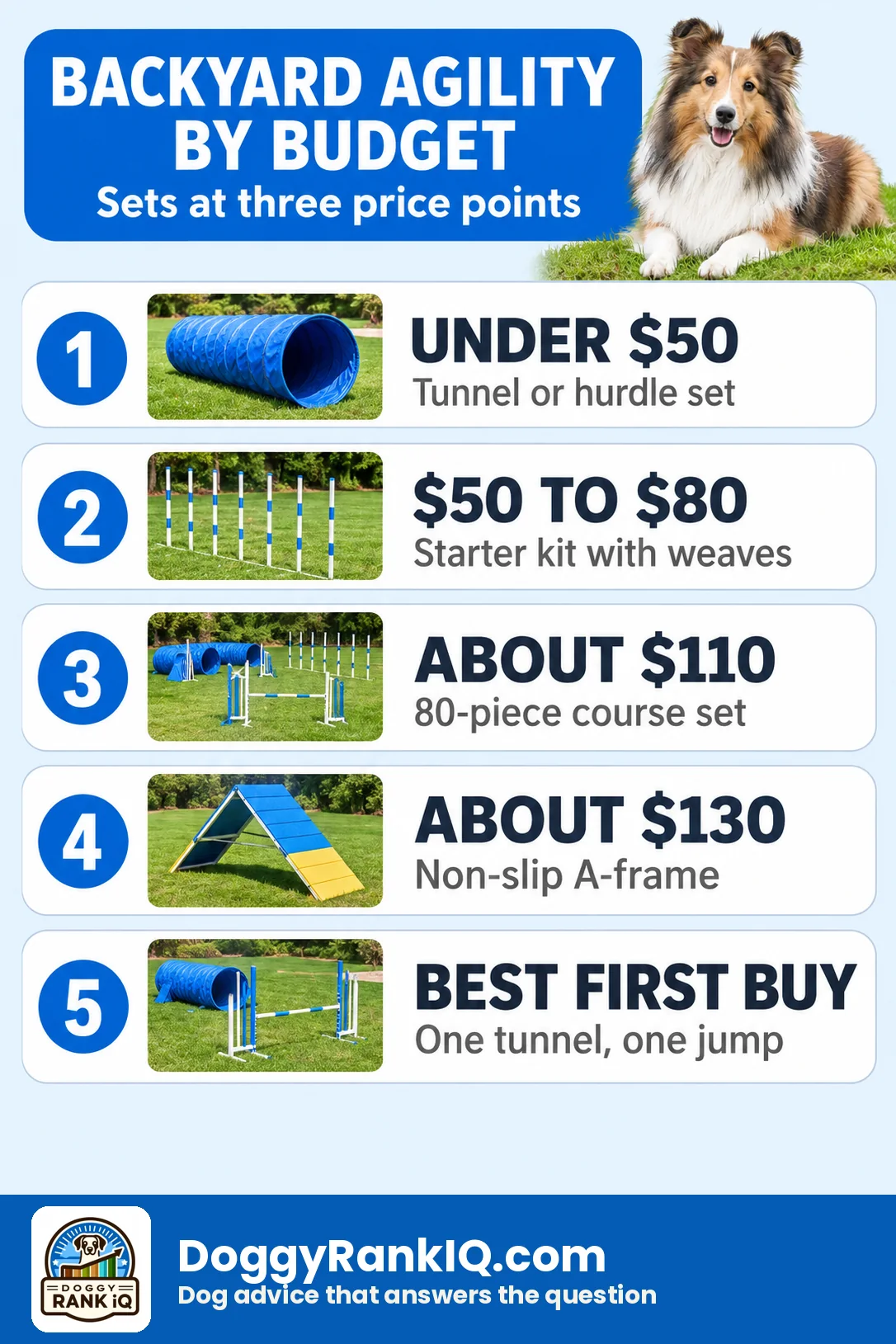
- Under $50: one obstacle, usually a tunnel or an adjustable jump.
- $50 to $100: a multi-obstacle set with jumps, a short run of weave poles, a tunnel, and sometimes a pause box.
- $100 and up: larger piece counts, sturdier materials for bigger dogs, or a dedicated A-frame.
Retailers outside this lineup show a similar spread. Chewy lists multi-piece courses in a comparable range, and brand name sets such as a Better Sporting Dogs deluxe seven-piece kit run closer to $185, which shows that price climbs with brand reputation and material grade more than with obstacle count alone. Owners on a tight budget should not assume the cheapest tunnel is lower quality; many budget tunnels use the same basic wire-frame-and-fabric construction as pricier versions, just with lighter stakes.
Dog agility equipment names: what each obstacle does
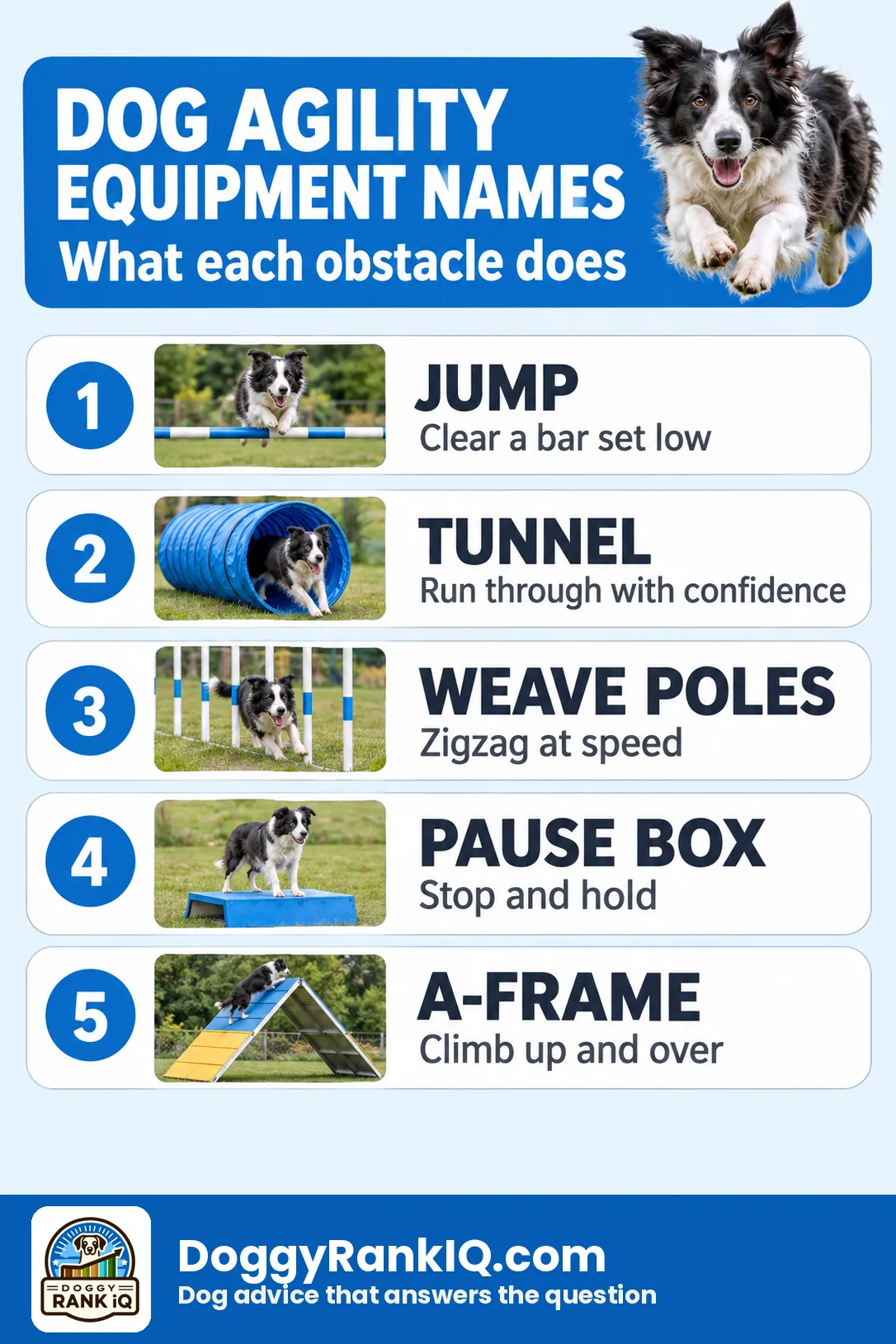
The core dog agility equipment names every owner should know are jumps, tunnels, weave poles, the pause table, the A-frame, the dog walk, and the teeter. Each obstacle tests a different skill, and backyard kits usually start with the first three before adding anything that requires balance or height.
- Jumps (bar or tire): A horizontal bar or hoop the dog clears. Jumps come first in almost every kit because they teach pace and confidence without asking the dog to climb anything.
- Tunnel: A collapsible fabric tube, usually 10 to 20 feet long, that the dog runs through. This is the obstacle most dogs learn fastest, since it’s just a longer, darker hallway.
- Weave poles: A row of upright poles the dog threads in a serpentine pattern. This is the hardest skill on the list and the one most backyard owners underestimate.
- Pause table or pause box: A flat platform where the dog sits or lies down for a count. It teaches impulse control between fast obstacles.
- A-frame: Two ramps meeting at a peak, which the dog climbs and descends with “contact zones” near the bottom that it must touch.
- Dog walk: A raised narrow plank course, similar to a balance beam with ramps on each end.
- Teeter (seesaw): A plank that tips under the dog’s weight. This is the obstacle most associated with injury and hesitation, and it’s rarely included in backyard starter kits for good reason.
A basic beginner-class format at the 4-H level uses 7 to 10 obstacles, built mostly from jumps, a table, and one or two tunnels, while leaving out the more demanding weave and contact obstacles until a dog has more experience. (akc.org)
Dog agility jumps vs weave poles: which to buy first?
Buy jumps first. Jumps are cheaper, safer to introduce, and teach the pacing and confidence a dog needs before weave poles make sense. Weave poles are the hardest skill in the sport and usually come third or fourth in a training sequence, not first.
Here’s why the order matters:
- Jumps ask a dog to do something it already knows how to do (jump over things) in a structured setting. Most dogs clear a low bar within the first few sessions.
- Weave poles ask a dog to perform a movement pattern it has likely never done before: a tight, side-to-side serpentine at speed. This takes weeks, not days, for most dogs.
- Trying to teach weaves before a dog understands basic obstacle focus from jumps and tunnel work tends to create frustration on both ends of the leash.
Decision rule: buy an adjustable jump and a tunnel first. Add a short 4 to 6 pole weave set only after the dog reliably completes a two-obstacle jump-and-tunnel sequence without hesitation.
Can you train agility at home, and at what age
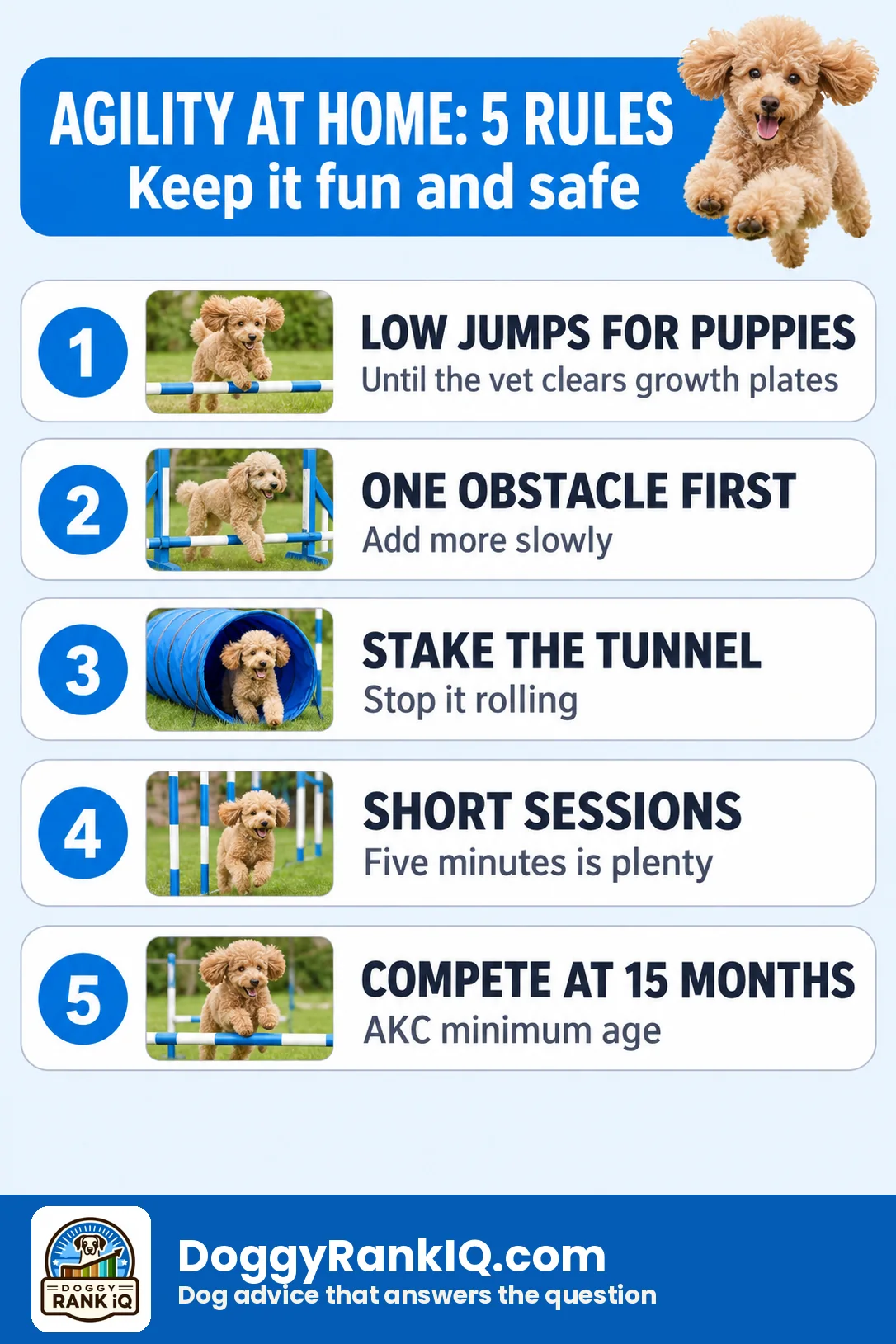
Yes, most of the skills behind competitive agility can be trained in a backyard with simple dog agility equipment, and dogs can start light groundwork well before they’re old enough to compete. AKC allows dogs to enter licensed agility trials starting at 15 months old, but that’s a competition rule, not a training rule. (akc.org)
Younger dogs and puppies can begin with:
- Ground-level jumps (a pool noodle on the grass works as well as a hurdle) while growth plates finish closing
- Short tunnel runs, 5 to 10 feet, with lots of treats at the far end
- Basic recall and “touch” cues that later become weave entries and contact zone behaviors
A veterinary check before starting any real jump height matters here. VCA notes that agility builds exercise capacity, coordination, and mental problem-solving, but also warns that developing joints can be stressed by excessive jumping before they’re ready, so a vet visit before raising bar height is a reasonable first step, not an overcautious one. (chewy.com)
For senior dogs, AKC’s Agility League rules allow dogs 10 years and older to jump up to two height divisions lower than their regular class, with a floor of 4 inches, which is a useful model for backyard practice too: lower the bar, keep the tunnel, skip the teeter. (jjdog.com)
Decision rule: start with one obstacle for one week before adding a second. A dog that confidently runs a tunnel and clears a low jump is ready for simple two-obstacle sequences; a dog that hesitates at either should stay there longer rather than move to weaves.
Can older dogs do agility training?
Yes, older dogs can train and even compete in agility, but they should jump lower heights and run shorter, simpler sequences than younger dogs. AKC’s own Agility League rules build this in directly, allowing dogs 10 and up to drop two jump height divisions with a floor of 4 inches. (jjdog.com)
For an older dog starting backyard work for the first time:
- Skip the A-frame and teeter entirely, or introduce them at the lowest possible incline with close supervision.
- Keep jump bars low, closer to the dog’s elbow height rather than shoulder height, especially if there’s any arthritis history.
- Favor the tunnel and simple straight-line jump sequences over tight turns, which stress joints more.
- Watch for stiffness the day after a session rather than just during it; soreness often shows up 12 to 24 hours later.
A senior dog that has done agility for years can often keep going for a long time with these adjustments. A senior dog brand new to the sport should start exactly like a puppy: one obstacle, short sessions, and no pressure to move fast.
Is dog agility safe for all breeds?
No. Dog agility is generally safe when equipment and heights are matched to the dog, but brachycephalic breeds (like bulldogs and pugs), dogs with existing joint conditions, and very young puppies with open growth plates need modified or delayed participation. Breed does not disqualify a dog from agility, but it does change how the equipment should be used.
Some practical breed-related guidelines:
- Flat-faced breeds overheat faster and tire sooner on contact obstacles; shorter sessions and more water breaks matter more than obstacle choice.
- Long-backed breeds such as dachshunds benefit from lower jump heights and gentler A-frame inclines to reduce strain on the spine. A look at how to size gear correctly, such as this guide to choosing the best harness for a dachshund, is a useful companion read since equipment fit affects movement on the course too.
- Giant breeds need sturdier A-frames and dog walks rated for their weight; a lightweight backyard A-frame built for a 20-pound dog is not safe for a mastiff.
- Mixed breed dogs can compete through AKC Canine Partners, so backyard practice on any mixed breed dog is not wasted even without a pedigree. (akc.org)
One large survey found that about 41.7% of dogs involved in agility had an injury that kept them out of the sport for a week or more, a reminder that matching equipment and pace to the individual dog, not just the breed, reduces risk. (chewy.com)
My dog is afraid of jumps, how do I help?
Lower the bar to ground level, or remove it entirely, and let the dog walk over just the base frame before any bar is added. Fear of jumps is almost always a confidence problem, not a physical one, and it responds well to slowing down rather than repeating the same scary setup.
Steps that tend to work:
- Remove the bar completely and let the dog walk through the empty jump frame for treats.
- Add the bar at the lowest setting, barely off the ground, and reward any attempt to step or hop over it.
- Use a favorite toy or treat tossed just past the jump to build forward motion instead of hesitation.
- Keep sessions under five minutes and end on a successful rep, even a small one.
- Raise the height in small increments only after several confident, relaxed clearances in a row.
A common mistake is raising the bar too fast because the dog cleared it once. One clean jump does not mean the dog is confident, it might mean it got lucky. Wait for several calm, repeated clearances before increasing height.
Dog agility equipment comparison table
| Set | What’s included | Best for | Price |
|---|---|---|---|
| 18 Ft Open Tunnel | One tunnel only | First obstacle, any size dog | $34.50 |
| Hurdle Cone Set | Adjustable 12 inch crossbar jump | Jump practice, small to medium dogs | $36.99 |
| 27 Pcs Course Set | Jumps, poles, rings, cones | Mixed small backyard course | $53.99 |
| Backyard Set (2 Hurdles, Tunnel, 8 Weaves) | Hurdles, weave poles, tunnel, pause box | Full beginner course | $75.99 |
| 60-Piece Starter Kit | Tunnel, hurdle, poles, ring, pause box | Families wanting variety | $79.99 |
| 80-Piece Backyard Set | Expanded obstacle variety | Larger yards, multiple dogs | $109.00 |
| POPMOON 13 Pcs | Sturdier obstacle pieces | Medium to large dogs | $119.99 |
| Non-Slip A-Frame, 84×24 in | Climbing obstacle | Dogs ready for contact obstacles | $129.99 |
All prices checked 2026.
Best sets under $50
A budget under $50 buys one solid obstacle rather than a full course, and that’s a reasonable way to start since most trainers recommend introducing obstacles one at a time anyway.
118 Ft Dog Agility Training Open Tunnel
The 18 Ft Dog Agility Training Open Tunnel is a collapsible fabric tube that folds down for storage and sets up in a few minutes. At $34.50, it’s the cheapest way to add a real obstacle, and tunnels are usually the fastest skill dogs pick up. Check the current price.
- Who it suits: any size dog, first-time agility owners
- Watch for: stake it down in wind; lightweight tunnels shift when a big dog runs through at speed
2Dog Agility Hurdle Cone Set with Adjustable Crossbar, 12 inch
The Dog Agility Hurdle Cone Set with Adjustable Crossbar, 12 inch runs $36.99 and adjusts low enough for puppies or small breeds. Check the current price.
- Who it suits: owners teaching jump mechanics before adding a full course
- Watch for: cone bases are light; sandbags or wide stance cones help on grass
Best sets $50 to $100
This range is the practical sweet spot for most backyards: enough obstacles for a short sequence without competition-grade bulk.
327 Pcs Dog Agility Course Equipment Set
At $53.99, the 27 Pcs Dog Agility Course Equipment Set mixes jumps, cones, and rings for a varied small course. Check the current price.
- Who it suits: small to medium dogs, apartment-adjacent yards
- Watch for: piece count includes small connectors, so set-up takes longer than a single obstacle kit
4Backyard Agility Set with 2 Hurdles, Jump Ring, 8 Weave Poles, Tunnel and Pause Box
This $75.99 set covers five obstacle types in one box. Check the current price. Find the Backyard Agility Set with 2 Hurdles, Jump Ring, 8 Weave Poles, Tunnel and Pause Box on Amazon.
- Who it suits: families wanting a full beginner course in one purchase
- Watch for: eight weave poles is a short run; add more poles later for AKC-style spacing
560-Piece Dog Agility Starter Kit with Tunnel, Hurdle, Weave Poles, Jump Ring and Pause Box
The 60-piece Dog Agility Starter Kit is $79.99 and includes every core beginner obstacle plus extra cones for layout flexibility. Check the current price.
- Who it suits: owners who want one order, not several
- Watch for: read the weight limits on poles before using with a large breed
Best sets over $100
Above $100, sets add more pieces, sturdier materials, or a contact obstacle like an A-frame. That extra cost mostly buys durability, not more training value, so it matters only if a dog has outgrown the basics.
680-Piece Dog Agility Course Backyard Set
At $109.00, the 80-Piece Dog Agility Course Backyard Set adds obstacle variety for yards with room to spread out. Check the current price.
- Who it suits: larger yards, multi-dog households
- Watch for: more pieces means more storage space needed
7POPMOON 13 PCS Dog Agility Equipment
The POPMOON 13 PCS Dog Agility Equipment set costs $119.99 and leans toward sturdier individual pieces rather than sheer piece count. Check the current price.
- Who it suits: medium to large dogs needing more durable jump bars
- Watch for: fewer total obstacles than cheaper 60 or 80-piece sets
8Non-Slip Dog Agility A-Frame, 84 x 24 inch
This is agility equipment for large dogs specifically: the Non-Slip Dog Agility A-Frame costs $129.99 and is the only true climbing obstacle in this lineup. Check the current price.
- Who it suits: dogs already confident on jumps and tunnels
- Watch for: contact obstacles carry more injury risk; introduce slowly and keep the incline low at first
Other options exist from retailers like Chewy, which lists PawHut four-piece courses around $59.95 and seven-piece courses around $104.45, and a Better Sporting Dogs deluxe seven-piece set at $184.99 for owners who want a known brand name. (activedogs.com)
Dog agility equipment DIY vs buying a kit
Agility equipment DIY projects work well for jumps, weave poles, and pause platforms, but tunnels and A-frames are harder to build safely at home. PVC jumps made from pipe and cones cost less than $20 in materials and teach the same skill as a store-bought hurdle.
- Good DIY candidates: jump bars from PVC pipe, pause platforms from a sturdy wood pallet, weave poles from rebar and traffic cones
- Better left to kits: tunnels (fabric and wire frame construction is hard to match at home) and anything load-bearing, like an A-frame or dog walk, where a wobble or collapse could spook or injure the dog
- Hybrid approach: buy the tunnel and A-frame, build the jumps and weaves yourself
Decision rule: build it yourself if the obstacle doesn’t bear weight; buy it if the dog has to climb, balance, or trust it not to move.
⭐ Top 5 Features We Love
- Collapsible tunnels that pack into a bag smaller than a gym duffel
- Adjustable crossbars on jumps, so one hurdle grows with a puppy
- Carrying bags included with most mid-range sets, which keeps pieces from scattering in storage
- Weighted or stake-ready bases on jumps and tunnels, which matter more for backyard agility equipment than competition gear since backyard pieces are lighter overall
- Modular piece counts, letting an owner start with a few obstacles and add more later without buying a whole new set
For owners building out a broader home training setup, related reading on choosing the best food for a dog and best puzzle toys for dogs can round out a routine that pairs physical agility work with mental stimulation on rest days.
⚠️ Things to Look Out For
- Thin jump bars that snap under an enthusiastic large dog
- Tunnels without stakes included, which means buying ground stakes separately
- Weave pole spacing that’s too tight for anything but a small breed
- A-frames with low weight ratings that aren’t disclosed until the fine print
- “Agility equipment for sale” listings with no dimensions, which makes comparing sets nearly impossible without checking the manufacturer’s page directly
How to lay out a backyard course
A usable beginner course fits in roughly 20 by 30 feet, which is far smaller than AKC’s regulation competition footprints of 70 by 100 feet or even the limited-division minimum of 50 by 70 feet. (4h.extension.wisc.edu) That’s the gap page-one guides tend to skip: owners don’t need a field, they need a corner of the yard.
A simple layout for a first course:
- Start with the tunnel at one end, facing away from fences or the house
- Place one jump about 10 feet after the tunnel exit
- Add a second jump at an angle, not in a straight line, to build turning skill
- Finish with the pause table or box, giving the dog a clear stopping point
- Leave at least 6 feet of run-out space past the final obstacle so the dog doesn’t have to stop short
Grass with good traction works better than a sloped or gravel yard. Check for sprinkler heads, low branches, and anything with a sharp edge before the first run.
Who should buy which
Choose the under-$50 tier if this is a first attempt at agility and the goal is simply to see whether the dog enjoys it. Choose the $50 to $100 tier for most families who want a real beginner course without committing to a specific breed’s long-term training path. Choose the over-$100 tier only once a dog is confidently running two or three obstacles and the household wants an A-frame or a sturdier, larger set built for size.
Professional agility equipment, the kind used in AKC trials, is typically sold through specialty suppliers rather than general marketplaces, and it costs considerably more than any backyard set listed here. Most recreational owners never need it; backyard agility equipment outdoor sets are built for yards, not sanctioned rings.
Breed matters less than people expect. Mixed breed dogs can compete through AKC Canine Partners, so a shelter dog with no papers is not locked out of the sport, and breeds known for trainability, like those covered in our guide to most obedient dog breeds, often pick up sequences fast. The Australian Shepherd in particular shows up often in agility circles for its drive and handler focus, though individual temperament varies even within a breed.
Not every dog is a good fit. Dogs with diagnosed joint issues, very young puppies with open growth plates, brachycephalic breeds that overheat quickly, or dogs with a history of fear around novel objects should get a veterinary opinion before attempting jumps or contact obstacles. A large survey found that 41.7% of dogs involved in agility had an injury serious enough to sideline them for a week or longer, with the shoulder, iliopsoas, digits, and lower back most commonly affected, which is a strong argument for a slow, supervised start regardless of breed. (avmajournals.avma.org)
Before starting any new physical activity, confirm with a veterinarian that the dog’s joints, heart, and overall health support it, especially for puppies, seniors, or dogs with a known condition.
FAQ
The bottom line
Agility equipment doesn’t need to be expensive or complete to be useful. A $34.50 tunnel and a $36.99 jump cover the first month of training for most dogs, and a $75 to $80 set adds weave poles and a pause box once the basics click. Save the A-frame and dog walk for later, confirm jump height against the dog’s actual shoulder measurement instead of guessing, and get a vet’s go-ahead before raising the difficulty. Start with one obstacle, see how the dog responds, and build the course from there.
For more ways to round out a dog’s activity routine, see our guide on teaching a dog recall, or explore the best dog frisbee picks for days when agility gear stays in the shed.
Doggy Rank IQ is reader supported. As an Amazon Associate we earn from qualifying purchases, at no extra cost to you.