
Quick Answer: Is a Doberman Right for You?
A doberman suits an active, consistent owner who wants a thinking dog with a strong off switch indoors and a serious workload outdoors. The breed was built in 1890s Germany to protect a tax collector, and that brief still shows: alert, fast, deeply attached to its people, and unusually touchy about how it is handled. Plan on 90 plus minutes of daily movement, daily training games, and lifelong cardiac screening, because dilated cardiomyopathy is common in the breed. Skip it if you are away ten hours a day or you want a dog that shrugs off harsh corrections.
Key Takeaways: Doberman
- Origin: Louis Dobermann, a tax collector and dog pound keeper in Apolda, Germany, developed the breed in the 1890s as a personal protection dog.
- Size: Males stand roughly 26 to 28 inches at the withers and females 24 to 26 inches under the AKC breed standard held by the DPCA.
- Lifespan: Commonly cited at about 10 to 13 years, with heart disease the biggest limiter, per Dogster’s breed lifespan review.
- Heart risk: Cumulative DCM prevalence estimates reach roughly 58% in European Dobermanns and around 40% in North America, according to Science for Animal Welfare.
- New genetics: An October 2026 Utrecht University study of 5,078 Dobermanns found the DCM4 variant (RNF207 gene) raised risk in both continents, while DCM1 and DCM2 test results did not predict disease, per Utrecht University.
- Temperament: The standard asks for a dog that is “energetic, watchful, determined, alert, fearless, loyal and obedient,” which is a job description, not a looks description.
- Cost: Expect roughly $1,500 to $3,500 for a health-tested puppy, plus $2,500 to $4,500 in first-year costs in most U.S. metros.
Where Does the Doberman Come From?
The doberman was created by one man with a dangerous commute. Louis Dobermann collected taxes in Apolda, Germany in the 1880s and 1890s and also ran the local dog pound, which gave him an unusual supply of breeding stock.
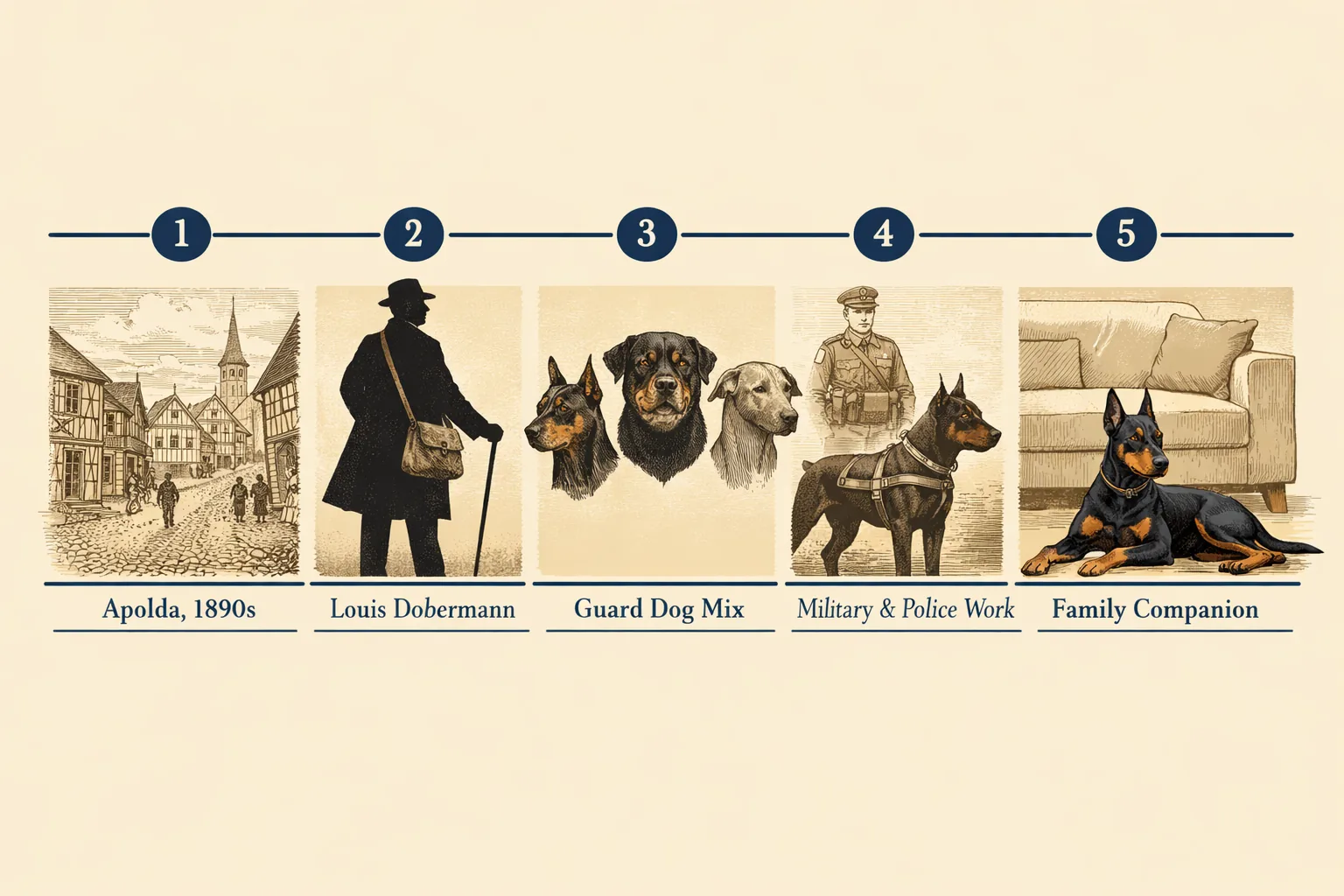
He wanted a dog that could walk beside him with cash in a satchel and make strangers reconsider. Fast, medium sized, short coated, naturally suspicious of approach, and tightly bonded to a handler. Records of the exact crosses are thin, but breed historians generally point to old German Pinschers, Rottweilers, black and tan Terriers, and smooth Greyhound influence for speed and leg length. Breed histories trace the line to that pound-keeper period.
Within two decades the dog had moved from one man’s personal escort to police and military work across Europe and later the United States. The U.S. Marine Corps used Dobermans in the Pacific during World War II.
That matters for you in 2026 for one reason. A breed selected for about 130 years to cooperate closely with a handler under pressure does not switch off when you move it into a two bedroom apartment. You have to supply the job. If you want the wider category, see our guide to protection dog breeds.
Modern note: there is no true “mini Doberman.” The small dog people mean is usually a Miniature Pinscher, an entirely separate and much older breed, or a mixed-breed lookalike.
What Makes the Doberman So Special (and So Cute)?
What owners love most is the contradiction: a dog that looks like a security system and behaves like a 70 pound shadow that wants to sit on your feet.
Three things come up again and again from Doberman people:
- The bond. Dobermans follow their person room to room. The nickname “velcro dog” is not marketing. The AKC describes the breed as affectionate with familiar people and happiest with close human contact plus a structured activity.
- The brain. They learn fast, retain sequences, and get bored by repetition. Teaching a Doberman to find your keys takes an afternoon. Teaching it not to invent its own jobs takes years.
- The athleticism. Trot, gallop, swim, hike, pull a bike. This is a genuine adventure partner, not a dog you drag along.
The cute part sneaks up on you. The ears, cropped or not, telegraph every thought. The head tilt is extravagant. Adolescents do a full body wiggle that looks structurally unsafe on a dog with that much muscle. And the leaning. A Doberman does not lean politely. It parks its full weight against your leg and waits for you to adapt.
Puppies are comically out of proportion: huge paws, loose skin, oversized untrimmed ears that flop in opposite directions. That phase lasts about four months, and then you have a teenage athlete.
Doberman Size, Weight and Lifespan
A male doberman typically stands 26 to 28 inches at the withers and a female 24 to 26 inches, with weight tracking height rather than a fixed number.
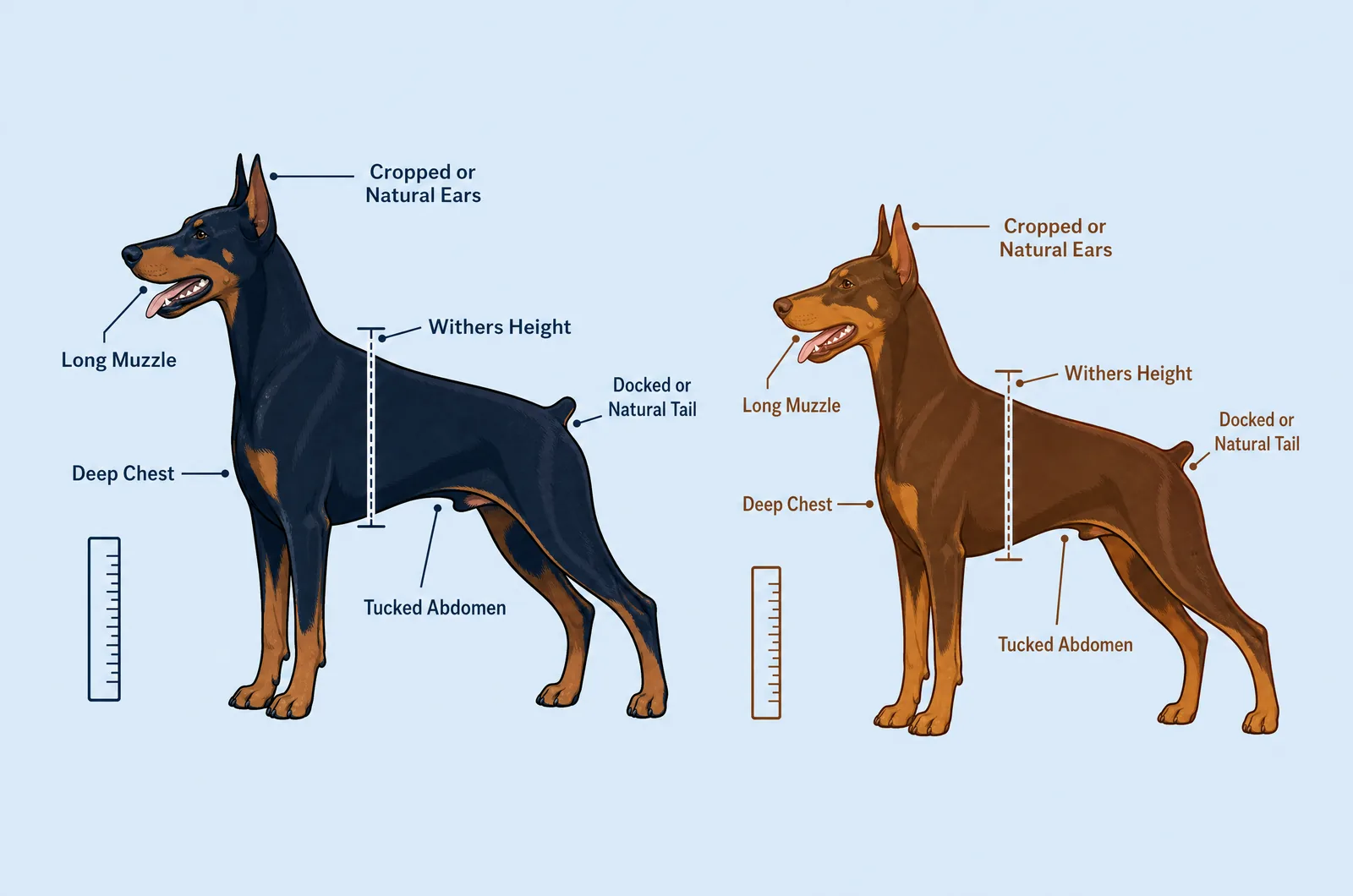
| Measure | Male Doberman | Female Doberman | Why it matters |
|---|---|---|---|
| Height at withers | 26 to 28 in (ideal 27.5) | 24 to 26 in (ideal 25.5) | Per the DPCA breed standard |
| Typical weight | 75 to 100 lb | 60 to 90 lb | Crate, car harness and bed sizing |
| Build | Heavier bone, broader head | Lighter, often faster | Affects joint loading on hard surfaces |
| Lifespan | ~10 to 13 years | ~10 to 13 years | Dogster breed lifespan review |
The standard does not list a weight range, which confuses buyers. Judges assess proportion: a square dog, deep chest reaching the elbow, compact feet. A 110 pound “king Doberman” advertised as rare is oversized, not valuable.
Growth runs long. Most Dobermans reach adult height by 12 months and fill out in chest and head until 24 to 36 months. Do not force-condition a puppy with long runs or repetitive jumping before growth plates close. Walk, sniff, swim, play on grass.
For where this breed lands on the size scale, see our large versus giant breed size guide.
What Is the Doberman Temperament Like?
Doberman pinscher temperament is best described as intense, handler-focused and emotionally thin-skinned. The AKC standard calls for a dog that is “energetic, watchful, determined, alert, fearless, loyal and obedient,” which reads as a working specification rather than a personality sketch.
Here is what that looks like at home.
Watchful means reactive by default. A Doberman notices the delivery van four houses away. Left unmanaged, noticing turns into barking, barking turns into lunging, and by 14 months you have a reactivity problem. Socialization is not optional. Expose a puppy calmly to traffic, hats, bikes, umbrellas, children, and other dogs at a distance where it stays relaxed.
Sensitive means corrections land hard. This is the single biggest thing new owners underestimate. Yelling at a Doberman does not produce a chastened dog. It produces a dog that shuts down, avoids you, or escalates. Humane training with markers, food, and clear rules works far better than confrontation.
Why so anxious? Partly selection for alertness, partly the strength of the attachment. A dog bred to monitor one person struggles when that person vanishes without warning. That same wiring produces separation anxiety at higher rates than in more independent breeds.
Individual variation is real. Some Dobermans are social butterflies at the brewery. Some never want a strange dog in their face. Meet the parents if you can and ask the breeder directly about nerve stability.
Are Dobermans Good With Kids and Other Pets?
A well-raised doberman can be excellent with children in its own family, and the AKC notes the breed may be good with kids when properly raised while cautioning that some are territorial with other dogs and unreliable with small animals, per AKC breed guidance.
Practical rules that actually reduce risk:
- Supervise everything under age 8. Not because the dog is vicious, but because a 90 pound dog at a trot can flatten a toddler by accident.
- Teach the kids first. No hugging the dog’s neck, no climbing, no approaching the food bowl, no waking a sleeping dog.
- Give the dog a legal exit. A crate or a room with a gate that children are banned from. A Doberman that can leave rarely needs to warn.
- Cats: possible with a puppy raised alongside them and a managed introduction. Prey drive varies widely. Rabbits, chickens and loose hamsters are a different conversation.
- Other dogs: same-sex adult pairings are the most common friction point. Neutral-territory introductions, parallel walks, separate feeding.
Babies specifically: do the work before the baby arrives. Practice stroller walks, play recorded infant crying at low volume paired with treats, and set the nursery boundary months ahead. If your Doberman stiffens, stares, or growls around the baby, call a certified behavior consultant that week, not next month. For gentler options, compare our most child friendly pet guide for parents.
Who Is the Doberman Made For, and Who Should Skip It?
Choose a doberman if you exercise daily regardless of weather, you work from home or have short absences, you enjoy training as a hobby, and you can budget for cardiac screening and possible cardiac treatment.
Skip the Doberman if any of these apply:
- You are a first-time owner with no training support lined up. Not impossible, but the adolescent phase from 8 to 20 months breaks a lot of beginners.
- You are gone 9 to 11 hours daily with no walker or daycare.
- You rent. Many U.S. insurers and landlords restrict the breed. There is no nationwide U.S. ban, but local ordinances, housing policies, insurers and military housing rules vary, so check all four before you buy.
- You want a dog that tolerates rough handling or inconsistent rules from multiple household members.
Doberman vs German Shepherd: the Doberman sheds far less, needs less coat work, is faster and lighter, and is usually more handler-dependent. The German Shepherd tends to be a bit more tolerant of handling errors, more prone to orthopedic issues, and sheds constantly. Pick the Doberman for a cleaner house and a closer bond, the Shepherd for a slightly more forgiving training partner.
Apartment living is workable with a Doberman if you genuinely do two real outings a day plus indoor enrichment. Floor space matters less than your schedule. Browse our apartment-friendly breed picks if you are unsure.
Similar breeds worth comparing: Beauceron, Rottweiler, Belgian Malinois, Giant Schnauzer, Boxer, and the Dobermann-adjacent Black Russian Terrier. Our best guard dog breeds comparison covers the trade-offs. For a guard-type dog needing less training intensity, a Rottweiler or Bullmastiff is usually the calmer pick.
How Much Exercise Does a Doberman Need?
Plan on 60 to 120 minutes of real activity daily for an adult doberman, split across at least two sessions, plus 15 to 30 minutes of mental work. Doberman pinscher exercise needs are not satisfied by a leashed loop around the block.
A workable weekday template:
- Morning, 30 to 45 min: brisk walk or jog with sniffing breaks.
- Midday, 10 min: training session. New trick, scent game, or a flirt pole burst.
- Evening, 30 to 45 min: off-leash run in a safe space, fetch, or a structured hike.
- Before bed, 10 min: chew or food puzzle to settle the nervous system.
Weekend add-ons that suit the build: swimming, canicross, agility foundations, dock diving, scent work, protection sports (IGP), and rally obedience. The breed thrives on anything with rules and a finish line.
Common mistake: treating a tired Doberman as the goal. Pure cardio builds stamina and you end up with a fitter dog demanding more. Mix cardio with problem solving. Fifteen minutes of nosework often settles a Doberman more than a five mile run.
Digging usually signals boredom, heat, or anxiety. A Doberman digging up the yard in July may be making a cool pit. One at 2 p.m. every weekday is telling you the schedule has a hole in it. Give a sandbox, shade, and a midday enrichment session before you reach for deterrents.
Edge case: puppies under 12 months should do free play, not forced distance work. Five minutes of structured walking per month of age, twice daily, is a reasonable ceiling.
Doberman Grooming and Shedding
Doberman pinscher shedding is low but constant, and the short stiff hairs weave into upholstery like tiny needles. Grooming time is genuinely minimal: ten minutes a week.
Your actual routine:
- Rubber curry mitt or hound glove, twice weekly. Pulls dead coat and distributes skin oils.
- Bath every 6 to 10 weeks or when the dog smells like a dog. Overbathing dries the skin. If your Doberman gets itchy, check our guide to dog shampoo for sensitive skin.
- Nails every 2 to 3 weeks. Dobermans have compact cat feet and long nails change their gait.
- Ears weekly. Cropped ears stand open and collect debris. Uncropped ears trap moisture. Either way, look.
- Teeth 3 to 4 times a week. The long muzzle crowds nothing, but tartar still builds.
Short coat does not mean weatherproof. There is almost no undercoat and very little body fat. Below roughly 45°F most Dobermans want a coat for anything longer than a toilet break, and they genuinely shiver. In summer, watch for heat stress: heavy panting that does not settle, bright red gums, wobbling, or collapse means cool the dog with water and call a vet immediately.
New owner basics are covered in our beginner’s guide to dog grooming.
Common Doberman Health Problems
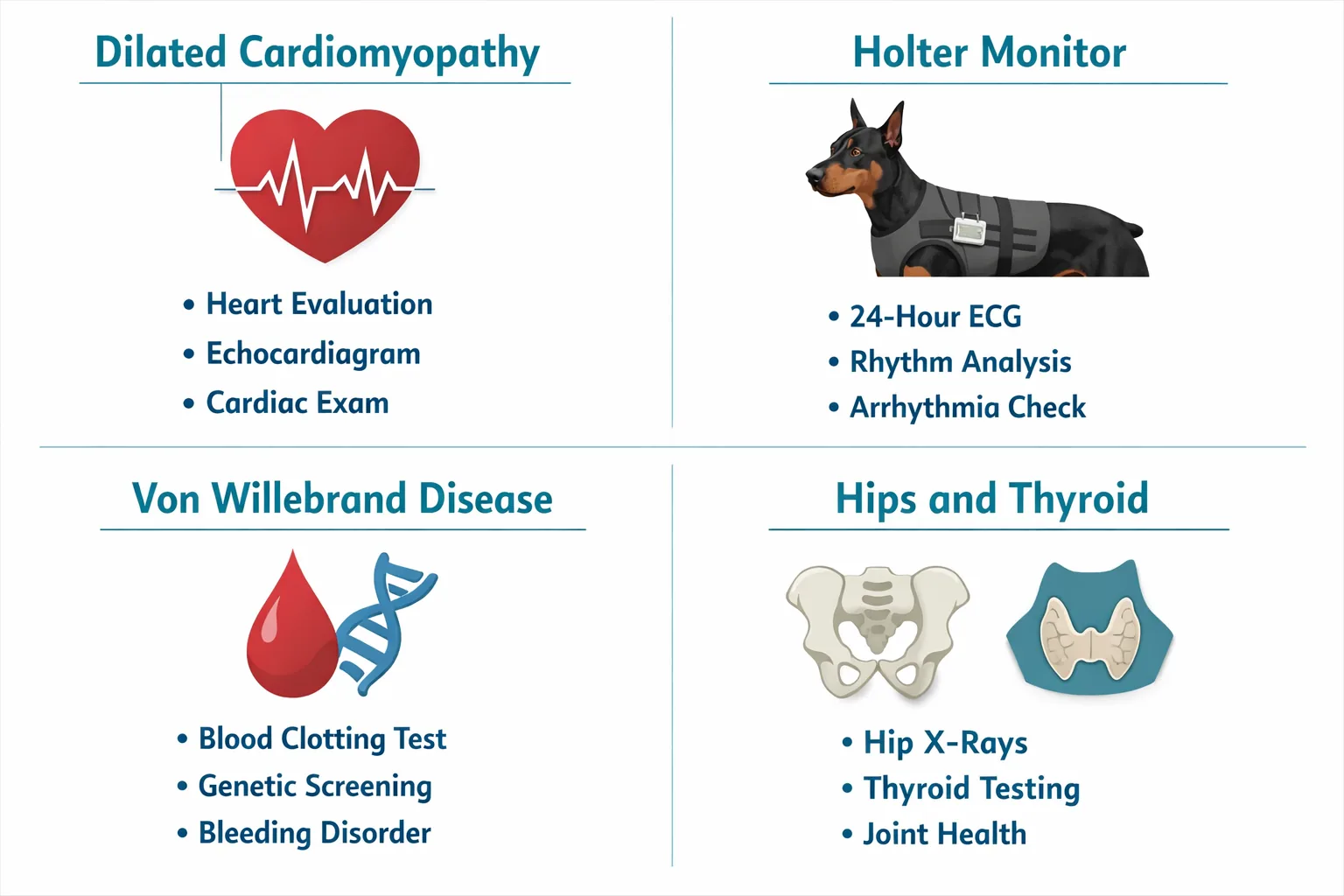
Doberman pinscher health problems are dominated by one condition: dilated cardiomyopathy, a disease of the heart muscle that can be silent for years and then present as collapse or sudden death.
What the numbers say. Cumulative prevalence estimates reach roughly 58.2% in European Dobermanns and around 40% in North American populations, per Science for Animal Welfare. Risk climbs steeply with age. One widely cited European screening dataset reported DCM in about 3.3% of dogs under 2, 9.9% at ages 2 to 4, 12.5% at 4 to 6, then 43.6% at 6 to 8 and 44.1% at 8 and older.
What the new genetics found. In October 2026, Utrecht University and international collaborators analyzed 5,078 Dobermanns across roughly 462,386 genetic markers, with 548 dogs meeting case or control definitions. The DCM4 variant (RNF207 gene) was a risk factor in both European and North American dogs, while DCM3 had a smaller, mainly European effect. Dogs with unfavorable DCM1 or DCM2 results were not more likely to develop disease in this analysis, per Utrecht University.
Where the facts end: the researchers are explicit that DCM3 and DCM4 are risk markers, not diagnostic tests. A dog carrying them may stay healthy. A dog without them can still develop DCM. Males carried greater risk in the study model. DNA results supplement screening, they do not replace it.
The screening that actually matters. The DPCA continues to recommend annual cardiac evaluation by a veterinary cardiologist using a 24-hour Holter monitor plus echocardiogram, generally starting around age 2 to 3.
Other conditions to ask a breeder about:
- Von Willebrand disease (vWD type 1): an inherited clotting disorder. A simple DNA test clears or identifies carriers. Ask for the parents’ results in writing.
- Hypothyroidism: common, cheap to test, treatable. Suspect it with weight gain, coat loss, or new anxiety in a middle-aged dog.
- Cervical vertebral instability (wobbler syndrome): neck pain, wobbly hind end, scuffed nails. Wobbly rear legs with pain is a same-day vet call.
- Gastric dilatation volvulus (bloat): deep-chested breed, real risk. Unproductive retching, a swollen hard abdomen, restlessness and drooling is an emergency. Go to a vet now. Ask your surgeon about prophylactic gastropexy at spay or neuter.
- Hip dysplasia and progressive retinal atrophy: screen the parents.
Given the cardiac picture, read our take on whether pet insurance is worth it before, not after, a diagnosis.
What Do Dobermans Love to Eat? Favorite Foods and Feeding
Best food for doberman pinschers means a complete, AAFCO-compliant diet matched to life stage, fed in two meals, with portions set by body condition rather than the bag chart.
Rough daily amounts for an adult at a healthy weight: 3 to 5 cups of dry food split into two meals, adjusted by activity. You should feel ribs easily under a thin fat layer and see a waist from above. A Doberman that looks slightly lean usually is correct.
Puppies: use a large-breed puppy formula with controlled calcium (roughly 1.2% to 1.5% dry matter) to slow growth rates and reduce orthopedic stress. Three meals a day until about six months, then two.
Treats Dobermans reliably love: freeze-dried liver, plain cooked chicken, low-fat string cheese, sardines in water, blueberries, carrot sticks, green beans, and frozen plain yogurt in a lick mat. Keep treats under 10% of daily calories.
Avoid completely: grapes and raisins, onions, garlic, xylitol (check peanut butter labels), chocolate, macadamia nuts, cooked bones, and alcohol.
Breed-specific feeding notes:
- Feed from a flat bowl on the floor, not an elevated stand. Raised bowls have been associated with increased bloat risk in large deep-chested dogs.
- Wait 60 minutes after a meal before hard exercise, and 30 minutes after exercise before feeding.
- Some Dobermans have sensitive stomachs. Switch foods over 7 to 10 days using our food transition guide.
- Taurine and diet-associated DCM remains an open research question. Many cardiologists suggest feeding diets from companies running feeding trials. This is an evolving area and not settled science. Compare labels with our buyer’s guide to the healthiest dog food.
How to Train a Doberman
Train a doberman with markers, food, short sessions and total consistency, because harsh corrections damage this breed’s working relationship faster than they fix behavior.
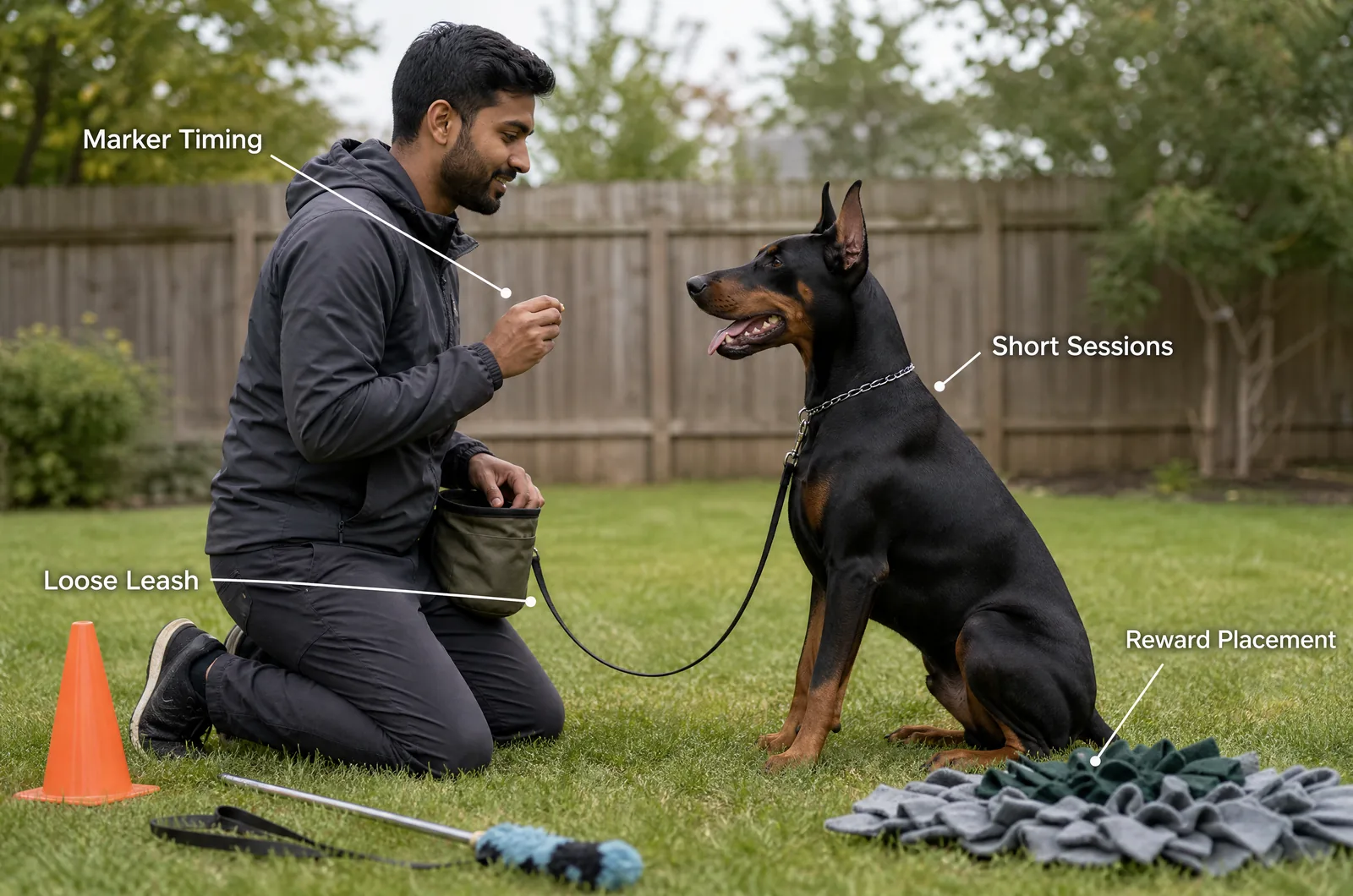
The first six skills, in order:
- Name response and marker word. Say “yes,” pay. Ten reps, twice a day.
- Crate as a good place. Feed every meal in the crate for two weeks.
- Settle on a mat. This is the off switch the breed needs most.
- Loose leash from day one. A 90 pound dog that learned to pull at 20 pounds is a daily argument.
- Recall with a long line. Never recall to end fun. Recall, treat, release.
- Handling and muzzle conditioning. Vet visits and Holter monitors both get easier.
Common mistakes with Dobermans:
- Escalating corrections. A Doberman that is ignoring you is usually overstimulated or confused, not defiant. Increase distance, lower difficulty, pay better.
- Letting adolescence slide. Months 8 to 18 bring testing, barking at the window, and sudden fear periods. Keep training during the worst of it.
- Encouraging “protection” informally. Praising barking at strangers builds an unreliable dog. Real protection work is a trained sport with rules, not an attitude.
- Too much arousal, not enough calm. Alternate tug and chase with scent games and settling.
Separation anxiety fixes. Start before it appears. Leave for 30 seconds, then two minutes, then ten, building only when the dog stays relaxed. Record on your phone. Pair departures with a frozen stuffed toy. Do not make goodbyes emotional. If the dog panics, drools, or destroys doorframes, work with a vet behaviorist. Medication plus a desensitization plan works far better than either alone.
Ear cropping, neutrally: cropping is cosmetic surgery performed on puppies, still permitted in most U.S. states, and banned in the UK, Australia and much of Europe. Arguments for it cite breed tradition and conformation show convention, plus a claimed reduction in ear infections that has limited supporting evidence. Arguments against cite pain, anesthesia risk, weeks of posting and aftercare, and the absence of a functional benefit. The AKC standard permits cropped ears; it does not require you to do it. Ask your vet and decide before the puppy is eight weeks old, because the window is narrow.
Try It: Doberman Heart Screening Planner
Dilated cardiomyopathy can progress silently in a Doberman for years before a single symptom appears. Enter your dog’s age and last screening date below to see what the DPCA-style schedule suggests you discuss with your veterinarian next.
Doggy Rank IQ Tool
Doberman Heart Screening Planner

Dilated cardiomyopathy (DCM) is a serious concern in Dobermans and can be silent for years. Enter your dog's age and screening history to plan the next step with your vet.
Doberman Heart Screening Planner
Plan your next cardiac conversation with your vet.
Educational planning tool only. Not a diagnosis. Screening decisions belong to you and your veterinary cardiologist.
‘+m;o.style.display=’block’; });
How Much Does a Doberman Cost?
A doberman puppy from a health-testing breeder typically runs $1,500 to $3,500 in the U.S., with European working lines and show prospects reaching $4,000 or more. Rescue adoption usually falls between $200 and $600.
| Cost bucket | Typical U.S. range | Notes |
|---|---|---|
| Puppy purchase | $1,500 to $3,500 | Should include vWD and cardiac results on parents |
| First-year total | $2,500 to $4,500 | Vaccines, neuter or spay, crate, training, food |
| Ongoing yearly | $1,400 to $2,600 | Food, preventives, routine vet |
| Annual Holter plus echo | $450 to $900 | Add from roughly age 2 to 3 |
| Pet insurance | $55 to $110 per month | Breed-rated; enroll before any heart finding |
Ranges are based on common U.S. market pricing and vary widely by region. Verify locally.
What a $600 “bargain” Doberman usually costs you later: untested parents, a vWD surprise during a routine spay, and a dog whose first echocardiogram at age five is the family’s introduction to veterinary cardiology. The cheap puppy is the expensive one.
Questions to ask a breeder, in writing: parents’ most recent Holter and echo reports, vWD DNA status, OFA hip results, thyroid panel, how many litters per year, and what happens if you cannot keep the dog.
Doberman Puppy Tips for the First 90 Days
The first 90 days with a doberman puppy set the adult dog’s nerve, so spend them on calm exposure and sleep rather than obedience polish.
Days 1 to 14
- Crate beside your bed. Midnight potty trip on a schedule, not on demand.
- One new thing per day, nothing more. A car ride. A vacuum running in the next room.
- Vet visit within 72 hours. Confirm the vaccine plan.
Days 15 to 45
- Puppy class with a trainer who uses food and markers. Walk away from anyone selling prong corrections to a nine week old Doberman.
- Socialization list: 10 surfaces, 10 sound types, 20 friendly strangers of varied ages and appearances, 5 calm adult dogs.
- Start alone-time training. Two minutes, five minutes, twenty.
Days 46 to 90
- Expect a fear period somewhere around 8 to 11 weeks and often again in adolescence. If the puppy spooks, do not flood it. Add distance, pay for calm, move on.
- Teach the settle mat daily. This is the skill you will use for the next decade.
- Begin nail and ear handling as a paid game.
Biggest first-90-days mistakes: too much dog park, too little sleep (puppies need 18 to 20 hours), and letting the puppy practice barking at the window. Block the view with film now.
What Doberman Owners Say
Reddit’s Doberman community is unusually honest about the hard parts, which makes it a better preview than any breed brochure.
“One day she is the most perfect creature in the world”
An owner on Reddit in a thread titled “Does it get easier?”. That swing between perfect and impossible is adolescence, and it is normal between roughly 8 and 20 months. The practical fix is not more discipline. It is a predictable daily structure, enforced naps, and a willingness to lower training criteria on bad days instead of escalating.
“really how sensitive they can be”
An owner on Reddit in one thing I wish I knew before I got a Doberman. Take this literally. A raised voice that another breed brushes off can produce days of avoidance in a Doberman. Trade corrections for management: block the rehearsal of the behavior, teach a replacement, pay it generously.
“I loved our snuggles”
An owner on Reddit in a post titled my biggest mistake. Closeness is most of why people keep coming back to this breed. The practical caution: build genuine alone-time tolerance alongside the snuggling, from week one, or the bond becomes the dog’s biggest source of stress.
Doberman FAQ
Are Dobermans good for first time dog owners? Usually not, unless you hire a trainer before the puppy arrives and can commit to daily exercise and training. The breed is smart and willing, but the adolescent phase and emotional sensitivity punish inconsistency.
What were Dobermans originally bred for? Personal protection. Louis Dobermann, a German tax collector and pound keeper, developed the breed in 1890s Apolda to accompany him safely while carrying money.
How long do Dobermans live? Commonly around 10 to 13 years. Dilated cardiomyopathy is the leading reason individual dogs fall short of that.
Do Dobermans shed a lot? No, shedding is light and year-round. The short stiff hairs are noticeable on fabric but a weekly rubber curry mitt handles most of it.
Can a Doberman live in an apartment? Yes, if you deliver two real outings daily plus indoor enrichment. Check your lease and your insurer first, since breed restrictions in U.S. housing and insurance policies are common.
Is a Doberman or a German Shepherd better? Choose the Doberman for less shedding, more speed, and a tighter bond with one person. Choose the German Shepherd if you want a slightly more forgiving training partner and do not mind heavy coat maintenance.
How much exercise does a Doberman need daily? Sixty to 120 minutes of physical activity for an adult, plus 15 to 30 minutes of mental work such as scent games or trick training.
Is there a miniature Doberman? No. The small lookalike is the Miniature Pinscher, a separate breed, or a mixed-breed dog marketed misleadingly.
Conclusion: Your Next Step
A doberman gives you a fast, funny, devoted dog that notices everything and takes your mood personally. That is the deal. Match it with structure, humane training and a cardiac screening plan and you get one of the most rewarding dogs in the country. Mismatch it with a long workday and a short temper and the dog suffers first.
Three things to do this week if you are serious:
- Call two breeders and ask for parental Holter, echo and vWD results in writing. No documents, no deposit.
- Price annual cardiac screening with a veterinary cardiologist in your area and add it to your budget before you buy.
- Book a trainer for the week your puppy comes home, not the month the problems start.
Still comparing? Run through our breed matchmaker guides before you commit.