
Quick Answer: Is an English Bulldog Right for You?
The english bulldog suits calm, climate-controlled homes with a healthy vet budget and a tolerance for snoring. This is a gentle, people-glued, low-arousal dog that will happily spend the afternoon pressed against your shin. It is also a breed with real airway, skin and heat limits, plus veterinary costs that run above average for its size. Choose a Bulldog if you want a devoted companion for short walks and long naps, and you can afford the care that flat-faced anatomy demands.
Key Takeaways: English Bulldog
- A 2026 PLOS ONE study of more than 4,000 tested dogs estimated clinical BOAS in 18.9% of registered English Bulldogs, well below older estimates of 51 to 64 percent. The authors noted that tested, registered dogs may not represent all Bulldogs.
- In that same dataset, obese dogs had roughly 3.8 times the odds of BOAS, and narrowed nostrils about 2.6 times the odds. Weight is the single biggest thing you control.
- Brachycephalic dogs carry roughly 1.5 to 4.5 times higher anesthesia complication risk than longer-nosed breeds, per a 2026 Today’s Veterinary Practice review. Any surgery needs a team that plans for it.
- Royal Kennel Club registrations for the breed fell from 7,785 in 2016 to 2,711 in 2025, a drop of about 65 percent, and from 2026 Grade 2 and Grade 3 dogs are barred from Crufts.
- Expect a puppy price of roughly $2,500 to $5,000+ from a health-testing breeder, and yearly running costs that commonly land between $1,800 and $3,500 once food, skin care and vet visits are counted.
- Typical adult size: 40 to 55 pounds, about 14 to 15 inches at the shoulder, with a published lifespan commonly given as 8 to 10 years (PetMD) (petmd.com).
- Temperament is the selling point. The Royal Kennel Club breed profile describes the Bulldog as calm, affectionate and strongly people-oriented.
Where Does the English Bulldog Come From?
The english bulldog was built for bull-baiting in England, a blood sport banned by the Cruelty to Animals Act of 1835. The dogs of that era were athletic, leggy and ferocious. Nothing like the dog snoring on your couch.
After the ban, the breed should have disappeared. A handful of fanciers kept it alive by breeding deliberately for a gentler nature, and by the 1860s show rings were rewarding a heavier, shorter-faced, lower-slung dog. That selection worked almost too well. Within a few generations the fighting temperament was mostly gone, and so was the muzzle.
The American Kennel Club registers the breed simply as the Bulldog. “English Bulldog” is the common name people actually search and say, used to separate it from the French Bulldog and the Olde English Bulldogge, a modern recreation bred for a longer muzzle and more athleticism.
Two things worth holding at once. The modern Bulldog’s sweetness is a genuine breeding achievement. The modern Bulldog’s body is a genuine welfare problem, and a 2024 Animal Welfare study on crossbreeding extreme brachycephalic dogs found that outcrossing improved health outcomes while keeping behavioral profiles and the owner relationship intact (cambridge.org).
What Makes the English Bulldog So Special (and So Cute)?
What owners love most is not the face. It is the velcro. Bulldogs want physical contact, preferably with a leg, and they are remarkably sensitive to household mood.
The cuteness is partly neoteny. Big round forward-facing eyes, a domed head, a short muzzle and a wide mouth read to the human brain as infant-like, which is why the breed photographs so well and why your phone fills up within a week. Add the rolling gait, the sideways head tilt and the resigned sigh when you move the blanket, and you have a dog that generates content without trying.
Owners also report that Bulldogs are smarter than the stubborn stereotype suggests. They learn tricks fast when food is involved. They simply reserve the right to decline.
The other recurring theme in owner communities is mascot status. Bulldogs become the character of a household, the neighborhood, the office. People who do not like dogs tend to make an exception.
The toy has a warranty. The sofa does not. Bulldogs are heavy sleepers with opinions about upholstery.
English Bulldog Size, Weight and Lifespan
A typical adult english bulldog stands about 14 to 15 inches at the shoulder and weighs 40 to 55 pounds, with a commonly published lifespan of 8 to 10 years (petmd.com). The body is wide and low, so the dog is far denser than the height suggests.
| Measure | Male Bulldog | Female Bulldog | French Bulldog (comparison) |
|---|---|---|---|
| Height at shoulder | 14 to 15 in | 13 to 14 in | 11 to 13 in |
| Adult weight | about 50 to 55 lb | about 40 to 50 lb | 16 to 28 lb |
| Typical lifespan | 8 to 10 years | 8 to 10 years | 10 to 12 years |
| Whelping | C-section very common | C-section very common | C-section very common |
On the english bulldog vs French Bulldog question: the Frenchie is roughly half the weight, more portable, usually bat-eared, and often a bit more active and vocal. Both are brachycephalic. Neither escapes airway and heat risk. The Frenchie’s smaller frame makes apartment life and travel easier, while the Bulldog is generally calmer indoors.
Longevity varies a lot by individual. Weight control, airway grade and skin management move the number more than pedigree marketing does. If you want help sizing up where this breed sits against others, our guide to dog breed size categories is a useful reference point.
What Is the English Bulldog Temperament Like?
Calm, affectionate, stubborn and highly bonded to people. That is the honest four-word summary of english bulldog temperament, and the Royal Kennel Club breed profile describes much the same picture: close family bonds and a steady, people-oriented nature.
What that looks like day to day:
- Low arousal indoors. Most Bulldogs are not pacers, barkers or door-chargers. They settle.
- Comic determination. A Bulldog who has decided the walk is over will stop, sit and become geologically heavy.
- Sensitivity. Harsh correction shuts them down. Humane training with food and short sessions works far better.
- Guarding instinct is mild. They may bark at the door, then introduce themselves to the burglar.
Two cautions. First, low energy is not the same as low maintenance. PetMD notes that limited exercise tolerance in Bulldogs often reflects airway and heat limits rather than genuine contentment with doing nothing (petmd.com). Second, sudden grumpiness, snapping or new reactivity in a Bulldog deserves a vet exam before a training plan. Pain from skin, eyes, joints or breathing is a common hidden cause, and this is a breed that hides discomfort behind a placid face.
Are English Bulldogs Good With Kids and Other Pets?
Generally yes, with normal supervision. The english bulldog’s tolerance level and low reactivity make it one of the more forgiving companions for families with school-age children, and the Royal Kennel Club notes Bulldogs can live well with children when interactions are properly supervised.
Practical points:
- Toddlers and Bulldogs both need rules. The dog is heavy and solid, so an excited 50-pound shoulder-check can knock a two-year-old flat. Teach kids to leave a resting dog alone.
- Food guarding is the most common family flashpoint. Feed in a separate room. Bulldogs can be serious about meals.
- Other dogs: usually fine when raised together or socialized early, but some adult males are less tolerant of same-sex dogs. Individual variation is real here.
- Cats: typically fine. Chasing requires stamina the Bulldog is not interested in supplying.
Edge case worth naming: a Bulldog who yelps when picked up, or growls during handling around the face, is often reacting to sore folds or an eye problem. Check the body before blaming the personality. If you are still weighing breeds for a household with young kids, our family-friendly pet guide for parents compares temperaments side by side.
Who Is the English Bulldog Made For, and Who Should Skip It?
Choose an english bulldog if you work from home or have a predictable routine, live somewhere with reliable air conditioning, and can absorb a surprise $3,000 vet bill without a crisis.
Good fit:
- Apartment dwellers who want a quiet, low-mileage dog. Bulldogs are genuinely decent apartment dogs: minimal barking, modest space needs, two short walks a day. Stairs and elevators are the thing to check, since heavy Bulldogs do badly on long stair climbs in heat.
- Calm households, older couples, families with children over about five.
- Owners who like grooming rituals. Folds need attention several times a week.
Skip the breed if:
- You live in Phoenix, Houston or anywhere with long 90-plus-degree stretches and limited indoor cooling. English bulldogs cannot handle hot weather. Flat-faced anatomy makes panting less efficient, and heatstroke can kill fast.
- You want a hiking, running or agility partner.
- Your budget has no room for insurance plus emergency care.
- You will feel ongoing guilt about owning a breed with documented health problems. That guilt is common in owner forums and it is not irrational.
Healthier similar breeds worth comparing: Boston Terrier (still brachycephalic but moderate), Staffordshire Bull Terrier, Olde English Bulldogge, Basset Hound for the low-slung calm look, or a Bulldog crossbreed. The 2024 Animal Welfare crossbreeding study found outcrossed brachycephalic dogs had better health outcomes with behavior and owner-bond quality preserved (cambridge.org). Rescue is also a genuine option.
How Much Exercise Does an English Bulldog Need?
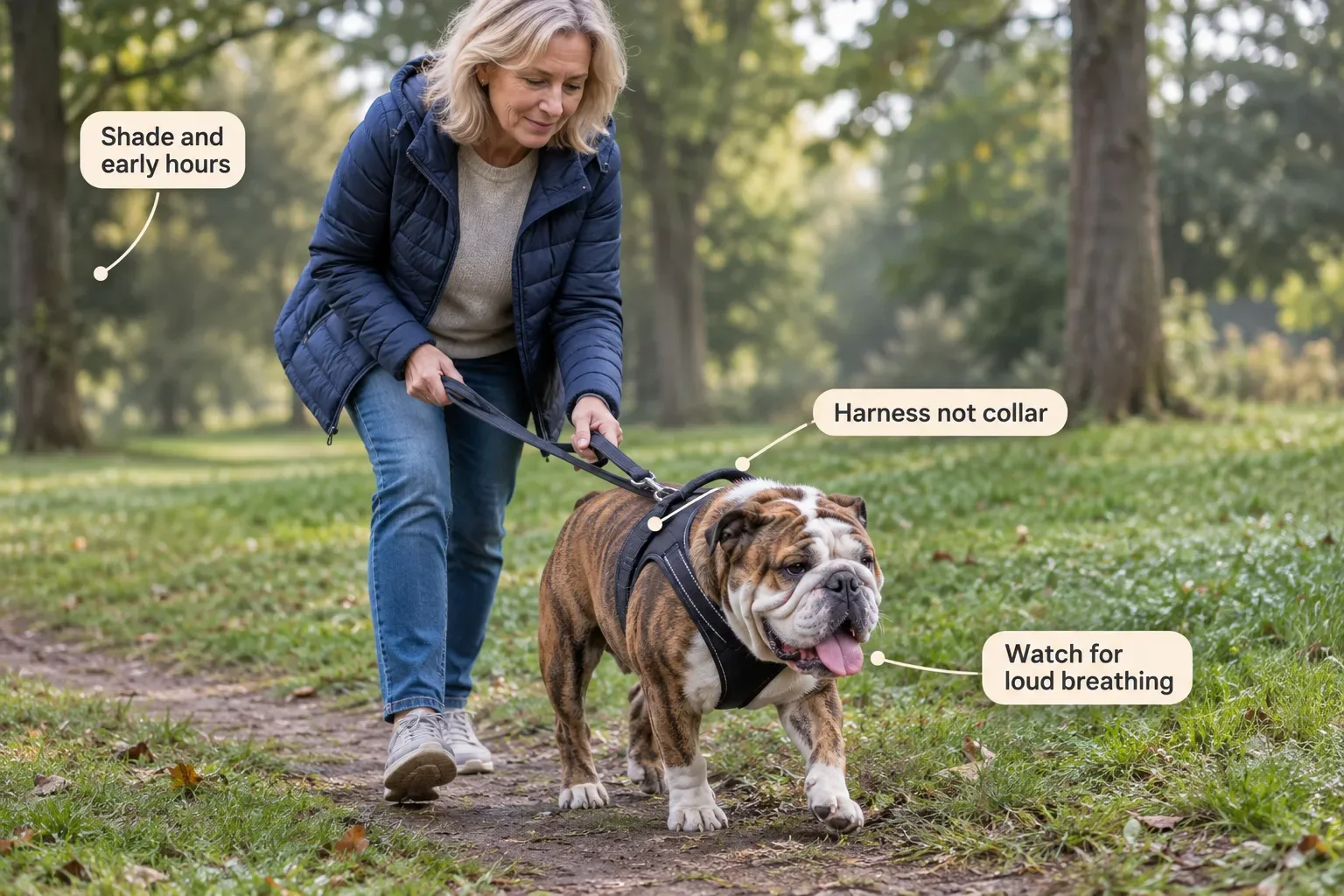
About 20 to 40 minutes of low-intensity activity per day, split into two or three short sessions, in cool conditions. No english bulldog should be jogged, cycled alongside or exercised in midday summer heat.
What works:
- Early morning and after sunset walks. Shade and pavement temperature matter more than distance.
- Flat ground over hills and long stair runs.
- A harness, not a collar. Neck pressure on a compromised airway is a bad combination.
- Sniffing walks over speed walks. Slow nose-led routes give mental work without respiratory load.
- Enrichment indoors: snuffle mats, scatter feeding, puzzle feeders, short trick sessions. A lick mat is a cheap way to add five calm minutes without heat or exertion.
Warning signs to stop immediately and cool the dog: loud rasping, blue or brick-red gums, staggering, retching, or collapse. Heatstroke is a veterinary emergency. Call a vet, do not wait to see if it passes.
Swimming is usually a bad idea without a life jacket and constant supervision. Bulldog body proportions make them poor floaters.
English Bulldog Grooming and Shedding
English bulldog shedding is moderate and year-round, not seasonal bursts. The short coat is easy. The skin folds are the actual job.
Weekly routine:
- Brush with a rubber curry or bristle brush once or twice a week to pull loose hair.
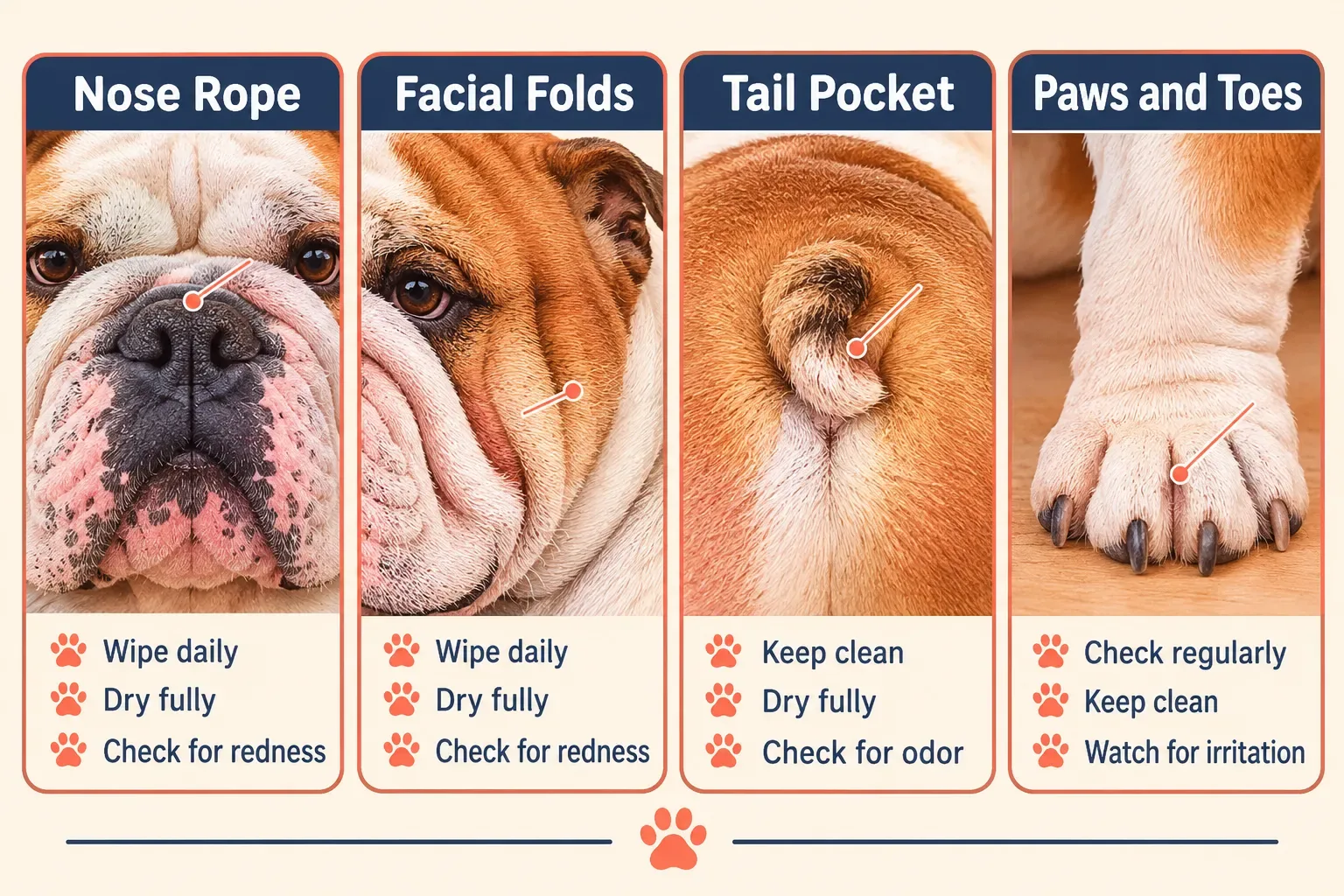
- Clean facial folds and the nose rope every one to three days depending on climate and how much the dog drools. Wipe with a damp cloth or an unscented, vet-recommended fold wipe, then dry thoroughly. Moisture left behind is what causes yeast and bacterial infections, not dirt.
- Check the tail pocket weekly. Screw-tailed Bulldogs often have a deep pocket under the tail that traps debris and can become badly infected. If the tail is tight and you cannot reach under it, ask your vet to show you.
- Trim nails every three to four weeks. Heavy dogs with long nails develop sore feet fast.
- Wipe between toes after wet walks.
Signs you need a vet rather than another wipe: yeasty smell that returns within a day, raw red skin, bleeding, hair loss, or the dog rubbing its face on furniture. Recurrent fold dermatitis sometimes needs medicated cleansers or, in severe cases, surgical fold reduction.
For brushing and nail basics, our beginner’s guide to dog grooming covers tools and technique.
Common English Bulldog Health Problems
The main english bulldog health problems are airway obstruction, skin fold infection, eye disorders, joint dysplasia, and reproductive difficulty. Brachycephalic obstructive airway syndrome, usually shortened to BOAS, sits at the center.
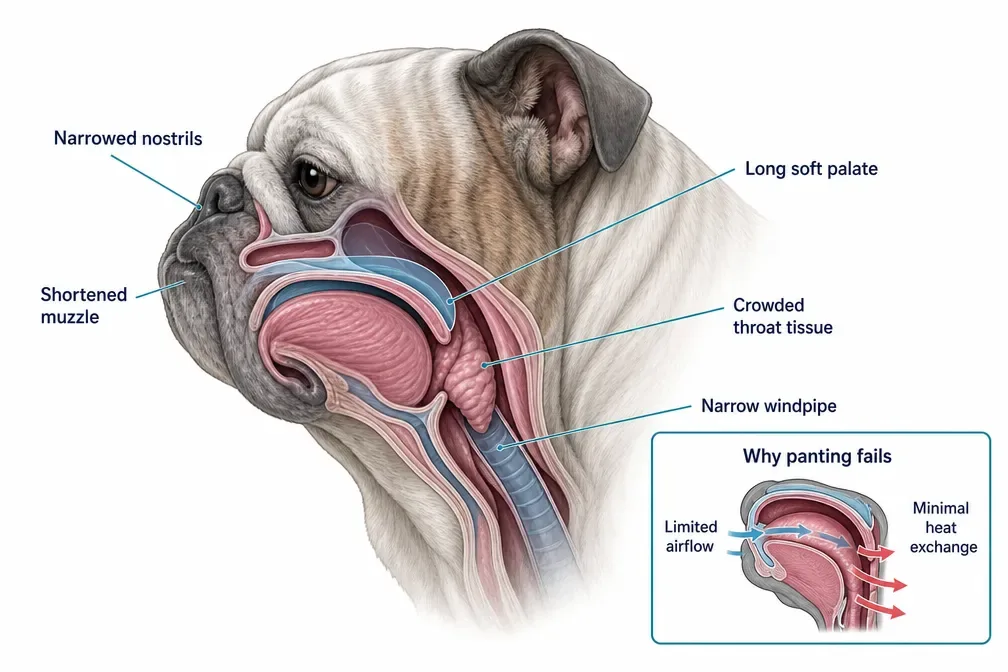
Why english bulldogs have trouble breathing. The skull was shortened over generations, but the soft tissue inside it was not. Cornell’s Riney Canine Health Center describes the result: narrowed nostrils, an overlong soft palate, crowded throat tissue and often a relatively narrow windpipe. Air has to squeeze through a smaller space, and panting, which is how dogs dump heat, becomes less effective.
A 2026 PLOS ONE analysis of over 4,000 registered Bulldogs, French Bulldogs and Pugs put clinical BOAS in tested English Bulldogs at 18.9 percent, lower than older figures of 51 to 64 percent. The researchers were clear that tested, registered dogs are a selected group. In the same data, obesity carried about 3.8 times the odds of BOAS and narrowed nostrils about 2.6 times. Keeping your dog lean is the most powerful lever you have.
The Royal Kennel Club warns that BOAS is progressive and can interfere with sleep, eating, play and exercise. Snoring is not automatically harmless. Gagging, regurgitation, dropping stamina or sleeping with the head propped up are reasons to book an airway assessment.
What to screen for
| Condition | What it looks like | Action |
|---|---|---|
| BOAS | noisy breathing, low stamina, heat intolerance, gagging | RFG-style grading from 12 months; surgery for nares and palate when indicated |
| Fold dermatitis | smell, redness, scratching the face | daily cleaning and drying; vet if recurrent |
| Cherry eye | red fleshy bulge at inner corner | vet promptly; surgical repositioning, do not let it sit |
| Dry eye (KCS) | thick discharge, dull cornea | tear testing; see our dry eye in dogs guide |
| Hip and elbow dysplasia | bunny-hopping, stiffness after rest | screening in breeding stock, weight control |
| Spinal defects | wobbliness, weak hind legs, pain | urgent vet visit |
| Heatstroke | panting, collapse, brick-red gums | emergency, call a vet immediately |
Two more realities. C-sections are very common because puppy heads are wide and dams’ hips are narrow, which is part of why ethical breeding is expensive. And anesthesia is higher risk: a 2026 Today’s Veterinary Practice review reports roughly 1.5 to 4.5 times the complication rate of longer-nosed dogs, including airway swelling, aspiration pneumonia and failure to extubate. Ask any clinic how they monitor brachycephalic recovery before you book a routine neuter or dental.
On the breeding side, the Royal Kennel Club made all pairings involving a Grade 2 Respiratory Function Grading dog “not recommended” from May 13, 2026, and from 2026 Grade 2 and Grade 3 dogs are excluded from Crufts. UK registrations fell about 65 percent between 2016 and 2025. There is no UK law banning Bulldog breeding as of November 2026, though existing licensing rules already prohibit breeding expected to harm dam or offspring.
What Do English Bulldogs Love to Eat? Favorite Foods and Feeding
Feed a measured, complete adult diet that keeps ribs easily felt, because weight is the strongest modifiable risk factor for BOAS in this breed. Most adult Bulldogs eat roughly 2 to 3 cups of dry food daily split into two meals, but the bag’s chart is a starting point, not a prescription.
What Bulldogs tend to love:
- Plain cooked chicken or turkey, small pieces
- Green beans, carrot sticks, cucumber, plain pumpkin (good volume, low calories)
- Blueberries and small apple slices without seeds
- Plain unsweetened yogurt in a lick mat
- Frozen bone broth cubes on warm days
Foods to avoid: grapes and raisins, onion and garlic, xylitol, chocolate, macadamia nuts, cooked bones, fatty trimmings and anything heavily salted. Rich fatty scraps are a pancreatitis risk in a breed already prone to digestive upset.
Bulldog-specific feeding notes:
- Use a shallow, wide or slightly tilted bowl. Flat faces struggle with deep bowls, and gulping air worsens gas and regurgitation.
- Elevated feeders help some dogs with regurgitation. Ask your vet first.
- Slow feeders reduce the swallowed-air problem.
- Grain-free is not automatically better. Pick a food that meets AAFCO adult maintenance standards.
- Food sensitivity shows up as itchy skin and ear trouble in this breed. If folds keep flaring, an elimination diet with veterinary guidance is reasonable.
If you are comparing products, our guide to choosing the healthiest dog food walks through dry, wet and fresh options and what the labels actually mean.
How to Train an English Bulldog
Train in short, food-led sessions and work with the stubbornness instead of fighting it. English bulldog training failures usually come from long repetitive drills and from heat, not from low intelligence.
What works:
- Three to five minutes, two or three times a day. Bulldogs lose interest and overheat before they lose ability.
- High-value food. Tiny pieces of chicken or cheese beat kibble for new behaviors.
- Name the easy wins first: sit, name recognition, hand target, settle on a mat. Mat settling is the single most useful behavior in this breed because it gives them a job that costs no oxygen.
- House training takes patience. Many Bulldogs need 16 to 20 weeks. Frequent short trips, a fixed spot, immediate reward.
- Handle the face and feet daily from day one. Cleaning folds and giving eye drops gets much harder if you start at two years old.
- Never use heavy corrections. They produce a shut-down Bulldog, not a trained one.
Common mistake: assuming a Bulldog who lies down mid-training is being defiant. Check breathing first. Loud, effortful panting means the session is over.
If aggression, resource guarding or real reactivity appears, get a certified behavior professional involved and a vet exam the same month. Pain and compromised breathing both lower a dog’s tolerance.
Try It: Bulldog Wrinkle Care Planner
Those famous folds trap moisture, and a warm, humid climate turns a cosmetic feature into a skin infection within days. Pick your english bulldog’s fold types and your local climate to get a realistic cleaning schedule and a list of warning signs that mean a vet visit rather than another wipe.
Doggy Rank IQ Tool
Bulldog Wrinkle Care Planner

Those famous folds trap moisture and can get infected. Pick your Bulldog's folds and climate for a cleaning schedule that keeps skin healthy.
How Much Does an English Bulldog Cost?
Expect $2,500 to $5,000 or more for an english bulldog puppy from a breeder who health tests, and a first year around $4,000 to $7,000 once supplies, vaccines, neutering and insurance are counted. Yearly costs after that commonly fall between $1,800 and $3,500, higher if airway or skin problems need treatment (articles.hepper.com) (petcost-calculator.com).
| Cost item | Typical range (US) |
|---|---|
| Puppy from a health-testing breeder | $2,500 to $5,000+ |
| First-year supplies and setup | $400 to $900 |
| Routine vet care per year | $400 to $900 |
| Food per year | $500 to $900 |
| Skin, ear and eye products per year | $150 to $400 |
| Pet insurance per month | often $60 to $130+ for this breed |
| BOAS surgery (nares and soft palate) | commonly $1,500 to $5,000 |
| Cherry eye repair, per eye | commonly $500 to $1,500 |
Why the puppy price is high: C-sections, artificial insemination and small litters make ethical Bulldog breeding genuinely expensive. A $900 “bargain” Bulldog usually means no health testing, and the savings reverse fast.
Insurance is worth modelling properly for this breed, since brachycephalic conditions are the most likely thing to be excluded as pre-existing. Enrol before symptoms appear. Our analysis of whether pet insurance is worth it runs the actual math on a $10,065 bill, and if the quotes make you wince, why vets are so expensive explains where the money goes.
English Bulldog Puppy Tips for the First 90 Days
Set up heat control, fold habits and vet relationships before anything else. An english bulldog puppy is a short window to build handling tolerance that pays off for a decade.
Days 1 to 14
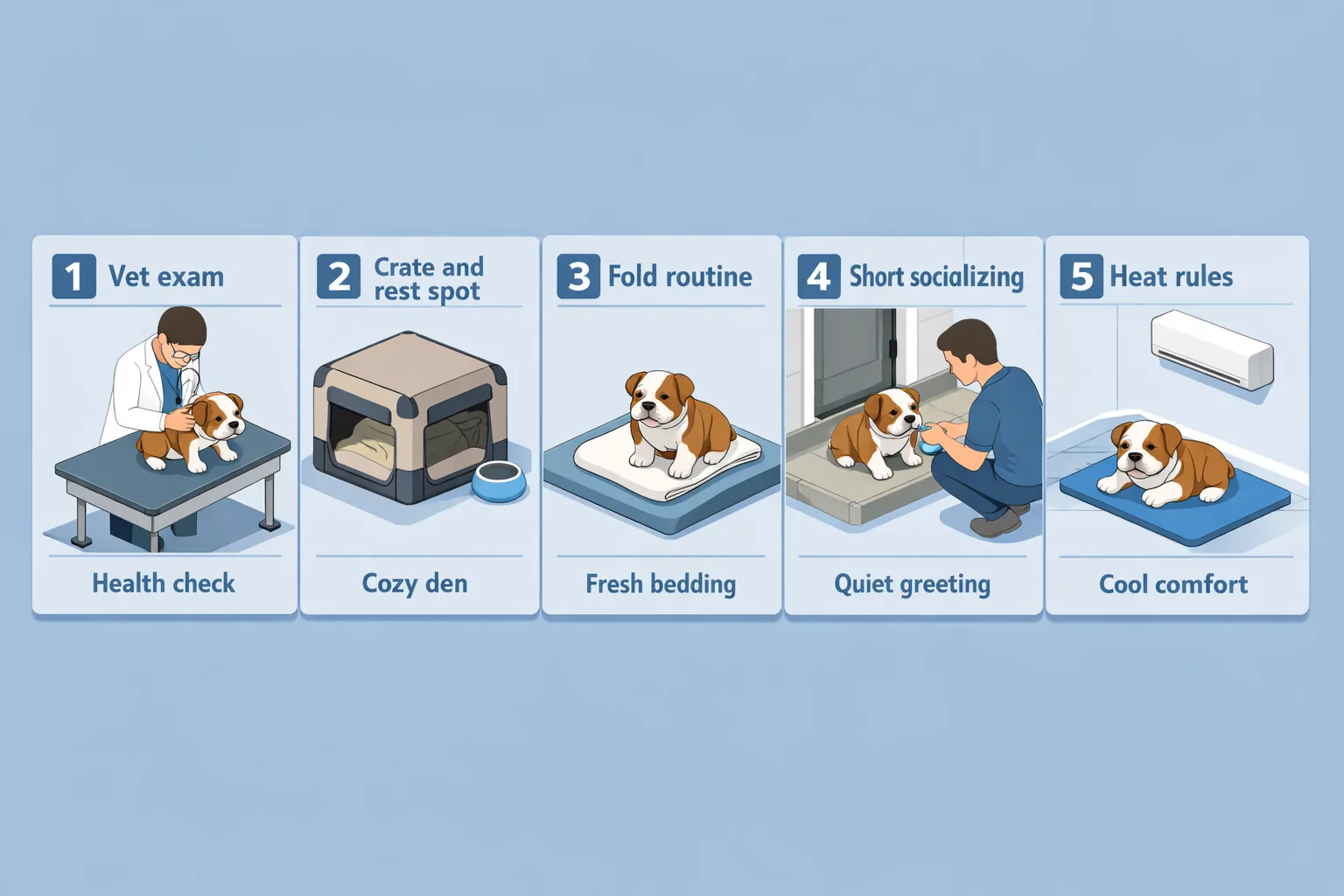
- Book a vet exam in the first week. Ask specifically about nostril width and palate. Early knowledge changes the plan.
- Keep the home at a steady temperature. Puppies overheat faster than adults.
- Start fold wiping on day two, even if the folds look clean. You are training tolerance, not treating a problem.
- Crate as a rest spot, never a punishment.
Days 15 to 45
- Socialize in short, low-heat sessions: car rides, calm visitors, different floor surfaces, the vet lobby for a treat and out again.
- Handle paws, ears, mouth and tail daily.
- Begin name, sit and mat settling. Three minutes at a time.
- Introduce the grooming tools before you need them.
Days 46 to 90
- House training should be reliable by now for many pups, patchy for others. Both are normal.
- Start lead walking on a harness, five to ten minutes.
- Weigh monthly and plot it. Catching early weight gain is the cheapest health intervention available.
- Discuss neuter timing and anesthesia protocol. Ask what monitoring the clinic uses for flat-faced patients.
Common first-90-days mistake: letting a puppy play hard with an older dog in a warm yard. Puppies do not self-regulate. You have to call time.
What English Bulldog Owners Say
Owner forums are blunt about the two hardest parts of this breed: the guilt and the demands.
“Do you guys ever have regrets/guilt?”
That question was posted by an owner on Reddit in r/englishbulldog. The feeling is widespread and it is not a sign you are a bad owner. Practical response: separate the guilt you can act on from the guilt you cannot. You cannot change the skull your dog was born with. You can keep him lean, get an airway assessment, fix narrowed nostrils early rather than at age seven, and choose rescue or an outcross next time. The 2024 Animal Welfare crossbreeding research found better health outcomes in outcrossed brachycephalic dogs with behavior and the owner bond preserved (cambridge.org), which means the affectionate Bulldog temperament does not have to come packaged with the airway.
“Are all bulldogs this demanding?”
Posted by an owner on Reddit in r/Bulldogs. Short answer: many are, and it surprises people who bought the lazy-couch-dog image. Practical response: demanding behavior in Bulldogs is usually unmet mental need plus physical discomfort, not spoiling. Add two short enrichment sessions a day, feed at least one meal from a puzzle or snuffle mat, and build a trained settle on a mat so lying down becomes a rewarded behavior instead of a loss. Then check skin, ears and eyes. A dog who cannot get comfortable will keep asking you to fix it.
English Bulldog FAQ
How long do english bulldogs actually live? Commonly 8 to 10 years (petmd.com). Lean body condition, managed airway and well-cared-for skin tend to sit at the longer end. Obesity and untreated BOAS shorten it.
Do english bulldogs need a lot of exercise? No. Roughly 20 to 40 minutes a day of low-intensity walking in cool conditions, split into short sessions, plus indoor enrichment.
Are english bulldogs good apartment dogs? Usually yes. They are quiet, low-mileage and content indoors. Check stair access and make sure cooling is reliable in summer. Our apartment dog breed guide compares other options.
How often should I clean the wrinkles? Every one to three days in most climates, daily in hot humid weather. Wipe with a damp cloth or vet-recommended wipe, then dry completely. Trapped moisture causes most infections.
Is snoring normal for an english bulldog? Mild snoring is common. Loud rasping, gagging, regurgitation, poor stamina or sleeping propped up are not, and warrant an airway assessment.
English bulldog vs French Bulldog, which is healthier? Both are brachycephalic with similar airway and heat risks. French Bulldogs are smaller, often slightly longer-lived and easier to transport. Neither is a low-risk breed.
What are healthier breeds that look or act similar? Boston Terrier, Staffordshire Bull Terrier, Olde English Bulldogge, Basset Hound, and Bulldog crossbreeds, which showed better health outcomes with behavior preserved in a 2024 Animal Welfare study (cambridge.org).
What is the biggest mistake new bulldog owners make? Letting the dog get heavy. Obesity carried about 3.8 times the odds of BOAS in the 2026 PLOS ONE data. Weigh monthly and feed to body condition, not to the bag.
Conclusion and Next Steps
The english bulldog is a genuinely lovely companion attached to a genuinely difficult body. If you want this breed, go in with a plan rather than a hope.
Do these five things in order:
- Budget honestly. Puppy price plus $2,000 to $3,500 a year, plus an emergency fund or insurance started before any symptoms appear.
- Buy from a breeder who grades breathing, shows hip and eye results, and will talk openly about C-sections and airway surgery. Or adopt from a Bulldog rescue.
- Book an airway and skin baseline with your vet in the first week and again around 12 months.
- Set the fold routine on day one, and weigh your dog monthly.
- Make a summer rule now: no walks above about 75 degrees, no car waiting, air conditioning non-negotiable. Heatstroke and sudden breathing distress are emergencies. Call a vet immediately rather than waiting.
Still deciding? Run your household through our breed matchmaker guides before you put down a deposit.