Quick Answer
Dogs are specialists, not all-rounders. Ask how smart are dogs and the evidence-led answer is this: they are unusually good at reading human signals, solid at learning rules and routines, and fairly ordinary at physical cause-and-effect puzzles compared with some birds and primates. In 2026, EEG work at Eötvös Loránd University found that dog brains track consonant patterns in continuous speech much the way human brains do. There is still no valid IQ number for a dog, and no study supports a single ranking of all dog minds. Guidance here checked October 2026.
Key Takeaways: How Smart Are Dogs?
- No dog IQ score exists. There is no validated test that converts canine cognition into a human-style number. Any “dog IQ” figure online is a marketing device or a game.
- Dog intelligence is a profile, not a score. Published reviews describe separate abilities: social cognition, learning speed, memory, inhibitory control, problem solving, communication, sensory discrimination, and adaptability. A dog can be brilliant at one and average at another.
- The human cue reading is the standout skill. Following a point, checking your face, reacting to attention, and learning from a demonstration are areas where dogs beat most other species tested.
- Brain research is young and the samples are small. The headline 2026 EEG and fMRI studies used 14 to 20 dogs each. Real findings, narrow samples.
- Word learning happens, but prodigies are rare. A handful of documented dogs learned hundreds of object names. Most pet dogs learn a working vocabulary of cues and a few toy names.
- Breed shifts the odds, not the outcome. The 2022 Darwin’s Ark study in Science found breed explained only a small slice of behavioral differences between individual dogs.
- Training builds skills, not raw brainpower. You can expand what a dog knows, how well it concentrates, and how fast it picks up new rules. That is the realistic version of “making a dog smarter.”
- Age matters in both directions. Puppies learn fast and forget fast. Older dogs can show measurable cognitive decline, which is now the subject of active aging research.
How smart are dogs compared to human toddlers?
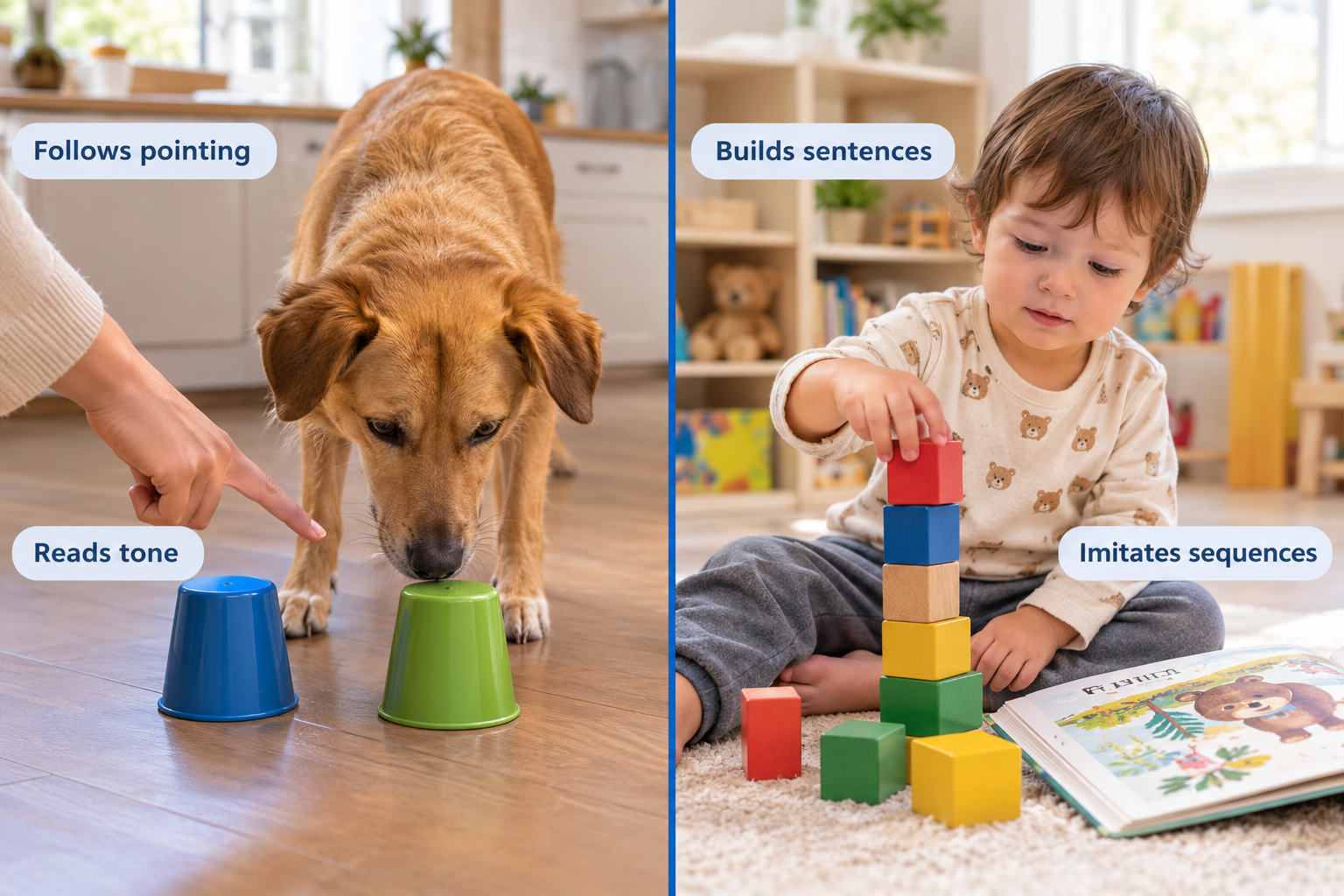
The toddler comparison is an expert interpretation, not a measurement. Stanley Coren, the psychologist behind The Intelligence of Dogs, popularized the idea that many dogs handle a vocabulary roughly in the range of a two-year-old child. It is a useful mental picture for owners. It is not the output of a shared test given to both species under the same conditions.
The comparison helps in one way and misleads in three.
Where it holds up: both a toddler and a trained adult dog can follow simple spoken cues, read a pointing gesture, remember where something was hidden, and work out that a person’s attention is pointed somewhere.
Where it falls apart:
- Language structure. A two-year-old starts combining words into new meanings. Nothing in the dog literature shows that. Dogs appear to treat a cue as a label or an instruction, not as grammar.
- Smell. A toddler cannot detect the odor trail of a person who walked past twenty minutes ago. Many dogs can. That ability has no place on a human developmental scale.
- Direction of the comparison. Toddlers are headed somewhere. A two-year-old will build sentences, do arithmetic, and read. A three-year-old dog is close to its adult ceiling for abstract reasoning.
On raw brain scaling, humans win by a wide margin. Comparative reviews of brain-to-body scaling put the human encephalization quotient near 7 and the dog’s near 1.2, meaning human brains are far larger than body size would predict. Encephalization is a rough proxy, and it does not predict performance on specific tasks, but it does put the “dogs are basically small people” idea to rest.
Decision rule: use the toddler analogy to set expectations about patience and attention span. Do not use it to assume your dog understands sentences, fairness, or spite.
What kinds of intelligence do dogs have?
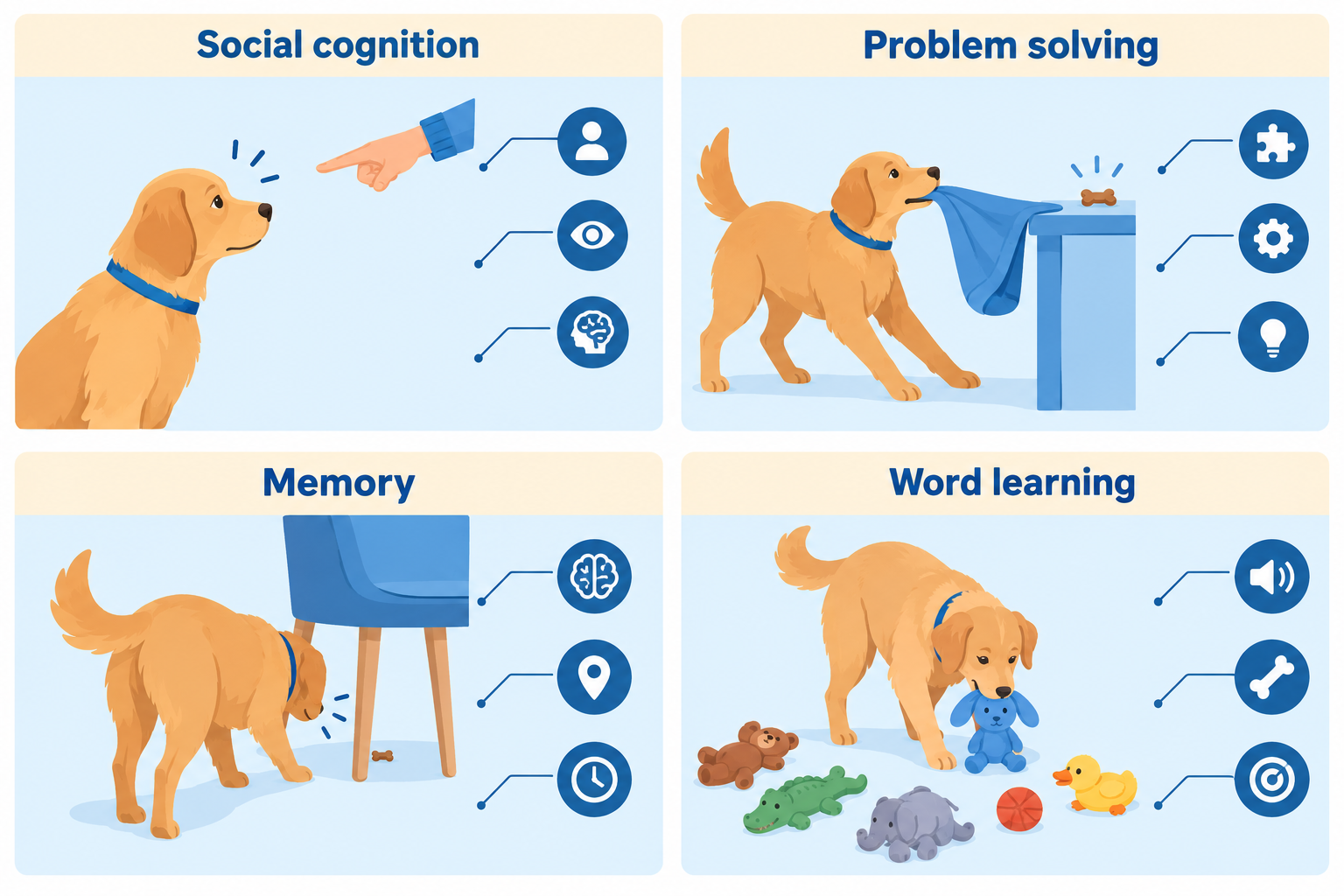
Dog cognition is best described as a set of separate abilities that do not rise and fall together. Cognition researchers typically break it into social cognition, learning speed, memory, inhibitory control, problem solving, communication, sensory discrimination, and adaptability. The dog who learns twelve toy names may also be the dog who cannot work out a door that pushes instead of pulls.
Can dogs solve problems and think critically?
Dogs solve problems, mostly by trial, error, and recruiting you. The well-documented canine pattern on a sealed container is to try it briefly, then look at the nearest human face. Brian Hare and Michael Tomasello’s influential framework argues that domestication selected for exactly this: cooperation with people rather than solitary persistence. Hand-raised wolves in comparison studies tend to keep working at a physical puzzle longer and ask for help less.
That is not proof of weak reasoning. It is a different strategy. A dog that checks your face has read the room correctly, because the room contains a person who opens jars.
Where dogs look weaker is causal reasoning about physical objects: understanding why a string moves a treat, or why a support surface matters. Comparative researchers stress that dog strength in human-directed communication does not transfer to every form of physical problem solving or to cooperation with other dogs.
How good is a dog’s memory really?
Dogs have strong associative and spatial memory, decent short-term recall of a few seconds to a few minutes in lab tasks, and some documented ability to recall a specific past event they were not told to remember. What they do not appear to have is the human habit of replaying autobiography in detail.
Practical version, and this is the part owners feel:
- A dog remembers places, people, routines, and outcomes extremely well.
- A dog’s memory for a single neutral event from an hour ago is weak.
- A dog’s memory for one frightening event can be long-lasting and specific, which is why a single bad grooming session can reshape behavior for months.
Sleep is part of the picture. Memory consolidation during sleep has been reported in dogs after learning sessions, which fits with how much of the day dogs spend asleep.
Common mistake: punishing a dog for something it did while you were out. Even if the memory existed, the connection between the act and your reaction twenty minutes later does not.
How intelligent are dogs compared to other animals?
Cross-species comparisons depend almost entirely on the task. Change the test and the ranking changes with it. The table below reflects what the published literature supports, in plain terms.
One caveat worth repeating: a species that fails a task may simply be failing that task. Pigs struggle with pointing partly because of how they are built and how they relate to people, not because the cognitive machinery is missing.
What does brain research say about dog intelligence?
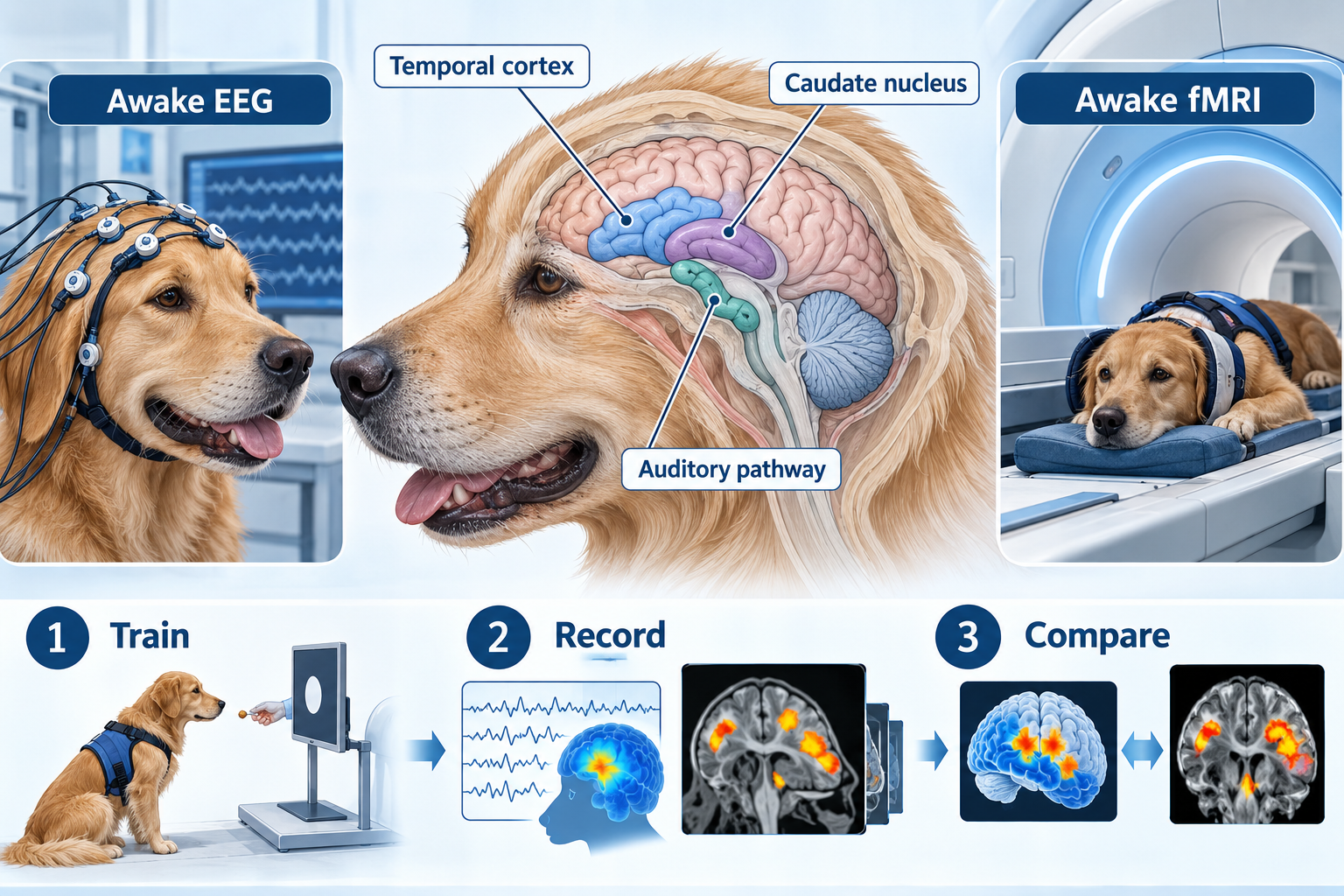
Brain research has moved from guessing at dog minds to recording them, and the 2026 results point toward shared mechanisms with humans in speech processing, self-restraint, and face reading. The samples are small and the conclusions are narrow, which matters more than the headlines suggest.
Three recent findings, with their limits attached.
Speech segmentation. Researchers at Eötvös Loránd University compared EEG responses from 20 dogs and 20 humans listening to continuous speech streams. Both species synchronized more strongly to recurring consonant-defined word patterns than to vowel-defined or random ones, and both showed a neural response about 400 milliseconds after word onset. Coverage of the work noted that dogs may pick words out of speech in a way that resembles infant language learning. What it did not establish: that dogs understand the words they segment.
Self-control. In a study published in Animal Cognition, researchers recorded 226 EEG segments of about 30 seconds each from 14 dogs, comparing periods when the dogs held a restraint command against periods of idling. The restraint periods produced activity patterns with human-like features. What it did not establish: conscious willpower, or identical frontal-lobe organization. Shared neural dynamics is a narrower claim than shared experience.
Faces and emotion. University of Vienna researchers using awake fMRI reported that images of smiling human faces activated a temporal-cortex and caudate-nucleus network linked to higher-level processing and reward. Reporting on the work described how brain scans show dogs distinguishing emotions in human faces, and the research release put the sample at 14 dogs. That is neural discrimination in a small, highly trained group, not a population estimate of canine emotional intelligence.
None of this would exist without the earlier method work. Training dogs to lie still, awake and unrestrained, inside a scanner made imaging the canine brain possible in the first place, and every dog in those studies volunteered in the sense that it chose to climb in.
Do dogs have emotions and self awareness?
Dogs clearly have emotional states with measurable brain and body signatures. Self-awareness is partly supported, in a form that looks nothing like the human version.
On emotions: the Vienna face-processing work supports discrimination of human expressions, and reward-network activity in response to human faces and praise has been reported repeatedly in fMRI studies. What the evidence supports is that dogs have affective states and respond to ours. What it does not support is complex social emotions like guilt. The famous “guilty look” tracks your scolding posture better than it tracks whether the dog actually did anything, which is also part of why head tilts get over-interpreted.
On self-awareness: dogs generally fail the mirror test. Studies using scent instead, where a dog is presented with its own odor and a modified version of it, report that dogs spend longer investigating the altered sample. That suggests a sense of “mine” in the sensory channel dogs actually prioritize. It is a modest finding, repeatedly replicated in small samples, and it does not demonstrate reflective self-concept.
How do dogs learn, and what age are dogs most intelligent?
Dogs learn by association, consequence, and watching. Learning speed usually peaks in young adulthood, roughly one to about seven years for most dogs, while puppies learn fast but retain unevenly and seniors can lose processing speed.
The main learning routes:
- Classical association. Leash means walk. Lid means dinner. Fast, durable, and running in the background whether you intend it or not.
- Consequence learning. Behavior that pays repeats. This is the engine of humane training built on rewards rather than intimidation.
- Social learning. Claudia Fugazza’s “Do as I Do” method at the Family Dog Project showed dogs can reproduce a human-demonstrated action on cue, including after a delay.
Age, in practical terms:
- 8 to 16 weeks: peak social sensitivity. What a puppy experiences now shapes later confidence more than later training does.
- 4 to 12 months: fast acquisition, poor impulse control, patchy recall of what was learned last week.
- 1 to 7 years: best combination of attention, motivation, and inhibitory control for most dogs.
- 8 years and up: possible slowing, disrupted sleep, and reduced flexibility in learned tasks. Cognitive aging is now an active research target, including a University of Arizona study on growth hormone signaling and cognitive aging in dogs, while puppy cognitive development research at the same institution works from the other end of the lifespan.
Edge case: a dog that suddenly stops responding to familiar cues is not necessarily stubborn or declining. Hearing loss and vision loss both look like disobedience, and vision in dogs differs from ours in ways owners underestimate. Get the senses checked before rewriting the training plan.
Are some dog breeds smarter than others?
Breed shifts probabilities for specific traits, especially trainability and working style, but it does not determine an individual dog’s cognitive profile. The best-known ranking is also the most misread.
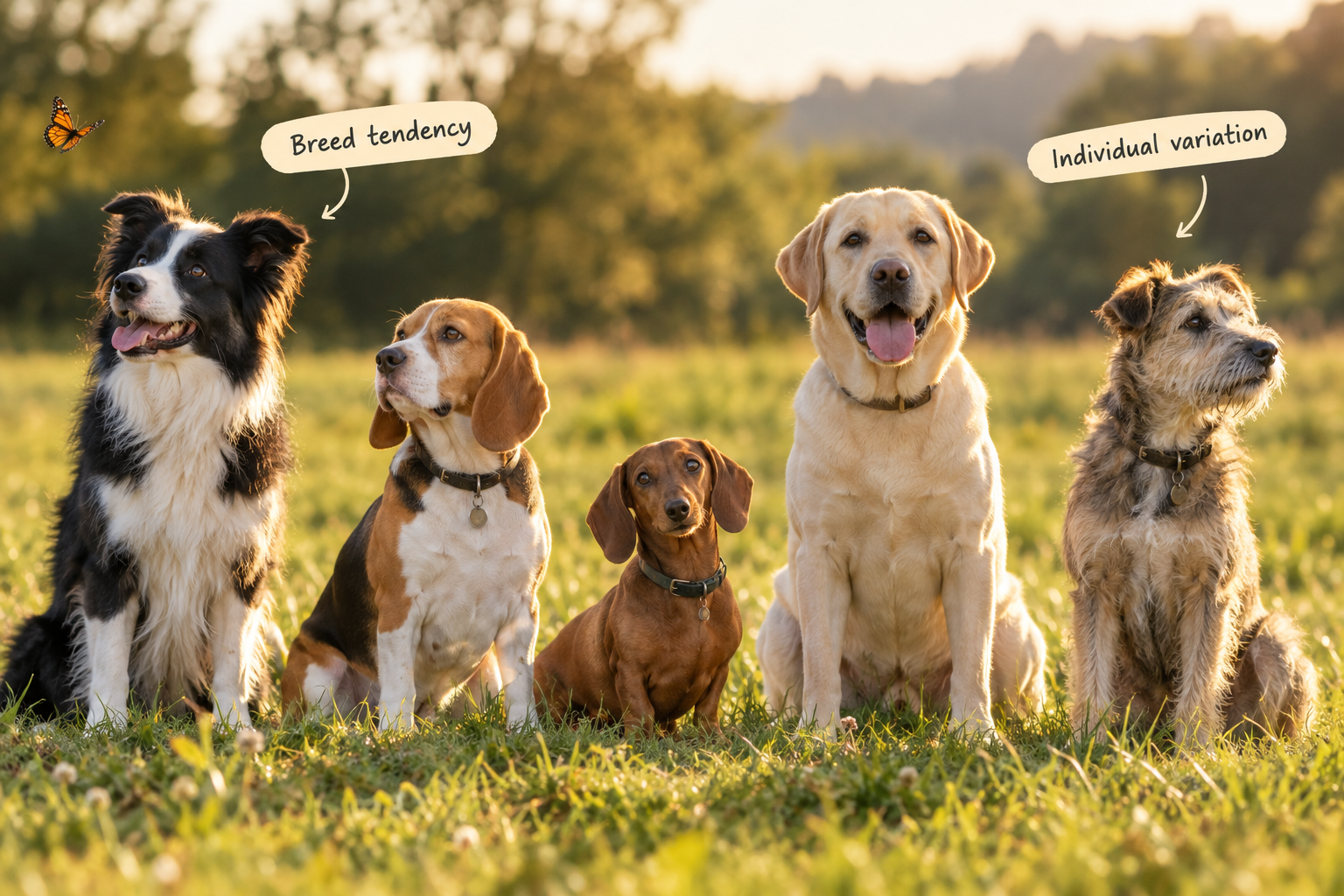
Stanley Coren’s breed ranking in The Intelligence of Dogs came from surveys of obedience judges and measured one thing: how quickly dogs of a breed learned and complied with formal obedience commands in competition settings. That is working and obedience intelligence. It is genuinely useful if you want a dog who picks up new cues fast. It is not a measure of memory, problem solving, or social reasoning, and Coren himself separated it from instinctive and adaptive intelligence.
Then the genetics arrived. The 2022 Darwin’s Ark study in Science, led by Kathleen Morrill with Elinor Karlsson, combined owner surveys with genetic data on thousands of dogs and found that breed explained only about 9 percent of behavioral variation between individual dogs. Biddability, the willingness to take direction, showed the clearest breed signal. Most other behaviors did not sort neatly by breed at all.
A separate 2016 review highlighted testing of 68 Border Collies that produced some evidence for a general cognitive factor in dogs, similar in shape to the human “g.” The authors flagged the obvious limits: one breed, selected for work, small sample, uncertain generalization to dogs as a whole.
Two research centers to know if you want to follow this further. The Duke Canine Cognition Center under Brian Hare built the citizen-science platform Dognition, which turned owner-run cognitive games into a large dataset. The Yale Canine Cognition Center runs studies on reasoning and social evaluation with volunteer pet dogs. Neither issues an IQ score, because there is nothing valid to score.
If you want the breed-by-breed version of this question, including what the rankings actually measure, see the most intelligent dog breeds and what smart really means, and if you are choosing a dog rather than studying one, start with how to pick a dog breed that fits your life.
Why do some dogs seem smarter than others?
Most of the gap owners notice is motivation, clarity, and practice, not processing power.
- Motivation. A dog uninterested in your treats looks slow. Change the payoff and the same dog looks sharp.
- Training history. A dog who has learned twenty cues learns the twenty-first faster. Learning how to learn is real.
- Arousal. An excited or anxious dog performs badly on anything requiring restraint. The 2026 EEG restraint work is a reminder that holding still is itself a brain task.
- Senses. Hearing and sight problems mimic poor comprehension.
- Individual variation. Two littermates raised in the same house can differ more than two breeds do on average.
How to test your dog’s intelligence at home
You cannot measure a dog’s intelligence at home, and nothing you do on the kitchen floor produces a score. What you can do is observe which specific skills your dog shows today, using simplified versions of tasks from the research literature. Treat the result as information about one dog on one afternoon.
What the 2026 brain studies actually measured
Can dogs understand words?
Dogs can learn spoken labels for objects, and a small number of documented dogs learned hundreds. Where the facts end: there is no evidence that dogs understand syntax, or that a typical pet dog can be trained into a prodigy.
The two best-documented lines of work:
Chaser, the Border Collie. Psychologist John Pilley trained and tested Chaser over years, reporting recognition of more than 1,000 object names, plus the ability to pick a novel object by exclusion when asked for an unfamiliar name. That is a single dog with an unusual trainer and thousands of hours of practice.
The Genius Dog Challenge. Claudia Fugazza and colleagues at the Eötvös Loránd University Family Dog Project recruited a handful of dogs whose owners claimed exceptional toy-name learning, then tested them under controlled conditions. The gifted dogs learned new toy names quickly. The researchers’ blunt conclusion was that this talent is extremely rare, and most of the standout dogs were Border Collies.
For the average household dog, a realistic picture looks like this: reliable response to a set of trained cues, recognition of several toy or person names, strong reading of tone and context, and no grammar. “Go get your ball from the kitchen” works because of the trained word plus the room you are standing in, not because the sentence parsed.
The 2026 consonant-tracking results add something useful here. If dog brains pick out word-shaped units from running speech, then clear and consistent consonants matter more than volume or sweetness of delivery. Short distinct cues beat long sentences. “Wait” and “watch” are a harder pair than “wait” and “come.”
How can you keep your dog’s brain sharp?
Training and enrichment expand what a dog knows and how well it concentrates. No evidence supports the idea that you can raise a dog’s underlying cognitive ceiling, and nobody should sell you that.
What the evidence supports, as practical routine:
- Keep teaching new things. Novel cues and new tricks give the learning system something to do. Older dogs benefit from short, easy, high-success sessions.
- Use food-based problem solving. Snuffle mats, scatter feeding, and puzzle feeders such as the Nina Ottosson range by Outward Hound turn a two-minute meal into a ten-minute task. Who it suits: dogs who inhale food, dogs on restricted exercise, apartment dogs with long indoor stretches. Not for dogs who guard food or destroy plastic, and supervision is the condition, not the extra.
- Let the nose work. Twenty minutes of sniffing a hedgerow is more cognitively demanding than a brisk mile on pavement. Free sniffing time is the cheapest enrichment available.
- Protect sleep. Learning consolidates during rest. A dog woken constantly is a dog learning less.
- Train with rewards. Fear-based methods suppress behavior and raise arousal, which reduces the inhibitory control the 2026 restraint study was measuring in the first place.
Decision rule: if your dog solves a puzzle feeder in under a minute, do not buy a harder one. Change the task type instead. Swap a sliding puzzle for a scent search, because variety does more than difficulty.
FAQ
Are dogs smarter than cats?
There is no fair test that settles it. Dogs outperform cats on human cue reading tasks in published comparisons, partly because cats are harder to test and less motivated to cooperate with strangers. On physical problem solving the two species are closer than owners of either expect.
What is the IQ of dogs?
Dogs do not have an IQ. IQ is a statistical score standardized on human populations, and no validated canine equivalent exists. Any site giving your dog a numeric IQ is running a quiz, not a test.
How smart are dogs compared to humans?
Humans outperform dogs on language, abstract reasoning, and planning by a wide margin, and human brains are far larger relative to body size, with an encephalization quotient near 7 against about 1.2 for dogs. Dogs outperform humans on scent discrimination and on tracking certain human social signals faster than we track them ourselves.
Are dogs smarter than wolves?
Not overall. Hand-raised wolves usually match or beat dogs on independent physical problem solving and persistence, while dogs are better at reading human gestures and attention. Domestication appears to have shifted the strategy rather than raising the ceiling.
Are dogs smarter than pigs?
Pigs do very well on operant and touchscreen learning tasks, sometimes better than dogs. Dogs are clearly ahead on human-directed communication. The honest answer is that the two species are good at different things.
Which dog has the highest IQ?
No breed does, because there is no IQ measure. Border Collies dominate obedience-based breed rankings and appear most often among documented word-learning prodigies, which is a real pattern about trainability and not a guarantee about any individual collie.
How many words can dogs learn?
Most pet dogs reliably learn a few dozen cues and names with regular practice. Documented exceptional dogs such as Chaser learned over 1,000 object labels, and the Genius Dog Challenge researchers described that level of talent as rare.
What do dogs think about all day?
Nobody can answer that from current evidence. Brain research shows processing of smells, sounds, human faces, and anticipated rewards, plus long stretches of sleep. Anything more specific, including imagined dog monologues, is entertainment rather than science.
Conclusion: one next step
The most useful reframe for any owner asking how smart are dogs is to stop looking for a number and start looking for a profile. Your dog has a shape to its mind: maybe a brilliant nose and poor impulse control, maybe fast cue learning and zero interest in puzzles, maybe a talent for reading your face from across the room before you have decided anything yourself.
Next step: run two of the games in the widget above this week, one social task and one physical task. Note which one your dog took to and which one it ignored. Then build the next month of enrichment and training around the skill your dog actually brought to the floor, rather than the skill a breed ranking promised. That is Dog Advice That Actually Answers the Question, applied to the dog in your house.
#dogscience #dogcognition #humanedogtraining