
Quick Answer
Oral flea medicine for dogs works from the inside out: the dog swallows a chew, the active ingredient circulates in the bloodstream, and fleas or ticks die after they bite. Spot-on topicals either sit in the skin’s oils and kill on contact or absorb through the skin and work systemically. The five differences that actually change a buying decision are speed of kill, what happens when the dog swims or gets a bath, the side effect and household-safety picture, the environmental footprint, and cost plus prescription rules. Guidance checked October 2026.
Key Takeaways: Oral Flea Medicine for Dogs
- Most modern chews (NexGard, Simparica, Credelio, Bravecto) belong to the isoxazoline class and kill parasites after a bite, so they are not repellents.
- Oral and systemically absorbed products are the usual choice when you want most fleas dead within about 12 hours, according to the Merck Veterinary Manual’s flea chapter.
- Cornell’s veterinary college notes that oral isoxazolines generally do not stop a tick from attaching, which matters for tick-borne disease risk.
- Water is the clearest practical split: a chew survives the lake, many topicals need up to two dry days.
- The FDA has linked the whole isoxazoline class, oral and topical, to rare neurologic reactions including tremors, ataxia and seizures.
- Dog topicals containing permethrin, such as K9 Advantix II, are toxic to cats. That single fact decides the choice in plenty of multi-pet homes.
- Almost all monthly oral flea medicine for dogs is prescription-only in the US. Capstar (nitenpyram) is the notable over-the-counter pill, and it only kills adult fleas for about a day.
- 2026 brought label changes worth knowing: the FDA’s Green Book records March 16, 2026 supplements adding a 12-month injectable fluralaner option and new tick indications for Bravecto Quantum and NexGard.
What is oral flea medicine for dogs and how does it work?
Oral flea medicine for dogs is a flavored tablet or chew containing an insecticide that the dog absorbs into the bloodstream. Fleas and ticks that bite the treated dog take in the drug and die. Nothing is applied to the coat, so nothing rubs onto the sofa, the toddler, or the cat.
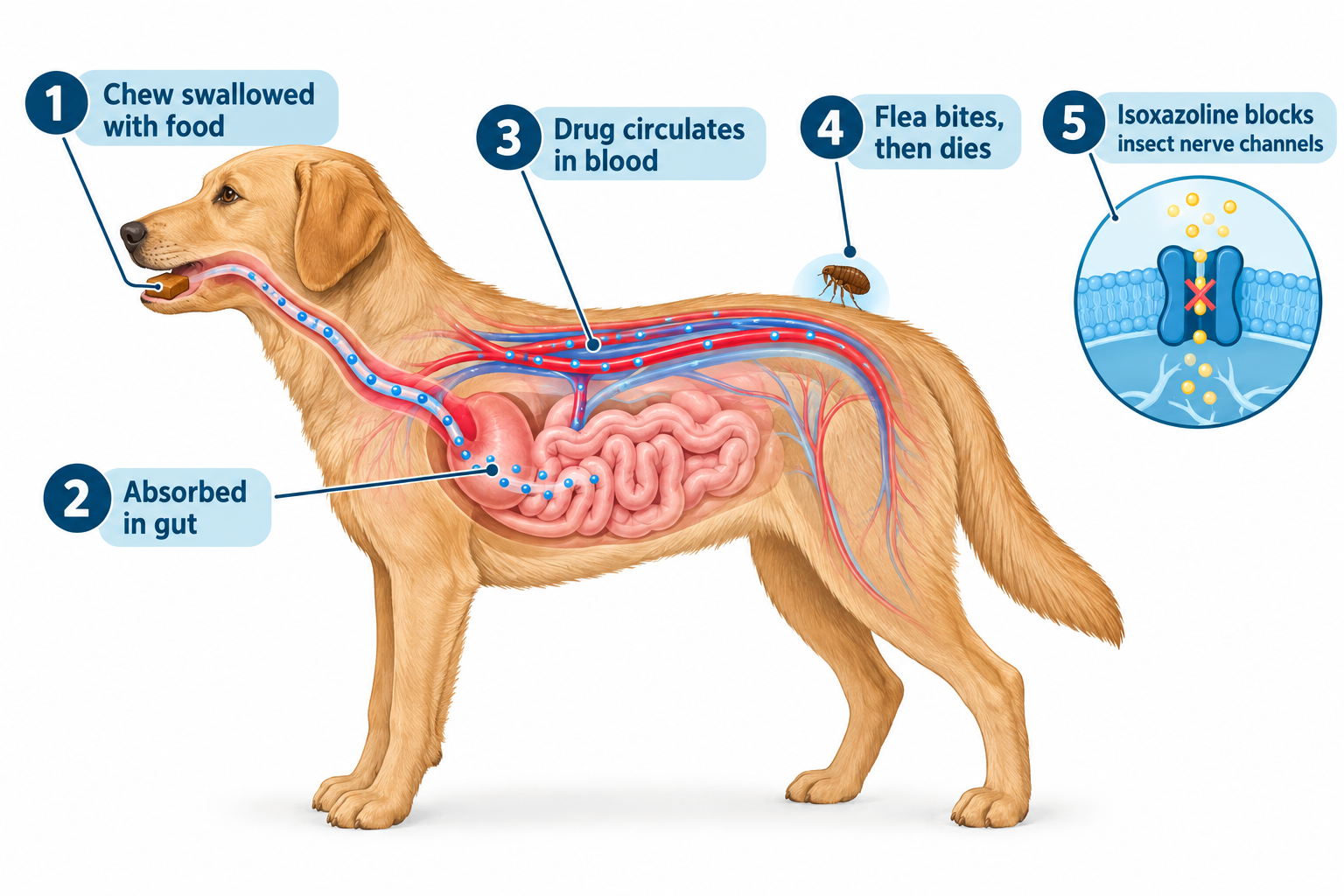
The dominant drug family is the isoxazolines: afoxolaner (NexGard, NexGard PLUS), fluralaner (Bravecto), sarolaner (Simparica, Simparica Trio) and lotilaner (Credelio). They block chloride channels in insect and arachnid nerve cells, which overstimulates the parasite’s nervous system. Mammal nerve channels are built differently, which is why these drugs can be dosed safely in most dogs at the label amount while being lethal to a flea.
Two things follow from that mechanism, and both get missed in product listings:
- The flea has to bite. A systemic chew interrupts the flea life cycle quickly, but it does not create an invisible fence around your dog.
- Speed matters more than “prevention” marketing. A 2026 peer-reviewed evaluation of an oral fluralaner formulation over 49 days reported flea efficacy between 99.7% and 100% and tick efficacy between 98.3% and 100% under controlled and field conditions. Strong numbers, from a defined study window, in dogs enrolled under study conditions. Not a promise about your specific dog in a flea-saturated apartment building.
One outlier worth naming: Capstar (nitenpyram, Elanco) is an oral tablet that kills adult fleas on the dog within hours and then stops. It is a rescue dose for an active infestation, not monthly cover.
What are the 5 real differences between oral flea medicine for dogs and topicals?
The short version: chews win on speed, water resistance and dosing accuracy; topicals win on avoiding systemic drug exposure, on some ectoparasite coverage, and on availability without a prescription. Below is each difference with the evidence and the decision rule.
Difference 1: Speed of kill
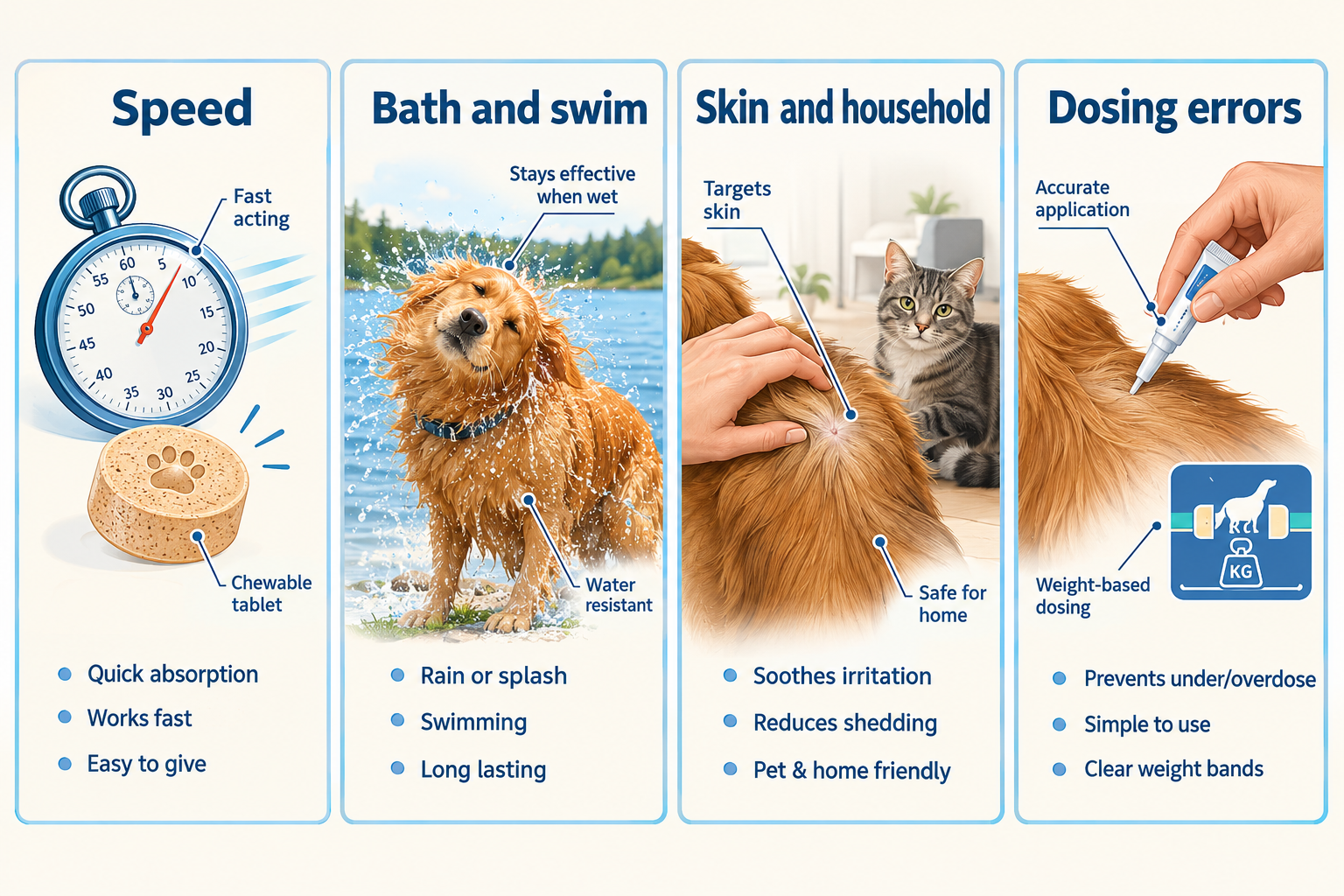
Systemic products are the faster option in most head-to-head descriptions. The Merck Veterinary Manual describes oral or systemically absorbed products as the desirable choice when the goal is eliminating most fleas within roughly 12 hours. A veterinarian-reviewed comparison published by PetMD reports that many oral flea medicines kill up to 99% of adult fleas within four hours, while some topicals take 12 to 24 hours to kill around 90%.
Choose a chew if: your dog is already scratching, you have flea dirt on the bedding, or someone in the house reacts badly to flea bites.
Difference 2: Bathing, swimming and rain
A swallowed dose cannot be washed off. Cornell’s flea and tick guidance notes that most topicals need to dry and that, depending on the label, bathing or swimming may need to be avoided for up to two days after application.
That is the whole argument for many households. A spaniel who swims every afternoon and gets a weekly bath is a bad candidate for a contact-killing spot-on, because the product is being partly removed on the schedule it depends on.
Common mistake: applying a spot-on the night before a grooming appointment. The groomer’s shampoo and the product’s label are now in direct conflict.
Difference 3: Side effects and who else lives in the house
Oral products put the drug inside the dog. Topicals put it on the dog, where it can transfer to hands, upholstery, children and other pets for a while after application.
The household risk is not theoretical. Dog products containing permethrin, including K9 Advantix II, are toxic to cats. A cat who grooms a freshly treated dog can get a serious pyrethroid poisoning. If you live with cats, that detail outranks almost every other feature on the box.
Oral dosing also removes a cluster of application errors: product landing on fur instead of skin, the dog shaking it off, or the wrong weight band. The trade is that an oral dose only counts if the dog swallows and keeps it.
Difference 4: What ends up in the environment
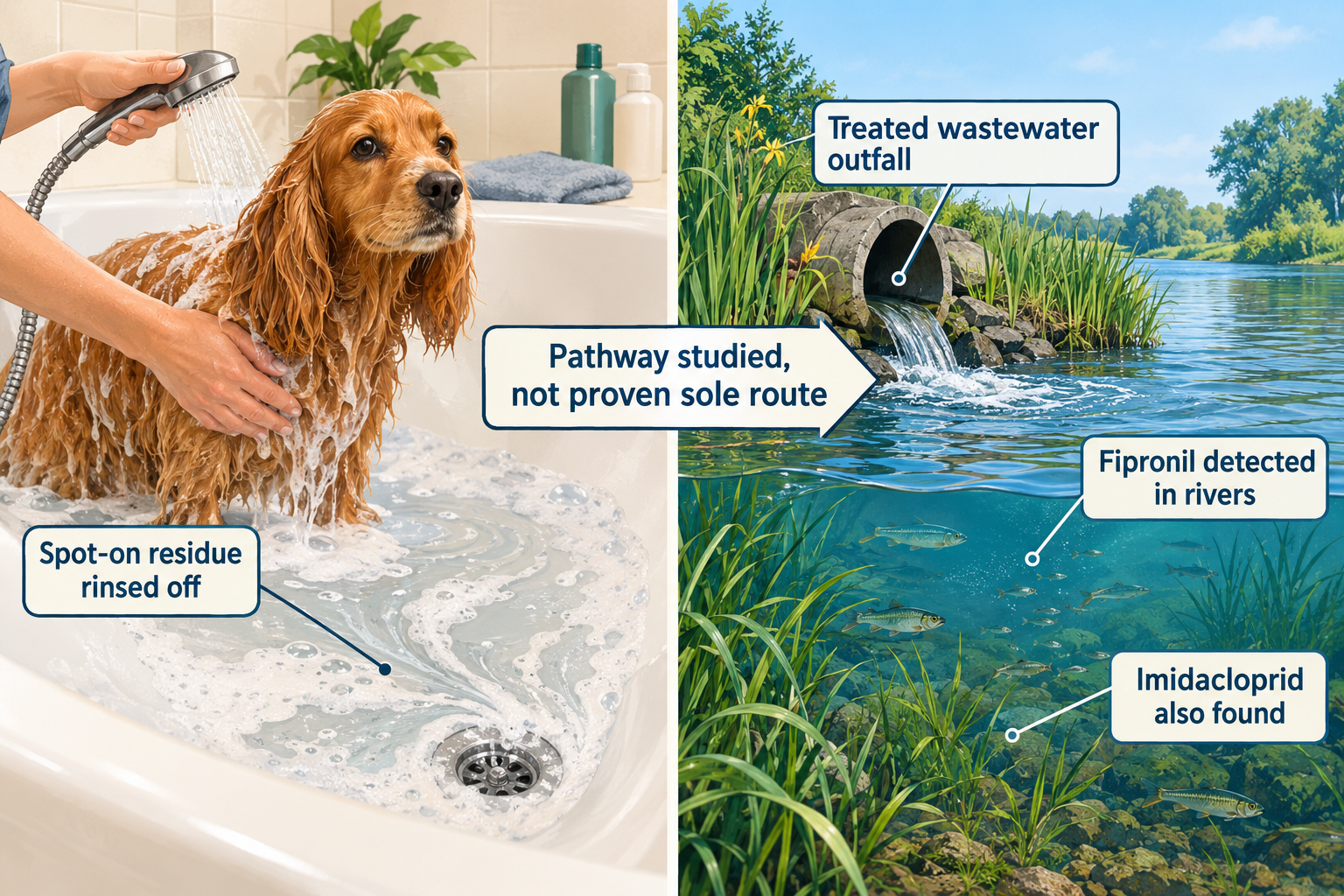
Spot-on insecticides sit on the coat and can be rinsed into household drains. Research led by scientists at Imperial College London (Perkins and colleagues, published in Science of the Total Environment in 2021) examined English rivers and found widespread contamination with fipronil and imidacloprid, the active ingredients in common spot-ons, and pointed to veterinary flea products as a likely contributing source. More on the limits of that study below.
Swallowed products are excreted rather than rinsed off, which changes the route but does not make them invisible to the environment.
Difference 5: Cost and prescription access
Topicals are generally the cheaper, easier-to-buy option. Frontline Plus, Advantage II, K9 Advantix II and the Seresto collar are sold over the counter in the US. Monthly isoxazoline chews are prescription products, which means a vet relationship, an exam in most cases, and a per-dose price that climbs with your dog’s weight band.
The comparison table
| Product (maker) | Type | What it covers | Dosing interval | US prescription? |
|---|---|---|---|---|
| Simparica Trio (Zoetis) | Oral chew, sarolaner + moxidectin + pyrantel | Fleas, ticks, heartworm prevention, roundworm, hookworm | Monthly | Yes |
| NexGard PLUS (Boehringer Ingelheim) | Oral chew, afoxolaner + moxidectin + pyrantel | Fleas, ticks, heartworm prevention, roundworm, hookworm | Monthly | Yes |
| Bravecto Chews (Merck Animal Health) | Oral chew, fluralaner | Fleas and several tick species (shorter window for lone star tick) | Every 12 weeks | Yes |
| Credelio (Elanco) | Oral chew, lotilaner | Fleas and listed ticks | Monthly | Yes |
| Capstar (Elanco) | Oral tablet, nitenpyram | Adult fleas only, rapid knockdown | As needed, about 24 hours of action | No |
| Frontline Plus | Spot-on, fipronil + (S)-methoprene | Fleas and flea eggs, ticks, chewing lice | Monthly | No |
| Advantage II (Elanco) | Spot-on, imidacloprid + pyriproxyfen | Fleas and lice. No tick claim | Monthly | No |
| K9 Advantix II (Elanco) | Spot-on, imidacloprid + permethrin + pyriproxyfen | Fleas, ticks, mosquitoes. Toxic to cats | Monthly | No |
| Seresto collar (Elanco) | Collar, imidacloprid + flumethrin | Fleas and ticks, slow release | Up to 8 months per collar | No |
Prices move constantly and vary by weight band, pack size and pharmacy, so check the listing on the day you buy. No prices were independently verified for this article. Coverage claims reflect manufacturer labeling as described at the time of writing (October 2026); the current label on the box is the authority.
Is oral flea medicine for dogs safe, and what are the side effects?
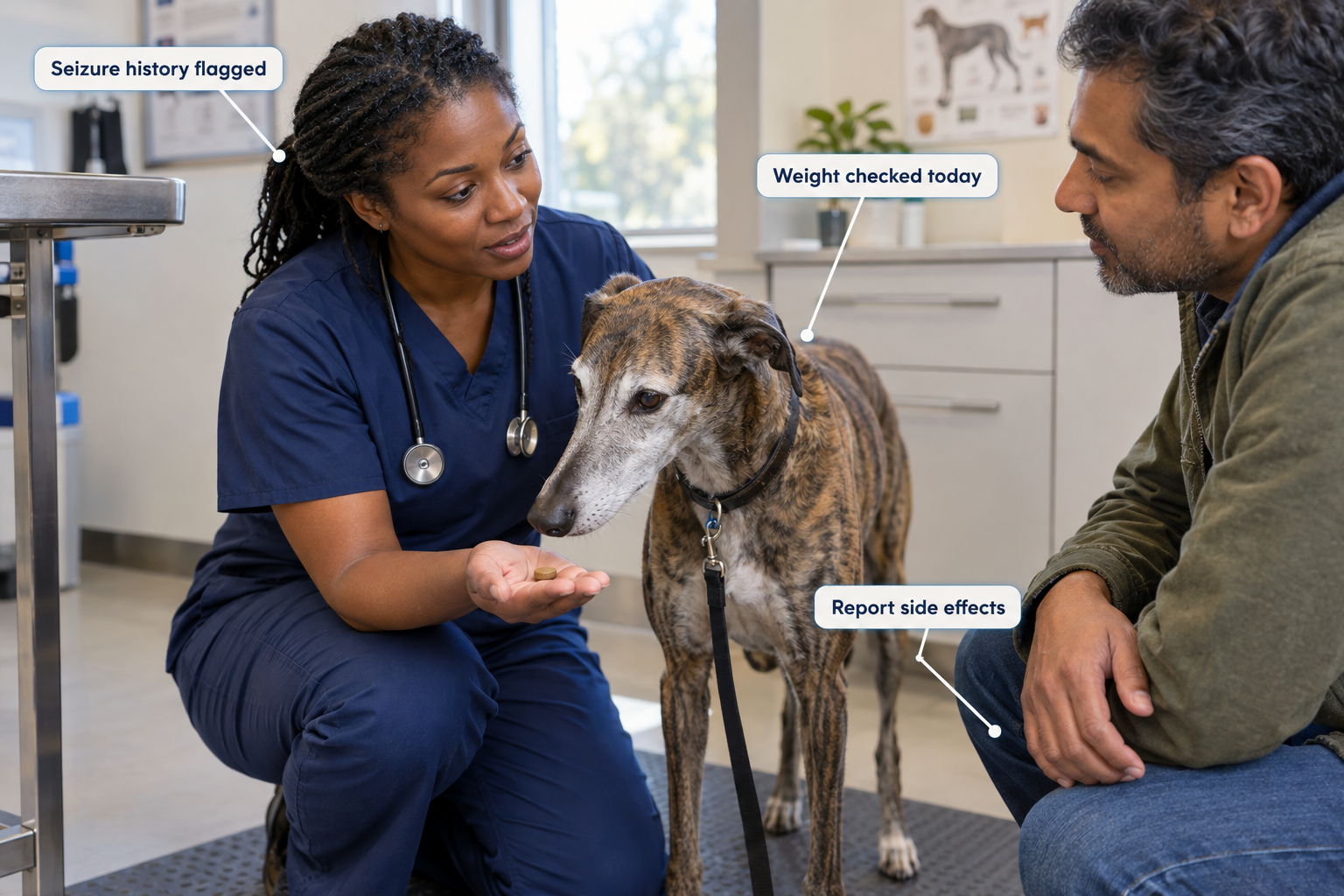
For most healthy adult dogs dosed by label weight, modern oral flea products have a well-documented safety record, and vets prescribe them in enormous volumes. The honest caveat is a class-wide one. The FDA’s fact sheet on isoxazoline flea and tick products states that afoxolaner, fluralaner, sarolaner and lotilaner products have been associated with neurologic reactions in some dogs and cats, including tremors, ataxia and seizures. The agency added that labeling language in 2018 after reviewing adverse event reports.
Commonly reported, usually mild and self-limiting effects across oral products include vomiting, diarrhea, reduced appetite and lethargy. Lethargy is the one owners misread most often, partly because healthy dogs already sleep a great deal; if you are not sure what is normal, how much sleep dogs actually need is a useful baseline before you panic about a dose.
Call your vet if you see tremors, incoordination, a seizure, facial swelling, repeated vomiting or a dog who will not eat for more than a day.
99.7% to 100%
Flea efficacy reported for an oral fluralaner formulation across a 49-day evaluation, controlled and field conditions (Frontiers in Veterinary Science, 2026)
98.3% to 100%
Tick efficacy range in the same 49-day study window (Frontiers in Veterinary Science, 2026)
About 12 hours
Window in which oral or systemically absorbed products can eliminate most fleas, per the Merck Veterinary Manual
Up to 2 days
Bathing or swimming may need to be avoided after a topical, depending on label (Cornell Riney Canine Health Center)
12 months
Flea and tick control from the extended-release injectable fluralaner product recorded in FDA approvals dated March 16, 2026
Is oral flea medicine safer than topical for dogs?
Neither route is categorically safer. They carry different risks. Isoxazolines appear in both oral chews and some topicals, so switching to a spot-on does not automatically avoid the neurologic warning. Topicals add skin reactions at the application site and household transfer risk, including the permethrin-and-cats problem. Oral products add gastrointestinal upset and the need for the dog to retain the dose.
Decision rule: if a dog has a seizure disorder, discuss non-isoxazoline options and route with a veterinarian before buying. If a dog has had a documented reaction to one product, bring the exact product name and date to that appointment.
What if my dog vomits after oral flea medicine?
Call the prescribing vet rather than guessing. Whether a replacement dose is appropriate depends on the product, the time between dosing and vomiting, and whether the chew is visible in what came up. PetMD’s veterinary-reviewed guidance makes the same point: an oral product only works if the dog swallows and keeps it. Do not stack a second full dose on your own.
To reduce the odds, give the chew with a full meal. Several labels specifically recommend dosing with food for better absorption.
Can I give my dog oral flea medicine with food, and how fast does it work?
Yes, and for most products food is the preferred way. Fluralaner and afoxolaner absorption is improved when given with a meal, which is also the easiest way to make sure the chew is swallowed rather than carried off and buried behind a cushion.
On speed: many oral flea medicines begin killing adult fleas within hours, with PetMD reporting up to 99% of adult fleas killed within four hours for some products, and Merck describing systemic products as suitable when you want most fleas gone inside roughly 12 hours. Ticks take longer than fleas. Expect a day or two of dead and dying fleas showing up in the coat, which looks alarming and is actually the product working.
If you hide a pill in food, check what you are hiding it in. Cheese is the classic vehicle and dairy tolerance in dogs is genuinely variable, and some popular human snacks are off limits entirely. Worth a glance at the list of foods dogs should never eat before you improvise with grapes or anything containing xylitol.
Which oral flea medicine for dogs also treats ticks?
All four isoxazoline chews sold for dogs in the US carry tick indications alongside fleas: NexGard and NexGard PLUS (afoxolaner), Simparica and Simparica Trio (sarolaner), Credelio (lotilaner) and Bravecto (fluralaner). Capstar does not. It is a flea-only product.
Which species are covered, and for how long, differs by label. Bravecto Chews, for example, cover most listed ticks for 12 weeks but carry a shorter window for the lone star tick. The FDA’s record of recent animal drug approvals shows March 16, 2026 supplements adding Asian longhorned and Gulf Coast tick indications to the extended-release injectable fluralaner product for dogs and puppies at least six months old, plus a new Gulf Coast tick indication for NexGard.
The limit nobody advertises: Cornell notes that oral isoxazolines generally do not prevent tick attachment. They kill ticks relatively quickly, but a tick still bites. For diseases that can be transmitted early in feeding, that gap matters, which is why some owners in heavy tick country pair a systemic product with a repellent collar or a permethrin-containing topical (cat-free households only) after a vet conversation. Keep checking your dog by hand after walks regardless of what you give.
In February 2026 the FDA also issued emergency use authorizations for NexGard to treat New World screwworm infestations in dogs. Not a routine flea use, and the agency repeated the isoxazoline neurologic caution in that announcement.
Oral flea medicine for dogs with sensitive skin or a reaction to topicals
If a dog develops redness, hair loss, crusting or frantic scratching at the shoulder blades after every spot-on, an oral product removes the trigger entirely because nothing is applied to the skin. That is the clearest single advantage of the chew for allergy-prone dogs.
Two things to separate before you switch:
- Application-site irritation from the carrier solvents or the active ingredient. An oral chew avoids this.
- Flea allergy dermatitis, where the dog is reacting to flea saliva. A fast-killing systemic product helps here, but a dog with established skin disease usually needs treatment for the skin as well as the fleas.
Dogs with food sensitivities need the other check: most chews are flavored, often with beef or pork protein, which can matter for an elimination diet. Ask the vet for an unflavored tablet or a different format if the diet is being controlled tightly.
Dosage for small dogs vs large dogs, and can puppies take oral flea medicine?
Every oral flea product is dosed in weight bands, not by a universal tablet. A 9-pound terrier and an 85-pound shepherd get completely different products from the same brand line, and the chews are not divisible or interchangeable.
Practical points that cause real problems:
- Weigh the dog. Guessing is how dogs end up underdosed at the top of a band. A growing puppy can outgrow a band in a month, which is why understanding adult size categories helps you plan rather than re-buy.
- Never split or combine. Two small-dog chews are not a safe substitute for one large-dog chew.
- Puppy minimums vary by product. Capstar is labeled from 4 weeks and 2 pounds; NexGard from 8 weeks and 4 pounds; Simparica Trio from 8 weeks and 2.8 pounds; Credelio from 8 weeks and 4.4 pounds; Bravecto Chews from 6 months of age. Confirm the current label before dosing, because minimums get updated.
Puppies also change weight weekly, so the month you plan their food is the month to plan their parasite cover. If you are already building a feeding plan, what growing dogs need in year one pairs well with that first vet visit.
How much does oral flea medicine cost for dogs?
Oral prescription chews are generally the more expensive option, and the price depends on three things: the dog’s weight band, the number of doses in the pack, and whether the product bundles heartworm and intestinal worm cover. Over-the-counter topicals and long-acting collars usually cost less per month of protection.
What actually drives the bill:
- Weight. Larger bands cost more per dose across every brand.
- Bundling. A combination chew replaces a separate heartworm preventive, so compare the combined total, not the single box price.
- Pack size. Six and twelve-dose packs normally cut the per-dose price.
- The exam. Prescription products need a valid vet relationship, and heartworm preventives need a heartworm test first.
Check live prices at a prescription pharmacy such as Chewy’s prescription flea and tick pills for dogs or 1-800-PetMeds, then compare against your clinic, which sometimes matches with manufacturer rebates. Prices in this category change often, so no figures are quoted here.
Do spot-on flea treatments pollute rivers?
There is credible evidence that the active ingredients in common spot-ons turn up in rivers, and veterinary flea products are considered a likely contributing source in at least one country’s waterways. Research led by Imperial College London scientists (Perkins and colleagues, Science of the Total Environment, 2021) sampled English rivers and found widespread presence of fipronil and imidacloprid, with the authors pointing to pet flea treatments as a plausible major pathway, most likely via bathing, swimming and washing bedding, with residues reaching wastewater treatment works.
What that study did and did not establish:
- Did: document the pesticides in English river samples and model plausible contributions from domestic pet treatments.
- Did not: measure what one household contributes, quantify harm to a specific river’s fish population, or test US waterways.
- Does not mean: stop treating your dog for parasites. Untreated dogs mean flea infestations, tick-borne disease risk and, in some regions, serious zoonotic exposure.
Sensible middle ground if this concerns you: treat only when there is a reason to treat based on your vet’s local risk advice rather than as a 12-month reflex, follow the label on post-application bathing, and consider an oral product for a dog who swims or bathes often. The EPA’s guidance on controlling fleas and ticks on pets still comes down to the same basics: right species, right weight band, follow the label, and ask a vet about sick, pregnant, nursing, medicated or previously sensitive animals.
Can you get oral flea medicine without a vet prescription?
Mostly no. In the US, the monthly isoxazoline chews (NexGard, Simparica, Credelio, Bravecto) are prescription-only. The main over-the-counter oral option is Capstar (nitenpyram), which kills adult fleas on the dog for roughly a day and does nothing about ticks, eggs or next week’s fleas.
If you want strong protection without a prescription, you are looking at topicals and collars: Frontline Plus, Advantage II, K9 Advantix II and the Seresto collar are all sold over the counter. They are EPA-regulated pesticides rather than FDA-approved drugs, which is a different regulatory route, not a quality verdict.
Online prescription pharmacies such as Chewy and 1-800-PetMeds can fill a chew prescription, but they still contact your veterinarian for authorization. There is no legitimate shortcut around that step, and listings promising prescription chews with no vet involvement are worth avoiding.
FAQ
Is oral flea medicine for dogs safe for a dog with epilepsy?
That needs a veterinary decision first. Cornell describes seizures as a rare adverse event linked to isoxazoline chewables and recommends discussing alternatives for dogs with seizure disorders. Bring the dog’s seizure history and current medications to the appointment.
How long does oral flea medicine take to work?
Fleas start dying within hours. PetMD reports up to 99% of adult fleas killed within four hours for some oral products, and Merck describes systemic products as appropriate when the goal is clearing most fleas within about 12 hours. Ticks take longer.
Can my dog swim after taking a flea chew?
Yes. A swallowed dose is not removed by water, shampoo or rain. That is the opposite of most topicals, which Cornell says may require avoiding bathing and swimming for up to two days after application.
Do vets recommend oral flea treatment?
Many do, especially for dogs who swim, dogs who live with small children, and dogs whose skin reacts to spot-ons. Recommendations are individual and depend on local tick species, the dog’s health history and household pets, so the right answer comes from the vet who examines your dog.
Is a flea collar a reasonable alternative to oral flea medicine for dogs?
It can be, for dogs who will not take pills. Seresto releases imidacloprid and flumethrin over up to eight months. Fit matters, it has to be checked regularly, and a collar is not the best bet for dogs who wrestle hard with other dogs or wear a lot of gear.
Are dog flea topicals dangerous to cats?
Dog products containing permethrin, including K9 Advantix II, are toxic to cats. Never apply a dog product to a cat, and keep a treated dog separated from cats until the application site is fully dry.
Can I use a topical and an oral product at the same time?
Only on veterinary advice. Doubling up on products in the same drug class raises exposure without a clear benefit. Some vets do pair a systemic chew with a repellent product in heavy tick areas, which is a decision to make with them.
Conclusion: one clear next step
Write down four facts before you shop: your dog’s current weight, whether there is any seizure history, whether a cat lives in the house, and how often the dog swims or gets bathed. Those four answers eliminate most of the catalogue on their own. Then ask your vet which products cover the tick species in your specific area, because that is the part no comparison table can answer for you.
A chew for the swimmer. A non-permethrin option for the cat household. A vet conversation before anything for the dog with a seizure history. Guidance checked October 2026, and labels do change, so read the box you actually bought.