
Quick Answer
In a 2026 analysis of 30,433 audio clips of people speaking during ordinary days, researchers found that about 9.2% of those clips were aimed at a pet rather than a person, with individual owners ranging from 0% to nearly half. So talking to your dog is normal, common, and wildly variable between households. Research supports four effects worth knowing: dog-directed speech holds a dog’s attention better than flat adult speech, it is linked to more affiliative behavior toward the speaker, some dogs learn object names from it, and tone alone carries usable information for dogs. What the evidence does not support is the idea that chatting makes your dog smarter or cures anxiety. Guidance checked October 2026.
Key Takeaways: Talking to Your Dog
- Talking to your dog is not harmful, and the measured benefit with the strongest support is attention. Dogs orient to dog-directed speech more than to ordinary adult speech.
- Puppies respond hardest to the exaggerated version. In a 2017 study using loudspeaker playback, 9 of 10 puppies reacted more strongly to puppy-directed speech than to adult-directed speech.
- Adult dogs care less about cartoon pitch and more about content plus delivery. A University of York study led by Alex Benjamin and Katie Slocombe found dogs preferred naturalistic dog-directed speech that combined dog-relevant words with dog-directed prosody.
- Brain imaging work from Attila Andics and colleagues at Eötvös Loránd University (2016, Science) indicated dogs process word meaning and intonation on partly separate tracks, with reward-related activity highest when praise words arrived in a praising tone.
- Most dogs learn a modest working vocabulary of cues and names. Gifted word learners are rare, not a training goal.
- People naturally slow down for dogs. A 2024 analysis found dog-directed speech sits between human speech rhythm and dog vocalization rhythm, which may suit canine auditory processing.
- There is no good evidence that talking reduces clinical anxiety. For fear, separation distress, or sudden behavior changes, get a veterinary behavior assessment.
- The newest tool in this area, AURAL-Pet, measures how people talk to pets. It does not yet prove that pet talk improves anyone’s health.
Do dogs understand what you say? Brain scan studies on words and tone
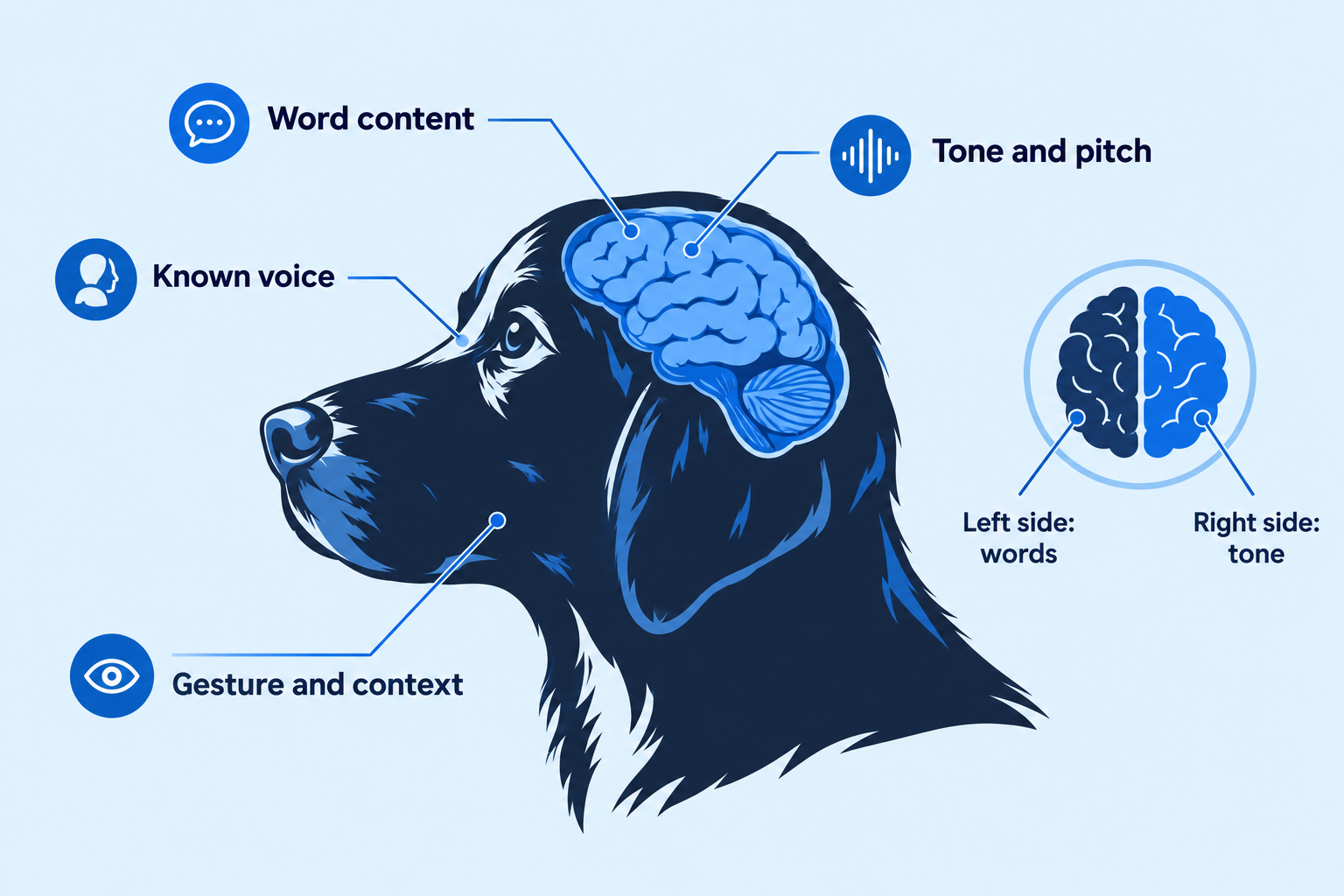
Dogs extract real information from speech, but they do it by combining several signals rather than parsing sentences. Word sound, tone, who is speaking, your face, your hands, and the situation all feed the same guess.
)
The most cited brain work comes from Attila Andics and colleagues at Eötvös Loránd University, published in Science in 2016. They trained family dogs to lie still, awake and unrestrained, inside an fMRI scanner while their trainer’s recorded voice played praise words and neutral filler words in both praising and neutral intonation. The dogs showed different processing for what was said and how it was said, with a left-side bias for word content and right-side activity tracking intonation. Reward-related regions lit up most when praise words came in a praising voice. That is a meaningful finding about lexical processing in a non-human species. It is not evidence that dogs grasp grammar.
A 2024 study by Boros and colleagues in Current Biology pushed further using EEG. Owners said a noun, then an object appeared. When the object matched the word, the dogs’ brain response differed from when it mismatched. That pattern suggests some referential understanding of nouns, meaning the word evoked something about the thing. The sample was small, as these studies usually are.
Then there is tone on its own. A report in June 2026 described work from Eötvös Loránd University in which dogs responded differently to the nonsense syllable “bü” depending on its acoustic shape, apparently separating patterns linked to “yes,” “no,” “here” and “there” without prior training. Promising, and worth watching. Treat it as preliminary until the full peer-reviewed methods and any replication are available.
What ties these together is a point from research on dogs following owner cues: performance improved when the useful information came from the dog’s own owner rather than an unfamiliar experimenter, and both tone and linguistic content contributed to how well dogs responded. Your voice is not a generic speech sample to your dog. It is a familiar one.
A practical aside: the famous head tilt often shows up during exactly this kind of listening. If you want the actual explanations on offer, we looked at what a dog’s head tilt can really mean.
What are the 4 real effects of talking to your dog?
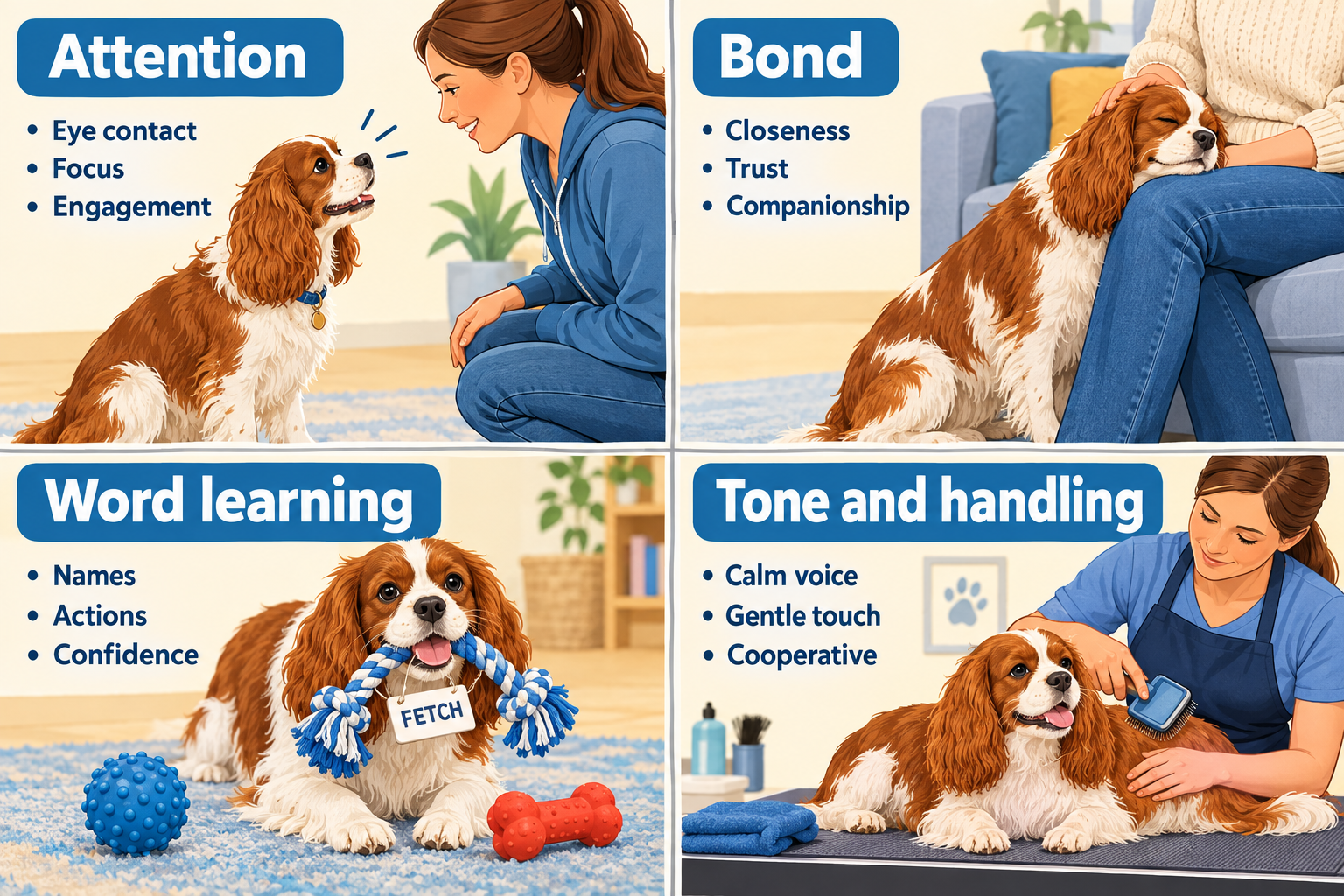
Four effects have reasonable support: attention, affiliative behavior toward the speaker, name and object learning in some dogs, and tone as usable information during handling. Each one has limits, and none of them turn talk into training.
)
1. Attention, the best-established effect
A 2017 Animal Cognition study using loudspeaker playback found adult dogs were more attentive to pet-directed speech than to adult-directed speech, and attention increased as the voice’s fundamental frequency rose. The same line of research found puppies reacted even more strongly, approaching the speaker faster and staying longer.
Why that matters at home: attention is the first step in nearly every training sequence. If your dog is not oriented to you, the cue has nowhere to land.
2. Affiliative behavior and the human-dog bond
In the University of York work, dogs did not just look at the speaker who used naturalistic dog-directed speech. They spent more time near that person afterward. The combination mattered. Dog-relevant words delivered in an adult register, or neutral words delivered in a singsong register, did not produce the same effect as the two together.
The finding is about preference and proximity measured in a session, not about long-term attachment. Think of it as evidence that how you speak affects whether your dog wants to be near you in that moment.
If you are choosing a dog partly for companionship, the breeds often suggested for emotional support roles still vary enormously as individuals.
3. Learning names and object words
Dogs pick up cue words through repetition paired with consequences, and some learn object labels. The ceiling is individual. A published case study of the border collie Chaser reported more than a thousand object names learned, and Claudia Fugazza’s gifted word learner project at Eötvös Loránd University has recruited dogs who learn toy names quickly, sometimes after few exposures. Those dogs are notable because they are uncommon.
4. Tone as information during handling
Your tone is doing work whether or not you plan it. The 2026 “bü” report suggests tone can carry distinct meanings. A 2026 Animal Cognition study of how women spoke to dogs found participants used a higher mean pitch with unfamiliar dogs, while smaller dogs drew a wider pitch range and warmer facial expressions. People adjust automatically, and the adjustment is driven partly by the dog in front of them.
Where the facts end: there is no study showing that daily conversation lowers a dog’s measured stress hormones or treats a diagnosed anxiety disorder. A calm, predictable voice during nail trims is reasonable practice. It is not therapy.
Key studies on talking to your dog, side by side
Does baby talk help dogs, or is baby talk bad for dogs?
Baby talk is not bad for dogs, and for puppies the exaggerated version genuinely works better at drawing them in. For adult dogs, the useful ingredient is not the pitch by itself but dog-relevant words delivered in a warm, slower, higher register.
)
Here is the split worth remembering. The 2017 playback research showed rising pitch tracked rising attention, and puppies responded hardest. The 2018 University of York work then showed adult dogs did not simply chase high pitch; they preferred naturalistic dog-directed speech, meaning real dog words said the way people actually say them. Dogs showed more looking and more affiliative behavior in that condition.
The 2024 rhythm analysis adds a quieter detail that may be the real mechanism. Owners slow down. Dog-directed speech landed between the faster rhythm of normal human conversation and the slower rhythm of dog vocalizations. Nobody teaches owners to do this.
Choose your register like this:
- Puppy under about 16 weeks, or any dog you have just met: warmer, higher, clearly animated. The 2026 pitch study found people already raise mean pitch with unfamiliar dogs, so you are probably doing it.
- Adult dog you live with, giving a trained cue: normal volume, steady tone, one word, no repetition. Save the bright voice for the reward moment.
- Nervous dog, vet waiting room, grooming: quiet, slow, few words, and no rapid-fire reassurance. A stream of anxious chatter is mostly your nervous system talking.
Common mistake: using the happy singsong voice for the cue itself, then flattening out for the praise. That reverses the information. The cue should be plain. The payoff should be the warm part.
How many words can dogs learn, and which dogs learn the most?
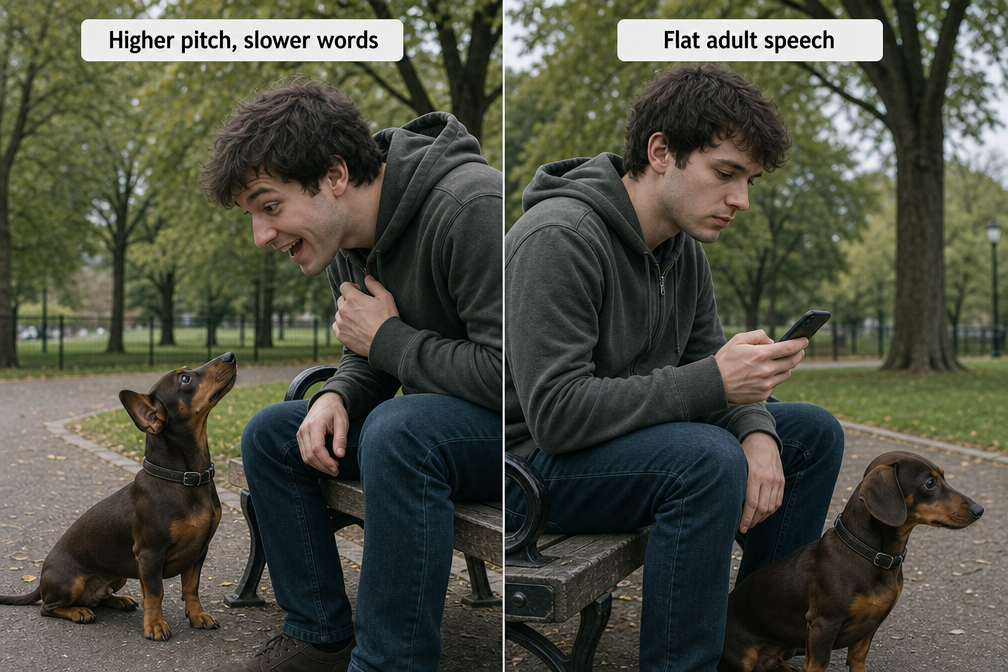
Most pet dogs reliably learn somewhere between a handful and a few dozen spoken cues and names, built through repetition and consequence. A small number of dogs, usually in the herding breeds, learn object labels fast and in large numbers. Those dogs are the exception that gets a paper written about them.
)
Claudia Fugazza’s gifted word learner project at Eötvös Loránd University found these dogs by public call-out, then tested them under controlled conditions with toys they had learned at home. The project exists precisely because the ability is unusual enough to be hard to recruit for. The published case study of Chaser, a border collie, reported more than a thousand object names. One dog, documented in detail, is a case study and not a breed guarantee.
What that means for your dog:
- Cues are easier than labels. “Sit” has an immediate consequence. “Rope” only means something if your dog has a reason to care which toy comes back.
- Breed tendency is a tendency. Border collies show up often in this research. Your border collie may still prefer staring at the washing machine. If you want the honest version of breed rankings, we looked at what intelligent really means across dog breeds.
- Context carries a lot of weight. Dogs often respond to a word plus your posture plus the time of day. Test a word in a new room before deciding it is learned.
- Soundboard buttons are a separate question. FluentPet sells hexagonal recordable buttons, and Federico Rossano’s lab at UC San Diego has run citizen-science research on owner-reported button use. Early results are interesting about button pressing patterns. They do not establish that dogs are forming sentences, and owner-reported data carries known bias. Worth trying as enrichment if you enjoy it. Not a substitute for cue training.
How much should I talk to my dog daily, and what should you talk about?
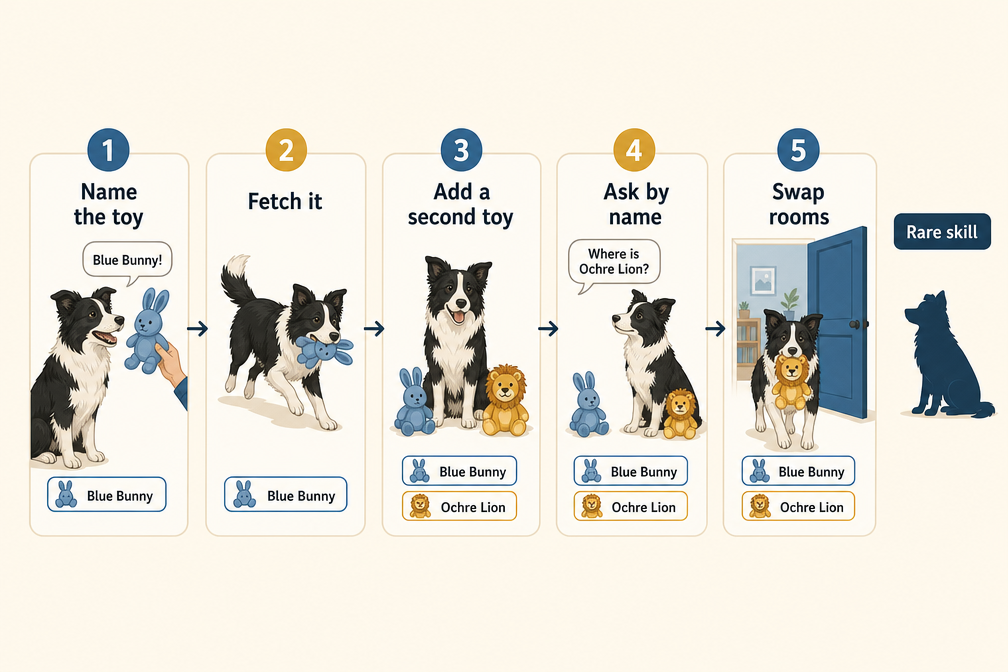
There is no evidence-based daily minimum for talking to your dog. The AURAL-Pet dataset showed owners ranging from never speaking to pets in recorded clips to nearly half of their speech being pet-directed, and the study was not designed to say which amount is better. Aim for quality moments rather than volume.
A workable daily shape, based on what the attention research supports:
- Three to five short labelled moments. Name, then cue, then outcome. Ten seconds each.
- One object-naming round during play. Say the toy’s name as your dog takes it.
- Narration during routines you repeat anyway. Harness on, door, car. Consistent wording helps your dog predict what happens next.
- Quiet time that stays quiet. Dogs sleep a great deal, and interrupting rest to chat is not enrichment. See how much sleep dogs actually need.
What to talk about hardly matters in terms of content, because your dog is not following the plot of your week. The useful part is consistency of the words that predict something, and the tone attached to them. Venting about your manager is fine. Just do not use the same tone you use for “leave it.”
Edge case: in a multi-dog or multi-person home, inconsistent cue words slow learning more than any amount of silence does. Agree on one word per behavior and write them on the fridge. Boring, and it works. Our guide on practical puppy training methods covers the sequencing.
How do you talk to your dog so they learn more?
Say the cue once, in a plain voice, when your dog is already paying attention, and attach a clear consequence. Repetition without consequence teaches your dog that the word is background noise.
Best ways to talk to your dog for training
- One word per behavior. “Down” or “off,” not both for the same thing.
- Name first, cue second. The name buys attention. The cue spends it.
- Say it once. Repeating “sit sit sit” teaches the dog that the third one is the real one.
- Reward with your voice and something tangible. The 2016 Eötvös Loránd University imaging work found reward-related activity highest when praise words came in a praising tone, which is a reasonable argument for matching both.
- Slow down. You probably already do. The 2024 rhythm analysis suggests dog-directed speech naturally sits closer to the timing of dog vocalizations.
- Drop the pitch for serious things. Recall off a road is not the moment to sound playful.
How do dogs learn to recognize their name?
Dogs learn their name as a predictor, not as an identity. The name repeatedly precedes food, touch, play, or a cue, so it becomes a reliable signal that something involving the dog is about to happen.
That has two practical consequences. A name used constantly with no outcome stops working, which is the usual cause of a dog who “ignores” their name in the park. And a name used mainly before unpleasant events, baths, nail clippers, the end of a walk, becomes a warning. If that has happened, pick a fresh attention word and pair it with good outcomes for a few weeks.
Signs your dog understands what you’re saying
Look for a consistent, specific response to the word before you add gestures. Reliable indicators include:
- Ear shift or head turn toward you the moment the word lands.
- The correct behavior offered when you stand still and keep your hands down.
- The same response in a new room, which rules out local context cues.
- Going to the right object or place rather than the nearest one.
- Head tilt while listening, which indicates attention rather than comprehension.
What does not count as understanding: your dog doing the right thing while you unconsciously glance at the mat, point with your foot, or reach for the treat pouch. Dogs read all of it, and they read it faster than you can hide it. They also read your face and body in ways that shape their choices, which is partly why a dog’s visual world is worth understanding alongside their hearing.
Decision rule: if your dog responds in the kitchen but not in the hall, the word is not learned yet. Train it in three locations before calling it done.
FAQ
Is it okay if I talk to my dog all day?
Yes. There is no evidence that frequent talking harms dogs, and the 2026 AURAL-Pet work shows pet-directed speech is common and varies widely between people. Keep rest periods genuinely quiet, and keep training cues separate from general chatter so the cue words stay meaningful.
Does talking to your dog make them smarter?
No study shows that conversation raises a dog’s general cognitive ability. Talking can expand a dog’s trained vocabulary and improve responsiveness, which looks like smarter behavior. The underlying capacity shows wide individual variation and is not something talking changes.
Does talking to dogs reduce their anxiety?
The evidence does not support that claim. A calm, slow voice is sensible during handling, and some dogs settle with familiar routines, but no controlled study shows that owner speech reduces clinical anxiety. Persistent fear, panic when left alone, or new trembling and hiding should be assessed by a veterinarian.
Do dogs try to talk to humans?
Dogs communicate with people constantly, mostly through body language, gaze, posture, position, and vocalizations like whines and barks. They are not attempting speech. Soundboard button research from Federico Rossano’s lab at UC San Diego is examining whether button use is communicative, and the findings so far are early rather than settled.
Is it bad to talk to your dog like a human?
No. Treating a dog as a conversational partner does not harm the dog. The risk is interpretive, not physical: assuming your dog understood your reasoning when they responded to tone, timing, and context. Keep imagined dog replies in the joke column where they belong.
Does talking to dogs make them happier?
There is no direct measure of canine happiness in this research. What studies show is attention and affiliative behavior. The 2018 University of York work found dogs chose to spend more time near a person who used naturalistic dog-directed speech, which is a reasonable sign of a positive interaction without being proof of mood.
How many words do dogs understand?
Most pet dogs reliably respond to a modest set of cues and names, typically tens rather than hundreds, and only when those words have been paired with consistent outcomes. A rare group of gifted word learners studied at Eötvös Loránd University acquires object labels far faster and in far greater numbers.
Can talking to your dog improve your bond?
It can support the day-to-day interactions the human-dog bond is built from, and dog-directed speech is linked to more proximity-seeking in controlled studies. Shared activity, predictable routines, and humane training do more of the work than speech alone.
Conclusion: one next step
Pick one word your dog nearly knows and make it airtight this week. Say it once, in a plain voice, with your hands still, in three different rooms, and pay for the right answer every time. That single change does more than a month of enthusiastic commentary, because it turns a familiar sound into reliable information.
Then use the Talk-Time Practice Card above for five minutes a day and keep a running list of the words your dog actually responds to. Not the words you say. The ones that work.
Dog Advice That Actually Answers the Question. Guidance checked October 2026, and when a finding is still early, this publication will say so.