
Quick Answer
A sleeping dog paddles one front paw, lets out a muffled bark, and goes still again. So do dogs dream? Almost certainly yes, and the strongest evidence is physiological rather than philosophical: dogs cycle into REM sleep with fast brain-wave activity, eye movement under closed lids, and floppy muscle tone, the same state in which humans report vivid dreams. What stays uncertain is the content. No one has been able to study what animals actually see in their dreams, so dream subjects are informed guesses, not measurements. Guidance here was checked in October 2026.
Key Takeaways: Do Dogs Dream?
- Yes, by the best available evidence. Dogs enter REM sleep, and canine sleep recordings identify REM by fast EEG activity, rapid eye movements, and reduced muscle tone.
- Dream content is inferred, not observed. Researchers can say dogs likely experience dream-like mentation. They cannot say your dog dreamed about the squirrel.
- Twitching, paddling, lip-licking, soft whines and muffled barks are normal REM behavior, according to veterinary behavior guidance from VCA.
- REM often starts roughly 20 to 40 minutes after a dog falls asleep, per veterinarian Juan Antonio Aguado speaking to EL PAÃS.
- Puppies and senior dogs appear to spend more time in restless, twitchy sleep than settled middle-aged adults.
- A dream is loose and brief. A seizure is usually rigid, longer, and hard to interrupt. Film it and call your vet if the episode looks stiff or confusion follows.
- Waking a dreaming dog is not forbidden, but it is rarely necessary. Startled dogs can snap reflexively, so use your voice from a distance.
- Breed stories about “pointers pointing in their sleep” come from interpretation, mainly psychologist Stanley Coren’s, not from controlled breed studies.
How do scientists know dogs dream?
They do not read dream content. They record sleep. Dog sleep laboratories use non-invasive surface EEG plus video to score sleep stages, and the REM stage in dogs looks physiologically like the REM stage in humans, which is where most reported dreaming happens.
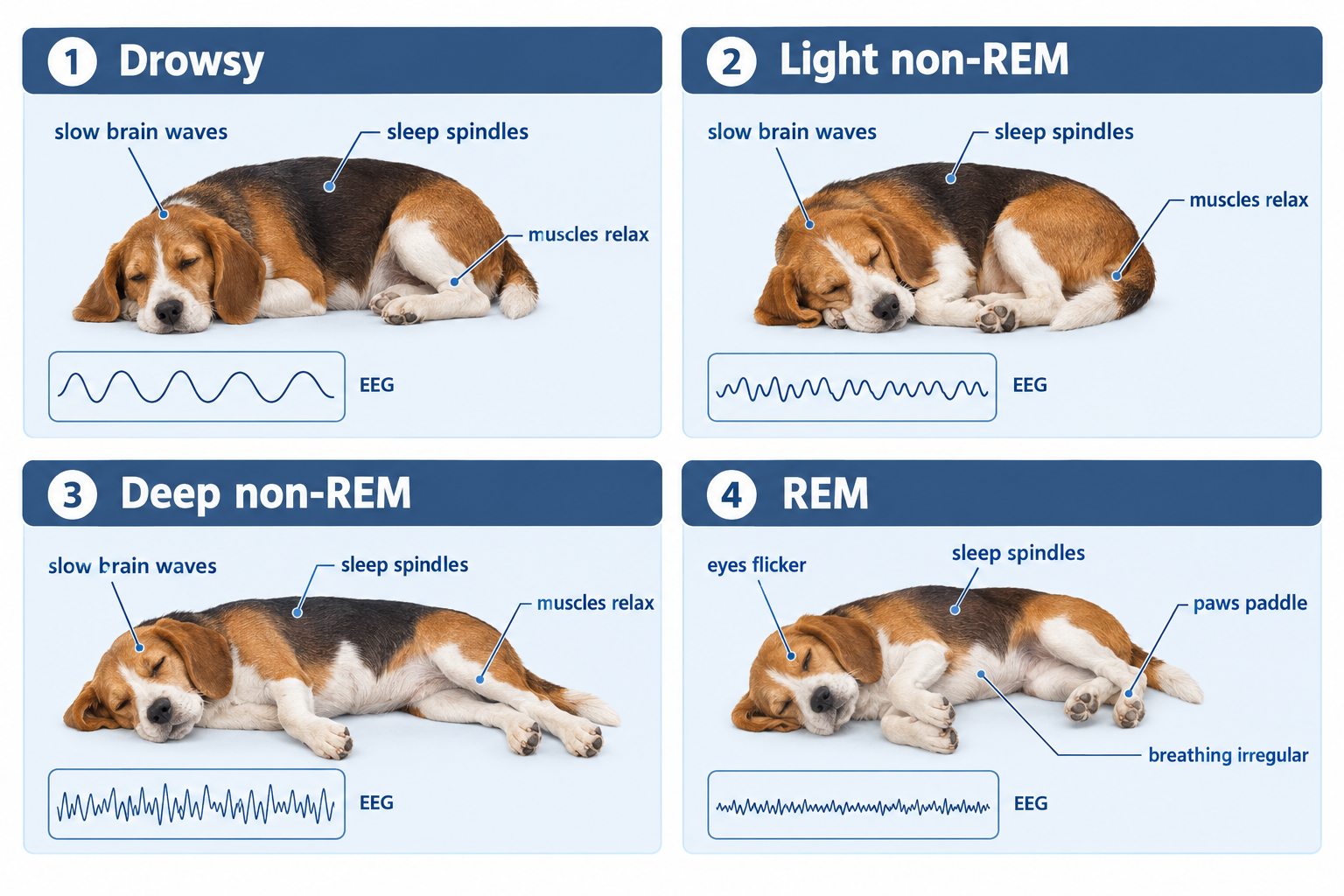
The method matters more than the headline. At Eötvös Loránd University in Budapest, the family dog research group including Anna Kis has run years of non-invasive polysomnography on pet dogs: electrodes taped to the head, the dog resting on a mat, often with the owner in the room. No surgery, no restraint, no sedation. Dogs tolerate it surprisingly well, which is why the dataset exists at all.
That approach has produced a few findings that are easy to state and easy to over-read:
- Dogs show the same broad sleep architecture as other mammals: drowsiness, non-REM sleep, and REM sleep.
- Sleep after a learning session differs from sleep after an ordinary session, which points to sleep playing a part in memory.
- Sleep spindles, short bursts of activity mainly tied to non-REM sleep and memory stabilization, can now be detected automatically. A meta-analysis by Ivaylo Borislavov Iotchev and Anna Kis on face-validity indicators for automatically detected dog sleep spindles was published in August 2026.
Spindles are not dreams. They are a non-REM phenomenon linked to consolidating what the dog learned. Worth separating, because plenty of articles blur the two.
A 2025 review of non-invasive canine EEG methods describes where the field is actually heading: using surface recordings and video to distinguish sleep stages, then applying that to learning, disrupted sleep, and neurological disease. The interesting research question has shifted from “do dogs dream” to “what is canine sleep doing for memory, aging, and diagnosis.”
What brain waves do dogs have during sleep?
Dogs produce the same families of brain waves humans do, in the same rough sequence. Drowsy and light sleep bring slower, higher-amplitude waves plus sleep spindles. Deep non-REM brings slow waves. REM brings faster, lower-amplitude activity that looks closer to waking, paired with eye movement and loss of muscle tone, which is exactly the combination described in canine polysomnography work.
That paralysis of the big muscles is the part owners miss. During REM, the body is mostly switched off. The leaks get through anyway: a paw, a whisker, a jaw, a half-swallowed woof.
Where the facts end
REM physiology is measurable. Subjective experience is not. A dog cannot file a dream report, and no movement uniquely identifies a dream image. A twitching paw is compatible with running. It does not prove the dog is running after anything in particular. That limit is real, and respectable sources say so plainly rather than filling the gap with charm.
What do dogs dream about?
The honest answer: probably their own lives. The working idea is the continuity hypothesis, which holds that dream content tends to reflect waking concerns. For a dog that means scent, food, walks, play, other dogs, and the people they live with.
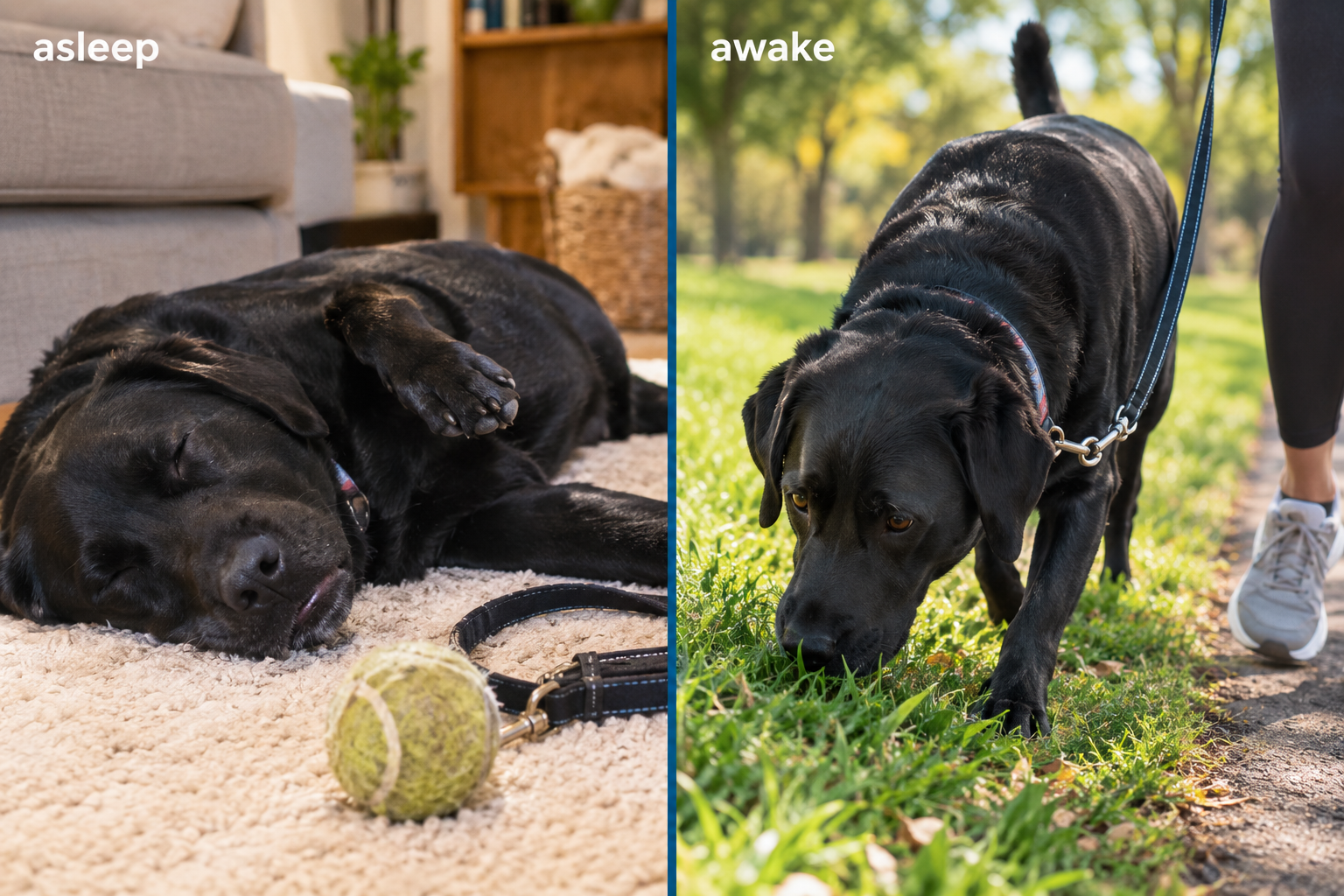
Harvard dream researcher Deirdre Barrett has applied that continuity reasoning to pets while being clear that nobody has studied the content of animal dreams. The American Kennel Club lands in the same place, summarizing the evidence as dogs dreaming about doggy things, meaning experiences relevant to their species and their individual life.
The animal evidence people usually reach for comes from rats, not dogs. At MIT, Matthew Wilson‘s lab recorded hippocampal activity while rats ran mazes, then recorded the same cells during sleep and found replay patterns closely resembling the waking runs. That is a strong result about memory replay in rodents. It is context for dogs, not proof about dogs. Different species, different task, different recordings.
Do dogs dream about their owners?
Plausibly, and no one has demonstrated it. If dream content follows waking salience, the person who delivers the food, the walks, the ball throws and most of the physical contact is a reasonable candidate for a starring role. That is an inference drawn from the continuity hypothesis, not a finding. The appeal of the claim does not make it measured, and the human-dog bond does not need a dream study to be obvious at 6am by the front door.
Do dogs dream in color or black and white?
If dogs dream visually, the sensible guess is that dream color matches waking color vision, which for dogs is dichromatic. Dogs see blues and yellows well and struggle to separate red from green. Nobody has tested dream color in any animal. There is also a decent argument that smell deserves more space in a dog’s dream than color does, given how much of their brain is devoted to scent. For the waking version of this, see our explainer on what colors dogs can actually see.
How often do dogs dream compared to humans, and how long do dog dreams last?
Dogs sleep more total hours than adults do, and they get there in shorter installments. Human adults typically run four to six longer sleep cycles overnight, reaching the first REM period after about 90 minutes. Dogs reach REM much faster and cycle more often, which is why a napping dog can be twitching within half an hour of flopping down.
Dog figures for REM onset come from EL PAÃS and canine polysomnography work; human figures are standard sleep-science values. Treat every row as an average with wide individual variation. If your dog’s total sleep hours surprise you, our piece on why dogs sleep so much covers the normal ranges by age.
Do small dogs and puppies dream more?
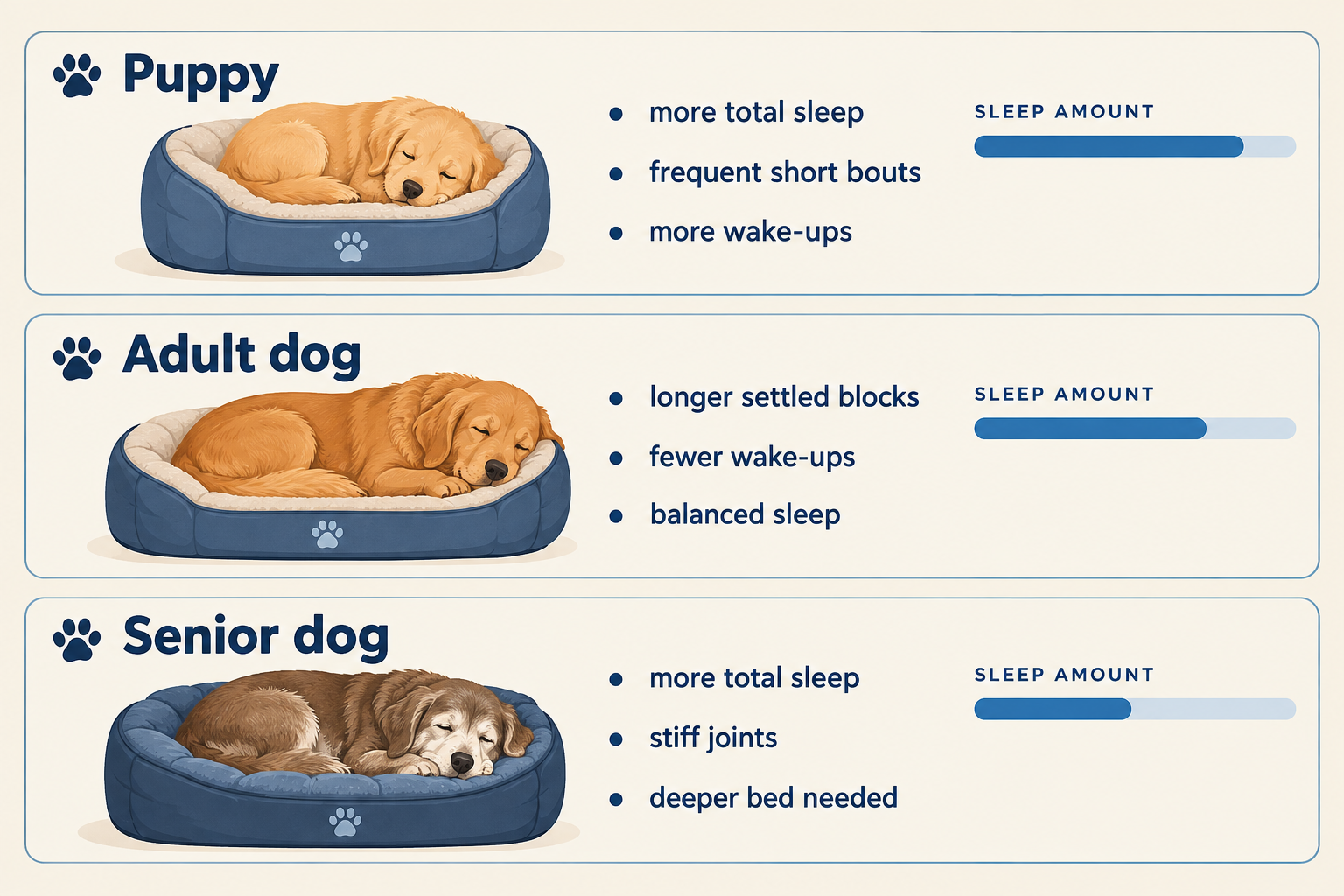
Probably more often, in shorter bursts, though the evidence here is observational rather than tightly measured. Puppies and senior dogs both show more restless, twitch-heavy sleep than a settled adult dog in the middle of life.
At what age do puppies start dreaming?
Very early, if REM is the marker. Newborn and young puppies spend a large share of sleep in an active, twitchy state, and that pattern appears in many mammal infants. Whether a two-week-old puppy has anything like a dream narrative is unknowable; the brain is still wiring itself, and REM at that age is thought to support that development. What you can say safely is that a puppy who jerks, squeaks and paddles during naps is doing something developmentally ordinary. Feeding and growth questions in that first year are covered in our guide to what growing puppies need in year one.
Do senior dogs dream less than younger dogs?
Senior dogs usually sleep more total hours but less efficiently, with more fragmented nights and more wake-ups. Fragmented sleep tends to mean shorter REM stretches, so a senior dog may show visible dreaming less often per hour while still twitching plenty. Night restlessness, pacing, or a reversed sleep schedule in an older dog is a separate issue and worth raising with a vet, because canine cognitive dysfunction and pain both disrupt sleep.
Do all dogs dream, or just some breeds?
All of them, as far as anyone can tell. REM sleep is mammalian, not breed-specific. The size claim is the one people repeat: smaller dogs are often described as having more frequent, shorter dream episodes than large dogs, while big dogs get fewer and longer ones. That description appears in veterinary commentary and popular write-ups, including the Animal Wellness summary, and it should be treated as an approximate clinical observation rather than a measured population benchmark.
Psychologist Stanley Coren, formerly of the University of British Columbia, went further and suggested breed-typical dream enactment: pointers making pointing-like movements, guarding breeds appearing to confront an intruder, as described in PetMD’s coverage of canine nightmares. It is a charming idea with obvious intuitive appeal. It is interpretation of observed movement, not a controlled breed study, and nothing about it predicts your individual dog.
Is my dog dreaming or having a seizure?
A dream is usually brief, loose-limbed, and easy to interrupt with your voice. A seizure is usually rigid or violently rhythmic, lasts longer, cannot be interrupted by calling the dog’s name, and often comes with drooling, loss of bladder or bowel control, and a confused, disoriented recovery afterward.
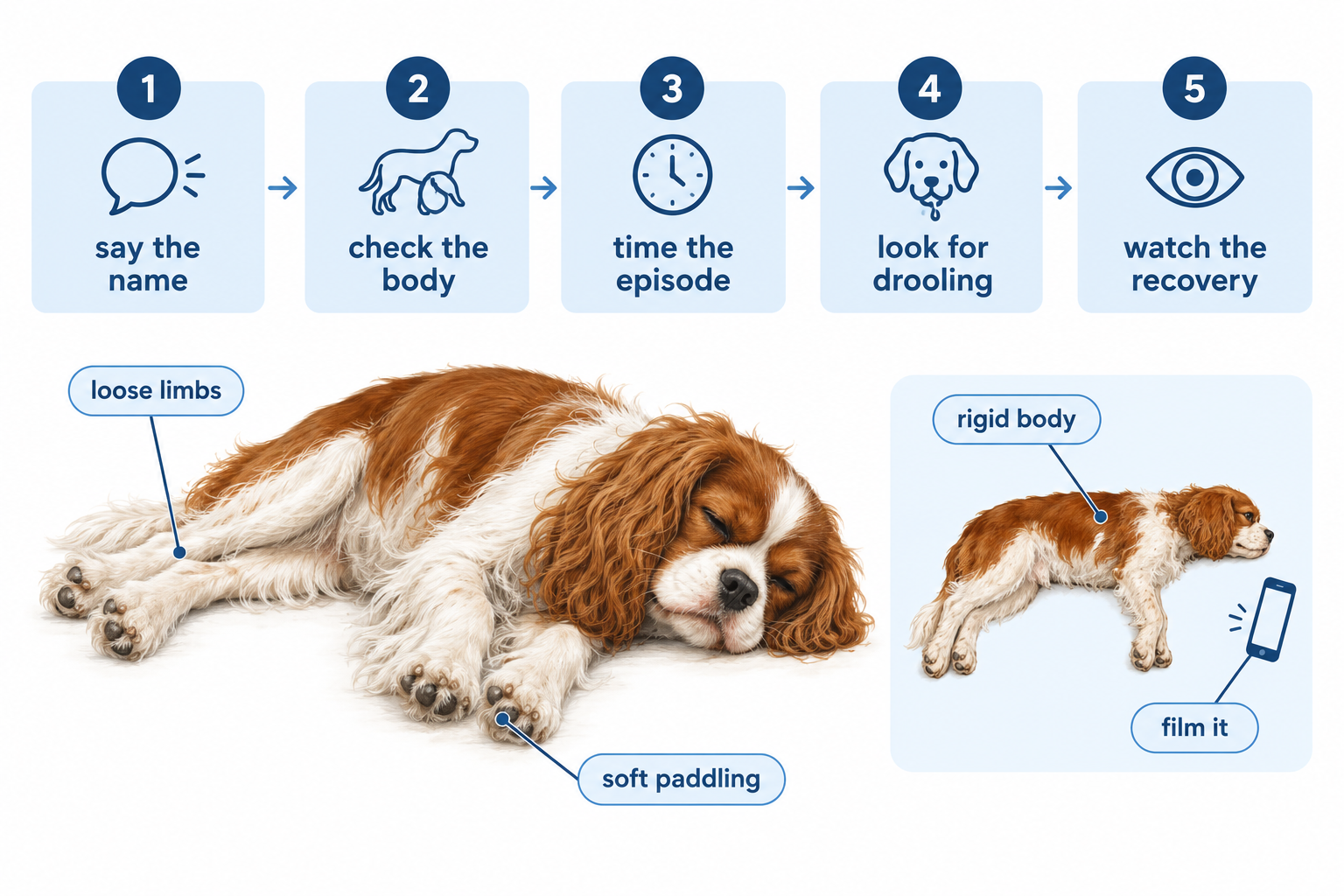
The distinction owners find most useful is responsiveness. A dreaming dog surfaces. Say the name in a normal voice from a few feet away and a dreaming dog will typically lift its head, blink, maybe sigh at you for the interruption. A seizing dog does not respond, because consciousness is affected.
Other separators worth knowing:
- Muscle tone. REM means low tone. Limbs look floppy, movements look soft and paddling. Seizures often bring stiffness, arching, or hard paced jerking.
- Duration. Visible dream twitching tends to run seconds to a couple of minutes. Convulsive activity lasting more than a few minutes is an emergency.
- Recovery. Dreaming dogs go straight back to sleep or get up normally. Post-seizure dogs may pace, bump into things, appear blind, drink heavily, or stay dazed for many minutes.
- Repetition. Several episodes in a day, or episodes while fully awake, point away from dreaming.
Film it. A 20 second phone video is worth more to a vet than any description, and no one can be expected to score neurological signs accurately at 2am.
Decision rule: if the dog cannot be roused by voice, the episode runs past roughly two minutes, or recovery looks disoriented, treat it as a possible seizure and contact a vet the same day. Repeated or prolonged convulsions are an emergency.
Can dogs have nightmares, and can you tell?
Dogs likely have bad dreams, and you cannot reliably tell which dream is bad. Distress noises, growling, or a sudden startled wake-up are consistent with an unpleasant dream, and also consistent with a muscle cramp, an itch, a loud noise outside, or REM activity that simply looks dramatic from the sofa.
Veterinary sources that address nightmares in dogs generally accept the possibility while stopping short of claiming the content. Given the continuity idea, a dog with a frightening history could plausibly replay frightening material. That is a reasonable hypothesis about a rescue dog’s whimpering, not a diagnosis of it.
Signs worth paying attention to, mostly because they point at daytime problems rather than dream problems:
- Waking in distress most nights rather than occasionally
- Reluctance to settle in a particular room or spot
- Yelping on waking combined with stiffness or difficulty rising, which can mean pain
- Noise-triggered waking in a dog who is already sound sensitive
Persistent night distress is better treated as a welfare question than a dream question. Daytime enrichment, predictable routines, humane training for specific fears, and a pain assessment from a vet address more of the problem than anything you can do at 3am.
Should you wake a dog having a nightmare?
Usually leave them. Most episodes end within seconds, REM sleep does work the dog needs, and a dog startled out of deep sleep can snap reflexively before it is fully awake. The standard veterinary advice is to let sleeping dogs lie unless there is a safety reason to intervene.
If you decide to intervene, do it the low-risk way:
- Use your voice first. A calm, normal-volume name from a few feet away. No looming over the bed.
- Do not touch the face, muzzle, or feet. These are the worst places to reach for a disoriented dog.
- Give the dog space to orient. Let it lift its head, look around, and reset before you pet it.
- Never wake a child’s way. Kids should be taught not to touch a sleeping dog at all. A startled bite from a dog who has never shown aggression is usually a defensive reflex, which our piece on why dogs sometimes bite their own owners explains in more depth.
Reasons that do justify waking a dog: the episode looks like a possible seizure, the dog is somewhere unsafe, or the dog is overheating. Otherwise, the kindest response is boring. Sit there. Let it pass.
Do dogs remember their dreams when they wake up?
Nobody knows, and there is no current method that could find out. Dream recall in humans is measured by asking people what they remember. Dogs cannot report, so any claim about canine dream memory is speculation.
What research does suggest is that sleep supports memory in dogs, which is a different mechanism. Sleep after learning looks different from ordinary sleep, and sleep spindles are tied to stabilizing new information. A dog may benefit from sleep without retaining a dream narrative, the same way most humans forget nearly everything they dreamed by breakfast. If your dog seems sharper on a new cue the day after training, consolidation is a better explanation than recollection.
Does the bed affect how well a dog sleeps?
Comfort and surface support affect sleep quality, especially for heavy, old, or arthritic dogs, which in turn affects how settled their sleep cycles are. No bed produces better dreams. A bed that lets a stiff dog stay asleep instead of shifting every 20 minutes is doing something measurable, though.
Three widely sold options and who each one tends to suit, with no testing claimed here:
- Big Barker. Thick foam built for large and giant breeds. Suits heavy dogs and seniors with joint pain where mattress depth matters most. Bulky, and priced at the top of the market, so check current price before buying.
- Casper Dog Bed. Foam construction with a removable cover, aimed at small to medium dogs in tidy living rooms. Suits owners who want something that looks deliberate in a lounge.
- Furhaven. Budget range with many shapes and bolster styles. Suits multi-bed households, crates, and dogs who destroy bedding often enough that replacement cost matters.
Whatever you compare, check the dimensions against your dog stretched out flat, not curled up, and read the cover washing instructions before the first accident rather than after. For giant breeds, our guide to dog size categories helps translate a weight range into a bed size.
FAQ
Do dogs dream like humans do?
Physiologically, close. Dogs cycle through non-REM and REM sleep with brain-wave patterns comparable to humans, which is the basis for saying they dream. Whether the subjective experience matches a human dream is unknown and probably unmeasurable with current methods.
What does it mean when a dog twitches in their sleep?
Usually REM sleep. During REM, muscle tone drops but motor signals leak through, producing paw paddling, facial twitches, lip movements, and small noises. Soft, brief, easily interrupted twitching is normal. Stiff, prolonged, unresponsive movement is not.
What do puppies dream about?
No one knows. Young puppies spend a lot of sleep in active REM-like states, which is thought to support brain development. Twitchy, squeaky puppy naps are expected and generally not a sign of distress.
Can dogs have bad dreams and wake up scared?
Possibly. A dog can wake with a startle, growl, or yelp, and a bad dream is one plausible explanation among several. Repeated nightly distress is better investigated as pain, noise sensitivity, or anxiety than treated as a dream problem.
Why do dogs cry or whine in their sleep?
Vocalizing during REM is common and does not reliably indicate a nightmare. Breathing becomes irregular in REM and partial vocal signals get through. Whining paired with difficulty rising, limping, or night pacing is worth a vet visit.
How long do dog dreams last?
Visible dream behavior typically runs from a few seconds to a couple of minutes per REM episode, and dogs enter REM within roughly 20 to 40 minutes of falling asleep. Longer, more violent episodes should be filmed and shown to a vet.
Is it bad to wake a dog up from a dream?
Not harmful, but rarely useful, and there is a bite risk from a startled dog. Use your voice from a short distance instead of touching, and only intervene if the episode looks like a seizure or the dog is in danger.
So do dogs dream about their owners specifically?
That is an inference from the continuity hypothesis, which says dream content follows waking concerns. Owners are central to a dog’s waking life, so they are a likely subject. No study has shown it.
Conclusion: watch one nap on purpose
The science supports a clear answer to do dogs dream, and an honest limit on what that answer covers. Dogs enter REM sleep with the same physiological signature humans dream in. The twitching, paddling and muffled barking you see are normal products of that state. The content stays guesswork, and the researchers closest to the question are the ones most comfortable saying so.
Your next step is small and genuinely useful: watch one afternoon nap with the clock running. Note how many minutes pass before the first twitch, how long the episode lasts, how loose the body looks, and how quickly your dog responds to its name. That gives you a personal baseline, which is the thing vets wish owners had when a strange episode happens at midnight. If an episode ever breaks that baseline, film 20 seconds and call your vet.
#dogscience #dogsleep #dogbehaviour