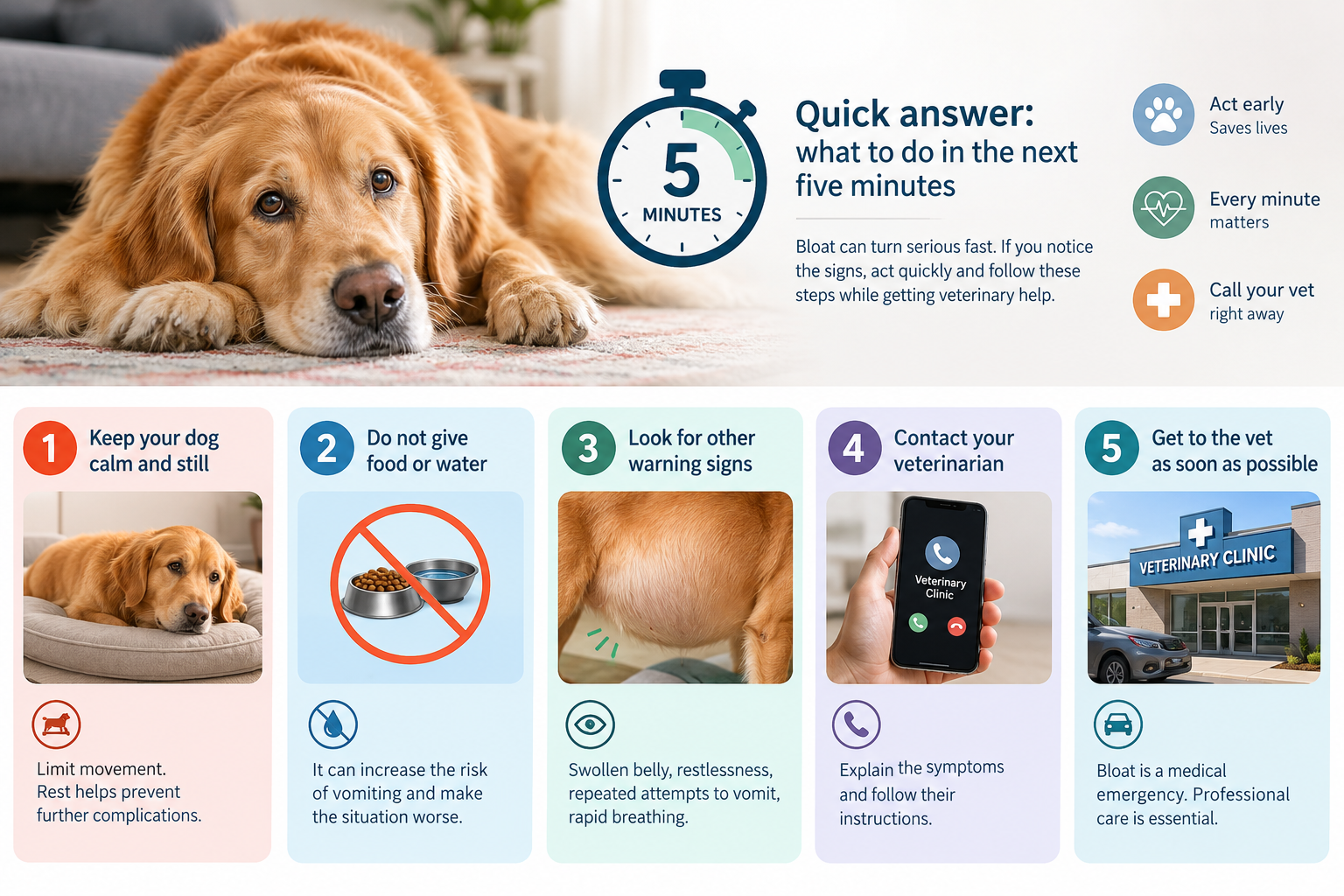
Quick answer: what to do in the next five minutes
If a large or deep-chested dog is retching without bringing anything up, and the belly looks tight or swollen, drive to the nearest emergency veterinary hospital now and call ahead while someone else drives. The most dangerous version of bloat in dogs symptoms is gastric dilatation and volvulus (GDV), in which the stomach fills with gas and then twists, cutting off its own blood supply. Cornell’s Riney Canine Health Center describes GDV as rapidly fatal without emergency treatment. No home remedy fixes a twisted stomach. Not baking soda, not simethicone, not a walk around the block. This article is general information checked in October 2026, not a diagnosis.
Key Takeaways: Bloat in Dogs Symptoms
- Unproductive retching plus a tight belly is the classic pairing. Either one alone is worth a call. Both together means leave the house.
- Minutes change outcomes. VCA Hospitals notes that GDV can progress to shock and death within hours, which is why waiting until morning is the mistake that kills.
- Bloat and GDV are not the same thing. Simple gas distension can sometimes resolve. A rotated stomach cannot resolve on its own.
- Risk is concentrated, not random. A 2025 Dog Aging Project analysis of 47,444 dogs found higher odds in purebred dogs, male dogs, dogs over 40 kg, dogs with low body condition scores, and Poodles or Poodle mixes.
- Surgery is the treatment, and gastropexy is the part that prevents repeats. A veterinary evidence review of gastropexy outcomes reported far lower recurrence in dogs that received gastropexy than in dogs stabilized and repositioned without it.
- Some prevention advice is supported, some is marketing. Raised bowls have never been shown to reduce risk, and the 2025 dataset did not find higher odds tied to diet type or number of daily meals.
- A swollen belly with no pain is still worth a vet visit. It may not be GDV. It may be fluid, an organ problem, or something else that needs a look.
Bloat in dogs symptoms: the 6 signs owners mistake for gas
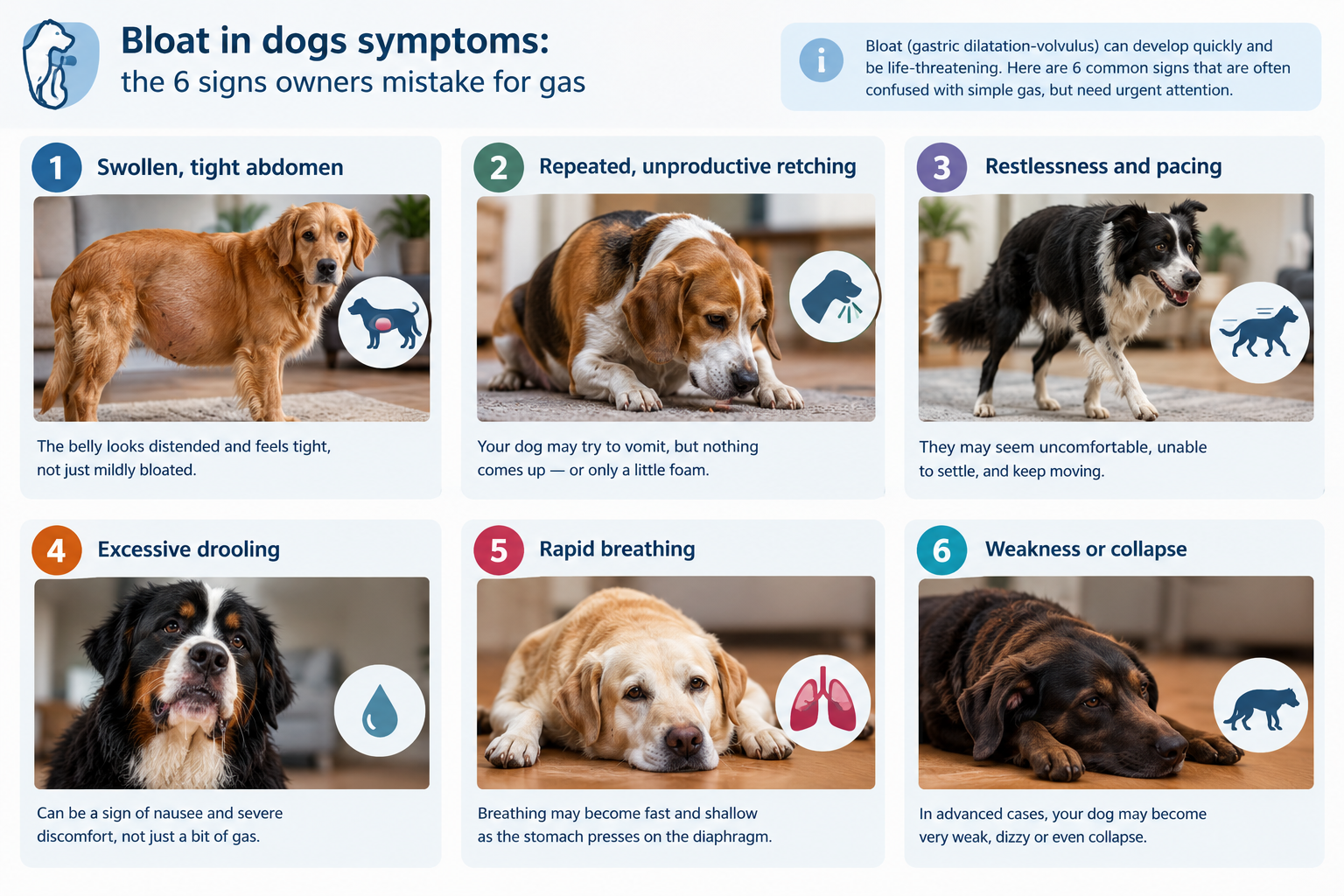
These six bloat in dogs symptoms are the ones most often written off as “he just has gas.” Each one appears in veterinary guidance on GDV, and the combination matters more than any single sign.
1. Retching with nothing coming up
The dog heaves. Nothing arrives. Maybe a tablespoon of white foam or drool, and then another heave. PetMD lists repeated unproductive retching among the hallmark signs of bloat. A gassy dog usually burps, passes gas, or vomits something. A dog with a twisted stomach has no exit route, so the attempt keeps failing.
Mistaken for: a hairball, eating grass, kennel cough.
2. A belly that is suddenly bigger, tighter, or tender
Look behind the rib cage and at the left flank. The abdomen may feel firm like a tight drum. Guidance from Blue Cross on bloat in dogs describes a swollen, hard belly as a key warning. In barrel-chested dogs, or early in the process, the swelling can hide under the ribs. A normal-looking belly does not clear your dog.
Mistaken for: a big meal, weight gain, “he always looks like that after dinner.”
3. Pacing, standing up and lying down, and an inability to settle
This is the sign people most often explain away, because it does not look like illness. It looks like fidgeting. Restlessness in GDV usually reflects severe abdominal pain. The dog may stare at its own flank, stretch repeatedly, or hold a praying position with front legs down and rear up. Dogs normally spend a large share of the day resting, which is exactly why a sudden refusal to settle is worth noticing.
Mistaken for: needing the toilet, anxiety, thunder, “just being weird tonight.”
4. Drooling, heavy panting, or fast shallow breathing
Ropey drool on the floor is common in dogs who cannot vomit or swallow comfortably. Panting can come from pain, from pressure on the diaphragm, or from early shock. With retching or a swollen belly in the picture, treat breathing changes as an emergency, not as heat.
Mistaken for: warm weather, excitement, nausea from a treat.
5. Pale, grey, bluish or sticky gums
Lift the lip and look. Healthy gums are usually pink and moist, and the colour returns within about two seconds after you press and release. The Merck Veterinary Manual lists pale mucous membranes, weak peripheral pulses, prolonged capillary refill and fast heart rate among signs of shock in GDV. Gum colour is the cheapest diagnostic you own.
Mistaken for: nothing, because most owners never check.
6. Weakness, wobbliness, or collapse
This is late. Circulation is failing, heart rhythm may be abnormal, and stomach tissue may already be dying. A dog at this stage needs transport immediately, with no stop to grab anything.
Mistaken for: tiredness after a long walk.
What are the first signs of bloat in a dog?
The earliest signs are usually behavioural rather than dramatic: restlessness, repeated unsuccessful attempts to vomit, drooling, and a dog who will not lie down the way it always does. Visible swelling and pale gums tend to come later. Waiting for the textbook balloon belly wastes the window where treatment works best.
0.23%
Estimated lifetime GDV prevalence among 47,444 dogs, Dog Aging Project analysis, 2025
1.74
Cases per 1,000 dog-years at risk in the same 2025 dataset
40 kg+
Body weight linked to increased odds of GDV, 2025 Dog Aging Project analysis
0% to 15.4%
Reported recurrence range after gastropexy, veterinary evidence review, 2025
What is bloat in dogs, and how is it different from gas?
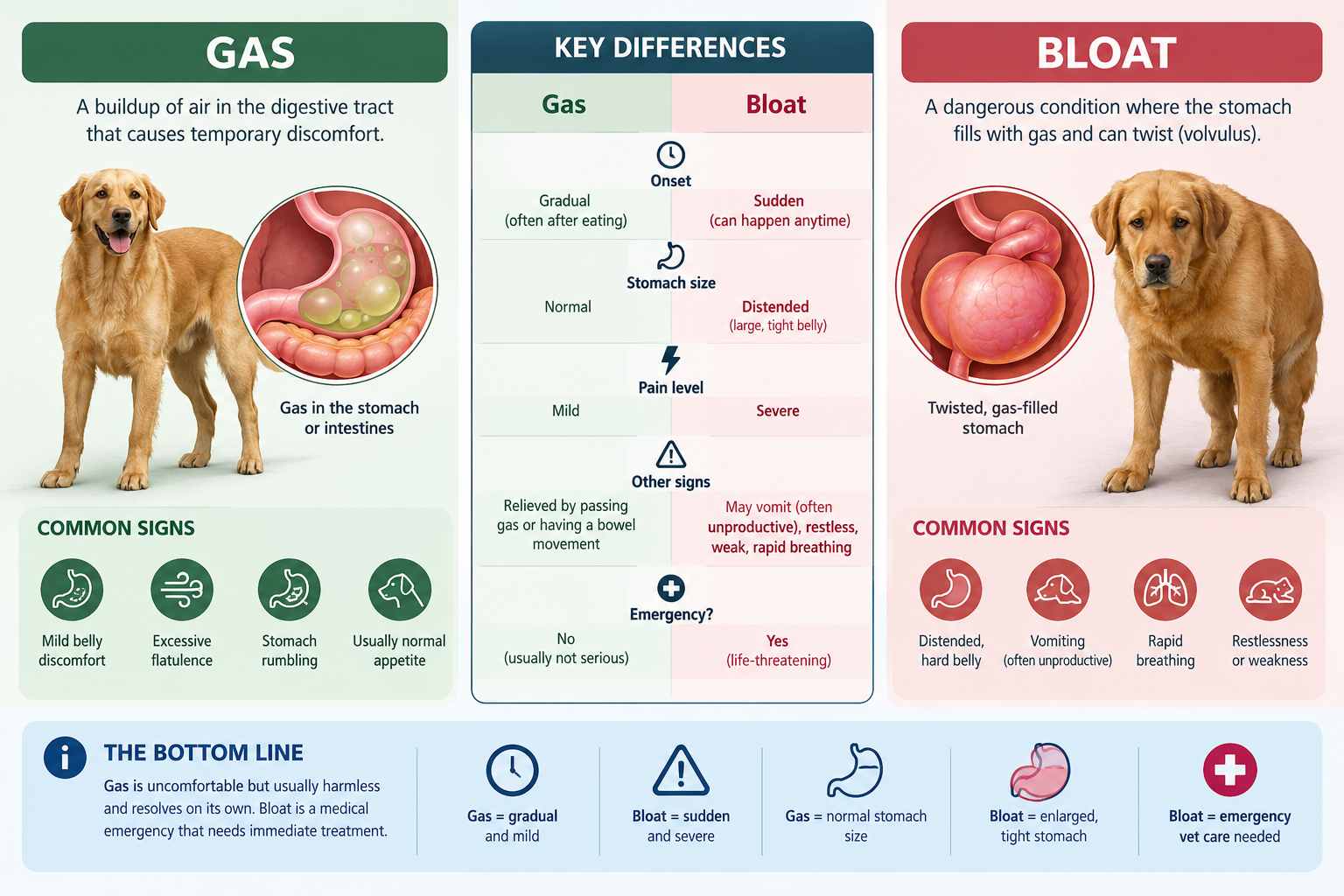
Bloat means the stomach is distended with gas, fluid or food. Ordinary gas moves. Bloat does not, because the stomach is stretched and pressure builds faster than the body can release it. Gas in a healthy dog produces burps, a few noisy minutes, and a dog who then falls asleep on the rug.
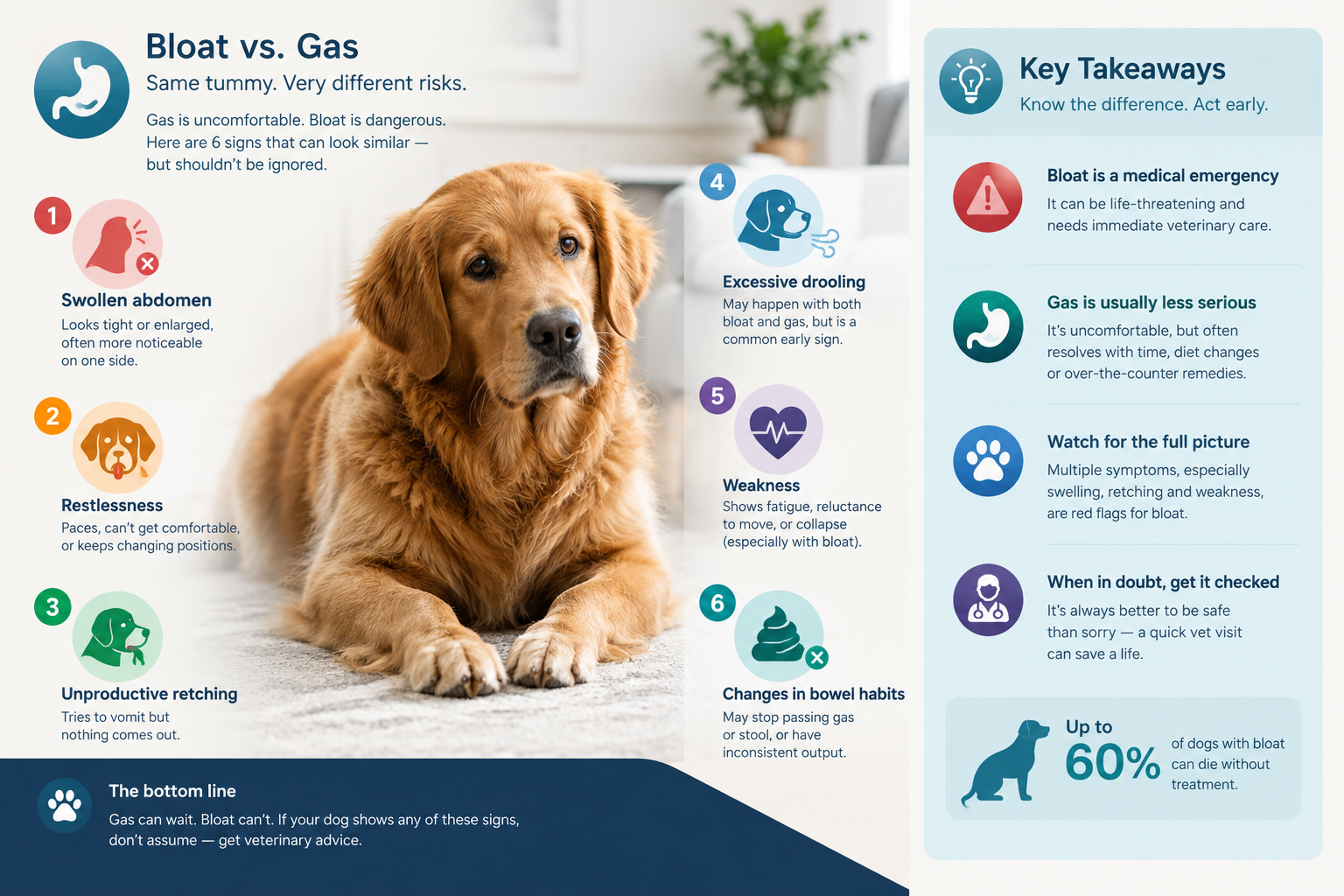
Simple gastric dilatation, sometimes called simple bloat, is a stretched stomach that has not rotated. It can be painful and it can still be dangerous, and some cases do need veterinary decompression. The stomach may empty on its own in milder cases. GDV is the version where the stomach rotates on its axis, sealing both the entrance and the exit. Gas keeps forming with nowhere to go, pressure crushes the blood supply to the stomach wall and spleen, and the dog slides into shock.
The practical distinction for an owner at 11pm: you cannot tell them apart by looking. Neither can a vet, reliably, without an x-ray. So the decision is not “which one is this.” The decision is “we go.”
My dog is bloated but still pooping. Does that rule out bloat?
No. Passing stool or gas does not rule out GDV, and it does not rule out simple dilatation either. The lower gut can still move contents that were already past the stomach. Judge the dog by the six signs above, especially retching, abdominal tightness and gum colour.
Dog swollen stomach, no pain. Is that still urgent?
A swollen abdomen without obvious pain is less typical of GDV, and it has other possible causes: fluid accumulation, organ enlargement, pregnancy, parasites in puppies, weight gain, or ingestion of something that should not have been eaten. It still deserves a same-day veterinary opinion rather than a wait-and-see week. If your dog has recently raided a cupboard, it is worth reviewing which human foods are genuinely toxic to dogs before the call so you can report what was available.
What’s the difference between bloat and gastric dilatation volvulus?
Bloat is the gas. Gastric dilatation and volvulus is the gas plus a twist. Volvulus is the word that turns a bad night into a surgical emergency, because rotation blocks blood flow and nothing you do at home can untwist a stomach.
| Condition | What is happening | Typical signs | Speed | What it needs |
|---|---|---|---|---|
| Ordinary gas | Gas forming and moving through normally | Burping, flatulence, gurgling, normal behaviour | Minutes to hours, then resolves | Monitoring, diet review if frequent |
| Simple gastric dilatation | Stomach stretched with gas or food, no rotation | Firm belly, discomfort, may vomit successfully | Can worsen or settle | Veterinary exam, imaging, possible decompression |
| GDV (bloat with twist) | Stomach rotates, blood supply cut off, shock develops | Unproductive retching, tight belly, pacing, pale gums, collapse | Hours, sometimes faster | Emergency stabilisation, decompression, surgery, usually gastropexy |
How quickly does bloat develop, and how long can a dog survive without treatment?
GDV can go from a dog pacing in the hallway to a dog in shock within a few hours, and some dogs deteriorate faster than that. There is no safe waiting period, and no reliable count of hours that applies to every dog.
What the published guidance supports is the direction, not a stopwatch. VCA’s bloat and GDV guidance describes the condition as rapidly progressive and life threatening, with shock developing as the stretched stomach compresses major blood vessels. Merck’s description of shock signs in GDV, including weak pulses and pale membranes, marks the stage where tissue is already suffering.
A workable rule: if the signs started within the last hour and you are reading this to decide, you have already spent part of the window. Phone the clinic from the car.
Why do people mistake bloat for regular gas in dogs?
Because the first ten minutes of GDV look like a mildly uncomfortable dog, and because the word “bloat” sounds like a human ailment that passes. The vocabulary works against owners.
Three other reasons this misread happens so often:
- The timing is believable. Bloat often follows a meal or a drink, so “too much dinner” is the obvious story.
- The swelling can be invisible early. In a deep-chested dog, a distended stomach sits partly under the rib cage.
- The dog may still wag, still greet you, still follow you to the kitchen. Dogs are not reliable narrators of their own pain.
The counter-habit is simple. Any time a large dog retches without producing anything, run the six-sign check instead of waiting for the next heave.
Which dog breeds are most at risk for bloat?
Risk clusters in large, deep-chested breeds: Great Danes, Standard Poodles, German Shepherds, Weimaraners, Setters, Boxers, Dobermans, Saint Bernards, Basset Hounds and similar body shapes. A 2025 Dog Aging Project analysis of 47,444 enrolled dogs identified 170 owner-reported GDV events and found increased odds associated with being purebred, male, over 40 kg, having a low body condition score, and being a Poodle or Poodle mix.
Two details from that dataset are worth holding onto. First, Poodles and Poodle mixes stood out, which may surprise owners who think of bloat as a Great Dane problem. Second, the authors did not find increased odds linked to diet type, number of daily meals, neuter status, or fearful behaviour in that population. That does not prove those factors are irrelevant in every dog. It means this particular dataset did not show the association.
Family history also matters. A first-degree relative with GDV raises concern, which is a reasonable question to ask a breeder alongside the usual questions about size and care demands for giant breeds. If you are still choosing, bloat risk belongs on the list when you match a breed to your household and routine, especially with the large guarding breeds like German Shepherds and Rottweilers.
Small dogs are not immune. They are simply far less likely to be affected.
What should I do if I think my dog has bloat?
Go to an emergency veterinary hospital immediately. Call on the way so the team can prepare for a possible GDV before you arrive, which saves minutes on triage, bloodwork and x-ray.
Do this:
- Load the dog into the car with as little exertion as possible. Large dog, two people if you can manage it.
- Call ahead and say the words “possible bloat or GDV.” Give the breed, the weight, and the time the signs started.
- Bring a note of what the dog ate and drank, and when.
- Keep the car cool and quiet. Let the dog choose its own position.
Do not do this:
- Do not give food or water.
- Do not give baking soda, vinegar, simethicone, oil, or any home gas remedy. None of these untwist a stomach, and swallowing anything can make anaesthesia riskier.
- Do not attempt to insert a tube or press on the abdomen.
- Do not walk the dog around hoping the gas moves.
- Do not wait for the regular clinic to open.
When should I take my dog to the emergency vet for bloat?
Go immediately if there is unproductive retching, a swollen or hard abdomen, pale or grey gums, weakness, or collapse. Go if the dog is pacing and cannot settle and also drooling. Go if you are genuinely unsure and the dog is a large deep-chested breed. Emergency veterinary guidance on a hard, bloated abdomen treats it as a now problem, not a morning problem.
The cost of being wrong in one direction is an exam fee. In the other direction it is the dog.
How do vets diagnose bloat in dogs?
Diagnosis combines a physical exam with abdominal x-rays, which show whether the stomach is simply distended or rotated. The classic radiographic appearance of a twisted stomach is sometimes described as a double bubble or a compartmentalised stomach shadow.
A typical emergency workup includes:
- Physical exam and vital signs: heart rate and rhythm, pulse quality, gum colour, capillary refill, abdominal palpation.
- Right lateral abdominal radiograph: the single most useful test for distinguishing dilatation from volvulus.
- Bloodwork and lactate: lactate helps assess how badly tissue perfusion has been affected and informs prognosis.
- ECG: arrhythmias are common in GDV and change the anaesthetic plan.
Stabilisation usually starts before the diagnosis is finished. Intravenous fluids, pain relief, oxygen and stomach decompression often happen while x-rays are being reviewed, because treating shock cannot wait for paperwork.
Can bloat be treated at home, or does it need surgery?
GDV cannot be treated at home. It needs emergency stabilisation, stomach decompression, and surgery to reposition the stomach, assess the stomach wall and spleen for damage, and in most cases perform a gastropexy that tacks the stomach to the body wall.
The treatment sequence described in current veterinary guidance has not changed in a way that gives owners a home option, and no approved home treatment for canine GDV was identified in sources reviewed through October 2026. The steps are:
- Shock treatment: large-bore intravenous catheters, fluid resuscitation, pain control, oxygen.
- Decompression: passing an orogastric tube, or trocarisation through the body wall to release trapped gas.
- Surgery: derotating the stomach, checking tissue viability, removing dead stomach wall or the spleen if needed.
- Gastropexy: surgically attaching the stomach so it cannot rotate again.
Gastropexy is the part with the clearest evidence behind it. A review of gastropexy after GDV found dogs that received gastropexy were substantially less likely to have a recurrence than dogs treated with stabilisation and repositioning alone, with one included comparison reporting an odds ratio of 0.05 (95% confidence interval 0.01 to 0.25). A related evidence review reported recurrence after gastropexy ranging from 0% to 15.4%, while noting the overall evidence base is weak because of study design limitations. Low recurrence, imperfect studies. Both facts belong in the same sentence.
Simple dilatation without rotation may be managed with decompression and supportive care, sometimes without surgery. That call belongs to the veterinarian looking at the x-ray, not to an owner looking at the dog.
How much does bloat surgery cost for dogs?
Emergency GDV treatment is expensive, and published cost figures vary too much by country, region and complication rate to quote a single reliable number. Owners in the United States are commonly quoted somewhere in the low thousands to well over ten thousand dollars, with the upper end involving stomach resection, splenectomy, arrhythmia management and several days of intensive care. Treat that range as an estimate based on how veterinary emergency billing is typically structured, not as a sourced figure.
What drives the bill:
- Whether surgery is needed, or decompression alone resolves it
- Whether stomach tissue or the spleen must be removed
- Length of intensive care and monitoring
- Out-of-hours emergency fees and regional pricing
- Complications such as arrhythmias or sepsis
Practical move: call your nearest emergency hospital on an ordinary afternoon and ask what a GDV workup and surgery typically costs there. Write the number on the fridge with the clinic’s phone number. Financial decisions made in a waiting room at 2am are worse decisions. Pet insurance purchased before any symptoms exist is the other option worth pricing, particularly for at-risk breeds.
Is bloat in dogs always fatal?
No. GDV is frequently survivable with prompt surgery, and it is frequently fatal without it. Outcomes depend heavily on how quickly the dog reaches treatment and how much stomach tissue has been damaged by the time surgery begins.
Recent surgical case series have reported encouraging survival in treated dogs. One 2025 single-institution study of 130 surgically treated dogs reported 86.4% survival. That number describes dogs who reached a hospital and had surgery. It says nothing about dogs kept at home overnight, and it should not be read as reassurance that observation is safe. Prognosis worsens with delay, with the presence of necrotic stomach wall, and with severe shock on arrival.
Can you prevent bloat in dogs?
You can reduce risk, and you cannot eliminate it. The only measure with strong supporting evidence is prophylactic gastropexy, usually discussed for very high-risk breeds and often performed at the same time as spaying or neutering.
Supported or reasonable:
- Prophylactic gastropexy in high-risk breeds, discussed with a veterinarian. Evidence for low recurrence after gastropexy is the strongest signal in this area.
- Maintaining healthy body condition. The 2025 dataset linked low body condition score to increased odds, which makes an underweight large dog a conversation with your vet rather than a shrug.
- Avoiding heavy exercise right around large meals. Widely recommended, modest evidence, low cost to follow.
- Slowing very fast eaters with a puzzle feeder or snuffle mat. Slow eating has biological plausibility and gives you useful enrichment either way. Evidence specific to GDV remains limited.
Unproven or contradicted:
- Raised food bowls. Often marketed as bloat prevention. There is no good evidence they lower risk, and earlier research raised the opposite possibility in large breeds.
- Switching diet type to prevent bloat. The 2025 Dog Aging Project analysis did not find increased odds associated with diet type.
- A fixed number of daily meals as protection. The same analysis did not find an association with meal frequency, so advice built entirely on that point is weaker than it sounds.
- Any supplement, paste or gas remedy marketed as bloat prevention. None has evidence behind it for GDV.
Where the facts end: GDV almost certainly involves several interacting factors including anatomy, genetics, stomach motility and temperament, and research has not sorted their relative weight. What the evidence supports today is knowing your dog’s risk, recognising the signs within minutes, and asking about gastropexy if you own a very high-risk breed.
FAQ
Can a dog have bloat without a swollen stomach? Yes. Early GDV, and GDV in deep-chested dogs, can occur without obvious visible swelling because the distended stomach sits partly under the rib cage. Unproductive retching, restlessness and drooling can appear before any change in belly shape.
How long does bloat take to kill a dog? There is no fixed timeline. Veterinary guidance describes GDV as progressing to shock and death within hours in many cases, and some dogs deteriorate faster. Treat it as an emergency from the first retch, not after a waiting period.
Is it bloat or just gas if my dog is burping? A dog who can burp and pass gas comfortably is behaving more like a gassy dog than a dog with a twisted stomach. That is reassuring, not conclusive. If retching, abdominal tightness or pale gums appear, go to the emergency vet.
Do raised bowls prevent bloat in dogs? No reliable evidence shows raised bowls reduce GDV risk, and earlier research suggested they may be associated with higher risk in large breeds. Choose bowl height for comfort and joint reasons, not as bloat prevention.
Does gastropexy mean my dog can never bloat again? No. Gastropexy strongly reduces the chance of the stomach twisting again, with reported recurrence ranging from 0% to 15.4% in a 2025 evidence review, but it does not prevent gas distension. A dog with a gastropexy showing bloat signs still needs veterinary assessment.
My dog is bloated but acting normal. Should I still call a vet? Call. A distended abdomen with no apparent pain has several possible causes, some of them serious and none of them diagnosable from across the room. A same-day phone call costs nothing and settles the question.
Which dog breeds are prone to bloat? Large deep-chested breeds including Great Danes, Standard Poodles, German Shepherds, Weimaraners, Setters, Boxers, Dobermans, Saint Bernards and Basset Hounds. A 2025 Dog Aging Project analysis also found increased odds in purebred dogs, male dogs, and dogs over 40 kg.
Conclusion: the plan to set up tonight
Bloat in dogs symptoms are easy to dismiss precisely because the early version looks like discomfort rather than catastrophe. A dog pacing, drooling, and heaving up nothing is not a dog with wind. That is the sign worth driving for.
Three things to do while nothing is wrong:
- Save the number of your nearest 24-hour emergency veterinary hospital in your phone, and write it somewhere a house-sitter will find it. Add the drive time.
- Practise checking gums on a calm dog so you know what normal pink looks like on your dog, not on a stock photo.
- Ask one question at your next appointment: given this breed, this weight and this family history, does prophylactic gastropexy make sense here? Ask for the reasoning, not just the answer.
That is a ten-minute project with a very large upside. Dog Advice That Actually Answers the Question means telling you the part that is uncomfortable: with GDV, the owner who leaves the house early is the owner with options. Guidance in this article was checked in October 2026 and is general information, not a diagnosis or a substitute for veterinary care.