Quick Answer
Is raw food good for dogs? Based on the evidence available in October 2026, raw meat based diets have not been shown to beat properly formulated cooked or commercial food on long term health, and they carry documented hazards: bacterial contamination, nutrient imbalance, dental fractures, household transmission, and frequent product recalls. Some owners report shinier coats and smaller stools, and those reports are real observations, but they are anecdotes rather than proof of superiority. If you still want to feed raw, the safest version is a recipe formulated by a qualified veterinary nutritionist, strict kitchen hygiene, and no young children, seniors, or immune compromised people in the house.
This is general information, not a diagnosis or a feeding plan for your individual dog.
Key Takeaways: Is Raw Food Good for Dogs?
- A September 2026 study in Frontiers in Microbiology found that 100 percent of the raw diets tested showed gaps between declared and measured nutrients, compared with 10 percent of extruded (kibble) diets.
- In the same small study, six of ten raw fed dogs were identified as pathogen carriers. Raw fed dogs had more diverse gut bacteria, and the authors cautioned that more diversity does not automatically mean healthier.
- A 2026 review in Comparative Clinical Pathology concluded that long term clinical superiority for raw diets has not been established, partly because raw products are wildly different from each other.
- The CDC does not recommend raw pet food, and the AVMA and WSAVA both discourage uncooked animal protein. WSAVA states there is no documented benefit that outweighs the known risks.
- Recalls are routine, not rare. FDA posted multiple raw pet food recalls and advisories during 2026 for Salmonella, Listeria, and Campylobacter, including one lot linked to three sick dogs.
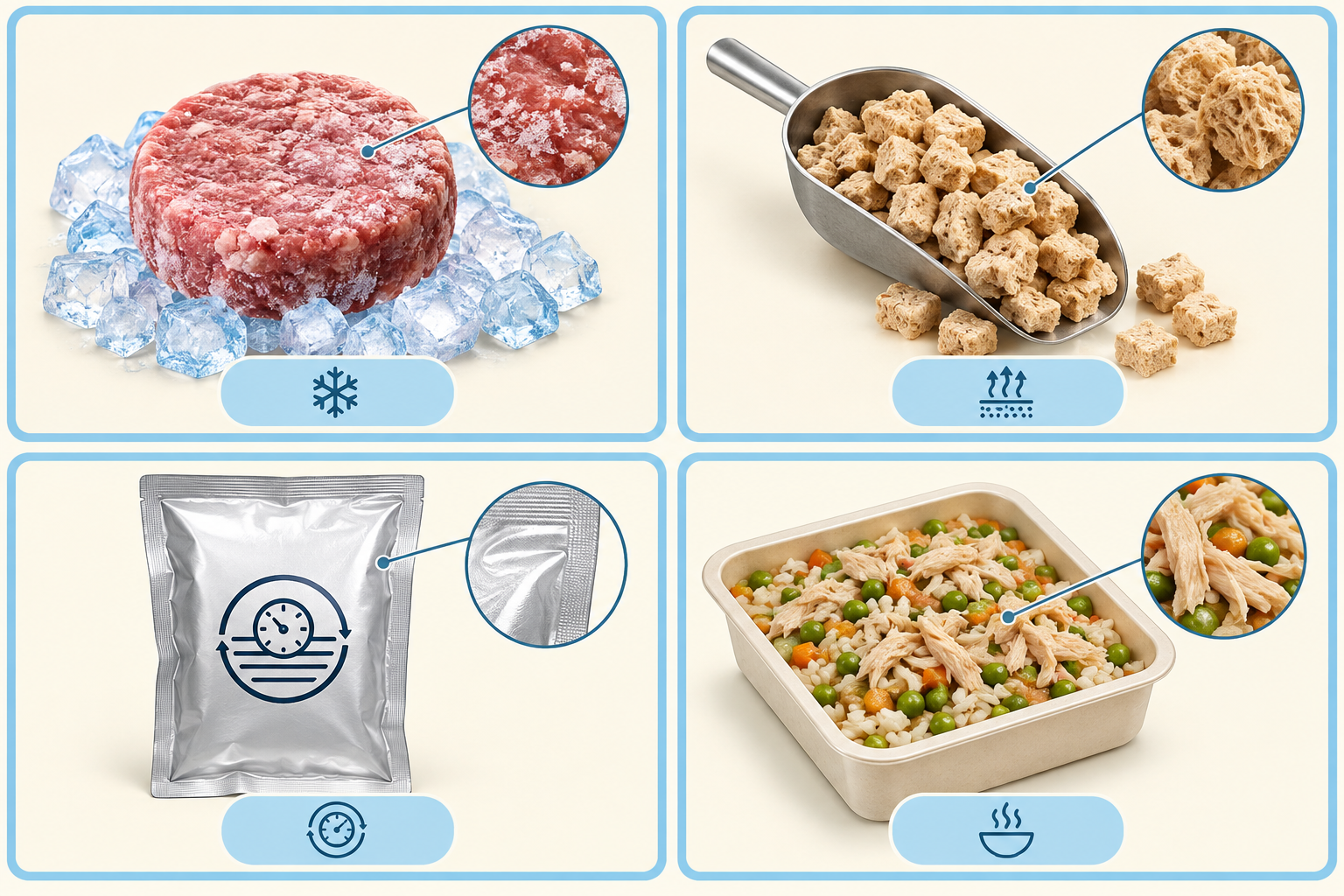
- Freeze dried raw, high pressure processed raw, and gently cooked fresh food exist precisely because people want the raw aesthetic with fewer live pathogens. They are reasonable middle options.
- Individual variation is real. A dog can eat raw for years and seem fine. That does not remove the risk for the dog beside them in the waiting room, or for the toddler who licks the floor.
The five risks raw feeding videos skip
Raw feeding content is built for the camera: glossy ground meat, a satisfied dog, a before and after coat shot. What rarely makes the edit are the five hazards veterinary nutrition groups keep naming.
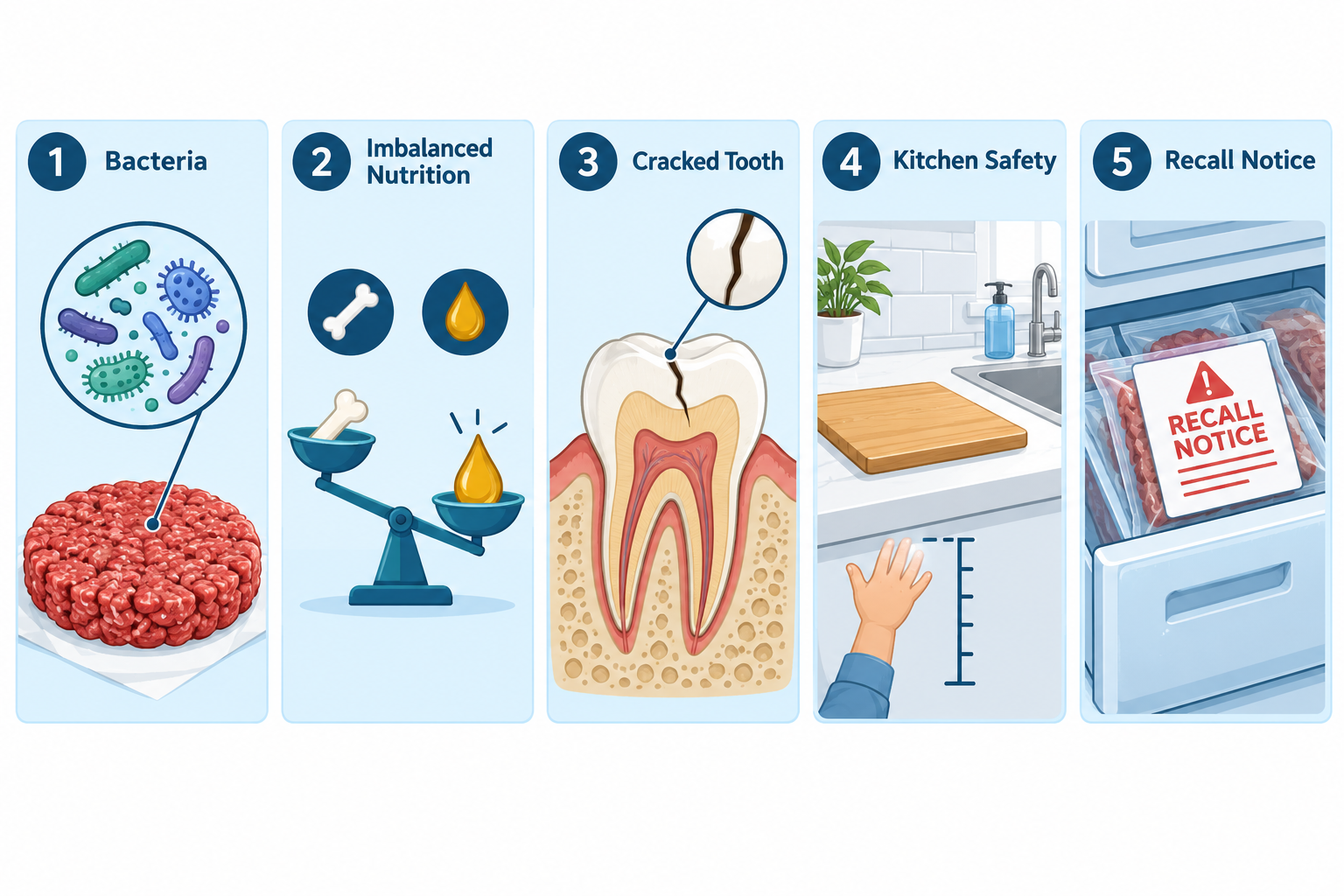
1. Pathogens that survive in the bowl and on your hands. Uncooked meat can carry Salmonella, Listeria monocytogenes, and Campylobacter. Dogs can shed these organisms in feces while looking completely healthy, which is the detail the AVMA policy keeps pointing at.
2. Nutrient composition that does not match the label. This is the quiet one. A raw patty can look perfect and still deliver too much fat, too little calcium, or the wrong calcium to phosphorus ratio.
3. Bone related injuries. WSAVA’s Global Nutrition Committee lists bone injury as one of three principal concerns, alongside pathogens and nutritional inadequacy. Tufts veterinary nutrition specialists note dental fractures among the problems they see.
4. Household transmission. The risk is not only the dog. It is the cutting board, the bowl rim, the fridge shelf, the dog’s muzzle after dinner, and the person in the house with a weaker immune system.
5. Recalls you have to track yourself. Kibble gets recalled too. Raw gets recalled for live pathogens, which changes what a recall means in practice. FDA keeps a running list of pet food outbreaks and advisories, and 2026 was a busy year on it.
100%
of raw diets tested showed declared vs measured nutrient discrepancies, vs 10% of extruded diets (Frontiers in Microbiology, 2026)
6 of 10
raw fed dogs in that study were identified as pathogen carriers (Frontiers in Microbiology, 2026)
684 lb
of raw chicken dog food recalled in August 2026 after testing positive for Listeria and Salmonella (FDA)
4 to 606
Salmonella isolates from raw meat pet food in Great Britain, 2013 compared with 2022 (Frontiers in Veterinary Science, 2026)
So is raw food good for dogs? What the evidence supports
Is raw food good for dogs in the way the videos claim? The honest answer is no, not on current evidence, and the reason is less dramatic than you would expect: the studies that would settle it have not been done.
The September 2026 review in Comparative Clinical Pathology described raw meat based diets as heterogeneous products rather than one treatment you can test. One brand’s beef and tripe blend and someone’s kitchen table mix of supermarket chicken and rice share a label and almost nothing else. The review found repeated evidence of bacterial contamination, product specific nutrient deviations, and links to antimicrobial resistant bacteria, while noting that short term studies often do report high apparent digestibility.
High digestibility is a genuine finding. It is also not the same as living longer, moving better, or itching less.
That review was careful about something most online debates skip. Observational studies of raw fed dogs carry residual confounding. Owners who feed raw often differ in exercise habits, breed choice, veterinary spending, and household routines. So when a survey shows raw fed dogs doing well on some measure, the diet may not be doing the work.
Where the facts end: nobody has run a long, controlled trial comparing raw and cooked complete diets across years of a dog’s life. Until that exists, the defensible position is the one the 2026 review landed on. Raw feeding creates preventable hazards and has not demonstrated long term superiority. That is different from saying every raw fed dog gets sick, because most do not.
If you are weighing formats more generally, our breakdown of dry, wet or raw dog food and which one suits your dog walks through the same decision without the ideology.
What are the benefits of raw food for dogs?
The reported benefits are mostly owner observations: glossier coat, smaller and firmer stools, better appetite in fussy dogs, more visible enthusiasm at mealtimes. Those observations are worth taking seriously as observations. They are not evidence that raw food is nutritionally better.
Here is what can plausibly explain them:
- Smaller stools fit the digestibility findings. Raw diets tend to be higher in protein and fat and lower in fiber and non fiber carbohydrates, which means less residue coming out the other end.
- Coat changes often track fat and fatty acid intake. You can get the same effect by moving to a higher fat cooked food, or by fixing a deficient diet. The raw part is not the active ingredient.
- Enthusiasm is real and easy to explain. Cold, soft, strong smelling food is more interesting than dry pellets. Tufts nutrition specialists make exactly this distinction: a shinier coat, better energy, or easier digestion does not establish superiority over a balanced cooked diet.
What raw does deliver reliably is owner engagement. People who switch to raw usually also start weighing portions, reading labels, watching body condition, and paying attention. That attention helps dogs. It just is not a property of uncooked meat.
Decision rule: if your main goal is a better coat or firmer stools, try a measured change to a complete cooked or commercial diet with a known fat level first. If the problem resolves, you got the benefit without the pathogen load. Our guide to dog food toppers worth adding to kibble covers the lower risk version of the same idea.
Raw dog food vs kibble: which is better?
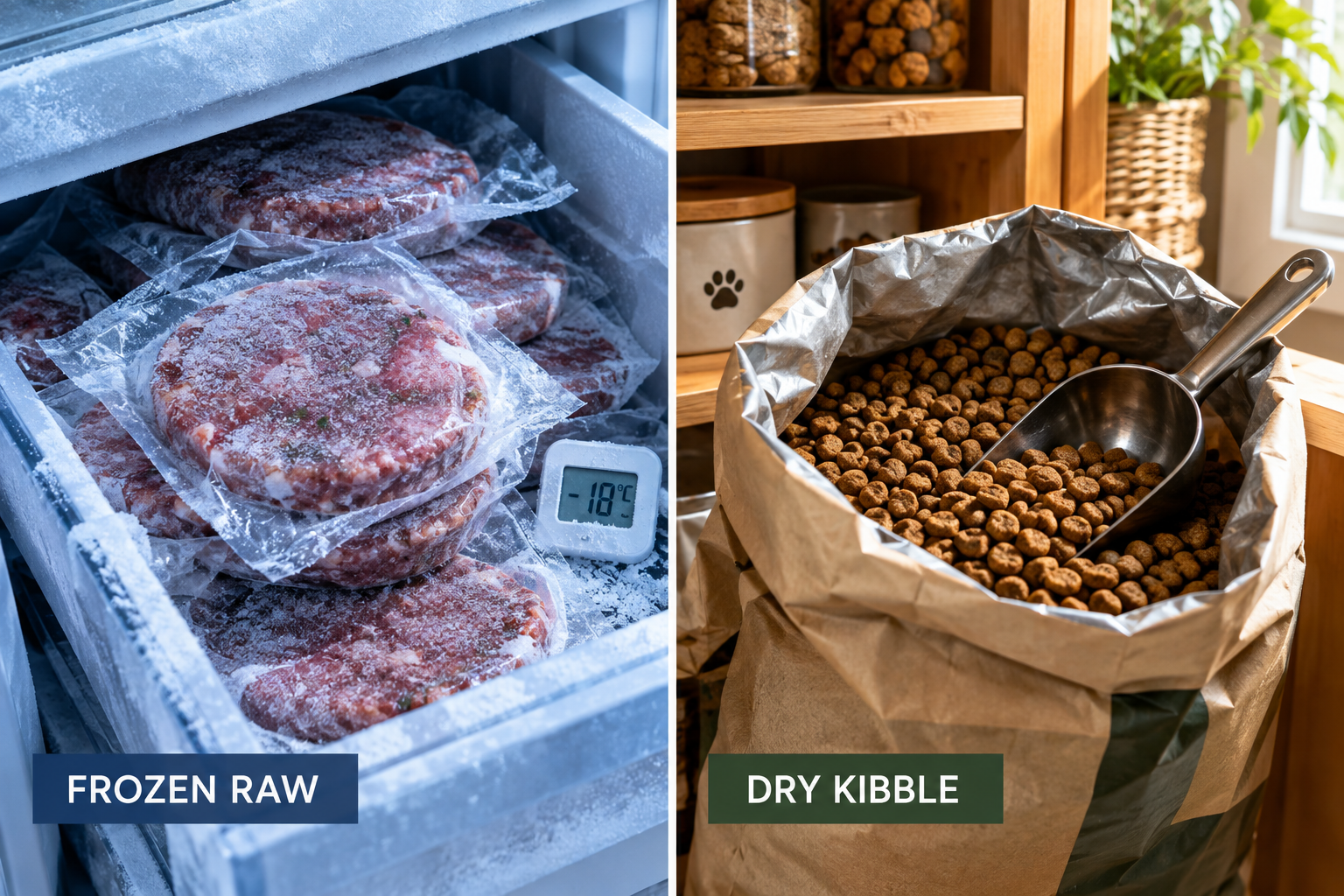
Neither format wins on principle. A well formulated kibble beats a badly built raw diet, and a well formulated raw diet still carries pathogen risk a kibble does not. The useful comparison is across five practical columns, so compare the options against your actual household.
| Option | Live pathogen risk | Nutrient reliability | Daily effort | Who it suits |
|---|---|---|---|---|
| Extruded kibble | Low, cooking step included | Highest in 2026 testing (10% showed deviations) | Scoop and go | Most households, kids, multi pet homes |
| Frozen raw | Highest, no kill step | Variable by product and batch | Thawing, freezer space, cleaning | Adults only homes with strict hygiene and vet oversight |
| Freeze dried raw | Reduced but not eliminated; drying is not a kill step | Depends on formulation | Shelf stable, rehydrate | Travel, treats, toppers |
| HPP raw | Lower than untreated raw; pressure reduces pathogens | Depends on formulation | Same as frozen raw | Owners committed to raw who want a safety step |
| Gently cooked fresh | Low, cooked to temperature | Good when formulated to a published profile | Fridge or freezer storage | Owners who want fresh food without live pathogens |
Choose kibble if anyone in the house is under five, over sixty five, pregnant, or immune compromised, or if you share a single small kitchen counter with no sanitizing routine.
Choose gently cooked fresh if you want the fresh food look and feel and can absorb the cost.
Choose raw only if you have a formulated recipe, a dedicated prep setup, and a vet who knows about it. If you want the mechanics of the format rather than the debate, see frozen and raw dog food storage, safety and cost.
Can raw food make dogs sick, and what are the real safety concerns?
Yes, it can, and 2026 produced documented cases. In August 2026, FDA reported that one lot of a raw chicken dog food (lot BB012729) tested positive for Salmonella after a consumer complaint, and that three dogs had become ill. That is the clearest version of the answer: not theoretical, not a scare campaign, three dogs.
Other 2026 actions tracked on FDA’s advisory pages include a nationwide recall of 684 pounds of raw chicken dog food that tested positive for both Listeria monocytogenes and Salmonella (no illnesses reported at the time of that notice), and a May 2026 advisory telling consumers not to feed eight lots of a raw brand after positive tests for Listeria, Salmonella, or Campylobacter jejuni across beef, tripe, duck neck, and chicken products.
Then there is the newer item. FDA now requires covered manufacturers using uncooked or unpasteurized poultry or cattle ingredients to consider H5N1 a known or reasonably foreseeable hazard in their food safety plans. Cooking, pasteurization, and canning inactivate the virus. Raw, by design, does not include that step. Dogs can contract H5N1, though reported illness in dogs has generally been milder than in cats.
The human side matters too. British surveillance published in Frontiers in Veterinary Science in 2026 reported Salmonella isolations from raw meat pet food rising from 4 isolates across 4 serovars in 2013 to 606 isolates across 39 serovars in 2022, alongside a fivefold increase in raw pet food plants operating in Great Britain. The authors called raw pet food a potential transmission vector while acknowledging that proving a direct path from bowl to person is hard.
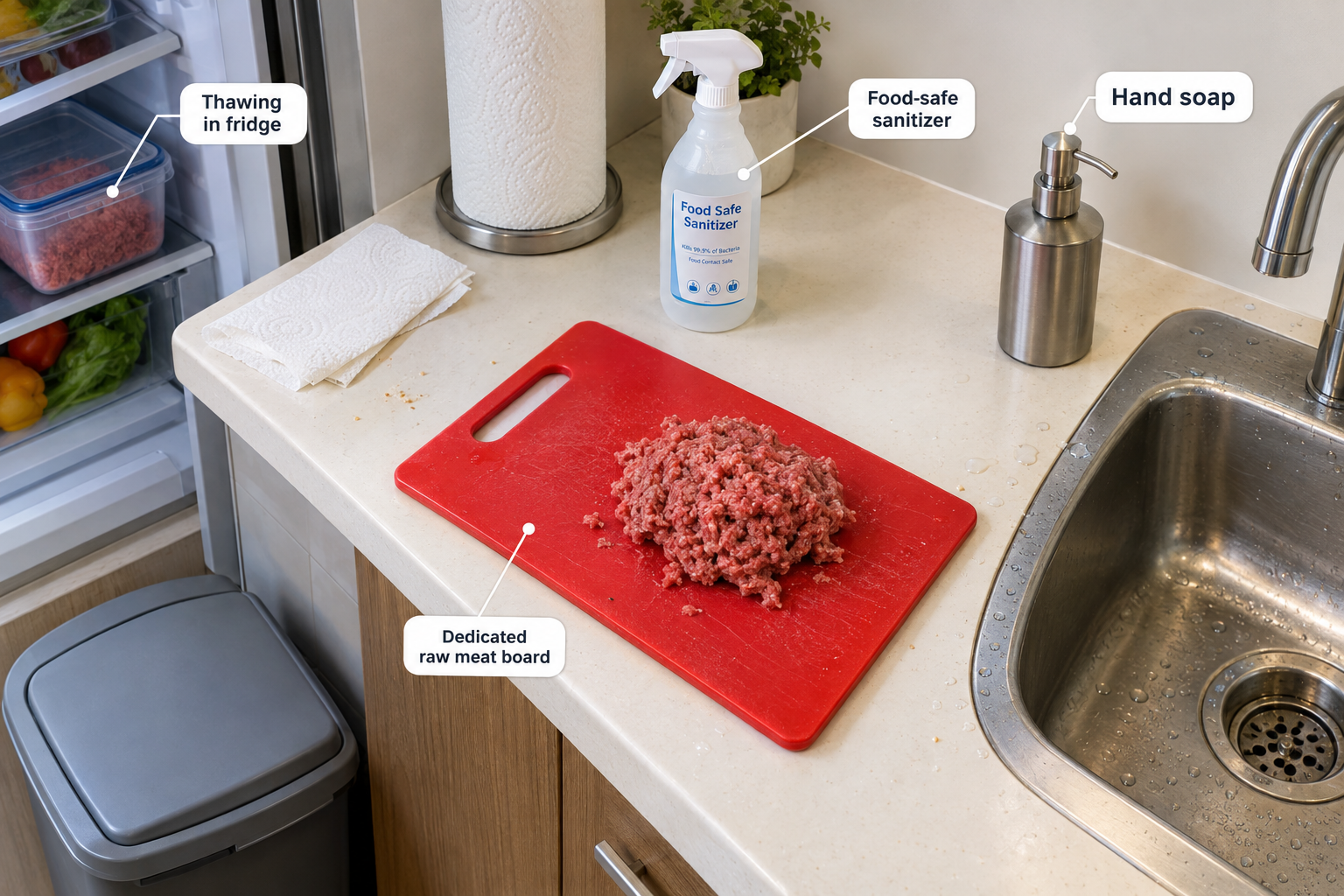
Common mistake: thawing a raw patty on the counter next to the kids’ lunch. Thaw in the fridge, in a sealed container, on the bottom shelf. Then wash what touched it, including the bowl, the scoop, and your phone if you picked it up mid prep.
Raw feeding household safety check
Work through the eight items below. The tally shows what you already cover and what needs a plan. Nothing here is a verdict on your dog.
What raw foods are toxic to dogs, and can you feed supermarket meat?
Some raw foods are hazardous regardless of diet philosophy. Raw salmon and trout from certain Pacific waterways can carry the parasite behind salmon poisoning disease. Raw bread dough, grapes, raisins, onions, garlic, xylitol, macadamias, and chocolate are off the list in any form. Raw egg whites in quantity can interfere with biotin. Weight bearing bones from large animals are a dental fracture risk, and cooked bones splinter.
Can you feed your dog raw chicken from the supermarket? You can, and plenty of people do, but understand what you bought. Retail poultry is processed on the assumption that a human will cook it. It is not screened to a standard that makes it safe uncooked, and Salmonella and Campylobacter are the usual suspects. If you proceed, handle it the way you would handle it for yourself before cooking, which means no shared boards and no rinsing in the sink that splashes everywhere.
What raw meats do dogs tend to tolerate best? Beef, lamb, and turkey are the common choices, with organ meat in small proportions. Tolerate is not the same as safe. None of these come with a pathogen guarantee.
For the full list of foods to keep away from your dog entirely, see our guide to foods dogs cannot eat.
Edge case: dogs on immune suppressing medication, dogs recovering from surgery, and dogs with inflammatory bowel disease are poor candidates for raw. So are dogs who live with someone on chemotherapy. The dog may cope. The household may not.
How much raw food should I feed my dog, and how do you transition?
Start with the feeding chart on the specific product, confirm the amount with your vet, and then adjust by body condition rather than by the number on the bag. Raw diets vary enormously in calorie density, so a volume that suits one brand overfeeds on another.
Practical approach:
- Weigh the dog and note a body condition score with your vet. That is your baseline.
- Use the manufacturer’s chart for the starting daily amount, split across two meals for most adults.
- Reassess at two and four weeks. Ribs easy to feel, waist visible from above, no weight creep. Adjust by around 10 percent at a time.
- Recheck after any brand change, because the fat level may have moved.
How to transition a dog to raw food
Transition over 7 to 10 days. Replace about a quarter of the old food on days one to three, half on days four to six, three quarters on days seven to eight, then the full amount. Loose stool during the change is common. Blood, vomiting, lethargy, or stool that stays loose past a few days is a vet call, not a detox. The same gradual method applies to any format, and our guide on how to switch dog food without upsetting their stomach covers the steps in more detail.
Can you mix raw food with regular dog food?
Yes, you can mix them, and the old claim that raw and kibble “digest at different rates” and must never meet is not supported by evidence. The real issues with mixing are different. Every raw meal, mixed or not, carries the same pathogen handling job. And partial raw feeding makes the total diet harder to balance, since you are now blending two products with different nutrient profiles and neither chart accounts for the other.
If you want the raw element without the balancing problem, keep raw to under 10 percent of daily calories as a topper and let a complete food carry the nutrition. Understanding what AAFCO statements on a label actually mean helps here, because that is the line between a complete diet and a garnish.
Is raw food good for puppies, or only adult dogs?
Puppies are the group where the risk goes up, not down. Is raw food good for dogs still growing? Veterinary nutrition guidance points the other way, for two reasons: growing dogs have tighter requirements for calcium, phosphorus, and total calories, and their immune systems are less practiced at handling a pathogen dose.
The calcium to phosphorus ratio is the part that causes real orthopedic damage in large breed puppies, and it is also the part most commonly wrong in homemade raw recipes. Given that the 2026 Frontiers testing found declared versus measured nutrient gaps in every raw diet sampled, a growing skeleton is a poor place to find out which direction the error went.
Senior dogs and dogs with chronic disease sit in a similar category for different reasons. Reduced immune function, medication, and kidney or liver disease all change what the diet needs to do.
Decision rule: feed puppies a complete diet formulated for growth, with a large breed version if the adult weight is over about 70 pounds. Our best puppy food guide covers what growing dogs need in year one. Revisit raw, if you still want to, once growth plates have closed and your vet is involved.
Does a raw food diet help dogs with sensitive stomachs or allergies?
Sometimes dogs improve on raw, and the likely reason is the ingredient change rather than the lack of cooking. Raw diets are often single protein, low carbohydrate, and free of the additives in the previous food. That makes them an accidental elimination diet. A cooked novel protein diet does the same job without the live bacteria.
What this means in practice:
- For suspected food allergy, the diagnostic standard is a controlled elimination trial of 8 to 12 weeks using a novel or hydrolyzed protein, supervised by a vet. Raw is not required and complicates the trial, since contamination can confuse the picture.
- For sensitive stomachs, fat level, fiber type, and meal frequency usually matter more than raw versus cooked. A high fat raw diet can make pancreatitis prone dogs worse.
- For itchy skin, most itching in dogs is environmental or flea related, not dietary. Changing food before ruling those out is a common detour.
If the diet change helped, work out which variable did the work. Then you can keep the benefit and drop the hazard. Our guide to dog food for sensitive stomachs and food allergies runs through the cooked options worth trying first.
Raw dog food cost compared with regular dog food
Raw is usually the most expensive way to feed a dog per calorie, with commercial frozen raw and gently cooked fresh subscriptions at the top and dry kibble at the bottom. Prices move constantly, so compare on cost per day for your dog’s weight, not per bag or per pound, and note the date you checked.
Costs people forget to include:
- Freezer space, which for a large dog can mean a second freezer.
- Shipping, often the largest line item on frozen subscription orders.
- Supplements, if the recipe is homemade and needs calcium or a vitamin mix.
- A formulation consult with a veterinary nutritionist, which is the single most useful spend if you are building your own recipe.
- Cleaning supplies and disposable gloves, small but recurring.
Homemade raw from supermarket meat can look cheaper than premium kibble until you add the supplements and the consult. Skipping both is what produces the nutrient gaps the 2026 testing kept finding. If budget is the main driver, cheap dog food that is still good is a more honest route than an underbuilt raw diet.
Raw dog food brands, where to buy, and safer alternatives
Commercial raw sells through pet specialty freezers, direct to door subscriptions, and some grocery chains. Rather than ranking brands, use buying criteria you can check yourself, because batch testing and recall history tell you more than packaging does.
What to look for before you buy:
- A nutritional adequacy statement naming the life stage, and ideally feeding trial evidence rather than formulation alone.
- A named qualified nutritionist behind the formulation.
- A stated pathogen control step, such as high pressure processing, and willingness to explain their testing program.
- A clean or well handled recall history. Check the FDA advisory list before each restock, not once a year.
- Price per day for your dog’s weight, with the date you checked it written down.
Three lower risk alternatives worth comparing:
Freeze dried raw. Shelf stable, light, popular as a topper or travel food. Drying removes water, not pathogens, so it is a reduction rather than a solution. Good for enrichment and training rewards.
High pressure processed raw. Pressure treatment reduces pathogen load while keeping the food uncooked. It does not fix a badly formulated recipe, so check the nutrition claims separately from the safety claim.
Gently cooked fresh food. Cooked to temperature, refrigerated or frozen, visually close to what raw feeders like. This is the option that keeps most of the appeal and drops most of the pathogen risk, and it is where many owners land after reading the 2026 safety notices. If you are weighing it up, see whether fresh dog food delivery is worth the subscription.
Do vets recommend raw food for dogs?
Most do not, and the major veterinary bodies say so in writing. The AVMA policy discourages feeding uncooked animal source protein to cats and dogs, singling out young children, older adults, pregnant people, and immune compromised household members as the people most at risk. WSAVA’s Global Nutrition Committee states there is no properly documented health benefit that outweighs the known risks, naming pathogen contamination, nutritional inadequacy or excess, and bone related injury. CDC does not recommend raw pet food or treats and tells owners to speak with a veterinarian first. Tufts veterinary nutrition specialists favor diets with an appropriate nutritional adequacy statement and, where possible, feeding trial evidence. News coverage in 2026 reflected the same veterinary caution.
Some veterinarians do support raw feeding, usually with conditions: a formulated recipe, commercial product with a pathogen control step, no high risk humans in the household, and regular monitoring. That is a narrower recommendation than most social media content implies.
The practical move is simple. Tell your vet the dog eats raw and ask them to note it in the record. It changes how they interpret a diarrhea case, a lab result, and a risk assessment if your dog visits a hospital ward or a care home.
Frequently asked questions
Why is raw food bad for dogs, in one sentence? Uncooked animal protein can carry Salmonella, Listeria, Campylobacter, and now H5N1 concerns, and 2026 laboratory testing found nutrient composition gaps in every raw diet sampled, which puts the hazard ahead of any proven benefit.
Is it better for dogs to eat raw or cooked meat? Cooked is safer, and no study has shown raw meat produces better long term health. Cooking inactivates most pathogens, including H5N1, without removing the protein value.
Can I feed my dog raw chicken? You can, and some dogs eat it for years without obvious problems, but retail chicken is not screened for uncooked feeding and commonly carries Salmonella or Campylobacter. Raw bones also carry a dental fracture risk.
Is freeze dried raw food good for dogs? Freeze dried raw is convenient and shelf stable, and the freeze drying process reduces moisture rather than reliably killing pathogens. Treat it as a reduced risk raw product, not a cooked one, and check the nutritional adequacy statement.
Can raw feeding make people in the house sick? Yes. Dogs can shed pathogens in feces while appearing healthy, and contaminated surfaces, bowls, and hands are plausible routes. The AVMA specifically flags children under five, adults over 65, pregnant people, and immune compromised people.
How do I check whether my raw brand has been recalled? Check the FDA outbreaks and advisories page before each restock and keep your lot numbers until the food is finished. Several 2026 actions were lot specific, including one lot linked to three sick dogs.
Does raw food clean a dog’s teeth? Chewing can reduce some plaque, and raw bones also appear among the causes of dental fractures reported by veterinary nutrition services. Dental chews sized to the dog and regular brushing carry less fracture risk.
Conclusion: what to do with this
Raw feeding is not a moral failure and it is not magic. It is a format with real appeal, a handful of documented hazards, and a 2026 evidence base that says the long term advantages have not been demonstrated. Dog advice that actually answers the question has to include that last part.
Your next steps, in order:
- Run the eight item household safety check above. If any of the first two items are unticked, the risk sits with your family as much as your dog.
- Pick your format on purpose. If the appeal is fresh food, gently cooked is the version that keeps most of the benefit. If the appeal is cost, compare price per day before assuming raw is cheaper.
- Get the recipe formulated by a qualified veterinary nutritionist if you feed any homemade raw, and check the adequacy statement on anything commercial.
- Bookmark the FDA advisory page and check it when you restock.
- Tell your vet. Then ask what they would monitor, and how often.
Individual variation runs through all of this. Your dog is one dog, not a study population. What the evidence supports is a careful version of raw feeding or a cooked alternative, with your eyes open either way.