Dog gastropexy buys one specific protection: the stomach is tacked to the body wall so it cannot rotate. That’s the whole promise. It does not stop gas from building up, it does not stop a dog from eating too fast, and it does not make a swollen abdomen a non-emergency. What it prevents is the part that kills dogs within hours, the twist. For a Great Dane, that distinction matters enormously. Cornell’s Riney Canine Health Center estimates a lifetime gastric dilatation volvulus risk of roughly 40 percent in the breed, and reports recurrence falling to about 3 to 5 percent after a gastropexy compared with rates as high as 80 percent in dogs treated without one.
Guidance in this article was checked in October 2026. It is general information for owners weighing a decision with their own veterinarian, not a diagnosis or a treatment plan for an individual dog.
Key takeaways
- Gastropexy prevents volvulus, not distension. The MSD Veterinary Manual states that gastropexy has not been shown to prevent gastric dilation but should prevent the life-threatening rotation.
- Elective cost is usually a few hundred to a few thousand dollars. Published veterinary cost guides put a gastropexy added to a spay or neuter at the low end and laparoscopic work at a specialty hospital at the high end. Emergency GDV surgery costs several times more.
- The clearest candidates are large, deep and narrow chested dogs with a close relative that bloated. The American College of Veterinary Surgeons lists giant size, deep chest conformation, anxious temperament and family history as reasons for the recommendation, and estimates GDV occurs in roughly 1 in 5 at-risk dogs without the surgery.
- Great Danes, Saint Bernards, Weimaraners, Irish Setters and Standard Poodles sit in the top risk tier. German Shepherds, Dobermans, Gordon Setters and Newfoundlands are not far behind.
- Feeding changes help but do not replace the surgery. Smaller meals, calm mealtimes and skipping raised bowls lower risk. None of them hold the stomach in place.
- Recovery is typically 10 to 14 days of restriction, with laparoscopic approaches often involving smaller incisions and less discomfort.
- Most pet insurance excludes elective gastropexy but commonly covers emergency GDV surgery, subject to waiting periods and pre-existing condition rules. Read the policy wording before assuming either way.
~40%
Estimated lifetime GDV risk in Great Danes (Cornell Riney Canine Health Center)
1 in 5
At-risk dogs without prophylactic gastropexy expected to develop GDV (ACVS client guidance)
3-5%
Recurrence after therapeutic gastropexy, versus up to 80% without it (Cornell)
5.79%
Perioperative mortality in 121 dogs treated for GDV in a 2026 Veterinary Surgery comparison of gastropexy techniques
What is dog gastropexy and why do vets recommend it?
A dog gastropexy is a surgery that attaches the wall of the stomach to the inside of the abdominal wall, usually on the right side, so scar tissue forms a permanent anchor. Veterinarians recommend it for dogs whose body shape and breed history put them at high risk of gastric dilatation volvulus, because once the stomach twists, the clock starts and the outcome depends on how fast the dog reaches surgery.
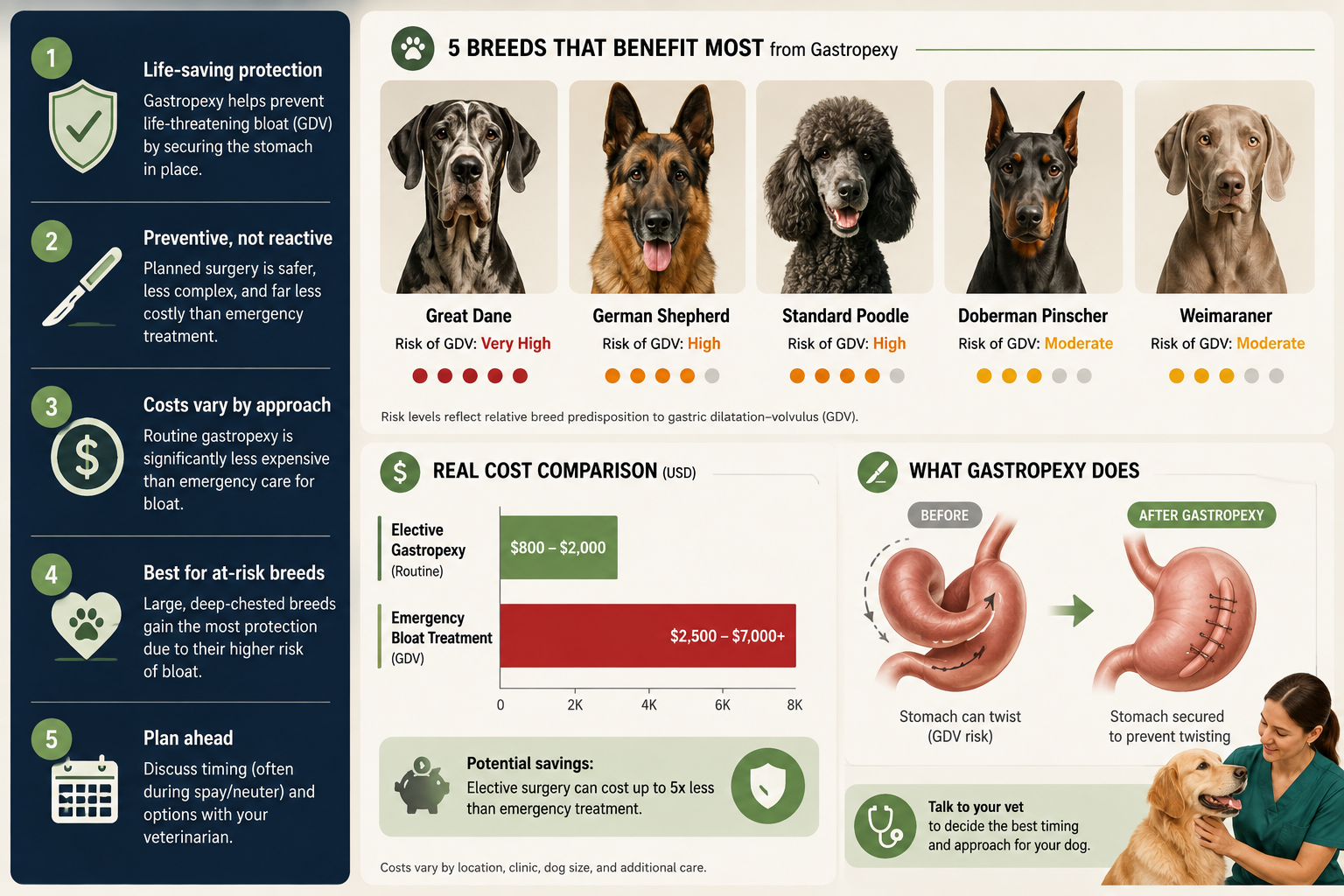
The surgical logic is simple. A deep, narrow chest gives the stomach room to swing. Anchor one side of it and the swing becomes mechanically unlikely. Surgical overviews of gastropexy for GDV describe several ways to build that anchor:
- Incisional gastropexy. Matching cuts in the stomach’s muscle layer and the body wall are sutured together. The standard open approach, often done through the same incision as a spay.
- Belt-loop and circumcostal variants. A flap of stomach tissue is passed under a muscle bridge or around a rib. Strong, more involved.
- Laparoscopic-assisted and total laparoscopic gastropexy. Small ports, a camera, smaller incisions.
- Endoscopic-assisted gastropexy. Guided from inside the stomach, minimal external cutting.
Technique research in 2026 has mostly been about speed and comfort rather than whether gastropexy works at all. A study published in Veterinary Surgery in August 2026 compared instruments for elective laparoscopic gastropexy and found standard laparoscopic instrumentation completed the first suture line in a median of 6 minutes against 8 minutes for an articulating needle driver. Every procedure was completed, adverse events were rare, and the newer tool was feasible without being clearly better. That is the kind of finding worth reading twice before paying extra for a technique described as advanced.
What is gastric dilatation volvulus in dogs, and how is it different from simple bloat?
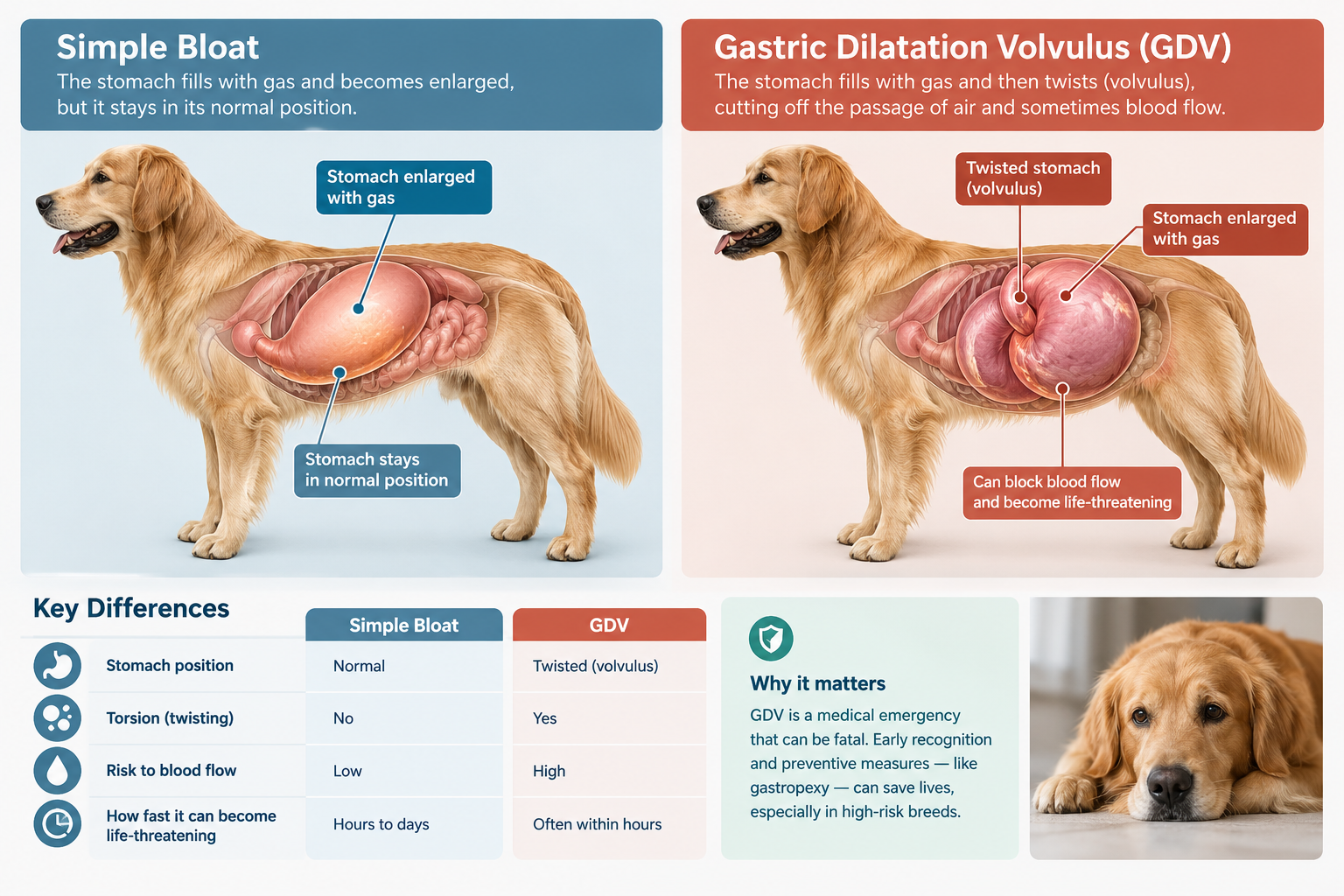
Bloat means the stomach fills with gas and fluid and swells. Gastric dilatation volvulus means the swollen stomach also rotates on its axis, sealing both the entrance and the exit, cutting off blood supply and putting pressure on the large veins returning blood to the heart. Dilation alone is painful and dangerous. Volvulus is a surgical emergency that can kill a dog in a matter of hours.
That difference is exactly where the facts end on what a gastropexy can do for you. An anchored stomach can still fill with gas. A dog with a gastropexy can still retch, pace, drool, pant and look bloated, and still needs to be seen urgently. Veterinary references list the signs that should put you in the car immediately:
- Repeated unproductive retching, nothing coming up
- A visibly enlarged, tight or drum-like abdomen
- Restlessness, pacing, an inability to settle
- Excessive drooling
- Pale gums, weakness, rapid breathing, collapse
Owners of high-risk breeds sometimes treat the surgery as a finish line. It isn’t. It removes the most lethal mechanism and leaves the emergency plan intact. If you own one of the giant dog breeds, the overnight emergency clinic’s address belongs in your phone whether or not your dog has had the procedure.
How much does gastropexy surgery cost for dogs?
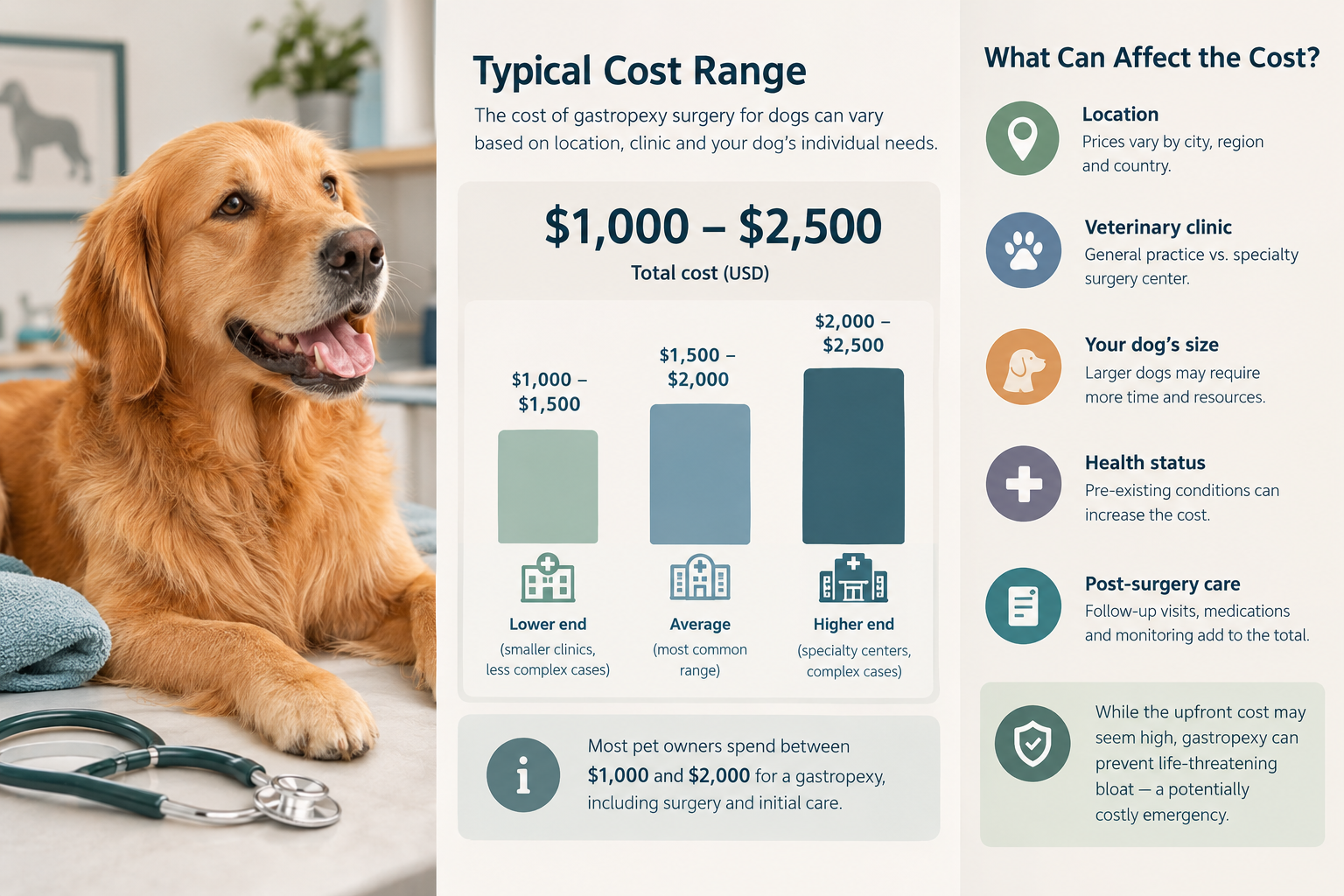
Elective gastropexy in the United States generally runs from a few hundred dollars when added to an existing abdominal surgery up to several thousand for a laparoscopic procedure at a specialty hospital. Published pet cost guides including CostFlock’s bloat surgery breakdown, FurVerdict’s gastropexy cost page and Pet Lifetime Cost’s gastropexy figures report ranges in that territory, with emergency GDV surgery costing several times the elective price.
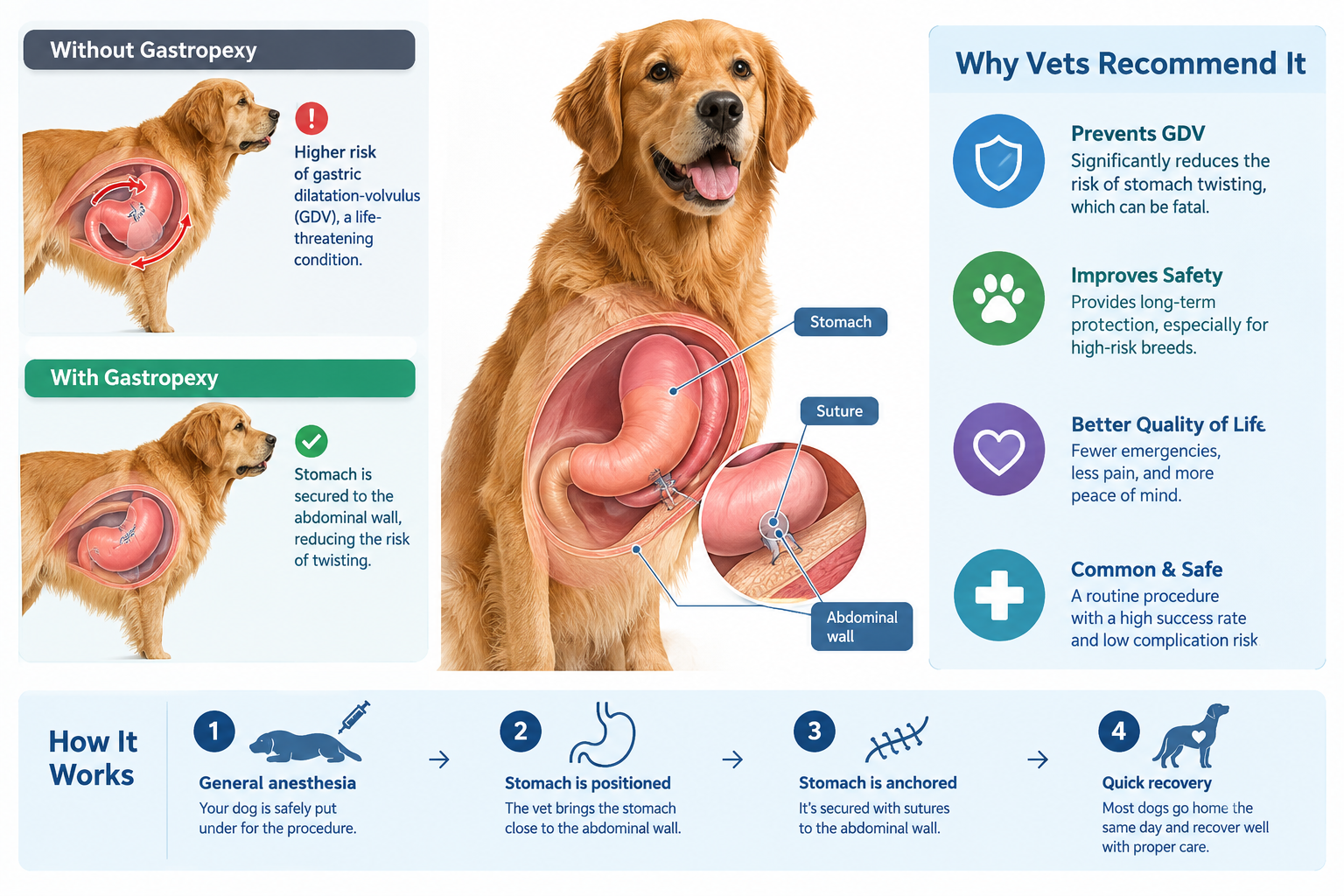
The ranges below are compiled estimates from those published guides, not quotes. Prices checked October 2026. Your written estimate from your own clinic is the only number that actually applies to your dog.
| Procedure | What it involves | Typical published estimate | Who it suits |
|---|---|---|---|
| Incisional gastropexy added to spay or neuter | Same anesthesia, same incision, extra surgical time | Roughly $400 to $1,200 | High-risk puppies already booked for sterilization |
| Standalone open incisional gastropexy | Its own anesthesia and abdominal incision | Roughly $900 to $2,000 | Already-neutered adults, rescue dogs, breed-risk cases |
| Laparoscopic or laparoscopic-assisted gastropexy | Camera ports, specialized equipment, often a specialist | Roughly $1,500 to $3,500 | Owners prioritizing smaller incisions and faster comfort |
| Emergency GDV surgery with gastropexy | Stabilization, decompression, untwisting, possible stomach or spleen resection, ICU | Commonly $3,000 to $8,000, higher with complications | Not a choice. This is the bill you are trying to avoid |
Gastropexy cost comparison by clinic type and region
The same surgery can carry very different invoices depending on where it happens:
- General practice, smaller city or rural area. Usually the lowest price, most often the open incisional technique added to a spay or neuter.
- General practice, major metro. Higher overhead shows up directly in the estimate. Coastal cities tend to sit at the top of published ranges.
- Specialty or referral hospital. Board-certified surgeon, dedicated anesthesia monitoring, laparoscopic options. Higher cost, and the sensible choice for a dog with other health concerns.
- Veterinary teaching hospital. Sometimes less expensive than private specialty care, with residents supervised by faculty. Waiting lists vary.
- Emergency hospital at 2am. The most expensive version of every veterinary service, including this one.
One practical move: ask for the estimate itemized. Anesthesia, monitoring, surgical time, pain medication, the gastropexy itself and the recheck should all be visible lines. That is also how you spot whether a quoted price includes take-home medication or not.
Which dog breeds need gastropexy most?
The breeds most often recommended for prophylactic gastropexy are large and giant dogs with deep, narrow chests, led by the Great Dane. Published breed risk research consistently puts the same cluster of breeds in the highest tier, and the American College of Veterinary Surgeons adds that a first-degree relative with GDV raises an individual dog’s risk regardless of breed.
1. Great Dane. The clearest case in veterinary medicine. Cornell’s estimate of roughly 40 percent lifetime risk is close to the approximately 39 percent figure cited in a 2026 surgical publication. Many breeders and specialists treat gastropexy as part of standard care for the breed. If your dog is in the 200-pound-plus weight class or heading there, this conversation should happen before the first season.
2. Saint Bernard. Giant, deep chested and heavy, with the added wrinkle that early abdominal signs can be hard to read in a dog that already moves slowly and rests a lot. Ranks in the top risk tier in breed-risk research.
3. Weimaraner. The classic deep and narrow chest in an athletic, food-motivated, frequently anxious package. Weimaraners also tend to eat quickly, which stacks another risk factor on top of conformation.
4. Irish Setter. A sporting breed with a notably deep chest relative to its width. Lighter than the giants, still firmly in the high-risk group.
5. Standard Poodle. The one that surprises people. Miniature and Toy Poodles are not in this conversation. The Standard, with its deep chest and tall frame, is. Owners researching the breed for its trainability and obedience often have no idea bloat risk is part of the package.
Close behind: German Shepherd, Doberman Pinscher, Gordon Setter, Newfoundland, Old English Sheepdog, German Shorthaired Pointer, Bloodhound, Akita and Basset Hound. German Shepherd owners in particular should ask, since the breed appears across both protection work rosters and GDV risk lists.
Individual variation runs through all of this. Breed tendency is a population statistic, not a prophecy for your dog. A line with no GDV history and a dog with a broader chest sits differently than a Dane whose littermate bloated at four.
How do I know if my dog is at risk for bloat?
Risk goes up with a deep and narrow chest, large or giant size, increasing age, a lean body condition, one large daily meal, fast eating, mealtime stress, an anxious temperament, and a parent or sibling with GDV. The MSD Veterinary Manual lists these contributors and recommends multiple smaller meals, avoiding intense exercise around meals, reducing mealtime stress, skipping raised bowls, and not breeding dogs with a first-degree relative that has had GDV.
A quick way to assess your own dog:
- Measure the shape, not just the weight. Looking at the dog from the side, does the chest drop deep toward the elbows while staying narrow from the front? That geometry is the risk, not the number on the scale. If you are unsure whether your dog counts as large or giant, our large versus giant breed weight chart sorts it out.
- Ask the breeder or rescue directly about GDV in the line. A documented case in a parent or sibling changes the recommendation more than most owners expect.
- Count the meals. One large bowl per day is a known risk pattern. Splitting the same daily amount into two or three servings costs nothing.
- Watch the eating speed. A dog that empties a bowl in 40 seconds swallows a lot of air with it.
- Note the temperament. Anxiety appears in the ACVS risk list. A dog that guards its food, eats in a chaotic household, or stress-gulps is carrying an extra factor.
Common mistake: assuming raised bowls reduce risk. Veterinary guidance points the other way, with elevated feeders associated with higher risk rather than lower.
Gastropexy vs other bloat prevention methods: can you prevent bloat without surgery?
Feeding and management changes can lower the odds of bloat but cannot stop the stomach from rotating. There is no approved medication, supplement, diet or feeding device that prevents gastric dilatation volvulus. Gastropexy is the only intervention that physically blocks the twist, which is why Cornell describes it as the most reliable preventive measure available.
What non-surgical steps genuinely support:
- Two or three smaller meals instead of one large one
- Slow-feeder bowls for dogs that gulp, placed on the floor rather than raised
- A quiet feeding spot away from competing dogs and household traffic
- No hard exercise immediately before or after eating
- Portioning by body size, which our guide to feeding by breed size covers for large and giant dogs
- Breeding decisions that avoid dogs with a first-degree GDV history
What the evidence does not support: probiotics, gas-reducing supplements, specific protein sources or anti-bloat collars as substitutes for surgery in a high-risk dog. Recent technique research has focused on making gastropexy faster and less invasive, not on finding a pill that replaces it.
Decision rule: choose management alone if your dog is medium sized, has a shallow or broad chest, no family history and no anesthesia-friendly window coming up. Choose gastropexy plus management if your dog is a giant deep-chested breed or has a close relative that bloated.
What are the risks and side effects of dog gastropexy?
The main risk is that this is elective surgery on a healthy dog, with the usual anesthetic and surgical hazards attached. Reported concerns include anesthesia complications, infection, seroma at the incision, pain, the possibility that the gastropexy site breaks down over time, and the unavoidable limitation that the procedure cannot prevent gastric dilation. A 2025 cross-sectional study of owner and veterinarian views found exactly those worries, with cost sitting alongside them.
Specific risks worth naming:
- Anesthetic events. Low in healthy young dogs with modern monitoring, not zero. Pre-anesthetic bloodwork and a surgeon comfortable with giant breeds both matter.
- Incision problems. Swelling, fluid pockets and infection are the most common postoperative complaints, usually managed medically.
- Breakdown of the attachment. Uncommon with established techniques, but a dog with a failed pexy loses the protection it paid for.
- Residual dilation. A pexied dog can still bloat and still needs emergency assessment.
On the other side of the ledger, outcome data is reassuring. A 2026 comparative study of 121 dogs treated for GDV reported 5.79 percent perioperative mortality with no significant difference between standard incisional gastropexy and barbed-suture gastropexy. Barbed sutures cut surgical time when gastropexy was the only procedure, 53.3 minutes against 62.6, without reducing recurrence or complications.
Be clear-eyed about the evidence quality. Much of the gastropexy literature consists of retrospective studies and case series without randomized untreated controls. A Veterinary Evidence review described the evidence for low recurrence after gastropexy as generally weak on methodological grounds, while still reporting recurrence between 0 and 15.4 percent across studies. The direction of the finding is consistent. The precision is not.
Dog gastropexy recovery time and aftercare: what to expect
Most dogs go home within 24 to 48 hours and need 10 to 14 days of restricted activity while the incision and the new adhesion heal. Laparoscopic approaches often involve smaller incisions and less postoperative discomfort, though the activity restriction period stays similar because the internal attachment needs the same time to form.
A realistic two-week plan:
Days 1 to 3. Quiet, confined rest. Leash walks for bathroom breaks only. Pain medication on schedule, not as needed. Small, bland meals as directed. Check the incision twice daily for redness, discharge or swelling.
Days 4 to 7. Appetite and energy usually improve, which is the point where most owners get into trouble. The dog feels better. The internal healing is not finished. Keep the restriction.
Days 8 to 14. Short leash walks, no stairs marathons, no running, no jumping into cars, no wrestling with the other dog. Recheck or suture removal around day 10 to 14.
After two weeks. Gradual return to normal activity once your veterinarian clears it.
Things that make the fortnight easier: a recovery suit instead of a hard cone for dogs that panic in plastic, a non-slip floor runner, a low-sided bed, and a second person to handle the stairs for a 140-pound patient. The crate you resented buying suddenly earns its keep.
Call the clinic rather than waiting if you see a reopened incision, discharge, worsening pain, refusal to eat beyond the first day, vomiting, or any sign of abdominal distension.
When should you schedule gastropexy for a puppy, and is it worth it?
The most common timing is at spay or neuter, because the dog is already under anesthesia with the abdomen open, which keeps both the cost and the total recovery to one event. For large and giant breeds, that often means somewhere between six and eighteen months depending on your veterinarian’s growth and sterilization plan.
Whether it is worth it comes down to three questions:
- How high is the breed and family risk? At roughly 40 percent lifetime risk, the Great Dane math is hard to argue with. A Labrador with a broad chest and no family history is a different conversation.
- What is the cost difference between planning and panicking? An elective gastropexy added to a spay sits in the hundreds. Emergency GDV surgery commonly runs into the thousands, at an hour you did not choose, with a survival question attached.
- Can you reach a surgical hospital quickly? A rural owner two hours from the nearest emergency theatre has a stronger case than a city owner ten minutes from a 24-hour specialty center.
Choose gastropexy if: your dog is a Great Dane, Saint Bernard, Weimaraner, Irish Setter, Standard Poodle or similar deep-chested giant, especially with a relative that bloated, and is already scheduled for abdominal surgery.
Consider waiting or declining if: your dog has anesthetic risk factors, sits outside the high-risk conformation group, or your budget is better spent on an emergency fund and the feeding changes that actually reduce dilation risk. That is a defensible decision, not a failure of care.
Can large breed dogs live without gastropexy?
Yes. Most large dogs never develop GDV, including plenty of deep-chested ones. Living without the surgery means accepting a risk that varies by breed and bloodline, running the feeding and management steps properly, learning the emergency signs, and having a plan and a route to a hospital that can operate overnight. For a 60-pound mixed breed with a moderate chest, that is reasonable. For a Great Dane facing roughly 1 in 5 to 2 in 5 odds depending on which estimate you use, it is a much bigger bet.
Do insurance plans cover dog gastropexy surgery?
Most pet insurance policies exclude elective and preventive procedures, which usually means a prophylactic gastropexy is not reimbursed. Emergency surgery for gastric dilatation volvulus is commonly covered under accident and illness policies, provided the condition is not pre-existing and waiting periods have passed. Policy wording decides the outcome, so read it before you book anything.
Before you assume coverage, check four things in writing:
- The exclusions list. Look specifically for “elective,” “preventive” and “prophylactic.”
- Whether GDV is treated as an illness or an accident under your plan, and whether any breed-specific exclusion applies.
- The waiting period for illness claims, which commonly runs from a couple of weeks upward.
- Annual and per-condition limits. A $3,000 cap and a $7,000 emergency bill is a painful combination.
Wellness add-ons generally cover vaccines and routine care, not abdominal surgery. If insurance will not pay for the elective version, some clinics offer payment plans or third-party financing, and a teaching hospital may quote less than private specialty care. Ask. Nobody is offended by the question.
Gastropexy decision card
Frequently asked questions
Does a gastropexy stop bloat completely? No. A gastropexy anchors the stomach so it cannot rotate, which prevents volvulus. The MSD Veterinary Manual notes it has not been shown to prevent gastric dilation. A pexied dog can still bloat and still needs emergency evaluation.
How long does dog gastropexy surgery take? Elective gastropexy is usually a relatively short addition to abdominal surgery. In a 2026 comparison of emergency techniques, gastropexy performed as the only procedure took 53.3 minutes with barbed suture and 62.6 minutes with standard incisional technique. Elective laparoscopic suture lines in a 2026 instrument study took a median of 6 to 8 minutes each.
Is laparoscopic gastropexy better than open surgery? It generally means smaller incisions and less postoperative discomfort, at a higher price and usually with a specialist. Outcome data has not shown the newest instruments clearly outperforming conventional laparoscopic tools, so choose based on your dog, your surgeon’s experience and your budget rather than the word minimally invasive.
Can gastropexy be done at the same time as a spay? Yes, and that is the most common timing for high-risk breeds. One anesthesia, one incision, one recovery period, and the lowest total cost of any elective option.
What is the recovery time after dog gastropexy? Most dogs are home in one to two days and need 10 to 14 days of restricted activity, with a recheck or suture removal around the two-week mark.
Do all large dogs need a gastropexy? No. The recommendation centers on large and giant breeds with deep, narrow chests, anxious temperament or a close relative that has had GDV. Plenty of large dogs with broader chests and no family history live full lives without it.
Can a gastropexy fail? It is uncommon but possible. Breakdown of the attachment is one of the concerns owners and veterinarians raised in a 2025 cross-sectional study. Recurrence of GDV after gastropexy has been reported between 0 and 15.4 percent across studies, with Cornell citing about 3 to 5 percent.
Does pet insurance pay for preventive gastropexy? Usually not, because most policies exclude elective and preventive procedures. Emergency GDV surgery is commonly covered under accident and illness plans if the condition is not pre-existing and waiting periods are satisfied.
Conclusion: what to do next
Dog gastropexy is one of the few preventive surgeries in veterinary medicine with a clear mechanical rationale and a measurable payoff for the right dog. It removes the lethal twist. It leaves the gas, the gulping and the emergency plan exactly where they were.
Three steps for this week:
- Establish your dog’s actual risk. Breed, chest shape, age, meal pattern and family history. Ask the breeder or rescue about GDV in the line, in writing if possible.
- Get an itemized estimate from two clinics. Your general practice and one specialty or teaching hospital. Ask which technique each recommends and why. Prices move, so date the quote.
- Fix the free things now. Split the meals, drop the raised bowl, slow the eating, separate the mealtime chaos, and save the nearest 24-hour hospital’s number as a favorite.
If your dog is a Great Dane, start that conversation before the sterilization appointment rather than after. If your dog is a deep-chested breed you are still researching, our breed size guide is a reasonable place to see where it falls. Either way, bring the question to your veterinarian with your dog’s history in hand. That is how this decision gets answered properly.