
Quick Answer: Is a Miniature Schnauzer Right for You?
A miniature schnauzer suits you if you want a smart, low-shedding, 13 to 20 pound watchdog and you are prepared to manage barking and a sensitive pancreas. The breed fits apartments, families and empty nesters, needs roughly an hour of activity a day, and requires professional grooming every six to twelve weeks. The weak spot is metabolic: this breed carries a well documented tendency toward high blood fats, pancreatitis and bladder stones, so the food bowl matters more here than in most small dogs. Skip the breed if nobody will train the barking or if you cannot commit to a controlled, lower-fat diet.
Key Takeaways: Miniature Schnauzer
- Size and weight: 12 to 14 inches tall, about 11 to 20 pounds, with males usually at the heavier end (VCA Animal Hospitals).
- Lifespan: plan for 12 to 15 years. VCA gives 12 to 14 years; other veterinary-care sources commonly cite 12 to 15 (Dogster).
- The weak spot: a July 2026 study from the Royal Veterinary College, Cambridge and Oxford analyzed 2,910 usable owner records and reported pancreatitis in 7.6% of Miniature Schnauzers (Companion Animal Health and Genetics).
- Dogs in that study with reported pancreatitis had 4.54 times the odds of a diabetes diagnosis (95% CI 1.7 to 11.6). Watch fat intake and blood glucose together.
- Early onset is real: 17.2% of reported pancreatitis cases were diagnosed between ages one and two. This is not only a senior dog problem.
- Exercise: about one hour per day of walks, play and training, per the AKC.
- Barking is the behavior tax. VCA notes some Miniature Schnauzers bark frequently, and the AKC links poor early socialization to reactivity.
Where Does the Miniature Schnauzer Come From?
The miniature schnauzer was developed in 19th century Germany as a small farm dog and ratter, bred down from the Standard Schnauzer with smaller crosses such as the Affenpinscher and Poodle. That job description explains almost everything you will live with: alertness, a loud alarm, a willingness to argue with something ten times its size, and an eye for anything small and fast.
The American Miniature Schnauzer Club is direct about the ratting heritage and what it means in a modern home: prey drive, chase behavior, and a dog you should not trust off leash near traffic, squirrels or a neighbor’s rabbit hutch.
One useful piece of trivia for anyone sorting the family tree. Despite the beard and the attitude, the breed sits in the Terrier Group in the United States but is not a British terrier at all. It is German, and it is a Pinscher-Schnauzer relative. That matters less for kennel club paperwork than for temperament. Schnauzers tend to be more people-focused and more biddable than many earth-dog terriers, which is part of why they train well.
The size ladder is worth knowing before you shop. Giant, Standard and Miniature Schnauzers are three separate breeds, not three sizes of one dog. The Standard is the original, roughly 30 to 50 pounds, built as a general farm guard and cart dog. The Miniature is the ratter version. Giants came last, bred for driving cattle and later for police and guard work. Temperaments differ too: Standards and Giants are more serious working dogs, while the Miniature is the chatty, portable, lap-adjacent one.
What Makes the Miniature Schnauzer So Special (and So Cute)?
The appeal is a specific combination: terrier energy in an apartment-sized body, a coat that sheds very little, and a face engineered by selective breeding to look permanently opinionated. The eyebrows do a lot of unpaid work.
What owners actually rave about, consistently:
- The beard. It is a real functional coat feature, wiry and dense, and it also means your dog’s chin is wet after every drink. Buy a small towel. Then buy a second one.
- Low shedding. The harsh double coat holds dead hair rather than dropping it across the sofa. Combined with the breed’s compact size, that is why allergy-conscious households keep circling back to this dog.
- Portability with presence. Twenty pounds that behaves like a security system. You can carry it onto a train and still get a bark when someone touches the door handle.
- Human focus. This is not an aloof breed. VCA describes the Miniature Schnauzer as bold, busy, mischievous and people-oriented. It wants to be in the room where things are happening.
- Expressive face. Bushy brows, a square muzzle and dark alert eyes produce an animal that reads as mildly scandalized by your decisions.
If you are still deciding between breeds entirely, our guide to choosing the best dog breed for your household walks through the same trade-offs with more breeds on the table.
Miniature Schnauzer Size, Weight and Lifespan
Adult Miniature Schnauzers stand 12 to 14 inches at the shoulder and weigh roughly 11 to 20 pounds, with a working lifespan expectation of 12 to 15 years. Males tend to run slightly taller and heavier than females, but the sex difference in this breed is small compared with many others.
| Measure | Male | Female | Notes |
|---|---|---|---|
| Height at shoulder | 12 to 14 in | 12 to 13.5 in | Breed standard range is the same for both |
| Typical adult weight | 14 to 20 lb | 11 to 17 lb | Body condition matters more than the number |
| Lifespan range | 12 to 15 yrs | 12 to 15 yrs | VCA cites 12 to 14; some sources report a median near 13.3 yrs |
| Full adult size reached | 10 to 12 months | 10 to 12 months | Weight can still settle until about 18 months |
Two practical notes. First, “teacup” or “toy” versions marketed as a mini miniature schnauzer are not a recognized variety. They are undersized dogs, sometimes from deliberately downsized lines, and they can carry extra health risk. Second, weight creep is the quiet lifespan thief in this breed, because extra pounds compound the fat metabolism problems covered below. If you are unsure where your dog sits, use our body condition walkthrough on whether your dog is overweight rather than guessing from the scale alone.
What Is the Miniature Schnauzer Temperament Like?
Expect an alert, intelligent, playful and vocal dog that forms strong attachments to its people. VCA characterizes the breed as bold, watchful, busy and mischievous, and generally good with children and other dogs. The temperament is sociable rather than standoffish, which is unusual for a terrier-group dog.
The behavior tax is noise. Some Miniature Schnauzers bark a lot, and the AKC warns that insufficient early socialization contributes to excessive barking, reactivity and friction with unfamiliar dogs. This is a dog bred to announce intruders, and it is very good at the job it was given.
Why do Miniature Schnauzers bark so much? Three overlapping reasons: alarm barking at movement and sound, demand barking when attention runs short, and boredom barking because a smart dog with nothing to do invents a project. VCA specifically notes that this breed gets bored quickly and makes its own entertainment, which usually means barking, chasing or mischief.
Practical fixes that address the cause rather than the noise:
- Remove the lookout post. Move the sofa away from the window or use frosted film on the lower pane. Visual triggers drive most alarm barking.
- Teach a trained alternative. Mark and reward two seconds of silence after one or two barks, then build duration. Pair it with a “go to mat” cue that gives the dog a job.
- Never reward the demand bark. If barking produces attention, even annoyed attention, it gets stronger. Wait for a pause, then engage.
- Front-load mental work. Ten minutes of scentwork or a food puzzle before you take a call does more than an hour of walking.
- Socialize early and on purpose. Calm exposure to other dogs, strangers, elevators and handling between 8 and 16 weeks pays off for a decade.
Common behavioral problems owners report besides barking: puppy nipping that feels relentless, leash stubbornness, resource guarding of a favorite chair, and dog-to-dog reactivity on leash. None are breed-wide guarantees. Individual variation in this breed is wide, and early training moves the needle far more than pedigree.
Are Miniature Schnauzers Good With Kids and Other Pets?
Yes, with supervision and some management. VCA describes the Miniature Schnauzer as generally good with children and other dogs, which makes it a reasonable family option for homes with school-age kids who understand how to leave a resting dog alone.
The caveats are specific, not vague:
- Toddlers and small dogs are a size mismatch. A 15 pound dog can be hurt by a fall or a grab. Teach children to sit on the floor to greet rather than lifting.
- Cats depend on the individual and the introduction. The ratting heritage means a real chase instinct. Many Miniature Schnauzers live happily with cats they were raised alongside. A cat added later, or a cat that bolts, can trigger pursuit. Use baby gates, a lead indoors for the first weeks, and reward calm attention rather than correcting the stare.
- Hamsters, gerbils, rabbits and birds are a genuine problem. This is the one combination worth being blunt about. A dog bred to kill rats may act on that. Keep small pets in a separate, securely closed room.
- Dog-to-dog aggression on leash usually starts as frustration, not hatred. Increase distance, feed for calm looks at other dogs, and stop letting the dog practice lunging while tethered.
Families comparing options may also find our roundup of popular family dog breeds useful for weighing size, tolerance and exercise load side by side.
Who Is the Miniature Schnauzer Made For, and Who Should Skip It?
Choose a miniature schnauzer if you want a trainable, low-shedding small dog with watchdog instincts and you will actually do the grooming and the barking work. Skip it if silence is a hard requirement or if nobody in the house will control the food.
Good fit if you are:
- An apartment resident who wants an alert dog and can commit to daily walks plus mental work. The breed is apartment-friendly on size and shedding, less so on noise, so training is non-negotiable in a building with shared walls. Our apartment dog breed guide compares the realistic options.
- An allergy-conscious household that still wants a companion dog. Low-shedding is not the same as allergen-free, but it helps.
- An empty nester or retiree with time, a steady routine and a tolerance for a dog who follows you into the bathroom.
- A first-time owner who is willing to train. Miniature Schnauzers are frequently recommended for first-timers because they learn fast and want to work with you. The two things that defeat beginners are barking and overfeeding, both solvable with planning.
Skip the breed if:
- You work long days and the dog would be alone for nine hours. Boredom turns into noise, and your neighbors will find you.
- You want a quiet dog. Barking can be reduced, not deleted.
- You feed table scraps as a love language. The pancreatitis risk below makes that a medical issue, not a habit.
- You want a dog that can be reliably off leash around wildlife.
- You cannot budget for grooming every six to twelve weeks on top of food and vet care.
Miniature Schnauzer vs Schnoodle: the Schnoodle is a Miniature Schnauzer crossed with a Poodle, so you get a less predictable coat (often softer and curlier, needing different grooming), typically a less vocal and softer temperament, and no breed standard for size. Crossbreeding does not remove inherited disease risk. If you want predictability in size, coat texture and temperament, buy the purebred from a health-testing breeder. If you want a softer, less alarm-prone dog and can accept variability, the cross may suit you.
How Much Exercise Does a Miniature Schnauzer Need?
Plan on about one hour of physical activity a day, which the AKC describes as generally suitable when it includes walks, structured play, training or similar enrichment. That hour does not have to be one block.
A workable daily pattern for an adult:
- Two walks of 25 to 30 minutes, with sniffing time built in rather than a forced march.
- Ten minutes of training or trick work, split into short sessions.
- One food puzzle, snuffle mat or scatter-feed meal.
- A short play burst: flirt pole, tug, or a hallway recall game.
Puppies need less structured exercise and more rest. A common vet guideline is around five minutes of formal walking per month of age, twice daily, until growth plates close near 10 to 12 months. Free play on soft ground is fine and self-limiting.
The mental half matters more in this breed than the physical half. A Miniature Schnauzer that has walked three miles and thought about nothing will still bark at the mail. A dog that spent fifteen minutes finding hidden treats around the living room often settles. Scentwork is particularly well suited here, because the ratting background rewards searching.
Edge case worth naming: a Miniature Schnauzer recovering from pancreatitis or diagnosed with high blood fats may need activity adjusted, especially during flare-ups. Ask your vet before starting a new exercise plan with a dog on a therapeutic diet.
Miniature Schnauzer Grooming and Shedding
Miniature Schnauzers shed very little but require more grooming labor than most short-haired breeds, with professional appointments every six to twelve weeks plus weekly brushing at home. The low shedding is why allergy-conscious families love the breed. It is also why the coat mats if ignored.
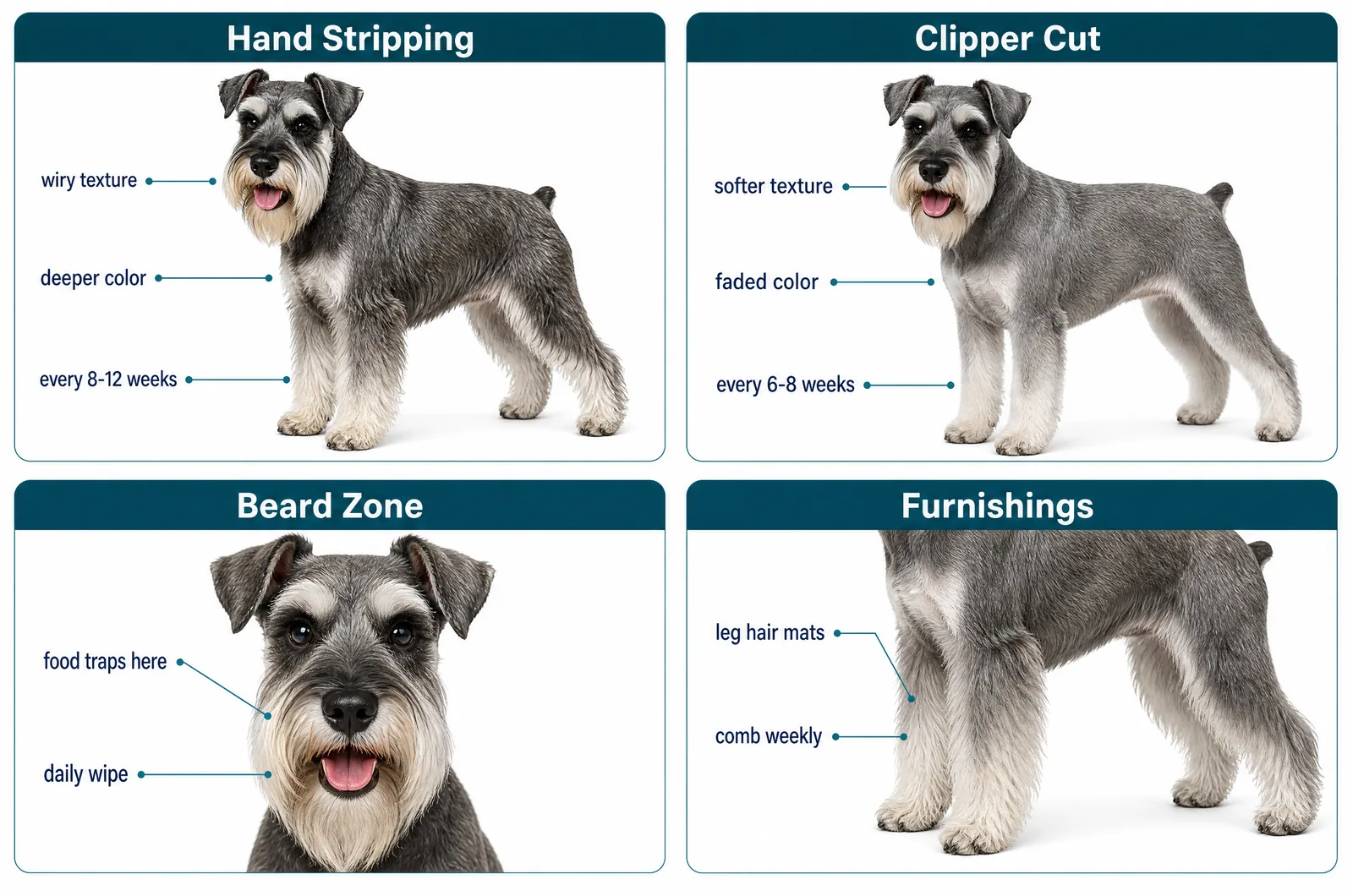
Hand stripping vs clipping. These produce different dogs.
- Hand stripping pulls dead hairs from the follicle by hand or with a stripping knife. It keeps the harsh wiry texture and the deep salt-and-pepper or solid black color. Show dogs are stripped. It takes longer, costs more, and needs a groomer who actually does it.
- Clipping cuts the coat. It is faster and cheaper, and over time the texture softens and the color fades toward a flatter grey. Most pet Miniature Schnauzers are clipped. That is a completely reasonable choice.
The beard and furnishings are the real maintenance. Leg hair and the beard mat faster than the body coat, and the beard collects food, water and whatever was on the sidewalk. Comb the beard and legs two or three times a week and wipe the beard after meals. A deep clean once a week keeps the smell down.
Popular miniature schnauzer haircut styles include the traditional schnauzer trim (short body, full skirt, full beard and brows), the puppy cut (even length all over, lowest maintenance), and the teddy bear trim with a rounder face. Ask your groomer for photos, and say plainly how much brushing you will realistically do at home.
Colors: salt and pepper, black and silver, and solid black are the standard colors. A miniature white schnauzer exists and is recognized in some European registries, though white is not accepted in the AKC breed standard. White dogs are not inherently unhealthy, but be wary of breeders charging a premium for “rare” colors instead of health testing.
Nails need attention every three to four weeks. If you are unsure which tool suits a wriggly small dog, compare the trade-offs in our dog nail grinder vs clipper breakdown. New to the whole process? Start with our beginner’s guide to dog grooming.
Are Miniature Schnauzers hypoallergenic? No dog is. The breed is low-shedding, which usually means less allergen spread around the house, but the major dog allergen is a protein in saliva and dander, not hair. Spend time with an adult Miniature Schnauzer before committing if someone in the home reacts.
Common Miniature Schnauzer Health Problems
The breed is generally healthy and long-lived, with three condition clusters that deserve specific attention: fat metabolism disorders (hyperlipidaemia, pancreatitis, diabetes), bladder stones, and eye and heart conditions.
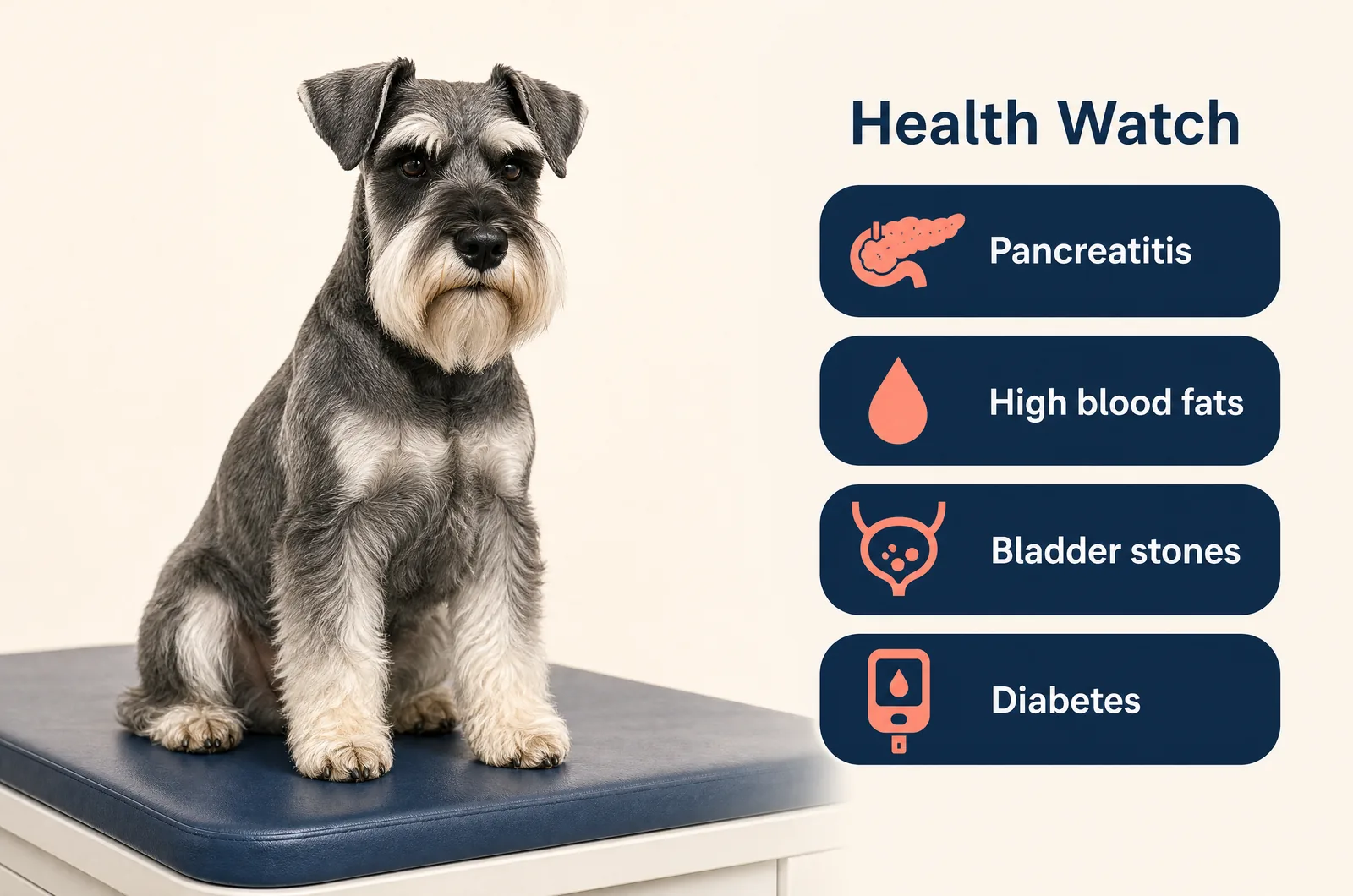
Pancreatitis and high blood fats. This is the weak spot in the headline. A study published July 9, 2026 by Arielle Johnson-Pitt and colleagues at the Royal Veterinary College, the University of Cambridge and the University of Oxford collected 4,786 UK owner responses and analyzed 2,910 usable records. It reported pancreatitis in 7.6% of Miniature Schnauzers, hyperlipidaemia in 1.0% overall and 3.3% among dogs older than nine years.
Three findings matter for daily life:
- Dogs with reported pancreatitis had 4.54 times the odds of a diabetes diagnosis (95% CI 1.7 to 11.6). Pancreatic disease and blood sugar should be monitored together, not separately.
- 17.2% of reported pancreatitis cases were diagnosed between ages one and two. Young dogs are not exempt.
- The authors flag a data-quality disagreement. Earlier studies using veterinary records did not show rates this high. Owner recall, diagnostic uncertainty and selection bias could inflate the 7.6% figure. Treat it as a strong signal for further research, not a settled prevalence number.
What that means for you: this is a reason to manage fat intake carefully and to take vomiting seriously, not a reason to assume your dog is doomed.
Call your vet promptly if your Miniature Schnauzer shows repeated vomiting, refuses food, has a hunched or praying posture, has a painful belly, or becomes lethargic after a fatty meal. Those signs can mean acute pancreatitis and can become an emergency. Do not wait it out overnight.
Bladder stones. Miniature Schnauzers are among the breeds most frequently affected by calcium oxalate and struvite urinary stones. Signs include straining, frequent small urinations, blood in urine and accidents in a house-trained dog. A dog straining and unable to pass any urine is an emergency.
Eyes and heart. The AKC’s Terrier Group parent-club recommendations list cardiac examination and ophthalmologist evaluation for this breed. Ask any breeder for those results in writing. Congenital juvenile cataracts and progressive retinal atrophy appear in breed lines, and genetic testing exists for some of them. If you want to know what a health panel actually tells you, our Embark vs Wisdom Panel comparison covers the reporting differences.
Other conditions seen in the breed: Cushing’s disease, hypothyroidism, portosystemic shunts and myotonia congenita.
What Do Miniature Schnauzers Love to Eat? Favorite Foods and Feeding
Feed a measured, moderate to low-fat complete diet, keep treats under 10% of daily calories, and treat fatty human food as off limits rather than occasional. Diet is the single lever with the most influence on this breed’s main health risk.
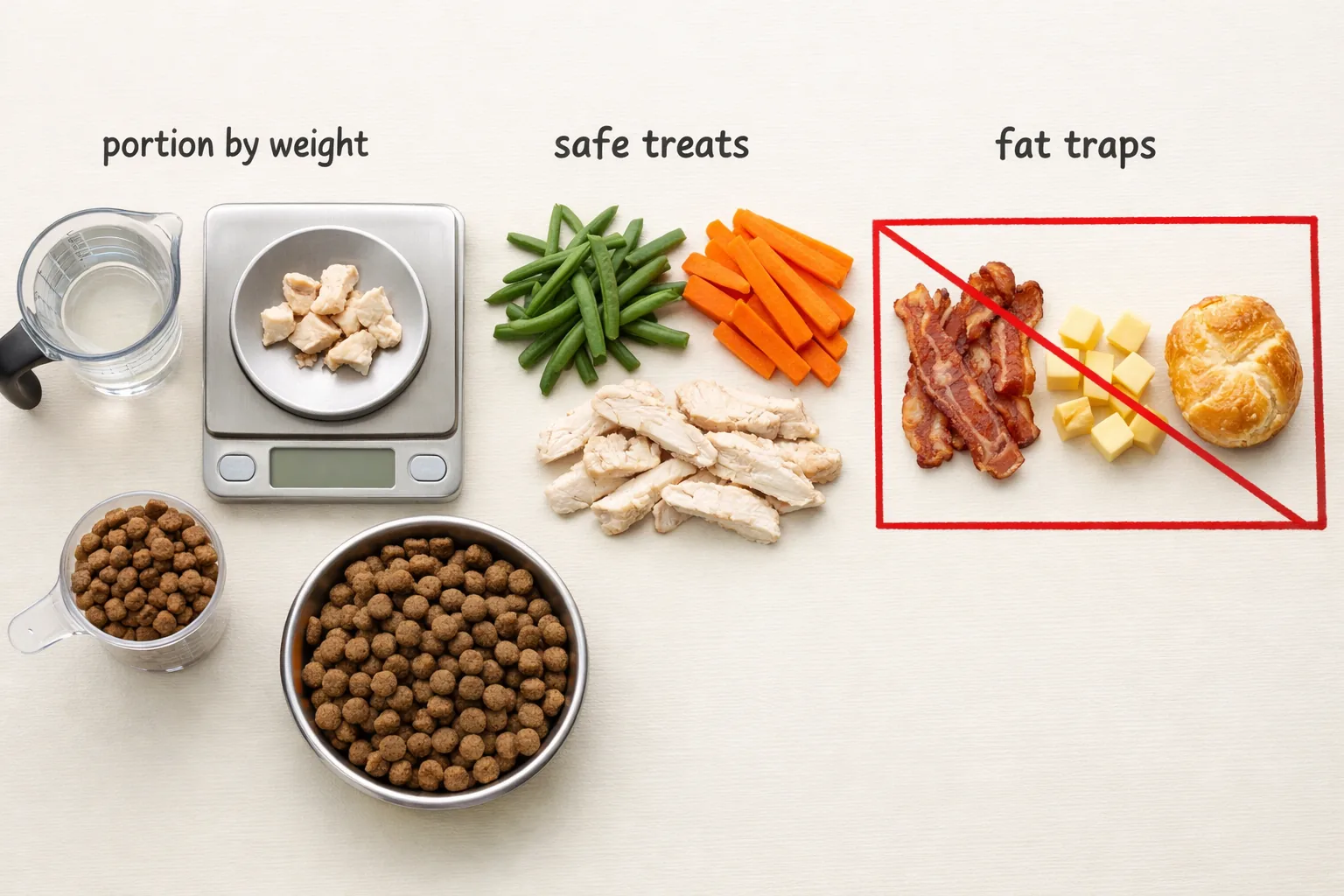
What this breed tends to love, and what is safe:
- Plain cooked chicken breast or turkey, shredded small
- Green beans, carrot sticks, cucumber and plain pumpkin
- Apple slices without seeds, blueberries, small pieces of banana
- Commercial low-fat training treats, broken into pea-size pieces
- Their own kibble, delivered from a snuffle mat, which many dogs treat as an upgrade
What to avoid, firmly:
- Bacon, sausage, pork fat trimmings, buttered anything, cheese cubes, pastry
- Turkey skin and gravy at the holidays, which is a classic pancreatitis trigger window
- Cooked bones, grapes, raisins, onion, garlic, macadamia nuts, xylitol
- High-fat dental chews and pig ears
Our list of foods to avoid feeding your dog covers the full set with reasoning.
Choosing the best food for miniature schnauzers. Look for a small-breed adult formula with an AAFCO statement for the right life stage, a named protein first, and a fat content you can actually read on the label. For dogs with a pancreatitis history or diagnosed hyperlipidaemia, vets often recommend a prescription low-fat diet; typical therapeutic formulas sit well below standard kibble on fat. Do not guess at this. Ask your vet for a specific target. If label reading is new to you, start with how to read a dog food label and what AAFCO means.
Portions. Measure by weight with a kitchen scale, not a scoop. Most adult Miniature Schnauzers eat somewhere in the range of half a cup to one cup of kibble daily, split into two meals, but the correct amount depends on calorie density and your individual dog. Reassess body condition monthly.
Water matters too for stone-prone dogs. Adding water to meals increases intake, which dilutes urine. Ask your vet whether a urinary diet is appropriate if your dog has had stones.
How to Train a Miniature Schnauzer
Train with short, food-rewarded sessions and clear rules, because this breed learns fast and also learns exactly how long you will tolerate being ignored. Reward-based methods work well. Repetitive drilling does not, because VCA notes the breed bores quickly.
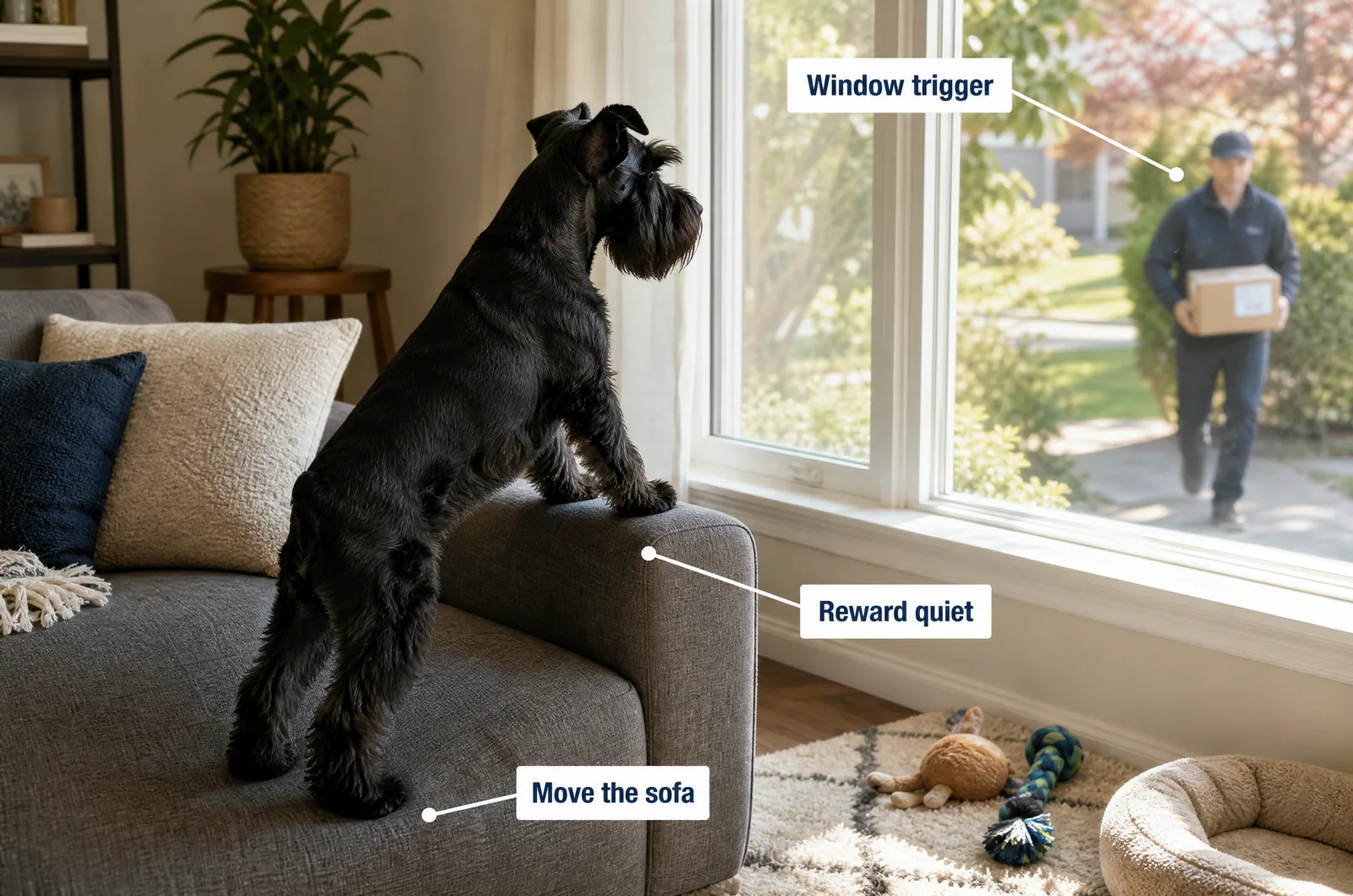
How to train a stubborn miniature schnauzer. Stubbornness in this breed is usually one of three things: the reward is not worth it, the dog does not understand the cue in that context, or the behavior is being driven by something stronger (a smell, a squirrel, a nap).
- Raise the pay. Kibble works at home. On a sidewalk with a squirrel in view, you need chicken.
- Retrain in the new place. A dog that sits perfectly in the kitchen has not generalized the cue. Teach each location like it is new.
- Shorten sessions. Three minutes, five times a day beats twenty minutes once.
- Stop repeating the cue. Say it once, wait three seconds, help the dog succeed, reward.
- For the dog who flops on walks, rule out pain or heat first, then make forward movement the thing that gets rewarded. Mark and feed every few steps, keep walks shorter, and let sniffing be a paid break rather than a stall.
Puppy biting is the other complaint that fills forums. A Miniature Schnauzer puppy bites because puppies bite, and the breed plays with its mouth enthusiastically. Redirect onto a tug or chew every single time, end the game calmly for 20 seconds when teeth hit skin, and make sure the puppy is sleeping 16 to 18 hours a day. Most severe nipping is overtiredness.
Barking needs the management plan in the temperament section above plus consistency from every household member. One person who laughs at the barking undoes a week of training.
Get help from a certified trainer using reward-based methods if you see growling over food or furniture, or lunging at other dogs. Early intervention is far cheaper than late.
Try It: Schnauzer Fatty-Food Risk Check
This quick checker scores the everyday habits that raise a Miniature Schnauzer’s risk of high blood fats and pancreatitis, from table scraps to holiday leftovers. Tick what applies in your household and see which single change would lower the risk the most.
Doggy Rank IQ Tool
Schnauzer Fatty-Food Risk Check

Miniature Schnauzers are prone to high blood fats and pancreatitis. Check the habits that raise the risk, especially around the holidays.
Schnauzer Fatty-Food Risk Check
Tick every habit that happens in your home in a normal month.
‘+msg+’
Educational tool only. Not a diagnosis.’; o.style.display=”block”;};
How Much Does a Miniature Schnauzer Cost?
Expect roughly $1,200 to $3,000 for a well bred Miniature Schnauzer puppy in the US, $2,000 to $3,500 in the first year including supplies and veterinary care, and $1,200 to $2,500 per year afterward. Rescue adoption typically runs $150 to $500.
What drives the puppy price: health testing on the parents (cardiac and ophthalmologist evaluations), show lines, geography and demand. Be skeptical of breeders charging extra for a “rare” color such as a miniature white schnauzer or chocolate, especially if health results are missing.
First year budget, realistic ranges:
- Puppy purchase: $1,200 to $3,000
- Vaccines, deworming, exams, neuter or spay: $500 to $900
- Crate, bed, bowls, leash, harness, toys: $200 to $400
- Grooming, roughly 6 to 9 appointments at $60 to $100: $400 to $900
- Food: $350 to $600
- Training class: $150 to $300
Ongoing yearly: grooming $500 to $900, food $350 to $700, preventive vet care $300 to $600, parasite prevention $150 to $250, insurance $300 to $700.
The variable that can blow the budget is a pancreatitis episode. Hospitalization with fluids and supportive care commonly runs into four figures. That is a strong argument for buying pet insurance before any symptoms appear, since pre-existing conditions are excluded.
Miniature Schnauzer Puppy Tips for the First 90 Days
Spend the first 90 days on socialization, a feeding routine you can keep for a decade, and preventing the barking habit before it forms. What you do between weeks 8 and 20 shapes the adult dog more than anything you do later.
Weeks 1 to 2 (settling in):
- Set up a crate with the door open and feed meals inside it.
- Start the measured feeding habit immediately. Weigh food. No scraps, ever, starting on day one.
- Begin short, cheerful handling sessions: paws, ears, muzzle, beard comb. You are preparing for a decade of grooming.
- Book the first vet visit and the first grooming appointment (a short introductory visit, not a full trim).
Weeks 3 to 6 (socialization window):
- Aim for calm exposure to new sounds, surfaces, people and vehicles several times a week. Quality over volume.
- Teach name, sit, a hand target and a mat settle. Two to three minutes per session.
- Start the quiet protocol early: reward silence after a bark, and do not let the puppy learn that barking opens doors or starts games.
- Introduce short alone-time periods daily to prevent separation distress.
Weeks 7 to 13 (habits set):
- Add a training class with a reward-based instructor.
- Begin leash walks at puppy-appropriate length, roughly five minutes per month of age twice daily.
- Introduce food puzzles and scatter feeding to build the independent-entertainment habit.
- Manage the nipping consistently across everyone in the house.
Mistake to avoid: letting the cute 10 pound puppy bark at the window because it looks funny. At 18 months with a 20 pound body and a confirmed habit, it stops being funny and starts being a neighbor complaint.
What Miniature Schnauzer Owners Say
Owner reports line up closely with the behavior patterns described by VCA and the AKC: the barking, the attention demands, and a walking style best described as negotiable.
“he lays down every 5mins on walks, whenever he wants to roll around”
That comes from an owner on Reddit in r/MiniatureSchnauzer. Practical read: rule out heat, paw discomfort, a badly fitted harness, or pain first, especially in a young or senior dog. If the dog is healthy, treat flopping as a rewarded behavior rather than defiance. Keep walks shorter, mark and feed forward movement every few steps, and let a sniff break be the reward for walking rather than something that happens when the dog stops cooperating. Changing the route also helps, because the flop often happens at the same three spots.
“Anyone’s schnauzer act up when he doesnt get enough attention?”
Also from an owner on Reddit in r/MiniatureSchnauzer. This matches VCA’s description of a people-oriented breed that invents its own activities when bored. Practical read: schedule attention rather than letting the dog schedule it. Two short training sessions and one puzzle feed at predictable times give the dog something to anticipate, which cuts the demand behavior more effectively than responding when it starts. If the acting up only happens when you are on the phone or at a keyboard, that is a specific trigger worth training a mat settle for.
Miniature Schnauzer FAQ
How long do Miniature Schnauzers live? Plan on 12 to 15 years. VCA cites 12 to 14 years, and other veterinary-care sources commonly give 12 to 15, with one reported median around 13.3 years.
Are Miniature Schnauzers hypoallergenic? No dog is truly hypoallergenic. Miniature Schnauzers shed very little, which often means fewer allergens spread around the home, but the main allergen comes from saliva and dander. Test your reaction around an adult dog first.
Do Miniature Schnauzers bark a lot? Many do. VCA notes that some bark frequently, and the AKC links limited early socialization to excessive barking and reactivity. Barking can be substantially reduced with training and by removing visual triggers, but this breed will alert.
What is the most common Miniature Schnauzer health problem? Fat metabolism disorders lead the list. A 2026 Royal Veterinary College study of 2,910 owner records reported pancreatitis in 7.6% of Miniature Schnauzers, with those dogs showing 4.54 times the odds of a diabetes diagnosis. Bladder stones, eye disease and heart conditions also appear in the breed.
Can a Miniature Schnauzer live in an apartment? Yes, provided you train the barking and supply roughly an hour of daily activity plus mental work. Size and low shedding suit apartments well. Noise is the limiting factor in buildings with shared walls.
Are Miniature Schnauzers good for first time owners? Generally yes. They are intelligent, people-focused and respond well to reward-based training. The two things that catch beginners out are barking and overfeeding, so plan for both before the puppy arrives.
What is the difference between a Miniature Schnauzer and a Standard Schnauzer? They are separate breeds. Standards weigh roughly 30 to 50 pounds, were bred as general farm guards, and tend to be more serious working dogs. Miniatures weigh 11 to 20 pounds, were bred as ratters, and are more portable and typically more vocal.
How often should you groom a Miniature Schnauzer? Professional grooming every six to twelve weeks, brushing the body weekly, and combing the beard and leg furnishings two or three times a week. Wipe the beard after meals. Trim nails every three to four weeks.
Next step: if you are still choosing, write down three things before you contact a breeder or rescue: your tolerance for barking, who will pay for grooming every two months, and whether everyone in the house can agree that nobody feeds this dog bacon. Get those settled, and the miniature schnauzer becomes one of the easier small dogs to live with for the next 13 years.