
Quick Answer: Is a Boxer Right for You?
A boxer dog suits an active household that wants a goofy, deeply attached, physically intense companion and can accept real cancer and heart risk. Boxers are typically 21.5 to 25 inches tall, live around 10 to 12 years, and are one of the breeds most associated with mast cell tumors and lymphoma. They are usually excellent with children, though a 65 pound adult who still thinks he is a lap dog can flatten a toddler by accident. Skip the breed if you want a calm first dog, a quiet apartment, or a lump you can safely ignore.
Key Takeaways: Boxer Dog
- Lifespan sits around 10 to 12 years, shorter than many dogs of similar size, and cancer is the most common cause of early loss according to PetMD’s Boxer profile.
- Mast cell tumors top the list. The Dog Cancer Foundation names Boxers among the breeds with the highest mast cell tumor risk, and these can look exactly like a harmless fatty lump.
- Arrhythmogenic right ventricular cardiomyopathy (ARVC), often called Boxer cardiomyopathy, is a breed-linked heart disease that can cause fainting or sudden death, per VCA Animal Hospitals.
- Males run roughly 65 to 80 pounds, females 50 to 65 pounds. Both need 60 to 90 minutes of daily movement plus real mental work.
- Heat is a genuine hazard. The short muzzle means a Boxer cools poorly, so summer midday walks are a bad plan (WebMD).
- Grooming is close to nothing. Shedding is not. Short coat, year-round hair, five minutes of brushing a week.
- First-year cost commonly runs $3,000 to $5,500 including a puppy from a health-testing breeder, then roughly $1,500 to $2,500 a year after that.
Where Does the Boxer Come From?
The Boxer descends from the German Bullenbeisser, a mastiff-type hunting dog bred to grip large game until the hunter arrived. That job explains the face. The broad, slightly upturned muzzle and undershot jaw let the dog hold on while still breathing through the nose.
In the late 1800s, German breeders crossed the smaller Brabanter Bullenbeisser with imported English Bulldogs and settled on a lighter, faster, cleaner-outlined dog. The first German Boxer Club formed in Munich in 1895. The breed worked as a butcher’s dog, a cattle drover, a police dog, and one of the earliest military messenger and guard dogs in Europe.
Two things carried over to the dog in your living room. The grip-dog build gave you the deep chest and the wide head. The working-dog selection gave you a breed that wants a job and gets inventive when it does not have one.
The white Boxer is not a separate breed or a defect of character. White markings over roughly a third of the coat fall outside the show standard, and white Boxers carry a higher rate of congenital deafness, which is worth a BAER hearing test. They can be wonderful pets. They do sunburn.
What Makes the Boxer So Special (and So Cute)?
The Boxer is the breed that turns greeting you into a performance. The whole back half swings sideways into what owners call the kidney-bean wiggle, the front paws come up and box the air, and the dog produces a noise somewhere between a groan and a kettle.
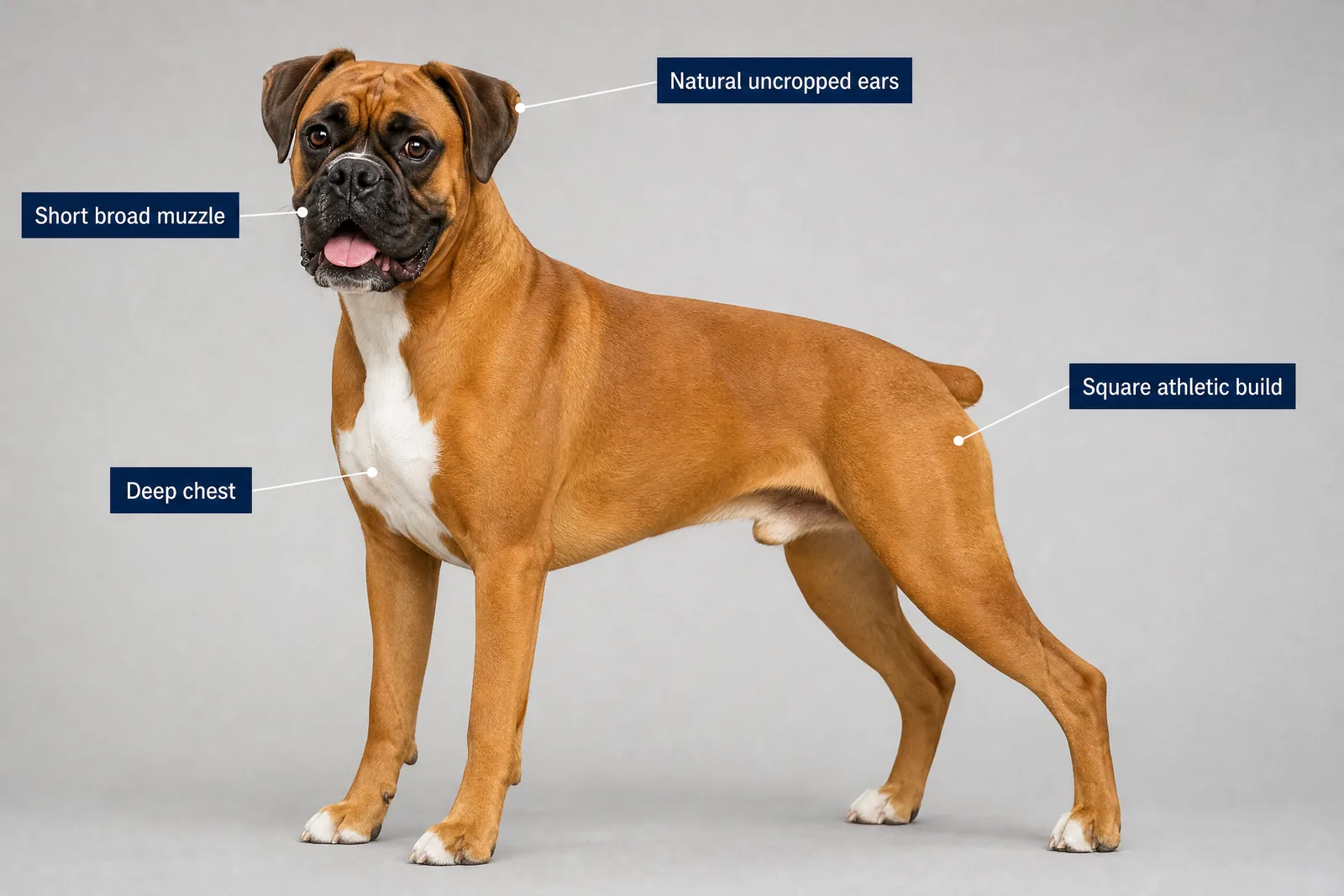
The cuteness is partly structural. A shortened muzzle, large forward-facing eyes, and a wide forehead hit the same visual cues that make human babies hard to ignore. Add wrinkles that move with every expression and you get a dog whose face appears to have opinions.
The personality is the real draw. Boxers tend to be dramatic, physically affectionate to the point of absurdity, and funny in a way that feels intentional even when it is not. They lean. They sit on you. They bring you a sock as a formal apology. They do the full-speed living room zoomies at 10pm with no warning.
They also stay juvenile longer than most breeds. A three year old Boxer still behaves like an adolescent, which is charming on a Saturday and exhausting on a Tuesday.
Coat colors come in fawn and brindle, with or without white markings and the classic black mask. A brindle boxer dog ranges from a few dark stripes to near-black “reverse brindle.” The color says nothing about temperament.
Boxer Size, Weight and Lifespan
Boxers are a medium-large working breed: males stand about 23 to 25 inches at the shoulder and females about 21.5 to 23.5 inches. Lifespan averages 10 to 12 years, which is shorter than many dogs of similar weight.
| Measure | Male Boxer | Female Boxer |
|---|---|---|
| Height at shoulder | 23 to 25 in | 21.5 to 23.5 in |
| Adult weight | 65 to 80 lb | 50 to 65 lb |
| Full physical maturity | 24 to 30 months | 18 to 24 months |
| Typical lifespan | 10 to 12 years | 10 to 12 years |
If you are trying to work out where this breed falls on the scale, our guide on whether your dog counts as a large or giant breed covers the thresholds. Boxers are solidly large, not giant.
Boxer dog lifespan is the number that hurts. PetMD and Nationwide’s breed health page both put average life expectancy near 10 to 12 years, with cancer the leading reason dogs fall at the lower end. Some Boxers reach 13 or 14. Plenty do not reach 9. Individual variation is real, and so is the breed-level pattern.
One decision rule: if you buy from a breeder, ask for the ages and causes of death of the grandparents. A breeder who has that written down is a different proposition from one who does not.
What Is the Boxer Temperament Like?
Boxer temperament is best described as alert, clownish, strongly bonded, and slow to grow up. The American Kennel Club breed standard calls temperament “of paramount importance” and describes the Boxer as dignified and self-assured with strangers, playful with family, and courageous when actually threatened.
What that looks like day to day:
- Attached to the point of shadowing you. Boxers follow you to the bathroom. This is normal for the breed and a setup for separation problems if never addressed.
- Expressive. Grumbles, groans, head tilts, dramatic sighs when the walk ends.
- Wary, not hostile, with strangers. A stable Boxer watches, assesses, then usually decides you are great.
- Bored by repetition. Ask for the same sit fifteen times and a Boxer will start offering creative variations.
Are Boxers aggressive or mean? Not as a breed trait. VCA describes them as loyal, protective and good with children, while noting that some individuals can be reactive toward unfamiliar dogs, especially same-sex pairs. That dog-directed edge is the behavior worth working on early, not stranger aggression.
Do Boxers bark a lot? Less than many working breeds. They are alarm barkers rather than chronic ones. You will hear more huffing, grumbling and the famous “woo” than sustained barking, though a bored under-exercised Boxer will absolutely invent reasons.
A pitbull boxer dog mix is common in shelters and tends to land somewhere between the two: similar energy, often more dog-selective, usually shorter in body. Judge the individual dog in front of you.
Are Boxers Good With Kids and Other Pets?
Boxers are generally very good with children and are one of the breeds most often recommended for active families, with one practical catch: the dog is built like a battering ram and does not know it.
The temperament fits well. Boxers tolerate noise, handling and chaos, and they genuinely enjoy children’s company. The risk is mechanical. A happy 70 pound adolescent who hits a toddler at a run causes a bruise and a fright, not a bite.
Practical rules that work:
- Teach “four on the floor” before the puppy weighs 40 pounds. Greeting only happens when all paws are down.
- Give kids a job. Children who can ask for a sit and deliver the treat get taken seriously by the dog.
- Supervise toddlers and frail adults. Not because of temperament. Because of physics.
- Build a decompression spot. A crate or bed where the dog is left alone, enforced for the humans.
With other dogs, early and ongoing socialization matters more in this breed than in many. Boxers that meet calm, well-mannered dogs regularly through adolescence usually stay sociable. Same-sex pairs in one home can be tense. Cats are a mixed picture: a Boxer raised with a cat is often fine, while an adult Boxer meeting a cat for the first time is a chase risk.
If you are still comparing options, our roundup of family-friendly dog breeds puts the Boxer next to its usual rivals.
Who Is the Boxer Made For, and Who Should Skip It?
The Boxer suits active households that are home a lot, enjoy training, and can handle an emotionally intense dog for a decade.
Choose a boxer dog if you:
- Walk, run, hike or play for at least an hour daily, in most weather
- Want a dog that is physically affectionate and involved in everything
- Have a secure yard or reliable off-lead space
- Can afford unplanned veterinary bills, or carry insurance
- Find a dog with a sense of humor more appealing than a dog with impeccable manners
Skip the breed if you:
- Work long days away from home with no dog walker
- Want a calm, independent first dog
- Have very young children plus no space, or an unsteady adult in the house
- Live somewhere hot with no shaded morning walking options
- Would be financially wrecked by a $4,000 oncology workup
Can you keep a boxer dog in an apartment? Yes, with conditions. The breed is quiet indoors and not a pacer, so square footage is less of a problem than access. You need stairs or an elevator you can use three to five times a day, a nearby green space, and a plan for the first two years of adolescence. Apartment life with a Boxer is a scheduling commitment, not a space one. Our apartment breed guide lists easier options if that sounds grim.
How Much Exercise Does a Boxer Need?
Plan on 60 to 90 minutes of real physical activity daily for an adult Boxer, split across at least two sessions, plus 15 to 20 minutes of mental work.
What counts:
- Fast walking or jogging (adults only, after growth plates close around 18 months)
- Fetch and tug, which Boxers love and which burns energy fast
- Flirt pole sessions of 5 to 10 minutes, excellent for rainy days
- Scent games: scattered kibble in grass, towel rolls, a cardboard box of crumpled paper
- Short training bursts of 3 to 5 minutes, several times a day
Heat changes everything. The shortened muzzle makes Boxers inefficient at cooling, and WebMD’s breed overview flags heat intolerance directly. Above roughly 75°F with humidity, move exercise to early morning or after dark, carry water, and stop at the first sign of loud raspy breathing, a wide flat tongue, or staggering. Heatstroke is an emergency. Cool the dog with room-temperature water and call a vet immediately. Do not wait to see if it passes.
Common mistake: assuming a tired body equals a tired dog. A Boxer who runs two miles and then stares at you is bored, not underexercised. Add a puzzle feeder or a five-minute trick session and watch the difference.
Puppies need the opposite restraint. A rough guide is five minutes of structured exercise per month of age, twice a day, with free play in the yard on top.
Boxer Grooming and Shedding
Grooming a boxer dog takes about five minutes a week. Shedding is moderate and constant, which surprises people who assume short hair means no hair.
The short, tight coat has no undercoat to blow out, so you get a steady year-round sprinkle of fine fawn or brindle hairs that weave into upholstery like they are being paid to. A rubber curry brush once or twice a week pulls most of it off before it reaches your sofa.
The rest of the routine:
- Bathe every 6 to 10 weeks or when the dog finds something memorable. Over-bathing dries the skin.
- Clean facial folds weekly with a damp cloth, then dry them. Moisture in a wrinkle breeds yeast.
- Trim nails every 3 to 4 weeks. Boxers are hard on their feet and long nails change their gait.
- Check paws after every walk. Interdigital cysts and sore pads are a frequent Boxer complaint on owner forums. Dry between the toes.
- Teeth two or three times a week. The undershot jaw traps debris.
Boxers run cold. In winter below freezing, a fitted coat is not a fashion statement. New to the basics? Our beginner’s dog grooming guide covers tools and technique.
Common Boxer Health Problems
The main boxer dog health problems are cancer (especially mast cell tumors and lymphoma), heart disease (ARVC and aortic stenosis), hypothyroidism, hip dysplasia, bloat, and degenerative myelopathy. Cancer is the one that shortens the most Boxer lives.
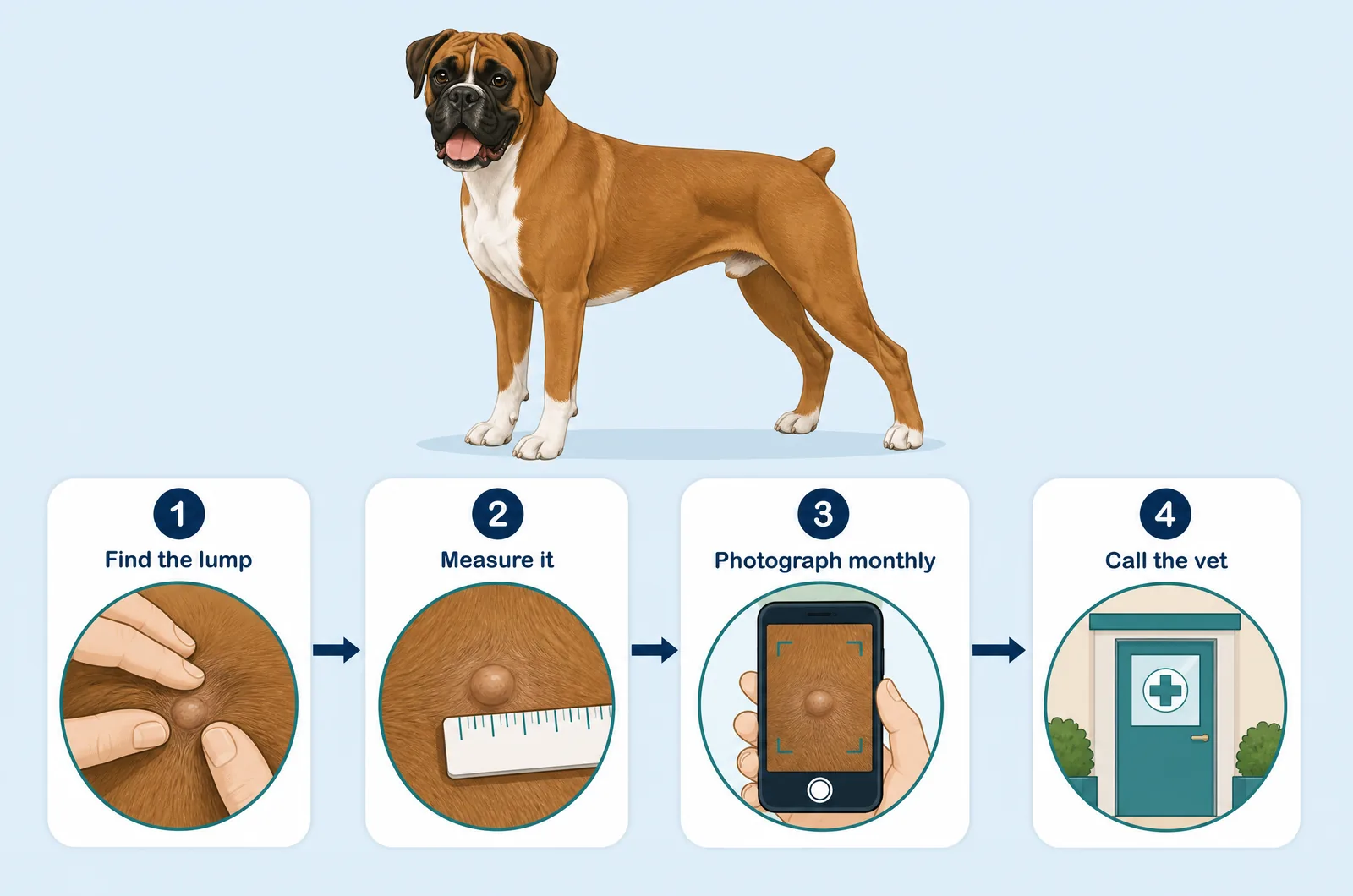
Mast cell tumors. The Dog Cancer Foundation lists Boxers among the highest-risk breeds. These tumors are shapeshifters. They can be soft, firm, raised, flat, hairless, red, or completely unremarkable. They can swell one week and shrink the next. You cannot diagnose one by touch, and neither can your vet. A fine-needle aspirate takes minutes and is usually cheap, and veterinary guidance on sampling lumps early is consistent: sample now rather than watch and wait. The rule to live by is see something, do something.
Lymphoma and hemangiosarcoma also appear at elevated rates in the breed. Sudden weakness, pale gums, a swollen belly or collapse needs emergency care that hour.
Boxer cardiomyopathy (ARVC). An inherited electrical disease of the heart muscle described on VCA’s Boxer page. Signs include fainting, exercise intolerance, and sometimes sudden death with no warning. A 24-hour Holter monitor is the standard screening test, and responsible breeders run them annually on breeding stock. Ask for results.
Aortic and subaortic stenosis. A narrowing below the aortic valve, common enough in Boxers that a puppy murmur should always be investigated by a cardiologist, not dismissed as innocent.
Hypothyroidism. Weight gain, coat loss, lethargy. Diagnosed with a blood panel, managed cheaply with daily medication.
Bloat (GDV). Deep-chested breeds are at risk. A distended abdomen, unproductive retching and restlessness is a surgical emergency. Call a vet immediately, do not wait overnight.
Degenerative myelopathy. A progressive spinal cord disease with a known genetic marker. Back-end weakness and scuffing nails in an older Boxer warrants a vet visit the same week.
Why is my boxer dog vomiting? Most often diet change, scavenging, or eating too fast. Call the vet if vomiting repeats over 12 hours, includes blood, comes with a tense or swollen belly, or the dog cannot keep water down. Boxers also get boxer colitis, an inflammatory bowel condition seen in young dogs, which responds to specific antibiotic treatment once diagnosed.
Given the cost profile, this is a breed where pet insurance math usually works out, and it helps to understand why veterinary care is priced the way it is before you are standing at the counter.
What Do Boxers Love to Eat? Favorite Foods and Feeding
Feed an adult boxer dog two measured meals a day of a complete food formulated for large-breed adults, typically 2.5 to 4 cups of dry food daily depending on weight and activity. Puppies need a large-breed puppy formula with controlled calcium until about 14 months.
Foods Boxers tend to go genuinely silly for, used as training rewards in pea-sized pieces:
- Plain cooked chicken or turkey, no skin, no seasoning
- Low-fat cheese cubes (high value, use sparingly)
- Sardines in water, a small amount once or twice a week
- Carrot sticks and green beans, free crunch with almost no calories
- Blueberries and watermelon with the seeds and rind removed
- Plain canned pumpkin, useful when stools go loose
Foods to keep away: grapes and raisins, onion and garlic, xylitol (check peanut butter labels), chocolate, macadamia nuts, cooked bones, and anything very fatty. High-fat table scraps are a pancreatitis route in this breed.
Practical feeding notes:
- Keep them lean. You should feel ribs under light pressure. Extra weight makes hips, heart and heat tolerance all worse.
- Slow the meal down. Boxers inhale food. A slow feeder bowl and avoiding hard exercise for an hour either side of meals are sensible bloat precautions.
- Gas is a breed feature. Brachycephalic dogs swallow air. A slow bowl helps more than any supplement.
- Change food gradually over 7 to 10 days. Our guide on switching dog food without stomach upset covers the schedule.
If you want help reading an ingredient panel and AAFCO statement before buying the big bag, start with our dog food label guide.
How to Train a Boxer
Train a boxer dog in short, varied, reward-based sessions of three to five minutes, several times a day. The breed learns fast and quits faster when drilled. Sensitivity is part of the package, so harsh corrections tend to produce a shut-down dog rather than a polite one.
Jumping. The number one complaint. Boxers greet with their front end because it worked when they weighed nine pounds. The fix is boring and reliable: all attention stops the instant front paws leave the ground. Turn away, no words, no eye contact. The second the paws land, reward at floor level. Then teach a default sit for greetings and ask guests to follow the same rule. Two weeks of consistency beats six months of knee-in-chest.
Mouthing and biting. Puppy Boxers are extremely oral and the teeth hurt. Keep a chew toy in every room and swap it into the mouth before the mouth finds your wrist. Yelp-and-withdraw works for some pups and winds others up. If the puppy escalates, the issue is usually overtiredness. Put them in the pen for a nap. An overtired Boxer puppy behaves like a toddler at a wedding.
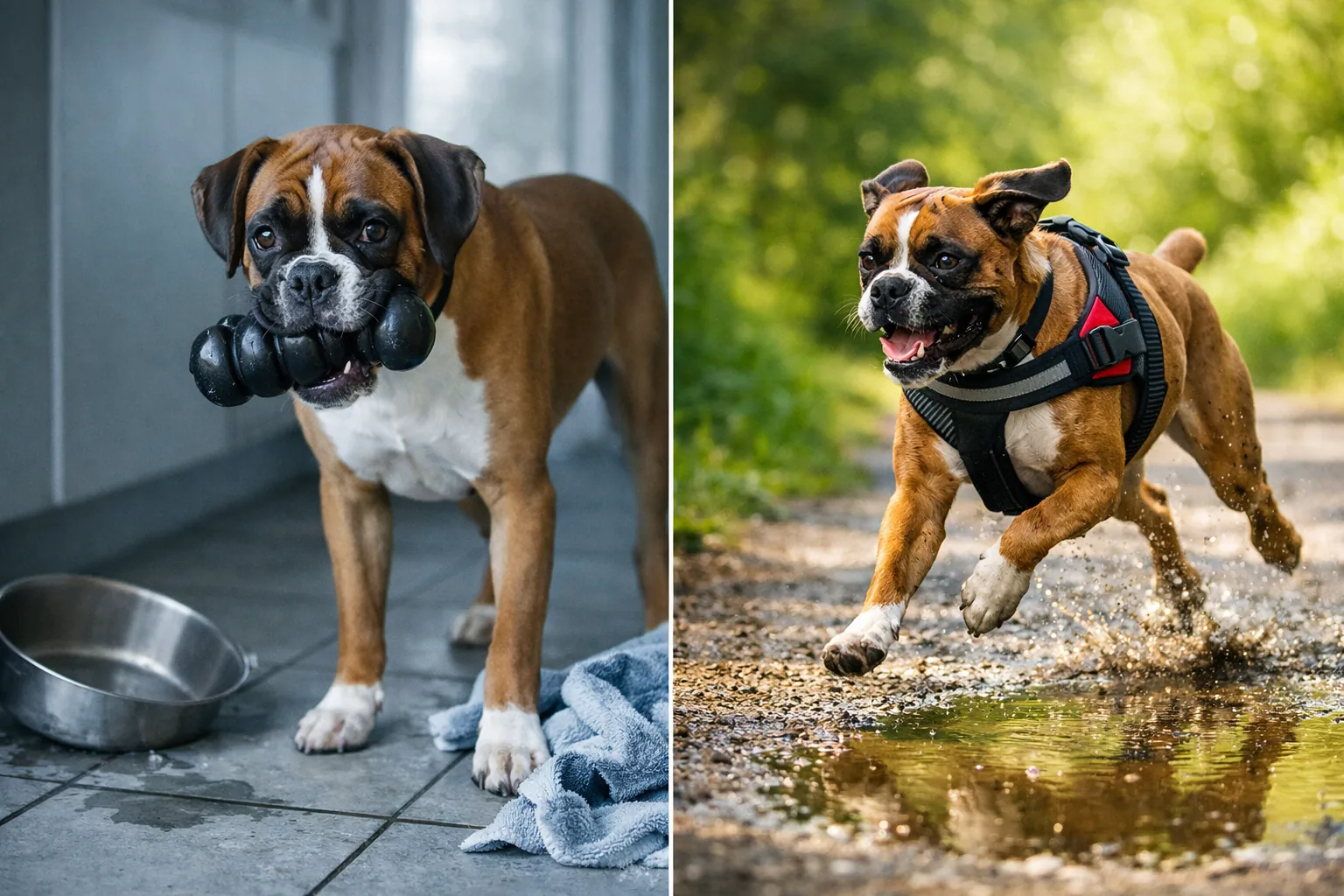
Destructive chewing and being left alone. Start alone-time training from week one, in seconds, before anxiety exists. Leave, return, no fuss either direction. Build to minutes, then to an hour. Frozen stuffed feeders turn departures into a good event. A Boxer who has never practiced being alone until month six will struggle.
Recall. Build it on a long line with food the dog rates as excellent. Never call a Boxer to end the fun.
Sign of progress: the dog offers the behavior before you ask. Common difficulty: adolescence at 8 to 18 months, when everything you taught appears to evaporate. It has not. Keep going, shorten sessions, raise reward value.
Try It: Boxer Lump Log
Boxers get skin lumps, and the dangerous ones feel exactly like the harmless ones, so touch is not a diagnostic tool. Use the log below to record size and changes and get a clear answer on whether this lump needs a vet appointment now.
Doggy Rank IQ Tool
Boxer Lump Log

Boxers are prone to skin lumps, including mast cell tumors. Most lumps are harmless, but some are not, and you cannot tell by touch. Use this to decide when to get a lump checked.
Boxer Lump Log
Record one lump and get a clear next step. Not a diagnosis.
Boxers are a high-risk breed for mast cell tumors. A fine-needle aspirate is quick and usually inexpensive. Any lump that is growing, changing, ulcerated or bothering your dog should be seen promptly.
How Much Does a Boxer Cost?
Expect to pay $1,200 to $3,000 for a boxer dog puppy from a breeder who runs health testing, with a realistic first-year total of $3,000 to $5,500 and ongoing annual costs of $1,500 to $2,500. Rescue adoption usually runs $150 to $500.
| Cost item | Typical US range |
|---|---|
| Puppy from health-testing breeder | $1,200 to $3,000 |
| Rescue or breed-club adoption | $150 to $500 |
| First-year setup (crate, bed, gates, leads, bowls) | $300 to $600 |
| First-year vet (vaccines, neuter, microchip, exams) | $600 to $1,200 |
| Food, annual | $600 to $1,000 |
| Routine vet and preventives, annual | $500 to $900 |
| Pet insurance, annual | $450 to $1,100 |
Prices checked November 2026 and vary widely by region, so treat these as planning estimates, not quotes.
What justifies the higher puppy price: annual Holter monitoring for ARVC in the parents, cardiac exam by a veterinary cardiologist, hip and elbow scoring, thyroid panel, and DM genetic testing. A breeder charging $900 with no testing is not a bargain. The $2,000 you saved is a down payment on a cardiology referral.
Insurance deserves a straight answer here. Because Boxers have elevated cancer and cardiac risk, a single oncology workup and treatment course can reach $5,000 to $12,000. Insure before symptoms appear, because anything documented first becomes a pre-existing condition.
Boxer Puppy Tips for the First 90 Days
The first three months with a boxer dog puppy set up the two things owners most regret skipping: alone-time tolerance and an off-switch for the mouth.
Days 1 to 14
- Set the crate up as a good place with food and chews inside, door open
- Begin alone-time drills measured in seconds, several times daily
- Start fold cleaning and paw handling now, while the puppy is small
- Book the first vet visit and ask for a cardiac listen specifically
- Expect night waking. Take them out, no play, straight back.
Days 15 to 45
- Socialize deliberately: 3 to 5 new surfaces, sounds or calm dogs per week
- Teach “four on the floor” before the jumping becomes a habit
- Introduce a slow feeder and a puzzle toy
- Enforce naps. Most biting peaks come from an overtired puppy.
Days 46 to 90
- Add a long line and build recall outdoors
- Keep exercise short and structured, about five minutes per month of age per session
- Start a monthly lump and body check so you know what normal feels like
- Book a puppy class that uses reward-based methods
Common mistake: letting an eight week old Boxer jump on everyone because it is adorable. At eight months the same behavior knocks over your mother-in-law.
What Boxer Owners Say
Owners on r/Boxer are candid about both ends of this breed, the devotion and the exhaustion.
“he was a beautiful soul, caring and loving best friend”
That comes from an owner on Reddit posting in a thread about Boxers leaving too early. The practical response is not comfort, it is scheduling. Move to twice-yearly vet exams from age six, run a monthly lump check at home, and sample anything new rather than watching it. Early detection is the single variable you actually control.
“Potty training was a breeze, but biting and jumping have been a nightmare”
From an owner on Reddit describing a puppy who is a lot to handle. This combination is extremely common and mostly fixable. Track when the biting happens. If it clusters in the evening or after visitors, the puppy is overtired and needs enforced crate naps, not more exercise. Pair that with zero attention for airborne paws and most households see a real change inside three weeks.
“I feel like boxers are their own species”
From an owner on Reddit asking first-time questions. Fair assessment. The useful version of that observation: stop comparing your Boxer’s training curve to a Labrador’s. Shorten sessions, raise reward value, change the exercise every few reps, and accept that adolescence runs long in this breed.
Boxer Dog FAQ
How long do boxer dogs typically live? Around 10 to 12 years, per PetMD. Cancer is the most common cause of earlier loss, and lean body weight plus early lump checks are the two factors most within your control.
What are the most common boxer dog health problems? Mast cell tumors, lymphoma, ARVC (Boxer cardiomyopathy), aortic stenosis, hypothyroidism, hip dysplasia, bloat and degenerative myelopathy.
Are boxer dogs aggressive? No, not as a breed trait. The AKC standard describes a stable Boxer as self-assured with strangers and patient with family. Some individuals are reactive toward unfamiliar dogs, which is a training and socialization issue rather than a temperament flaw.
Should I crop my boxer dog’s ears? There is no medical benefit. Cropping is cosmetic surgery on a puppy, is banned in much of Europe, and is opposed by the American Veterinary Medical Association. Natural ears are fully acceptable in AKC conformation.
Do boxer dogs shed a lot? Moderately and constantly. Short fine hairs year-round, no seasonal blowout. A weekly rubber curry brush removes most of it.
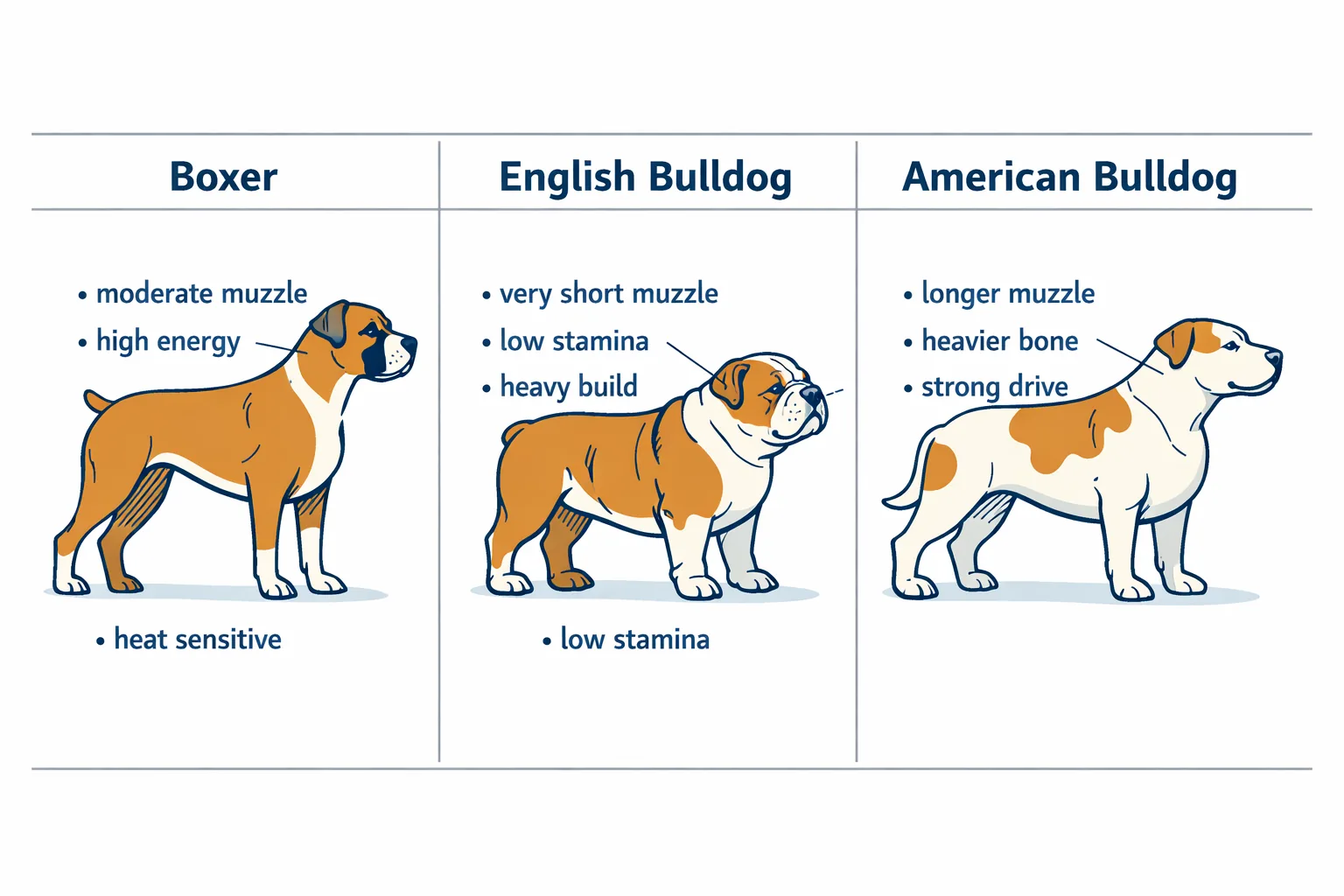
What other breeds look like boxers? American Bulldogs, Bullmastiffs, Cane Corsos, Dogue de Bordeaux, Valley Bulldogs and many pitbull-type mixes share the broad head and short muzzle. Boxers are lighter and leggier than most of them.
Boxer dog vs bulldog: which should I choose? Choose a Boxer if you want an athletic dog for daily running, hiking and active play. Choose an English Bulldog only if you want a low-stamina companion and accept significant breathing-related health risk. The Boxer has the longer muzzle and far more endurance of the two.
Can boxer dogs live in apartments? Yes, if you can deliver 60 to 90 minutes of outdoor activity daily plus mental work. Boxers are quiet and settled indoors. The constraint is your schedule, not your square footage.