
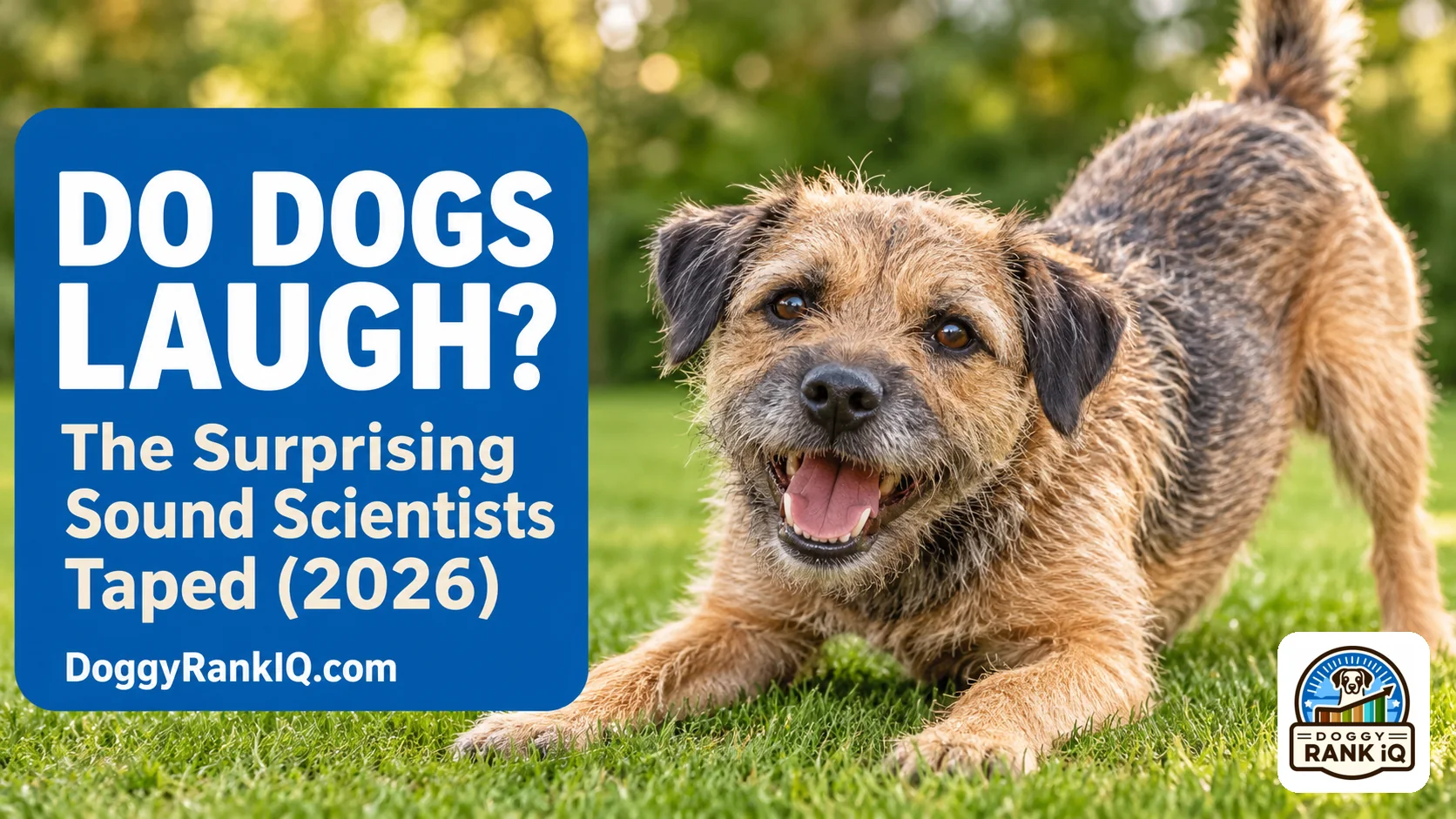
A dog in the middle of a wrestling match with a tug toy makes a sound no vacuum cleaner, no squeaky hinge, and no ordinary pant quite explains. Researchers have recorded that sound, measured it, and compared it against every other noise a dog makes. So do dogs laugh? The short answer is that dogs produce a distinct, breathy exhalation during play that sounds different from regular panting and shows up almost exclusively when dogs are having fun, which several scientists have described, somewhat carefully, as a dog laugh.
Quick Answer
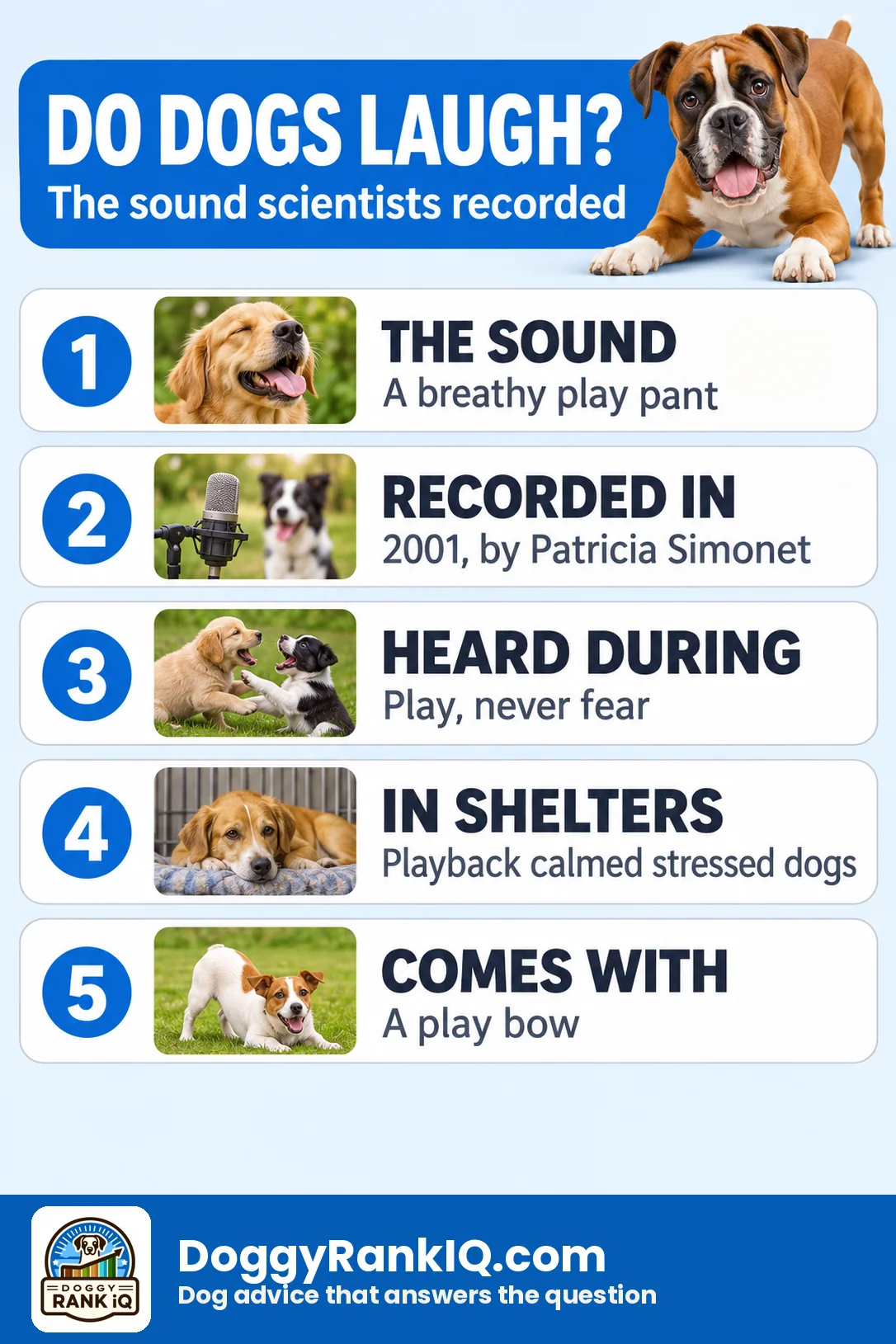
Do dogs laugh? Not in the human sense of ha-ha, but dogs do make a specific “play pant,” a forced, breathy, irregular exhalation that researchers first recorded and described in 2001 and have since measured acoustically in controlled studies. The sound is noisier, higher pitched, and less rhythmic than regular panting, and it shows up during play far more than during rest or training. Scientists avoid calling it laughter outright because they can’t confirm the inner feeling behind it, but they agree it signals strong positive emotion and an invitation to keep playing.
Key Takeaways: do dogs laugh
- Do dogs laugh? They make a breathy “play pant” that researchers first documented and labeled informally as a dog laugh.
- The sound is acoustically different from normal panting: noisier, higher-pitched, and irregular rather than steady.
- A 2022 study found the sound occurred alongside play about 93% of the time across recorded sessions.
- A 2026 Eötvös Loránd University study found play pants had the greatest formant dispersion of any panting type tested.
- Playing a recording of the sound to shelter dogs was reported to lower stress behaviors and increase tail wagging.
- The sound usually appears with a play bow, a loose wiggly body, and bouncy movement.
- Ticklish-looking kicking is a spinal scratch reflex, not laughter.
- Owners can sometimes trigger a version of the sound by imitating a breathy “hhuh hhuh” during play, though results vary by dog.
- Puppies can produce a version of the play pant early on, but it’s less consistent than in adult dogs.
- No veterinary or scientific body has formally classified the sound as laughter in the human sense.

What do you hear?
Tap an option to see the answer.
The short answer: do dogs laugh?
Dogs don’t laugh the way people do, with a vocal cord vibration tied to amusement at a joke. What they do have is a measurable play vocalization that researchers keep returning to because it behaves like a social signal, not an accident of breathing hard.
Konrad Lorenz, the ethologist known for his work on animal behavior, described something laugh-like in dogs decades ago in his book Man Meets Dog, noting an expression during play that resembled a grin paired with a particular kind of breathing. That observation sat mostly as a curiosity until behavioral scientist Patricia Simonet picked it up formally, a history also summarized by Psychology Today’s look at whether dogs laugh.
Simonet’s research gave the idea a name and a sound profile. She described a “pronounced breathy forced exhalation” that occurred almost exclusively during play, and in media coverage of her work she called it a dog laugh, describing the sound to an untrained ear as something close to “hhuh, hhuh.” That single description is the reason the phrase “dogs laughing” shows up across dog forums and recorded clips today, and it’s the same description PetMD references when explaining whether dogs can laugh.
Separate from dogs, research on rats found that rats produce ultrasonic “chirps” during rough-and-tumble play, a sound now associated with positive affect in rodents. That work doesn’t prove anything about dogs directly, but it supports a broader pattern: play vocalizations that function like social glue show up across more than one mammal species, a point echoed in broader coverage of animals that appear to laugh.
The surprising sound scientists taped
Researchers have actually recorded this sound under controlled conditions, and the recordings hold up as a distinct acoustic category, not just an owner’s wishful interpretation.
A 2022 peer-reviewed study recorded 16 human-dog pairs, with 14 usable recordings, across training sessions, play sessions, and shared rest, using wireless microphones and video. Across those sessions, researchers logged an average of 353 target vocalizations, and about 330 of them, roughly 93%, occurred alongside play behavior or direct playful interaction. The statistical association was strong: a correlation of r = 0.998, with the sound appearing significantly more often during play than during training or rest (F(2,39) = 5.897, p =.006).
The team also defined the sound with hard numbers instead of vibes. The proposed play pant generally sat in the 0 to 4 kHz range, lasted about 0.1 to 0.3 seconds, and showed large, irregular bursts of amplitude without the clean harmonic bands you’d expect from a bark or whine. In plain terms: it’s breath, not voice.
“A pronounced breathy forced exhalation” is how the sound was first described, and recordings since have backed up that it’s physically different from a tired dog catching its breath.
The newest piece of evidence came in 2026, when a team at Eötvös Loránd University recorded 38 dog-owner pairs during neutral exploration, play, brief separation, and an approach by an intimidating stranger, then compared the panting across all four contexts. Play pants stood out from every other context as the noisiest and highest-pitched panting pattern, with the greatest formant dispersion, an acoustic trait linked to a dog sounding smaller than it is. The researchers interpreted this as a functional signal rather than literal mirth: a way for a dog to broadcast strong positive emotion and tell a play partner, human or dog, that nothing about this interaction is a threat.
No regulatory body or veterinary group has formally classified this sound as laughter. The science so far improves how precisely researchers can measure positive emotion in dogs. It doesn’t establish that dogs experience humor the way people do, a distinction the American Kennel Club also makes when discussing dog humor claims.
Can dogs actually laugh or is that just panting?
Dogs can’t laugh in the vocal, voiced way humans do, but the play pant is not simply ordinary panting either. It’s a separate acoustic category with its own frequency range, rhythm, and context, which is why scientists treat it as a meaningful signal rather than a side effect of exertion.
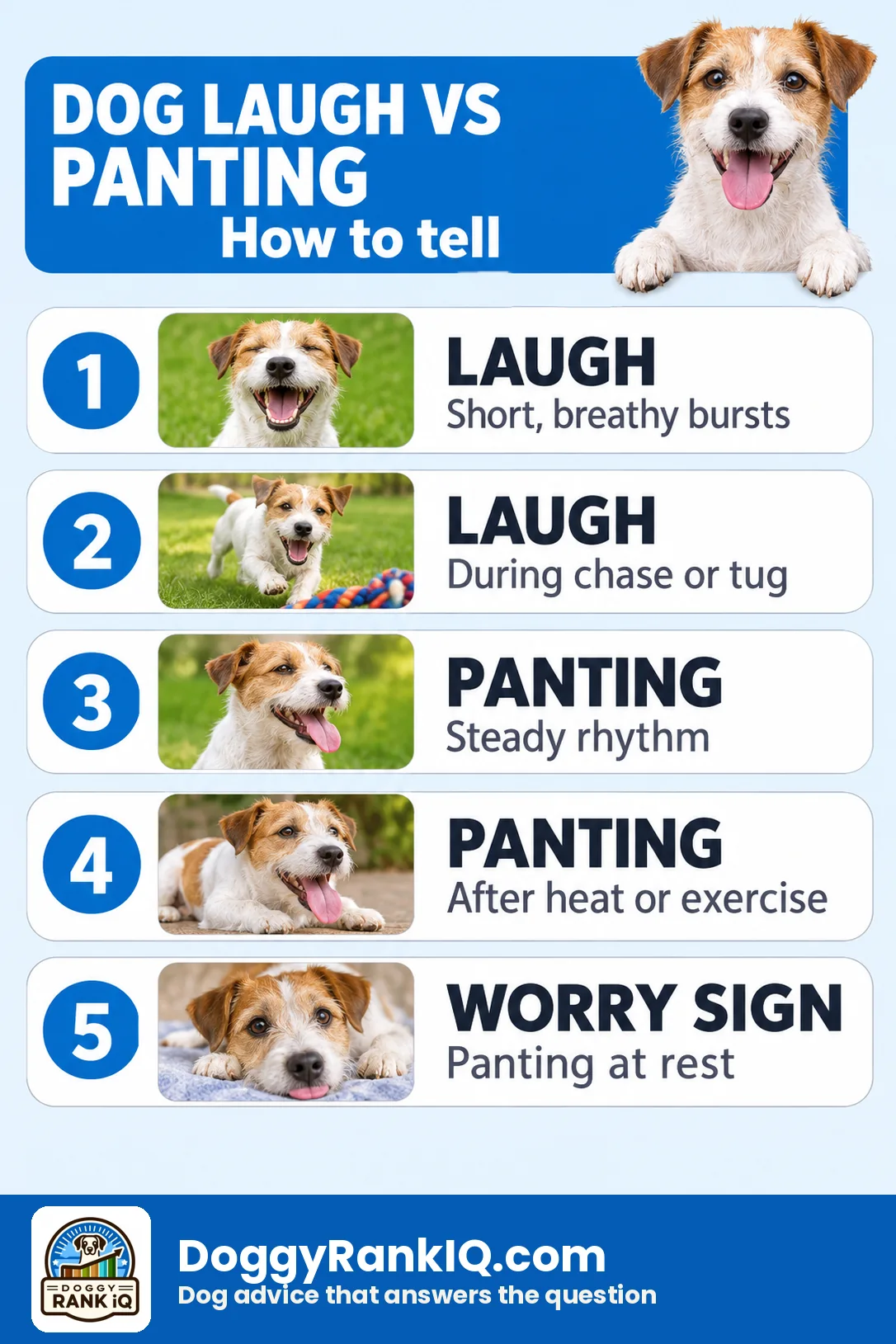
The key difference comes down to three things: sound quality, timing, and body language. Ordinary panting is steady and tied to body temperature or exercise recovery. The play pant is choppy, breathy, and tied almost exclusively to active play. A dog can pant hard after a sprint and never make the play-pant sound, and a dog can make the play-pant sound while barely moving if it’s mid-wrestle with a toy.
Decision rule: if the panting is steady and continues whether or not the dog is interacting with anyone, that’s regular panting. If the panting is choppy, breaks rhythm, and shows up only while the dog is actively engaged in a game, that fits the pattern researchers call a dog laugh.
What does it mean when a dog laughs?
When a dog makes the play-pant sound, it most likely means the dog is experiencing strong positive arousal and is signaling that the interaction is playful, not threatening. It functions less like an emotional overflow and more like a message aimed at a play partner.
This matters in multiplayer situations, like a dog park or a multi-dog household. A dog making this sound while play-wrestling with another dog is effectively saying “this is still a game,” which can prevent rough play from escalating into real conflict. Veterinary behavior resources that cover common myths about dog body language note that signals like this are part of a larger communication system dogs use to keep play safe.
How do dogs laugh compared to humans?
Human laughter involves voiced sound, vocal cord vibration, and is often tied to cognitive triggers like jokes or surprise. Dog laughter, by contrast, is unvoiced, breath-based, and tied almost entirely to physical play rather than cognitive humor.
A few concrete differences:
- Humans laugh in bursts with a vocalized “ha,” while dogs produce exhaled, breathy pulses with no vocal tone.
- Human laughter can happen while sitting still and thinking about something funny. The dog version almost always occurs during active physical engagement.
- Humans laugh in response to abstract humor. Dogs respond to immediate physical play, not stored jokes or delayed punchlines.
So when people ask do dogs laugh the way people do, the honest answer is no, but the function (signaling enjoyment and inviting more interaction) overlaps more than the mechanism does.
What sounds do dogs make when they’re happy?
Happy dogs make a range of sounds beyond the play pant, including soft grumbly groans, play growls, and excited yips, and the correct interpretation depends heavily on the body language accompanying each one.
- Play pant: breathy “hhuh hhuh,” tied to active play, covered above.
- Play growl: lower pitched, often during tug or wrestling, paired with a loose body and wagging tail rather than stiffness.
- Excited yips or barks: higher pitched, short, often at the start of a game like fetch.
- Contented groan: low, soft sound made during settling in, like a sigh after lying down near a favorite person.
Context decides the meaning. The same yip during a stressful vet visit means something different than the same yip at the sight of a leash.
Is dog laughter a sign of stress or happiness?
In the research available so far, the play pant specifically tracks with happiness and positive play, not stress. Stress-related panting looks and sounds different and pairs with a stiff body rather than a loose, bouncy one.
The 2026 Eötvös Loránd University comparison is useful here because it tested panting across four very different contexts, including an approach by an intimidating stranger. Play pants were the noisiest and highest pitched of all the panting types recorded, while stress-context panting didn’t carry the same acoustic signature. That’s a meaningful distinction for owners trying to figure out do dogs laugh out of joy or out of nerves: the research points toward joy specifically when the sound pairs with play behavior.
Common mistake: assuming any fast, breathy panting during an intense moment is a happy dog laugh. A dog panting heavily while cornered by a larger dog at the park is showing stress, not play, even if the sound is fast and irregular.
Do all dog breeds laugh the same way?
No single study has confirmed that every breed produces the play pant identically, and anatomical differences likely affect how the sound comes out. Brachycephalic breeds (like French Bulldogs or Pugs) have different airway structure than long-snouted breeds, which can change the acoustic quality of any pant, including a play pant.
What’s consistent across breeds, based on the available behavioral research, is the context: the sound shows up during play regardless of breed, paired with a play bow and loose body. The pitch, rasp, or snort quality of the sound will vary with snout shape and size more than with personality.
Edge case: flat-faced breeds often sound more labored even during normal happy panting, which can make it harder for owners to distinguish a play pant from effortful breathing. If a short-snouted dog seems to be struggling rather than playing, treat it as a breathing concern first and a possible dog laugh second.
Can puppies laugh like adult dogs?
Puppies can produce a version of the play pant, but it tends to be less consistent and harder to distinguish from general excited breathing because puppies pant more easily during low-level activity. As play skills and stamina develop, the sound tends to become clearer and more tied specifically to active play bouts.
Owners of young puppies often notice the sound first during wrestling with a litter mate or another household dog, since that kind of rough-and-tumble play produces the clearest examples. If you’re working on foundational behaviors alongside play, our guide to essential commands every puppy should learn covers how structured training fits around normal puppy play and energy.
Facts table: dog laugh vs regular panting
How to tell if your dog is laughing
A dog laugh shows up with context clues, not in isolation. If you hear a breathy, choppy “huh-huh-huh” while your dog is mid-play, bouncing on front legs, or holding a play bow, that’s the pattern researchers tracked.
Watch for the combination rather than the sound alone:
- A play bow: front legs down, rear end up, tail loose and moving.
- A loose, wiggly body instead of a stiff, still one.
- Bouncy, exaggerated movement, sometimes called the “zoomies” posture, covered in more detail in our guide to dog zoomies.
- The sound breaking the rhythm of normal panting, getting choppier and louder during active play.
Edge case: a dog recovering from a sprint sometimes pants hard enough that it sounds similar. The difference is timing. Play pants happen during active engagement, not during the cooldown a minute later. If your dog’s breathing sounds off and labored outside of play, consider a vet visit if it doesn’t settle.
How can I tell if my dog is laughing or just panting?
The quickest test is to check what the dog is doing physically at the exact moment the sound happens. If the body is loose, bouncy, and engaged in a game, it’s likely the play pant researchers call a dog laugh. If the dog is lying still, recovering from exercise, or overheated, it’s ordinary panting.
A simple three-step check:
- Watch the body first. Is the dog mid-play (tugging, chasing, wrestling) or resting/recovering?
- Listen for rhythm. Play pants are choppy and irregular. Regular panting has a steady, metronome-like rhythm.
- Check what happens next. If the sound stops the moment play stops, it’s tied to play. If it continues regardless of activity, it’s likely just thermoregulation.
What does dog laughter sound like?
Dog laughter, as researchers have recorded it, sounds like a breathy, unvoiced “hhuh, hhuh,” closer to forced exhaling than to a vocal sound. It lacks the tonal quality of a bark, whine, or growl because there’s no vocal cord engagement involved, just air being pushed out in short, choppy bursts.
People sometimes describe it as a stuttering pant or a “laughing” huff, and that casual description is close enough to what the acoustic data shows: noisy, irregular, high-pitched bursts in the 0 to 4 kHz range lasting roughly a quarter second each.
Do dogs laugh when tickled? Are dogs ticklish?
Dogs don’t laugh when tickled the way the question implies. What people usually see is a scratch reflex, not amusement. Are dogs ticklish? In a reflexive sense, yes: scratching certain spots, often along the belly or flank, triggers an involuntary leg kick tied to a spinal nerve response rather than a felt tickle sensation the way humans experience it.
That kicking motion is well documented and explained in our piece on why dogs kick when you scratch them. It’s a reflex arc, similar to a knee-jerk test at the doctor’s office. No research cited here connects that reflex to the breathy play-pant sound. A dog can be mid-scratch-reflex and silent, or make play sounds with no scratching involved at all. The two behaviors are related to the body, not to each other.
Decision rule: if the leg kicks but the dog’s face and breathing stay neutral, that’s reflex. If the kick comes with a play bow and the breathy exhale, the dog has likely shifted into play mode on its own.
Do dogs find things funny? Do dogs have a sense of humor and get jokes?
The evidence doesn’t support dogs understanding a joke, a pun, or a punchline. What it does support is dogs reading and reacting to human emotional states, which is a different and still interesting thing, a point the American Kennel Club addresses directly when asked whether dogs have a sense of humor.
Some writers and behaviorists, including Simonet in her early work, suggested dogs might have something like a sense of humor, often citing cases where dogs seemed to repeat an action that made their owner laugh. That’s an interpretation, not a measured finding, and it should be treated as such. Separately, general animal behavior coverage, including a UCLA analysis on whether animals laugh, has asked whether any non-human species laughs at all, and the honest answer across species is that most “laughter-like” behavior documented so far functions as a social signal tied to play, not comedic appreciation.
What’s better supported: dogs pick up on human vocal tone, including laughter, and often respond with increased activity, tail wagging, or approach behavior. That’s closer to emotional contagion than humor comprehension, a dynamic also discussed in Science Focus’s piece on why dogs seem to want to make people laugh. If you want to go deeper on how dogs read human feelings generally, our guide on how dogs show affection covers related signals.
⭐ Top 5 Features We Love
- The sound is measurable, not just anecdotal. Researchers defined it with frequency ranges and duration, which is rare for an “is my dog happy” question.
- It’s tied to a body language package. The play bow and loose wiggle make it easy for owners to confirm what they’re hearing.
- Playback studies found a calming effect. Recorded play pants reportedly reduced stress behaviors in shelter dogs and increased tail wagging and play bows when played back.
- It crosses into cross-species research. Findings on rat play chirps suggest play vocalizations aren’t unique to dogs, which gives the dog data more scientific company.
- The 2026 study improved the acoustic picture. Comparing play pants against pants from separation and a stranger approach gave researchers a clean contrast, not just a guess.
⚠️ Things to Look Out For
- Heat-related panting: heavy, steady, often with bright red gums or excessive drooling. This is not play behavior and needs water, shade, and monitoring.
- Stress panting: can look similar to exertion but pairs with a stiff body, tucked tail, or avoidance, not a play bow.
- Pain-related breathing changes: irregular breathing paired with reluctance to move, whining, or a hunched posture warrants a vet check, not a play session.
- Breathing that doesn’t settle: if panting continues long after activity stops, especially in brachycephalic breeds, treat it as a medical question.
- Confusing crying with laughing: some whines and yips get mistaken for play sounds. Our breakdown of do dogs cry explains the difference in context and sound.
If a dog’s breathing looks labored, rapid, or paired with distress at rest, that’s not a laugh. Check with a veterinarian rather than guessing from a video clip.
How to make a dog laugh: 5 play ideas
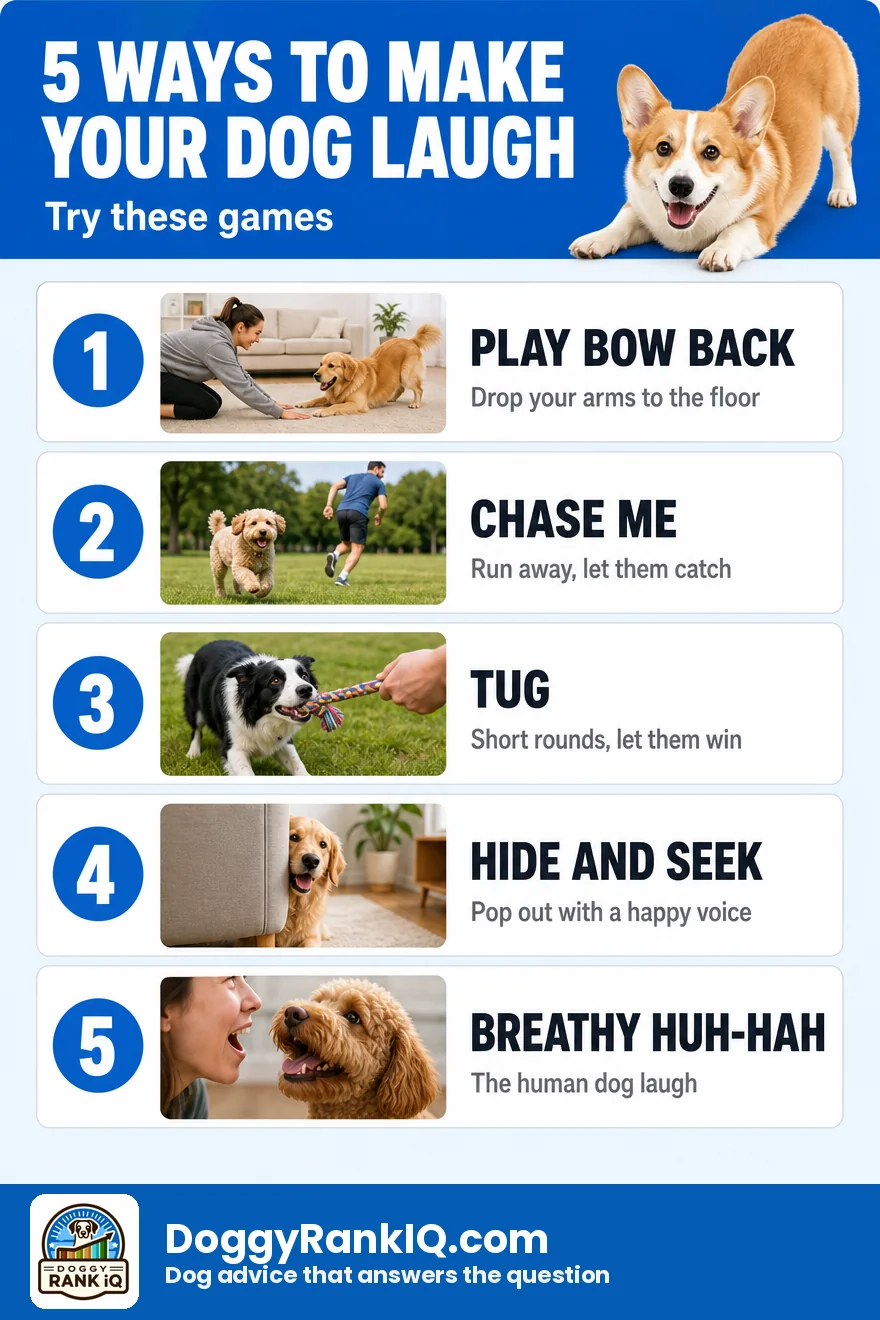
1Imitate the breathy “hhuh hhuh” sound during play
Simonet suggested people can mimic the play pant with a breathy, unvoiced “hhuh hhuh,” no actual voice behind it, just exhaled air in short bursts. Results vary widely by dog. Some dogs perk up and escalate play immediately. Others ignore it completely. Try it during an already-playful moment rather than cold, since context matters more than the sound alone.
2Use a tug toy for back-and-forth play
Tug play reliably triggers the loose-body, bouncy behavior tied to the play pant. A KONG Tug Toy gives both dog and owner something to hold onto without risking fingers. Check the current price.
3Play chase with a bumper-style toy
Fetch and chase games mimic predatory play sequences that reliably produce play bows and bouncy movement. A Chuckit! Ultra Bumper Tug Dog Toy works for both throwing and tugging. Check the current price.
4Add a squeaky, crinkly toy for solo excitement
Some dogs get worked up into play-pant territory on their own with a toy that makes noise back at them. The Best Pet Supplies Interactive Squeaky Dog Toy, Crinkle Chicken adds texture and sound in one toy. Check the current price.
5Match play to your dog’s actual preferences
Not every dog wants tug or fetch. Some prefer wrestling, chasing another dog, or a slow-building game of hide and seek. Watch which activity consistently produces the play bow and bouncy body, then repeat that one. For dogs that seem over-aroused instead of playful, our guide on dog zoomies explains when high energy tips into something that needs a break instead of more play.
Helpful play toys
Price checked 2026.
These are named as helpful options based on what manufacturers document and what owners commonly report, not hands-on lab testing. The Genius of Dogs, by cognitive scientist Brian Hare, is a good next read if the question of do dogs laugh pulled you into wanting more dog cognition research generally; it covers broader findings on how dogs think, which pairs well with the body language guidance in this article.
FAQ
The bottom line
Do dogs laugh? They make a specific, scientifically documented play pant that behaves like a laugh in function, if not in feeling: breathy, noisy, tied almost entirely to play, and linked to a body language package that’s easy for any owner to spot. Scientists stop short of calling it human-style amusement because nobody can confirm what a dog subjectively feels during it. What they can confirm is a measurable, repeatable signal that shows up when dogs are having a good time.
The practical takeaway is simple. Watch for the combination, not just the sound: breathy huffing, a play bow, a loose wiggly body. If you want to try to produce it, a round of tug or chase with the right toy is a better bet than a flat imitation on a bored dog. And if breathing sounds labored or distressed outside of play, that’s a vet question, not a laugh.
Doggy Rank IQ is reader supported. As an Amazon Associate we earn from qualifying purchases, at no extra cost to you.