
Why do dogs kick when you scratch them? Quick Answer
Dogs kick when you scratch them because a skin receptor in the flank, belly, or saddle region triggers a spinal reflex, not a conscious decision, and the signal reaches the hind leg muscles before the brain is even involved. This is the same basic answer veterinary neurologists give to why do dogs kick when you scratch them: it is an old protective reflex, likely tied to dislodging parasites, and a kicking leg by itself does not prove a dog is enjoying the touch.
Key Takeaways
- The scratch reflex is a spinal reflex arc, first documented in detail by Charles Scott Sherrington, who used dogs with spinal-cord transections in his classic neurophysiology work published in 1906 .
- Sherrington’s experiments found that stronger stimulus intensity increases the force and duration of the kick, while the basic rhythm of the leg movement stays fairly constant .
- The reflex fires most reliably in the “saddle” region, meaning the flank, belly side, and area near the hindquarters, though the exact spot varies dog to dog .
- The AAHA 2023 Allergic Skin Diseases Guidelines recommend a workup (history, skin cytology, flea combing, skin scraping) once scratching becomes constant or shows up with skin changes.
- Pruritus, the medical term for itch-driven scratching, has many causes: parasites, bacterial or yeast infection, allergy, and even hormonal disease .
- A dog can kick and still dislike being touched there. The kick is not a consent signal on its own .
- Sudden onset, one-sided kicking, or limping afterward is worth mentioning at the next vet visit rather than guessing at home .
When to call the vet
Call if the kicking is brand new, happens only on one side, comes with limping, hair loss, scabs, or an odor. Also call if your dog keeps licking or chewing the same spot after you’ve stopped scratching. A normal scratch reflex does not leave lingering soreness, and if it does, something other than the reflex is likely at play . This is one of the few places where guessing isn’t a good strategy, since skin problems and nerve issues can look similar from the outside.
Doggy Rank IQ Tool
Scratch Reflex Spot Explainer

Pick the spot you scratch and what you see. The reflex is neither pleasure nor pain, but new or constant kicking can be a skin signal.

What is the scratch reflex in dogs, and why do dogs kick when you scratch them?
The scratch reflex is a built-in nerve circuit that makes a dog’s hind leg move in a rhythmic kicking pattern when a specific patch of skin gets stimulated, and it’s the full mechanical answer to why do dogs kick when you scratch them. The brain doesn’t need to be consulted for the leg to move.
Here’s the sequence. Mechanical pressure on the skin, your fingernails working along the flank, activates sensory nerve endings under the surface. Those nerves carry an electrical signal up to the spinal cord. Inside the cord, a short chain of interneurons passes the signal directly to motor neurons that control the hind leg muscles . The brain registers the kick after it’s already happening. It never approved it in the first place.
This explains why a sleepy, half-dozing dog can still kick like a wind-up toy the moment you hit the right spot on the flank. The circuit runs on its own schedule, not the dog’s attention span.
Popular Science describes this response as a holdover reflex, something that likely helped wild canine ancestors shake off ticks, fleas, or other irritants without needing to think about it or even look down.
Why do dogs kick when you scratch them? What triggers the leg-kicking reflex when you scratch a dog?
A reliable trigger is repeated mechanical pressure on a receptive skin zone, most often the flank, the side of the belly, or the saddle area near the hindquarters. Stronger or longer scratching tends to produce a stronger, longer kick rather than a different kind of reaction altogether .
Sherrington’s original research on spinal reflexes found something specific: the strength of the stimulus changes how hard and how long the leg kicks, but the rhythm of the kick stays fairly steady regardless of how hard you scratch . That consistency is a hallmark of a reflex rather than a voluntary choice, since a deliberate behavior would vary more in timing and pattern.
A few patterns owners commonly notice:
- Light rubbing produces a small twitch, sometimes nothing visible at all.
- Firm, repeated scratching on the flank produces a full kick cycle, often several beats in a row.
- The same spot scratched again a minute later usually gets the same response, because the circuit fires the same way each time.
- A spot that never triggers anything is often just an area with lower nerve density in that particular dog, which is normal.
Decision rule: if the kick shows up consistently at the same spot and stops cleanly the moment you stop scratching, that’s the ordinary reflex at work. If it keeps going after you’ve stopped, or the dog spins around to bite or lick the spot right away, something besides the reflex may be going on, and that’s worth paying attention to.
Why do dogs kick when you scratch them? Is it normal for dogs to kick their back legs when scratched, and do all dogs kick when you scratch them?
Yes, it’s normal, and the reflex is present in dogs generally, not something limited to a handful of individuals or breeds. That said, not every dog shows a visible kick every time, since the strength of the visible response depends on nerve sensitivity in that spot, coat thickness, and how relaxed the dog is at the moment .
Some dogs kick hard and fast on the first touch. Others barely twitch even when the scratching clearly hits the saddle region. Both are within normal range. A dog that never kicks doesn’t necessarily lack the reflex; it may simply have a less pronounced response, or you haven’t found its specific trigger spot yet.
Common mistake: assuming a dog is “broken” or has a nerve problem because it never kicks. Unless there’s an actual injury or illness involved, a quiet response to scratching is just individual variation, the same way some people are more ticklish than others.

Why do dogs kick when you scratch them? What causes that kicking reflex in dogs? The scientific explanation
The scratch reflex is driven by a spinal reflex arc: a short circuit of sensory nerve, spinal interneuron, and motor neuron that completes the loop without routing through the brain’s higher processing centers . This is the core scientific explanation for why do dogs kick when you scratch them, and it was first mapped out in detail more than a century ago.
Sherrington’s 1906 work, often cited as foundational in neurophysiology, used dogs with surgically severed spinal cords to prove that the hind leg could still produce a coordinated kicking motion in response to skin stimulation, even with no connection to the brain above the cut . That demonstrated the reflex lives entirely in the spinal cord itself, not in conscious decision-making.
Modern veterinary sources, including Hill’s Pet Nutrition, describe the same mechanism in plainer terms: a nerve under the skin gets irritated, the spinal cord fires a protective kicking motion, and the whole thing happens faster than conscious thought could manage. The leading theory for why this reflex exists at all is that it evolved to help dislodge fleas, ticks, or other irritants from hard-to-reach areas like the flank, a region a dog can’t easily scratch with its own back legs while grooming normally .
Why do dogs kick when you scratch them? Are some dog breeds more prone to kicking than others?
No credible veterinary source links the scratch reflex to specific breeds having a stronger or weaker version of it, so breed by itself isn’t a useful predictor . What varies is the individual dog, not the breed as a category.
Coat density, skin sensitivity, and simple personality differences in how tolerant a dog is of touch likely explain most of what owners notice. A thin-coated dog, like a Whippet or a short-haired Chihuahua, may show a more visible kick simply because the stimulus reaches skin receptors more directly through less fur. A dog with a heavy double coat, like a Siberian Husky, may need firmer pressure to trigger the same response because the fur buffers some of the stimulation. This is a reasonable explanation based on how the reflex mechanically works, not a confirmed breed-specific study finding, so it’s worth treating as a plausible pattern rather than an established fact.
Why do dogs kick when you scratch them? Why does my dog kick harder in certain spots?
Dogs kick harder in certain spots because nerve density isn’t uniform across the body, and the flank and saddle region simply carry more of the sensory nerve endings that feed into this particular reflex arc . Other areas of the body, like the top of the head or the paws, don’t reliably trigger the same circuit at all.
Think of it as a reflex map rather than a full-body switch. Most dogs have one or two obvious “buttons,” usually somewhere along the flank or just above the hip. Scratching the chest, ears, or base of the tail might feel great to the dog without producing any kick, because those areas aren’t wired into the same spinal circuit. A dog with one reliable spot and nothing happening elsewhere is completely normal.
Edge case: a spot that suddenly becomes a trigger when it never was before, especially if the dog also starts licking or biting that same area unprompted, deserves a closer look rather than being chalked up to a “new sensitive spot.”
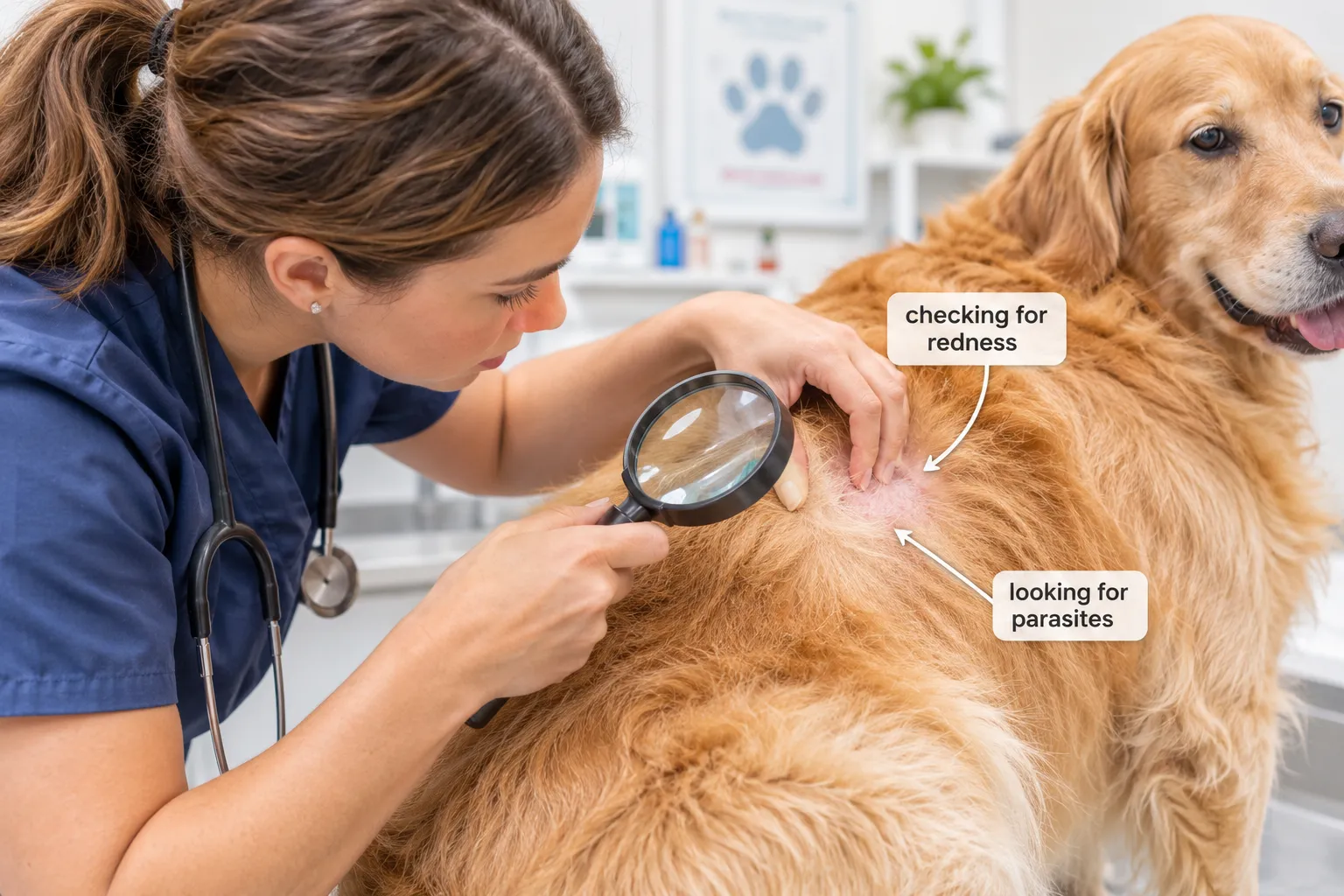
Why do dogs kick when you scratch them? Is kicking a sign my dog is happy or uncomfortable? How do you know if your dog is enjoying the scratching?
A kicking leg by itself is not proof of enjoyment, since it’s a motor reflex rather than an emotional signal. Better indicators of genuine enjoyment include a relaxed body, soft or half-closed eyes, leaning into your hand, and staying still once you stop, rather than the leg movement itself .
PetMD notes that body language around a belly rub or flank scratch, not the kick, is what actually tells you how a dog feels. A dog can be mildly annoyed, completely content, or somewhere in between and still produce the exact same kick, because the spinal cord doesn’t know or care about mood . If you want a real read on enjoyment, watch the rest of the body and watch what happens the second you stop. A dog that nudges your hand back into place wants more. A dog that gets up and walks away mid-kick is done, regardless of what the leg was just doing.
What’s the difference between happy kicking and a pain response?
Happy or neutral kicking starts and stops cleanly with the scratching, and the dog shows no guarding, yelping, or avoidance of the area afterward. A pain response usually includes flinching before you’ve even made contact, yelping, snapping, or the dog pulling the area away rather than leaning into your hand .
| Signal | Normal reflex kicking | Possible pain or irritation |
|---|---|---|
| Timing | Starts and stops with the scratching | Starts before touch, continues after |
| Dog’s posture | Relaxed, often leaning in | Tense, pulling away, guarding the spot |
| Sound | Silent or content sighing | Yelping, growling, sudden snapping |
| Skin condition | Normal coat and skin | Redness, scabs, hair loss, odor |
| Follow-up behavior | Dog settles back down | Dog licks, chews, or scratches the spot repeatedly |
Table: How to tell normal scratch-reflex kicking apart from a pain response, which matters most for owners trying to understand why do dogs kick when you scratch them without missing an actual skin problem underneath.
How is the dog kicking reflex similar to a human reflex?
The dog’s scratch reflex works on the same basic wiring principle as a human knee-jerk reflex: a sensory signal enters the spinal cord, gets relayed through interneurons, and triggers a motor response without needing the brain to weigh in first . Sherrington’s research, which won him a share of the 1932 Nobel Prize in Physiology or Medicine, established this spinal reflex arc concept using animal models and it still forms the basis of how doctors and vets think about reflexes today .
When a doctor taps below your kneecap with a small hammer, the same type of circuit fires: a tendon stretch is detected, the signal shoots to the spinal cord, and the leg kicks out before you consciously register the tap. The dog’s flank-to-hind-leg circuit is a close cousin of that same mechanism, just tuned to a different trigger (skin pressure instead of tendon stretch) and a different muscle group. Both are checked by doctors and vets, respectively, as a quick way to confirm the spinal cord and peripheral nerves are communicating properly.
Should I be worried if my dog kicks excessively?
Occasional vigorous kicking during a good scratching session is not something to worry about, since stronger stimulation naturally produces a stronger, longer kick response according to the original reflex research . What’s worth watching is excessive kicking paired with other signs, not the intensity of the kick alone.
Pay closer attention if the kicking happens even with very light touch, continues well after your hand has stopped moving, or if the dog seems startled or distressed by it rather than relaxed. Also watch for kicking that happens spontaneously, without you touching the dog at all, since that pattern falls outside the normal stimulus-response reflex and could point to a neurological issue worth asking a vet about. A single oddly timed kick is not an emergency. A consistent new pattern, especially one-sided or paired with limping, is worth a phone call .
What if my dog doesn’t kick when scratched?
A dog that never kicks, even in the classic flank and saddle spots, is usually still within normal range, since the visible strength of this reflex varies a great deal between individual dogs . Lacking an obvious kick is not, by itself, a sign of a nerve problem.
Some dogs simply have a weaker version of the reflex, or need firmer, more targeted pressure to trigger it than owners typically apply during casual petting. Heavy double coats can also dampen the visible response since less direct skin contact is made. If a dog used to kick reliably and has now stopped altogether, especially alongside other changes like reduced hind leg mobility or signs of pain when touched, that combination is worth raising with a vet, since it could suggest a nerve or spinal issue rather than simple individual variation .
Does kicking mean my dog has a skin problem or itch?
No, the reflex kick triggered by your hand is a different thing entirely from pruritus, which is the medical term for itch-driven, self-directed scratching that a dog does on its own . The scratch reflex is a one-time motor response to outside touch. A skin problem shows up as the dog scratching, licking, or chewing itself repeatedly, with or without anyone touching it.
The Merck Veterinary Manual lists parasites (including sarcoptic mange and fleas), bacterial or yeast infections, and allergies as the most common drivers of ongoing itch in dogs. VCA Animal Hospitals adds that chronic itching paired with redness, hair loss, or a change in skin texture almost always points to something that needs a vet exam rather than at-home guessing. The American Kennel Club also notes that external parasites remain one of the most common and most treatable causes of persistent scratching in dogs of any age or breed.
Edge case: a dog that kicks normally during petting but also separately scratches itself raw at night needs that second behavior evaluated on its own, even if the reflex itself looks completely ordinary during a vet visit.
Can you train a dog to stop kicking when scratched?
Not reliably, because the scratch reflex is a spinal circuit rather than a learned behavior, so it doesn’t respond to the usual training methods the way commands like sit or stay do . Training can change how a dog feels about being touched in that area, but it can’t override the reflex arc itself.
What owners can actually influence is the behavior around the reflex: teaching a dog to stay settled during grooming or vet exams, or building tolerance for handling through calm, consistent sessions, similar to the approach used when teaching basic obedience commands early on. If a dog seems genuinely stressed by the kick itself, which is rare but does happen with easily startled dogs, slower introduction to touch and more predictable handling during grooming sessions help more than any attempt to suppress the reflex directly, which isn’t possible anyway.
Why do dogs kick more when they’re relaxed and lying down?
Dogs often show a stronger, more visible kick when lying down and relaxed because the reflex isn’t competing with other nervous system activity like walking, playing, or alertness to the environment . A standing or distracted dog may partially suppress the response simply because its attention and muscle activity are directed elsewhere.
This is consistent with general reflex physiology rather than a dog consciously deciding to “let” the kick happen. A dog deeply asleep, mid-play, or focused on something outside the window may barely react to scratching that would normally trigger a full kick cycle while it’s lying calmly on the couch. Once the dog settles into a relaxed, lying-down position, the reflex circuit has less interference and the kick shows up more cleanly, which is part of why do dogs kick when you scratch them so dependably during evening couch time but not during an excited play session.
Is it like tickling for dogs?
It’s related but not identical, since human tickling involves a conscious, often emotional response (laughter, squirming, mixed discomfort), while the scratch reflex is a pure spinal motor response that doesn’t require any conscious processing at all . The two can overlap in appearance, which is part of why the “ticklish” comparison comes up so often.
Dog Health points out that dogs may well experience something tickling-adjacent in certain spots, given how sensitive some skin areas are, but the leg kick itself isn’t evidence of that sensation one way or the other. A dog could find a scratch pleasant, neutral, or mildly irritating and the kick would look the same in all three cases, since the reflex fires from the spinal cord regardless of how the brain interprets the sensation.
Frequently asked questions
Why do dogs kick when you scratch them in the exact same spot every time? Because the reflex depends on nerve density in that particular patch of skin, and that density doesn’t change from one scratch to the next. A consistent trigger spot is a sign the reflex is working normally, not a quirk to worry about .
Does a strong kick mean the dog likes it more than a weak kick? No. Kick strength tracks stimulus intensity, meaning how hard or long you scratch, not the dog’s level of enjoyment . A relaxed, leaning-in posture is a better enjoyment signal than kick force.
Can puppies do the scratch reflex as early as adult dogs? Yes, the basic spinal circuitry is present from an early age. Puppies sometimes add extra wiggling, rolling, or vocalizing around the kick as they build general body awareness, but the reflex itself works the same way it will as an adult .
Do cats have the same scratching reflex as dogs? Yes, cats show a comparable spinal scratch reflex, and the underlying central pattern generator in the spinal cord that produces rhythmic limb movement has been studied across several mammal species, not just dogs .
Can excessive scratching from the reflex itself cause skin damage? No, the reflex kick is a quick motor response and doesn’t involve the dog’s own claws scratching its skin repeatedly. Skin damage is almost always tied to self-directed scratching from pruritus, not the reflex kick triggered by your hand .
Is one-sided kicking always a problem? Not necessarily, since some dogs simply have a more sensitive reflex spot on one side. But new, consistent one-sided kicking, especially with limping or reluctance to put weight on that leg, is worth mentioning at a vet visit rather than assuming it’s normal variation .
How fast does the reflex actually happen? Reflex arcs like this one operate on the order of milliseconds, since the signal only has to travel from skin receptor to spinal cord and back, never making the longer round trip up to the brain and back down .
Should I stop scratching if my dog kicks? No, kicking by itself isn’t a signal to stop. Watch the dog’s overall body language instead: a relaxed posture means keep going, while pulling away, tensing up, or trying to move means it’s time to stop .