
Why do dogs lick their paws? Quick Answer
Why do dogs lick their paws? Most of the time it is ordinary cleanup: a dog’s paw picked up dirt, pollen, salt, or dew on a walk and the tongue is finishing the job. Licking becomes a concern when it targets one paw for days, involves all four paws with no outdoor trigger, or comes with swelling, odor, hair loss, or limping. The pattern, not the act itself, tells you which situation you are in.
Key Takeaways
- The American Kennel Club lists injury, allergies, dermatitis, parasites, pain, boredom, and anxiety as the main reasons dogs lick or chew their paws.
- VCA Animal Hospitals notes that itchiness from allergies is one of the single most common drivers of paw licking in dogs seen at general practice clinics.
- One paw licked repeatedly points toward a local problem (splinter, cut, insect sting, embedded grass seed); both front paws plus itchy ears points toward allergy, according to AKC’s pododermatitis guidance.
- Reddish brown staining on fur comes from a pigment in saliva called porphyrin, not automatically a yeast infection, per AKC’s explanation of fur color change.
- Yeast infections on paws often produce a distinct musty or “corn chip” odor along with the staining, according to AKC’s guide to yeast infections in dogs.
- Compulsive paw licking tied to anxiety or boredom can become a self-reinforcing habit over weeks, as described by VCA’s overview of compulsive disorders in dogs.
- Forbes Advisor points out that pet insurance claims related to skin and allergy issues, including paw licking, are among the most common reimbursed conditions for dog owners.
Why do dogs lick their paws? When to call the vet
Call a veterinarian if one paw is swollen, hot, bleeding, or the dog is limping. Also call if licking has gone on for more than a week, if there is a strong odor, or if hair loss and raw skin have appeared. A same-day visit matters more than a home remedy when pain is visible, and waiting rarely makes a skin infection or embedded object resolve on its own.
Why do dogs lick their paws?
Why do dogs lick their paws? Because paws touch everything a dog’s nose already investigated on a walk, and the tongue finishes the cleanup. A paw picks up dirt, pollen, road salt, dew, and the occasional bee sting, and licking is the dog’s built-in way of dealing with it.
The trouble is that “normal” and “something is wrong” look almost identical in the first thirty seconds. The American Kennel Club groups the causes into two broad categories: physical problems such as injury, dermatitis, allergy, or parasites, and behavioral drivers such as pain, boredom, anxiety, or a compulsive habit. A dog chewing a paw raw at two in the morning is not cleaning anything. A dog giving a paw three quick licks after a muddy loop around the block is.
Context decides which bucket applies. A single short walk through wet grass, licked off within a minute, fits normal grooming. A paw licked for ten minutes after every outing, or licked constantly regardless of whether the dog went outside at all, points toward something with a name: allergy, yeast, a cut, or stress. The timing, the number of paws involved, and how long the behavior lasts are the three questions worth answering before reaching for a spray bottle of vinegar or a bottle of antihistamines.
Dogs that lick paws from boredom or separation stress often do it away from walks entirely, and the habit can overlap with other repetitive behaviors like tail chasing or flank sucking. For a broader look at licking that targets people instead of paws, see why dogs lick you, which covers affection, taste, and anxiety separately from this paw-focused topic. If the underlying issue turns out to be anxiety rather than a walk-related trigger, it also helps to look at daily structure, since dogs with inconsistent routines or weak foundational training tend to self-soothe more, something covered in essential commands every puppy should learn.
Why do dogs lick their paws? Is it normal for dogs to lick their paws?
Yes, it is normal for dogs to lick their paws, within limits. Brief, occasional licking that targets whichever paw got dirty, wet, or irritated is part of a dog’s normal self-grooming routine, the same way a cat licks a paw to wash its face.
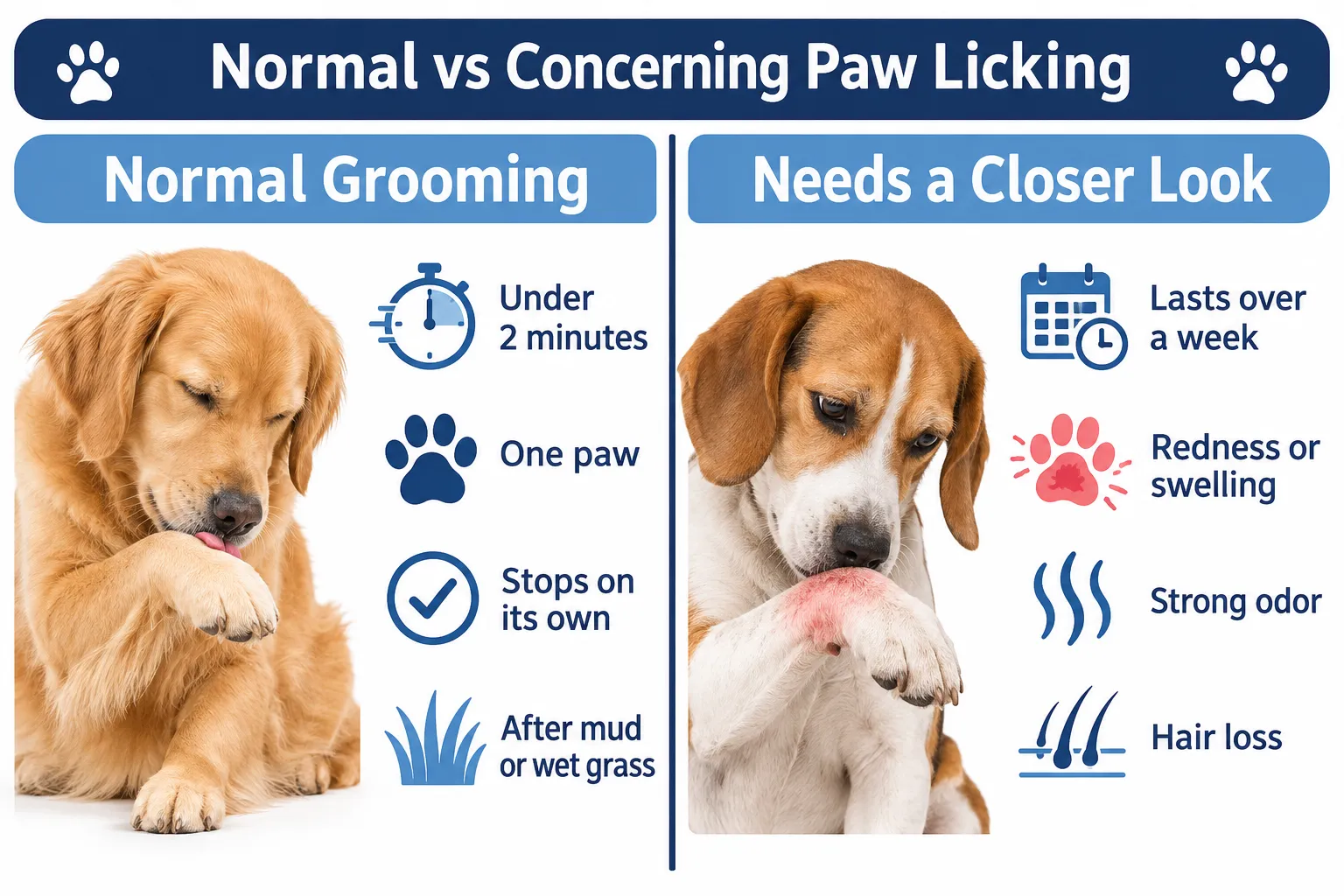
Normal paw licking usually:
- Lasts under a minute or two
- Happens right after coming inside from a walk
- Targets the paw that visibly touched something (a puddle, gravel, long wet grass)
- Does not return later that night once the paw looks clean
A useful decision rule: if the licking stops once the paw looks clean and dry, let it go. If the dog keeps returning to the same paw an hour later, or does it again the next day without a new walk to explain it, that is no longer simple grooming, and it is worth watching more closely over the following days.
Why do dogs lick their paws? Why is my dog licking their paws so much?
Excessive paw licking usually means one of four things: an allergy flaring up, a skin infection taking hold, an injury that has not healed, or a behavioral habit that has become self-reinforcing. The amount of licking matters less than the pattern behind it.
VCA Animal Hospitals identifies itchiness, most commonly from environmental or food allergies, as one of the leading causes of heavy paw licking in dogs brought into general practice clinics. Fleas, mites, and contact irritants (lawn chemicals, de-icing salt, cleaning products tracked in from a floor) can all trigger the same itch response.
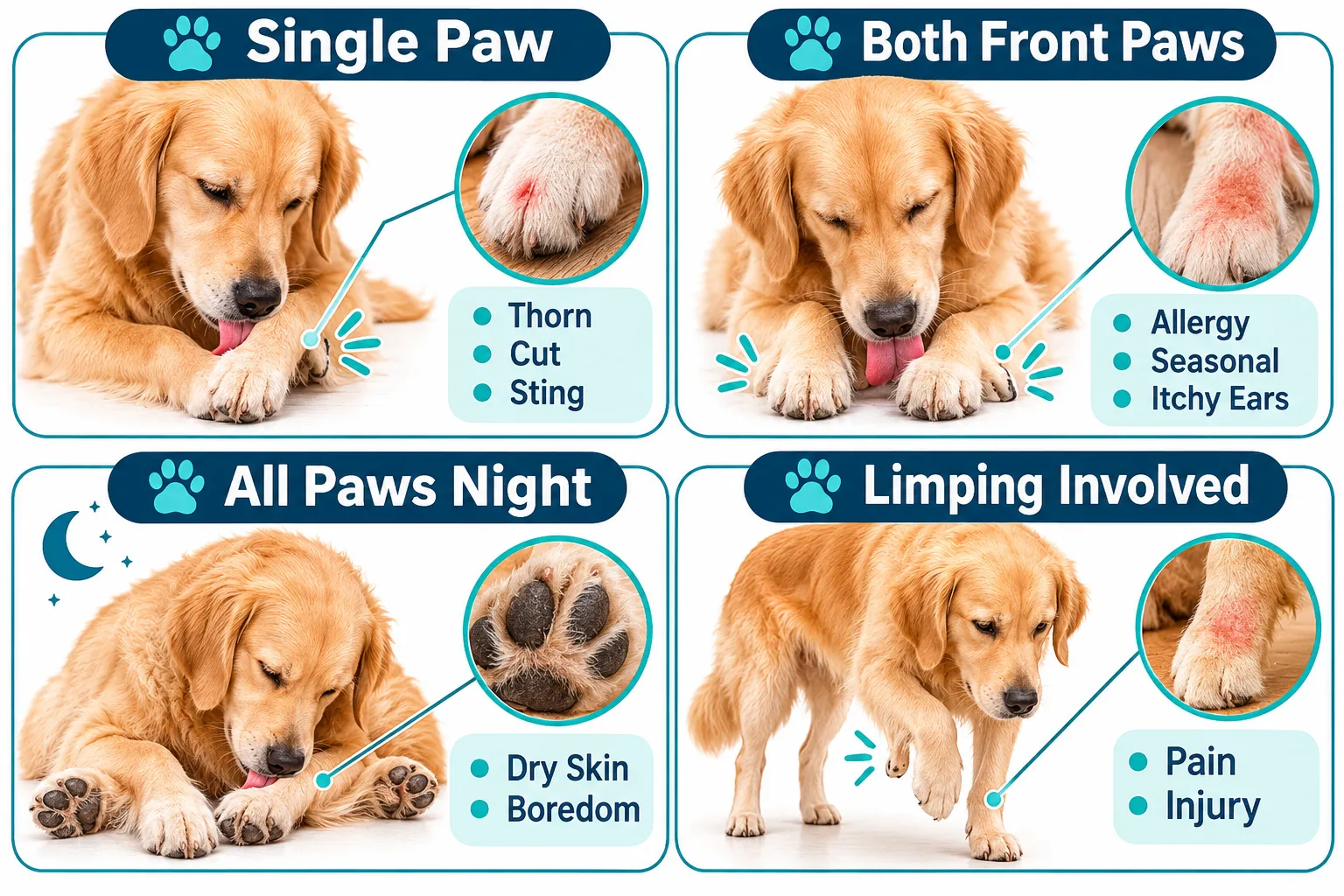
A common mistake owners make is assuming heavy licking always means allergies. In reality, a dog that licks one specific paw far more than the others is more likely dealing with something localized: an embedded grass seed, a small cut, a cyst between the toes, or even early arthritis making that paw feel sore. Allergy-driven licking tends to be more symmetrical, hitting both front paws or all four, often along with itchy ears or a red belly.
Why do dogs lick their paws? Can paw licking mean my dog has allergies?
Yes, paw licking is one of the most recognizable signs of allergies in dogs, especially when it affects both front paws, happens seasonally, or shows up alongside itchy ears, red skin folds, or recurrent ear infections. AKC’s pododermatitis guidance describes this symmetrical, multi-paw itch pattern as a classic sign vets look for when screening for atopic or environmental allergy.
Signs that point toward allergy rather than a one-off irritant:
- Both front paws affected, not just one
- Licking that gets worse in spring or fall, pointing to pollen or mold triggers
- Itchy ears, red skin folds, or recurrent skin infections alongside the paw licking
- A pattern that repeats year after year around the same season
- No obvious injury, splinter, or object found during a hands-on check
Choose an allergy workup conversation with a vet if the pattern above fits and has repeated for more than one season. Choose a simpler local check first if only one paw is affected and there is no seasonal pattern.
Why do dogs lick their paws? What does it mean when dogs lick their paws excessively?
Excessive paw licking, meaning licking that continues for more than a week, happens multiple times a day, or leaves the paw raw or hairless, is the body telling you something has moved past simple grooming. PetMD notes that licking severe enough to cause hair loss, open sores, or a thickened “lick granuloma” on the skin needs veterinary attention rather than home management, because the behavior itself can become the injury once it crosses that line.
At this stage, a dog is often licking for one of these specific reasons:
- An untreated allergy that has caused secondary bacterial or yeast infection
- A foreign object (grass awn, splinter, thorn) still embedded in the pad or between the toes
- Chronic pain from arthritis, a healing fracture, or nail bed disease
- A compulsive behavior pattern that started as itch relief and is now self-sustaining
Why do dogs lick their paws? How do i get my dog to stop licking their paws
Stopping paw licking starts with finding the cause, not covering the symptom. A cone or bitter spray can prevent further damage short term, but the licking will return once the deterrent wears off unless the underlying trigger (allergy, infection, injury, boredom) is addressed.
A practical approach:
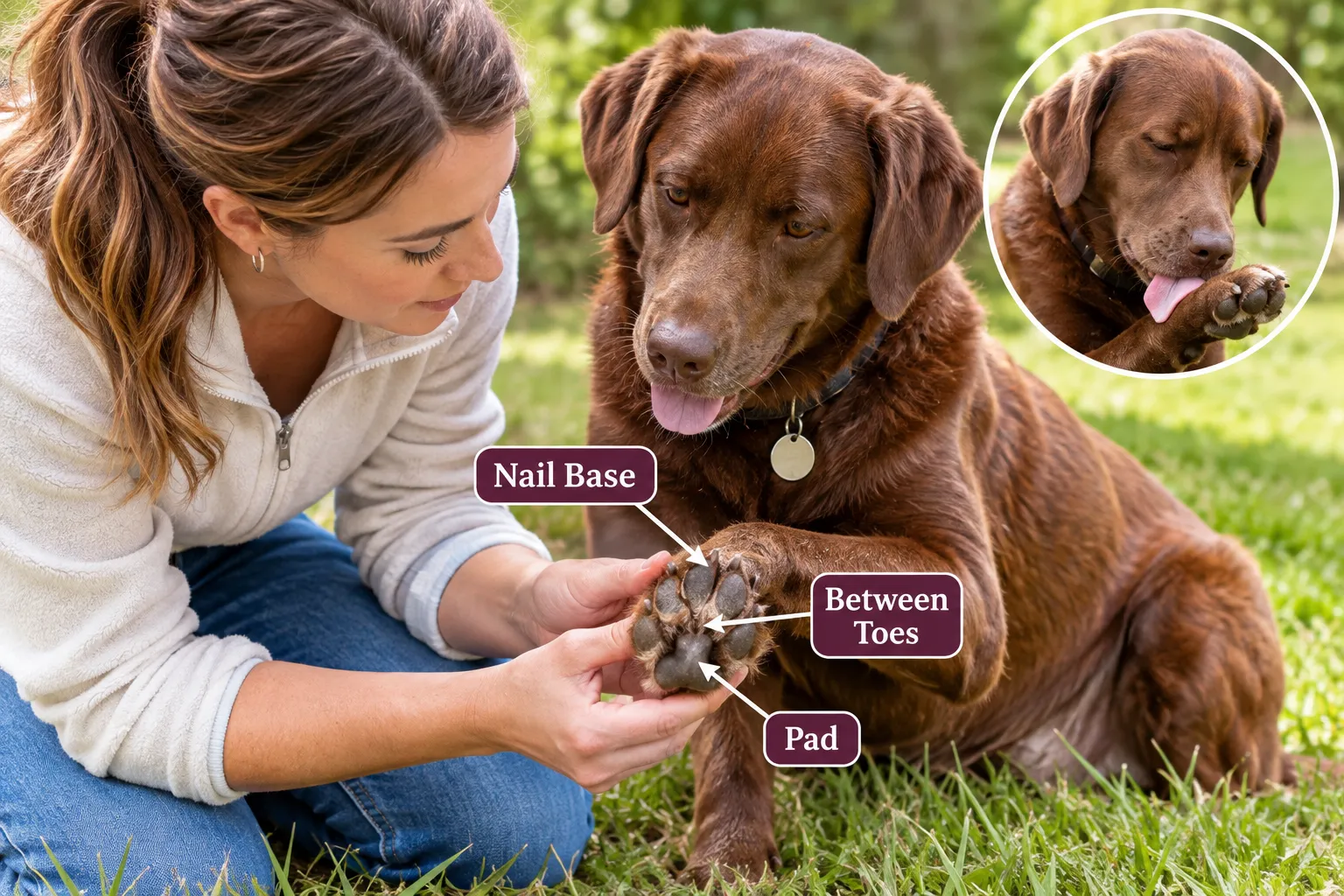
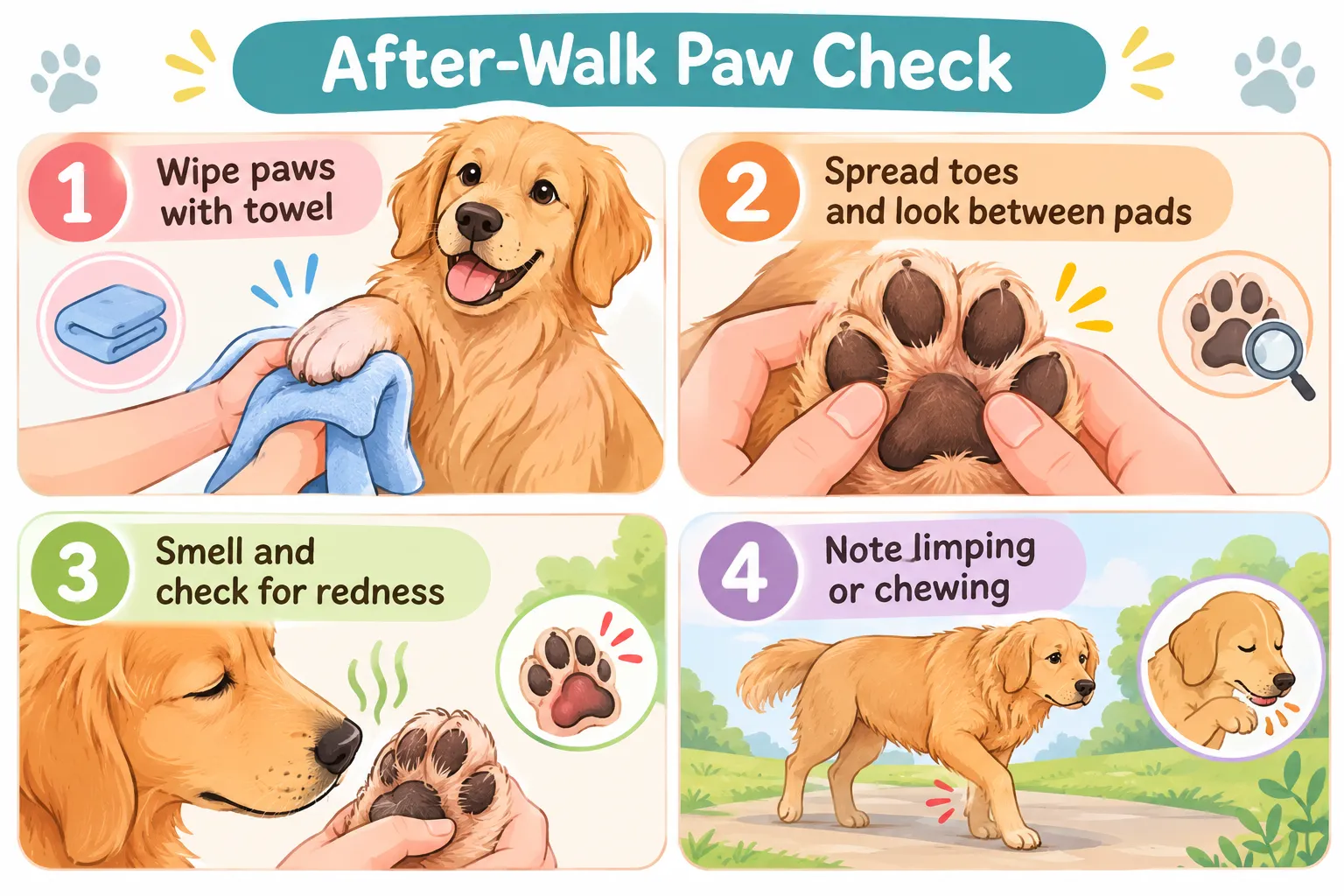
- Do a hands-on paw check immediately: look between every toe, check the pads and nails, and smell for anything unusual.
- Note how many paws are involved and how long the behavior has lasted using the symptom log further down this page.
- If it looks local (one paw, visible debris, mild redness), clean the area, remove any foreign object you can see, and watch for 48 hours.
- If it looks seasonal, symmetrical, or tied to itchy ears, book a vet visit for an allergy discussion rather than guessing with home remedies.
- If there is no outdoor trigger at all and licking happens mostly at night or when the dog is alone, treat it as a behavioral issue and increase physical and mental activity before assuming a medical cause.
- Use a cone, sock, or bootie only as a short-term barrier while the actual cause is being treated, not as the long-term fix.
Why do dogs lick their paws? Is paw licking a sign of anxiety in dogs?
Yes, paw licking can be a sign of anxiety, particularly when it happens away from walks, at night, during thunderstorms, or when the dog is left alone for long stretches. VCA’s overview of compulsive disorders in dogs explains that repetitive self-licking can start as a response to stress and, left unaddressed, develop into a compulsive pattern that continues even once the original stressor is gone.
A dog licking from anxiety tends to show other signals too: pacing, panting without heat, destructive chewing when left alone, or whining at the door. If paw licking shows up only during specific triggers (fireworks, a new pet in the house, an owner’s absence) and the paw itself looks completely normal, anxiety is a more likely explanation than a skin condition.
Why do dogs lick their paws? Do dogs lick their paws just to clean themselves?
Yes, cleaning is the most common reason dogs lick their paws, and it is completely normal behavior. A dog’s paw is the part of its body that makes the most direct contact with the ground, so licking off mud, dew, dust, or sticky residue functions the same way a person might wipe their shoes before coming inside.
This cleaning instinct explains why so much paw licking after a walk needs zero intervention. A dog that steps in a puddle, licks the paw dry over sixty seconds, and then moves on to normal activity is simply tidying up, the same category of behavior as licking a dirty face after eating.
What’s the difference between normal and excessive paw licking?
The difference comes down to three factors: duration, number of paws involved, and whether the skin shows any physical change. Normal licking is brief, targeted, and leaves no visible mark. Excessive licking is repeated, often symmetrical or stuck on one spot for days, and eventually leaves staining, hair loss, or raw skin behind.
| Factor | Normal licking | Excessive licking |
|---|---|---|
| Duration | Under 1 to 2 minutes | Returns repeatedly over hours or days |
| Paws involved | Whichever paw got dirty | Often both front paws or all four |
| Skin condition | Unchanged | Redness, staining, hair loss, or odor |
| Trigger | Clear (mud, wet grass, gravel) | Often unclear or year-round |
Can dry skin or infections cause paw licking?
Yes, both dry skin and skin infections are common, verifiable causes of paw licking. Dry, cracked pads from cold weather, hot pavement, or low humidity can make a dog lick to relieve the discomfort, and secondary bacterial or yeast infections often develop once skin is already irritated from allergies or constant moisture.
AKC’s guide to yeast infections in dogs describes a reddish brown, musty smelling residue between the toes as a telltale sign of yeast overgrowth, which thrives in warm, damp spaces like paw folds. This is different from the simple saliva staining mentioned earlier: staining alone does not confirm infection, but staining combined with a strong odor and visible redness usually does, and a vet can confirm with a quick skin cytology test in the exam room.
Seasonal dry skin tends to show up as cracked pads and flaky skin rather than odor, and often improves with a humidifier indoors and a vet-approved paw balm during winter months. Infection-driven licking tends to get worse over days rather than better, regardless of weather.
When should I call the vet about paw licking?
Call a vet if the paw looks swollen, bleeds, has a strong odor, or if the dog is limping or avoiding weight on it. Also call if licking has continued for more than a week without improvement, or if hair loss and raw, red skin have developed at the licking site.
A same-day or next-day visit is worth it over waiting, because conditions like an embedded grass awn or a developing infection tend to get harder (and more expensive) to treat the longer they go unaddressed. A vet visit for paw licking commonly involves a physical exam, a close look between the toes, and sometimes a skin cytology sample if infection is suspected.
Is my dog licking their paws because of boredom or stress?
Boredom and stress are plausible causes, especially in dogs left alone for long hours, dogs with little physical outlet, or dogs going through a recent change (new home, new pet, schedule shift). This type of licking usually happens away from walks entirely and often targets the same paw out of habit rather than in response to an actual irritant.

A dog licking from boredom typically:
- Licks mostly when alone, at night, or during quiet downtime
- Shows no consistent connection to walks or weather
- May do it alongside other repetitive habits like tail chasing or spinning
- Often improves with more physical exercise, puzzle feeders, or structured training time rather than medical treatment
If boredom seems like the root cause, building more structure into the day, through consistent walks, basic obedience practice, and food puzzles, tends to help more than any topical product. A dog with a solid grasp of basic commands and daily mental work is generally less likely to fall into repetitive self-soothing behaviors.
What products or treatments help with excessive paw licking?
The right treatment depends entirely on the cause, and no single product fixes every case of excessive paw licking. For suspected infection, a vet-prescribed topical antiseptic or antifungal is typically the first step, since treating the skin directly addresses the problem faster than oral medication alone in milder cases. For diagnosed allergies, a vet may recommend an elimination diet trial, an antihistamine, or in more persistent cases a prescription allergy medication. For dry or cracked pads, a vet-approved paw balm applied after walks in cold or dry weather can prevent further irritation. For behavioral licking, enrichment toys, more consistent exercise, and in some cases a referral for anxiety support work better than any topical cream.
A cone, recovery sock, or boot can stop a dog from making an existing sore worse while the real cause is treated, but none of these are long-term solutions on their own.
Can I use home remedies like apple cider vinegar for paw licking?
Apple cider vinegar and similar home rinses are not recommended on broken, cracked, or already irritated skin, since the acidity can sting and slow healing. On fully intact skin, a well-diluted rinse is sometimes used anecdotally to address mild yeast odor, but it is not a substitute for a proper diagnosis, and there is no strong clinical evidence it treats an actual infection.
A safer home step while deciding whether a vet visit is needed: rinse the paw with plain lukewarm water, pat dry completely (including between the toes), and check closely for any visible foreign object. If the paw looks normal and the licking stops within a day or two, that is a reasonable sign to keep watching rather than escalate. If redness, swelling, or odor shows up at any point, skip the home remedy and call the vet instead.
Which dog breeds are more prone to paw licking problems?
Breeds with known skin sensitivities or allergy tendencies tend to show up more often in paw licking discussions, including West Highland White Terriers, Bulldogs, French Bulldogs, Labrador Retrievers, Golden Retrievers, and German Shepherds. AKC’s pododermatitis guidance notes that breeds prone to skin fold issues or environmental allergies are overrepresented in paw and pododermatitis cases seen by veterinary dermatologists.
This does not mean every dog of these breeds will develop chronic paw licking, and plenty of mixed-breed dogs develop the same patterns from individual allergy sensitivity or anxiety. Breed is a risk factor worth knowing, not a guarantee, and any dog showing the persistent patterns described above deserves the same hands-on check and vet conversation regardless of what is listed on its registration papers.
Doggy Rank IQ Tool
Paw Licking Sorter

Months of cones and sprays go by while the real cause waits. Answer what you see and get the likely category and what to check tonight.
Comparison: common paw licking scenarios
| Scenario | Likely cause | Action |
|---|---|---|
| One paw, brief lick, after mud | Normal grooming | Wipe and watch |
| One paw, days, swelling | Embedded object, cyst, injury | Vet visit |
| Both front paws, seasonal, itchy ears | Allergy pattern | Vet exam, consider allergy workup |
| All paws, nighttime, no outdoor trigger | Boredom, anxiety, or dry skin | Enrichment, structured training, vet rule-out |
Things to watch out for
Months of guessing cost more time and money than a single vet visit. A cone, a vinegar rinse, or an over-the-counter antihistamine can mask the surface problem while an allergy, infection, or sore paw keeps going underneath.
Common mistakes to avoid:
- Assuming reddish brown staining proves a yeast infection. It only proves saliva has been sitting on the fur; a vet can confirm infection with a simple skin sample.
- Relying on antihistamines as a long-term fix. They may dull mild itching for some dogs but do not treat an infection, an allergy source, or an injury.
- Using vinegar or acidic rinses on broken or cracked skin, which can sting and delay healing.
- Ignoring boredom-driven licking because it does not happen after walks. A dog alone for nine or more hours a day may lick from under-stimulation, and more walks alone will not fix that without added enrichment.
- Treating one-paw licking like a whole-body allergy. Localized licking on a single paw is far more consistent with a splinter, sting, or small cyst than with food or environmental allergy.
Editor’s Take
The paw licking question gets treated like a yes-or-no problem online: either it means nothing, or it always means allergies. Neither holds up well once you actually watch the pattern. A dog’s paw touches more of the outside world than almost any other part of its body, so a little licking after a walk is routine maintenance, nothing more.
The useful skill is noticing when maintenance turns into a pattern. One paw, licked repeatedly with no obvious trigger, deserves a flashlight and a close look between the toes before anything else. Two front paws, itchy ears, and a seasonal flare look more like the allergy pattern vets actually screen for. Weeks of antihistamines and vinegar sprays are not a diagnosis, and they rarely fix anything on their own. A short symptom log, kept for about a week, usually answers why do dogs lick their paws in a specific household faster than any home remedy ever will. For owners building a broader health routine around their dog, pairing this kind of paw check with basic grooming habits, as covered in a beginner’s guide to dog grooming, makes early problems easier to catch before they turn into something that needs a vet visit.
| Scenario | Likely cause | Action |
|---|---|---|
| One paw, brief lick, after mud | Normal grooming | Wipe and watch |
| One paw, days, swelling | Embedded object, cyst, injury | Vet visit |
| Both front paws, seasonal, itchy ears | Allergy pattern | Vet exam, consider allergy workup |
| All paws, nighttime, no outdoor trigger | Boredom, anxiety, or dry skin | Enrichment, structured training, vet rule-out |
FAQ
Why do dogs lick their paws so much?
Frequent paw licking usually comes from one of a few sources: grooming after a walk, allergy or dermatitis, a skin infection, pain, or boredom. The amount matters less than whether it is localized to one paw or spread across all four, and whether it stops on its own within a day or two.
Is it normal for dogs to lick their paws every day?
Brief daily licking after walks is normal if it lasts a minute or two and stops once the paw looks clean. Daily licking that lasts longer, targets the same spot repeatedly, or happens with no walk involved is outside normal grooming and worth tracking for a week.
Can allergies really cause a dog to lick just the paws?
Yes. Environmental and food allergies commonly show up as itching concentrated in the paws, ears, and belly, and paw licking is often one of the earliest visible signs an owner notices before other symptoms appear.
What does it mean if only one paw is being licked?
Licking limited to a single paw usually points to something local rather than a body-wide allergy: a splinter, an embedded grass seed, an insect sting, a small cut, or even a developing cyst. A close visual check between the toes is the first step before assuming anything more serious.
How long is too long for paw licking to continue?
More than a week of consistent licking, especially if it is not improving, is generally considered long enough to warrant a vet visit. Licking that produces hair loss, raw skin, or an odor should prompt a visit sooner than that.
Can boredom alone cause excessive paw licking?
Yes, boredom and under-stimulation can lead to repetitive paw licking, particularly in dogs left alone for long stretches without enough physical or mental activity. This type of licking often happens at night or during quiet periods rather than right after a walk.
Should I use a cone if my dog keeps licking a paw?
A cone or recovery sock can be a reasonable short-term barrier to stop a dog from making a sore worse, but it does not address the underlying cause. It works best alongside, not instead of, figuring out why the licking started in the first place.
Does paw licking always mean my dog has an infection?
No. Paw licking has many possible causes, including normal grooming, allergies, dry skin, injury, boredom, and anxiety. Infection is one possibility among several, and it is typically confirmed through a vet exam and skin sample rather than assumed from licking alone.