
Quick Answer
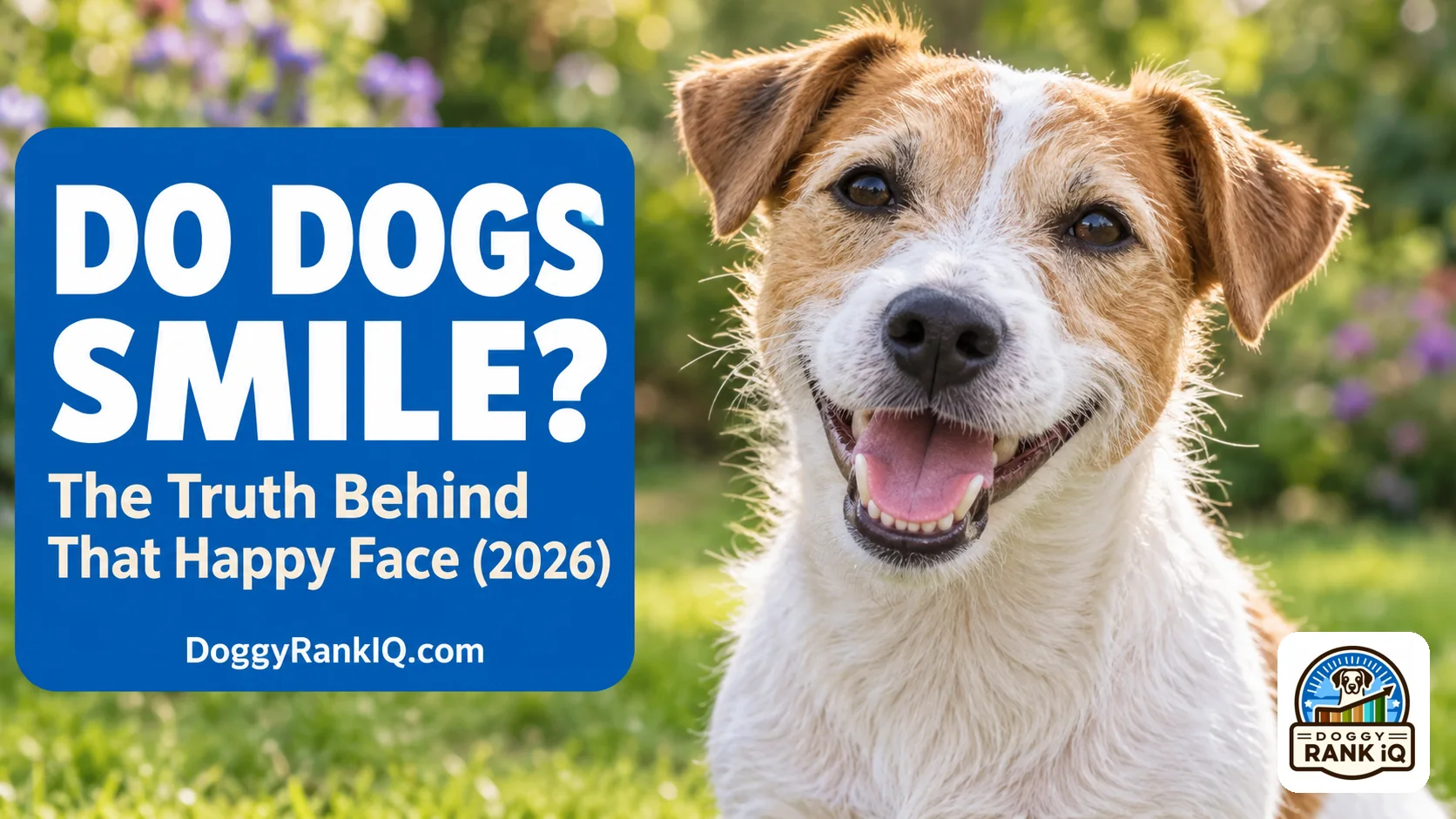
Do dogs smile? Not the way people do, but dogs make an open-mouth, relaxed-jaw face that reads as a smile and often does signal comfort. A relaxed open mouth with soft eyes and a loose body usually means a content dog. A similar-looking face with bared front teeth, squinty eyes and a lowered head is a submissive grin, which is an appeasement signal, not aggression. The real test is never the mouth alone. It’s the whole body.
Key Takeaways: do dogs smile
- The question “do dogs smile” has a detailed answer: dogs don’t smile for the same reason humans do, but a relaxed open mouth can honestly reflect comfort.
- A 2026 brain-imaging study found dogs’ brains respond differently to happy human faces than to neutral ones, with activity in a reward-linked region (pmc.ncbi.nlm.nih.gov, univie.ac.at).
- A submissive grin bares the front teeth but comes with a lowered head, soft eyes and a loose body. It is not a threat.
- A snarl has a wrinkled muzzle, hard eyes and a stiff, forward-leaning body. That is the opposite of a smile.
- Panting looks a lot like a relaxed smile but can mean heat, exercise, or stress depending on context.
- Dogs likely learn that a soft, open-mouth face gets attention from people, and owners reinforce it without realizing.
- Do dogs smile when they see you? Many dogs produce the relaxed face specifically at greeting moments, paired with a wagging tail and wiggly body.
- Teeth exposure is not automatically friendly or automatically dangerous. Context decides.
- Good dental health keeps that happy-looking mouth comfortable, which matters more than people assume.
What does the face look like?
Tap an option to see the answer.
The short answer: do dogs smile?
Dogs don’t smile the way humans do, with a conscious decision to look happy for someone. But many dogs do produce a face that looks remarkably like a smile, and in the right context, it’s a fair read.
The expression in question is a relaxed, slightly open mouth. The jaw hangs loose, the tongue lolls out at an easy angle, the eyes are soft rather than fixed, and the body is loose rather than tense. Veterinary behavior resources describe this combination as consistent with a relaxed, comfortable dog (aspcapro.org). That’s different from claiming the dog is expressing joy the way a person would with a grin at a birthday party.
Here’s the complication. A dog panting from a hot afternoon or a hard run can look nearly identical. Veterinary behavior literature flags panting as something that needs context: normal after exercise or heat, but worth a second look if it shows up in a cool, resting dog alongside pacing, lip licking or a tucked posture (avmajournals.avma.org). So when someone asks do dogs smile with their mouth closed, the honest answer is that a closed-mouth, soft-faced, relaxed dog can also be perfectly content. The open mouth isn’t required. It’s just the version people photograph.
The truth behind that happy face: 3 look-alike expressions
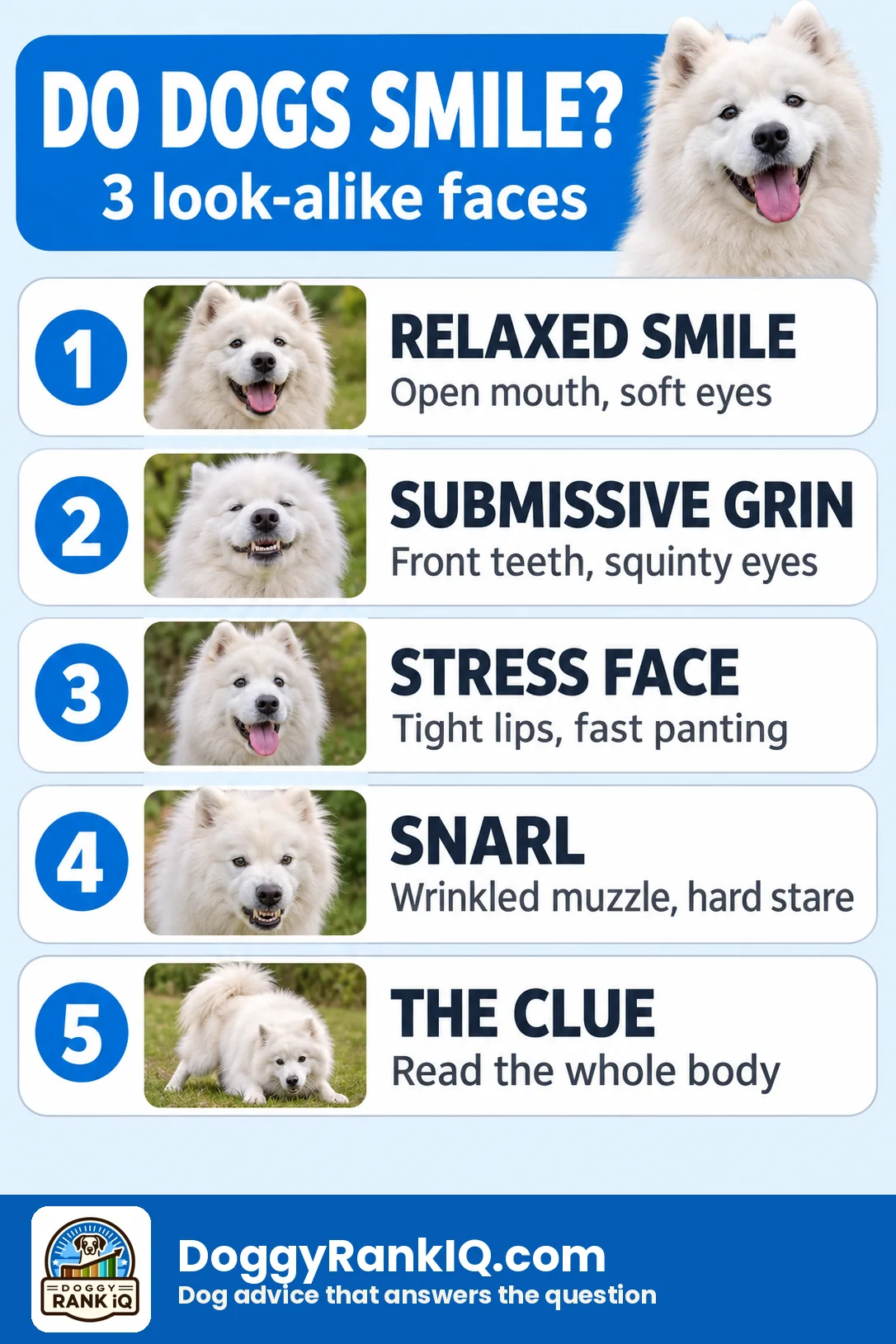
A dog’s face sends three distinct messages that all can involve an open mouth and visible teeth. Telling them apart means watching the eyes, ears and body, not just the mouth.
1The relaxed open mouth
This is the “classic” dog smile. Loose jaw, tongue out, soft almond-shaped eyes, ears in a natural neutral position, and a body that moves easily rather than stiffly. It often shows up during play, greetings, or a comfortable nap-adjacent moment on the couch.
2The submissive grin
Front teeth show, sometimes a lot of them, but the head is lowered, the eyes are squinty rather than hard, the body is lower to the ground, and the tail is often wagging in a low, wide sweep. This is one of several submissive grin dog breeds behaviors seen more in some lines than others, but any dog can do it. It’s an appeasement signal: “I am not a threat, please don’t be mad.” The ASPCApro canine body language guide describes this grin specifically so owners stop mistaking it for aggression (aspcapro.org).
3The stress or snarl face
This is the one to take seriously. A snarl pairs a wrinkled muzzle with hard, fixed eyes and a stiff, often forward-leaning body. A stress face can look different: tight lips pulled back, repeated yawning out of context, lip licking, or “whale eye” where the whites of the eyes show. The AVMA notes that dogs communicate stress and threat through body language that people frequently misread (avma.org). If the body is stiff and the eyes are hard, that’s not a smile under any definition.
Facts table: smile vs submissive grin vs snarl
Do dogs smile when they see you, with their mouth closed, or with their teeth?
Do dogs smile when they see you specifically? Many owners report exactly this: the dog’s whole face softens, the mouth relaxes open, and the tail goes into a full-body wag at the sound of keys in the door. That greeting moment is a strong context for a real relaxed expression, since it comes packaged with other comfort signals rather than appearing alone.
A dog can also look happy with a closed mouth. The tongue-out panting look is popular on social media, but a soft-eyed dog with its mouth gently shut, ears relaxed and tail loose is just as comfortable. Do dogs smile with their mouth closed is really a question about the whole face, not the mouth position.
Teeth are the trickiest part. A dog smiling with teeth could be doing the relaxed play-face version, the submissive grin, or sliding toward a warning display. The AVMA’s guidance on reading canine body language makes clear that bite risk rises specifically when people misjudge which one they’re looking at (avma.org). If teeth show up with stillness, a hard stare, or raised hackles, treat it as a warning, not a grin, and give the dog space. For a fuller rundown of posture and tail signals, see dog body language.
Do dogs know when we smile?
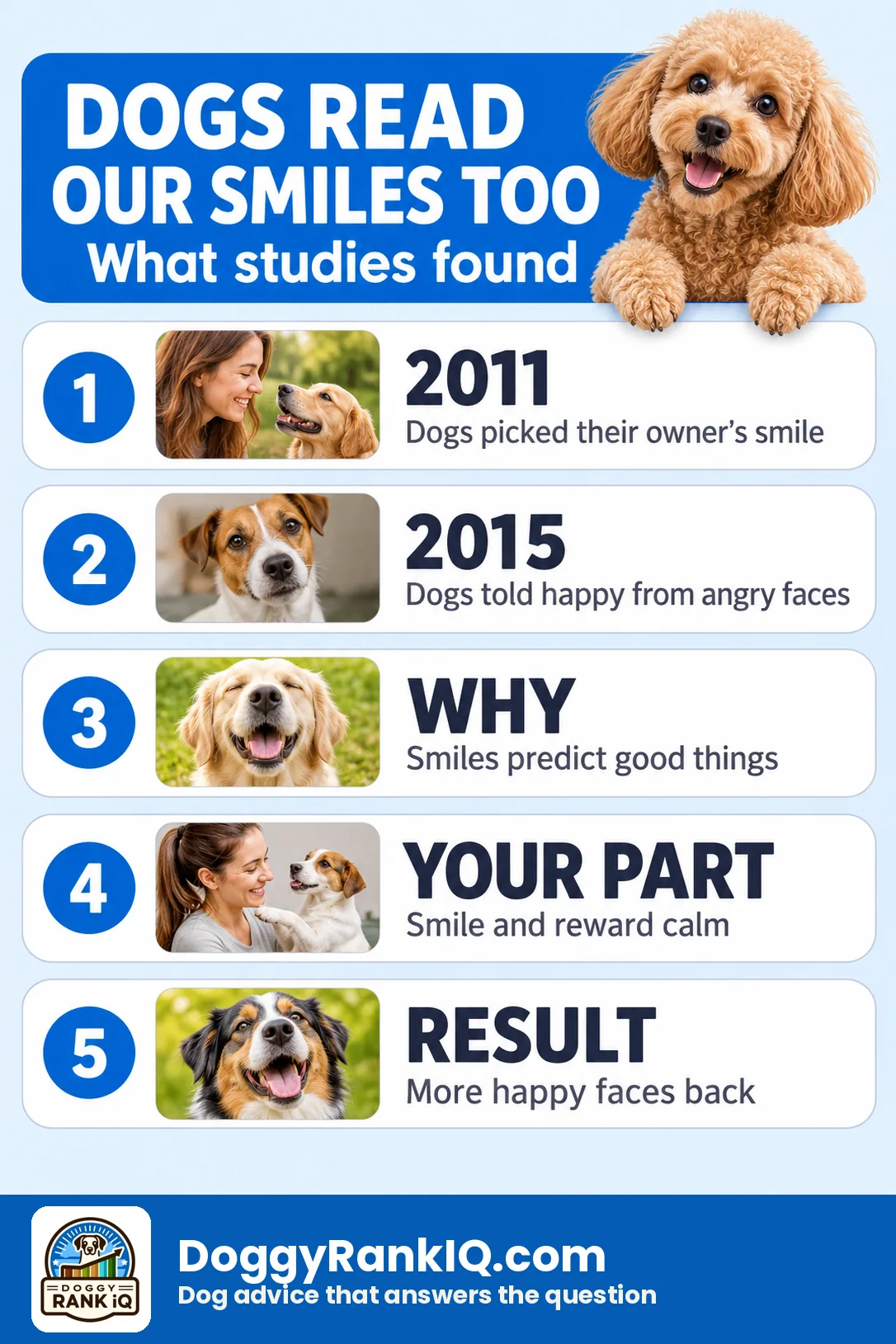
Dogs appear to recognize that a human smiling face is different from a neutral one, and research increasingly ties that recognition to reward-related brain activity, not just visual pattern matching. A 2026 study out of the University of Vienna scanned the brains of pet dogs while they viewed human faces (univie.ac.at).
In one part of the study, eight dogs viewed happy versus neutral human faces while awake inside an MRI scanner. Happy faces produced stronger activity in a right temporal brain region that extends into the caudate nucleus, an area tied to reward processing (pmc.ncbi.nlm.nih.gov, univie.ac.at). In a second part, 12 dogs viewed faces showing happiness, anger, fear and sadness, and machine-learning analysis could tell happiness apart from each negative expression (pmc.ncbi.nlm.nih.gov, eu.usatoday.com).
What the study did not show matters just as much. It measured how dogs’ brains respond to seeing a human smile, not whether a dog’s own open-mouth expression is an equivalent smile or proof of subjective happiness (univie.ac.at, scientificamerican.com). Those are separate questions, and conflating them overstates the finding. The practical takeaway: dogs likely do register that your smile is a positive social cue, probably because smiling faces have reliably come with good things, like treats, play, and a relaxed voice. That’s a learned association worth having, whether or not it’s identical to human emotion. For how dogs register your emotional state more broadly, see can dogs sense human emotions.
😄 Dogs copy each other’s play faces in under a second
The relaxed open mouth has a second audience: other dogs.
In 2015, Elisabetta Palagi and colleagues at the University of Pisa filmed dogs playing in a park in Palermo, Sicily, and went through the footage frame by frame. When one dog showed a play bow or a relaxed open mouth, the partner often matched it within a second. The researchers call this rapid mimicry. It happened more between dogs who knew each other well than between strangers, and play sessions that included it lasted longer. Their paper appeared in Royal Society Open Science.
People do the same thing. You smile back at a friend before you have decided to. The Pisa team argues that this quick mirroring is a basic building block of sharing a mood, and that dogs have it with each other. When two dogs at the park bounce apart, mouths open and loose, each one is reading the other’s face and answering it.
“Dogs answer a play face in under a second, faster than either of them could decide to.”
That gives owners a simple check during rough play. Look for the open, floppy mouths and the pauses where both dogs reset. If one dog’s mouth has gone tight and closed, the ears are pinned and only one of them is doing the chasing, the game has stopped being mutual. Call them apart for a minute.
🐕 The tail and the face: read both ends
A face is half the message. Angelo Quaranta, Marcello Siniscalchi and Giorgio Vallortigara reported in Current Biology in 2007 that dogs wagged with a bias to their right side when they saw their owner, and with a bias to the left when they saw an unfamiliar, dominant dog. You will not spot a few degrees of lean in your hallway, and nobody is asking you to. The useful part is the idea behind it: the wag has more than one setting.
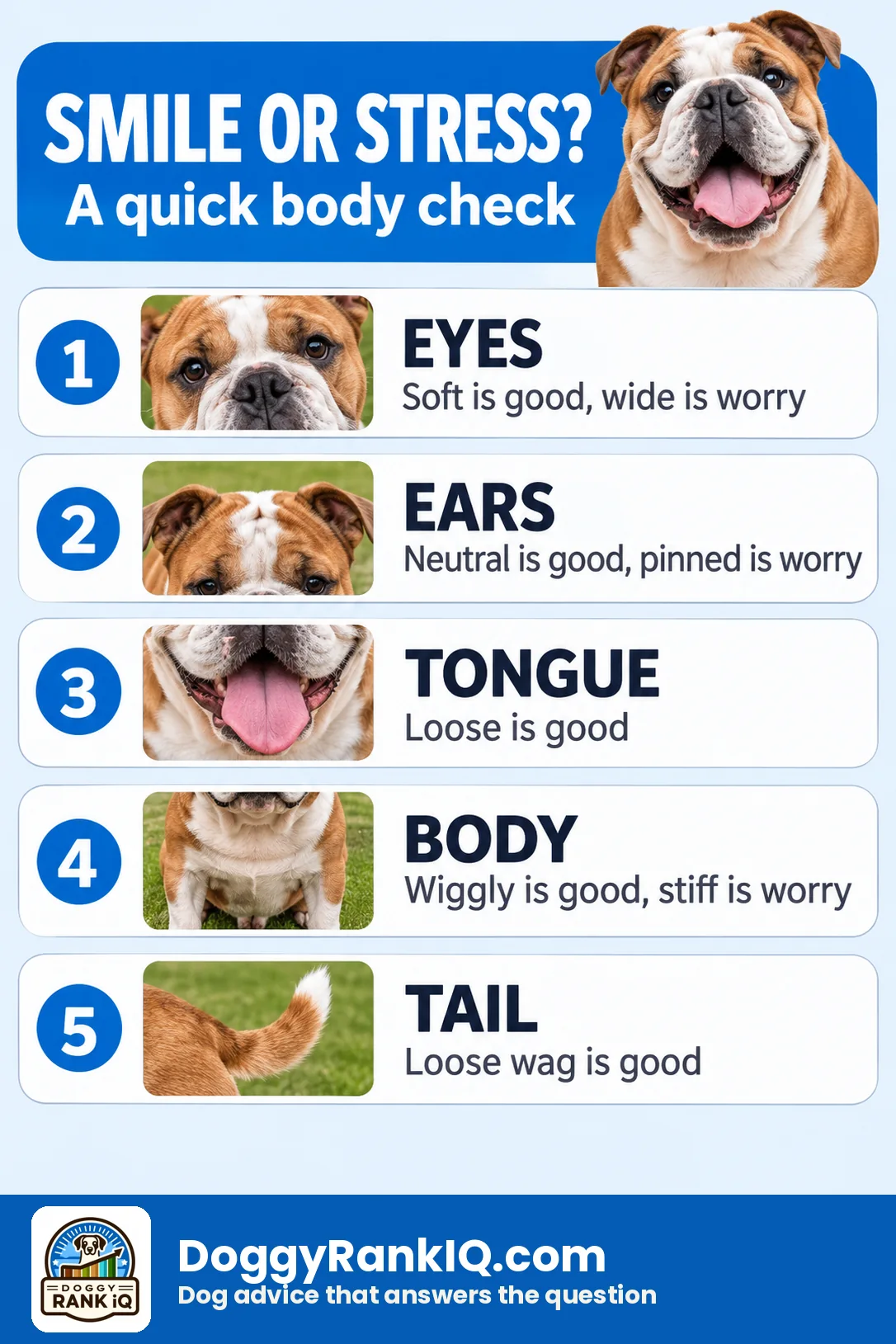
So pair the mouth with the back end. A soft open mouth plus a loose, sweeping wag that moves the hips is a relaxed dog. An open mouth with a high, stiff, fast-vibrating tail is an aroused dog, and aroused can tip either way. A long-lipped pant with the corners of the mouth pulled far back, a tongue that is wide and cupped at the tip, and a low tail is a hot or stressed dog. Offer water and shade, and end the outing if it does not ease within a few minutes.
🦷 Do dogs smile more in some breeds?
Owners of Dalmatians, Greyhounds and Australian Shepherds report the toothy submissive grin more often than most, and breed fans have nicknames for it. (Dalmatian people call it a “smarl.”) No study has counted grins by breed, so treat this as kennel folklore with a lot of witnesses.
If your dog is a grinner, warn visitors. A stranger who sees front teeth will assume the worst, and a dog who gets yelled at for a friendly greeting learns that greeting people goes badly. Tell guests what the squinty eyes and wiggling body mean before they come through the door.
⭐ Top 5 Features We Love
- The loose jaw drop. A dog settling into a relaxed open mouth after a walk is one of the easiest “all is well” signals to read at a glance.
- The greeting switch. Many dogs flip into a soft, open face specifically for their person, which is a nice, if informal, nod to the human-dog bond.
- The play face. During play, dogs show a relaxed, open-mouth expression alongside bounces and play bows. It’s a genuine social signal, not a stray grin.
- The reward-brain link. The 2026 Vienna research gives a real, documented reason to think dogs register human happiness as something positive, not just visually different (pmc.ncbi.nlm.nih.gov, univie.ac.at).
- The submissive grin’s honesty. Once owners learn to read it, the submissive grin is a clear, low-stakes “I’m not a threat” message that heads off unnecessary tension.
⚠️ Things to Look Out For
- Confusing panting with happiness. A panting dog indoors with no exercise and no heat may be stressed, not smiling (avmajournals.avma.org).
- Ignoring the eyes. Hard, fixed eyes paired with an open mouth is a warning sign, regardless of how “smiley” the teeth look.
- Mistaking a submissive grin for aggression. This can lead to an owner scolding a dog that was trying to de-escalate, which can backfire.
- Missing whale eye and lip licking. These are stress markers that often get photographed as “funny faces” instead of being read correctly (aspcapro.org, webvet.com).
- Reading a smile in isolation. A mouth shape alone is weak evidence of anything. Body, ears, and tail carry more information.
How to get more real smiles from your dog
The direct answer: give a dog predictable comfort, play, and attention, and the relaxed open-mouth face shows up more often on its own.
- Keep greetings calm and let the dog approach rather than looming over it.
- Build in regular play sessions using something interactive like a KONG Tug Toy ($15.96, price checked 2026), which gives a dog a legitimate outlet for the loose, bouncy body language that goes with a genuine play face.
- Avoid punishing a submissive grin. It’s appeasement, and a harsh response can increase anxiety instead of resolving whatever worried the dog.
- Watch for consistent patterns. A dog that smiles at the door every day but rarely elsewhere isn’t being less affectionate; dogs show comfort differently depending on context. For more on recognizing affection beyond facial expressions, see how do dogs show affection.
- If a dog seems consistently tense rather than relaxed, that’s a conversation for a vet or qualified trainer, not something to push through with more petting.
Helpful products for a healthy smile
A comfortable mouth is part of what makes that relaxed, open-jaw face possible in the first place, since dental pain can change how a dog holds its mouth and face entirely. These picks support basic dental care; they are not medical treatments, and persistent bad breath, pawing at the mouth, or visible tartar should go to a veterinarian.
- Vet’s Best Dog Toothpaste and Toothbrush Dental Care Kit ($15.13, price checked 2026): a starter kit for owners building a brushing routine. Check the current price.
- Dentalife Purina Daily Dental Chews for Large Dogs, 18 ct ($7.94, price checked 2026): a chew-based option for dogs that won’t tolerate brushing. Check the current price.
- Doggie Language: A Dog Lover’s Guide to Understanding Your Best Friend ($8.99, price checked 2026): an illustrated reference for telling a relaxed face apart from a stressed one. Check the current price.
Confirm any new dental routine with your veterinarian first, especially for dogs with existing dental disease. For more on brushing basics, see do I need to brush my dog’s teeth.
FAQ
The bottom line
Do dogs smile? In the loose, practical sense that owners mean it, often yes. A relaxed open mouth, soft eyes and a wiggly body are an honest read on a comfortable dog, and the 2026 brain research gives real support to the idea that dogs register human happiness as something good (pmc.ncbi.nlm.nih.gov, univie.ac.at). But the smile-like face isn’t a single signal with one meaning. The same loose mouth can show up on a submissive dog trying to de-escalate, or disappear entirely behind a stiff, hard-eyed warning face that looks nothing like happiness at all.
The fix is simple: stop reading the mouth by itself. Check the eyes, the ears, the tail and the overall posture before deciding what a dog’s face is telling you. A dog that greets you with a loose jaw, a wagging tail and a bouncy approach is about as close to a real smile as dogs get.
Doggy Rank IQ is reader supported. As an Amazon Associate we earn from qualifying purchases, at no extra cost to you.