
Quick Answer
A canicross harness that fits wrong at the neck, back length, or rear attachment point turns a running tool into a brake. The Non-stop Dogwear Freemotion is the most commonly recommended canicross harness, but correct fit depends on checking chest girth, low neck circumference, and back length together, not chest girth alone. The most common mistakes are sizing by chest alone, checking fit while the dog stands still, ignoring the rear strap adjustment, skipping the under-tension test, and treating a no-pull walking harness as an acceptable substitute. Fixing all five takes about ten minutes with the dog on a short line.
Key Takeaways: canicross harness
- A canicross harness distributes pulling force across the chest and shoulders, unlike a no-pull walking harness, which is built to discourage pulling.
- The Non-stop Dogwear Freemotion 5.0 sizes by chest girth, back length, and neck opening, not chest alone.
- Neck openings on the Freemotion range from 28 cm in size 1 to 72 cm in size 10, according to Inlandsis’ canicross fit guide.
- Fit should be checked while the dog leans into light line tension, not while standing still.
- The five common mistakes: sizing by chest girth only, checking fit at a standstill, ignoring rear strap adjustment, skipping the tension check, and reusing a walking harness for pulling sports.
- Jae Thomas, a Certified Professional Dog Trainer, rated the Freemotion among the top picks for canicross, bikejoring, and skijoring in Hound & Field’s harness testing, while flagging it as bulky to put on.
- Independent testing from Hound & Field scored the Freemotion 5.0 at 78/100 for durability, ahead of several sled-style competitors.
- Price checked 2026: the Freemotion 5.0 runs roughly $69.54 to $99.99 depending on size and retailer.

What do you see when your dog pulls?
Check the current price
Tap an option to see the answer.
What is a canicross harness and how does it work?
A canicross harness is a dog harness built specifically for pulling sports, with a rear attachment point that lets the dog lean forward into a line without pressure on the throat or chest. Unlike a collar, which concentrates force on the neck, a well-fitted canicross harness spreads load across the chest plate and the body, so the dog can run at full stride while towing a runner through a bungee line.
The design usually falls into one of two shapes: a Y-front, where straps form a Y across the chest to avoid the shoulder joints, or an X-back, more common in sled and skijoring circles, which wraps around the torso for heavier, sustained pulling. Both shapes clip behind the dog’s back rather than at the chest, which is the key mechanical difference from a walking harness.
Example: a 25kg dog pulling a runner uphill generates considerably more force through the harness than the same dog on a loose leash walk. A running harness is built to handle that repeated, directional load; a casual walking harness generally is not rated or padded for it.
Best canicross harness brands and reviews
Non-stop Dogwear’s Freemotion line is the most frequently recommended running harness among trainers and gear reviewers in 2026, but it is not the only brand worth knowing. WUFTREK’s buying guide and Hound & Field’s comparison testing both point to a handful of brands that consistently score well for fit, durability, and pulling comfort.
- Non-stop Dogwear Freemotion / Freemotion 5.0: the most widely cited starting point, with a ten-size range and a published fit video.
- Inlandsis: a French brand popular in European canicross circles, offering adjustable, open-fit designs such as the Inlandsis adjustable running harness and padded options like the Inlandsis Polar Quest harness, aimed at sustained, cold-weather pulling.
- Decathlon’s canicross range, reviewed in Decathlon Switzerland’s canine sports guide, is a budget-friendly entry point for owners testing the sport before investing in a premium brand.
Decision rule: choose the Freemotion if the dog has an average or deep chest and a mid-range neck size. Choose a brand like Inlandsis or a sled-style X-back if the dog is a Nordic-type breed doing longer, sustained pulls rather than short recreational runs.
What is the best harness for canicross, and why a walking harness is the wrong tool
The best running harness for most recreational runners is a Y-front, rear-clip design built for sustained forward pulling, not a front-clip no-pull harness built to discourage it. These are different tools solving opposite problems.
A no-pull walking harness clips at the chest and is designed to turn the dog sideways when it leans into the leash, which interrupts pulling. A running harness clips at the back, sits clear of the shoulders, and is built to let the dog pull in a straight line without pressure on the throat or chest. Manufacturer design notes and independent gear testing both treat these as separate categories, not interchangeable gear, according to Inlandsis and Hound & Field.
Using a restrictive front-clip harness for an hour of trail running is a mismatch. The dog either can’t extend its stride, or the harness rotates and digs into the armpit on every stride. Jae Thomas’s testing criteria for pulling sports specifically flagged shoulder restriction and armpit rubbing as fit failures, not just comfort complaints.
Decision rule: choose a dedicated running harness if the dog runs more than a mile at a time pulling against a bungee line. Choose a standard walking harness if most walks are loose-leash and pulling is occasional.
The Non-stop Dogwear Freemotion harness ($69.54) and the Non-stop Dogwear Freemotion 5.0 ($99.99) are the two most commonly cited starting points for canicross for beginners. Check the current price on Non-stop Dogwear Freemotion harness.
How the Freemotion 5.0 is built
The Freemotion 5.0 fits across three measurements: chest girth, back length from withers to the rear strap, and a neck opening that is adjustable but not infinitely stretchy. Getting any one of the three wrong produces a running harness that fits on paper and rubs on the trail.
Non-stop Dogwear’s own sizing guide lists ten sizes, with neck openings running from 28 cm at size 1 up to 72 cm at size 10, as detailed in the Canicross Coaching sizing notes. That range matters because a harness one size too small at the neck will choke slightly on every lunge forward, and one size too large will let the whole rig rotate on the dog’s back.
Three things the Freemotion 5.0 checks that a basic walking harness usually doesn’t:
- Back length. The rear strap needs to sit at the base of the tail, not partway down the back, so the pulling force lands on the hindquarters instead of the spine.
- Chest plate width. It should sit flat against the sternum without bunching when the dog’s front legs reach forward.
- Neck opening. Non-stop now offers two neck options in several sizes for deep-chested, slim-necked dogs such as hounds and Pointer-type breeds, a change introduced with the newer Freemotion pro line.
Non-stop’s own size finder and fit video walk through all three measurements together, and that video is worth watching before ordering, since a tape measure alone misses how the harness sits on a moving dog. For a broader walk-through of general sizing principles that apply to any brand, see our how to fit a dog harness guide.
Common mistake: measuring the dog once, in the morning, calm, and assuming that number holds after the dog eats breakfast and gets excited at the trailhead. Chest girth can shift by a couple of centimeters between a relaxed dog and an excited one.
How to size a canicross harness for my dog
Sizing a running harness correctly means taking three separate measurements, chest girth, back length, and neck circumference, and cross-referencing all three against the brand’s size chart rather than picking a size off one number. Skipping this step is the single biggest reason new canicross owners end up with a harness that rubs or rotates.
Step-by-step:
- Stand the dog square on a flat surface and wrap a soft tape around the chest at the widest point, just behind the front legs.
- Measure from the withers (the highest point of the shoulders) to roughly where the tail meets the body, for back length.
- Measure the low neck circumference, where a collar would normally sit.
- Compare all three numbers to the brand’s chart. If measurements fall between two sizes, size up for a growing or stocky dog and size down for a lean, narrow-chested one.
- Recheck fit under light tension once the harness arrives, not just at a standstill.
Edge case: deep-chested, narrow-necked breeds like hounds and Pointer-types often need a larger body size paired with a slimmer neck option, which is why WUFTREK’s sizing advice recommends measuring the neck and chest independently rather than assuming they scale together.
Canicross harness vs regular dog harness: what’s the actual difference?
A running harness and a regular walking harness differ mainly in where they clip and what they’re built to encourage. A regular harness, especially a front-clip no-pull style, is designed to discourage pulling by rotating the dog sideways. A running harness is designed to support pulling, with a rear clip set well clear of the shoulder joints.
Other practical differences:
- Padding placement: canicross harnesses pad the chest plate and shoulder straps heavily, since that’s where sustained load sits. Many walking harnesses pad the back panel instead.
- Strap stiffness: pulling harnesses often use firmer webbing to resist stretching under load, while walking harnesses can use softer, more flexible straps since they’re not meant to bear constant tension.
- Attachment style: canicross gear is built to connect to a bungee line and running belt, not a standard 4 to 6 foot leash.
Decision rule: if the dog is expected to pull steadily for more than a few minutes at a time, a regular walking harness is the wrong tool regardless of brand quality.
How much does a canicross harness cost?
A running harness typically costs between $40 and $150 in 2026, depending on brand, materials, and whether it includes premium features like dual neck openings or seam-reduced construction. Budget options from retailers like Decathlon start lower, while premium builds like the Freemotion harness pro sit at the top of that range.
- Entry-level: around $40 to $60, often basic Y-front designs with fewer adjustment points.
- Mid-range: $69.54 to $99.99, covering the standard Freemotion and Freemotion 5.0.
- Premium: $149.99 for the Freemotion harness pro, which adds CleanSeam construction and dual neck width options on select sizes, though it has shown limited availability in the United States.
Add the rest of the kit (belt and bungee line) and a full canicross setup usually runs somewhere between $130 and $250 total.
Can any size dog use a canicross harness?
Most running harness brands cover a wide size range, but not every dog is a good physical candidate for the sport regardless of harness fit. Non-stop’s Freemotion line spans ten sizes with neck openings from 28 cm to 72 cm, covering small terriers up through large working breeds, but very small dogs (under roughly 10kg) and brachycephalic breeds with breathing restrictions are generally poor fits for sustained pulling sports.
- Good candidates: medium to large, structurally sound dogs with no history of joint or spine issues.
- Questionable candidates: toy breeds, very young puppies, senior dogs with arthritis, and short-muzzled breeds that struggle with sustained exertion.
- Not recommended: dogs with diagnosed hip dysplasia, spinal issues, or active injuries, without veterinary clearance first.
Common mistake: assuming that because a harness technically fits a small dog’s measurements, the dog is physically suited to pulling sport. Size compatibility and athletic suitability are two separate questions.
What age can puppies start canicross?
Most canicross coaches recommend waiting until a puppy’s growth plates have closed before starting structured pulling work, which typically means around 12 to 18 months depending on breed size, with larger breeds needing longer. Starting earlier risks stressing developing joints under repeated pulling load.
Before that age, puppies can still wear a running harness casually around the house, as described in the training plan later in this guide, to build comfort with the gear without any line tension attached. Short, unstructured walks on a loose line are fine; sustained pulling against resistance is the part that needs to wait.
Decision rule: check with a veterinarian about growth plate closure for the specific breed before beginning any structured canicross training, since large and giant breeds mature considerably slower than small breeds.
The 5 fit mistakes, numbered, each with the fix
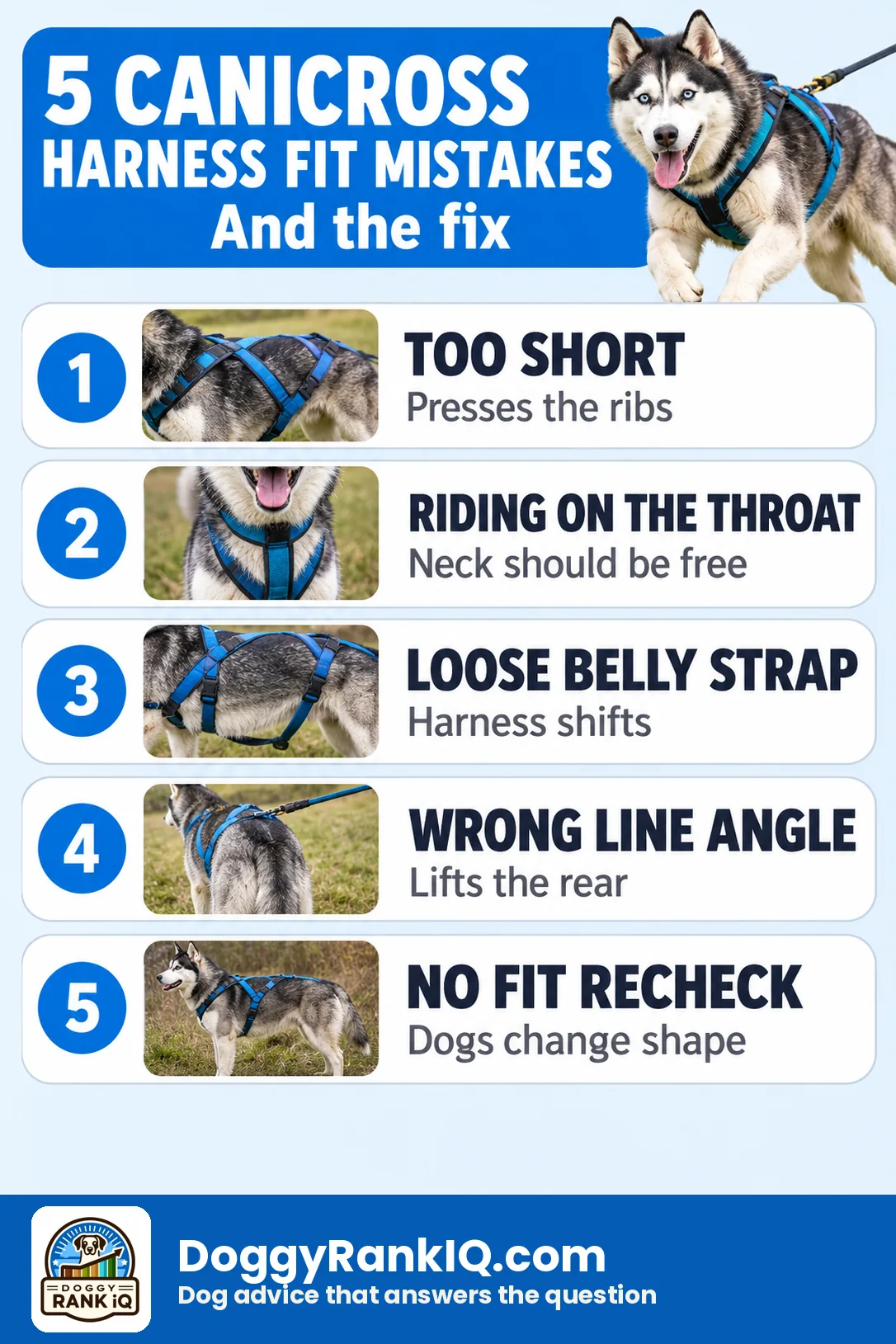
Here are the five fit mistakes that show up most often with Freemotion-style canicross harnesses, and the specific fix for each one.
Mistake 1: Sizing by chest girth alone
Non-stop’s size finder uses chest girth, back length, and neck opening together, but owners often measure only the chest and pick a size from a single number. A dog with a deep chest and a narrow neck, like many hounds, can need a wider body size paired with the slimmer neck option now offered on several Freemotion pro sizes.
The fix: measure all three points, chest girth at the widest part behind the front legs, back length from withers to just in front of the tail, and low neck circumference. Compare all three to the size chart before ordering, not just the one that seems easiest to grab with a tape measure.
Mistake 2: Checking fit while the dog stands still
A running harness that looks perfect on a standing dog can shift the moment that dog leans into a line. Checking fit at a standstill is the single most common reason owners think a harness fits, then discover rubbing three miles into a run.
The fix: clip the harness to a short line and let the dog walk into light tension, the same motion it will make pulling a canicross belt. Watch the rear strap position and the chest plate. If either slides, the harness is either too loose through the body or the rear strap needs tightening.
Mistake 3: Ignoring the rear strap adjustment
The rear strap sets how far back the pulling force lands. Too far forward, and the strap presses on the ribs. Too far back, and it slips toward the legs during a full stride.
The fix: adjust the rear strap so it sits just ahead of where the hind legs meet the body when the dog is standing, then recheck it during the light-tension test above. Expect to retighten this strap seasonally as coat length and body condition shift.
Mistake 4: Skipping the under-tension test entirely
Several reviewers, including testing from Hound & Field, note that pulling-harness fit has to be judged under load because the geometry changes completely once a dog is pulling at a working angle rather than standing upright.
The fix: budget time for a short test run, not just a fitting in the living room. A five-minute jog on a quiet street, watching for shifting straps or the dog favoring one shoulder, catches fit problems a standing check misses.
Mistake 5: Treating a walking harness as a canicross substitute
A front-clip, no-pull harness and a canicross pulling harness solve opposite problems, and using one for the other role is a mismatch in design intent, not just a comfort preference.
The fix: reserve the no-pull harness for errands and casual walks, and switch to a rear-clip pulling harness for structured canicross sessions. If budget is the obstacle, the standard Freemotion at $69.54 is a reasonable entry point before upgrading. Owners weighing a no-pull option for everyday walks can compare models in our best no pull dog harness guide.
Canicross harness fitting guide and tips
A good running harness fitting routine takes about ten minutes and should always be repeated under light tension, not just checked once at a standstill. The goal is a harness that sits flush against the body without bunching, pinching, or sliding when the dog pulls.
Quick checklist:
- Two fingers should fit flat under the neck strap and chest plate, no tighter, no looser.
- The rear strap sits just ahead of the hind legs, never partway down the back.
- The chest plate lies flat against the sternum, without bunching when the front legs reach forward.
- No fabric edges sit directly over the armpits, a common rubbing point flagged in Hound & Field’s testing.
- The harness is rechecked every few months, since weight, coat thickness, and muscle tone change the fit over time.
Owner tip: take a short phone video of the dog pulling in the harness during the first test run. Watching it back in slow motion makes shifting straps far easier to spot than watching live.
Are canicross harnesses safe for dogs?
A well-fitted running harness is safe for most healthy adult dogs doing age-appropriate pulling work, but a poorly fitted one can cause chafing, restricted movement, or joint strain over repeated use. Safety in canicross depends almost entirely on fit, conditioning, and matching the activity to the dog’s physical condition, not on the harness brand alone.
- Safe practice: gradual conditioning, correct sizing, regular fit checks, and rest days between hard sessions.
- Risk factors: using an ill-fitting harness, skipping warm-up walks, running dogs with existing joint or spine issues, or jumping straight into long runs without a buildup period.
- None of the major pulling harnesses compared in independent reviews, including the Freemotion line, publishes a formal tensile or load rating, so fit and gradual conditioning matter more than any single spec.
Decision rule: if a dog shows limping, reluctance to run, or visible rubbing marks after a session, stop and recheck the harness fit before resuming training.
Common mistakes people make with canicross harnesses
Beyond the five Freemotion-specific fit mistakes covered above, a few broader mistakes show up across running harness brands generally.
- Buying based on a single online size chart without checking the dog in motion.
- Ignoring seasonal coat changes that alter chest girth measurements between summer and winter.
- Running the dog in a brand-new harness for a long session without a short break-in period.
- Failing to check the inside of the harness for wear or fraying before each use.
- Assuming a harness is suitable for bikejoring or skijoring without checking the brand’s load guidance.
How do I train my dog for canicross? A first-month plan
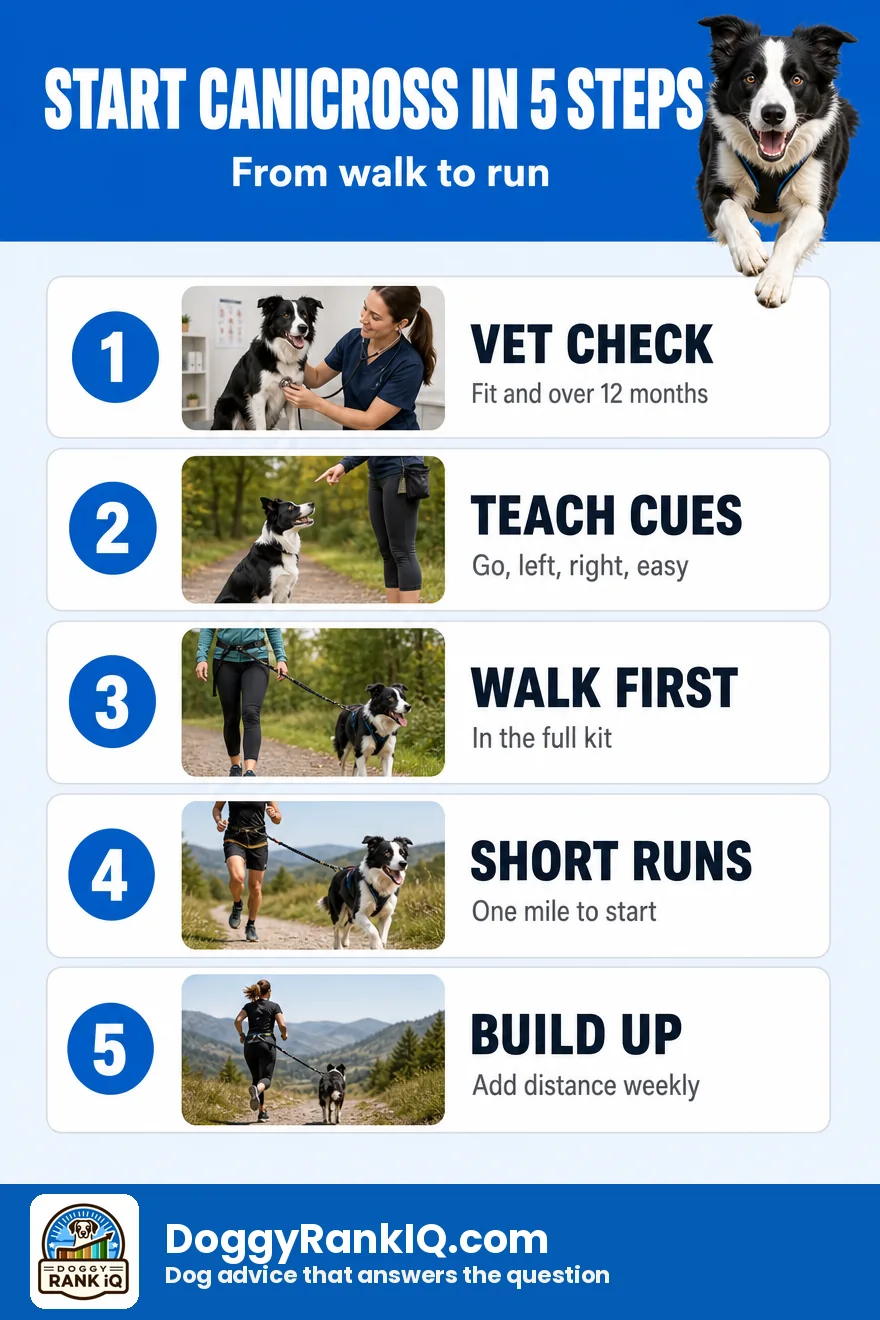
Training for canicross starts with teaching directional cues on a loose line before ever attaching a belt, and the whole first month should stay short and slow regardless of how fit the dog already is.
Week 1: Fit the running harness and let the dog wear it around the house and yard for short stretches, unattached to anything. The goal is just comfort with the gear.
Week 2: Attach a short line and walk, not run, with light tension. Introduce basic directional words like “left,” “right,” and “straight on” during normal walks, rewarding the dog for responding. The 5 essential commands every puppy should learn guide covers foundational cues that make this stage easier.
Week 3: Add short jogging intervals, 30 to 60 seconds of light pulling followed by walking recovery, over a route the dog already knows.
Week 4: Build toward a continuous run of 10 to 15 minutes at an easy pace, checking the harness fit again under tension since muscle and coat changes from the training itself can shift measurements slightly.
Common mistake: jumping straight to a full run in week one because the dog “already pulls on walks.” Pulling on a flat leash and pulling in a structured running harness use different muscles and a different line of force, and conditioning that gradually avoids soft-tissue strain.
Owners managing a reactive or anxious dog through this transition may find it useful to review dog body language cues, since stress signals during early harness training are easy to miss at a jog.
Canicross harness and belt: the rest of the kit
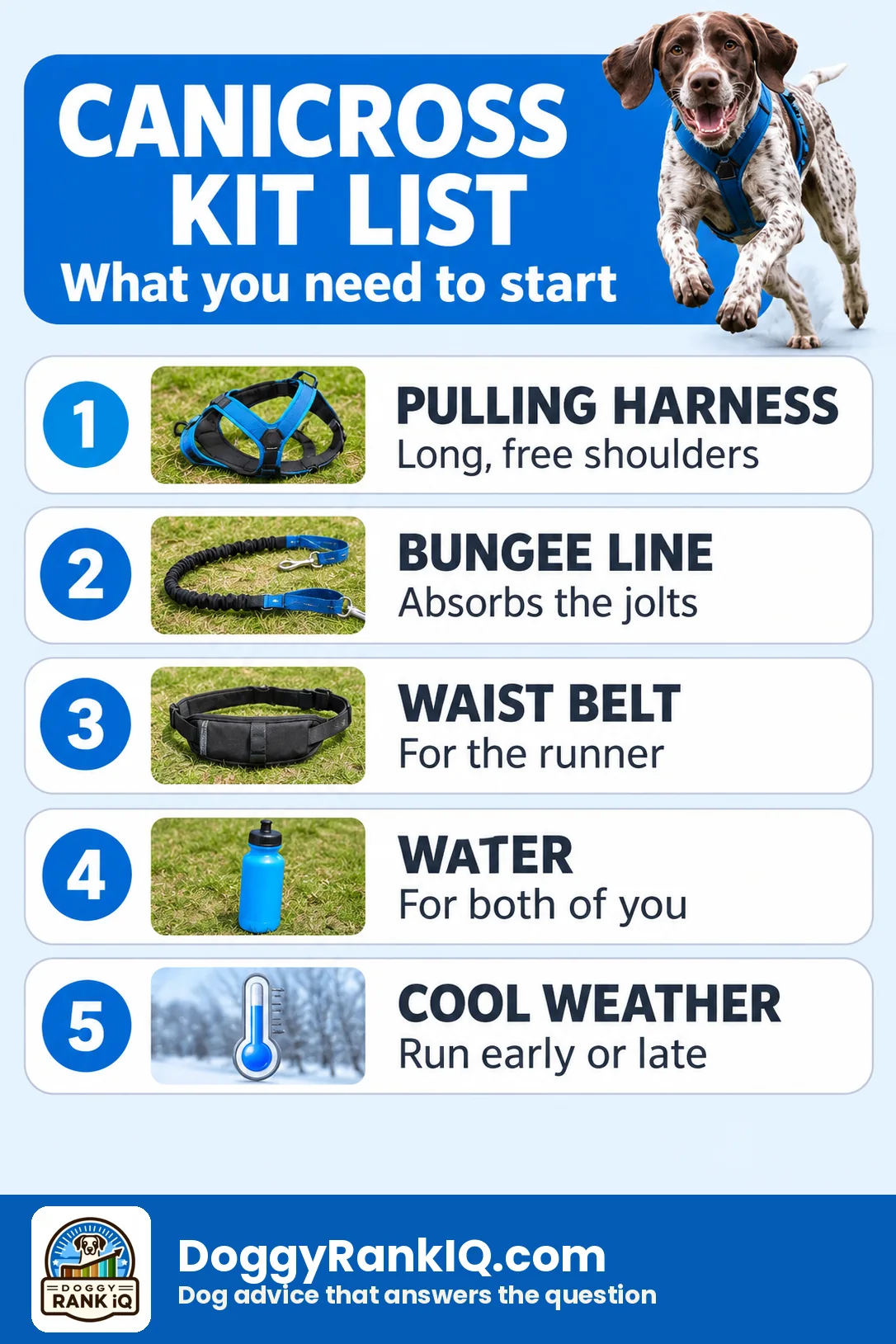
A running harness is only one third of the setup. The belt and the bungee line matter just as much for how the pull actually feels to both runner and dog.
| Item | Role | Notes | Price (checked 2026) |
|---|---|---|---|
| Non-stop Freemotion harness | Dog’s pulling point | Standard model, 10 sizes | $69.54 |
| Non-stop Freemotion 5.0 | Dog’s pulling point | Updated version, same core sizing | $99.99 |
| Freemotion harness pro | Dog’s pulling point, lighter build | CleanSeam construction, two neck options on select sizes | $149.99, limited availability |
| Running belt | Runner’s connection point | Padded, hip-level, quick release | ~$40 to $60 |
| Bungee line | Shock absorber between dog and runner | 2 to 6 foot range, stretch zone | ~$25 to $45 |
Decision rule: budget for the full kit before buying any single piece. A perfectly fitted running harness attached to a leash with no stretch still jars the dog’s neck and the runner’s hip on every stride. For broader gear comparisons across the sport, TrailRunTemple’s canicross gear guide is worth a look.
⭐ Top 5 Features We Love
- Adjustable rear strap that lets owners shift the pulling point as the dog’s build changes across a season.
- Two neck width options on several Freemotion pro sizes, aimed at deep-chested, narrow-necked breeds like hounds and Pointer types.
- Ten-size range with a 28 cm to 72 cm neck spread, which covers dogs from small terriers to large working breeds.
- CleanSeam construction on the newer pro model, reducing seams that can rub during long runs.
- Published, step-by-step size finder and fit video from the manufacturer, rather than a single chest-girth chart.
⚠️ Things to Look Out For
- The Freemotion harness pro carries a noticeably higher price, listed at $149.99, and was showing as sold out or limited in the United States when checked in 2026.
- Jae Thomas’s testing flagged the standard Freemotion as bulky and slower to put on and take off compared with more casual harnesses like the Rush.
- None of the major pulling harnesses compared by independent reviewers, including the Freemotion line, publishes a formal tensile or load rating.
- Fit depends on body shape. Lean, long-bodied dogs and broad Nordic-type dogs may do better with an X-back style than a Freemotion, according to independent comparison testing.
- Sizing between a chest-only measurement and the three-point method can land a buyer on the wrong size by a full step, so recheck before the return window closes.
FAQ
The bottom line
A running harness earns its price when the fit is checked under tension, not at a standstill, and when the rear strap, neck opening, and back length are all measured against the dog’s actual build rather than one chest number. The Freemotion 5.0 remains a reasonable starting point for most recreational runners at $99.99, with the standard Freemotion at $69.54 working as a lower-cost entry point. The newer Freemotion pro, at $149.99, targets a narrower group of deep-chested, narrow-necked athletic dogs and comes with limited availability. Measure three points, test under light tension, and recheck the fit after the first few runs, since a harness that fit perfectly on order day can shift once training actually starts.
Next step: run the three measurements, chest girth, back length, and neck opening, against the manufacturer’s size chart before buying, and plan a short test jog in the first week to confirm the fit holds under real pulling tension.
Doggy Rank IQ is reader supported. As an Amazon Associate we earn from qualifying purchases, at no extra cost to you.