
Quick Answer: Is a Chihuahua Right for You?
A chihuahua suits you if you want a 3 to 6 pound companion who lives 14 to 16 years, travels easily, and genuinely prefers your lap to a dog park. The trade is real: potty training can take a year or more, cold weather needs clothing, dental disease is close to a certainty without brushing, and a poorly socialized chihuahua can become loud and snappy with strangers. This breed fits apartments, seniors, singles and first-time owners who like training. It fits toddlers and chaotic households badly.
Key Takeaways: Chihuahua
- Lifespan 14 to 16 years, among the longest of any dog breed, which makes a chihuahua a two-decade-adjacent commitment, not a phase. See our guide on how long dogs live for breed-size context.
- Weight under 6 pounds by the American Kennel Club standard, with males and females close in size. Height is roughly 5 to 8 inches.
- The AKC breed standard describes “terrier-like” qualities: self-importance, confidence and self-reliance. That is charm and liability in one package.
- A November 2026 Stanford genetics report found about 0.1% coyote-derived DNA and roughly 4% ancestry from pre-contact American dogs in modern chihuahuas. Researchers said the coyote fragments do not explain the attitude.
- Hill’s Pet Nutrition’s World of the Small Dog Report (November 2026) notes small dogs need roughly twice the calories per kilogram of large dogs, and that small and miniature breeds accounted for 71% of urinary stones in about 388,000 cases from the Minnesota Urolith Center, 2019 to 2024. Details here.
- Expect $500 to $2,500 for a puppy from a responsible breeder, far less from rescue, plus a realistic first year around $1,500 to $2,500.
- Two coats, smooth and long, both shed. Neither is hypoallergenic.
Where Does the Chihuahua Come From?
The chihuahua is Mexican, named for the state of Chihuahua, and its deep history is still partly a hypothesis. The most repeated origin story links the breed to the Techichi, a small companion dog kept by the Toltec and later the Aztec. That link is a theory supported by archaeology and tradition, not a settled genetic fact.
Genetics has now added something real. A Stanford team using a high-resolution ancestry algorithm reported in November 2026 that modern chihuahuas carry roughly 4% ancestry from pre-contact American dogs, which is a plausible thread back to ancient Mexican companion dogs. The same analysis found tiny coyote-derived segments, around 0.1% of the genome, and the fragments look ancient rather than recent. Alexander Ioannidis of Stanford cautioned that the behavioral contribution is likely negligible, and that confirming the picture needs more chihuahua genomes and broader coyote sampling. Coverage here.
So no, your dog is not part coyote in any way that matters to the sofa. The boldness is dog boldness.
What Makes the Chihuahua So Special (and So Cute)?
The appeal is a big personality in a body you can carry in one arm, plus a bond that tends to be intense and specific. Most chihuahua owners describe one chosen human.
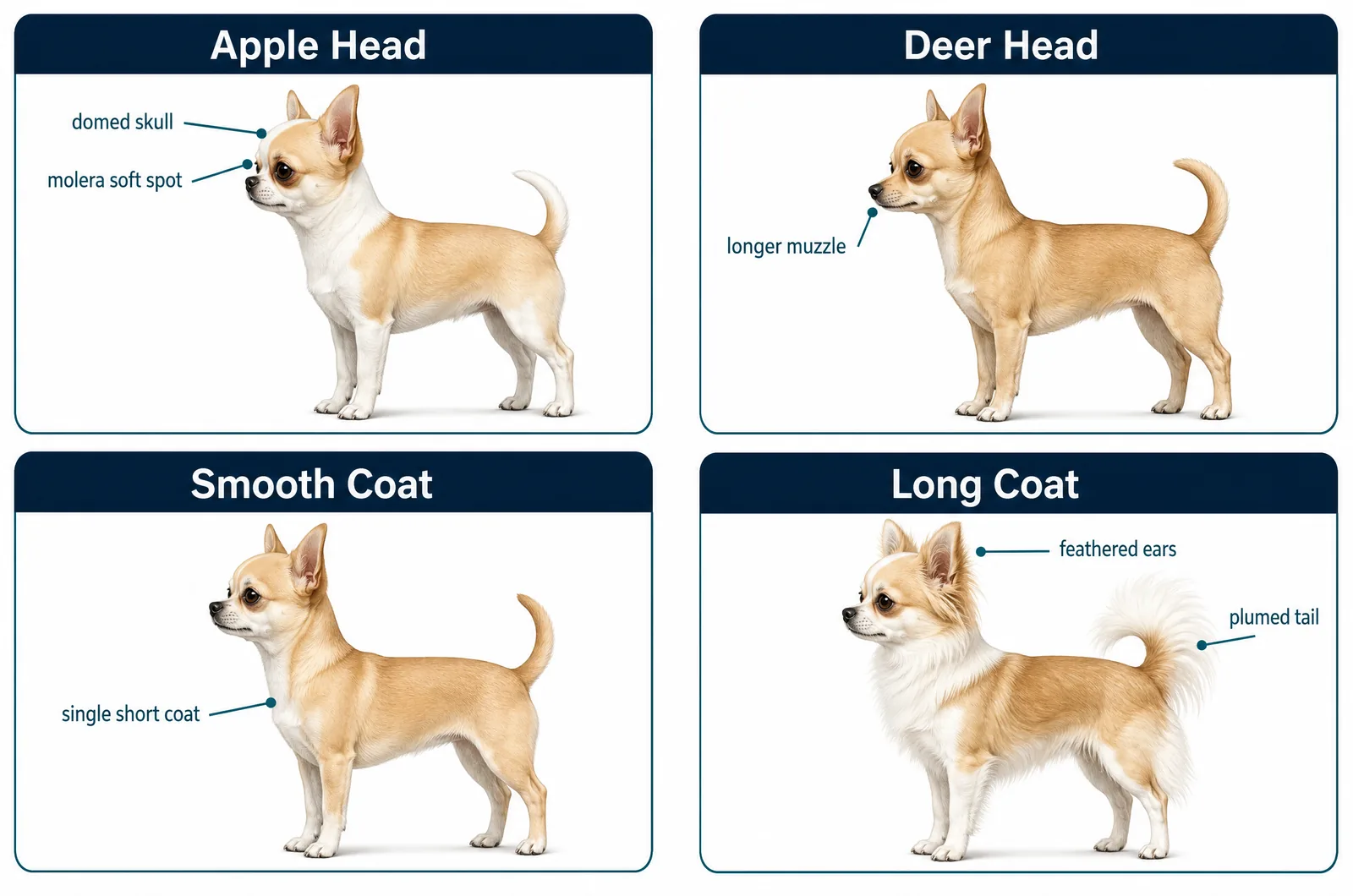
What drives the look:
- Apple head chihuahua: a domed, rounded skull with a short muzzle set at close to a 90 degree angle. This is the shape the breed standard calls for, and it is what most people picture.
- Deer head: a longer muzzle and flatter skull. Common, healthy, loved, just not the show standard.
- Large upright ears and big round eyes, which read as perpetual surprise.
- Long hair chihuahua versus smooth coat. The long coat chihuahua has feathering on the ears, legs and tail. Same breed, same temperament tendencies, different grooming bill.
Owners also love the bossiness. A four pound dog deciding where everyone sits is funny until you realize you moved. The affection runs deep, and so does the influence.
Chihuahua Size, Weight and Lifespan
A chihuahua should weigh under 6 pounds, stand about 5 to 8 inches at the shoulder, and live 14 to 16 years. Males and females are nearly identical in size, unlike most breeds.
| Measure | Male chihuahua | Female chihuahua | Toy Poodle (for comparison) |
|---|---|---|---|
| Weight | 3 to 6 lb | 3 to 6 lb | 4 to 6 lb |
| Height | 5 to 8 in | 5 to 8 in | up to 10 in |
| Typical lifespan | 14 to 16 yr | 14 to 16 yr | 10 to 18 yr |
| Coat shedding | Low to moderate | Low to moderate | Very low |
Skip any breeder advertising “teacup” chihuahuas at 2 pounds. That is a marketing word, not a size class, and dogs bred under the standard carry higher risks of low blood sugar, fractures and dental crowding.
What Is the Chihuahua Temperament Like?
Confident, alert, deeply attached to one or two people, and quick to announce visitors. The AKC describes the breed as alert and swift-moving with terrier-like self-reliance. Think small watchdog with strong opinions about the mail carrier.
That confidence has a shadow side. A chihuahua who has never learned that strangers are ordinary can become reactive, and the behavior gets accidentally rewarded when owners scoop the dog up mid-bark. The lift feels protective. To the dog it works, so it repeats.
Do chihuahuas bark a lot? Many do. Barking is the breed’s default alert, and it responds well to training the alternative, which is coming to you for a treat after two barks instead of continuing for ninety seconds.
Why do chihuahuas shake so much? Usually three reasons, in this order: they are cold (tiny body, high surface area to volume ratio, heat leaves fast), they are excited or stressed, or their blood sugar has dipped. Persistent trembling with weakness, wobbliness or collapse is not a quirk. Call your vet the same day.
Are Chihuahuas Good With Kids and Other Pets?
Chihuahuas do well with calm children over about age 8 and poorly with toddlers. The problem is physics before personality: a 4 pound dog can be seriously injured by a dropped toy or a misjudged step, and a dog who has been hurt learns to defend itself.
Practical rules that work:
- No floor-level chasing games. Teach kids to sit and let the dog approach.
- Carrying privileges for adults only, or a seated hold with the dog supported under the chest and rear.
- A pen or raised bed the dog can retreat to, treated as off limits to children.
- With other dogs, supervise anything involving a size gap. A playful Lab bounce can break a chihuahua’s leg.
Families with young kids may be better matched elsewhere. Our roundup of family dog breeds worth considering covers sturdier options.
Who Is the Chihuahua Made For, and Who Should Skip It?
Choose a chihuahua if you live in an apartment, work from home or have a flexible schedule, want a dog that travels in a carrier, enjoy short daily training sessions, and are honest about needing a year of patient potty work.
Skip the chihuahua if you have toddlers, you are away 10 hours a day, you want a running partner, you live somewhere with long freezing winters and no tolerance for dog clothing, or you want a dog that greets every stranger warmly without training.
Apartment fit is genuinely strong. Low space needs, quiet exercise, and easy indoor enrichment. The barking is the thing to manage, not the energy. See our picks for dog breeds suited to apartment living.
Similar small breeds worth comparing: Papillon (more trainable, more energy), Toy Poodle (lower shedding, higher grooming cost), Miniature Pinscher (bolder, needs more exercise), Italian Greyhound (same cold sensitivity, more fragile legs).
How Much Exercise Does a Chihuahua Need?
Around 20 to 40 minutes of activity a day, split into short sessions, plus daily mental work. Chihuahua exercise needs are modest in distance but not in stimulation.
A workable week:
- Two 15 minute walks on a harness, never a collar, because the breed is prone to tracheal collapse.
- 5 to 10 minutes of training games, food puzzles or scatter feeding each day.
- Indoor fetch down a hallway on a non-slip runner.
- Avoid repeated jumping off sofas and beds. Add a ramp or steps. Knees and spines in toy breeds do not forgive that habit.
Edge case: in heat above about 85°F or cold below about 45°F, cut the walk short and do indoor enrichment instead. Small bodies lose and gain heat faster than large ones.
Chihuahua Grooming and Shedding
Chihuahua shedding is low to moderate, and both coat types shed. Smooth coats need a rubber curry brush once or twice a week. Long coats need a pin brush two or three times a week, with extra attention behind the ears and on the trouser feathering where mats form.
The rest of the routine:
- Bath every 4 to 8 weeks with a gentle dog shampoo. More than that dries the skin.
- Nails every 3 to 4 weeks. Tiny dogs rarely wear nails down on pavement.
- Ears checked weekly, especially on long coats.
- Teeth brushed daily. This is the single highest value grooming task for the breed, not an optional extra. Our guide to brushing your dog’s teeth walks through the first two weeks.
- Clothing is functional here, not a costume. Sweater below about 50°F, insulated coat below about 40°F.
New to the tools? Start with our beginner’s guide to dog grooming.
Common Chihuahua Health Problems
Chihuahuas are long-lived but carry a predictable set of toy breed issues. Screening and prevention matter more than luck.
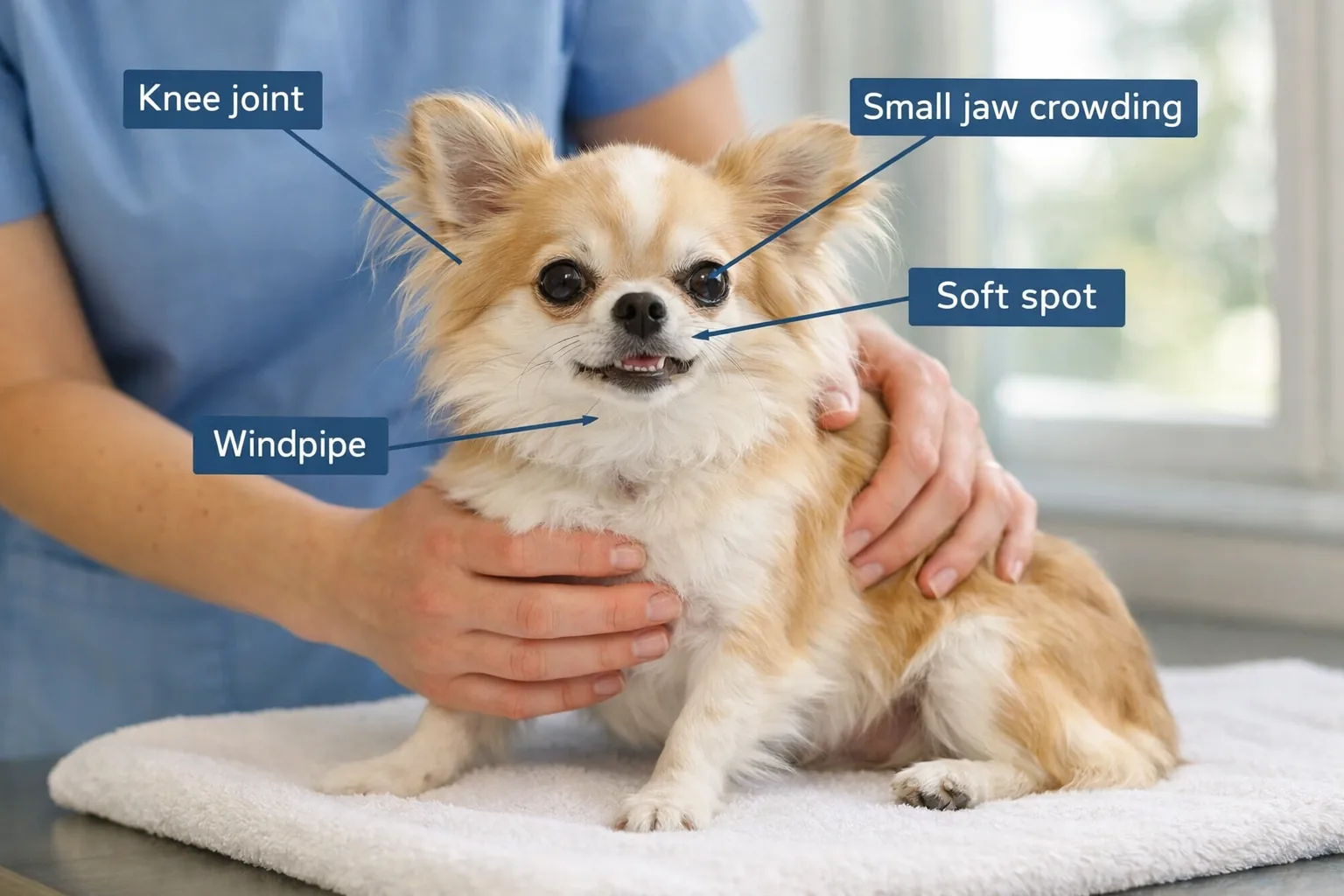
Dental disease. The most common chihuahua health problem. Small jaws crowd 42 adult teeth, plaque builds fast, and untreated periodontal disease causes pain and tooth loss by middle age. Daily brushing plus professional cleanings under anesthesia when your vet recommends them.
Luxating patella. The kneecap slips out of its groove. Signs include a skipping step or holding one back leg up briefly, then carrying on. Graded 1 to 4; mild cases are managed with lean weight and joint support, severe ones need surgery. Ask breeders about patella evaluations.
Molera. Many chihuahuas have a soft spot on the skull where the bones have not fully fused. A small molera is normal for the breed and usually harmless. It does mean head trauma is more dangerous, so no rough handling and no unsupervised play with larger dogs.
Tracheal collapse. Coughing that sounds like a goose honk, worse with excitement or collar pressure. Use a harness.
Hypoglycemia in puppies under 4 months, and heart valve disease, patent ductus arteriosus and hydrocephalus in some lines.
Urinary stones. The Hill’s small dog report cited Minnesota Urolith Center data in which small and miniature breeds made up 71% of stones, with calcium oxalate at 53% in miniature breeds. Practical meaning: keep water available, feed wet food or add water to kibble, and get straining or bloody urine checked immediately.
Call a vet urgently for: trouble breathing, collapse, repeated vomiting, a seizure, head trauma, sudden back pain with weak or dragging back legs, or any trembling with weakness in a puppy. Those are same-day problems.
What Do Chihuahuas Love to Eat? Favorite Foods and Feeding
Feed a small-breed formula with small kibble, measured to the gram, split into two or three meals a day. Hill’s small dog research notes that dogs under 25 pounds need roughly twice the calories per kilogram of large dogs because of higher metabolic rate and faster heat loss. That does not mean free feeding. A 5 pound chihuahua typically needs only about 150 to 250 calories a day, so a single rogue cheese cube is a meaningful share of the budget.
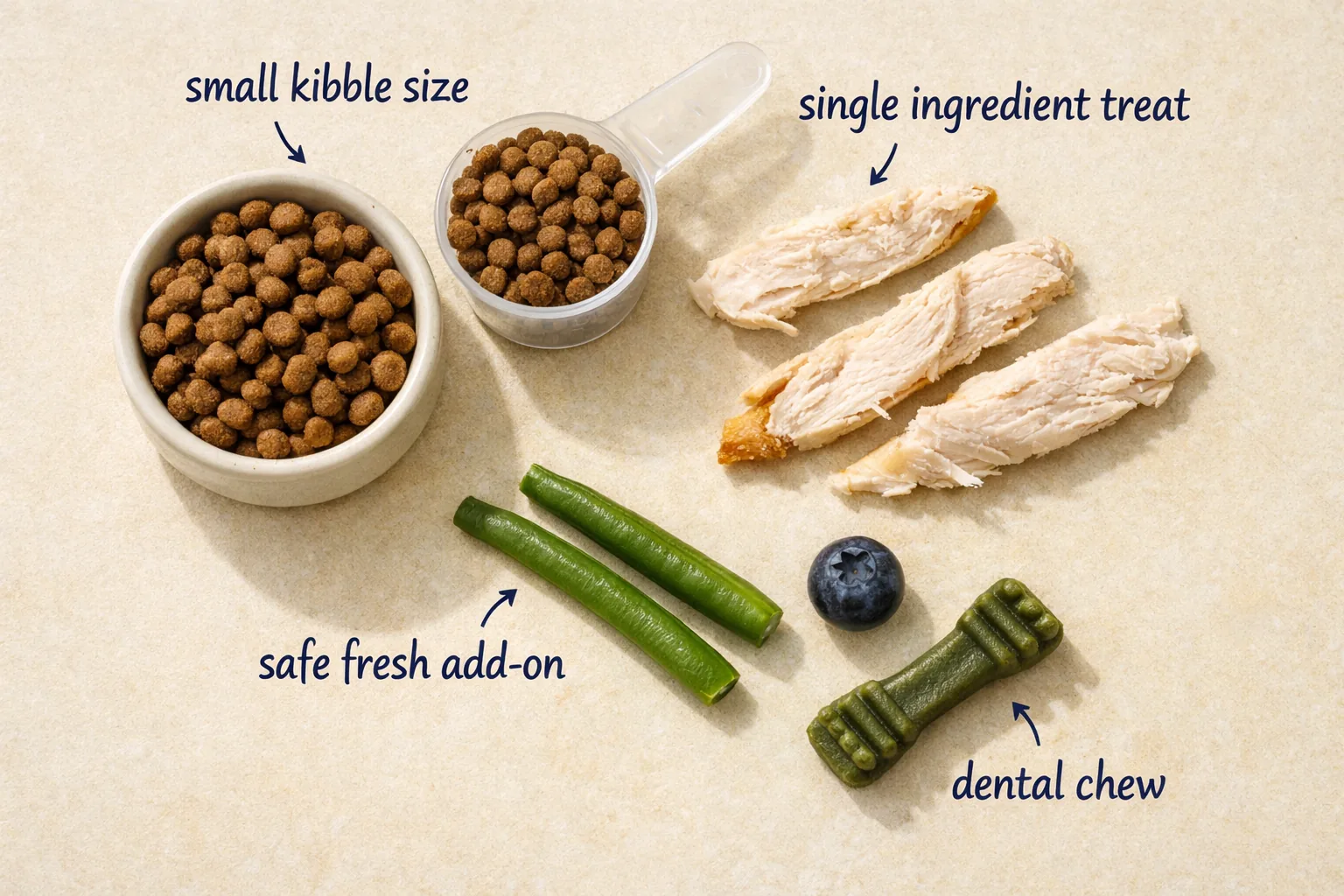
Treats most chihuahuas go for: plain cooked chicken, freeze-dried liver crumbs, tiny pieces of plain boiled sweet potato, green beans, blueberries, a lick of plain unsweetened yogurt. Break everything into pea-sized pieces.
Never feed: chocolate, grapes and raisins, xylitol, onions, garlic, macadamia nuts, cooked bones, alcohol. Toy dogs reach toxic doses at tiny amounts. For a safe produce list, see our guide to fruits and vegetables dogs can eat.
The picky eater problem. Very common in this breed, and often owner-made. The cycle: dog refuses kibble, owner adds chicken, dog learns that waiting produces chicken, dog waits longer. Fix it by putting food down for 15 minutes, removing it, and offering nothing until the next meal. Keep the topper consistent instead of escalating. If your dog skips more than two meals, vomits bile, or loses weight, that is a vet visit, not a standoff. Puppies under 4 months should never go a full day without eating.
Choosing food by age? Our breakdown of dog food by life stage covers puppy to senior.
How to Train a Chihuahua
Train with positive reinforcement in 3 to 5 minute sessions, several times a day. The AKC describes the breed as intelligent and eager to please, and the small size means tiny treats go a long way without wrecking the calorie budget.
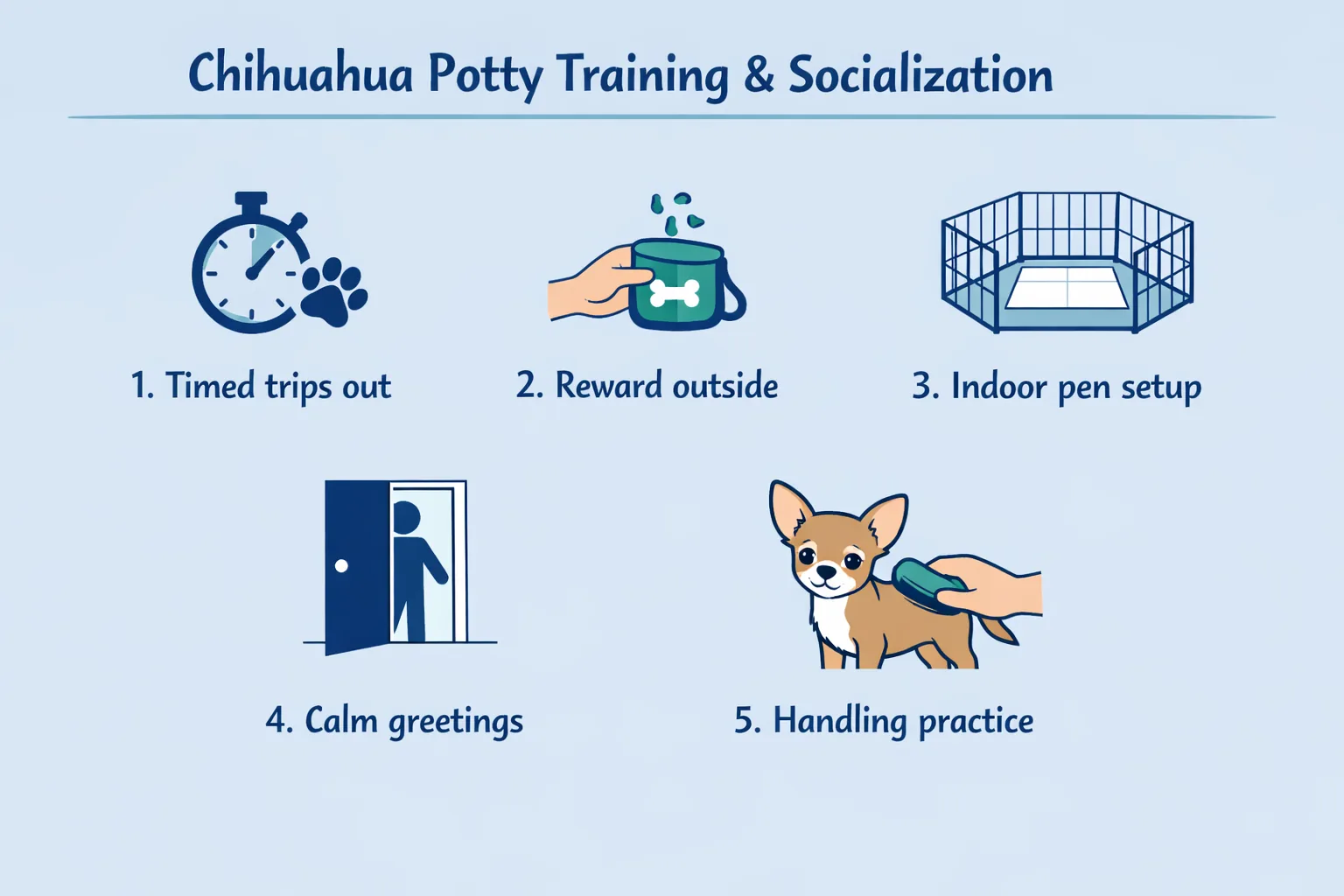
Potty training, the single most reported struggle, needs a different approach than a large breed:
- Take the puppy out every 45 to 60 minutes while awake, plus after every nap, meal and play session.
- Reward within 3 seconds of finishing, outside, with something excellent.
- Use a pen or tether indoors. Freedom is earned, not given at week one.
- Expect cold and rain to cause regression. A chihuahua standing in 38°F drizzle is not going to concentrate. Put a coat on, use a covered spot, or set up an indoor grass pad as a legitimate backup.
- Clean accidents with an enzyme cleaner. Regular cleaners leave the scent marker.
Many owners report full reliability closer to 8 to 12 months than 8 to 12 weeks. That is normal for the breed, not failure.
Socialization and defensiveness. Pair strangers with food at a distance the dog can handle. Do not force greetings. Do not lift the dog when it barks at a person; step back instead and reward quiet. Teach a solid “come,” “leave it,” and tolerance for being handled, picked up and having its mouth checked.
Separation anxiety. Build alone time from day one with short absences, a stuffed food toy, and departures that are boring rather than emotional.
Try It: Chihuahua Sweater Weather Check
Chihuahuas lose body heat faster than almost any breed, so the right call on clothing changes with temperature, wind and your dog’s weight. Enter today’s conditions below to see whether to grab a sweater, a coat, or shorten the walk.
Doggy Rank IQ Tool
Chihuahua Sweater Weather Check

Chihuahuas lose body heat fast. Enter today's weather and your dog's size to see whether to grab a sweater, a coat or skip the walk.
How Do You Keep a Chihuahua Safe in a Big-Dog World?
Most Chihuahua injuries come from everyday life, not rare diseases. A dog that weighs about as much as a bag of sugar can get hurt by a jump, a door or a friendly giant at the park. A few habits cover most of the risk.
- Use a harness, not a neck collar, for walks. Small toy breeds are prone to windpipe problems, and a harness keeps leash pressure off the throat.
- Control the height. Add pet steps to the sofa and bed, and carry your Chihuahua on stairs until you know it handles them well. Falls from arms and furniture are a common cause of broken legs in toy dogs.
- Pick play partners carefully. Skip crowded dog parks with large dogs. Set up playdates with calm, similar-sized dogs instead.
- Watch the yard. Supervise outdoor time, check fences for small gaps, and know that hawks and coyotes do take small pets in some areas.
- Buckle up in the car. A crash-tested carrier or small-dog car seat beats a lap every time.
Teach guests and children to sit on the floor before they hold the dog. A Chihuahua that feels safe tends to bark less, bite less and trust more, which solves a lot of the "nervous Chihuahua" reputation before it starts.
How Much Does a Chihuahua Cost?
Expect $500 to $2,500 for a puppy from a responsible breeder, and $75 to $400 in adoption fees from a rescue. Chihuahuas and chihuahua mixes are among the most commonly surrendered dogs in US shelters, especially in the Southwest, so rescue is a genuine option rather than a consolation prize.
| Cost area | First year | Each year after |
|---|---|---|
| Food (small-breed, 5 lb dog) | $180 to $350 | $180 to $350 |
| Routine vet, vaccines, spay/neuter | $500 to $900 | $200 to $400 |
| Dental cleaning under anesthesia | often not needed yet | $400 to $900 every 1 to 2 years |
| Gear (harness, carrier, pen, coats, bed) | $200 to $400 | $60 to $120 |
| Pet insurance | $200 to $420 | $200 to $500 |
A realistic first year lands around $1,500 to $2,500 excluding purchase price, with roughly $800 to $1,600 a year after that. Budget separately for dental work, which is the most predictable large expense in this breed.
Finding gear that fits is its own small ordeal. Measure the chest girth and neck before ordering anything, because “XS” means wildly different things across brands. Check the dimensions. (Yes, including the carrier that has to fit under an airline seat.)
Chihuahua Puppy Tips for the First 90 Days
A chihuahua puppy needs frequent small meals, constant potty supervision, careful socialization and protection from falls. The first three months set most of the adult behavior.
Days 1 to 14
- Feed 4 small meals a day. Under 4 months, low blood sugar is a real risk. Keep high-calorie gel on hand and ask your vet how to use it.
- Set up a pen with a bed, water, toys and a potty pad. No free run of the house.
- Start the potty schedule immediately. Out every 45 minutes when awake.
- Begin alone time: 2 minutes, then 5, then 15, with a food toy.
Days 15 to 45
- Socialization window. Aim for calm exposure to 3 or 4 new people a week, at a distance the puppy chooses.
- Introduce the harness indoors before the first walk.
- Touch the paws, ears and mouth daily. Pair with treats. This pays off at every future vet visit.
- Start toothbrushing with a finger brush and dog toothpaste.
Days 46 to 90
- Short training sessions on sit, come, leave it and a mat settle.
- Add ramps or steps to furniture before jumping becomes habit.
- Expect a confidence wobble around 4 to 5 months. Keep exposures short and positive.
Common mistakes new chihuahua owners make: carrying the dog everywhere so it never learns to walk past strangers, skipping toothbrushing, using a collar instead of a harness, free feeding, and giving full house access before potty training is reliable.
What Chihuahua Owners Say
Two threads from r/Chihuahua capture the honest version of life with this breed.
“Things you wish you knew before getting a chihuahua…”
That thread title, posted by an owner on Reddit, is doing a lot of work. The recurring answers in these discussions are the same ones covered above: potty training taking far longer than expected, cold sensitivity, and the difficulty of finding gear that fits. The practical response is to plan for them as features of the breed rather than surprises. Put the enzyme cleaner, the indoor pad, two coats and a measuring tape on the shopping list before the dog arrives, and the first six months stop feeling like a series of failures.
“Did I make the right choice?”
That question, asked by an owner on Reddit, comes up constantly in the first weeks with any small dog. Useful answer: give it 90 days with a written routine before judging. Most doubt in week two is about sleep disruption and accidents, both of which change fast with a pen, a schedule and consistent alone-time practice. If the doubt is about reactivity or biting, that is the moment to book a certified positive-reinforcement trainer, not to wait it out.
Welfare note worth taking seriously: on October 6, 2026, the Houston SPCA and local authorities removed 45 chihuahua mixes from a north Houston mobile home, many with infections and severe hair loss. Small dogs reproduce quickly and conditions deteriorate fast. If you are buying, visit in person and see the parents and the space.
Chihuahua FAQ
How long do chihuahuas live? Typically 14 to 16 years, with some reaching 18. Dental care, lean body weight and treating heart murmurs early make the biggest difference.
Are chihuahuas good with kids? Better with calm children over 8 than with toddlers. Their size makes accidental injury likely, and injured dogs learn to defend themselves.
Why do chihuahuas shake so much? Cold, excitement or stress most often. Small bodies lose heat quickly. Trembling with weakness or wobbliness in a puppy can mean low blood sugar and needs a vet the same day.
Do chihuahuas shed? Yes, both smooth and long coats shed low to moderate amounts year round. Neither type is hypoallergenic.
Are chihuahuas good apartment dogs? Very good on space and exercise, less good on noise. Train an alternative to alert barking from week one and the fit works well.
What is a molera? A soft spot on the skull where bones have not fully fused, common and usually harmless in this breed. It means head trauma is more dangerous, so avoid rough handling and unsupervised play with big dogs.
Is an apple head chihuahua different from a deer head? Only in skull shape and muzzle length. Apple head matches the AKC standard; deer head chihuahuas are the same breed and just as healthy.
What should I feed a picky chihuahua? A small-breed complete food, offered for 15 minutes then removed, with a consistent topper rather than an escalating one. Two skipped meals, vomiting or weight loss means call the vet.
A chihuahua rewards preparation more than most breeds. Order a fitted harness and two coats, book a vet visit in the first week, start toothbrushing and the potty schedule on day one, and sign up for a positive-reinforcement puppy class before the socialization window closes around 16 weeks. Still deciding between breeds? Run your household through the Doggy Rank IQ breed matchmaker before you commit to the next 15 years.