
Quick Answer: Is a Corgi Right for You?
A corgi suits you if you want a loud, clever, shedding herding dog in a short package. The Pembroke Welsh Corgi was bred to move cattle by barking and nipping at heels, so ankle herding and a surprisingly big voice are the breed doing its old job in your hallway. They are sturdy, funny, fast to learn, and they shed year round with two heavier blowouts. Skip the breed if you need a quiet dog, hate vacuuming, or cannot commit to weight control and back care.
Key Takeaways: Corgi
- The Pembroke Welsh Corgi is a Welsh cattle-driving breed that worked low to the ground, nipping heels and dodging kicks, according to Encyclopaedia Britannica.
- Adults typically stand about 10 to 12 inches tall and weigh up to roughly 30 pounds for males and 28 for females, per the AKC Pembroke Welsh Corgi breed standard.
- Typical lifespan is around 12 to 13 years, with intervertebral disc disease (IVDD) and degenerative myelopathy among the conditions owners should know about, as noted by Embark Veterinary.
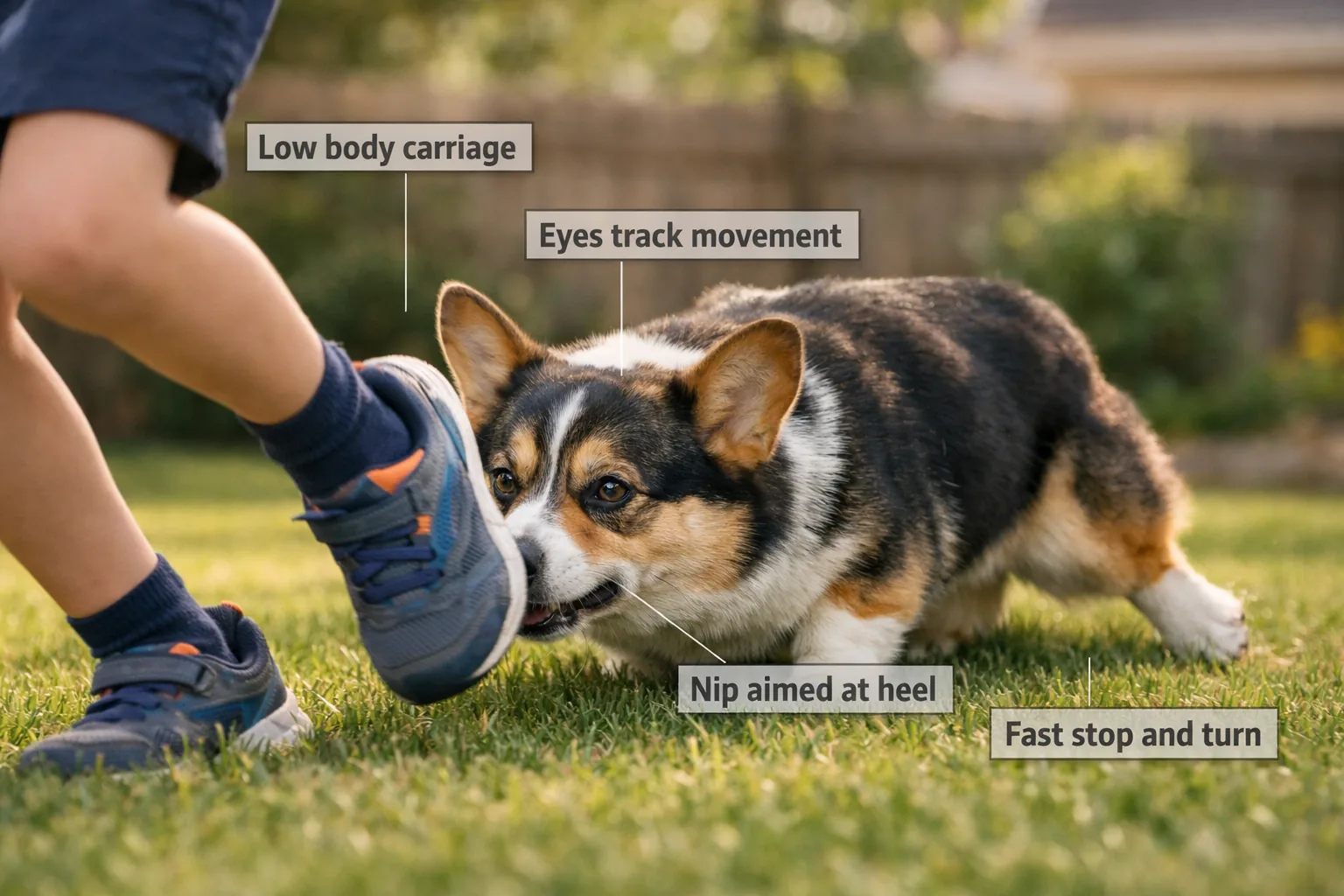
- Ankle nipping is herding behavior, not automatic aggression. Embark describes the instinct as triggered by fast movement: kids, bikes, scooters, cats.
- Barking is both herding equipment and watchdog work. VCA Canada describes some Pembrokes as frequent barkers and recommends exercise plus obedience training as management.
- The Merck Veterinary Manual recommends reward-based training and teaching an alternative behavior rather than punishing a dog for barking.
- The Fédération Cynologique Internationale published an updated Pembroke standard on September 8, 2026, stressing that only functionally and clinically healthy dogs should be bred (FCI standard 039).
Where Does the Corgi Come From?
The corgi comes from Wales, where short-legged dogs drove cattle to market by nipping at heels and ducking under the kick. Britannica notes the Welsh Corgi was developed to work livestock at a distance from the handler, thinking for itself and responding to commands. That job description explains nearly everything people later complain about.
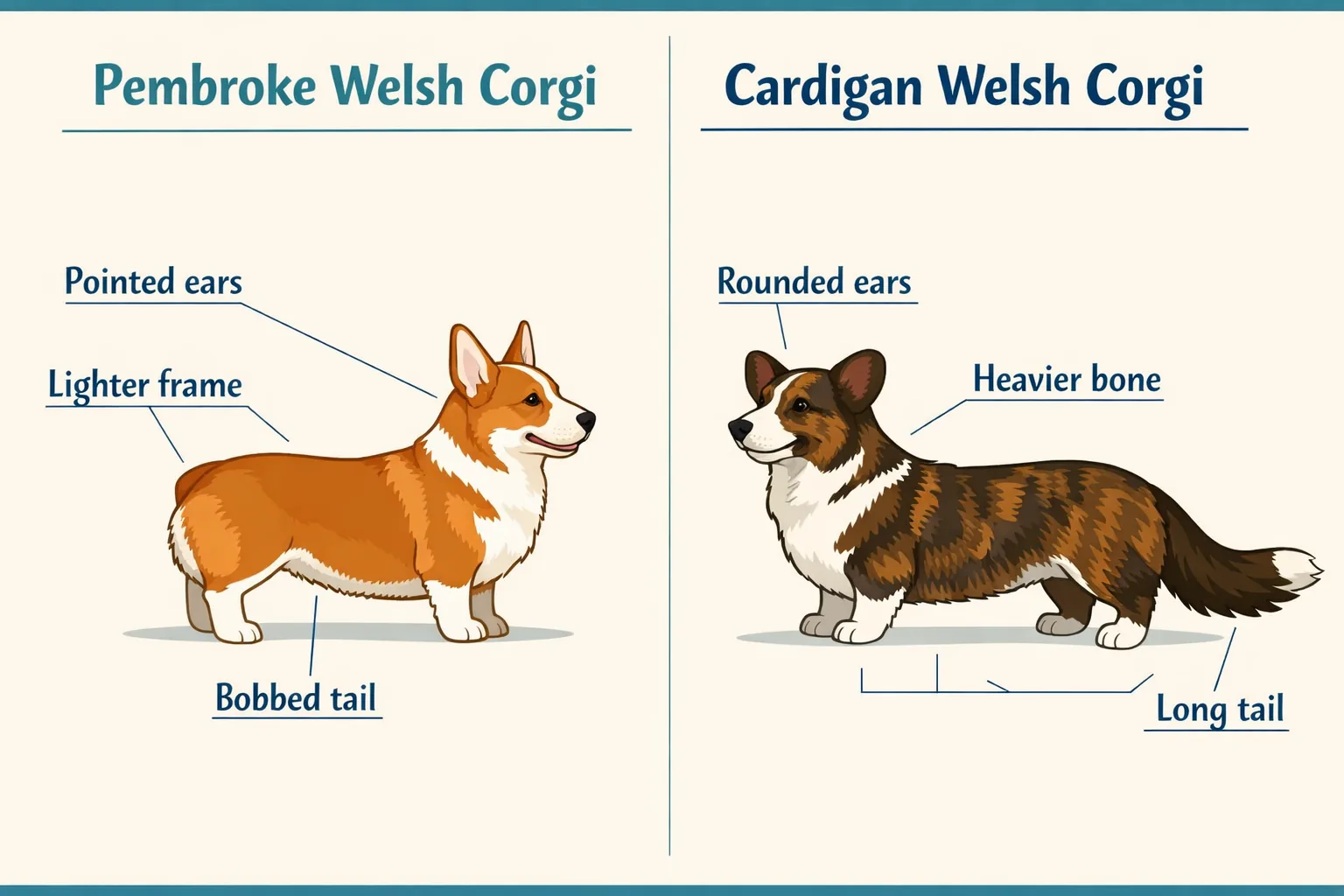
Two separate breeds share the name. The Pembroke Welsh Corgi comes from Pembrokeshire and is the one most people picture: foxy head, pointed ears, usually red and white, with a very short or absent tail. The Cardigan Welsh Corgi comes from Cardiganshire, is older, heavier boned, has larger rounded ears and a long bushy tail. They were shown as one breed in the UK until 1934, then split.
Then came the royal connection. Queen Elizabeth II kept Pembrokes from 1933 onward, starting with a dog named Dookie and later Susan, who founded a line that ran for generations. The televised corgis made the breed famous far outside farm work, which is how a cattle dog ended up in Manhattan studio apartments.
Pembroke vs Cardigan corgi differences at a glance
| Feature | Pembroke Welsh Corgi | Cardigan Welsh Corgi |
|---|---|---|
| Tail | Very short or naturally bobbed | Long, bushy, carried low |
| Ears | Pointed, erect | Larger, rounded tips |
| Build | Lighter, more fox-like | Heavier bone, longer body |
| Common colors | Red, sable, fawn, tri-color with white | Brindle, blue merle, black, red, sable |
| Weight (adult) | Up to about 30 lb | Roughly 25 to 38 lb |
What Makes the Corgi So Special (and So Cute)?
Corgis are special because a working herding brain got packaged in a 28-pound body with stumpy legs, and the mismatch is permanently funny. The breed is dwarfed (chondrodysplastic), which gives the short legs and long spine, paired with a normal-size head and ears built like satellite dishes.
What owners actually fall for:
- The speed of learning. A corgi can pick up a new cue in a few short sessions, then spend the rest of the week testing whether the rule still applies.
- The entertainment value. The sideways gallop. The sploot. The dramatic sigh when you sit in the wrong chair.
- The adventure appetite. Short legs, long range. Corgis hike, swim, play fetch, and do agility and herding trials.
- The opinion-to-body-size ratio. You get a big dog’s personality without a big dog’s doorway problem. If you are still weighing breed options, our guide to choosing the best dog breed for your household walks through the tradeoffs.
The ears go up before the dog decides anything. That is the whole breed in one gesture.
Corgi Size, Weight and Lifespan
A Pembroke corgi stands about 10 to 12 inches at the shoulder and weighs up to roughly 30 pounds, with a typical lifespan near 12 to 13 years. The AKC breed standard caps males at about 30 pounds and females at about 28, in show condition.
| Measure | Male Pembroke | Female Pembroke |
|---|---|---|
| Height at withers | 10 to 12 in | 10 to 12 in |
| Weight (fit adult) | 24 to 30 lb | 22 to 28 lb |
| Typical lifespan | 12 to 13 years | 12 to 13 years |
Those numbers matter more than they would in another breed. A long spine on short legs does not forgive extra pounds. An overweight corgi is carrying load on discs that already have a hard job, and weight gain creeps in because the breed is persuasive. If you are not sure where your dog sits, check our walkthrough on how to tell if your dog is overweight.
Decision rule: if you cannot feel your corgi’s ribs under light finger pressure and see a waist from above, cut food by about 10 percent and recheck in four weeks with your vet’s input.
What Is the Corgi Temperament Like?
Corgi temperament is bold, chatty, affectionate with its people, and clever enough to run a small household badly. The AKC describes Pembrokes as readily trained with gentle handling, needing regular exercise, mental activity and human company. Britannica’s point about working independently at a distance is the other half: this is a dog that makes decisions.
Three traits show up again and again in owner reports:
- Vocal. Corgis bark at arrivals, departures, noises, squirrels, and sometimes at you hugging someone else. That last one is often herding plus arousal, not jealousy in the human sense.
- Pushy about movement. Running kids, bikes, scooters and the vacuum all read as livestock that needs managing.
- Easily underemployed. A bored corgi invents a job. Usually window patrol. Sometimes shoe inventory.
Stubbornness is usually inconsistent reinforcement wearing a costume. If barking at the window sometimes gets attention and sometimes does not, the behavior gets stronger, not weaker. Reading arousal early helps, and our primer on how to read dog body language covers the signals that come before a bark.
Are Corgis Good With Kids and Other Pets?
Corgis are generally good with children who are old enough to handle a dog that herds, which usually means school age rather than toddler age. The dog is sturdy and playful. The problem is physics: small fast humans trigger the heel-nipping instinct the breed was built for.
Practical management:
- Teach kids to stop moving when the corgi gets excited. A still target is boring.
- Keep a toy within reach and redirect the mouth onto it before contact happens.
- Reward the corgi for lying on a mat while kids run. That is the competing behavior veterinary guidance recommends.
- Supervise feeding and high-value chews. Resource guarding toward other pets is a common complaint in corgi owner forums and responds best to management plus a certified behavior consultant, not confrontation.
With other dogs, corgis can be bossy and leash reactive. Many bark first and assess later. Distance work, treats for calm looks at other dogs, and avoiding on-leash greetings in tight spaces do most of the heavy lifting. For families comparing options, our list of family-friendly breeds for kids gives alternatives with lower herding drive.
Who Is the Corgi Made For, and Who Should Skip It?
A corgi fits active people who want a smart, loud, medium-energy dog and have a plan for shedding, barking and back care.
Good fit if you:
- Walk or train daily and enjoy teaching tricks
- Own a vacuum you do not resent
- Live somewhere barking will not get you evicted, or you will train an alternative early
- Want a dog that travels well, hikes, and fits in a car footwell
Skip it if you:
- Share thin apartment walls and work night shifts
- Have toddlers and no bandwidth for constant supervision
- Want a low-maintenance coat (see our low-maintenance breed comparison)
- Are away 10 hours a day with no midday break
Apartments: yes, with conditions. A corgi needs maybe 400 square feet less than people assume and about 90 minutes a day more attention than people assume. The barking is the real apartment risk, not the square footage. Ground floor helps, because stairs are not great for a long spine.
First-time owners: manageable but not easy mode. A corgi forgives inexperience in training and punishes inconsistency in boundaries.
How Much Exercise Does a Corgi Need?
Plan on roughly 60 to 90 minutes of activity a day for a healthy adult corgi, split between physical exercise and brain work. The AKC lists regular exercise and mental activity as part of basic care for the breed.
A workable daily shape:
- Morning: 25 to 30 minute sniff walk, loose leash, let the nose lead.
- Midday: 10 minutes of training or a food puzzle.
- Evening: 20 to 30 minute walk plus 10 minutes of fetch, flirt pole, or scent games.
Skip repetitive high-impact work on hard surfaces, long stair sessions, and jumping down from furniture. Low-impact options that satisfy a corgi: scent work, treibball, trick training, herding-ball games, and swimming if your dog likes water.
Common mistake: replacing mental work with more running. A physically tired corgi with an unoccupied brain still barks at the window. Enrichment does more for noise than mileage does.
Corgi Grooming and Shedding
Corgis shed a lot, year round, with two heavier coat blows in spring and fall. The double coat has a weatherproof outer layer and a dense undercoat that releases in clumps when the seasons turn.
What actually works:
- Brush 2 to 3 times a week with an undercoat rake, daily during a blowout
- Bathe every 6 to 8 weeks, then dry thoroughly down to the skin
- Never shave the coat. It insulates against heat as well as cold and often grows back patchy
- Nails every 3 to 4 weeks, ears checked weekly, teeth brushed most days
Budget for hair on dark clothing permanently. A quality vacuum with a motorized brush head, washable throws on the sofa, and a high-velocity dryer for blowout season cut the workload more than any brush. New to coat care? Start with our beginner’s guide to dog grooming.
Common Corgi Health Problems
The corgi health issues to know are intervertebral disc disease (IVDD), degenerative myelopathy, hip dysplasia, von Willebrand disease, and eye conditions including progressive retinal atrophy. Embark lists the breed as predisposed to several of these and offers genetic screening for them.
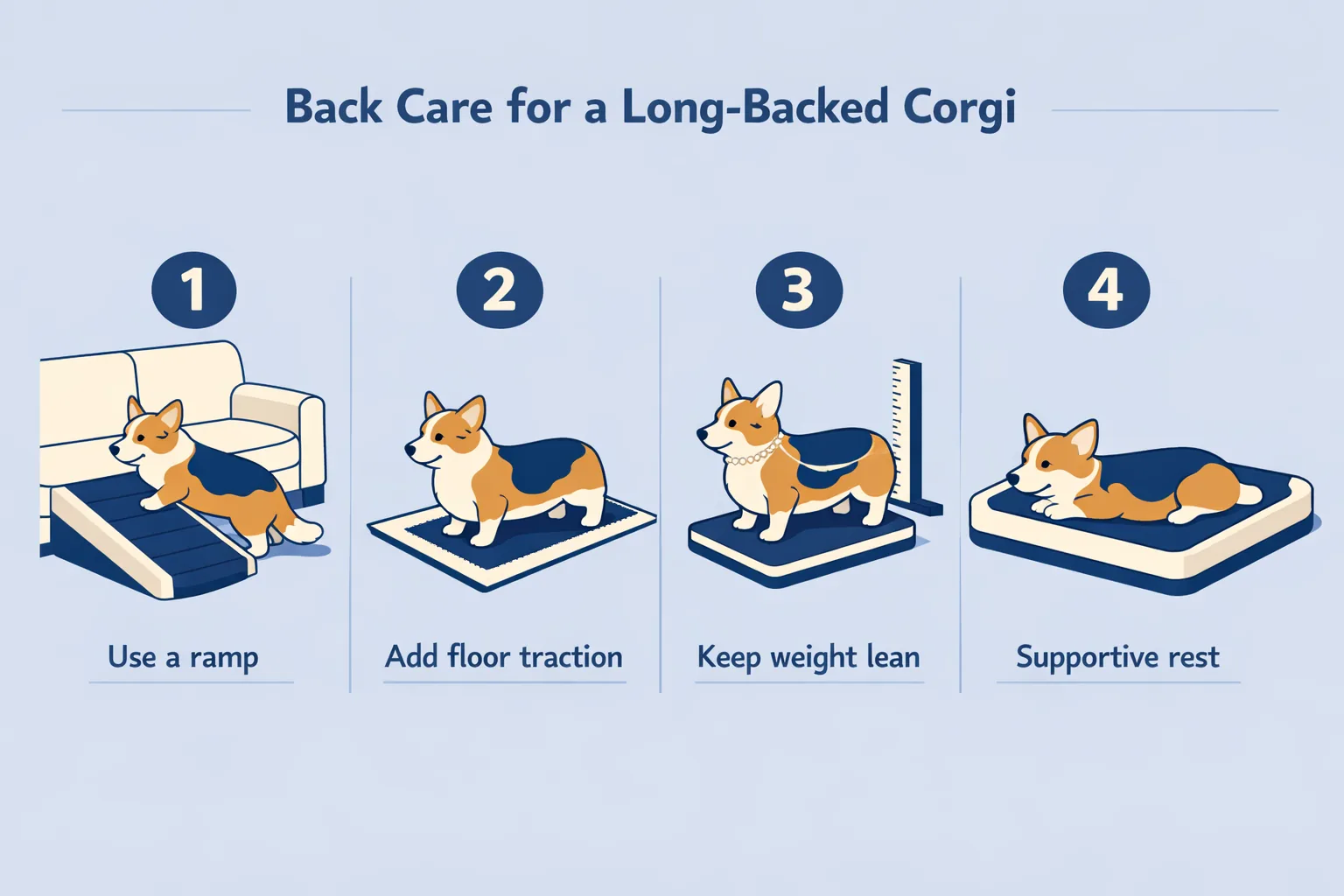
IVDD is the back-related one. The long spine and dwarfed build raise disc risk. Warning signs that need a vet the same day: sudden yelping, reluctance to jump, a hunched back, wobbly or dragging hind legs, or loss of bladder control. Weak or paralyzed back legs is an emergency. Call your vet or an emergency hospital immediately. Do not wait to see if it settles overnight.
Degenerative myelopathy is a progressive spinal cord disease usually appearing in older dogs, starting with hind-end weakness and knuckling. A DNA test identifies the common risk variant, though carrying two copies does not guarantee the disease will develop. That distinction matters and gets flattened constantly online.
Screening to ask a breeder for: hip evaluation (the Royal Kennel Club lists BVA/RKC hip scoring as best practice for Pembrokes), eye examination, von Willebrand testing, and DM genotype. The Welsh Corgi League published 2025/26 health survey results in August 2026 and opened a new owner survey on November 4, 2026, so breed-specific data is actively being gathered.
Daily back protection: keep the dog lean, add ramps to furniture and the car, put rugs on slick floors, use a Y-front harness instead of a neck collar for pulling, and discourage repeated jumping off beds.
What Do Corgis Love to Eat? Favorite Foods and Feeding
Feed a corgi measured portions of a complete adult food, because this breed gains weight easily and weight is a spinal issue, not a cosmetic one. Most adult Pembrokes eat somewhere around 3/4 to 1.5 cups of dry food daily split into two meals, adjusted to body condition, activity and the specific food’s calorie density.

Treats corgis tend to love that will not wreck the calorie budget:
- Baby carrots and cucumber slices
- Green beans, plain and unseasoned
- Blueberries
- Small pieces of plain cooked chicken
- Air-dried single-ingredient fish or liver, broken into tiny pieces
Foods to avoid entirely: grapes and raisins, onions and garlic, chocolate, xylitol (birch sugar) in peanut butter and baked goods, macadamia nuts, cooked bones, and anything heavily salted.
Practical rules that hold up: weigh the food instead of scooping, count treats inside the daily total (keep them under about 10 percent of calories), and use part of the meal ration for training. For help reading the bag, see our explainer on how to read a dog food label and what AAFCO means, and how to switch dog food without upsetting their stomach if you are changing brands.
Puppies need a food labeled for growth, fed three to four times daily until about six months. There is no evidence that a corgi needs a breed-specific formula. Calorie control and body condition matter far more than the shape of the kibble.
How Do You Keep a Corgi at a Healthy Weight?
Corgis love food, and their long back and short legs pay for every extra pound. Keeping a corgi lean is one of the simplest things you can do for its spine, its joints and its energy on walks. The AKC standard tops out around 30 lb for a male Pembroke and 28 lb for a female, and many healthy pets sit below that.
- Run the hands-on check monthly. You should feel the ribs under light pressure, see a waist from above, and see the belly tuck up slightly from the side.
- Measure every meal. A kitchen scale beats a scoop. Start from the feeding guide on the bag, then adjust by body condition, not by begging.
- Count the treats. Keep treats and chews to about 10 percent of daily calories, and break training treats into pea-sized pieces.
- Swap high-impact play for steady exercise. Brisk walks, sniff walks and herding-style ball games on flat ground burn calories without repeated jumping.
- Add ramps early. Ramps or steps for the sofa, bed and car keep a corgi from launching off furniture while you work on its weight.
If the scale keeps creeping up despite careful portions, book a vet visit. Thyroid problems and other medical causes can add weight, and your vet can set a target weight and calorie plan for your individual dog.
How to Train a Corgi
Train a corgi with reward-based methods and give it a job to do instead of the one it picked. The Merck Veterinary Manual recommends reward-based training, avoiding triggers where practical, and teaching alternative behaviors such as staying quiet or lying on a mat. Punishment can shut down the warning without reducing the arousal underneath it.
Can you train a corgi not to nip? You can train it to do something else when the nipping urge fires, which is the realistic goal. Instinct does not get deleted. It gets redirected.
Five behaviors worth teaching in the first year:
- Hand target. A nose-to-palm touch moves the dog without grabbing a collar and interrupts a chase before it starts.
- Go to mat. The single best tool for doorbells, dinner time and running children.
- Leave it. Applies to ankles, socks, and the cat.
- Recall off movement. Practice away from traffic, with a long line, paying generously.
- Quiet on cue. Mark the pause after barking, reward it, and build duration. Do not shout over the dog, because that sounds like joining in.
Stopping the barking without breaking the dog
- Identify the trigger first. Window barking, separation barking and demand barking need different fixes.
- Window patrol: block the sightline with frosted film or move the dog’s resting spot. Reduce the rehearsal and the habit weakens.
- Barking at you hugging someone: that is often arousal at movement and body contact. Teach a mat station and reward before the bark, not after.
- Leash reactivity: increase distance, mark and feed for calm looks, turn away before the threshold.
- Demand barking: stop reinforcing it, and teach the dog to go lie down for the thing it wants instead.
If barking has a panicky quality when you leave, that may be separation distress rather than herding noise and deserves a vet or veterinary behaviorist. Curious about the vocal range generally? Our piece on why dogs howl covers the other end of it.
Try It: Corgi Bark Trigger Decoder
Corgis were bred to move cattle with their voice and a nip, so the bark usually has a specific job attached to it. Pick what sets your corgi off below to see the likely reason and the first technique to try.
Doggy Rank IQ Tool
Corgi Bark Trigger Decoder

Corgis were bred to move cattle with their voice and a nip. Pick what sets your Corgi off to learn why it happens and what to try first.
How Much Does a Corgi Cost?
A Pembroke corgi puppy from a health-testing breeder in the U.S. commonly runs about $1,500 to $3,500, with waitlists of several months. Rescue adoption typically falls between $200 and $600. Prices checked November 2026 against U.S. breeder and rescue listings; regional variation is wide.
First year, rough budget:
| Item | Typical first-year range |
|---|---|
| Puppy or adoption fee | $200 to $3,500 |
| Vet (vaccines, spay/neuter, exams) | $500 to $900 |
| Food | $350 to $650 |
| Crate, bed, harness, ramps, toys | $300 to $600 |
| Training classes | $150 to $500 |
| Pet insurance | $300 to $700 |
Expect $1,200 to $2,500 per year afterward for food, routine vet care, grooming supplies and insurance, before any IVDD event. Back surgery, if it happens, often runs into five figures, which is why insurance tends to pay for itself in this breed specifically.
Finding a reputable breeder is the common frustration. Ask to see hip scores, eye certificates, vWD and DM results in writing. Meet the mother. Walk away from anyone selling “mini corgis,” shipping without a conversation, or producing litters year-round. A DNA test like Embark or Wisdom Panel can confirm risk variants after you bring a dog home.
Corgi Puppy Tips for the First 90 Days
The first 90 days decide whether you live with a trained corgi or a loud one. Focus on three things: socialization, bite redirection and back habits.
Weeks 1 to 4 (8 to 12 weeks old)
- Crate training and a predictable potty schedule
- Short, positive exposures to surfaces, sounds, hats, umbrellas and calm adults
- Start the name game and hand target
- Handle paws, ears and mouth daily so grooming is boring later
Weeks 5 to 8 (12 to 16 weeks old)
- Puppy class with a reward-based trainer
- Begin mat training before it is needed
- Redirect every nip onto a toy within one second, every time
- Introduce brushing in 60 second sessions
Weeks 9 to 12 (16 to 20 weeks old)
- Build alone-time tolerance in small increments
- Practice recall on a long line outdoors
- Add ramps now so furniture jumping never becomes the default
- Start a quiet cue before barking becomes a habit
Common mistake: letting a puppy win ankle games because it looks hilarious at 11 pounds. At 27 pounds with adult teeth and a running toddler, it stops being hilarious.
What Corgi Owners Say
Owner reports line up closely with the breed’s working history: fast learners, strong opinions, lots of noise.
“I have wanted a Corgi my entire life”
An owner on Reddit, posting after adopting a Pembroke Welsh Corgi. That sentiment is extremely common, and it is worth naming the risk inside it. A breed you have loved since childhood can arrive with behavior you did not budget for. The practical move is to write down, before the dog comes home, what you will do about barking at 7 a.m. and hair on everything. Enthusiasm is not a plan.
“For the most part he’s a good dog and is a very fast learner”
An owner on Reddit asking for help as a new Pembroke Welsh Corgi owner. Fast learning cuts both ways. A corgi that learns “sit” in four reps also learns that barking at the window makes people appear. Decide which behaviors you are accidentally paying for, then pay for the quiet ones instead.
Corgi FAQ
Why do corgis herd and bite at ankles? Because the Pembroke was bred to move cattle by nipping at heels. Embark notes the instinct fires at fast-moving people, children, pets and bikes. It is usually drive, not aggression, and it responds to redirection onto a toy plus a trained alternative behavior.
Why are corgis so vocal? Barking was part of the job. Corgis used voice to move livestock and to alert the farm, and VCA Canada describes some Pembrokes as frequent barkers. Exercise, enrichment and a trained quiet cue reduce it. Nothing eliminates it entirely.
Do corgis shed a lot? Yes. A corgi sheds year round from a double coat and blows the undercoat heavily twice a year. Brush two to three times weekly, daily during a blowout, and never shave the coat.
How long do corgis live? Roughly 12 to 13 years. Keeping the dog lean, protecting the spine and screening for hip, eye and DM risk gives the best odds of reaching the upper end.
Are corgis good for apartments? They can be, if you manage barking and give 60 to 90 minutes of daily activity. Our apartment-friendly dog breed picks lists quieter alternatives if thin walls are a concern.
Are corgis good for first-time owners? They are workable for a committed first-time owner who trains consistently. They are a poor match for someone who wants a quiet, low-effort, low-shedding dog.
What breeds are similar to corgis? Swedish Vallhund, Shetland Sheepdog, Australian Cattle Dog and the Cardigan Welsh Corgi share herding drive and alert barking. Dachshunds share the long-back care needs without the herding instinct.
What size space does a corgi need? Less than people expect. A one-bedroom apartment works if daily walks, training and enrichment happen. Floor traction and furniture ramps matter more than square footage.