
Quick Answer: Is a Cane Corso Right for You?
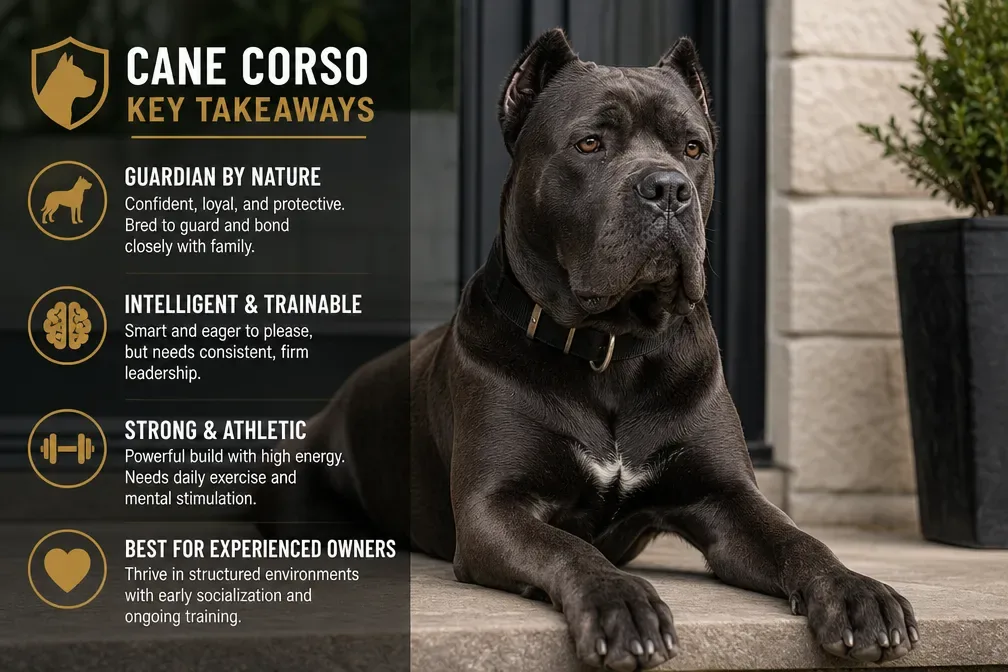
A cane corso suits confident, consistent owners with time, space, and large-dog experience. This is a 90 to 110 pound Italian guardian bred to watch property, not to greet strangers at the park. Trained and socialized early, most are calm, affectionate, deeply bonded house dogs. Skipped training plus 100 pounds of muscle is a problem you cannot out-love, which is why the American Kennel Club’s own lifestyle guide says the breed is usually a poor fit for first-time dog owners.
Key Takeaways: Cane Corso
- The cane corso climbed to No. 11 in the AKC’s 2025 breed popularity ranking, up from No. 14, which means more puppies and more careless breeders.
- Typical adult size: males around 25 to 27.5 inches tall and 99 to 110 pounds, females 23.5 to 26 inches and 88 to 99 pounds, per Britannica’s breed entry.
- Average lifespan is roughly 9 to 12 years, shorter than small breeds, as Dogster’s lifespan guide explains.
- The AKC recommends six health evaluations for breeding stock: hips, elbows, patella, cardiac, DSRA DNA, and NCL1 DNA (AKC Working Group testing requirements).
- The AKC breed standard calls the cane corso “docile and affectionate with its owner, loving with children and family”, a description of ideal type, not a promise about any individual dog (AKC breed standard PDF).
- Corsos keep maturing until roughly three years old, per an AKC parent club flier, so plan for a long adolescence.
- No U.S. state bans ordinary cane corso ownership, but landlords, HOAs, and home insurers restrict the breed regularly (Legal Clarity).
Where Does the Cane Corso Come From?
The cane corso descends from Roman Molossian-type dogs of southern Italy, then spent centuries as a working farm guardian before nearly vanishing in the mid-20th century. Italian enthusiasts rebuilt the breed from a small surviving population starting in the 1970s. The AKC gave it full recognition in 2010.

The name is commonly read as “guardian dog” or “bodyguard dog,” and the job description matched. Corsos drove cattle, guarded the farmhouse, held wild boar, and worked where one dog had to make decisions alone. That last part explains more about modern behavior than any temperament chart. You are living with a dog bred to assess a stranger and act without asking.
Mechanized farming in postwar Italy removed the job. Numbers collapsed. A group of breeders in Puglia and the surrounding regions tracked down the remaining dogs and started a recovery program, and the Italian kennel club recognized the breed in 1994.
The revival matters for buyers today. A reconstructed breed with a narrow founding population and a recent popularity spike is exactly the setup that rewards careful breeders and punishes casual ones. If you want context on where the corso sits among other guardians, our guide to protection dog breeds compares the working types side by side.
What Makes the Cane Corso So Special (and So Cute)?
What owners love most is the contrast: a dog built like a bank vault who leans on your leg while you brush your teeth. Corsos bond hard to their household and follow their person from room to room. They are also genuinely funny once you know them.
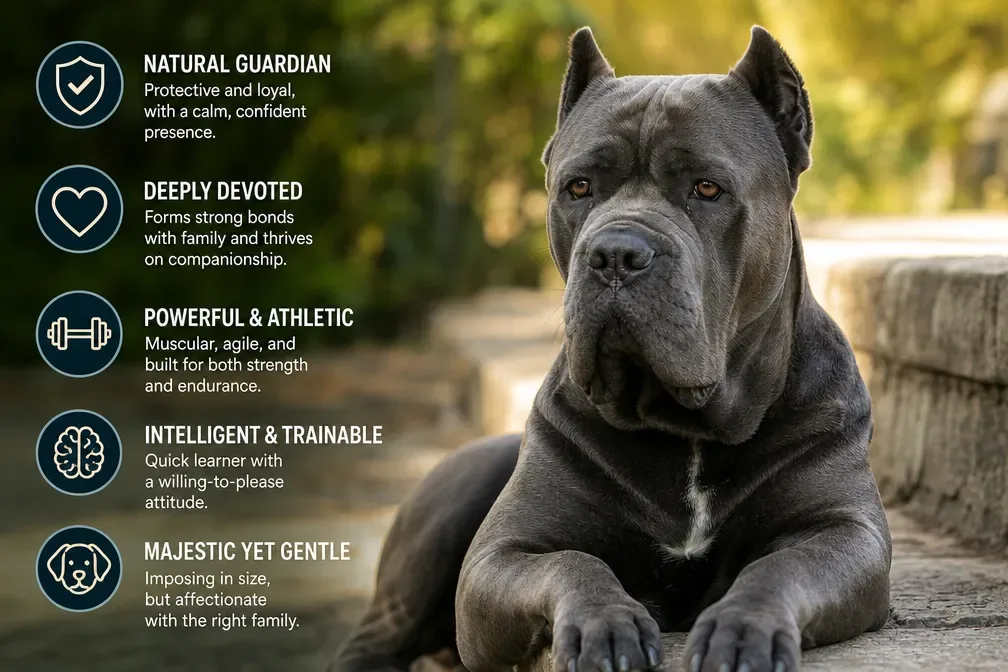
The visual appeal is obvious. Deep chest, square head, expressive brow, a coat in black, gray, fawn, red, or brindle. Puppies have forehead wrinkles that make them look permanently mildly offended. The adults keep the eyebrow mobility, and that is where the “expressive” reputation comes from.
Beyond looks:
- Quiet in the house. A well-exercised adult corso is often a floor rug with opinions.
- Low-noise guarding. Many are not barky. They watch, then position themselves.
- Trainable intelligence. They learn routines fast, including the ones you did not intend to teach.
- Velcro affection. Expect a 100-pound dog who thinks he is lap-sized.
One honest caveat on the cute factor. Social media has made the cane corso a visual trend, and plenty of people buy the aesthetic without the training plan. The puppy is adorable for about eight months. Then he is a strong adolescent testing every boundary at once.
Cane Corso Size, Weight and Lifespan
Adult cane corsos are large but not giant: males typically 25 to 27.5 inches at the shoulder and 99 to 110 pounds, females 23.5 to 26 inches and 88 to 99 pounds, with a lifespan around 9 to 12 years. Some males exceed 120 pounds. That is not a goal to aim for.
| Measure | Male cane corso | Female cane corso | Notes |
|---|---|---|---|
| Height at shoulder | 25 to 27.5 in | 23.5 to 26 in | Per Britannica |
| Weight | 99 to 110 lb | 88 to 99 lb | Lean working condition |
| Average lifespan | 9 to 12 years | 9 to 12 years | Per Dogster |
| Full physical maturity | Up to ~3 years | Up to ~3 years | Per AKC club flier |
Two practical points. First, keeping a corso lean adds comfortable years, because extra weight loads hips and elbows that are already carrying a lot. Second, slow growth means you should not run hard surface impact work with a puppy under about 18 months.
If you are trying to work out which gear and vet cost tier you fall into, see our breakdown of large versus giant breed sizing.
What Is the Cane Corso Temperament Like?
A cane corso is protective, confident, and reserved with strangers, not inherently aggressive. The AKC’s 2026 guidance makes that distinction directly: Corsos may become reactive or overly controlling without structured socialization and training, which is a management problem, not a fixed trait.
What that looks like in daily life:
- Inside the house with family: affectionate, physically close, calm, often goofy.
- With a visiting stranger: watchful, neutral at best, usually not interested in petting.
- On a walk past another dog: depends almost entirely on early socialization and handler skill. Same-sex dog intolerance is common in the breed.
- When something is genuinely odd: deliberate. A corso tends to place itself between you and the thing.
Compared with a German Shepherd, the corso is generally less biddable and less social, and slower to recover from arousal. Shepherds want the job explained. Corsos want to decide whether the job is necessary. Neither is better. The shepherd is usually the easier first protection dog, which is why our guard dog breeds comparison ranks handler experience alongside the dog.
On bite force, skip the numbers you see online. Most circulated PSI figures for the cane corso trace back to no published measurement on this breed. What is verifiable: this is a big-headed, powerful dog, and any bite from one is a serious event. Train accordingly rather than quoting statistics.
Common mistake: treating stranger-wariness as a flaw to fix with forced greetings. Pushing a reserved corso into handling by strangers can create the exact defensive behavior you were trying to prevent. Aim for neutrality, not friendliness.
Are Cane Corsos Good With Kids and Other Pets?
Many cane corsos are gentle and tolerant with the children in their own household, and the AKC standard describes the breed as loving with family children. That is the ideal type. The practical answer still depends on the individual dog, the breeder, the training, and your supervision habits.
Real factors that change the outcome:
- Size accidents. A happy 100-pound dog clears a toddler like a bowling pin. Teach a settled greeting before the baby starts walking.
- Guarding generalization. Some Corsos become protective of “their” kids and misread rough play from visiting children as a threat. Manage playdates actively.
- Other dogs. Opposite-sex pairings usually work better. Two same-sex adult Corsos in one home is a setup many experienced owners avoid.
- Cats and small pets. Possible with early exposure, but prey drive varies, and chasing is not a behavior you want to test once.
Choose a different breed if nobody in the house will reliably supervise dog-child interaction, or if you want a dog who greets every child on the street happily. Families wanting that profile should compare the options in our popular family dog breeds guide.
Supervision is not a slur on your dog. It is what you do with any large guardian breed around children, every time, for the life of the dog.
Who Is the Cane Corso Made For, and Who Should Skip It?
The cane corso fits confident owners with previous large-dog experience, a secure property, time for daily training, and a budget that absorbs big vet bills. It fits poorly for most first-time owners, which the AKC states plainly.
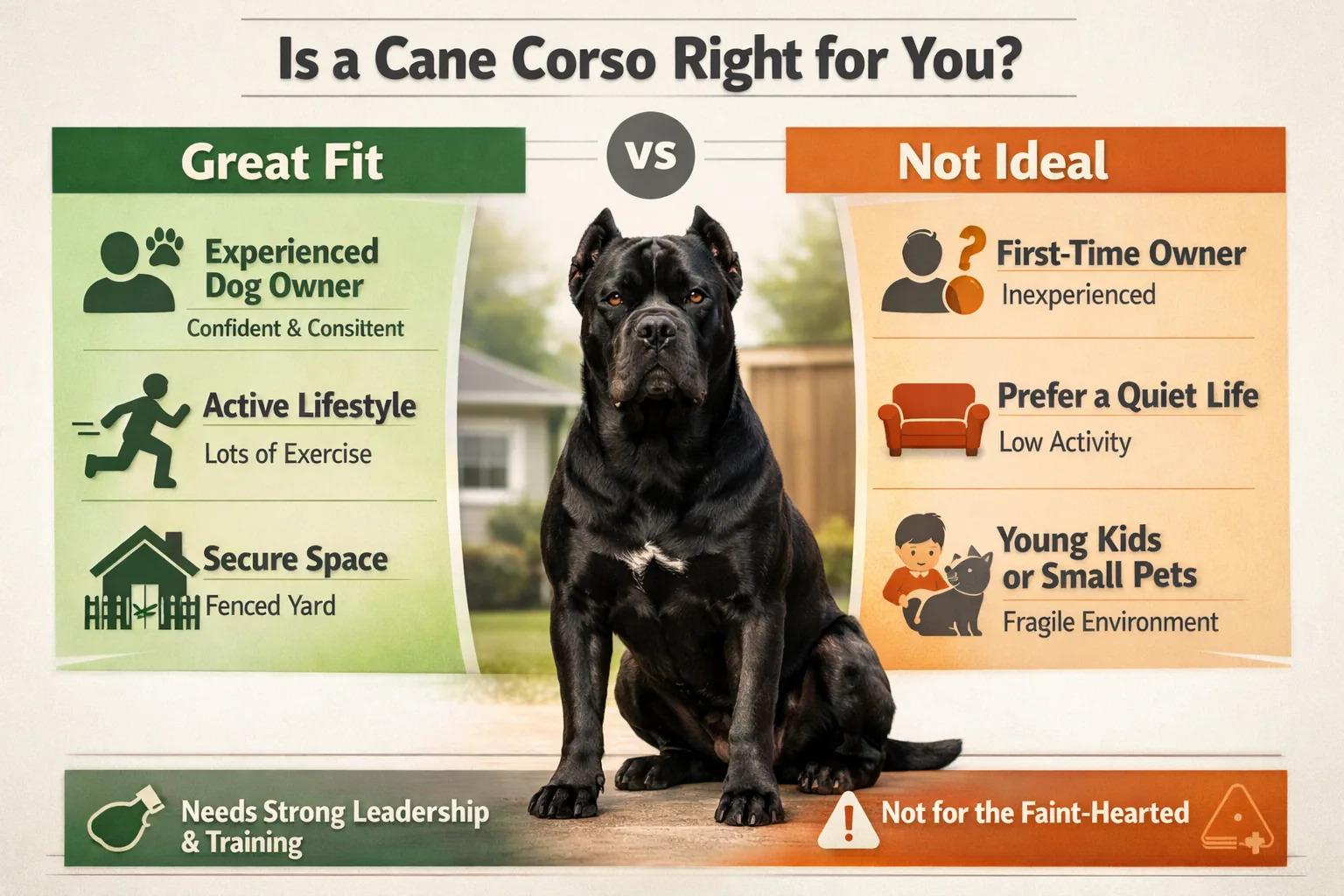
Good fit if you:
- have handled a 70 pound-plus dog through adolescence before
- are home enough to train and exercise daily, not just weekends
- own your home or have written landlord approval, and have checked your insurer
- want a watchful guardian and are fine with a dog who ignores strangers
- can budget roughly $2,000 to $4,000 a year for food, vet care, and insurance
Skip it if you:
- want a dog you can hand to any pet sitter or dog park
- travel often with unpredictable schedules
- are buying for looks or status
- live somewhere with restricted-breed rental or HOA rules
- want a low-effort companion, in which case start with lower-maintenance breed options
Insurance is the overlooked one. Several homeowners and renters insurers place the cane corso on restricted-breed lists, exclude dog liability, or decline renewal, as industry reporting on restricted lists documents. Call your carrier before you pay a deposit, not after.
How Much Exercise Does a Cane Corso Need?
Plan on 60 to 90 minutes of physical activity daily for an adult cane corso, split across two or more sessions, plus mental work. This is a working guardian, not a marathon breed. Steady, varied, purposeful activity beats one exhausting run.
A realistic weekday:
- Morning: 30 minute structured walk with leash manners practice, not sniff-free route marching.
- Midday: 10 minutes of obedience or a food puzzle.
- Evening: 30 to 45 minutes combining a walk, a decompression sniff area, and short drag-weight or hill work for fit adults.
Mental work matters as much as mileage. Scent games, a flirt pole (short sessions, flat ground, adults only), place training, and obedience under mild distraction will tire a corso faster than another lap of the block. Enrichment is not a luxury here. A bored corso redesigns your furniture.
Puppy rule: keep impact low until the growth plates close. Short lead walks, soft surfaces, no forced jogging, no repetitive stair work, no jumping out of the SUV. Let him jump down at 10 months and you may pay for it at seven years old.
Heat warning: Corsos have shortish muzzles and dense muscle. On warm humid days, exercise early or late. Heavy panting that does not settle, bright red gums, wobbling, or collapse is a veterinary emergency. Cool the dog and call a vet immediately.
Cane Corso Grooming and Shedding
Cane corso grooming is easy. Cane corso shedding is not nothing. The short double coat sheds year-round with two heavier seasonal drops, and the stiff hairs weave into upholstery like tiny needles.
A workable routine:
- Weekly: rubber curry mitt or short-bristle brush, five minutes, outdoors if possible.
- Shedding season (spring and fall): every other day, plus a deshedding tool used lightly.
- Bath: every six to eight weeks, or when he finds something regrettable.
- Nails: every two to three weeks. Big dog, big use, start as a puppy.
- Ears and skin folds: check weekly, dry after swimming.
- Teeth: brush several times a week. Dental disease is the quiet cost nobody budgets for.
Then there is drool. Corsos with looser flews sling it, and the trajectory is remarkable. Owners who stay sane keep a drool towel in every room, wipe the jowls after drinking, and choose washable throws over nice fabric. If grooming routines are new to you, our beginner’s guide to dog grooming covers the basics in order.
Quick example: one towel by the water bowl and one by the front door handles about 80 percent of the mess in most households. The sofa is the thing you are really protecting.
Common Cane Corso Health Problems
The most reported cane corso health problems are hip and elbow dysplasia, gastric dilatation-volvulus (bloat), cardiac disease including dilated cardiomyopathy, eyelid issues such as entropion and cherry eye, and certain inherited eye and neurological conditions. Screening parents reduces risk. It does not eliminate it.
The AKC’s Working Group page recommends six evaluations for breeding cane corso stock: patella, hip, elbow, cardiac, DSRA DNA, and NCL1 DNA. The AKC’s breed-specific DNA list adds Multifocal Retinopathy 1. Ask any breeder to show results for both parents. Ask by name. A breeder who cannot produce OFA or equivalent paperwork is telling you something.
Bloat is the emergency to know cold
Gastric dilatation-volvulus is the deep-chested breed emergency. Signs: a swollen, tight abdomen, unproductive retching, pacing, drooling, restlessness, pale gums. This kills in hours. Do not wait and watch. Drive to an emergency vet.
Many owners of deep-chested breeds discuss preventive gastropexy at the time of spay or neuter. Our explainer on gastropexy surgery for dogs covers what the procedure does and what it does not prevent. Discuss it with your own vet.
Everything else
Keep the dog lean, keep joints in condition, screen the heart annually from middle age, and watch for eyelid irritation. A corso who reaches 11 in good shape has usually had an owner managing weight and catching things early.
What Do Cane Corsos Love to Eat? Favorite Foods and Feeding
Feed a cane corso a complete large-breed formula appropriate for the life stage, split into two or three measured meals a day, never one large bowl. Adults typically eat around 4 to 6 cups of kibble daily depending on food density and activity, which is real money.
Practical feeding points:
- Puppies need large-breed puppy food with controlled calcium and energy, which supports slower joint growth. Do not feed a standard puppy formula and do not supplement calcium.
- Split meals and rest after eating. No hard exercise for an hour either side of a meal, as part of general bloat caution.
- Slow feeders help gulpers. A corso can finish a bowl in 40 seconds otherwise.
- Check the label. Confirm the AAFCO statement matches the life stage. Our guide on how to read a dog food label and what AAFCO means walks through it.
Treats most Corsos love: plain cooked chicken or turkey, freeze-dried liver (tiny pieces, strong motivator), carrot sticks, green beans, plain pumpkin, frozen apple slices without seeds, and a kibble-stuffed frozen toy for crate time. Keep treats under 10 percent of daily calories.
Foods to avoid completely: grapes and raisins, onions and garlic, xylitol (birch sugar) in peanut butter and gum, chocolate, macadamia nuts, cooked bones, alcohol, and heavily salted human snacks. Fatty table scraps are an easy route to pancreatitis in a dog this size.
Budget check: a 100-pound dog on a mid-range kibble commonly runs $70 to $130 a month in food alone. Buying in larger bags and storing airtight is the honest way to cut that without downgrading nutrition. Compare formulations in our buyer’s guide to choosing healthy dog food.
How to Train a Cane Corso
Train a cane corso with early socialization, reward-based methods, and boundaries you never relax. Corsos are responsive and quick to learn, which is different from easy. Their power and guardian instincts mean small training gaps become big behavior problems.
Priorities in order:
- Socialization window (roughly 3 to 16 weeks). Calm, positive exposure to surfaces, sounds, vehicles, umbrellas, hats, people of different ages and appearances, and stable adult dogs. Quality over volume. Neutral is the goal.
- Name, recall, and loose leash from week one. A 25 pound puppy pulling is practice for a 100 pound dog pulling.
- Place and settle. The single most useful household behavior for a guardian breed. It gives the dog a job when the doorbell rings.
- Door and threshold manners. No barging. No guarding the entryway.
- Handling and muzzle conditioning. Do it early and cheerfully. Vets will thank you.
- Adolescent re-training (8 to 24 months). Expect regression. Re-teach everything with higher reinforcement and tighter management.
Use humane training throughout: clear markers, food and play rewards, and management that prevents rehearsal of bad behavior. Punishment-heavy methods with a confident guardian breed risk escalating defensive responses, and they damage the handler relationship you rely on.
Hire help early. A qualified trainer with large guardian breed experience, booked before problems start, costs far less than a behaviorist booked after a bite. For first-time owners drawn to the breed, that line item is not optional.
Try It: Cane Corso Readiness Score
A cane corso is a powerful guardian that needs a confident, consistent owner. Answer six questions to see how ready you are and where the gaps are.
Doggy Rank IQ Tool
Cane Corso Readiness Score

A Cane Corso is a powerful guardian that needs a confident, consistent owner. Answer six questions to see how ready you are and where the gaps are.
Cane Corso Readiness Score
Six questions. Honest answers only.
‘+(i+1)+”. “+q+’