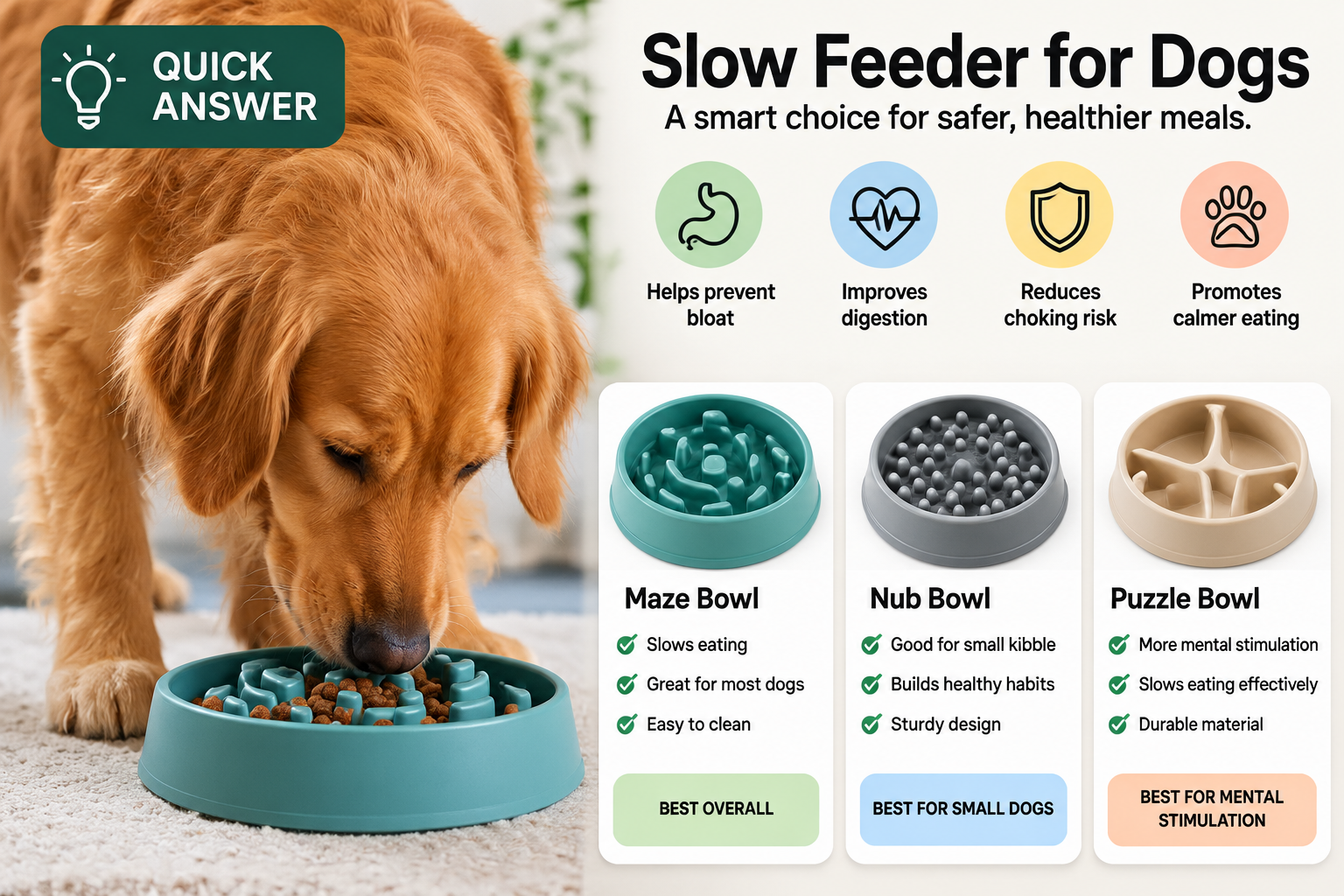
Quick Answer
No slow feeder for dogs has been shown to prevent bloat. What a maze bowl reliably does is make a meal take longer, which can help dogs who gulp, swallow air, vomit shortly after eating, or finish in seconds and then stare at the empty bowl with real disappointment. Fast eating shows up as a possible risk factor for gastric dilatation and volvulus (GDV) in some observational research and not in others, and the only intervention currently described as significantly reducing lifetime GDV risk is prophylactic gastropexy surgery in appropriately selected high-risk dogs. Guidance checked October 2026.
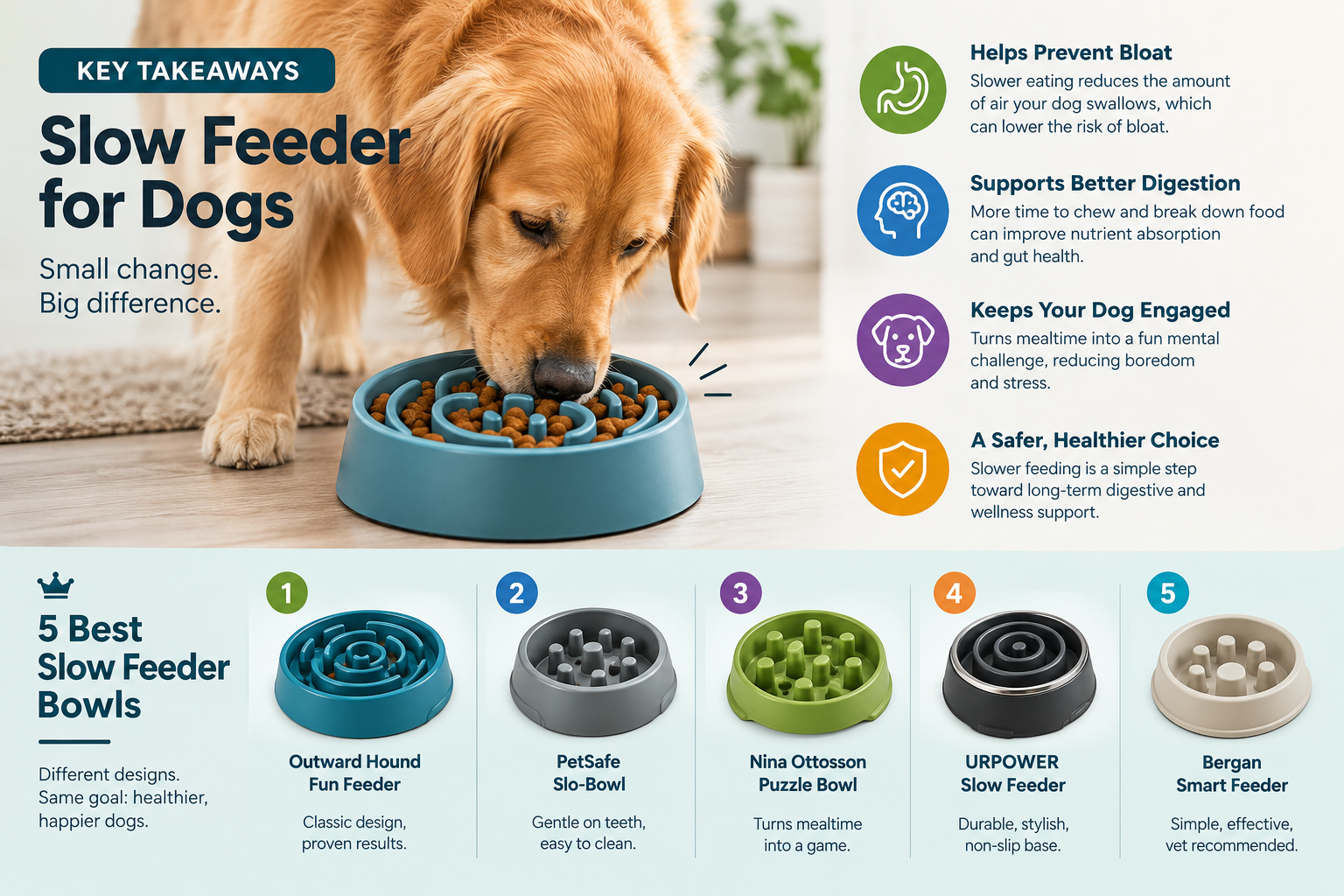
Key Takeaways: Slow Feeder for Dogs
- A slow feeder for dogs is a bowl with ridges, mazes, domes, or inserts that force a dog to work food out of narrow gaps instead of inhaling it from an open dish.
- Veterinary education material from Chewy’s slow feeder explainer, updated October 3, 2026, states plainly that no bowl can completely prevent GDV, though slowing rapid eating may reduce risk in susceptible dogs.
- A Veterinary Evidence review of eating speed and GDV found the available studies mixed and limited. Most found no significant relationship. The studies that did find one implicated fast eating, not slow eating.
- Manufacturer claims run ahead of clinical proof. Outward Hound’s 2026 product materials advertise slowing eating by “up to 10x,” which is a claim about eating speed, not evidence of fewer GDV cases.
- Best candidates: fast eaters who regurgitate whole kibble, dogs who guard food from housemates, bored eaters, and dogs recovering from gastrointestinal upset under vet direction.
- Poor candidates without modification: flat-faced breeds with short muzzles, dogs with dental pain or jaw problems, and dogs who become genuinely frustrated and skip meals.
- Choose stainless steel or a steel insert for wet food and easy washing, plastic maze bowls for cheap variety, ceramic for weight and chew resistance.
- Estimated US price bands in October 2026 run roughly $8 to $45 depending on material and size. These are estimates, not quoted prices.
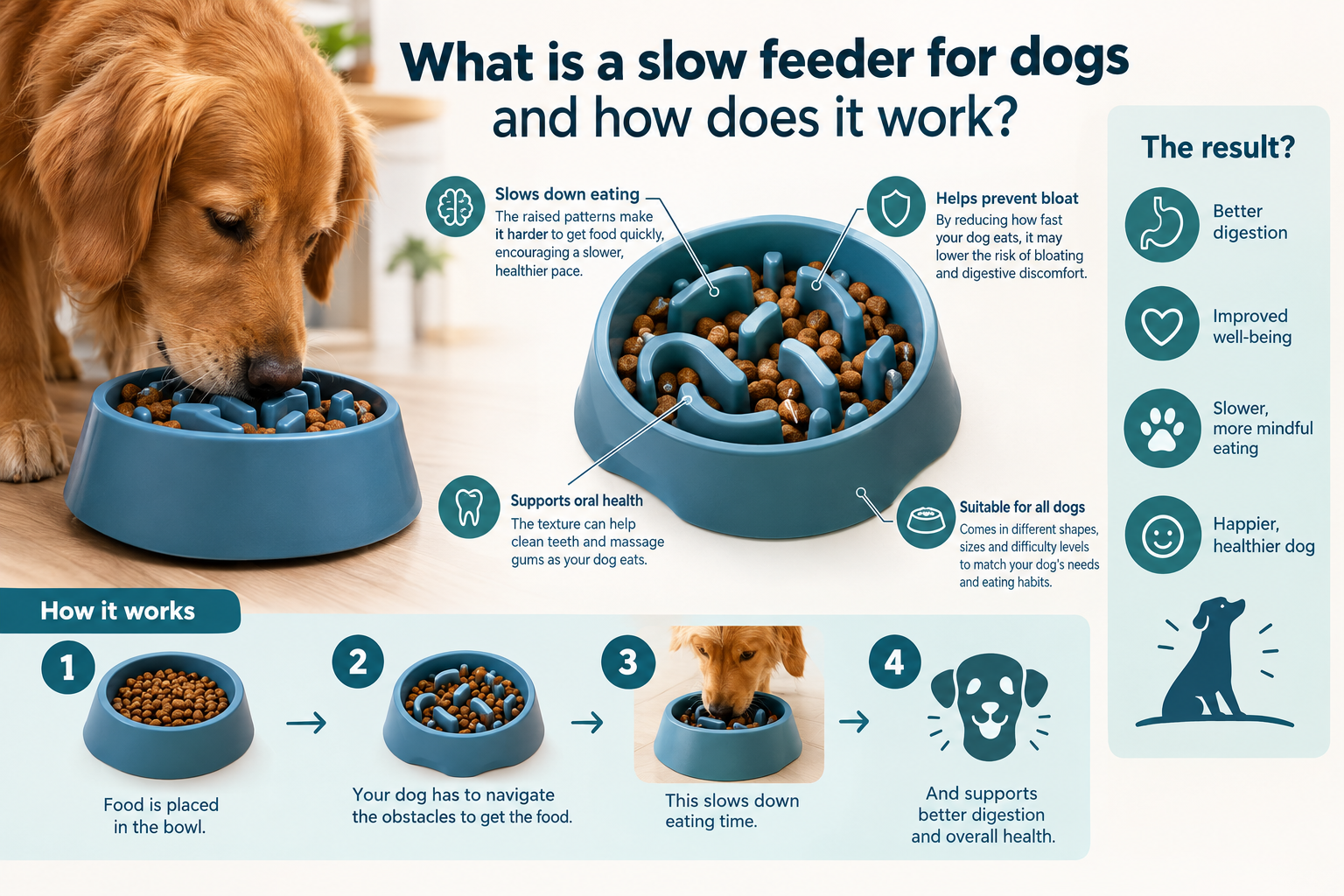
What is a slow feeder for dogs and how does it work?
A slow feeder is a feeding dish with obstacles built into the surface. Instead of a clear pool of kibble, the dog gets food spread between walls, ridges, posts, or a raised central dome, so each mouthful has to be licked or nosed out of a narrow space. The mechanism is simple physics plus patience.
The main styles, as sold by retailers like Chewy’s dog slow feeder category:
- Maze and spiral bowls. Molded plastic with tall ridges. The most common design, and the cheapest.
- Dome or centre-post bowls. A raised middle pushes food to the outer ring, so the dog eats around a circle.
- Grid feeders. A rigid tray covered in blunt plastic fingers. Food falls between them and has to be tongued out.
- Inserts. A separate ridged plate, often stainless steel or silicone, that drops into a bowl you already own.
- Lick mats and snuffle mats. Not bowls, but they do the same job for wet food and small portions.
Decision rule: if your dog mostly eats dry kibble and finishes in under a minute, start with a maze bowl in the correct size. If your dog eats wet or raw food, pick a smooth-surfaced steel insert or a shallow ridge pattern, because narrow plastic channels and wet food are a cleaning problem you will resent by day three.
Common mistake: buying the deepest maze available. A dog who cannot physically reach the food does not slow down. They give up, or they flip the bowl and eat off the floor, which is the opposite result.
Do slow feeders prevent bloat? What the research actually supports
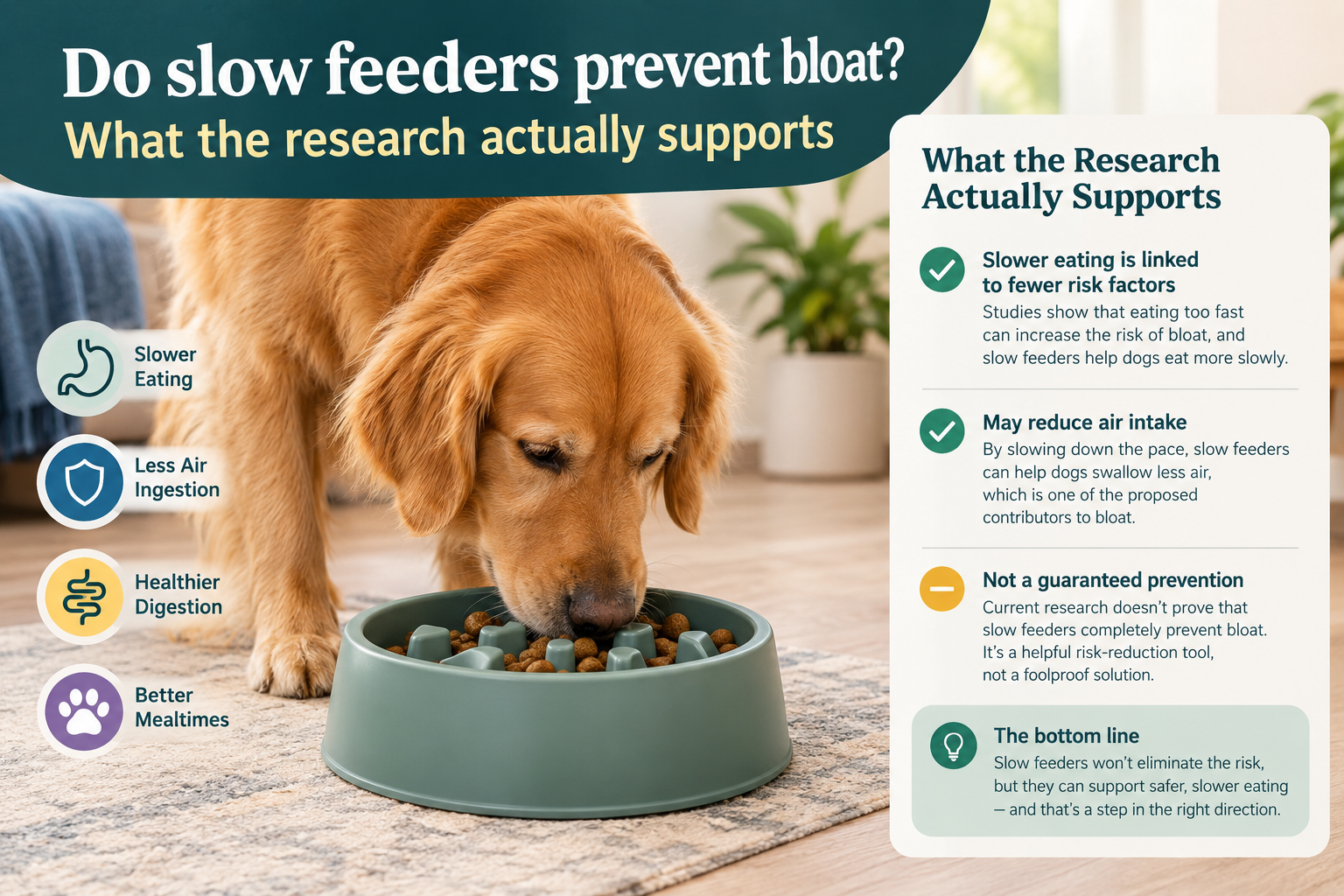
A slow feeder has not been shown to prevent bloat or GDV. The evidence supports a narrower statement: rapid eating appears on several veterinary risk-factor lists, and slowing a fast eater is a reasonable step for a susceptible dog, with no guarantee attached.
GDV involves the stomach distending with gas and, in the dangerous form, rotating. That is a surgical emergency. The American College of Veterinary Surgeons treats GDV as immediately life-threatening and describes prophylactic gastropexy, where the stomach is tacked to the body wall, as the preventive surgical option for high-risk dogs. A 2026 cross-sectional study stated that prophylactic gastropexy is the only intervention shown to significantly reduce lifetime GDV risk, citing breed-study reductions ranging from 2.2-fold in Rottweilers to 29.6-fold in Great Danes. Worth sitting with: even gastropexy generally does not stop the stomach from dilating. It is intended to reduce the chance of the twist.
A bowl cannot do either of those things. It can only change how fast food arrives.
What the research found on eating speed
Observational research from Purdue University led by Lawrence Glickman and colleagues, published around 2000, followed large and giant breed dogs and reported associations between GDV and factors including increasing age, a first-degree relative with GDV, a deep and narrow chest, and faster eating. A later Veterinary Evidence review summarizing this body of work reported that large-breed dogs who ate quickly were described as 2.36 times more likely to develop GDV than slow eaters, with other estimates of 2.59 for moderately fast eaters and 4.72 for fast eaters. The same review cautioned that confidence intervals and study design weaken the certainty of those figures.
Then the other side. An internet-based survey of GDV risk factors published in JAVMA could not demonstrate an association between GDV and feeding frequency, eating speed, or feeding height, and the authors therefore declined to make recommendations on those points.
Merck Veterinary Manual’s GDV guidance emphasizes genetics and conformation, specifically deep or narrow chests and a first-degree relative with GDV, as the proven risk factors, with rapid eating, once-daily feeding, dry food, lean body condition, stress, and advancing age listed alongside. Cornell’s Riney Canine Health Center guidance, dated October 2, 2026, lists rapid eating as one factor among many, including raised bowls and exercise soon after meals. Even post-meal exercise advice is unsettled: a September 2026 veterinary article noted that older guidance stressed strict rest, while a newer study reportedly linked moderate post-feeding exercise with lower risk, and the author still advised avoiding strenuous activity after a large meal.
Where the facts end: fast eating is a plausible, partly supported risk factor. A slow feeder addresses that one factor. It does not address chest shape, family history, age, or temperament, and nobody has run a trial showing slow feeder bowls reduce GDV cases.
If you own a Great Dane, Standard Poodle, Weimaraner, or another deep-chested breed, the conversation that matters is with your vet about gastropexy timing and emergency signs, not which maze bowl has the better reviews. Breed size categories and what counts as a giant breed are explained in our guide to dog size categories from small to giant.
Do vets recommend a slow feeder for dogs?
Veterinary-reviewed consumer guidance generally supports slow feeders as a practical tool for fast eaters while rejecting the idea that a bowl prevents bloat. That is the honest version of “vet recommended,” and it is the version you should trust.
The reasons repeated across veterinary education material and editorial reviews from Whole Dog Journal’s slow feeder bowl roundup and Forbes’ slow feeder bowl guide:
- Less air swallowed, which can mean less burping and less immediate regurgitation.
- Fewer episodes of a dog bringing up undigested kibble minutes after a meal.
- A small amount of mental work at mealtime, which counts as everyday enrichment.
- Slower eating during post-illness feeding, when a vet has asked you to pace meals.
No product should be labelled safe for all dogs, and no slow feeder should be sold to you as medical prevention. If your dog vomits often, drools, strains, has a swollen or tight abdomen, or retches without producing anything, that is a vet call, not a bowl purchase.
Is your dog eating too fast?
There is no published, agreed-upon number of seconds per cup that defines “too fast.” So use your own dog as the baseline: time one ordinary meal now, switch to a slow feeder, then time the same meal again next week. The change tells you whether the bowl is doing anything. Vomiting after meals, repeated gulping of air, or food guarding matters more than any stopwatch.
Which dogs need a slow feeder the most?
- Dogs who finish a full meal in well under a minute and then retch or bring food back up.
- Dogs in multi-dog homes who bolt food to beat a housemate.
- Puppies learning that food is not a race, worth pairing with correct portions from our guide to puppy food in the first year.
- Dogs who need a little mental work at dinner because the day was short on walks.
- Dogs your vet has asked you to feed in slower, smaller amounts.
Slow feeder vs regular bowl for dogs: what actually changes
A regular bowl delivers food as fast as the dog can take it. A slow feeder adds friction. The real trade is a longer, tidier meal in exchange for harder cleaning and a bowl some dogs dislike.
What improves with a slow feeder
- Meal duration goes up, often considerably, which is the only effect the design can honestly claim.
- Less air gulped, which can mean less immediate burping or regurgitation.
- A dose of problem-solving at a time of day your dog already cares about.
What gets worse
- Cleaning. Every ridge is a place for wet food, grease, and biofilm.
- Frustration risk for anxious, elderly, or short-muzzled dogs.
- Plastic wear. Scratched plastic holds bacteria and odour, so worn bowls need replacing.
- Cost, mildly, compared with a plain steel dish.
Edge case: dogs with dental disease, a healing jaw, or missing teeth often do better with a plain bowl plus a different pacing method, such as hand feeding or several small meals. Scraping food from hard plastic ridges is unkind when a mouth already hurts.
The 5 best slow feeder bowls for dogs
Review method: this comparison is based on published product specifications, retailer listings, and editorial reviews from outlets including Forbes, Whole Dog Journal, Dogster, Business Insider, and People. No hands-on testing was performed for this article, and nothing here is a medical claim. Price bands are estimates for common US retail listings in October 2026, not quoted prices, and they shift with size and colour. Affiliate disclosure: Doggy Rank IQ may earn a commission from retailer links. The ranking follows reader needs and the available evidence, not commission.
| Bowl | Material and sizes | Dishwasher | Who it suits | Price band (est. Oct 2026) |
|---|---|---|---|---|
| Outward Hound Fun Feeder Slo Bowl | Plastic, mini to large, several maze patterns | Top rack, per brand | Dry-food gulpers, first-time buyers | $10 to $20 |
| Neater Pet Brands Slow Feed Bowl | Plastic, single wide size, gentle ridge pattern | Top rack, per brand | Medium dogs, mild slowing, feeder-station fit | $12 to $25 |
| Dogit Go Slow Anti-Gulping Bowl | Plastic, small and medium, central dome | Top rack, per brand | Small dogs, simple design, easier washing | $10 to $18 |
| Northmate Green Interactive Feeder | Rigid plastic grid tray, one large size | Yes, per brand | Large determined eaters, maximum slowing | $30 to $45 |
| Stainless steel slow feeder insert | Steel plate, multiple diameters, brand varies | Yes, steel | Wet or raw food, chewers, plastic avoiders | $12 to $30 |
1. Outward Hound Fun Feeder Slo Bowl
Verdict: the default first purchase, and the one most editorial roundups, including Dogster’s slow feeder bowl reviews, list near the top. Who it suits: dogs eating dry kibble who clear a bowl in seconds. Evidence: Outward Hound’s September 2026 materials advertise slowing eating “up to 10x,” a manufacturer performance claim about speed, not a reduction in GDV cases. Drawbacks: plastic scratches, the deeper maze patterns are hard to scrub, and the non-skid base still slides on wet tile.
2. Neater Pet Brands Slow Feed Bowl
Verdict: a milder, wider pattern for dogs who refuse a tight maze. Who it suits: medium dogs, mild gulpers, and owners who already use a raised feeder station from the same brand. Drawbacks: fewer size options and less slowing than a grid feeder, so very determined eaters will beat it.
3. Dogit Go Slow Anti-Gulping Bowl
Verdict: the simple one. A central dome instead of a complicated maze, which means fewer crevices. Who it suits: small and toy breeds and anyone who hates scrubbing channels. Drawbacks: the slowing effect is modest, and a large dog can empty the outer ring quickly.
4. Northmate Green Interactive Feeder
Verdict: the strongest slowing of the five, and the one that looks least like a bowl. Who it suits: large, fast, determined eaters who have already outsmarted a maze bowl. Drawbacks: bulky, one size, the highest price band, and useless for wet food. Some dogs find the blunt fingers annoying and quit.
5. Stainless steel slow feeder insert
Verdict: the sensible pick for wet food, raw food, or dogs who chew plastic. A ridged steel plate drops into a bowl you own. Who it suits: owners who feed wet food, listed as a practical format across Chewy’s slow feeder bowl listings and in Business Insider’s dog bowl guide. Drawbacks: fit matters, so check the dimensions of both the insert and your bowl, and a loose plate can rattle or be nosed out.
Numbers worth keeping in mind
What are the downsides of slow feeder bowls?
The real costs are cleaning, frustration, worn plastic, and poor fit for some face shapes. Reported choking from a slow feeder is not a documented pattern, and a search of the US Consumer Product Safety Commission recall database on October 1 and 2, 2026 showed no slow-feeder-specific recall in the available results. That does not make every bowl safe for every dog.
Can slow feeders cause choking or other problems?
The plausible problems are different from choking. A dog who cannot reach food may swallow larger, hurried mouthfuls between ridges, chew the bowl edge, or flip the whole thing. Damaged plastic is the more realistic hazard: cracks, sharp edges, and broken-off pieces. Inspect bowls monthly and retire anything chipped, deeply scratched, or chewed.
Flat-faced breeds
Pugs, French Bulldogs, Bulldogs, Boxers, and Shih Tzus have short muzzles that cannot work into narrow channels. Many brachycephalic dogs also swallow air at speed, so slowing a meal is appealing in theory. Pick very wide, shallow patterns or a grid feeder, and watch the first three meals. If the dog is panting, giving up, or getting food in the nose, go back to a plain shallow dish and use portion splitting instead.
Plastic, frustration, and cleaning
Plastic is cheap and light and it scratches. Steel and ceramic last longer and clean better. On frustration, the signal is behavioural: a dog who paces, whines, walks away, or leaves food is telling you the task is too hard. Make it easier rather than waiting it out, especially with anxious dogs or seniors, whose changing needs are covered in our guide to dog food for puppies, adults and seniors.
Are slow feeders good for all dog breeds?
No. A slow feeder suits most medium and large dogs with normal muzzles and healthy mouths, and it suits short-muzzled dogs, tiny breeds, seniors, and dogs with dental disease far less well. Breed labels only get you so far, because individual variation decides it.
- Deep-chested large and giant breeds: reasonable use, and the group most often discussed in bloat research. Pair it with vet advice on gastropexy, not with false reassurance.
- Small and toy breeds: use a mini size with shallow ridges. A deep maze built for a Labrador is a wall to a Chihuahua.
- Flat-faced breeds: wide, shallow patterns only, with supervision.
- Seniors and dogs with dental pain: usually skip it. Smaller, more frequent meals, softer food, or hand feeding does the same job kindly. Wet versus dry dog food matters more here than the bowl.
- Guarding or anxious dogs: slowing a meal while another dog circles can increase tension. Feed separately first, then slow things down.
My dog won’t eat from a slow feeder. What should I do?
Make it easier for a few days instead of waiting for the dog to accept it. Most refusals come from a puzzle that is too hard, a bowl that slides, or a sudden switch with no transition.
A workable five-step reset:
- Transition, do not swap. Put half the meal in the slow feeder and half in the old bowl beside it. Shift the ratio over a week.
- Stop the sliding. Put the bowl on a rubber mat or a damp towel. Chasing dinner across the kitchen is its own kind of discouraging.
- Reduce the difficulty. Use a shallower pattern, or add a tablespoon of something appealing on top. Our notes on dog food toppers worth adding cover what helps and what to skip.
- Check the physical fit. Can the muzzle reach the base of a channel without strain? If not, no amount of patience fixes it.
- Watch for pain signals. Dropping food, chewing on one side, head shaking, or bad breath means a dental check before another bowl purchase.
Alternatives for picky eaters: a lick mat such as a LickiMat spread with wet food, a snuffle mat with kibble hidden in fabric folds, scatter feeding across a clean floor or lawn, a food-dispensing toy for part of the meal, or simply three smaller meals in a plain bowl. Pacing is the goal. The bowl is just one route to it.
What else slows a fast eater?
Several methods slow eating without a maze bowl, and some are free. Choose by the food type and the dog’s temperament.
- Lick mats. Best for wet food, raw, pâté, or soaked kibble. Spread thin, freeze for a longer session. Easy to wash, kind to short muzzles.
- Snuffle mats. Kibble hidden in fabric strips. Excellent enrichment, poor hygiene choice for wet food.
- Scatter feeding. Toss kibble across grass or a clean floor. Free, instantly slower, and it uses the nose. Not for homes with another dog who would hoover it up.
- Smaller, more frequent meals. Two or three meals instead of one large one addresses meal volume, which appears on several veterinary risk-factor lists.
- Muffin tin trick. Portion kibble into a muffin tray. One cup becomes six small ones, and the cleanup is a dishwasher cycle.
- Hand feeding part of the meal. Pairs slower eating with humane training and calm handling practice.
Portion size still decides whether any of this helps a dog’s weight. Our guide to choosing the right dog food covers how to work out daily amounts before you redistribute them across mats and bowls.
How much does a slow feeder dog bowl cost?
Estimated US retail bands in October 2026 run roughly $8 to $45. Plastic maze bowls sit at the low end, grid feeders and large steel options at the high end. These are estimates based on typical listings at retailers including Amazon and Chewy, not quoted prices, so check the current listing before you buy.
- $8 to $15: small plastic maze or dome bowls, store brands, mini sizes.
- $15 to $25: name-brand plastic maze bowls in medium and large, and mid-size steel inserts.
- $25 to $45: rigid grid feeders, ceramic slow feeders, and larger stainless steel bowls with moulded ridges.
- $0: scatter feeding, a muffin tin, or splitting the meal into two bowls.
Decision rule: if you are not sure your dog will accept a slow feeder, buy the cheapest appropriate size first. If it works and your dog is a chewer or eats wet food, replace it with steel. A $12 experiment beats a $40 ornament.
Slow feeder bowl cleaning and maintenance tips
Wash a slow feeder after every wet-food meal and daily for dry food. Narrow channels trap grease and saliva, and a slimy film builds up faster than it does in a plain dish. This is the part nobody mentions in the product photo.
- Use a bottle brush or a stiff silicone brush that reaches the base of each channel.
- Hot soapy water, then a full rinse. Soap residue puts some dogs off the next meal.
- Top rack only for plastic bowls, as brands including Outward Hound specify. High heat warps plastic and opens micro-cracks.
- Let it dry fully. A damp maze is a good home for bacteria.
- Inspect monthly for cracks, sharp edges, deep scratches, and chewed rims. Replace rather than repair.
- Replace plastic bowls once the surface is visibly scratched, usually sooner than you would guess. Steel and ceramic last far longer.
FAQ
Does a slow feeder for dogs prevent bloat?
No. Veterinary education material updated October 3, 2026 states that no bowl can completely prevent GDV, although slowing rapid eating may help reduce risk in susceptible dogs. Prophylactic gastropexy is the intervention described as significantly reducing lifetime GDV risk in high-risk dogs.
How long should it take a dog to eat from a slow feeder?
There is no published standard. Time one ordinary meal in a plain bowl, then time the same meal in the slow feeder and compare. A meaningful increase means the bowl is working for your dog.
Are slow feeders good for all dog breeds?
No. They suit most normal-muzzled medium and large dogs. Flat-faced breeds, tiny breeds, seniors, and dogs with dental pain often need shallow patterns or a different pacing method.
Stainless steel or ceramic slow feeder bowl: which is better?
Stainless steel is lighter, hard to break, and easy to clean, which makes it the practical choice for wet food. Ceramic is heavier so it stays put, but it chips and cracks, and a cracked bowl should be retired.
Can a slow feeder make a dog choke?
Choking from a slow feeder is not a documented pattern, and no slow-feeder-specific CPSC recall appeared in database results checked in early October 2026. The realistic risks are cracked plastic, broken pieces, and bowl chewing, so inspect and replace worn bowls.
Will a slow feeder stop my dog vomiting after meals?
It may reduce episodes caused by gulping and swallowed air, which is one of the most commonly reported reasons owners buy one. Repeated vomiting still needs a veterinary assessment, because the cause may have nothing to do with speed.
Do slow feeders help with weight loss?
Not by themselves. Portion control does that. A slow feeder can make a reduced portion feel like a longer meal, which helps the dog’s experience more than the scale.
Conclusion: your next step
If your dog eats fast, buy an inexpensive, correctly sized maze bowl and run the comparison yourself: time one plain-bowl meal this week, switch over, then time the same meal again. That single test tells you more than any review, including this one.
And if your dog is deep-chested, large, or has a relative with a bloat history, put the bowl second. Book the vet conversation about gastropexy and learn the emergency signs of GDV: a swollen or tight abdomen, unproductive retching, drooling, restlessness, and sudden distress. A slow feeder for dogs buys you a calmer dinner. Knowing what an emergency looks like buys you time. Guidance in this article was checked October 2026.