
Quick Answer
Night one often goes the same way. The crate is in the kitchen, the puppy is eight weeks old, and nobody realised the kitchen had such good acoustics. A puppy crying in crate at night is almost always protesting a brand new sleeping arrangement and a bladder that holds very little, not plotting against your sleep. Most puppies settle within a few nights to about two weeks when the crate sits beside your bed, the last toilet trip happens right before lights out, and night wake-ups get a quiet leashed potty break with no play attached. The American Kennel Club’s crate training guidance, revised in September 2026, specifically advises against forcing a puppy into a crate or leaving one to “cry it out.” Guidance checked October 2026.
Key Takeaways: Puppy Crying in Crate at Night
- Crying in the first nights is normal. A puppy who left its litter days ago is a social animal sleeping alone for the first time.
- Timing tells you a lot. Noise within minutes of the door closing points to stress about confinement. Noise after the puppy has already slept points to a bathroom need, hunger, cold, or discomfort, per AKC guidance.
- Ignoring is not a plan. Brief, non-escalating grumbling can be left for a few minutes. Escalating distress means ending the session and changing the setup, according to VCA Animal Hospitals.
- Use the bladder maths. A common AKC rule of thumb is roughly one hour of bladder control per month of age, so an eight week old puppy needs a break about every two hours overnight.
- Move the crate first. Putting the crate within arm’s reach of your bed solves more night crying than any gadget.
- Never punish the noise. AVSAB’s position statements back reward-based methods and reject shouting, intimidation, and aversive tools.
- Most puppies quiet down within one to two weeks. Individual variation is real, and a few need a slower plan or a different sleeping space.
- Sudden crying in an older, previously settled dog is a different question and often a medical or pain question first.
Why do puppies cry in their crate at night?
Puppies cry in the crate at night because they have been separated from their litter, cannot yet hold their bladder for long, and have no history of sleeping alone behind a door. The crying is communication, not defiance.
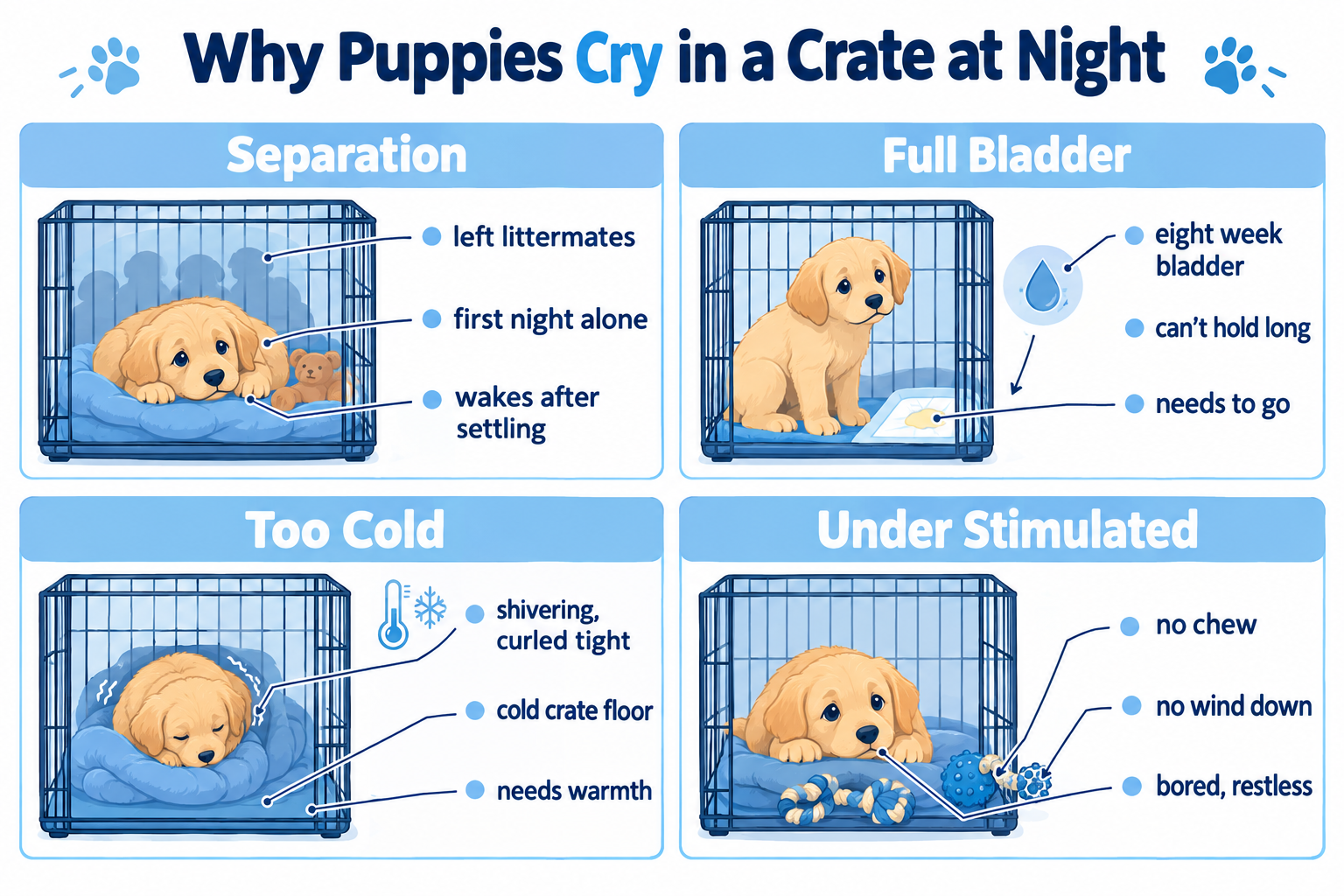
Four causes cover most cases:
- Social separation. Until recently the puppy slept in a warm pile of siblings. A plastic tray in a dark room is a downgrade by every measure the puppy cares about.
- A full bladder. Young puppies physically cannot hold on through an eight hour night. The AKC potty training timeline uses the rule of about one hour of bladder control per month of age as a starting point.
- Temperature and comfort. Thin bedding on a cold tiled floor is a reason to complain.
- Unspent energy or an empty stomach. A puppy who napped all evening and ate at 5 p.m. may be wide awake and hungry at 3 a.m. Meal timing and a suitable diet matter here, and our guide to what growing dogs need from puppy food in year one covers portioning for that age.
)
AKC’s updated advice makes a distinction that changes what you should do. Whining that starts within minutes of the door closing is more consistent with stress about confinement. Vocalising after the puppy has already settled and slept is more consistent with a bathroom need, hunger, boredom, or discomfort. One asks you to slow the training down. The other asks you to open the door and walk outside.
Is it normal for puppies to cry in the crate?
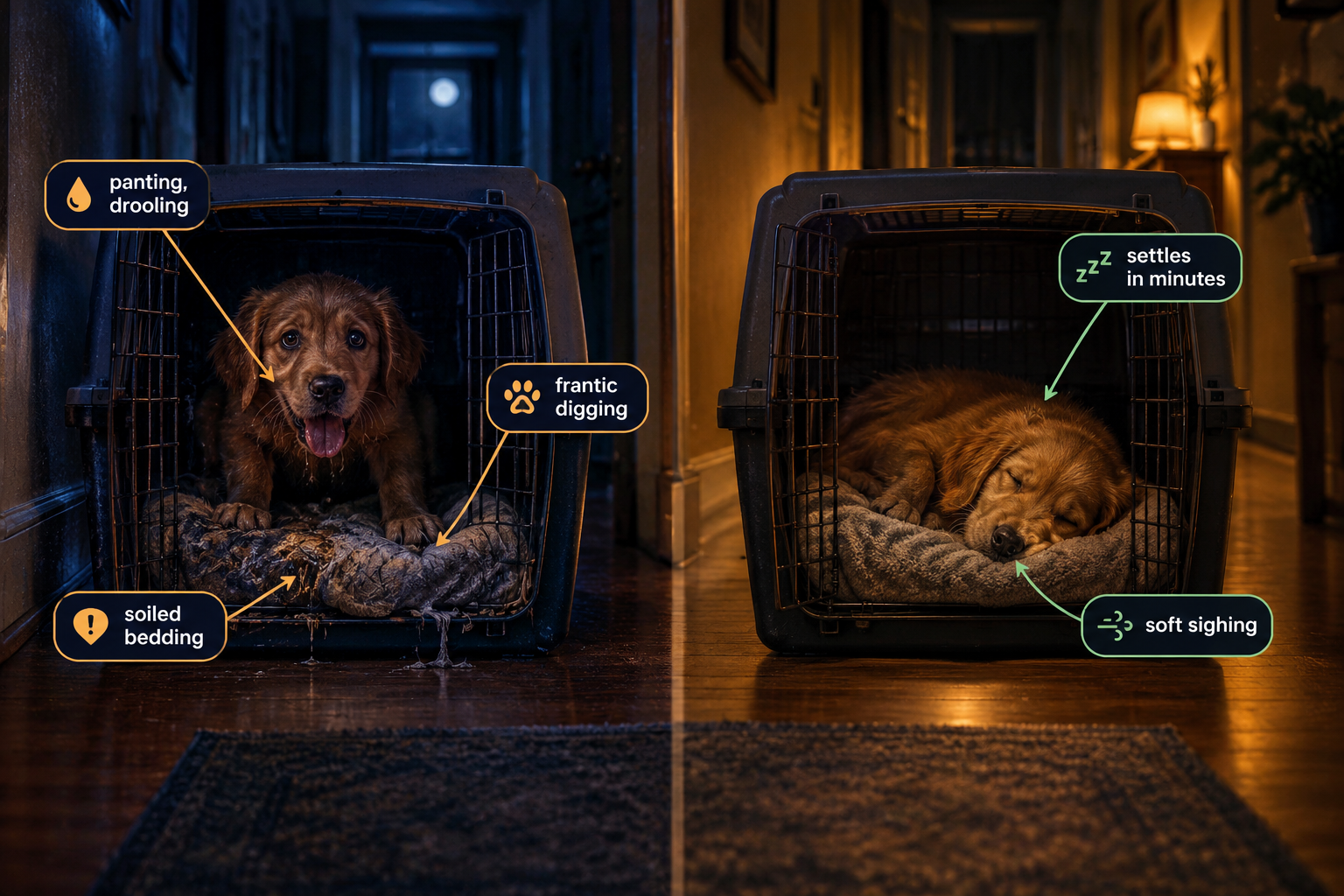
Yes. Vocalising in a crate during the first nights in a new home is expected, and it is not a sign you chose the wrong puppy or the wrong crate. What is not expected is sustained panic: screaming for an hour, heavy panting, drooling, frantic digging at the tray, or soiling a crate the puppy had previously kept clean. That pattern means stop and change the plan.
What is the difference between crying and whining in puppies?
Whining is low level, intermittent, and fades as the puppy gives up and flops down. Crying, screaming, and howling are louder, rhythmic, and tend to escalate rather than settle. The useful test is direction of travel over five minutes. Quieting down means the puppy is coping. Getting louder, faster, and more physical means the puppy is not, and waiting it out teaches only that the crate is a place where nobody comes.
Should you ignore a puppy crying in the crate at night, or comfort them?
Do neither at the extremes. A few minutes of non-escalating grumbling can be left alone, since going in at the noisiest moment teaches a puppy that volume opens doors. Sustained or escalating distress should be answered, because an unanswered panic session makes the crate worse, not better.
A practical decision rule:
| What you hear | What it probably means | What to do |
|---|---|---|
| Soft grumbling, pauses, getting quieter | Settling in | Wait. Stay quiet. Do not speak or open the door. |
| Steady whining after two or more hours asleep | Bladder | Quiet leashed potty trip, no play, straight back |
| Rising, rhythmic crying within minutes of the door closing | Confinement stress | Reassure calmly, move the crate next to your bed, shorten the sessions by day |
| Screaming, panting, drooling, frantic digging, soiling | Panic | End the session, use a safe pen or puppy proofed room for tonight, rebuild crate training slowly, speak to your vet |
Comforting a frightened puppy does not “reward fear” in any way the evidence supports. Fear is an emotional state, not a trick. What you want to avoid is the pattern where the door opens only after a long escalation, because that is the sequence the puppy remembers. The fix is to get there first: a quiet alarm, a scheduled break, and a calm response before the volume climbs.
Opening the door at minute twelve of screaming teaches one lesson. Opening it at minute two of grumbling, before the panic, teaches a better one.
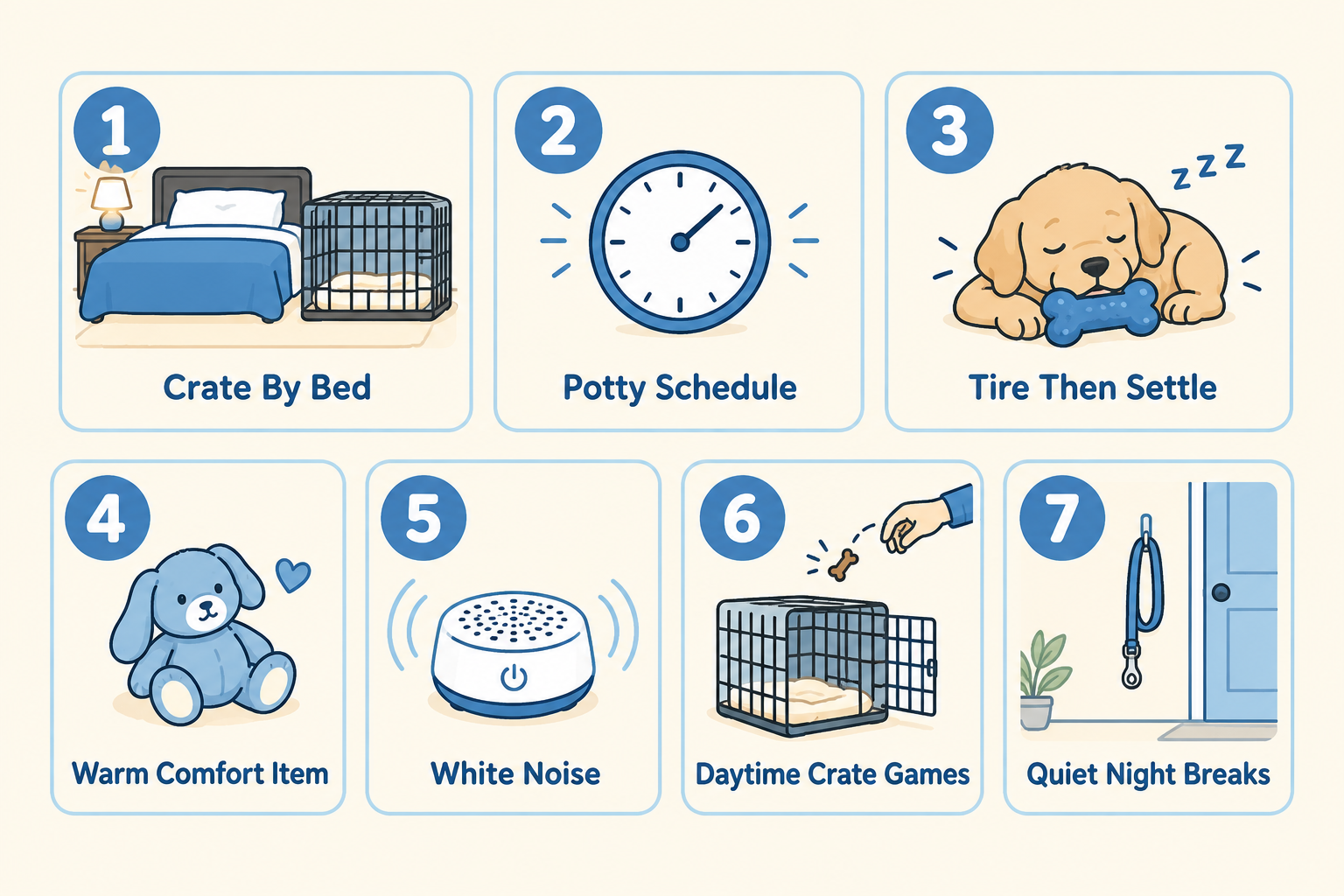
The 7 gentle fixes for a puppy crying in crate at night
These seven changes address the usual causes in the order that tends to help fastest. None involve punishment, which AVSAB advises against for all training and behaviour work.
)
1. Put the crate next to your bed
This is the single highest value change and it costs nothing. VCA recommends placing the crate where the family is present during early training. At night, that means your bedroom, close enough that you can drop a hand over the side. Your breathing, your smell, and your presence do most of the work that a gadget claims to do. You can move the crate a metre at a time, later, once nights are quiet.
2. Match the potty schedule to the bladder, not to your sleep
Use the one hour per month of age rule of thumb from AKC as a starting interval, then adjust. Eight weeks means a break roughly every two hours. Twelve weeks means roughly every three. Set an alarm and go before the crying rather than after it. Puppies who are carried out at a predictable time stop learning that crying is the request form.
3. Build a tire and settle routine before bed
AKC advises meeting toilet and exercise needs before crating, and training when a puppy is calm or sleepy. A workable evening shape: age appropriate activity earlier, sniffing or gentle chewing as the wind-down, nothing wild in the last half hour, water bowl lifted about an hour before bed unless your vet says otherwise, then the final toilet trip and quiet crate entry with one small treat. Sleep quantity matters too. Young puppies need enormous amounts of it, and AKC notes puppies sleep around 18 to 20 hours a day.
4. Add warm, washable comfort items
Soft bedding, a worn t-shirt that smells of you, and a crate pad that survives a wash cycle. The Smart Pet Love Snuggle Puppy is a plush toy with a weighted heartbeat insert and a removable warmer. Who it suits: young puppies who sleep pressed against something. Where the facts end: the heartbeat feature is a manufacturer-designed comfort aid, not a treatment for separation distress, and any soft toy needs supervision with a determined chewer. Check the dimensions against your crate before buying.
5. Use steady background sound
A fan, a radio at low volume, or a machine such as the LectroFan masks the fridge, the stairs, and the 4 a.m. bin lorry. Who it suits: apartment residents and anyone whose puppy startles at household noise. Keep the volume conversational, not loud.
6. Run crate games during the day
Night crying is usually a daytime training problem wearing pyjamas. VCA’s approach is to feed meals inside the crate, use interactive food toys there, close the door only after several successful open-door sessions, and lengthen the time gradually. Toss treats in, let the puppy walk out freely, repeat. A KONG Puppy stuffed with part of the evening meal turns crate entry into a reward and adds enrichment, and our list of cheap whole foods that improve a dog’s diet has safe additions for stuffing. Pair the crate with other early skills too, since the same reward-based mechanics drive the five essential commands every puppy should learn.
An Adaptil diffuser is sometimes suggested as an add-on. It is marketed on dog appeasing pheromone. The independent evidence is limited and mixed, so treat it as an optional extra rather than a reason to skip the routine work.
7. Keep night potty breaks boring on purpose
VCA’s nighttime protocol is deliberately dull: if the puppy wakes after previously settling, take it outside on a leash for a business-only trip, praise elimination calmly, then return it to the crate with a small treat. No play, no cuddles on the sofa, no light show, no conversation. A puppy who gets a party at 3 a.m. will book the party again tomorrow.
Crate setups and comfort items: which fits a puppy sleeping at night?
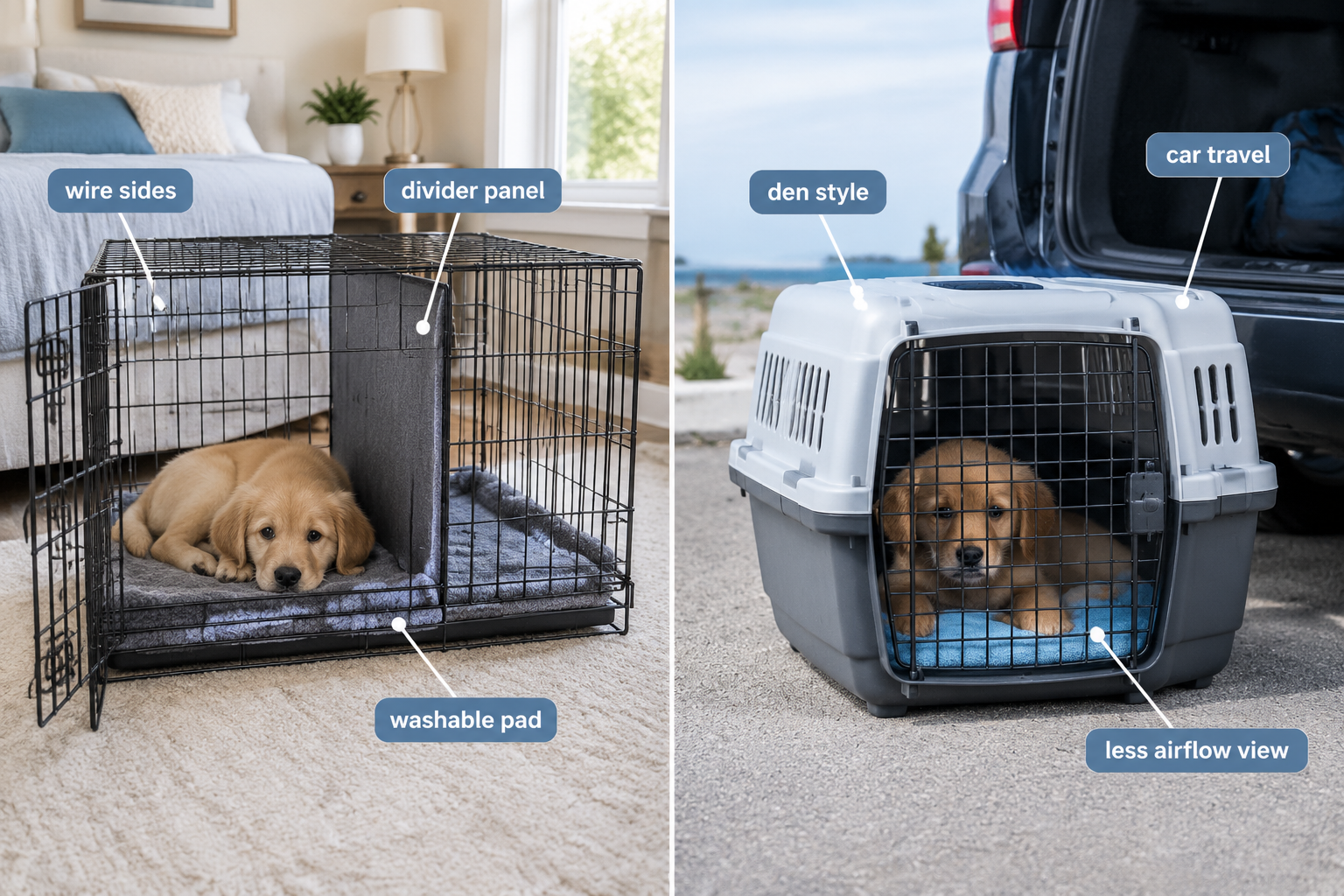
Pick the crate by the sleeping space, the puppy's adult size, and how much you plan to travel. All three types below work. Compare the options on cleaning, divider availability, and whether you need to fold it flat.
| Setup | Build | Who it suits | Drawbacks |
|---|---|---|---|
| MidWest iCrate | Folding wire panels, plastic tray, divider panel in most sizes | Most first-time owners who want one crate that grows with the puppy | Open sides may need a blanket over part of it; wire can rattle |
| Diggs Revol | Collapsing frame with mesh sides, built-in divider, wheels on larger sizes | Small homes, renters, and owners who move the crate between rooms or cars | Heavier and costlier than wire; fewer size options |
| Plastic airline style crate | Enclosed two-piece shell with vented sides and a metal door | Puppies who settle better in a den; car travel and vet trips | No divider, less airflow and visibility, bulky to store |
Review method: specification comparison and published product descriptions, not hands-on testing of these three models. Prices change constantly and have not been checked, so the verdicts above rest on build and use case rather than cost. Nothing here is safe for every dog, and no crate is a treatment for anxiety.
Comfort items worth adding: a Snuggle Puppy for a young puppy who sleeps against something warm, a KONG Puppy stuffed with part of a meal for calm crate entry, a LectroFan or any steady fan for noise masking, and an Adaptil diffuser as an optional extra with limited independent evidence behind it. Fear Free Happy Homes publishes low stress handling material that pairs well with slow crate introductions.
What crate size does a puppy need for sleeping at night?
Big enough to stand up, turn around, lie down, and stretch out. Not so big that the puppy can toilet at one end and sleep comfortably at the other, which is exactly the habit you are trying to avoid. Both AKC and VCA describe this standard. For a puppy who will grow into a large adult, buy the adult size and fit the divider now, then move the divider back as the puppy grows. Check the dimensions against the space beside your bed before ordering. (Yes, including the door swing.)
Sourced numbers worth knowing
What are the best crate training methods, and at what age should you start?
Start as soon as the puppy comes home, usually around eight weeks, using short voluntary sessions with food. The method that holds up across AKC, VCA, and reward-based training guidance is gradual and door-open first.
A workable sequence:
- Open door, no pressure. Crate in a family room, door fastened open, treats appearing inside at random.
- Meals inside. Feed every meal in the crate, door still open, ideally in a food toy.
- Short closures. Close the door for a handful of seconds while the puppy eats, then open it before the food runs out.
- Build duration. Seconds to a minute to a few minutes, always ending before the puppy gets worried. VCA recommends several successful open-door sessions before the door closes at all.
- Add distance, then nights. Step away, come back, repeat. Only then ask for a full night, crate beside your bed.
Common mistake: jumping from step one to step five on day one because bedtime arrived. Edge case: a puppy who has already had a frightening crate experience, in a shelter transport or at a previous home, may need weeks at step two. That is slow, not broken. The broader approach matches everything in our guide to the best ways to train your puppy, which is humane training in the same reward-based shape.
How long until a puppy stops crying at night?
Most puppies cut the night crying substantially within one to two weeks of consistent routine, with the first three nights being the loudest. There is no published universal timeline, so treat that range as a pattern from training guidance rather than a promise.
What changes the outcome:
- Crate location. Bedroom placement usually shortens the noisy phase.
- Potty interval accuracy. Guess too long and the puppy wakes you anyway.
- Consistency. Three quiet nights followed by one night of play at 3 a.m. resets the lesson.
- Individual variation. Age at separation from the litter, early handling, and temperament all shift the timeline.
Puppy still crying in crate after weeks of training
If a puppy is still screaming after two to three weeks of consistent, reward-based work, stop repeating the same night and change something structural. Go back to short daytime sessions with the door open. Move the crate next to your bed if it is not already there. Use a pen or a puppy proofed room for sleeping while the crate work rebuilds. Then book a vet appointment to rule out pain, parasites, or a urinary problem, and ask for a referral to a qualified behaviour professional. Weeks of unresolved panic is information, not stubbornness, and the ASPCA's separation anxiety material describes the kind of distress that needs a professional plan rather than more crate time.
What are the alternatives to crate training for puppies?
A puppy proofed room, an exercise pen, or a baby-gated kitchen are all legitimate alternatives, and both AKC and VCA describe them as options when the crate causes distress. A crate is a management and safety tool, not a requirement.
How to choose:
- Choose a pen or gated room if the puppy panics in a closed crate, you need a toileting area overnight, or you are away longer than the puppy can hold on.
- Choose a crate if you need car safety, vet or grooming confinement, travel, or a puppy who chews cables and skirting boards unsupervised.
- Choose both if you can: open crate inside a pen gives the den without the locked door.
The safety trade-off is real. A larger space means a puppy can toilet away from the bed, which slows house training a little. Puppy pads inside a pen can help, and the AKC overview of potty pad training covers the benefits and the downsides honestly. Temperament and breed tendencies influence how easily a puppy settles alone too, which is part of why matching the dog to the household matters so much. Our guide on how to pick a dog breed that fits your life covers that fit question before a puppy arrives.
When is puppy crying in crate at night a sign of a problem?
Treat crying as a possible health problem when it starts suddenly in a dog who previously slept quietly, when it comes with physical signs, or when it looks like panic rather than protest.
)
See a vet promptly if night crying appears alongside any of these:
- Straining to urinate, frequent small puddles, or blood in the urine
- Diarrhoea, vomiting, or a refusal to eat
- Limping, yelping when touched, or trouble settling into a lying position
- Sudden house soiling in a previously clean dog
- Scratching, licking, or chewing one spot repeatedly
- Disorientation or restlessness at night in an older dog
Panic signs that mean ending the session tonight: heavy panting with no heat to explain it, drooling, dilated pupils, frantic digging or biting at the crate, escape attempts that risk injured nails or teeth, and soiling during confinement. Keep the dog safe in a pen or room, and ask your vet about pain, cognitive change, or a behaviour referral. Pain and fear can also change how a dog responds to handling, which is one of the themes in our piece on why dogs bite their own owners and how to prevent it.
FAQ
How long should I let a puppy cry in the crate at night?
A few minutes of non-escalating grumbling is reasonable to wait out. VCA describes brief, non-escalating vocalising as something you may observe, while marked distress should end the session. Do not use timed "cry it out" sessions, which current AKC guidance advises against.
Does crate crying mean my puppy needs to potty?
Often, especially if the puppy had already settled and slept first. AKC's guidance treats post-settling vocalising as more consistent with a bathroom need, hunger, or discomfort, and early-session whining as more consistent with confinement stress. When in doubt, do a silent leashed toilet trip and nothing else.
My dog started crying in the crate at night all of a sudden. Why?
Sudden change in an adult dog who previously slept fine deserves a vet visit first. Urinary infections, gastrointestinal upset, pain, and age-related cognitive change all show up as night restlessness. Household changes, a new schedule, or a move can also trigger it.
Should I ignore my puppy crying at night?
Not as a strategy. Ignore brief settling noise, respond to needs and to real distress, and get ahead of the pattern with scheduled potty breaks so the puppy is not forced to escalate to get help.
Is it bad to put the crate in my bedroom?
No, and for the first week or two it is usually the best place. You can move the crate gradually toward its long-term spot once nights are reliably quiet.
Does a Snuggle Puppy actually stop crying?
It may help a young puppy who sleeps pressed against something warm, and many owners report it settles them. The heartbeat feature is a comfort design, not a documented treatment, and it will not substitute for correct potty timing or crate placement. Supervise it with a dog who shreds soft toys.
When do puppies stop crying in the crate?
Most quiet down within one to two weeks of a consistent routine, with the loudest nights at the start. Some need longer, and a puppy still in distress after several weeks needs a slower plan and a vet check.
Can I leave water in the crate overnight?
Many trainers lift the bowl about an hour before bed to reduce overnight accidents, but puppies on certain diets or with medical conditions need water available. Ask your vet before restricting water for your individual puppy.
Conclusion: one clear next step
Tonight, move the crate beside your bed and set one alarm based on your puppy's age, using the rough one hour per month of age interval. That single change, plus a boring leashed potty break instead of a 3 a.m. social event, fixes more cases of a puppy crying in crate at night than any purchase will. Then spend tomorrow doing five short, cheerful, door-open crate games with food, because the night is only ever as good as the daytime training behind it.
The noisy phase is short, and it is not a referendum on your skills as an owner. Guidance checked October 2026 against AKC, VCA, AVSAB, and ASPCA material. That is Dog Advice That Actually Answers the Question.