
Quick Answer
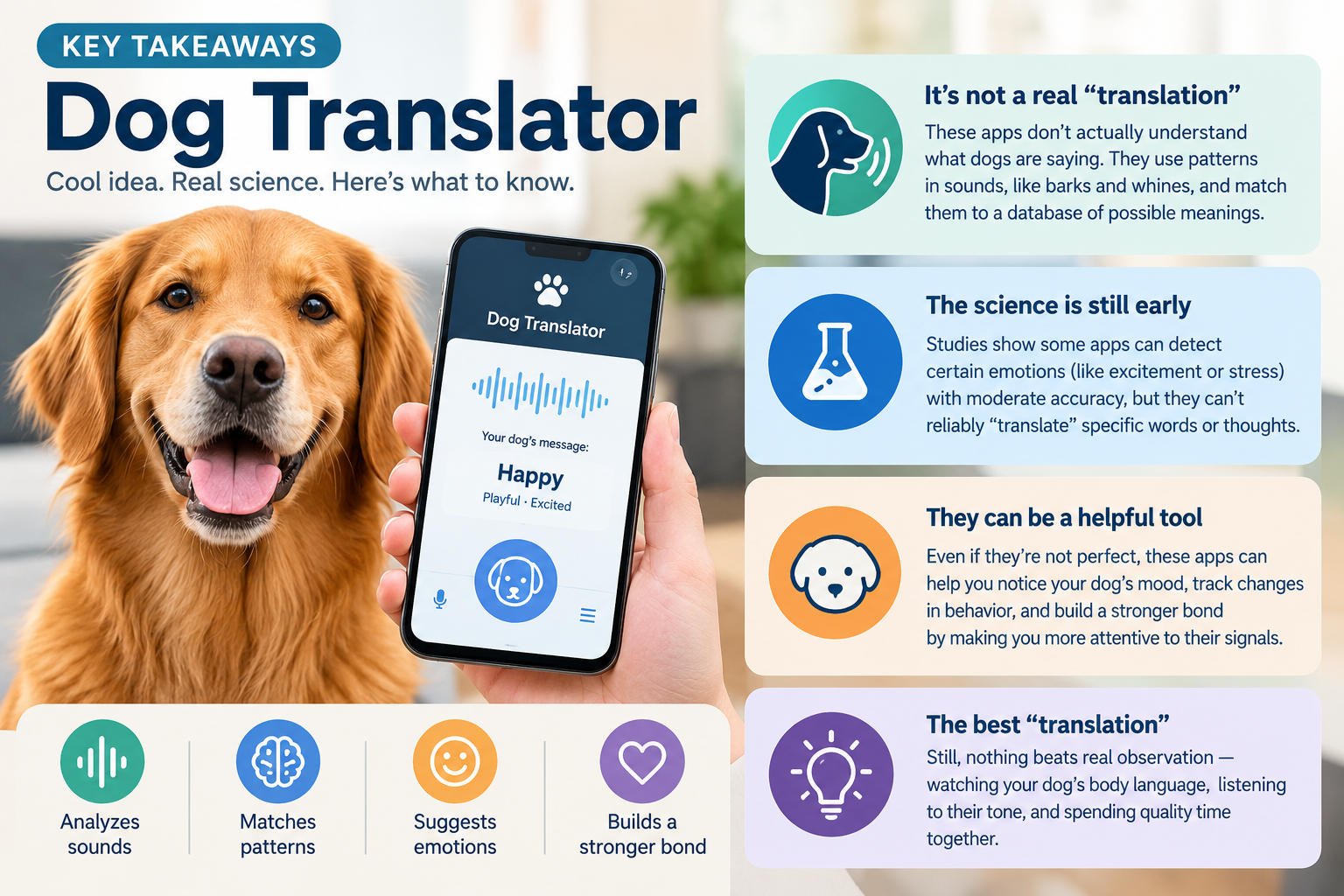
No dog translator app available in October 2026 can turn a bark into a sentence. The strongest published work, including a 2024 project from the University of Michigan and Mexico’s INAOE, shows that machine learning can sort dog vocalizations into categories such as breed, sex, individual dog, and rough situation, with accuracy around 70 percent on those tasks. That is pattern recognition, not translation. Most consumer dog translator apps are listed as entertainment, and the collar products making bigger claims have not released methodology anyone outside the company can check.
Key Takeaways: Dog Translator
- No dog translator produces real sentences. Dogs do not use words, so there is nothing to map a bark onto one to one.
- AI can classify, not translate. The Michigan and INAOE model reached roughly 70 percent on identification and context tasks, using a speech model built for human voices.
- Store listings often admit it. The Google Play page for one popular dog translator describes “fun phrase suggestions and possible mood interpretations” for entertainment.
- Collar accuracy claims are unverified. PettiChat’s reported 94.6 percent figure came from company testing, with no public dataset, confusion matrix, or third-party audit found in coverage.
- Barks carry information, just not vocabulary. Acoustic features such as pitch, harshness, and repetition rate shift with the situation, and listeners read them better when they can also see the dog.
- Soundboard buttons are training, not translation. FluentPet style boards teach a dog to press a labelled target. That is a learned association.
- The most reliable method is still free. Watch the body, the situation, and what happened right before the noise, then get a qualified behavior consultation for anything worrying.
Do dog translator apps actually work?
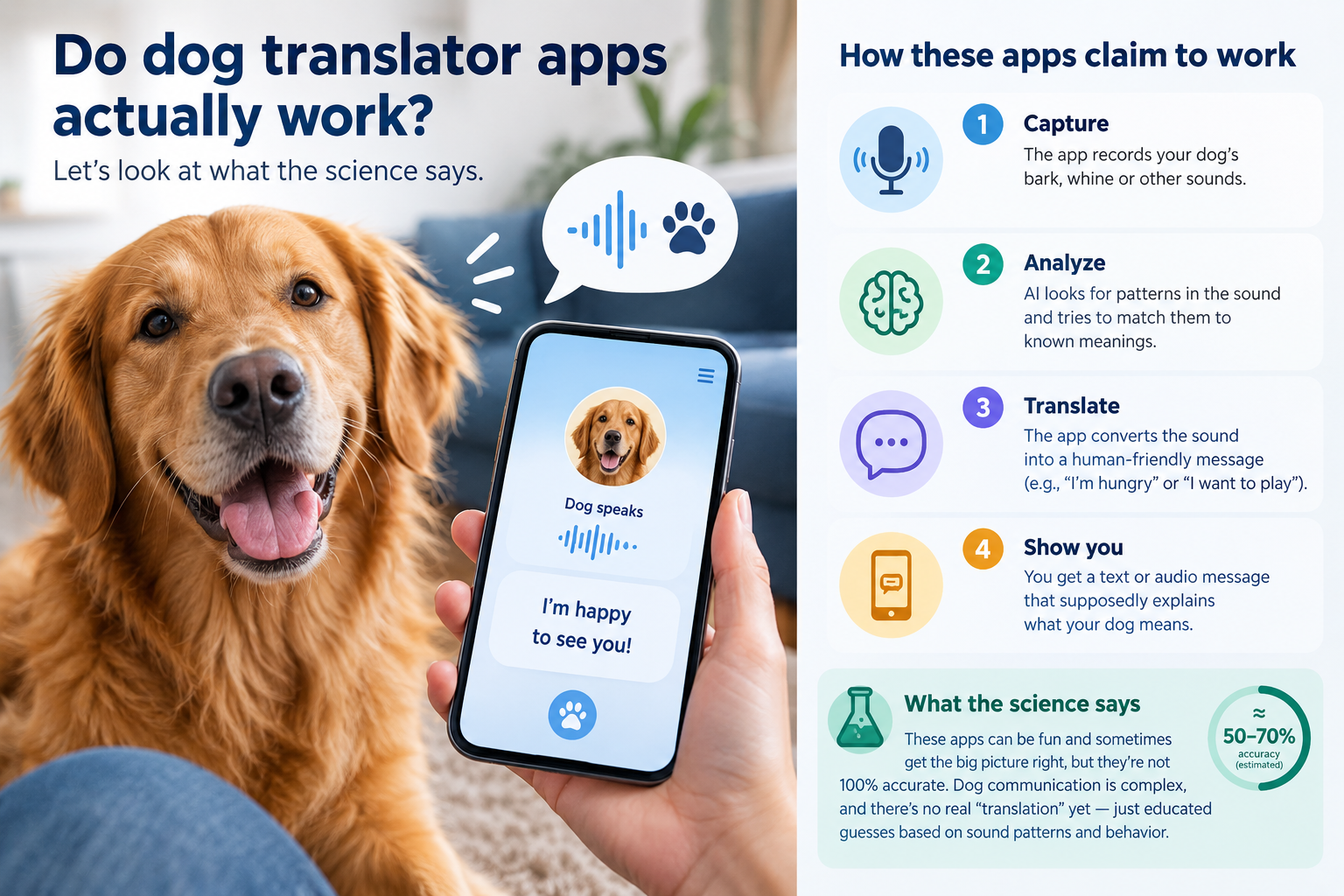
Not in the way the app icon suggests. A dog translator app takes audio from a phone microphone, runs a rough analysis, and returns a mood label or a cute phrase. It cannot recover a specific request from a bark, because dogs do not encode specific requests in barks the way humans encode them in words.
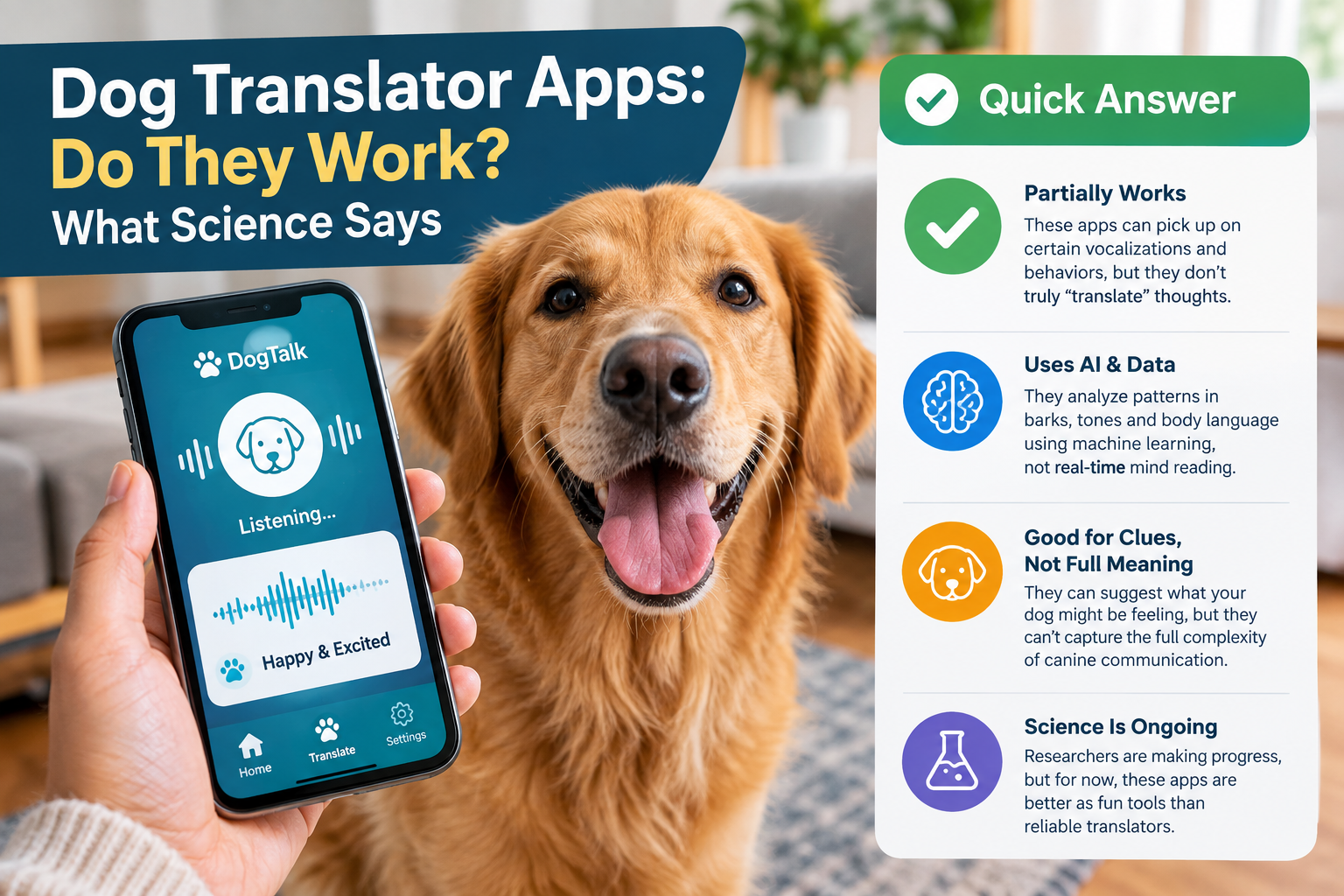
Search interest keeps climbing anyway. One trend-tracking report, RisingTrends in 2026, put the rise in pet translator searches at about 140 percent. Treat that as a search-volume estimate from a commercial trend tracker rather than peer-reviewed data, because no public methodology was available to check. The direction of travel is still clear: a lot of people want this to exist.
What do dog translator apps actually do
Most of them do one or more of four things, and only the first involves your dog at all:
- Record a short clip and compare its basic acoustic features to stored patterns, then display a mood word such as “playful” or “alert.”
- Play synthesized dog sounds back at your dog, which the marketing calls a human to dog translator. There is no evidence a generated whine means anything specific to a listening dog.
- Accept a photo or video and generate a written interpretation from an image model, which is how the Traini app markets its pet behavior analysis.
- Bundle care tools, such as reminders, feeding logs, or a chatbot that answers general dog questions.
The fourth one is genuinely useful. The first three are novelty features with a label that overpromises.
How accurate are dog translator apps really
There is no independent accuracy figure for any consumer dog translator app, because none of the popular ones have published a test anyone outside the company can repeat. That absence is the answer. A product that reached even 70 percent on a defined classification task would have strong reasons to publish the method.
A decision rule for the app store: if the listing never states what was measured, against what ground truth, and on how many dogs, treat the output as a toy. Google Play’s listing for Dog Translator & Pet Care, updated around late 2026, describes its translator as entertainment that produces fun phrase suggestions and possible mood interpretations. The developer is being honest. The screenshots are not.
Can dog translator apps really understand what dogs are saying
They cannot, and neither can researchers yet. Recognizing an emotional state is not the same as knowing what a signal means to the dog who produced it or the dog who heard it. Reporting from September 2026 citing animal bioacoustics researchers made that point directly: reliable interpretation needs behavioral observation, recipient responses, and controlled experiments, not just a classifier output. Newsweek’s coverage of recent bark work framed AI as a tool for finding patterns rather than a dog-language translator.
What has AI research found about dog barks?
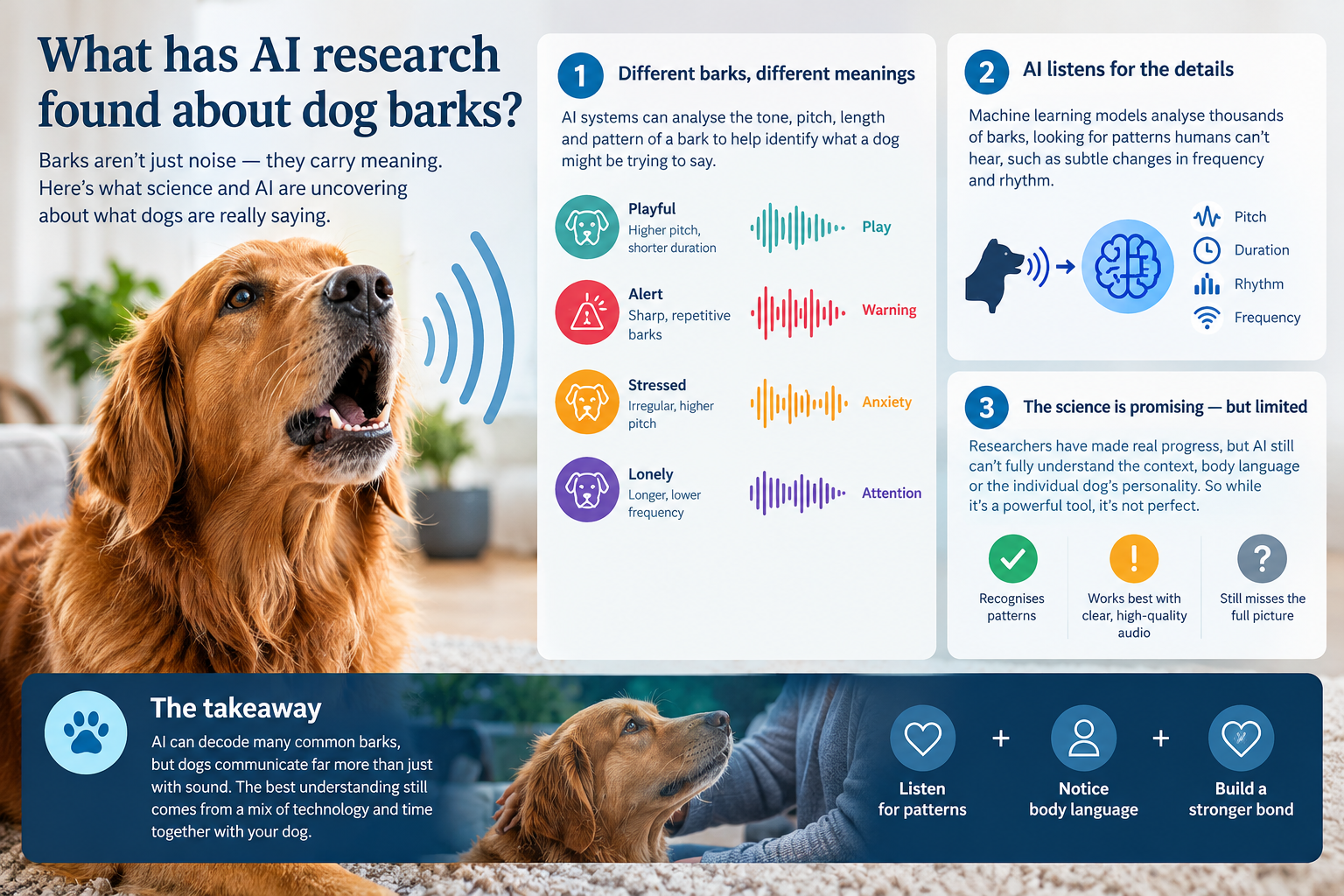
AI has found that dog vocalizations contain more usable structure than people expected, and that models built for human speech can pick up on it. What AI has not found is a dictionary.
The best-known project came from Artem Abzaliev and Rada Mihalcea at the University of Michigan, working with researchers at INAOE in Mexico. They used recordings from 74 dogs of different breeds, ages, and sexes, gathered in homes in Tepic and Puebla. Their model, built on Wav2Vec2, a representation model originally trained on human speech, was set four tasks: identify the individual dog, the breed, the sex, and the context of the vocalization. It reached accuracy up to roughly 70 percent and beat some models trained only on dog sounds.
The paper was presented at LREC-COLING 2024 as work on dog recognition, breed identification, gender classification, and context grounding. Not translation. Popular coverage still ran with headlines about interpreting the meaning of barks, which is how a 70 percent four-way classifier becomes a talking collar in the public imagination.
Other groups are working the same ground from different angles. The Earth Species Project, a nonprofit applying machine learning to animal communication across species, has released audio models for animal sounds, and AI-based animal communication research has drawn mainstream coverage. Open resources now exist too, including a public dog vocalization dataset used for bark classification research. Zoolingua, the venture associated with prairie dog communication researcher Con Slobodchikoff, has discussed a dog translation product for years. No validated consumer release or peer-reviewed accuracy result was found at the time of checking in October 2026.
Is there science behind dog translator apps
There is real science in the same neighborhood, and almost none of it inside the apps. A 2026 review in Frontiers in Veterinary Science summarized findings that AI can classify contextual and emotional features in dog vocalizations, including distinctions tied to play, threat, and intensity. The same review concluded that performance depends heavily on the model, the features, the dataset, and the task, that no single approach wins across the board, and that these systems should support veterinary and behavioral assessment rather than replace it.
That is a reasonable position to hold. It is also a long way from a $119 collar telling you your dog is bored.
Why dog translators don’t work the way they claim
Four reasons, and the first one is the one no amount of compute fixes.
- Dogs do not have words. Barks are graded signals that shift with arousal and situation, so a single sound has no fixed dictionary entry. Veterinary behavior sources describe barks as context dependent, varying with play, isolation, disturbance, alarm, and social interaction.
- Audio alone throws away most of the message. Dog communication leans heavily on posture, movement, face, and smell. A phone microphone captures none of that.
- Ground truth is slippery. To train a model on “wants to go outside,” someone has to label clips that way, and that label is a human guess about intent.
- The datasets are small and local. Seventy-four dogs recorded in two Mexican cities is a sensible research sample. It does not establish performance across every breed, microphone, tiled kitchen, or household routine.
Comparing the options: apps, collars, buttons, and body language
Prices and listings checked October 2026. Where a figure comes from company marketing rather than independent testing, the table says so.
What do different barks mean?
Barks do not have fixed meanings, but their acoustic shape tracks the situation closely enough that untrained human listeners can often sort recordings into the right category. Bark research associated with Péter Pongrácz and colleagues at Eötvös Loránd University in Budapest reported that pattern: lower, harsher, less tonal barks clustered around stranger and disturbance situations, while higher pitched barks with faster repetition clustered around play and being left alone.
Use the decoder below as a thinking tool, not a verdict. It reflects the published pattern between acoustic features and situation. It does not read your dog.
Sourced numbers worth remembering
74 dogs
Size of the recording set behind the best-known AI bark study, gathered in homes in Mexico. arXiv, 2024
~70%
Top accuracy reported on classification tasks, not on translating barks into sentences. LREC-COLING, 2024
4 tasks
What the model was actually asked to do: identify the dog, breed, sex, and context. University of Michigan, 2024
94.6%
Accuracy claimed by PettiChat from company testing. No public method or audit found. ExplainX, 2026
The practical version of all this: the sound tells you about arousal and probably about category. The dog’s body and the situation tell you which category. That is also why head tilting has more than one plausible explanation and why reading one signal in isolation goes wrong so often.
Can talking buttons or AI collars translate dogs?
Buttons and collars do different things, and neither is translation. A soundboard teaches a dog to press a labelled target that produces a recorded human word. A collar records sound or movement and outputs a label chosen by a classifier.
Talking buttons. The idea reached most people through Hunger For Words, the project of speech-language pathologist Christina Hunger, and through FluentPet’s hexagonal tile kits. What the setups clearly demonstrate is learning: a dog can associate a button with an outcome, and some dogs press with obvious intent. What is not established is grammar, combination of words into novel meaning, or that the dog understands the recorded word the way a person does. Researchers studying soundboard users have been collecting press data precisely because the hard question, whether presses reflect intentional reference, needs controlled testing rather than clip reels.
Buttons are still worth owning for the right household. They create structured enrichment, they slow the human down, and they force the owner to notice what the dog does right before the press. That is useful even if the vocabulary claim never holds up.
AI collars. Petpuls markets emotion detection from vocal analysis. PettiChat reportedly ran a Kickstarter campaign in April 2026 for a 27-gram collar, advertising a 1.2-second response time, more than 10,000 preorders, training on over a million vocal and behavioral samples, and that 94.6 percent accuracy figure. Independent coverage looking for support behind the headline number found no accessible methodology, confusion matrix, or third-party audit.
A decision rule before preordering any dog translator collar: ask what happens when the device is wrong. If it mislabels pain as boredom, you delay a vet visit. That failure mode is the reason the Frontiers review positions these systems as assistants to professional assessment.
What do dog translator apps cost, and how do you use one without fooling yourself?
Most dog translator apps are free to download with in-app purchases or a subscription, which means the real cost is attention rather than money. Collars are the expensive category, and the crowdfunding ones carry delivery risk on top of the accuracy problem.
Dog translator app cost and pricing
- Free apps with ads or in-app purchases: the common model on Google Play and the App Store. Checked October 2026.
- Subscription apps: some behavior-analysis apps charge monthly for photo or video interpretation and chat features. Read what you get before the trial converts.
- Hardware: PettiChat reported a $119 early-bird price during its campaign. Crowdfunding prices are not retail prices, and delivery dates slip.
- Soundboard kits: sold in starter and expansion sets, with price depending on retailer and number of buttons.
- The free option: learning to read your own dog costs nothing. A one-off consultation with a certified behavior professional costs money and usually answers the question the app was standing in for.
Best dog translator apps in 2024 and 2026: why a ranking misleads
Round-up lists of the best dog translator apps, whether written in 2024 or now, rank novelty features against each other. There is no accuracy benchmark to rank on, so the lists end up scoring interface design and star ratings. A fair way to compare: pick based on the non-translation features you would actually use, such as reminders, weight logs, training plans, or a photo-based behavior note you can show a vet.
How to use a dog translator app effectively
If a dog translator app is already on the phone, it can still earn its space as a prompt to pay attention.
- Record video, not just audio. You now have the posture, the trigger, and the aftermath.
- Note the 10 seconds before the sound. Most “mystery” barking has a visible cause in that window.
- Treat the output as a hypothesis. “Alert” is a guess to test, not a result.
- Keep a simple log. Time, place, trigger, what the dog did next. Three weeks of entries beats any classifier.
- Show a professional the clip. A vet or qualified behavior consultant can use the footage. They cannot use a mood word from an app.
Common mistakes people make with dog translator apps
- Playing synthesized dog sounds at the dog. A human to dog translator feature has no established meaning for the listener, and repeated odd sounds can worry a sensitive dog.
- Believing a mood label over the dog’s body. If the app says “happy” and the dog is stiff with a tucked tail, believe the dog.
- Using an app to explain pain. Sudden vocal changes, restlessness, or new reactivity deserve a veterinary exam, not a classifier.
- Teaching barking by accident. Opening the door whenever barking happens trains barking. The app had nothing to do with it.
- Reading a single bark as a sentence. Arousal level is not a request.
Do dog translator apps work for specific breeds?
Breed-specific accuracy claims are the weakest part of the whole category. The Michigan and INAOE work did include breed identification as a task, and reported accuracy up to about 70 percent across its four tasks, but that is a model guessing breed from a sound, not a model translating a Beagle’s bark differently from a Border Collie’s.
Breeds do differ in how much and how they vocalize. Many hounds bay. Several terriers alarm-bark readily. Some northern breeds howl more than they bark. Those are group tendencies with wide variation, and your individual dog’s history and household routine matter more than the label on the pedigree. The same caution applies to breed claims about how intelligent different breeds are and which breeds rank as most trainable.
Edge case worth naming: brachycephalic dogs. Flat-faced breeds produce distorted airway sounds, which means a classifier can read normal breathing noise as distress, or read genuine respiratory distress as ordinary snuffling. For those dogs especially, a vet’s ears beat a phone microphone.
Do professional dog trainers use dog translator apps?
Qualified trainers and veterinary behaviorists do not use dog translator apps to assess dogs. They use direct observation, owner history, video of the real-world situation, and structured assessment. Where technology helps, it is usually a camera and a notebook, not a translator.
Dog translator app vs real behavior training
| What you want | What the app gives | What training gives |
|---|---|---|
| Stop barking at the window | A mood label | Management of the view plus reinforcement for an alternative behavior |
| Know if the dog is stressed at the groomer | A guess from audio | Body language reading, cooperative care, handling plans |
| Understand why the dog growls at one visitor | A phrase suggestion | History, trigger assessment, a safety plan |
| Help a dog alone at home | A sound clip | A graduated separation plan, with veterinary input if distress is severe |
The honest comparison: a dog translator app is a reading of a symptom, and humane training changes the situation that produced the symptom. One of those alters your Tuesday evening.
What is the most reliable way to understand your dog?
The most reliable method in October 2026 is still the oldest one: watch the whole dog in context, note what came before and after, and build a baseline for your specific dog over weeks. That approach is also what bioacoustics researchers say is needed before any signal can be interpreted, since recognizing an emotional state does not reveal full communicative meaning without behavioral observation and recipient responses.
A practical starting checklist:
- Learn the quiet signals first. Lip licking, turning away, half-moon eye, slow blinking, shifting weight backward. These appear long before a growl.
- Watch the tail and body together. Tail height, stiffness, and speed mean different things paired with a loose body than with a frozen one.
- Build a baseline. Know how your dog normally sleeps, eats, greets, and settles. Sudden changes are information, and research on how much dogs sleep is a good reminder of how wide normal can be.
- Respect sensory differences. Dogs are not reacting to the same world you are. Their color vision alone works differently, and their hearing and sense of smell pick up triggers you never register.
- Record short videos. Thirty seconds of the actual problem is worth more to a vet than a paragraph of description.
- Escalate properly. Growling, biting, panic when alone, or a sudden change in vocal behavior deserves a veterinary exam first to rule out pain, then a qualified behavior professional.
Part of understanding your dog is also noticing the obvious things we skip past, like the fact that what owners call loyalty is usually a set of learned, observable behaviors rather than a mystery. The human-dog bond gets easier to read when you stop waiting for a device to explain it.
FAQ
Are there actual dog translators that work?
No. As of October 2026, no product converts dog vocalizations into human sentences. AI can classify dog sounds into categories with partial accuracy, and that is the current state of the science.
Is there a free dog translator online that is accurate?
Free dog translator websites and apps are entertainment tools. Several, including the Google Play listing for Dog Translator & Pet Care, say so in their own descriptions.
Does a dog barking translator feature tell me why my dog barks?
Not reliably. Bark acoustics vary with context, so a sound alone narrows the possibilities without identifying the cause. The trigger, the setting, and the dog’s posture carry more information.
Can AI understand dog language?
AI can detect acoustic patterns linked to situations and arousal. A 2026 Frontiers in Veterinary Science review concluded that performance varies by model and dataset and that such systems should support, not replace, veterinary and behavioral assessment.
Are FluentPet buttons the same as a dog translator?
No. Buttons teach a dog to press a target that plays a recorded human word. That is learned association. Translation would mean decoding signals the dog already produces.
Should I buy an AI dog translator collar?
Only if you accept it as a novelty log rather than a diagnostic tool. The accuracy figures circulating for collars such as PettiChat come from company testing without published methodology or independent audit.
What about my dog’s whining and sighing, not barking?
Whines, grumbles, and sighs are graded signals tied to arousal and conflict. New or increased whining in an adult dog is worth a veterinary check, since pain is a common and often missed cause.
Will a real dog translator ever exist?
Something more useful than today’s apps is plausible, probably as a tool that flags likely emotional states and pain indicators for a professional to review. A device that returns full sentences would require dogs to have sentences.
Conclusion: one clear next step
Delete nothing, buy nothing yet. Instead, do this once: film 30 seconds of the barking, whining, or behavior you most want explained, note what happened in the 10 seconds before it, and write down what your dog did immediately after. Repeat for a week. That five-minute habit gives a vet or a certified behavior professional more usable information than any dog translator on the market, and it costs the price of nothing.
Then compare the options honestly. If you want a soundboard or a tracking collar for enrichment and curiosity, buy it for what it does, not for a translation claim nobody has verified. Guidance and listings checked October 2026.