
Quick Answer
Are retractable leashes bad? They are badly matched to the places most people use them, which is sidewalks, parking lots, vet waiting rooms, and apartment hallways. The core objection from veterinary and shelter groups is not the spool itself but the loss of immediate control: with a dog pulling at the end of the line, the American Kennel Club notes you cannot reel the dog back in and must walk toward the dog or rely on a verbal cue. MSPCA-Angell recommends against them in most situations for that reason. Two uses hold up: open low-traffic space with a dog that has reliable recall, and a brake locked at a fixed short length for stationary breaks. Guidance checked October 2026.
Key Takeaways: Are Retractable Leashes Bad?
- Are retractable leashes bad in every situation? No. The honest answer is that they fail in crowded, fast, or unpredictable places and work acceptably in open, quiet ones.
- The documented injury pattern involves people more than dogs: cuts, friction burns, falls, and a published case of eye trauma from leash recoil, described in a 2026 veterinary review of collars, harnesses and leashes.
- That same review found no comparable published database of leash-related injuries in dogs, and said entanglement injuries are plausible but under-investigated. That is where the facts end.
- Many viral claims about chronic thyroid, tracheal, and spinal damage from ordinary leash tension are not documented in the scientific literature, per the 2026 review. Acute strangulation and equipment misuse are a different matter.
- A retractable leash teaches a dog that pulling buys distance, which is why the AKC recommends teaching loose-leash walking on a conventional six-foot leash first.
- A long line (15 to 30 feet of flat webbing) gives most of the sniffing freedom with none of the plastic housing, spring, or recoil.
- As of October 3, 2026, a search of the CPSC recalls database did not turn up a recall or federal ban specific to retractable dog leashes. Absence of a recall is not proof of safety.
- If you keep one: lock the brake at six feet by default, choose wide tape over thin cord, clip to a harness, and never grab a moving line.
Why are vets against retractable leashes?
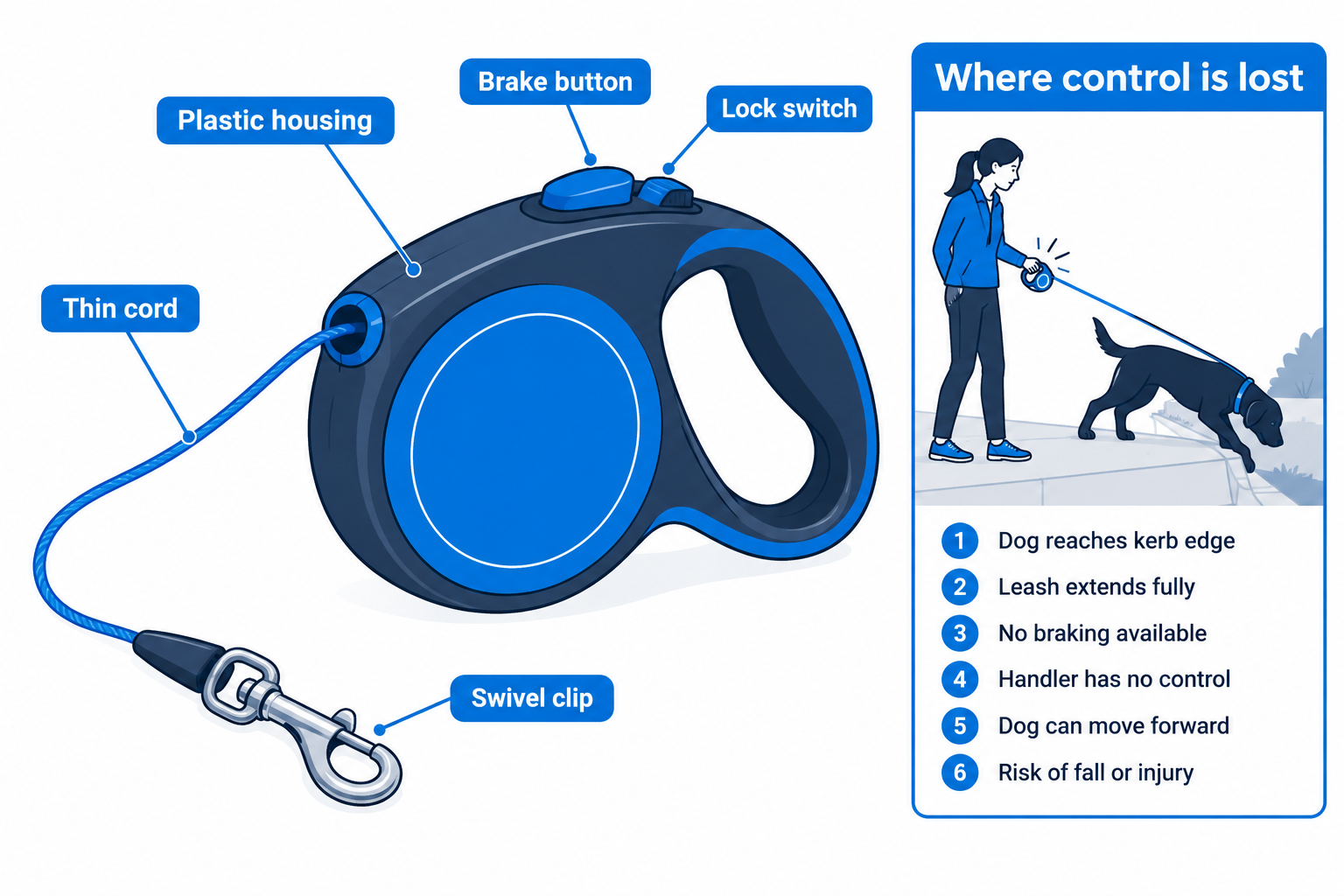
Veterinary and shelter objections center on one practical failure: you cannot shorten the leash fast enough when something goes wrong. MSPCA-Angell’s position is blunt, recommending against retractable leashes in most situations because a handler cannot quickly bring a dog back when traffic, a reactive dog, or any other emergency appears. The AKC makes the mechanical point: a dog already pulling cannot be reeled in, so the human has to close the distance on foot.
)
Think about the geometry for a second. Sixteen feet of line means a dog can be standing in the road while you are standing on the kerb, holding a plastic handle and a loop of slack. The brake works. The physics does not care.
The other veterinary concerns, in rough order of how often they come up:
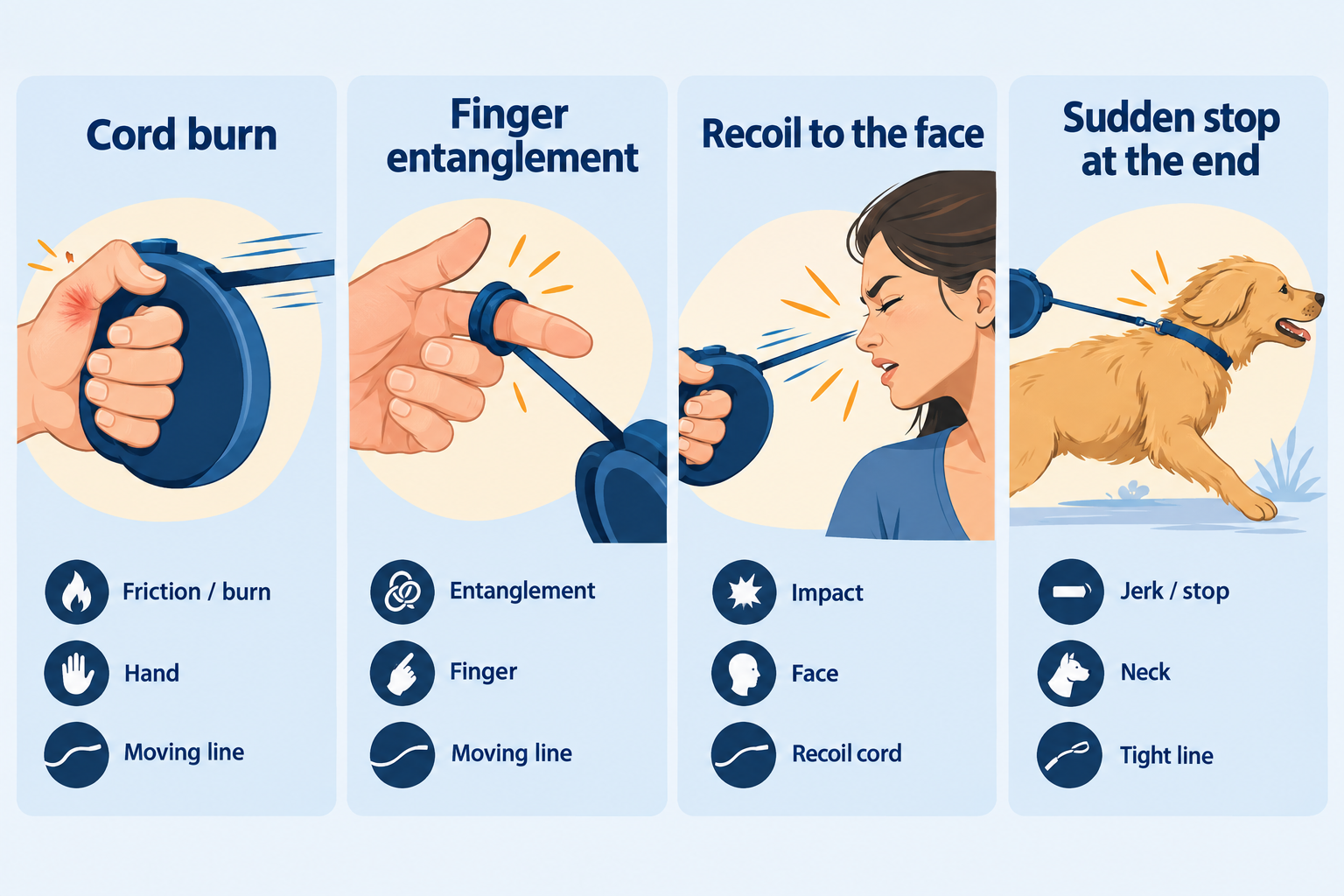
- Cord burns and cuts. Grabbing a moving line is the instinctive reaction, and MSPCA-Angell warns it can cause cuts and friction burns.
- Sudden stop at the end of the line. The AKC warns that a dog running at full speed into the leash limit may sustain tracheal or spinal injury. Attaching to a flat collar concentrates that force at the neck.
- Poor visibility. A thin cord at shin height is close to invisible to a jogger or a cyclist. People walk into it.
- Recoil. When a clip breaks or a dog is unclipped under tension, the housing and line snap back toward the handler.
- No fast recall of the dog in a conflict. Dog-to-dog greetings happen at the dog’s chosen distance, not yours. If you want a sober look at how bite risk gets reported and misreported, see our breakdown of dog bite statistics by breed and what they leave out.
What the research found, and where it stops
A review published in Frontiers in Veterinary Science on May 12, 2026 by Marcella Ridgway, DVM, at the University of Illinois Urbana-Champaign looked at the evidence behind collars, harnesses, and leashes. The review’s conclusion is uncomfortable for everyone arguing online: research on dog equipment risk is sparse, and several widely repeated claims are not documented in published literature. Specifically, it found no published documentation of leash-pulling injuries to the thyroid, trachea, jugular veins, or carotid arteries. It did document a human ocular injury caused by retractable leash recoil and noted that manufacturers themselves routinely warn of amputation risk.
Read that carefully, because it cuts both ways. The scary chronic-damage posts are running ahead of the evidence. The handling and control problems are real, acknowledged by equipment makers, and the reason most clinics ask you to switch leashes in the lobby.
The strongest argument against a retractable leash is not what it does to a dog’s neck. It is that you cannot get your dog back in two seconds, and two seconds is the whole ballgame near a road.
What injuries do retractable leashes cause?
The documented injuries fall into two groups: human injuries from the cord and housing, which are described in case reports and news coverage, and dog injuries from sudden stops and entanglement, which are plausible but poorly tracked. The 2026 veterinary review was explicit that no comparable published database of leash-related injuries in dogs exists, which means anyone quoting a precise percentage is guessing.
)
Known and reported injury types:
| Injury | Who gets hurt | How it happens |
|---|---|---|
| Cuts and friction burns | Handler, bystanders | Grabbing or being wrapped by a moving line |
| Eye trauma | Handler | Recoil of cord or housing, documented as a case report in the 2026 review |
| Falls and head injuries | Handler, pedestrians | Being pulled off balance or tripped by a low, thin line; UK reporting in 2023 described hospital cases of traumatic brain injury linked to retractable dog leads |
| Neck and spinal strain | Dog | Full-speed run into the end of the line, per AKC guidance |
| Entanglement wounds | Dog, handler | Cord wrapping a leg, tail, or ankle while the spool is under tension |
On official data: as of October 3, 2026, the public CPSC recalls database did not list a recall or prohibition specific to retractable dog leashes, and no federal ban exists. Dog-walking injuries also do not get tracked in a way that separates leash types cleanly, so the public numbers you see quoted in comment threads usually cannot be traced back to a source.
Can retractable leashes hurt your hands or fingers?
Yes, and this is the hazard manufacturers warn about most directly. The 2026 review noted that product warnings routinely include amputation risk, which happens when a finger or thumb is looped by a thin cord as a dog accelerates. Friction burns on the palm come from the same reflex: the dog lunges, you reach out and grab the line, the spool keeps feeding.
The rule that prevents most of it: never wrap any part of the line around a hand, wrist, or finger, and never grab the cord to stop a dog. Step on the line or walk toward the dog instead.
How do retractable leashes fail or break?
The common failure points are the brake, the housing, the line, and the clip, in that order of everyday nuisance. There is no published failure-rate data for retractable leashes, so what follows comes from manufacturer warnings and widely reported owner experience, including an owner PSA thread titled STOP USING RETRACTABLE LEASHES on r/Dogowners. Forum posts are not evidence. They are a reasonable map of where things go wrong.
- Brake slip. The lock holds under light tension and releases under a hard lunge.
- Dropped handle. The handle hits the pavement, retracts partway, then clatters along behind a now-frightened dog. The chase is on, and the noise is the thing chasing.
- Cord fraying. Thin cord abrades where it enters the housing. Frayed line snaps under load.
- Cracked housing. Plastic that has been dropped in a few parking lots stops being plastic you want to trust.
- Clip and swivel failure. The smallest metal part carries the whole dog.
An old retractable leash does not announce its retirement. Check the line for fuzz and the brake under firm pull every few weeks, and replace rather than repair.
Retractable leash vs regular leash: which is safer?
A fixed-length leash is safer in nearly every shared space, because safety here is mostly about how fast you can reduce distance. Here is how four setups actually compare.
Decision rule: if there is any chance of a car, a kid on a scooter, or an unknown dog arriving within ten seconds, carry a fixed-length leash. Save the long options for ground where you can see thirty feet in every direction.
Are retractable leashes bad for dog training?
For leash manners, yes. A retractable leash pays the dog for pulling: apply tension, receive more distance. That is reinforcement working exactly as designed, just not on the behavior you wanted. The AKC recommends teaching loose-leash walking on a conventional six-foot leash before introducing a retractable model at all.
Good loose-leash work needs three things the spool actively undermines: a consistent target position, a clear boundary, and reinforcement for slack rather than tension. VCA Hospitals’ guidance on controlling pulling covers the practical version, including front-clip harnesses and head halters as management tools while the dog learns. Pay for the behavior with small, soft treats delivered at your knee, and keep daily totals sensible using our guide to how many treats and table scraps a dog can safely have in a day.
Individual variation matters here. Some dogs sort out leash pressure in a week. Others need two months of short sessions, and breed tendencies only hint at the starting point rather than the outcome, which our look at the most obedient dog breeds and how trainable they really are gets into.
Are flexi leashes bad for pulling dogs?
They are the worst available choice for a dog that already pulls. A dog that leans into pressure gets rewarded with distance on every single step, and the constant light tension gives the dog nothing to learn from. Switch to a fixed leash plus a correctly fitted front-clip harness, and keep the humane training simple: stop when the leash tightens, move when it loosens, reward the loose version often.
One edge case worth naming. A retractable leash with the brake locked permanently at six feet is functionally a heavy, breakable six-foot leash. It will not teach pulling, and it will also not be as pleasant to hold as $12 of flat webbing.
Are retractable leashes bad for small dogs, or does size change anything?
Size changes the failure mode, not the principle. Small dogs are more vulnerable to the whiplash of a sudden stop at the end of the line and to being lifted or dragged if the handle is dropped. Large, powerful dogs are more likely to overpower the brake, snap a worn cord, or rip the housing out of a hand.

What to check before deciding:
- The stated weight limit on the specific model. Manufacturers rate each size, and the rating assumes a walking dog, not a sprinting one.
- The attachment point. Clip to a well-fitted harness, not a flat collar, so a hard stop loads the chest and shoulders rather than the throat.
- Line type. Wide tape is more visible and easier to handle than thin cord, which is why product reviewers generally prefer tape models, including Wirecutter’s retractable leash testing.
A caveat on harnesses: they are not automatically risk-free. The 2026 veterinary review found that both restrictive and nonrestrictive harness designs can alter shoulder extension and gait, with effects varying by design and by individual dog. Fit and supervision still matter. Size categories also shift expectations for strength and drive more than most new owners expect, which is part of why breed research pays off before purchase, as in our look at the top 10 dog breeds of the year and why they rank.
Where are the 2 safe uses for a retractable leash?
Two uses survive the evidence and the professional guidance: open-space sniffing with a dog that has reliable recall, and stationary breaks with the brake locked at a short fixed length. Both assume the handler can see what is coming from a long way off.
)
Safe use 1: open, low-traffic ground with a trained dog. The AKC does not call retractable leashes unusable. It limits them to trained dogs in low-risk environments and warns against use in crowds, on sidewalks, near other dogs, and before recall is reliable. An empty playing field at 7 a.m., a wide low-tide beach, a quiet rural track. The dog gets sniffing enrichment, you get a legal tether where off-leash is not allowed.
Safe use 2: locked-length stationary breaks. A campsite, a rural layby, a garden with no fence, a boat dock. The dog needs eight to ten feet of movement, you need to stand still with a drink in your other hand. Lock the brake, keep the line visible, and treat it as a fixed leash that happens to live in a plastic case.
Non-negotiable conditions for both:
- The brake is locked whenever anything or anyone appears.
- The dog is clipped to a harness.
- You can see thirty feet in all directions.
- The dog comes when called at least most of the time, on the ground you are standing on.
What kind of leash do vets and trainers recommend instead?
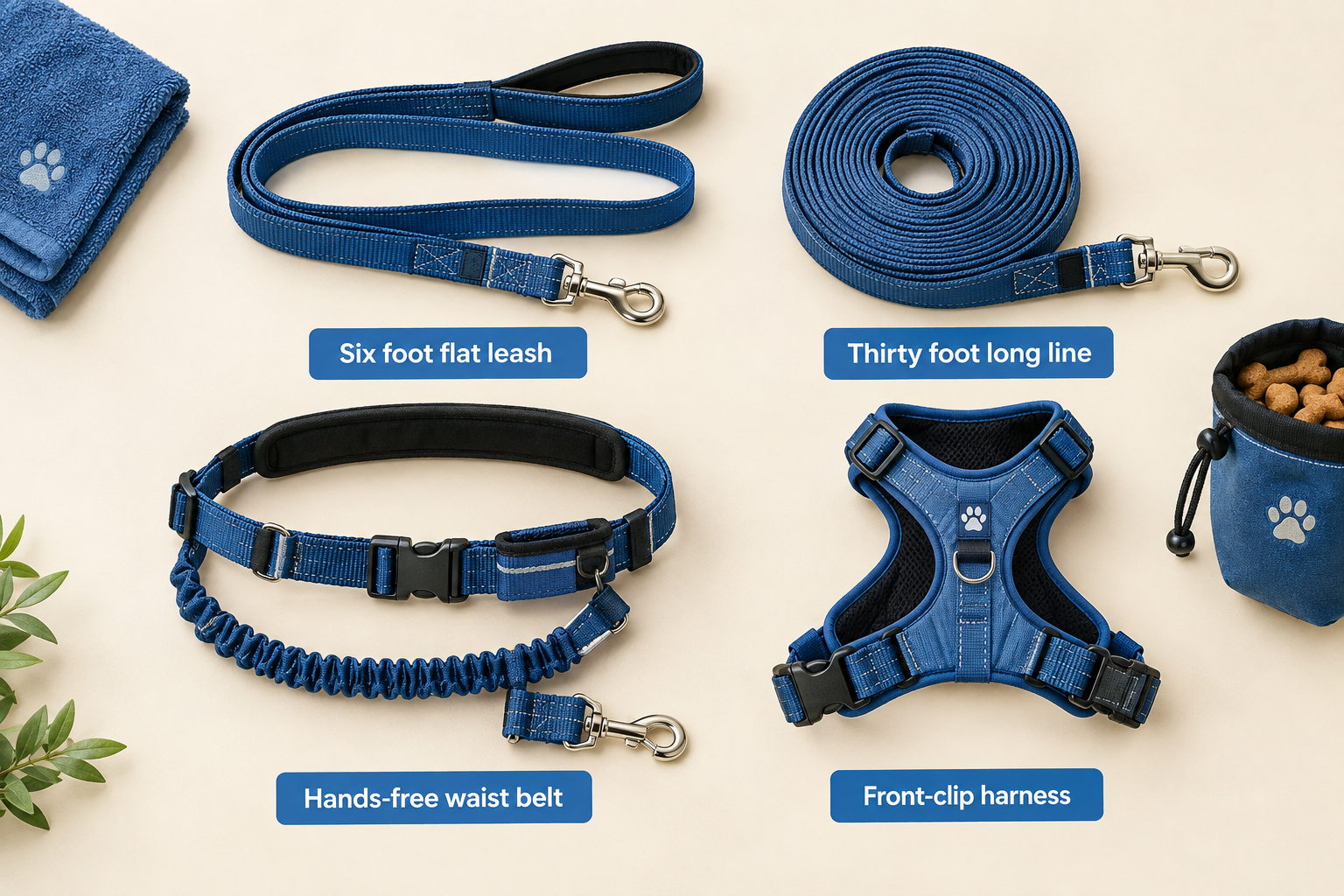
The default recommendation is a four to six foot flat leash clipped to a correctly fitted harness, with a 15 to 30 foot long line kept in the car for open-space sniffing. That combination covers almost every walk, costs less than most retractable models, and has no spring, spool, or plastic housing to fail.
)
Who each option suits:
- Flat 6 ft leash, biothane or webbing. Everyone, every day, in every shared space. Easiest to shorten by hand.
- Long line, 15 to 30 ft. Dogs practising recall, dogs who need sniffing enrichment, owners without a fenced garden. Gather the slack in loops rather than letting it drag through brambles.
- Front-clip harness or head halter. Dogs who pull hard enough to hurt a handler, used as management while loose-leash skills develop, per VCA guidance.
- Hands-free waist leash. Runners with dogs that already walk politely. Poor choice for a lunger, since your centre of gravity becomes the anchor point.
- Short traffic lead, 2 to 3 ft. Vet lobbies, elevators, crowded pavements, the doors of busy shops.
Check the dimensions and ratings before buying: line length, stated weight limit, clip size, and the width of the handle loop relative to your hand.
No dog injury database
The May 2026 Frontiers in Veterinary Science review found no comparable published database of leash-related injuries in dogs, and called entanglement injuries plausible but under-investigated.
One documented eye injury
The same review documented a human ocular injury caused by recoil from a retractable leash, and noted manufacturers routinely warn of amputation risk.
AKC limits, not a ban
AKC guidance updated March 10, 2026 restricts retractable leashes to trained dogs in low-risk settings and warns against crowds, sidewalks and use before reliable recall.
No recall found
As of October 3, 2026, the CPSC recalls database listed no recall or federal prohibition specific to retractable dog leashes. That is not the same as a safety clearance.
Review method and price note
Doggy Rank IQ may earn a commission if you buy through retailer links, and commission never decides a verdict. The comparisons above come from specification review, published professional guidance, and manufacturer warnings rather than a controlled test of competing models. Prices checked on Chewy between late September and early October 2026 showed retractable leashes still widely sold rather than withdrawn: a 16-foot Flexi model at $18.78, a Flexi New Classic at $29.59, and a Flexi New Comfort medium at $36.48. Fit note: those ratings are size-specific, so compare the options against your dog's actual weight and pulling strength, not the next size up for comfort.
How do you use a retractable leash more safely if you keep one?
Keep it, use it in two places, and lock it the rest of the time. If the leash lives in the car for field walks rather than on the hook by the door, most of the risk disappears.
A usable checklist:
- Lock the brake at six feet as the default. Unlock only in open space with nothing approaching.
- Buy tape, not thin cord. Wider line is more visible to people and less likely to cut.
- Hold the handle with two hands when a dog, cyclist, or child comes into view.
- Clip to a harness, so a hard stop does not load the throat.
- Never grab the moving line. Step on it or walk toward the dog.
- Keep fingers out of loops. No wrapping, ever.
- Retire it when the brake slips or the line frays. Test both monthly.
- Leave it at home for vet visits, pavements, elevators, markets, and patios.
- Respect the stated weight rating rather than the one you hope applies.
Retractable leash cord tangling: how to prevent it
Tangles happen because the spool keeps feeding line while the dog orbits. Prevent it by locking the brake at a short length in close quarters and by standing still rather than turning in circles when a dog sniffs. If the line wraps a leg, lock the brake first so the spool stops pulling, then unwind by hand instead of lifting the leg. On long grass or scrub, a flat long line tangles less and untangles faster.
FAQ
Are retractable leashes bad for all dogs?
No. They are poorly suited to untrained dogs, hard pullers, reactive dogs, and anyone walking in traffic or crowds. For a trained dog with reliable recall in open low-traffic space, AKC guidance treats them as acceptable with the brake managed carefully.
Why do vets hate retractable leashes?
Because they remove immediate control. The AKC notes a pulling dog cannot be reeled in, and MSPCA-Angell recommends against them because a handler cannot shorten the line fast enough in an emergency. Cord cuts and recoil injuries add to the objection.
Can a retractable leash hurt my dog's neck?
A full-speed run into the end of the line can cause tracheal or spinal injury, per AKC guidance. The 2026 veterinary review found no published documentation that routine leash pulling causes chronic thyroid, tracheal, or vascular damage, so the chronic claims are not established.
What is the best alternative to a retractable leash?
A four to six foot flat leash for everyday walking, plus a 15 to 30 foot long line for sniffing and recall practice in open space. Add a front-clip harness if the dog pulls hard.
Are retractable leashes bad for training a puppy?
Yes, for leash manners. The leash pays the puppy for pulling. Teach loose-leash walking on a conventional six-foot leash first, which is the sequence the AKC recommends.
Have retractable leashes been recalled or banned?
Not as a category. As of October 3, 2026, the CPSC recalls database did not list a recall or federal prohibition specific to retractable dog leashes, and they remain widely sold.
What size dog can use a retractable leash?
Only within the stated weight rating of the specific model, and that rating assumes a walking dog. Small dogs risk whiplash at the end of the line; large strong dogs can overpower the brake or break a worn cord.
Conclusion
Are retractable leashes bad? They are a specialist tool sold as a general one. The evidence base is thinner than either side of the argument admits: the 2026 veterinary review found sparse research overall, one documented recoil eye injury, manufacturer amputation warnings, and no published database of leash injuries in dogs. The control problem, though, is not in dispute. You cannot shorten a retractable leash while your dog is pulling, which is exactly when you need to.
Three next steps worth taking this week:
- Move the retractable leash to the car, and hang a six-foot flat leash by the door.
- Order a 15 to 30 foot long line for sniffing walks and recall practice in open space. It does the good part of the retractable leash with none of the housing.
- Test the brake and inspect the line on the leash you already own. If it slips or frays, retire it rather than hoping.
The dog does not need twenty-six feet of range on a pavement. The dog needs a handler who can close the gap in one second flat.