
Quick Answer
Fewer than half of customers using large veterinary groups knew their practice was part of a chain, according to the UK Competition and Markets Authority’s March 2026 market investigation. Private equity vet clinics are practices owned or backed by investment firms that buy multiple hospitals and run them as a group. Ownership by itself does not tell you whether the care is good. The useful move is to ask five specific questions: who owns the practice, who writes the treatment plan, can you get an itemized estimate, will they write an outside prescription, and who is on the floor at 9pm. Guidance checked October 2026.
Key Takeaways: Private Equity Vet Clinics
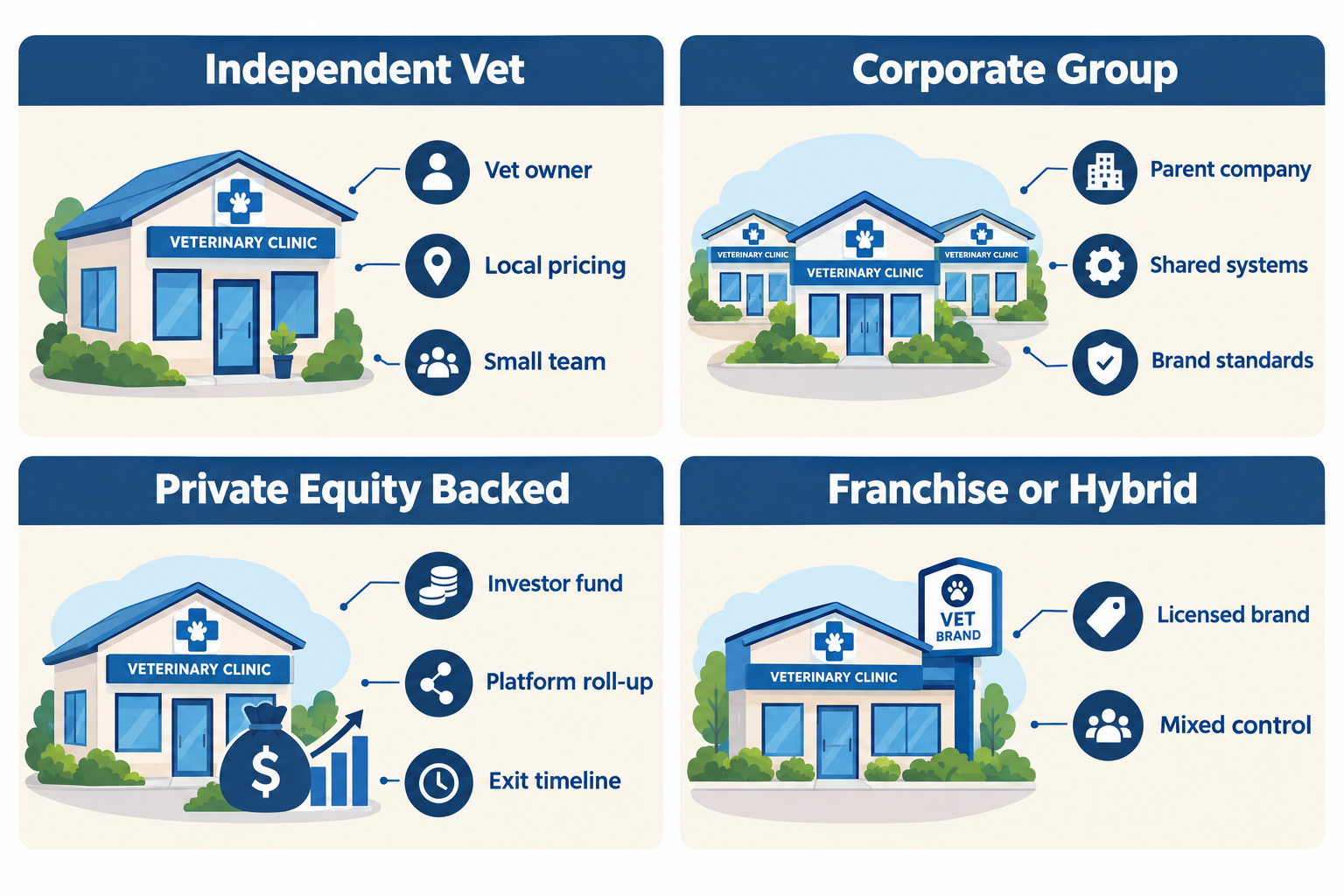
- Private equity vet clinics are hospitals bought by investor-backed groups that consolidate many clinics under one owner, often keeping the original name and the original staff.
- Not every corporate vet is private equity. Mars Veterinary Health, which includes VCA, Banfield and BluePearl, is owned by a privately held family company, not an investment fund.
- The American Veterinary Medical Association has said there is no evidence that corporate practices are inherently better or worse than independent ones on patient care, efficiency, pay or client satisfaction.
- UK regulators found corporate ownership rose from roughly 10% of practices in 2013 to about 60% in 2026, with average vet prices up 63% between 2016 and 2023. Those are market-wide trends, not proof that one owner type caused every increase.
- Ownership and operations are different things. A fund can centralize billing, purchasing and HR while vets still make the medical calls.
- A 2023 JAVMA study found corporate employees got better insurance and continuing education benefits, and also reported more pressure to generate revenue.
- You can usually identify ownership in under ten minutes using the website footer, the invoice, the door signage and your state’s business registry.
- Red flags are behavioral, not structural: refused itemized estimates, blocked outside prescriptions, high staff turnover, and a different vet every visit.
What are private equity vet clinics, and who owns them?
Private equity vet clinics are veterinary practices owned by, or financially backed by, investment firms that buy clinics to build a larger group, improve its financial performance, then sell it on within a typical hold period of a few years. The clinic sign often stays the same. The waiting room smells the same. The paperwork at the top of the invoice is what changed.
What is private equity in veterinary medicine
Private equity is pooled investor money used to buy whole companies rather than shares on a public market. In veterinary medicine, a fund typically buys one well-run hospital as a “platform,” then adds smaller clinics around it. The group grows, administrative costs get spread across more locations, and the whole thing becomes attractive to a larger buyer later.
Veterinary care drew that money for an unglamorous reason: people keep spending on their dogs in good years and bad, the market was full of small owner-operated businesses, and almost nobody had consolidated it yet. PBS NewsHour reported in 2026 that rising veterinary costs have brought that ownership model under closer public scrutiny.
How do private equity firms buy vet clinics
The pattern is consistent enough to describe plainly:
- A fund identifies a platform practice. Usually profitable, well staffed, with a retiring owner and a good local reputation.
- The owner sells, often taking part cash and part equity in the new group, with a work commitment of two to five years.
- Add-on acquisitions follow. Smaller clinics in the same region get bought one at a time. US regulators call this a serial acquisition strategy, and the Federal Trade Commission’s veterinary page describes competition concerns the agency identified in several local specialty and emergency markets, including divestiture requirements in JAB-related deals involving SAGE Veterinary Partners and Ethos.
- Back office functions get centralized. Billing, purchasing, payroll, marketing, HR, scheduling software.
- The group is sold to another fund or a strategic buyer, and the cycle can repeat with the same clinic under a third owner.
The important detail for dog owners: step 4 is where your experience usually changes, and step 1 is where it usually does not.
Private equity veterinary groups list: who the big names are
Be careful with lists circulating online, because they blur three different ownership types. Here is the honest version.
Corporate but not private equity. Mars Veterinary Health is the largest operator in the sector and includes VCA Animal Hospitals, Banfield Pet Hospital, BluePearl and Linnaeus. Mars is a privately held family-owned company. Calling a VCA a private equity clinic is simply wrong.
Investor-backed multi-site groups. Names that appear repeatedly in consolidation coverage and in the 2026 veterinary consolidation tracker published on LinkedIn include National Veterinary Associates (NVA), Ethos Veterinary Health, Thrive Pet Healthcare, VetCor, PetVet Care Centers, Southern Veterinary Partners and Heartland Veterinary Partners. Specific fund ownership shifts as groups are bought and sold, which is exactly why a list goes stale. Check the group’s own corporate page before repeating a claim.
Recent deals worth knowing about. On September 24, 2026, GoodVets announced its acquisition of WellHaven Pet Health, adding more than 40 hospitals across seven states and taking GoodVets from 75 to 116 locations. Financial terms were not disclosed. The same day, Bridgepoint announced its acquisition of Altano International, a network of equine and veterinary practices with almost 1,000 veterinarians across Europe, North America and Oceania, subject to regulatory approval.
Both announcements said the same thing in different words: the local teams keep caring for existing clients, with added technology and management support. That claim is testable. You test it with your own invoices and appointment history over the following year.
How many vet clinics are owned by private equity or corporations?
There is no single official US figure for the share of clinics owned by private equity specifically, and anyone quoting a precise national percentage is usually estimating. The best documented numbers come from the UK, where regulators measured the shift directly. Independent practices still make up a large part of the US market, especially outside metro areas.
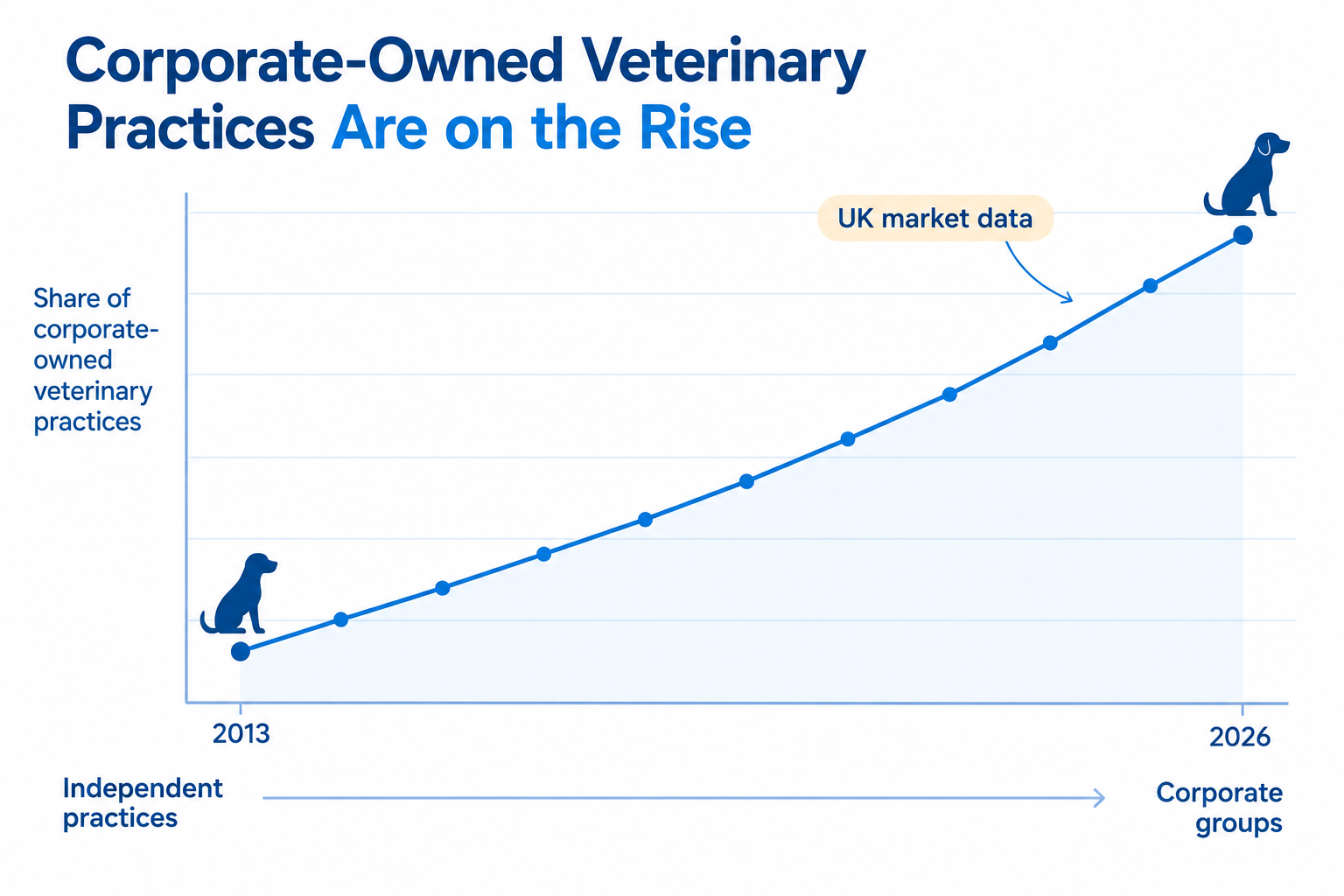
The UK price increase matters, and so does its limit. The CMA measured a market, not a causal mechanism. Drug costs, wages, equipment, and the simple fact that veterinary medicine can now do far more for a dog than it could in 2016 all sit inside that 63%. The CMA’s own conclusion was that the market was not working well for consumers, which led to reforms on pricing transparency and ownership disclosure rather than a ruling that one ownership model overcharges.
Private equity vet clinics vs independent vets
| Model | Who owns it | Pricing control | Staffing and benefits | What to ask |
|---|---|---|---|---|
| Independent practice | One or a few veterinarian owners, usually local | Set in house, can be adjusted case by case | Smaller team, often thinner insurance and CE benefits | Who covers emergencies when you are closed? |
| Corporate group (e.g. Mars Veterinary Health: VCA, Banfield, BluePearl) | A large privately held or public company, long hold horizon | Standardized fee schedules, regional variation | Structured benefits, internal specialists, defined protocols | Can I keep seeing the same veterinarian? |
| Private equity backed group (e.g. NVA, Thrive, Southern Veterinary Partners) | Investment fund plus management, typical hold of a few years | Centrally reviewed, often tied to growth targets | Better insurance and CE reported, more revenue pressure reported | Has ownership changed in the last two years, and what changed with it? |
Decision rule: choose on the strength of the specific clinic, not the category. If an independent practice has one exhausted vet and no emergency plan, and the corporate hospital across town has a surgeon on staff and an after-hours number that a human answers, the corporate hospital is the better choice for a dog with a torn cruciate.
What changes for my dog when a private equity group buys my vet?
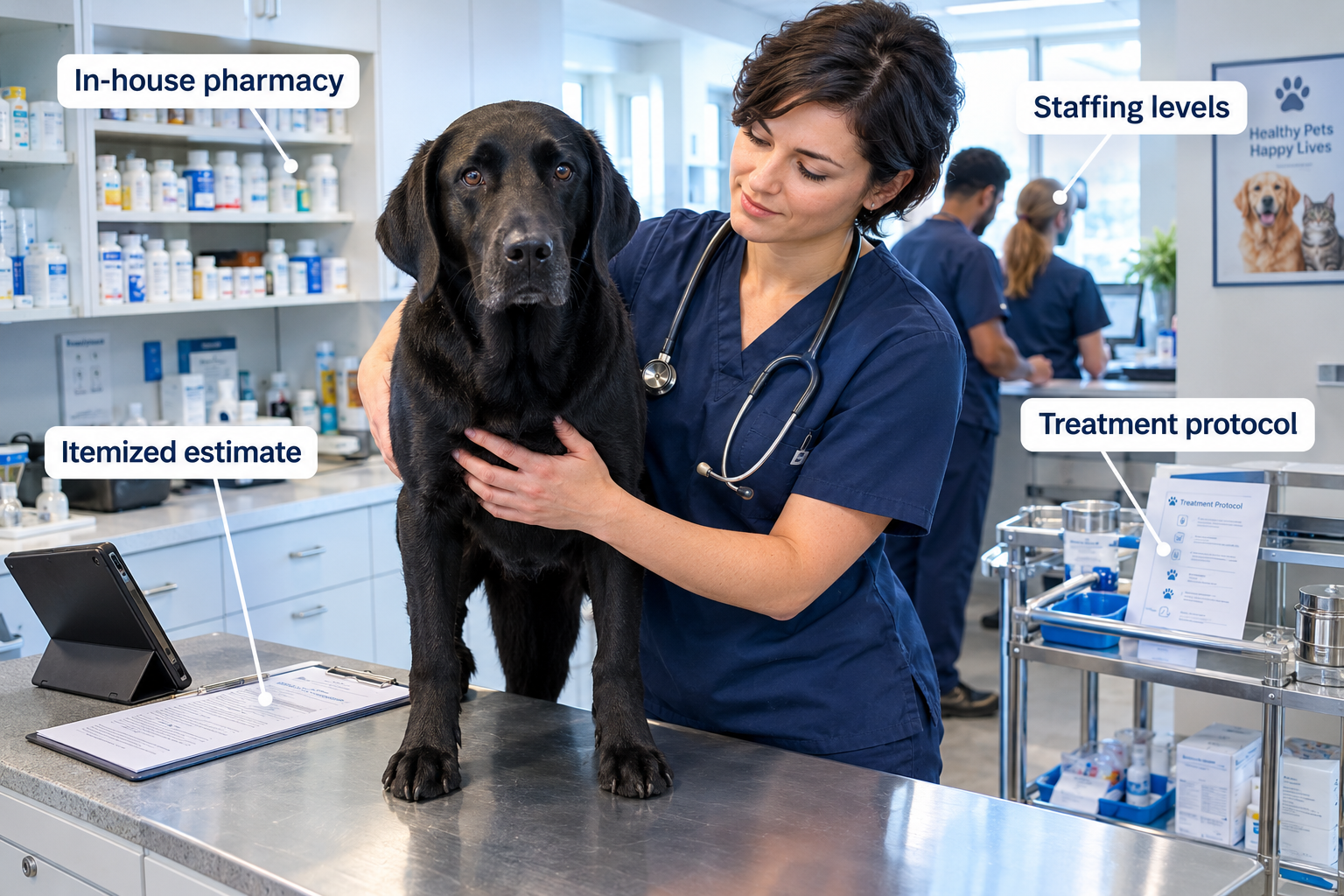
Usually the people stay and the systems change. The treating veterinarian is often the last thing to move, which is why so many owners find out about a sale months later from a logo on a receipt. What changes first is scheduling software, appointment length, pricing structure, pharmacy policy and the referral network.
Are private equity vet clinics more expensive, and will my prices go up?
Expect pricing to become more standardized, which can mean higher for some services and lower for others. Standardization removes the informal discounts a long-time owner-vet might have given you without writing anything down.
What the evidence supports: UK regulators documented a 63% rise in average prices across the whole market between 2016 and 2023 and a 53% rise in average treatment costs, alongside the shift to corporate ownership. What the evidence does not establish is that investor ownership caused that specific increase at your specific clinic. Analyses of veterinary consolidation point at the same cluster of drivers: labor shortages, wage increases, more advanced diagnostics, and higher drug and equipment costs.
Practical check: pull two invoices for the same service, one from before the sale and one from after. Compare the line items, not the total. A total can change because the visit included more.
If you want the longer version of the cost story, our guide on whether paying more for premium dog food is actually worth it applies the same logic to the other big line in a dog’s budget: price alone is weak evidence of quality.
Does private equity ownership affect vet care quality?
There is no good evidence that ownership type predicts care quality on its own. The AVMA’s position is that corporate practices are not inherently better or worse than independent ones, which is why it advises evaluating the actual clinic instead of the label.
Where consolidation can genuinely help a dog:
- Specialists and advanced imaging that a two-vet practice cannot finance
- Standardized anesthesia and pain protocols, which reduce variation between individual vets
- Overnight staffing and emergency cover in group hospitals
- Shared records across locations, so a second opinion already has the bloodwork
A 2025 analysis in Frontiers in Veterinary Science identified real savings from consolidated HR, payroll, accounting, marketing, inventory and purchasing. Whether those savings reach your bill or the investor’s return depends on the group.
Where it can hurt: shorter appointments, more vets rotating through the exam room, pressure toward standard packages that do not fit an individual dog, and reduced ability for your vet to spend forty minutes on a complicated geriatric case.
How does private equity change vet clinic operations
The operational changes you are most likely to notice, in rough order of speed:
- Front desk and scheduling. New software, online booking, prepayment at check-in.
- Appointment length. Often shortened to a fixed slot.
- Estimates. More formal, sometimes presented as good/better/best tiers.
- Pharmacy. A push toward the in-house or group-affiliated online pharmacy.
- Diet and supplement sales. More prominent retail shelves and recommended brands. If a therapeutic diet is suggested, it can still be the right call; our guide to vet recommended dog food for specific health problems explains when the clinical evidence supports it and when a standard complete food will do.
- Referrals. More likely to stay inside the group’s own specialty hospitals.
- Staff. Technicians and receptionists often turn over before veterinarians do.
Edge case worth naming: a sale can rescue a failing clinic. A retiring solo vet with ageing equipment and no successor either sells or closes. For the neighborhood, a bought clinic beats a shuttered one.
Private equity vet clinics employee complaints: what staff actually report
The most useful data here is a 2023 JAVMA study of veterinarians. It found corporate employees were more likely to receive health, dental, life and disability insurance, mental wellness programs, paid continuing education and professional memberships. The same study found corporate employees reported greater pressure to generate revenue and to see more clients per shift.
And on preference: 55% of participants preferred working in private practice, against 12% preferring corporate practice. Vets in independent practices reported more satisfaction with culture, mentorship, being personally known by management, and the ability to dismiss abusive clients.
That last item sounds like an HR footnote. It is not. A vet who cannot decline a hostile client is a vet closer to leaving, and staff continuity is one of the few things that reliably improves your dog’s care. Reporting from PublicSource in Pittsburgh and the advocacy group Private Equity Stakeholder Project’s veterinary campaign collect similar accounts from staff. Advocacy material is a legitimate source of first-hand complaints and also has a position to argue. Read it as testimony, not as measurement.
Private equity vet clinic consolidation pros and cons
Potential benefits
- Access to specialists, surgery and advanced imaging
- Overnight and weekend staffing
- Standardized protocols and better record keeping
- Stronger employee benefits and funded continuing education
- Bulk purchasing that can hold some costs down
- Clinics that stay open instead of closing with a retirement
Potential drawbacks
- Shorter appointments and less continuity with one vet
- Revenue targets influencing how options get presented
- Reduced local price flexibility
- Referrals steered inside the group
- Pharmacy policies that discourage outside prescriptions
- Ownership that can change again in three years
How do I find out who owns my vet clinic?
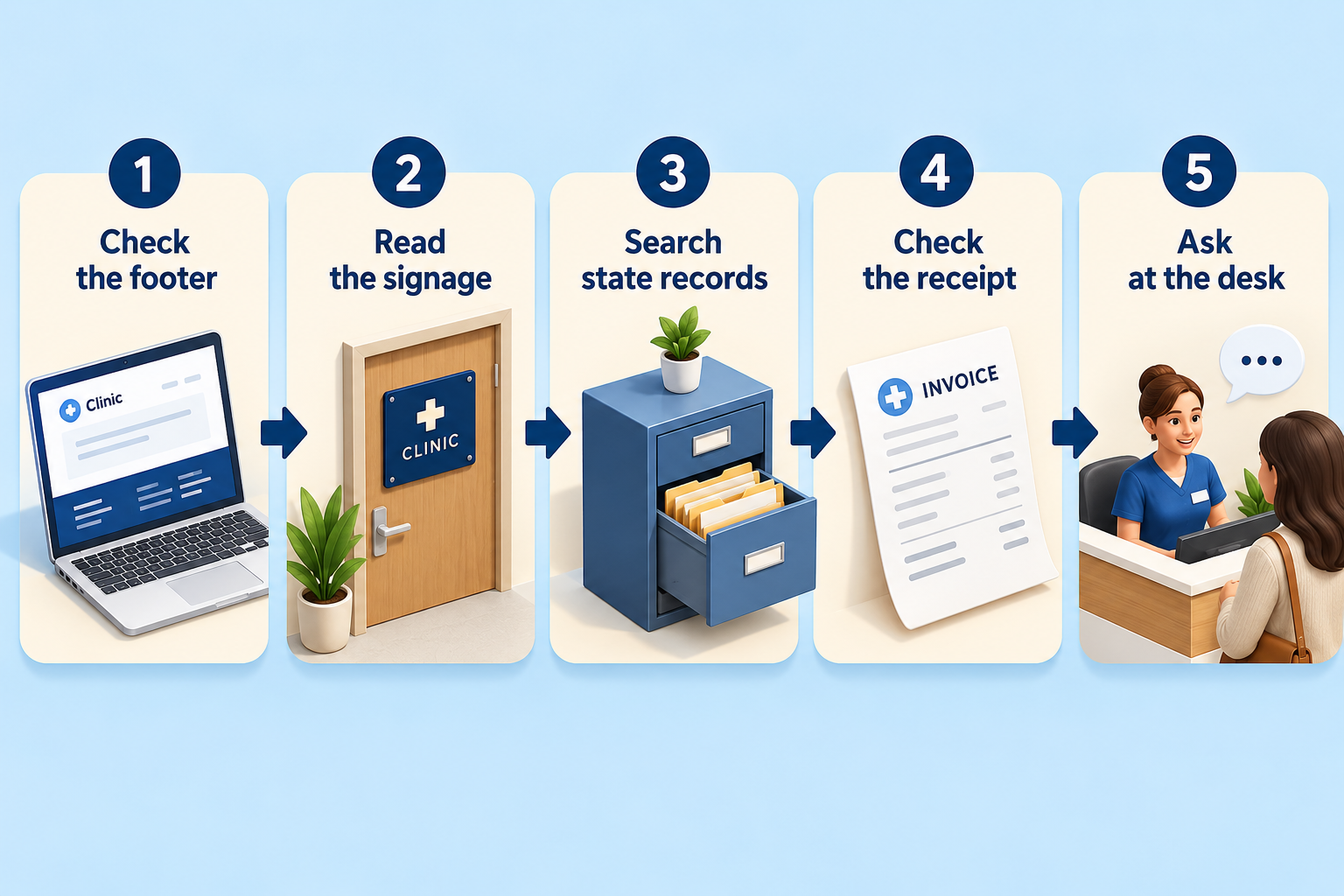
Start with the website footer and the invoice. Multi-site owners are legally required to disclose themselves in some markets and voluntarily name themselves in most others, usually in small type at the bottom of a page or beside the practice name on a receipt.
How to know if my vet clinic is owned by private equity: a five minute check
- Scroll to the website footer. Look for a second company name, a group logo, or “part of the ___ family of hospitals.”
- Read the invoice and the card receipt. The legal entity billing you is often different from the clinic name on the door.
- Check the door and reception signage. Following the CMA’s reforms, GOV.UK guidance tells UK veterinary businesses operating multiple first-opinion practices, or combining practices with online pharmacies, to display ownership information online, on premises, in signage and in communications.
- Search your state or national business registry for the clinic’s legal name. Registered agents and parent entities show up there.
- Search the clinic name plus “acquisition” or “joins” in news results. Deals are usually announced in a press release.
- Ask the practice manager. Directly, politely, in person. A group with nothing to hide answers in one sentence.
VetFairly maintains a resource on veterinary ownership research if the registry route stalls.
Private equity vet clinics near me: how to find an independent vet instead
There is no official national directory of independent clinics, so searching “private equity vet clinics near me” tends to return the corporate groups rather than the alternatives. These approaches work better:
- Search “veterinarian owned” or “locally owned animal hospital” plus your city. Independents advertise it, because it is a selling point.
- Check your state veterinary medical association member directory and look for practices listing a named DVM owner.
- Ask a local rescue, breeder, trainer or groomer. People who move a lot of dogs through clinics know who runs which one.
- Look for clinics with one or two locations and the owner’s surname in the practice name.
- Ask at the desk: “Is this practice veterinarian owned?” An independent will say yes before you finish the question.
One honest caveat, laid out well in a comparison of corporate and independent clinics: independence does not guarantee lower prices or better medicine. It guarantees that the person setting policy is in the building.
Private equity vet clinics red flags to watch for
Judge behavior, not structure. These are the signals worth acting on:
- ð© Refusal to provide a written, itemized estimate before a procedure.
- ð© Resistance to a written prescription you can fill at an outside pharmacy, or a per-script fee that quietly cancels the saving.
- ð© A different veterinarian at every visit, with nobody who knows your dog’s history without reading it cold.
- ð© Visible technician and reception turnover across a few months.
- ð© Tiered packages presented before a diagnosis, where the “recommended” tier is always the middle one.
- ð© Referrals only inside the group, with no outside specialist offered.
- ð© Pressure during an emergency, when you are least able to compare the options.
Any one of these can happen in an independent clinic too. Three at once, at any clinic, is a reason to get a second opinion.
Worth remembering: the discussion thread just found out my trusted vet practice is owned by private equity on r/AskVet is full of owners describing that exact sequence, learning about a sale, then re-reading every recent recommendation with suspicion. That instinct is understandable. It is also worth checking against the actual record of what your vet recommended and whether your dog got better.
What are the 5 questions to ask your vet?
Ask these five, in this order, at a routine appointment rather than an emergency: who owns this practice, who decides my dog’s treatment plan, can I get an itemized estimate in writing, will you write a prescription I can fill elsewhere, and who is here after hours. The answers tell you more about private equity vet clinics than any ownership list will.
1. Who owns this practice, and has that changed recently?
What a good answer sounds like: a named group, a date, and what did and did not change. Vagueness is the problem, not corporate ownership.
2. Who decides my dog’s treatment plan?
You want to hear that the attending veterinarian sets the plan. The CMA’s reforms specifically included safeguards for veterinary clinical judgment, because that is the hinge the whole question turns on.
3. Can I get an itemized estimate in writing before you proceed?
A yes should be immediate and unbothered. Line-item estimates let you ask which test changes the plan and which one is confirmatory.
4. Will you write a prescription I can fill at an outside pharmacy?
Legal in most US states on request. Ask about any handling fee up front. This also applies to therapeutic diets, where comparing brands is reasonable. Our guide to reading a dog food label and what AAFCO means helps you tell a genuinely therapeutic formula from a premium-priced ordinary one.
5. Who is on the floor after hours, and where do you refer emergencies?
Get the name of the emergency hospital and the drive time. Do this before you need it.
FAQ
Is my dog getting worse care at a private equity vet clinic?
Not automatically. The AVMA has said there is no evidence that corporate practices are inherently better or worse than independent ones on patient care or client satisfaction. Judge the clinic by continuity of staff, willingness to itemize, and whether your dog’s problems actually get solved.
Are VCA and Banfield private equity vet clinics?
No. Both are part of Mars Veterinary Health, along with BluePearl. Mars is a privately held family-owned company, not an investment fund. They are corporate, with standardized pricing and protocols, which is a different thing from a private equity hold period.
Why are vets so expensive now?
UK regulators recorded a 63% rise in average veterinary prices between 2016 and 2023 across the whole market. The documented drivers include wages in a tight labor market, drug and equipment costs, and far more advanced diagnostics and surgery being available than a decade ago. Ownership structure is one factor among several, not the sole explanation.
Can my vet refuse to write a prescription for an outside pharmacy?
In most US states a veterinarian must provide a written prescription on request, though some clinics charge a handling fee. Ask about the fee before you decide, because a per-script charge can cancel out the saving on a cheap generic.
Should I switch vets after my practice is sold?
Not on the news alone. Give it two or three visits and watch four things: whether you still see the same veterinarian, whether appointment length changed, whether estimates stay itemized, and whether staff you recognize are still there. Switch if those slip, not because the parent company changed.
How do I find a vet not owned by private equity near me?
Search “veterinarian owned animal hospital” plus your city, check your state veterinary medical association directory for practices with a named DVM owner, and ask local trainers, groomers and rescues. Then ask the practice directly. Independents usually volunteer it.
Does ownership change what food my vet recommends?
It can change which brands sit on the retail shelf. The underlying clinical reasoning should still be about your dog’s condition. If a diet is recommended for weight, joints, skin or gut problems, ask what it is meant to do and over what timeframe, then compare the options using our guide to dog food for weight, joints, skin and gut problems.
What regulation applies to private equity vet clinics?
In the UK, the CMA concluded its market investigation in March 2026 with reforms on ownership disclosure, pricing transparency and protections for clinical judgment. In the US, the FTC has focused on serial acquisitions, imposing divestiture requirements and acquisition restrictions in JAB-related deals involving SAGE Veterinary Partners and Ethos.
Conclusion: choose on care, not just ownership
The ownership question is worth asking and it is not the whole answer. Private equity vet clinics can run with excellent staff, modern equipment and a surgeon on site. Independent practices can run beautifully, or can run one exhausted vet into the ground with no emergency plan. Individual variation between clinics is larger than the average difference between ownership models, which is exactly why the AVMA points owners at the clinic rather than the category.
Your next three steps:
- Check your ownership in five minutes tonight. Website footer, last invoice, state business registry.
- Take the five questions to your next routine appointment. Use the checklist above and copy it to your phone. A routine visit is the right time, because an emergency is the wrong one.
- Keep two numbers on your fridge: your regular clinic and the emergency hospital they refer to, with the drive time written next to it.
Then watch the things that actually predict good care: the same vet who remembers your dog’s knee, a printed estimate you did not have to request twice, and a technician who has been there longer than the parent company has. That is where the facts end and your own record begins.
While you are doing household admin for the dog, two other decisions reward the same kind of checking: picking the right everyday food using our guide to choosing the best dog food, and keeping the toxic list on the fridge beside the vet numbers with our rundown of foods dogs cannot eat.