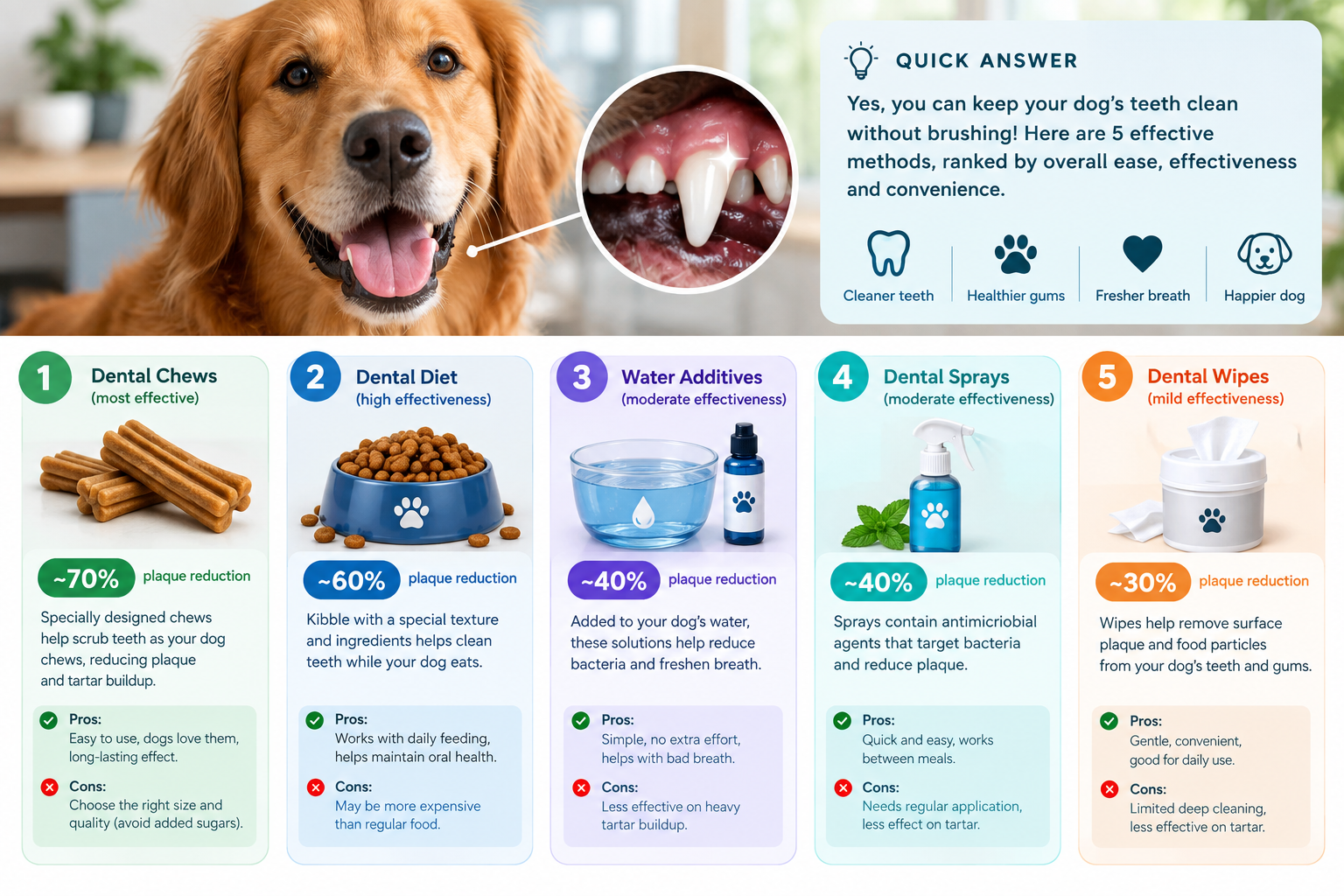
Quick Answer
How to clean dog teeth without brushing comes down to stacking daily habits, not buying one miracle product. Ranked by the strength of the evidence behind them: VOHC-accepted dental chews, a VOHC-accepted dental diet, dental wipes or gels, water additives, and safe chew toys. Every one of those controls plaque. None of them removes hardened tartar below the gumline, which is why the American Veterinary Medical Association still names brushing the most effective home measure and why a brown-stained mouth needs a veterinary exam, not another bag of treats. Guidance checked October 2026. General information, not a diagnosis.
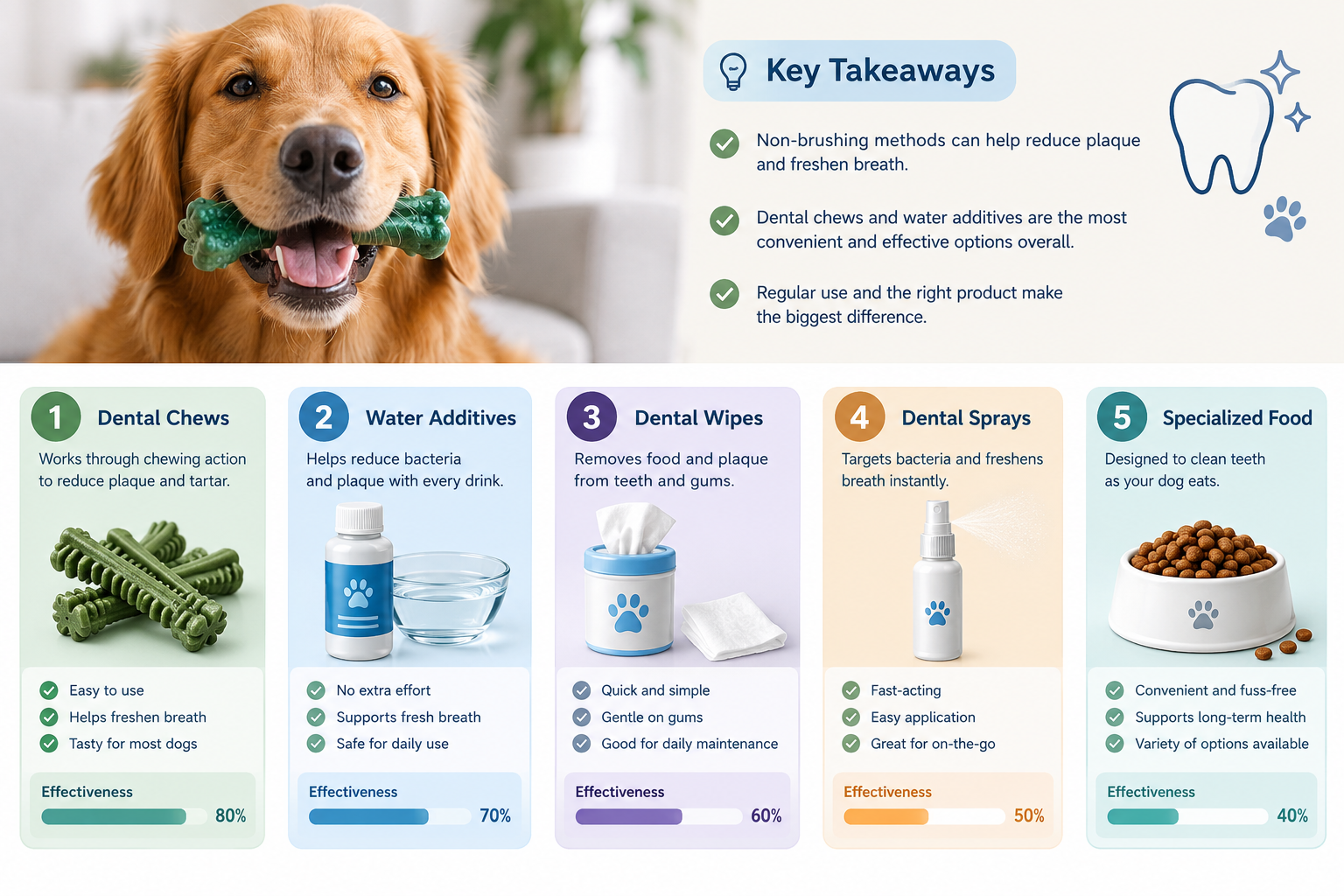
Key Takeaways: How to Clean Dog Teeth Without Brushing
- Daily beats fancy. Any no-brush method only works on the days it actually happens, which is why the easiest option in your house usually outperforms the theoretically best one.
- The VOHC seal is the fastest filter. The Veterinary Oral Health Council accepted-products list covers dental diets, edible chews, water additives, gels, sprays, powders, wipes and sealants that have shown plaque or tartar control under set standards.
- Chews have the best published support. A 2021 comparative study in 45 dogs under 10 kg and 60 dogs weighing 15 to 30 kg found three tested chews reduced plaque, calculus and gingival bleeding over 30 days against controls.
- Wipes are the most underrated option. Merck Veterinary Manual notes that wiping teeth with gauze every two to three days can remove plaque in dogs who refuse a brush.
- Plaque is soft, tartar is cemented. Home care manages the first. The second needs professional scaling, which is also when the vet can finally see below the gumline.
- Coconut oil, baking soda and home ultrasonic gadgets lack good evidence. Hard antlers, hooves and weight-bearing bones carry a real fracture risk.
- Stacking works. Chew plus dental diet plus an occasional wipe gets most dogs closer to clean than any single purchase.
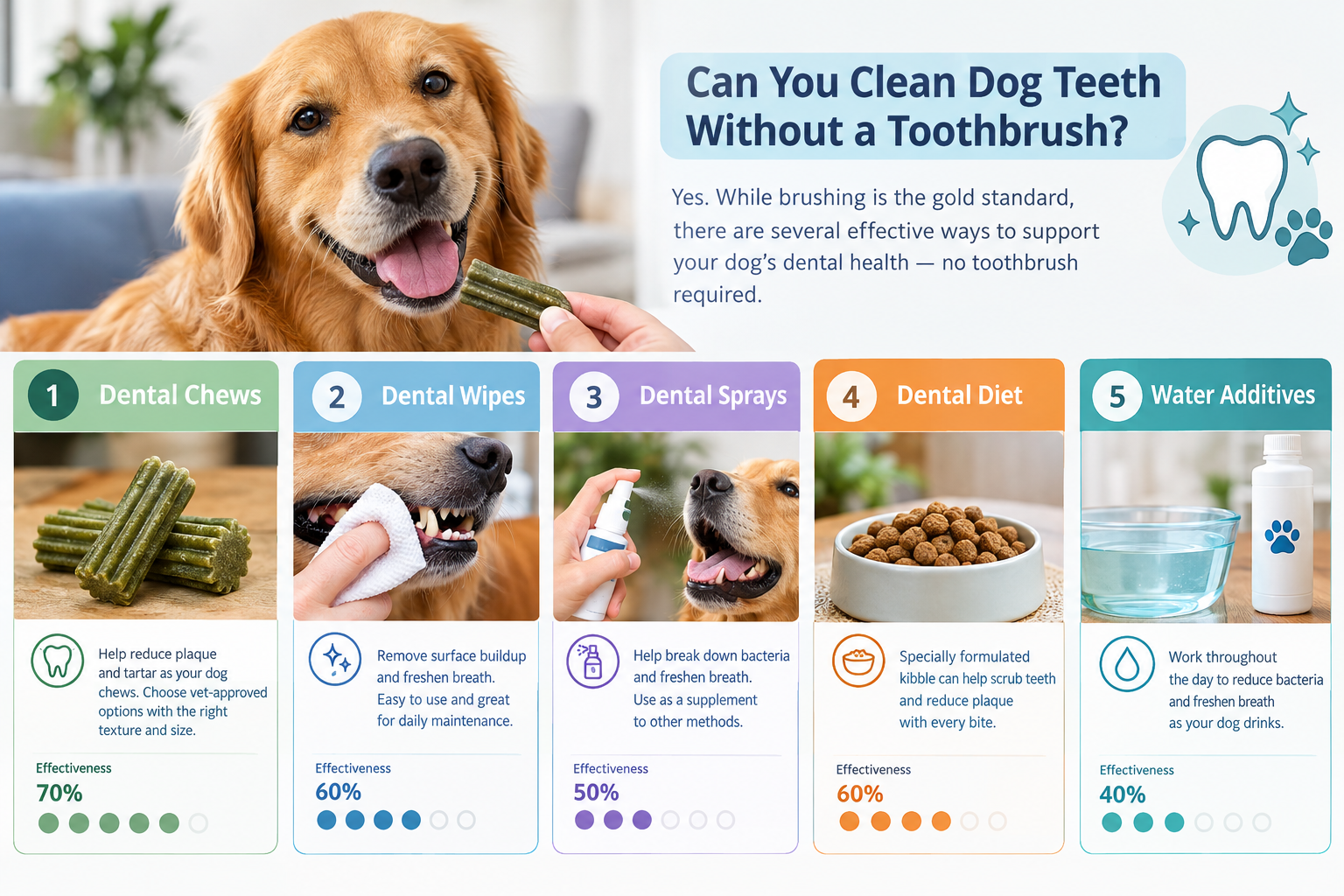
Can You Clean Dog Teeth Without a Toothbrush?
Yes, you can meaningfully reduce plaque without a toothbrush, but you cannot replicate everything a brush does. A brush reaches the gum margin, which is exactly where gingivitis starts. Most no-brush methods reach the broad outer surfaces of the big chewing teeth and miss the narrow line where the tooth meets the gum.
That is the honest trade. It still matters, because plaque left alone mineralizes into calculus within days, and the dog who gets nothing is on a faster track than the dog who gets something.
The useful detail: the two mechanisms behind every method on this list are mechanical action and chemical action. A chew scrapes. A dental kibble is built so the tooth sinks in rather than shattering the piece on contact. A wipe rubs. Additives and powders work on the chemistry of the mouth instead. VOHC’s own brushing guidance treats daily hygiene as the goal and brushing as the benchmark, with accepted products as support.
Decision rule: if your dog tolerates having their lip lifted for three seconds, you have more options than you think. If they do not tolerate hands near the mouth at all, start with food-based and water-based methods and build handling tolerance separately with short, rewarded sessions. Practical handling practice fits neatly alongside basic cooperation work, the same way the five commands most puppies benefit from learning build everyday manageability.
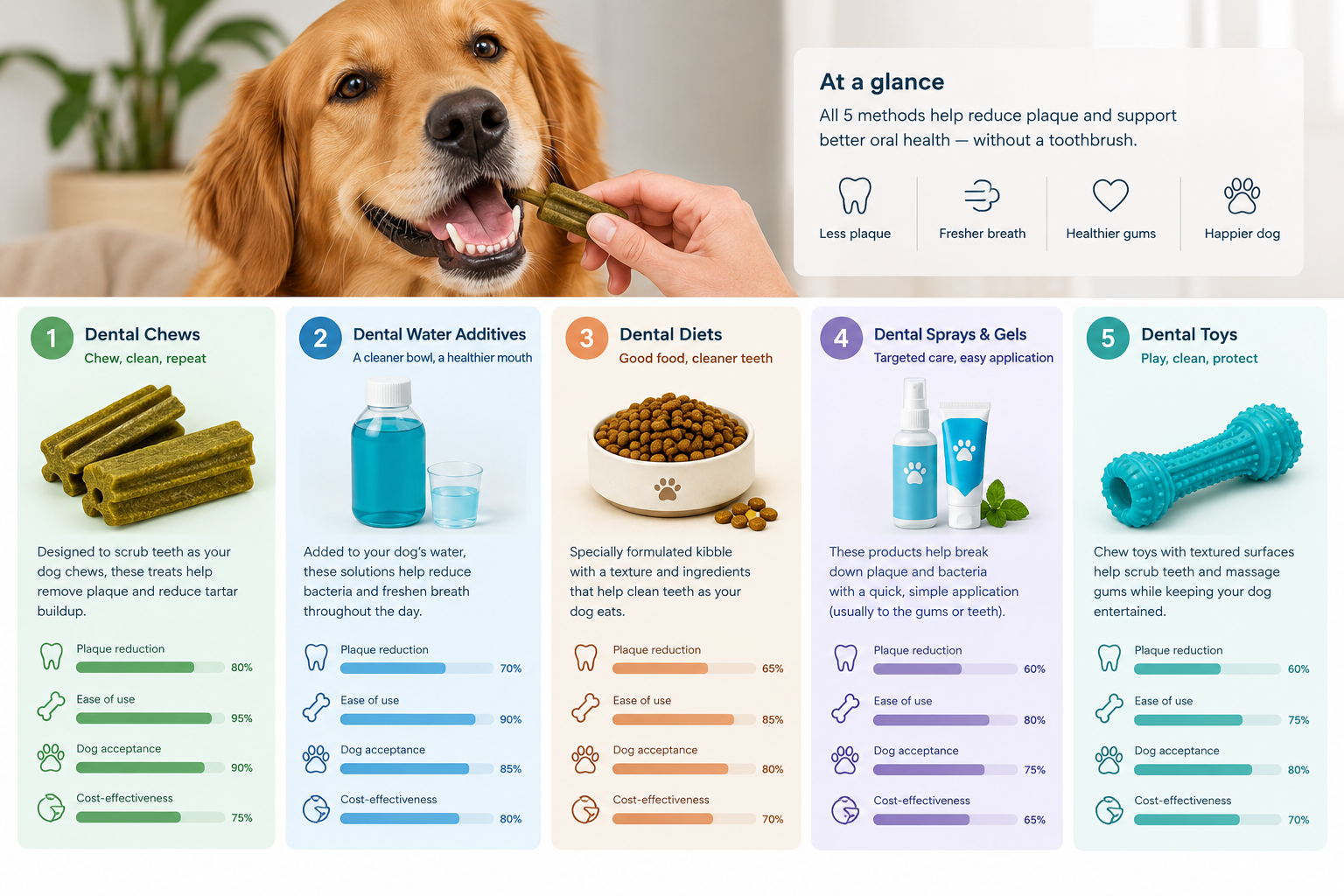
How to Clean Dog Teeth Without Brushing: The 5 Methods Ranked
The ranking below weighs published evidence, VOHC acceptance, daily effort and how often owners actually keep it up. A method that works brilliantly for two weeks and then lives in a cupboard scores badly here.
105 dogs
In a 2021 chew trial: 45 dogs under 10 kg and 60 dogs at 15 to 30 kg, over 30 days (peer-reviewed study, PMC)
8 categories
Product types on the VOHC dog list: diets, chews, additives, gels, sprays, powders, wipes, sealants (VOHC, Oct 2 2026)
Every 2 to 3 days
Gauze wiping frequency cited for dogs who will not accept brushing (Merck Veterinary Manual)
$0.92 per treat
Greenies Regular at $33.12 for 36, price checked October 3 2026 on Chewy
1. VOHC-accepted dental chews (best evidence, lowest friction)
Dental chews rank first because they combine mechanical scraping with the one thing most owners can sustain: handing the dog something they want. The dog does the work.
What the research found: in a peer-reviewed comparison of three dental chews, all three significantly reduced plaque, calculus and gingival bleeding against controls across 30 days, in both the small-dog group and the 15 to 30 kg group. What it did not establish is that any chew matches daily brushing, or that results hold for a dog with existing periodontal disease.
Who it suits: dogs who chew thoroughly rather than swallowing in two gulps, and households that can fit the calories in. Price checked October 3, 2026 on Chewy: Greenies Regular at $33.12 for 36 (about $0.92 each), OraVet small-dog chews at $37.99 for 30 (about $1.27 each).
Honest limits: chews add daily calories, size matters for safety, and no chew dissolves cemented tartar. Supervise, always.
2. VOHC-accepted dental diets (lowest effort, quietly effective)
A dental diet is the laziest high-value option available, because the cleaning happens during a meal that was going to happen anyway. These diets use kibble shape, size and fibre alignment so the tooth penetrates the piece instead of snapping it, which increases contact with the tooth surface.
Who it suits: dogs with no competing dietary restriction, owners who want one decision instead of a daily task. It works only when the diet makes up most of what the dog eats, so a handful sprinkled on top of regular food is not the same intervention.
Switch slowly over seven to ten days. Our guide on how to switch dog food without upsetting their stomach covers the transition, and the wet versus dry comparison explains why food texture gets talked about in dental terms at all.
Honest limits: prescription dental diets usually need a vet’s involvement, and dogs with kidney, weight or allergy needs may not be candidates.
3. Dental wipes and gels (the method people skip)
Wipes are the closest no-brush substitute for a brush, because they involve actual contact with the tooth surface. Merck Veterinary Manual notes that gauze wiping every two to three days can remove plaque in dogs who will not accept a toothbrush. That is a specific, repeatable instruction, and it costs almost nothing to try with a gauze square.
Wipes also got a credibility upgrade this year. Dechra announced VOHC acceptance of VETRADENT Dental Wipes in February 2026, with the listed claim being tartar control in dogs. A tartar-control claim backed by canine clinical data sits well above a generic fresh-breath promise.
Who it suits: dogs who accept a lip lift. Start with one upper canine for two seconds, then stop and reward. Build from there over a week.
Honest limits: a wipe reaches outer surfaces and nothing under the gum. Gels and sprays rely on chemistry rather than friction, and the results vary by product, so check the current accepted list before trusting a label.
4. Water additives (low effort, variable evidence)
Water additives rank fourth because the effort is near zero and the evidence is genuinely mixed by brand. Some additives hold VOHC acceptance. Plenty of bottles on the shelf do not, and presence in a store proves nothing about plaque control.
Price range checked October 1 to 3, 2026 on Chewy: roughly $15.76 to $24.99 per bottle depending on brand and size. ProDen PlaqueOff Powder, a food-sprinkled option in the same chemical-action family, was listed at $24.99 for 60 g, with the soft chews at $23.24 for 90.
Who it suits: multi-dog households, dogs who will not accept handling, owners who want one more small layer.
Honest limits: some dogs drink less when the taste changes, which is a problem worth more attention than fresher breath. Introduce at a partial dose, keep a second bowl of plain water available at first, and never use an additive as the only measure.
5. Chew toys and edible texture (useful enrichment, weakest dental claim)
Rubber chew toys, textured nylon shapes and chew-friendly designs give the teeth some mechanical work and give the dog real enrichment. The dental claim is the softest part of the story, since these products generally sit outside the VOHC list.
The safety point matters more than the dental point. The American Animal Hospital Association’s dental-care guidance advises choosing products that carry the VOHC seal and avoiding very hard objects that can fracture teeth. Antlers, hooves, weight-bearing beef bones and hard nylon bones are the classic offenders. A slab fracture of an upper carnassial tooth is an expensive, painful way to learn that a chew was harder than enamel.
Rule of thumb: press a thumbnail into it. If the surface gives slightly, it is a reasonable chew. If it is like hitting a rock, pick something else.
Dog Dental Products Compared
| Product | Type | Price checked Oct 3, 2026 | Who it suits |
|---|---|---|---|
| Greenies Regular Dental Treats | Edible chew | $33.12 / 36 (~$0.92 each) | Thorough chewers with calorie room |
| OraVet Dental Hygiene Chews (small) | Edible chew | $37.99 / 30 (~$1.27 each) | Owners wanting a barrier-style chew |
| ProDen PlaqueOff Powder | Food powder | $24.99 / 60 g | Dogs who refuse all handling |
| VETRADENT Dental Wipes | Wipe | Not checked | Dogs who accept a lip lift |
| Water additives (various brands) | Additive | $15.76 to $24.99 / bottle | Multi-dog homes, extra layer only |
Review method: specification and label comparison against the current VOHC accepted-products list, published veterinary guidance, and retailer pricing checked October 1 to 3, 2026. No hands-on testing was performed for this article. Products are named for reference, not as paid placements, and no retailer product links appear above. If a Doggy Rank IQ page carries affiliate links, that page says so plainly.
What Foods Help Clean Dog Teeth Naturally, and Is Raw Food Better?
Food texture helps a little, and no food cleans teeth the way a chew or a brush does. Large, firm kibble pieces and dense edible chews create some scraping. Soft, sticky foods create none. Carrot sticks and apple slices give a crunch and a low-calorie treat, and the dental benefit is modest rather than measurable.
Raw feeding is where the claims get loud. Raw diets with raw meaty bones are often credited with cleaner teeth, and there is a plausible mechanism: chewing through tissue and cartilage scrapes tooth surfaces. Where the facts end is the part that gets skipped. Published evidence comparing raw-fed and kibble-fed dogs on periodontal outcomes is limited, and the known risks include tooth fractures from hard bones, obstruction, perforation and bacterial contamination of kitchens and hands. AAHA’s advice to avoid very hard chew objects applies directly to bone.
Choose by situation:
- Want texture with low risk: a VOHC-accepted dental kibble or chew.
- Want a crunchy fresh treat: carrot, cucumber or apple slices, within daily treat calories.
- Considering raw: talk it through with your vet first, especially in homes with young children or immunocompromised adults.
- Cooking at home already: our guide to balanced homemade dog meals explains why complete nutrition is harder than it looks.
Individual variation shows up here more than anywhere. Two dogs on identical food can have very different mouths at age five, because breed skull shape, tooth crowding, saliva chemistry and chewing style all play a part. Small breeds and short-faced breeds tend to accumulate problems earlier.
Can I Use Coconut Oil to Clean My Dog’s Teeth?
Coconut oil does not have good evidence for cleaning dog teeth, and it is not a substitute for any method above. The idea travels well because it sounds harmless and tastes good to dogs. What it does not do is remove plaque mechanically or show plaque-control results under the kind of testing behind the VOHC list.
Two related home remedies worth the same caution:
- Baking soda. Abrasive, highly salty, unpleasant to most dogs, and not formulated for swallowing. Dogs cannot rinse and spit. Skip it.
- Home ultrasonic or “anesthesia-free” scaling. Awake scaling can smooth the visible crown while leaving disease under the gum untouched, which produces a mouth that looks improved and a dog who still has periodontal inflammation. The AVMA notes that disease below the gumline cannot be properly assessed or cleaned in an awake dog.
If a natural approach appeals, the highest-value natural measure is boring: friction applied often. A damp gauze square wrapped around a finger, rubbed along the outer surfaces of the back teeth, every two or three days, as cited by Merck Veterinary Manual. No purchase required.
How Often Should I Clean My Dog’s Teeth, and When Should I Start With a Puppy?
Daily is the target for home care, and with puppies you start before anything needs cleaning. VOHC and AVMA guidance both treat daily oral hygiene as the aim, because plaque begins reforming within hours and starts mineralizing in days.
A workable frequency plan:
- Chew or dental diet: daily, according to the label and your dog’s size.
- Wipes or gauze: daily if tolerated, every two to three days as the practical minimum.
- Water additive: daily, measured, with fresh water available.
- Mouth check: weekly. Lift the lip, look at the gumline of the upper back teeth, note any brown buildup, redness or a tooth that looks different from its neighbour.
- Veterinary oral exam: at every routine visit, and sooner if something changes.
Puppies: begin handling at eight to twelve weeks, long before deposits appear. The goal at that age is tolerance, not cleaning. Touch the muzzle, lift a lip, reward, stop. Thirty seconds. Puppies also lose deciduous teeth between roughly four and six months, so sore gums mean easing off for a while. The same calm, short-session approach used in practical puppy training is what makes mouth care possible later, and it belongs in the same category as nail and coat handling covered in our beginner’s guide to dog grooming.
What’s the Difference Between Dental Chews and Professional Cleaning?
A dental chew controls soft plaque above the gumline. A professional cleaning removes mineralized calculus, assesses the tooth root and bone, and treats disease you cannot see. They are not competing options, they are different jobs.
Dog teeth plaque vs tartar, explained simply
- Plaque is a soft bacterial film. It wipes off. Every home method targets this.
- Tartar (calculus) is plaque that has mineralized and bonded to enamel. AAHA’s dental guidelines distinguish the two clearly, with home-care products aimed at plaque control and calculus generally requiring scaling and polishing.
How to soften dog tartar at home
The candid answer: you mostly cannot, and no responsible product should promise it. Additives, powders and gels may slow new tartar formation. Nothing on a shelf reliably dissolves calculus that is already cemented to the tooth, and nothing reaches the pocket under the gum where periodontal destruction happens.
So if you came here searching how to remove tartar from dog teeth without a dentist, that is the point where this guide stops being optimistic. Home care prevents the next layer. A veterinary procedure deals with the layer that is already there.
What a professional cleaning includes
A full dental under general anesthesia typically involves examination of every tooth, dental radiographs to evaluate roots and bone, ultrasonic scaling above and below the gumline, polishing, charting, and extractions or treatment where teeth cannot be saved. Anesthesia is what makes the below-the-gumline portion possible and allows the airway to be protected while water and debris are suctioned.
How Much Does Professional Dog Teeth Cleaning Cost?
Costs vary widely by region, clinic type, dog size and what the X-rays reveal, and the sources checked for this article do not include a verified current national average, so this guide will not invent one. What you can do is get a written estimate, which most clinics will provide.
Ask for pricing broken into these parts:
- Pre-anesthetic bloodwork and physical exam
- Anesthesia, monitoring and intravenous fluids
- Full-mouth dental radiographs
- Scaling and polishing
- Possible extractions, charged per tooth or by difficulty
- Pain medication and antibiotics to go home
- Recheck visit
Decision rule: call two or three clinics in your area, ask for the base dental price and the typical extraction range, and ask whether radiographs are included or extra. Clinics that quote a suspiciously low all-in figure are often excluding radiographs and extractions, which is where most of the real variation lives. Pet insurance and wellness plans sometimes cover part of this, and discussing it before the mouth is painful is a better position than discussing it in an emergency.
What Happens If You Don’t Clean Your Dog’s Teeth? Can Bad Teeth Cause Other Health Problems?
Untreated plaque turns into tartar, tartar drives gum inflammation, and inflammation can progress to periodontitis with loss of the bone holding teeth in place. That path causes chronic pain, infection and tooth loss, and dogs hide it remarkably well because they keep eating anyway.
Signs worth a vet visit:
- Breath that has changed or become strongly offensive
- Red, swollen or bleeding gums
- Brown buildup at the gumline, especially on upper back teeth
- Dropping food, chewing on one side, or pawing at the mouth
- A loose, discoloured or fractured tooth
- Facial swelling below an eye, which can signal a tooth root abscess and needs same-day attention
On the wider health question: periodontal disease involves chronic bacterial load and inflammation, and veterinary sources treat it as a whole-body concern rather than a cosmetic one. Associations have been reported with organ changes in some research, and the strength of a causal link in dogs is not settled. What the evidence supports clearly is the local picture: pain, infection and bone loss in the mouth. That alone is reason enough. More general care questions live in our health and care section.
What’s the Easiest Way to Keep Dog Teeth Clean?
The easiest reliable setup is a VOHC-accepted chew every day, attached to a habit you already have, plus a weekly lip-lift check. Two minutes total, no wrestling.
A workable daily stack:
- After the evening walk: the dental chew. The walk is already a fixed event, so the chew gets remembered.
- At the morning water refill: the measured additive, if you use one.
- Twice a week, during a calm moment on the sofa: gauze or a dental wipe on the outer surfaces of the upper back teeth. Ten seconds per side is a real contribution.
- Sunday: lift the lip, look, note anything new.
How to brush dog teeth when they refuse
If brushing is the goal and the dog has other plans, treat it as training rather than cleaning for the first week or two.
- Let the dog lick dog-specific toothpaste off your finger. End the session there.
- Next, touch a single tooth with your finger, reward, stop.
- Then a gauze-wrapped finger on two teeth.
- Then a finger brush, outer surfaces only, upper canines first.
- Keep sessions under thirty seconds and stop before the dog wants to.
Growling, freezing, lip-lifting or repeated head-turning means stop, not push. Those are communication, and overriding them makes future handling harder. If your dog has a history of defensive behaviour around the face, get help from a qualified trainer or behaviourist using humane training methods, and have a vet rule out existing mouth pain first. A dog with an abscessed tooth has an excellent reason to refuse.
FAQ
Can you clean dog teeth without a toothbrush? Yes. Dental chews, dental diets, wipes, gels and water additives all reduce plaque, and gauze wiping every two to three days is recommended by Merck Veterinary Manual for dogs who will not accept brushing. None of these replaces professional scaling for existing tartar.
Do dental chews actually clean dog teeth? Yes, within limits. A 2021 study of three dental chews in 105 dogs found significant reductions in plaque, calculus and gingival bleeding over 30 days compared with controls. Chews work on surfaces they contact and do not clean below the gumline.
Are water additives for dog teeth cleaning effective? Some are. A number of additives hold VOHC acceptance for plaque or tartar control, while many retail bottles have no comparable testing behind them. Check the current VOHC accepted-products list by brand and product name, and treat an additive as one layer rather than the whole plan.
Can I use coconut oil to clean my dog’s teeth? There is no good evidence that coconut oil controls plaque or tartar in dogs. It is palatable and adds fat and calories. A damp gauze square rubbed along the teeth does more for less money.
How often should I clean my dog’s teeth? Aim for daily home care, with wiping at least every two to three days if a brush is out of the question, plus a weekly visual check and a veterinary oral exam at every routine appointment.
What’s the difference between dental chews and professional cleaning? Chews control soft plaque above the gumline. Professional cleaning under anesthesia removes hardened calculus, includes dental radiographs, and treats disease under the gum that cannot be assessed in an awake dog.
Are antlers, hooves or bones good for dog teeth? They carry a real fracture risk. AAHA advises avoiding very hard chew objects, since they can break teeth, and recommends choosing VOHC-accepted products instead. If your thumbnail cannot dent it, pick something softer.
When should I start cleaning my puppy’s teeth? Start handling at eight to twelve weeks, aiming for tolerance rather than cleaning. Keep sessions under thirty seconds, reward generously, and ease off during teething between roughly four and six months.
Conclusion
Knowing how to clean dog teeth without brushing is really about choosing the version you will still be doing in March. Evidence ranks the methods in a clear order: VOHC-accepted chews, then a dental diet, then wipes and gels, then water additives, then chew toys. Compliance ranks them again in your own household, and that second ranking is the one that decides your dog’s gumline.
Your next three steps:
- Open the VOHC accepted-products list and check whether whatever is already in your cupboard appears on it.
- Lift your dog’s lip tonight and look at the upper back teeth. Brown buildup or red gums means booking a veterinary dental exam, not buying another chew.
- Attach one new habit to one existing habit. Chew after the evening walk. That is the whole plan, and it beats the perfect routine you abandon in a fortnight.
Guidance checked October 2026. This is general information for dog owners, not a diagnosis or a treatment plan for your individual dog.