
Quick Answer
A Fi GPS collar is a GPS tracker built into a dog collar band that reports location to a phone app using LTE, Wi-Fi, and Bluetooth, and it needs a paid membership to do the cellular part. The Series 3+ is the cheaper, long-battery option that suits most dogs in areas with decent cell coverage. The Fi Ultra, launched July 8, 2026, adds T-Mobile’s T-Satellite service with Starlink direct-to-cell connectivity so a dog can be found outside cellular range, and it pays for that with a battery measured in days instead of months. Prices and specs below were checked on Fi’s own store pages in October 2026 and are labeled as manufacturer claims.
Key Takeaways: Fi GPS Collar
- The satellite feature is the only reason to pay more. If your dog runs in places where your own phone has bars, the Series 3+ does the same job for less money.
- Fi’s own pricing is inconsistent across pages. Fi lists the Series 3+ at $129, while the Ultra page has shown everything from promotional pricing near $129 up to $299 depending on promotion and customer status. Trust the checkout total, not the headline.
- A subscription is required, not optional. Fi’s store lists membership at roughly $99 for six months, $189 for one year, or $339 for two years. Without it, the cellular and satellite features stop.
- Battery is the Ultra’s weak spot. The Verge’s early week-long test found the Ultra barely hit its advertised two-day runtime and dropped close to 20 percent during a 30-minute live-tracking session.
- Satellite tracking is slower than live tracking. In an LTE dead zone, the same test saw the map refresh about every two to three minutes. Good for recovery. Not a second-by-second chase.
- Coverage is United States focused at launch, with reports that it shipped US-only while a Fi retail page describes extended North American coverage. Verify eligibility for your address before buying.
- Alternatives matter. Halo adds boundary training, Tractive is the budget subscription, and an AirTag is not a GPS tracker at all.
What is a Fi GPS collar and how does it work?
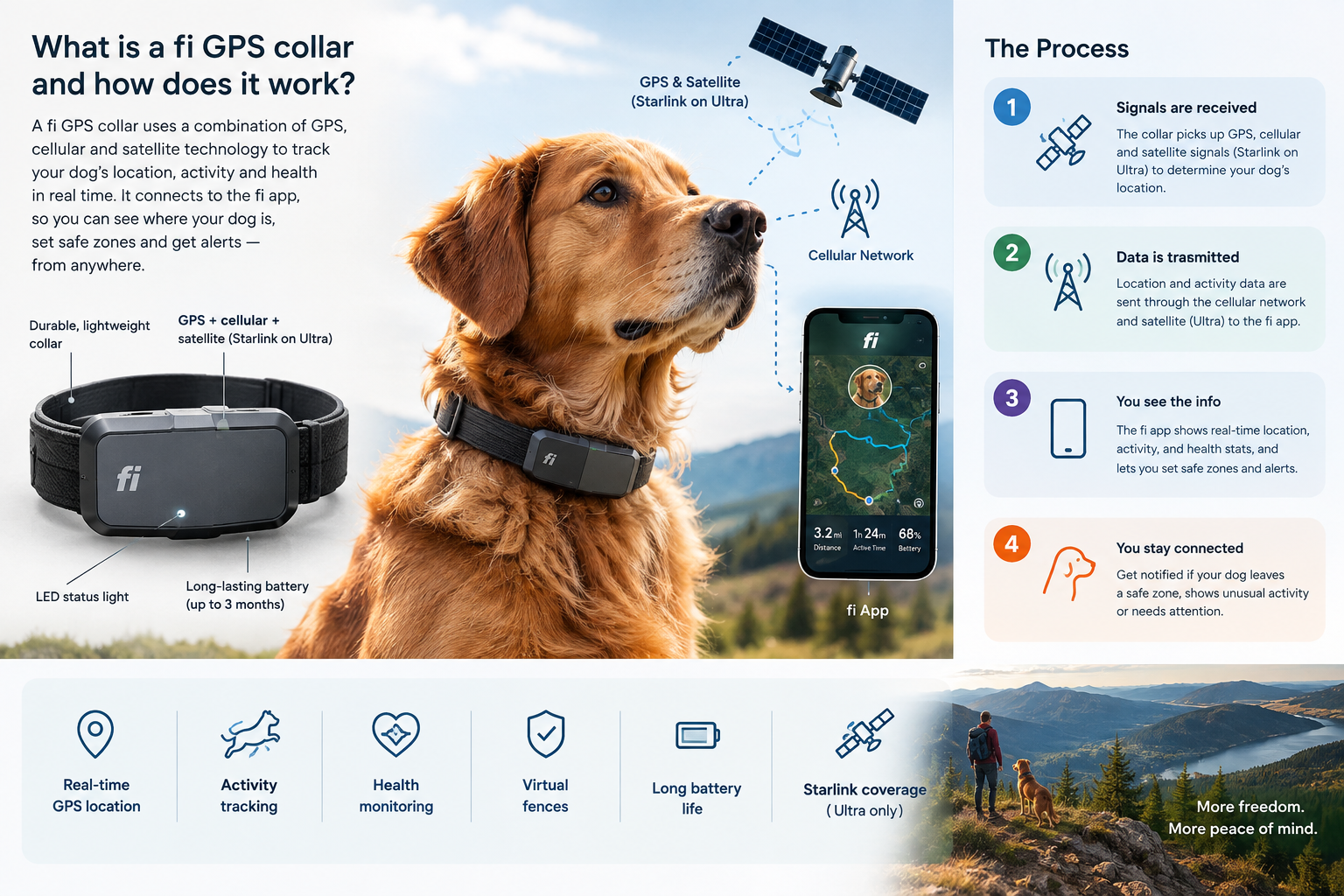
A Fi GPS collar is a dog collar with a removable tracker module that combines a GPS receiver with three ways to send its position home: Bluetooth when the dog is beside you, Wi-Fi when the dog is at a known base like your house, and LTE cellular when the dog is out in the world. The app shows live location, location history, escape alerts, and geofenced safe zones.
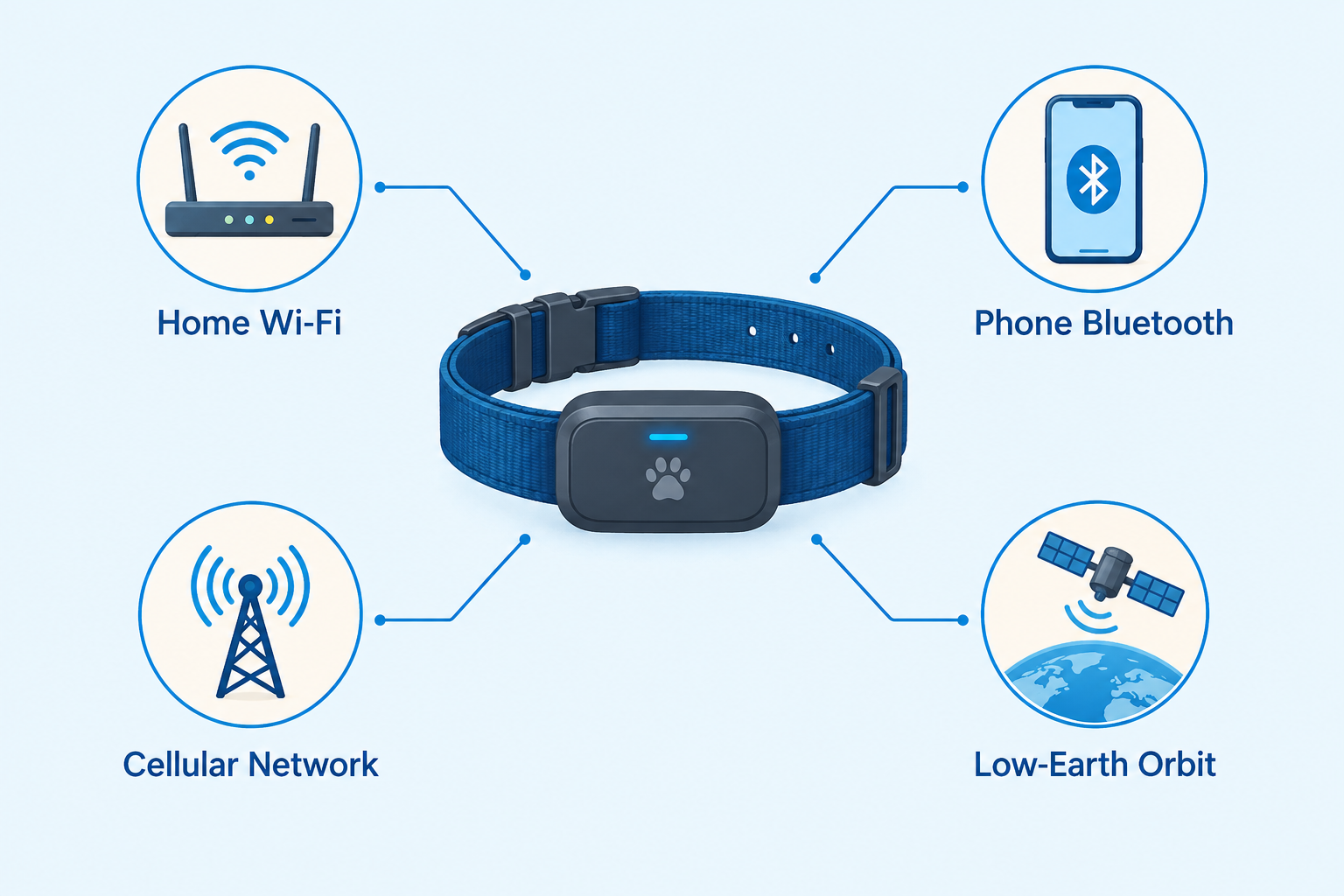
The clever part is the power management. Bluetooth and Wi-Fi cost almost nothing to run, so when your dog is asleep on the sofa, the collar is basically idling and reporting “still home.” The expensive radios wake up when the dog leaves a known zone. That is why older Fi models can claim months of battery while still calling itself a GPS tracker.
Fi’s lineup as of October 2026:
- Fi Series 3+: the mainstream tracker, GPS plus LTE, Wi-Fi, Bluetooth, listed at $129 on Fi’s store.
- Fi Mini: the smaller-dog version of the same idea.
- Fi Ultra: the July 2026 model that adds satellite messaging through T-Mobile’s T-Satellite, plus always-on GPS, Bluetooth 5.4, and 2.4 GHz Wi-Fi, which GearJunkie described as a large technical jump over the older models.
The tracker slots into Fi’s own band, so you are buying a collar system rather than a clip-on tag. Swapping to a different brand of collar later means buying a Fi-compatible band.
$408
First-year total reported at launch for new Ultra customers: $199 hardware, $20 activation, $189 annual membership. Source:
The Verge, 2026
~2 days
Fi's stated Ultra battery life, which an early test found hard to reach after long walks. Source:
GearJunkie, 2026
2 to 3 min
Map update interval observed over T-Satellite in an LTE dead zone. Source:
The Verge, 2026
July 8, 2026
Ultra launch date, presented as the first consumer pet tracker on Starlink direct-to-cell. Source:
PCMag, 2026
Fi GPS collar Series 3 vs Ultra: which should I get?
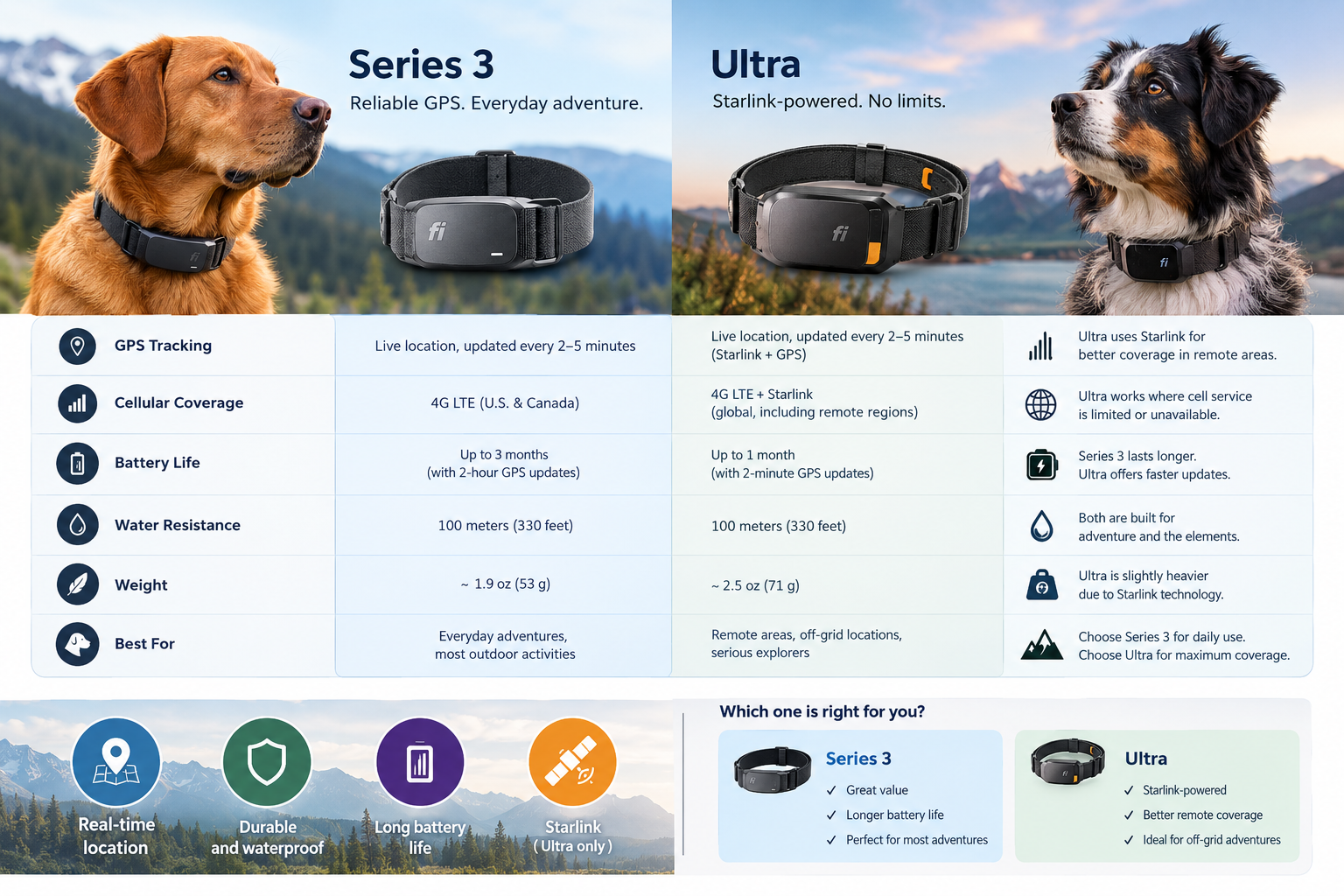
Buy the Series 3+ if your dog’s escape routes are covered by cell service, and buy the Ultra only if the dog realistically goes where phones do not work. That is the whole decision, and it is smaller than Fi’s marketing suggests.
The Ultra’s satellite radio solves one specific problem: a dog running loose in terrain with no LTE. Canyons, big ranch land, forest service roads, backcountry trails. For a dog who bolts through a suburban gate, the satellite link adds a battery penalty and almost no benefit, which is the tradeoff most launch coverage landed on.
Choose the Series 3+ if:
- Your usual walks, parks, and neighborhood all have cell signal
- You want to charge the collar every few weeks rather than every couple of days
- You care more about escape alerts and location history than wilderness recovery
- The budget matters, and the $129 listed hardware price is the deciding number
Choose the Ultra if:
- Your dog is off leash on trails, farmland, or hunting ground with coverage gaps
- You will actually plug it in most nights, the same way you charge a watch
- You accept a two to three minute map refresh over satellite instead of continuous updates
A common mistake: buying the Ultra “just in case” for a dog who never leaves a fenced yard in town. The extra money buys a radio that may never be used, and the shorter battery means a flat collar on the one evening it matters. A dead tracker tracks nothing.
What does a Fi GPS collar cost, including the subscription?
Hardware plus a required membership. Fi lists the Series 3+ at $129, and the membership tiers on Fi’s store run about $99 for six months, $189 for one year, or $339 for two years. The subscription is not a bonus feature. It pays for the cellular and satellite link, so cancelling turns the tracker into a Bluetooth finder.
For the Ultra, the new-customer math reported at launch was $199 hardware plus a $20 activation fee plus the $189 annual membership, which came to $408 before tax in year one. Existing Fi members were reported to pay a flat $299 upgrade fee while keeping their current plan, according to CNET’s launch coverage.
One thing worth knowing before you compare the options: Fi’s own pages do not agree with each other. The Ultra listing has displayed promotional pricing as low as $129 and figures as high as $299, which is why a date-stamped checkout total beats any price quoted in a review, including this one. Add the collar band, a replacement band after a year of mud, and the charger you will inevitably leave at a relative’s house.
How long does the Fi GPS collar battery last?
Fi claims months of battery for the Series 3+ and Mini and about two days for the Ultra. Independent testing has been kinder to the first claim than the second.
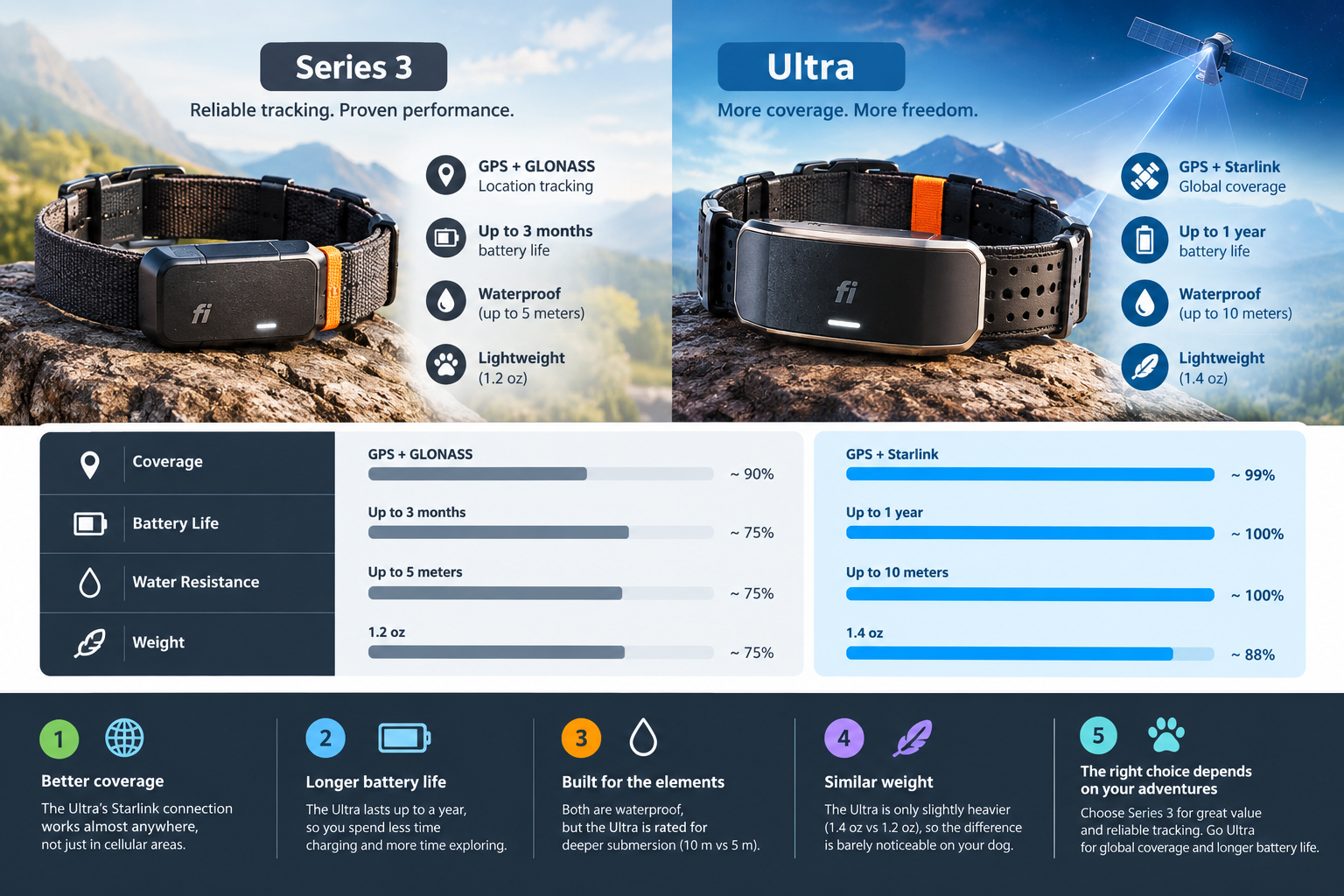
In a week-long early test, The Verge found the Ultra barely reached its advertised two-day runtime, needed daily charging after long walks, and lost close to 20 percent of its battery during a single 30-minute live-tracking session. GearJunkie framed the same number as the Ultra’s main compromise against months-long claims for the older models.
What drives the drain, in rough order:
- Live tracking sessions. Watching a moving dot is the most expensive thing the collar does.
- Time outside a known Wi-Fi or Bluetooth zone. The LTE and satellite radios only stay busy when the dog is away.
- Satellite searching. Looking for sky in heavy tree cover burns power without always getting a fix.
- Cold weather, which shortens runtime on any lithium battery.
Decision rule: if nobody in your household will reliably charge a dog collar every other night, buy the Series 3+. Battery life you do not maintain is not battery life.
Can a Fi GPS collar work without cell service?
The Ultra can send position updates without cellular coverage, using T-Mobile’s T-Satellite service on Starlink direct-to-cell. The Series 3+ and Mini cannot. They need LTE, Wi-Fi, or Bluetooth to report anything.
The Verge’s tester confirmed the Ultra connected over T-Satellite inside an LTE dead zone and refreshed the map roughly every two to three minutes. That is genuinely useful for finding a dog who has crossed a ridge. It is not the same as continuous tracking, and independent reviewers have seen longer gaps in harder conditions.
Where the facts end: satellite access depends on open sky, terrain, tree cover, satellite availability, network rules, and geographic eligibility. No consumer tracker can promise a signal from the bottom of a wooded ravine. Treat the satellite link as a recovery tool with better odds, not a guarantee.
How accurate is Fi GPS collar tracking?
Position accuracy on any consumer GPS tracker is typically good enough to tell you which field, yard, or block a dog is in, not which bush. Fi uses standard GNSS positioning, so the usual physics apply: open sky gives tight fixes, dense trees and tall buildings give drift.
Three things matter more than raw accuracy in practice:
- Update frequency. A precise fix from four minutes ago is less helpful than a looser fix from ten seconds ago when a dog is running.
- Geofence reliability. False escape alerts, or a late one, are the complaints that make owners lose trust.
- The handoff. Accuracy effectively drops when the collar moves from LTE to satellite and the refresh rate slows to minutes.
Quick example: a dog who slips a gate and runs four blocks is well served by any LTE tracker. A dog who disappears over a hill on a hunting property is the case the Ultra was built for, and even then the map will be showing you where the dog was a couple of minutes ago.
Is the Fi GPS collar waterproof, and can dogs swim with it?
Fi markets its trackers as waterproof and designed for dogs who swim, and both models are sold for outdoor use. Before you buy, check the current water rating on the product page you are ordering from, because Fi’s listed specifications have changed between model generations and promotional pages.
Practical notes for water dogs:
- Rinse salt water and pond scum off the module and the band. Grit under a tracker is what causes rubbing.
- Dry the charging contacts before charging.
- Check the skin under the collar when you groom. If you are new to coat and skin checks, our beginner’s guide to dog grooming covers what to look for.
- Fabric bands hold smell. Buying a spare band is cheaper than replacing the tracker because you kept using a stiff, salty one.
What size dog do you need, and does a Fi GPS collar work for cats?
Fi’s trackers are built for dogs, with several band sizes for the Series 3+ and a Mini aimed at smaller breeds. Check the dimensions against your dog’s actual neck measurement rather than their breed label, because individual variation inside a breed is wide.
Size guidance that holds up:
- Under about 10 pounds, the Mini or a lighter competitor is the sensible choice. A full-size module on a toy breed is a lot of hardware on a small neck.
- Medium and large dogs carry either model without trouble.
- Deep-coated and thick-necked dogs need the band snug enough that the tracker sits against the neck. A collar spinning under the throat reports worse positions.
- If you are unsure which weight class your dog falls into, our large and giant breed weight chart is a quick reference.
Cats: Fi designs and markets for dogs, and the hardware reflects that in weight and band design. Cat owners are better served by a tracker built for cats, with a breakaway collar and a module sized for a 9-pound animal. The physics of a cat squeezing through a fence gap do not forgive a bulky tracker.
What are the common Fi GPS collar problems and complaints?
The recurring complaints fall into four groups: battery life on the Ultra, subscription dependence, band wear, and app connection hiccups. Two of those are design choices rather than defects.
- Battery. Covered above. The Ultra’s two-day claim is the single most criticized number in its launch coverage.
- The membership. Stop paying and the tracking stops. Some owners feel that was not obvious enough before checkout.
- Bands and wear. Fabric bands fray, especially on dogs who wrestle or swim daily. Budget for replacements.
- Coverage expectations. Satellite capability reads like “works anywhere.” Terrain and sky visibility still decide the outcome.
- Separate recall note: Fi issued a recall in September 2026 affecting its supplement products, not its collars or trackers. Current notices are published in the FDA’s animal and veterinary recalls and withdrawals listing, which is the place to confirm scope rather than relying on a forum summary.
Fi GPS collar not connecting to the app: troubleshooting steps
Work through these in order before contacting support:
- Check the membership status in the app. An expired plan looks exactly like a broken tracker.
- Force quit and reopen the app, then confirm the phone has Bluetooth and location permissions granted, including background location.
- Stand within a few feet of the collar so it can pair over Bluetooth instead of waiting on cellular.
- Charge the tracker fully. Low batteries drop radios before they drop the status light.
- Re-check your Wi-Fi base setup. Fi trackers use 2.4 GHz networks, so a combined 2.4 and 5 GHz network name can cause odd behavior.
- Restart the tracker, then the phone, then the router, in that order.
- Update the app and the tracker firmware, which often fixes map and alert glitches.
- If the collar still shows offline in a known-good signal area, open a support ticket with the timestamp of the last fix. That detail speeds up a warranty conversation.
Does the Fi GPS collar work internationally or only in the US?
Treat Fi as a United States product. Launch reporting described Ultra availability as US-only, with some coverage noting Alaska was excluded, while one official Fi retail page describes extended coverage across North America.
Those two statements do not match, which is reason enough to ask Fi directly before you buy from Canada, Mexico, or anywhere outside the contiguous states. The LTE side depends on carrier agreements, and the satellite side depends on T-Satellite service rules, so a device that works perfectly in Montana may do nothing useful on a trip abroad. European owners generally have better luck with trackers built for local networks.
What are the best GPS collar alternatives to Fi?
The honest answer is that the best GPS dog collar depends on what you are trying to prevent. Escape, wandering off leash, or simple peace of mind are three different problems with three different products. Prices below change often, so check current figures before deciding.
| Option | What it does well | Main drawback | Who it suits |
|---|---|---|---|
| Fi Series 3+ | Long battery claim, solid escape alerts, dog-friendly band | Needs cell coverage, subscription required | Town and suburban dogs with reliable LTE |
| Fi Ultra | Satellite link outside cell range, always-on GPS | About two days of battery, highest first-year cost | Rural dogs, hunting dogs, backcountry hikers |
| Halo Collar | GPS wireless boundaries plus training feedback | Subscription required, boundary accuracy depends on signal, training commitment | Owners managing unfenced property who want containment, not just tracking |
| Tractive | Low device cost and the cheapest monthly plans, clips to your existing collar | Battery measured in days, no satellite, bulkier on small dogs | Budget-focused owners who want LTE tracking without a collar system |
| Apple AirTag | Cheap, year-long replaceable battery | Not a GPS tracker. It relies on nearby Apple devices to report a location | City dogs and gear, as a backup tag only |
That last row is the one that changes the most minds. A Bluetooth tag has no GPS and no cellular radio, so it reports a position only when someone else’s phone walks past it, which is the basic limitation Life360’s guide to GPS dog collars describes. On a busy sidewalk, that works. In a wheat field at 10 p.m., it does not. Is Fi better than an AirTag for a dog who runs? Yes, and not by a small margin.
Containment is a separate question from tracking. If your dog’s problem is patrolling and testing boundaries rather than escaping, our explainer on why some breeds guard and patrol the house is worth reading alongside any fence product, and humane training does more for recall than hardware does.
How do you set up a Fi GPS collar?
Setup takes about 15 minutes and is mostly app work. Do it at home, on Wi-Fi, with the tracker charged.
- Charge the tracker fully before you start. A partial charge makes the first pairing slower.
- Install the Fi app and create an account with your dog’s details.
- Activate the membership. Nothing cellular works until this step is done.
- Pair over Bluetooth, with the phone next to the collar.
- Add your Wi-Fi base on the 2.4 GHz network, so the collar knows when the dog is home and can save power.
- Thread the module onto the band and fit the collar with two fingers of room. Check the fit again after a week.
- Draw your safe zones. Set the home geofence first, then any second location like a relative’s yard.
- Test it once on purpose. Walk out of the zone with the collar in your hand and confirm the alert arrives. Better to learn now than during an actual escape.
One edge case: apartment residents often set a home zone so small that normal hallway and courtyard movement triggers alerts. Widen the zone until it covers the building footprint and the path to the sidewalk.
Is a Fi GPS collar worth it, and who does it suit?
It is worth it for owners whose dog has actually escaped, or who let a dog off leash where recall is not guaranteed. It is hard to justify for a leash-only dog in a fenced yard who has never gone missing, because you are paying an annual fee for a problem you do not have.
Who it suits:
- Repeat escape artists, diggers, and gate specialists
- Working and hunting dogs off leash in open country
- Owners who hike, camp, or travel with a dog in coverage gaps (Ultra specifically)
- Multi-person households where the dog gets handed off and “did someone shut the gate” is a live question
Who should probably skip it:
- Owners of senior or leash-only dogs who never leave sight
- Anyone unwilling to pay a recurring membership, since the hardware alone is limited
- Small-breed owners who find the module too heavy, where a lighter tracker fits better
Gear reduces the cost of a mistake. It does not replace training, a secure gate, or a collar that fits. If you are still choosing a dog and thinking about escape risk, exercise needs, and home setup, our guide to picking a dog breed that fits your life is a better starting point than any tracker.
Review method and what the evidence supports
This comparison is based on documented research: Fi’s own store listings for the Series 3+ and Ultra, launch reporting from The Verge, PCMag, CNET, GearJunkie, and other outlets, and published independent testing. No hands-on testing is claimed here, and no battery figures, water ratings, or coverage claims have been measured by Doggy Rank IQ.
Prices and specifications were checked in October 2026 on Fi’s retail pages and may have changed by the time you read this. Manufacturer claims are labeled as such. Independent test results are attributed to the outlet that ran them. For more gear and care explainers, browse the Doggy Rank IQ guides archive.
FAQ
Does the Fi dog collar require a subscription? Yes. Fi’s cellular and satellite features depend on an active membership, listed at roughly $99 for six months, $189 for one year, or $339 for two years. Without a plan, the tracker falls back to short-range Bluetooth and stops reporting remote locations.
What is the Fi GPS collar subscription cost in 2026? Fi’s store lists about $99 for six months, $189 annually, and $339 for two years as of October 2026. The reported first-year total for a new Ultra customer at launch was $408, including $199 hardware and a $20 activation fee.
Is the Fi Ultra better than the Series 3? Only for dogs who go beyond cell coverage. The Ultra adds Starlink-based satellite messaging and always-on GPS, but its stated battery life is about two days versus months-long claims for the Series 3+, and The Verge’s test found it barely reached that two-day figure.
Fi collar vs Halo: which should I choose? Choose Fi to find a dog who is already loose, with location history and escape alerts. Choose Halo if your main goal is a GPS boundary with training feedback on unfenced land. Both require subscriptions, and Halo asks for more training time from you.
Is a Fi collar better than an AirTag? For a dog who runs, yes. An AirTag has no GPS and no cellular connection, so it only reports a position when a nearby Apple device detects it. Fi uses GPS plus LTE, and the Ultra adds satellite, which works in empty areas where no phones pass by.
Can my dog swim with a Fi collar on? Fi markets its trackers as waterproof and suitable for swimming, so check the exact rating listed on the model page you are buying. Rinse and dry the module and band after salt water or muddy ponds, and inspect the skin underneath regularly.
Does the Fi collar work in Canada or Europe? Treat it as a United States device. Launch reporting described Ultra availability as US-only, with one Fi page mentioning extended North American coverage. Confirm eligibility for your address with Fi before ordering from outside the contiguous states.
Was the September 2026 Fi recall about the collars? No. That recall covered Fi supplement products, not trackers or collars. Check the FDA’s animal and veterinary recalls and withdrawals listing for the current notice and its exact scope.
Conclusion
The Fi GPS collar decision comes down to geography, not features. Map where your dog would actually go if a gate opened. If that map has cell service, the Series 3+ at its listed $129 plus a membership does the job with a battery you charge every few weeks. If that map includes canyon, forest, or farmland where your own phone goes quiet, the Ultra’s satellite link is the only consumer option in this comparison that can report from there, and you will be plugging it in most nights.
Your next steps:
- Measure your dog’s neck and check the dimensions against Fi’s size chart before choosing a model.
- Open the checkout page and note the total with activation and membership, dated, because Fi’s headline prices move.
- If you are outside the contiguous United States, email Fi to confirm coverage before paying.
- Set your home geofence, then test one escape alert on purpose in the first week.
- Keep working recall and gate habits. The tracker is insurance, not a fix.