Quick Answer
Yes. If you are asking do i need to brush my dog’s teeth, the short answer from veterinary bodies is that brushing is the single most effective thing an owner can do between professional cleanings, and the AVMA says brushing several times a week can still be effective when daily is not realistic. Daily is the gold standard. Three days a week sits well above zero, and a controlled study in beagles found that brushing every other day performed close to daily and clearly better than weekly. The mouth you never touch is the one that ends up on an operating table.
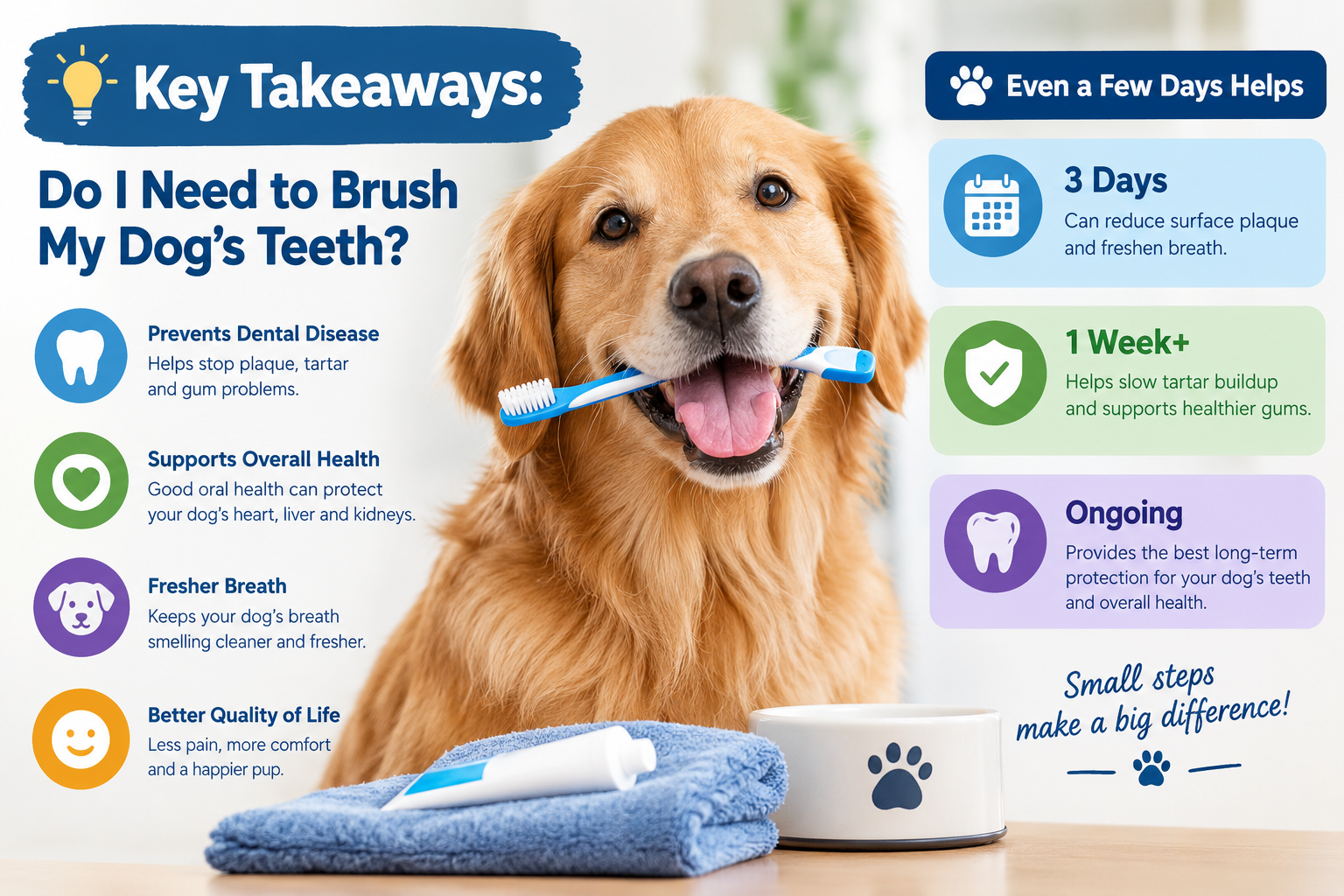
Key Takeaways: Do I Need to Brush My Dog’s Teeth?
- Do i need to brush my dog’s teeth is a yes question, not a maybe question. The Veterinary Oral Health Council recommends daily brushing and states plainly that any brushing used regularly beats none.
- Plaque is soft and brushable for a short window. Veterinary guidance commonly cites roughly 48 to 72 hours before plaque mineralizes into tartar, which is why gaps of two or three days hurt less than gaps of a week.
- A randomized study in beagles compared daily, every other day, weekly, every other week, and no brushing. Daily and every-other-day brushing produced significantly better plaque, calculus, and gingivitis outcomes than weekly or fortnightly.
- A two-month greyhound study found both weekly and daily brushing cut calculus, but only daily brushing significantly reduced gingivitis. The same paper cites laboratory work suggesting three brushings per week may be the threshold frequency for preventing gum inflammation in healthy mouths.
- Brushing prevents. It does not fix. AAHA’s dental guidelines note that home care removes plaque but not calculus once it has hardened.
- Periodontal disease is close to a default setting. Cornell’s Riney Canine Health Center reports that 80 to 90 percent of dogs over three years old have some component of it.
- Never use human toothpaste. Fluoride and xylitol are not made for an animal who swallows everything.
- Chews, diets, water additives, and wipes help, with uneven coverage. Look for products on the VOHC accepted list rather than packaging adjectives.
- Guidance in this article was checked in October 2026. Individual variation is real: a nine-year-old small breed with crowded teeth needs more help than a four-year-old lab.
What happens if you never brush your dog's teeth?
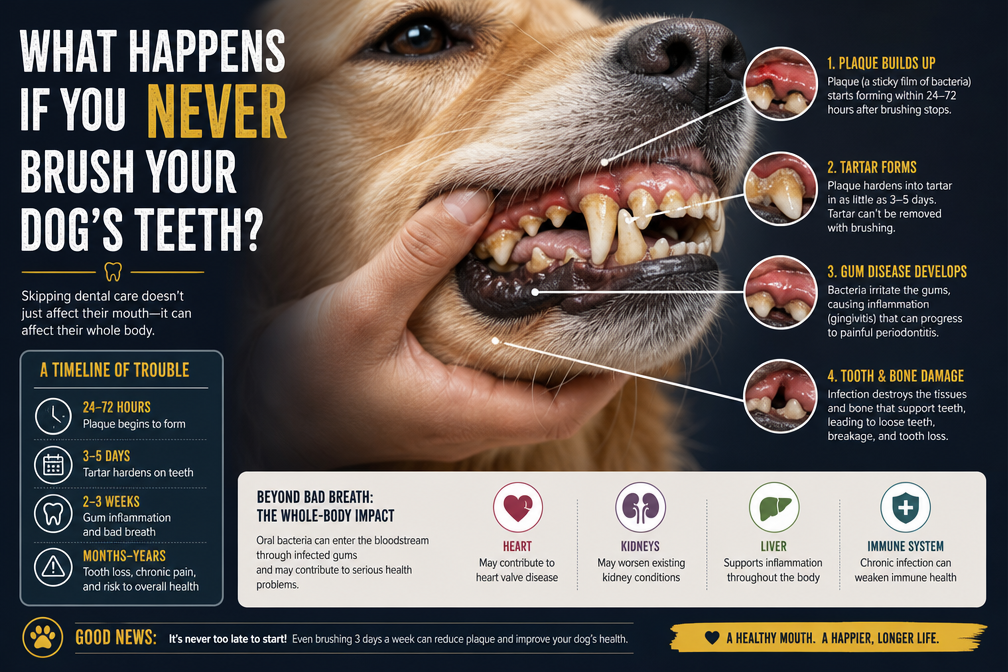
Plaque builds, hardens into tartar, and pushes bacteria under the gumline, where it inflames tissue and eventually destroys the bone holding teeth in place. That process is periodontal disease, and Cornell's Riney Canine Health Center reports that 80 to 90 percent of dogs older than three have some part of it, including dogs whose teeth look passable from the front.
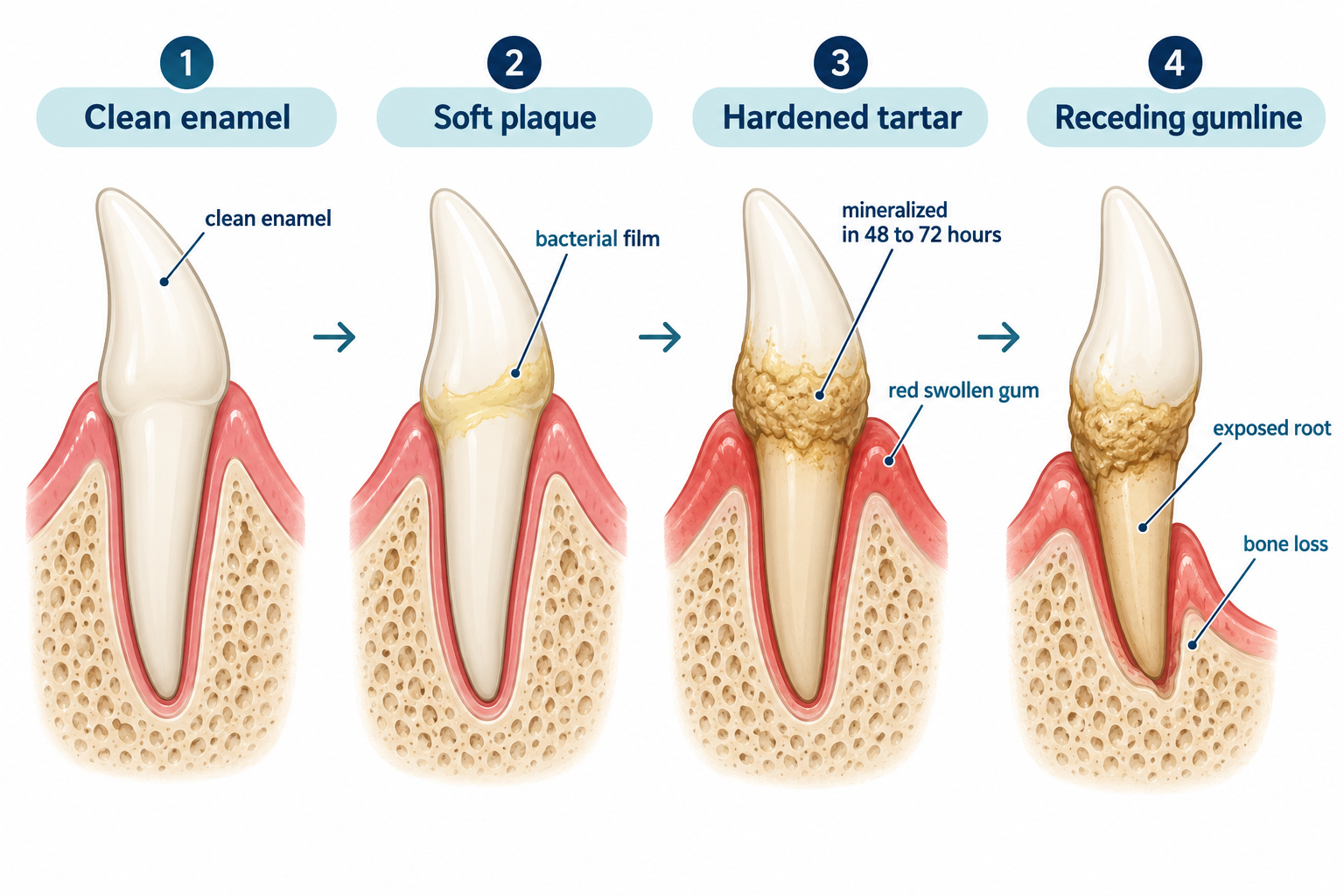
The timeline is the part most owners have never been told. Plaque is a soft bacterial film you can brush away. Veterinary sources commonly cite 48 to 72 hours for that film to mineralize into calculus. Once it is hard, a toothbrush is a polite gesture. AAHA's dental care guidelines are clear that home care does not remove established calculus, which has to come off under anesthesia with proper instruments.
What a neglected mouth costs the dog, in rough order of appearance: breath that clears a room, bleeding when they chew, gum recession, loose teeth, root exposure, and pain they hide with impressive commitment. Dogs rarely stop eating because of dental pain. They just eat differently, drop food, chew on one side, or go quiet with toys they used to destroy.
Can dogs get cavities and tooth decay?
Dogs can get true cavities, but caries are much less common in dogs than in people, partly because of tooth shape and a mouth that is less acidic. Periodontal disease is the far bigger problem, and fractured teeth come second. A dog who cracks a premolar on a bone or a rock can expose the pulp, which hurts and can abscess, with no visible hole to find at home.
Do dogs naturally clean their own teeth?
Not reliably. Chewing scrapes some deposit off the tips of the big teeth, which is why a dog's canines often look fine while the molars behind them carry a brown ledge. Dry food is not a toothbrush either, though texture and kibble shape do make some difference, something worth considering if you are already comparing wet and dry dog food for cost and dental effects. Royal Canin's veterinary academy explains why brushing remains the standard: chews and diets contact teeth unevenly and often miss the gumline, where disease starts.
Signs your dog has dental problems
Book an exam if you notice any of these:
- Breath that changed, not just breath that smells like a dog
- Red, puffy, or bleeding gums, especially along one row
- Brown or grey build-up at the gumline, worst on the back teeth
- Dropping food, chewing on one side, or turning away from hard treats
- Pawing at the face, head shyness, drooling, or blood-tinged saliva
- A tooth that looks darker than its neighbours, or sits at a new angle
- Swelling under an eye, which can signal an abscessed upper tooth
Dogs with crowded mouths deserve closer watching. Small and brachycephalic breeds pack a standard number of teeth into a shorter jaw, so plaque sits in overlaps a brush struggles to reach. Our dog health and care section covers more of these everyday checks.
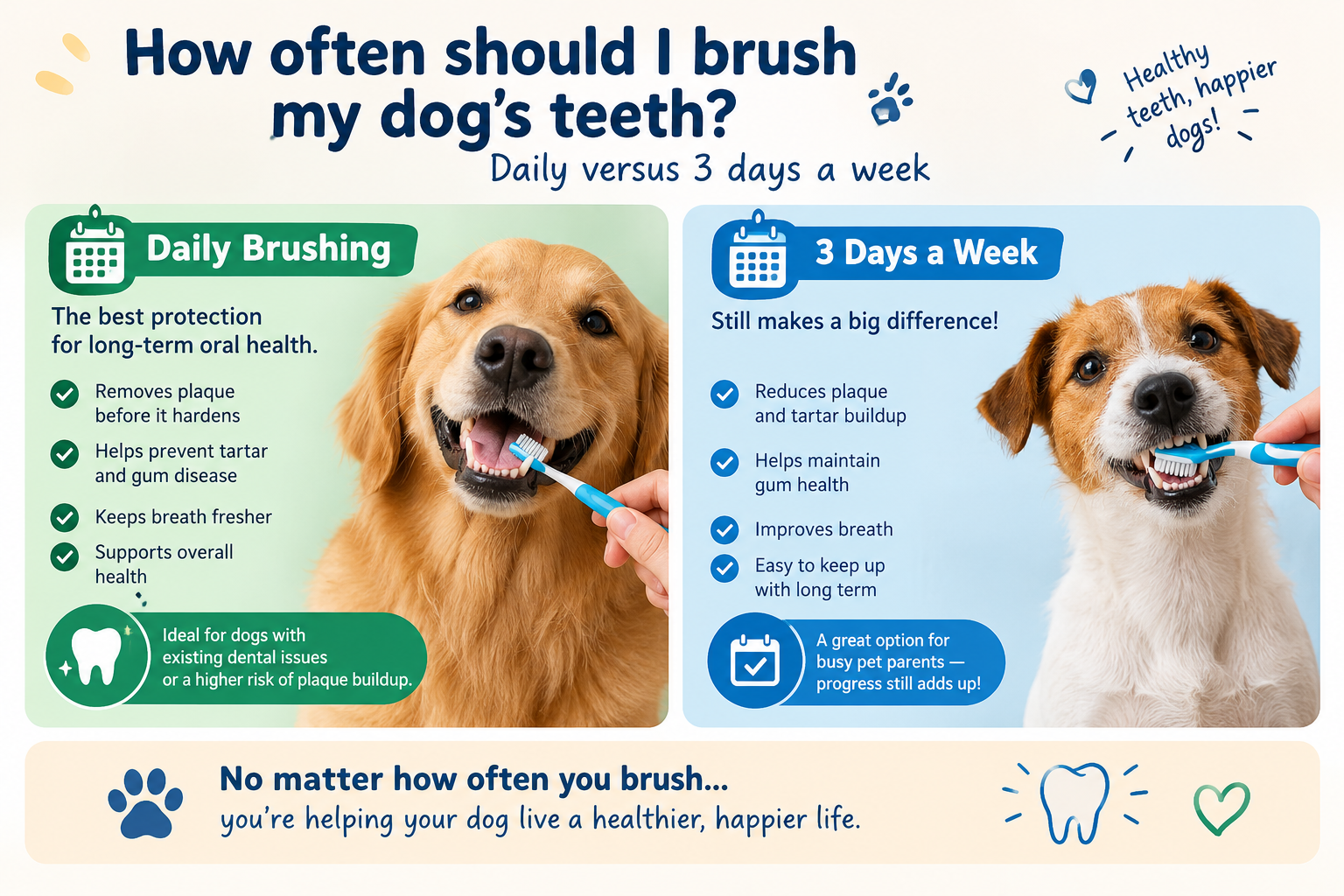
How often should I brush my dog's teeth? Daily versus 3 days a week
Daily is best. Three times a week is a defensible minimum. Weekly is where the evidence gets thin. That hierarchy comes from actual trials, not opinion, and it is the honest answer to do i need to brush my dog's teeth every single day.
A randomized, controlled study in beagles compared five schedules: daily, every other day, weekly, every other week, and none at all. More frequent brushing produced better plaque, calculus, and gingivitis scores, with daily and every-other-day brushing significantly ahead of weekly and fortnightly. The study population was research beagles under controlled conditions, so it shows what frequency does in a tidy setting rather than what your schedule will do in a kitchen at 10pm.
Gingivitis is where daily pulls away from everything else. In a two-month greyhound study, weekly and daily brushing both reduced calculus, but only daily brushing significantly reduced gingivitis. That paper also cites laboratory work indicating that three brushings per week may be the critical frequency for preventing gum inflammation in dogs whose gums are healthy to begin with.
Can brushing dog teeth 3 times a week make a difference?
Yes, and that is the most useful finding in this whole topic for busy households. Three times a week sits near the threshold identified in the laboratory work cited above, and it respects the 48 to 72 hour window before plaque hardens. What the evidence does not support is calling three days a week equal to daily. It is a meaningful fallback, not a tie.
| Your real schedule | What the research supports | Where it falls short |
|---|---|---|
| Daily | Strongest protection; the only frequency that significantly cut gingivitis in the greyhound study | Still cannot remove hardened calculus |
| Every other day | Performed close to daily in the beagle trial; reduced deposits in a 2025 trial of unscaled dogs | Slightly more plaque maturation between sessions |
| 3 times a week | Near the threshold suggested for preventing gum inflammation in healthy mouths | Not shown to match daily for gingivitis |
| Once a week | Reduced calculus in the greyhound study | No significant gingivitis benefit |
| Never | Nothing | Periodontal disease affects most dogs over three |
A 2025 study in unscaled dogs tested every-other-day brushing, a daily dental chew, water additives, and combinations over eight weeks. Brushing every other day and the daily chew both reduced dental deposits, and certain water additive combinations improved periodontal health scores. Eight weeks is short, and the dogs started with existing deposits, so treat it as support for realistic routines rather than proof that products replace brushing.
Decision rule: if you can brush daily, do that. If daily will quietly become never by week three, commit to Monday, Wednesday, Friday and add a VOHC-accepted chew on the off days.
How do you brush a dog's teeth step by step?
Lift the lip, angle soft bristles at the gumline, and make small circles on the outside surfaces only. You do not need the inner surfaces, you do not need the dog's mouth open, and you do not need to win the whole mouth on day one. VCA Animal Hospitals walks through the same approach, including the gradual introduction that makes it last.
- Days 1 to 3: paste only. Let the dog lick dog toothpaste off your finger. That is the entire session. Enzymatic poultry-flavored paste helps here, since the flavor is doing the persuading.
- Days 4 to 6: finger on gums. Rub the outside of the canines and a few cheek teeth with a pasted finger for ten seconds. Stop before the dog decides to leave.
- Day 7: introduce the brush. Let them lick paste off the bristles. No brushing yet.
- Week 2: one side, outside only. Slide the brush under the lip at a 45 degree angle to the gumline. Small circles. Ten to fifteen seconds per side.
- Week 3 onward: full pass. Front teeth, then both cheek rows, ending with the back molars where the worst build-up lives.
Position matters more than technique. Sit beside the dog or let them stand, facing the same direction you are facing, rather than looming over the head. Keep the hand on the muzzle light. A dog who feels restrained learns that brushing is a wrestling match. The same reward timing you use in basic puppy command training applies: mark the moment they tolerate the brush, not the moment you finish.
How long does it take to brush a dog's teeth?
Once a dog is used to it, a full pass over the outside surfaces takes about a minute, maybe thirty seconds per side. The first two weeks are shorter, under fifteen seconds, on purpose. A rushed two-minute session that ends with a stressed dog and a bitten thumb costs you the next six months.
What age should you start brushing a dog's teeth?
Start handling a puppy's mouth as soon as they settle into your home, usually eight to twelve weeks, and begin actual brushing once adult teeth are coming through at around four to six months. Teething gums are sore, so keep sessions to finger rubs during that stretch. Puppies raised with mouth handling turn into adults who tolerate it, which is worth as much as the brushing itself. If you are still setting up year-one basics, our guides on what growing dogs need in their first year and grooming routines for beginners cover the rest of the handling work.
Older dogs can learn this too. The one difference is pain. An eight-year-old with inflamed gums will refuse because brushing hurts, not because they are stubborn. Get the exam first.
Do all dogs need their teeth brushed, or just some breeds?
All dogs benefit. Some need it more. Small breeds, toy breeds, and short-faced dogs tend to have crowded or rotated teeth that trap plaque, and greyhounds are frequently noted in veterinary dentistry for heavy calculus. Breed tendency is not a prediction for your individual dog, though, and plenty of large dogs with roomy jaws still arrive at nine with advanced disease. Mouth shape, chewing habits, diet, saliva, and home care all stack up differently. Individual variation decides this one, not the breed label.
What if my dog refuses the toothbrush?
Back off to a step the dog accepts, and change one variable at a time: the tool, the flavor, the position, or the time of day. Refusal is almost always about the handling, the gag of a long brush at the back of the mouth, or a sore spot you cannot see.
Practical fixes worth trying in order:
- Swap the brush. A silicone finger brush feels less alarming than a handled brush for many dogs. A dual-head or small-head brush reaches molars without pushing into the throat.
- Change the flavor. Poultry, malt, and vanilla-mint dog pastes all exist. A dog who hates one will often tolerate another.
- Brush after exercise. A dog who just walked three miles is a more reasonable negotiator than one who just woke up.
- Do two teeth. Two teeth today, four tomorrow. Finishing calm beats finishing complete.
- Rule out pain. Head shyness that appeared suddenly needs a vet, not more patience.
If brushing stays genuinely impossible, use the alternatives below and raise it at the next appointment. Owners sometimes need a different plan rather than more willpower, and that is a conversation worth having out loud. The r/dogs thread titled okay real talk, do you actually brush your dog's teeth? is documented evidence that the question keeps needing to be asked. Treat forum replies as owner experience, not guidance.
Alternatives to brushing dog teeth, compared
| Option | What the evidence supports | Effort | Who it suits |
|---|---|---|---|
| Silicone finger brush | Mechanical plaque removal, though bristle contact at the gumline is shallower than a bristled brush | Low, 1 minute | Beginners, small dogs, brush-shy dogs |
| Dual-head or small-head dog toothbrush | The gold standard tool; daily use is the VOHC recommendation | Low once trained | Any dog who tolerates mouth handling |
| Dental wipes | Wipe away surface plaque; limited reach below the gumline | Very low | Dogs who refuse bristles entirely |
| VOHC-accepted chews and diets | A daily chew reduced dental deposits in the 2025 unscaled-dog trial; contact is uneven across teeth | Minimal | Off-days, multi-dog homes, calorie budget permitting |
| Water additives and gels | Some additive combinations improved periodontal scores in the 2025 study; weakest as a standalone | Near zero | Add-on only, never a replacement |
Two cautions. Hard bones, antlers, and hooves clean teeth and also fracture them, so trading gingivitis for a slab fracture is a poor deal. And anesthesia-free scaling by a non-veterinarian polishes the visible crown while leaving disease under the gumline, which makes a mouth look better and tells you less.
What toothpaste is safe for dogs? Never use human toothpaste
Use a toothpaste made for dogs. Human toothpaste contains fluoride, which dogs should not swallow in paste quantities, and some human products contain xylitol, which is toxic to dogs. Baking soda is also a poor choice: alkaline, unpleasant, and unhelpful for a patient who cannot spit.
What to look for on a dog paste:
- Enzymatic or plain, both work. The mechanical brushing does most of the job. Flavor exists to buy cooperation.
- A VOHC seal if available. The council's August 2026 accepted products list spans diets, chews, water additives, gels, toothpastes, toothbrushes, wipes, and professional sealants, with listed examples including Virbac C.E.T. AQUADENT FR3SH and Dentalis Canine Toothpaste. Acceptance means the manufacturer submitted trial data meeting published protocol requirements, not that a product suits every dog.
- No xylitol, confirmed on the label. Worth knowing alongside the rest of the foods and ingredients dogs should never swallow.
- A small amount. A pea-sized blob. You are not frosting a cake.
Do i need to brush my dog's teeth with paste at all? No. A damp brush used correctly still removes plaque. Paste mostly makes the dog agree to the appointment.
When does a dog need a professional dental cleaning, and what does it cost?
A dog needs a professional cleaning when calculus, gum inflammation, or pain is already present, because those cannot be brushed away. Most dogs get an oral exam at their annual visit, and your vet recommends a cleaning based on what they see and feel, not on a calendar rule.
A proper veterinary dental involves general anesthesia, full-mouth radiographs, scaling above and below the gumline, polishing, and any extractions or treatment the x-rays reveal. AAHA's home care guidance for clients frames brushing as the work between those visits, not a replacement for them.
Professional cleaning versus home brushing
- Home brushing removes soft plaque daily and delays the whole disease process. It reaches crown surfaces above the gumline and nothing below it.
- Professional cleaning removes hardened calculus, cleans subgingival surfaces, and finds hidden problems with radiographs. It cannot stop new plaque forming tomorrow.
- Together they work. Brushing alone misses existing disease. Cleanings alone mean repeat procedures at shorter intervals.
Dog dental disease cost to treat
Costs vary too much by region, clinic, dog size, and findings for any honest single figure, so ask for a written estimate with a best case and a worst case. The variables that move the number: pre-anesthetic bloodwork, anesthesia time, full-mouth radiographs, how many teeth need extraction, surgical versus simple extractions, pain medication, and antibiotics. Advanced disease costs far more than maintenance, since extractions and surgical closures take time under anesthesia. That gap is the actual financial argument for brushing, and it is a better one than guilt.
FAQ
Is it bad to not brush your dog's teeth?
Yes, it raises the risk of periodontal disease, which Cornell reports affects most dogs over three. It does not make you a bad owner, and the fix is available this week. Start with finger rubs and book an oral exam.
How long can I go without brushing my dog's teeth?
Plaque starts mineralizing in roughly 48 to 72 hours, so gaps longer than two or three days let deposits harden beyond what a brush can remove. A week-long gap still beats stopping entirely, but it did not significantly reduce gingivitis in the greyhound study.
Should I brush my dog's teeth every day?
Daily brushing is the recommendation and the only frequency shown to significantly reduce gingivitis in that two-month trial. If daily is not realistic, three times a week is a reasonable floor supported by the evidence.
What is the 3-3-3 rule for dogs?
The 3-3-3 rule describes a newly adopted dog's adjustment, roughly three days to decompress, three weeks to settle, three months to feel at home. It has nothing to do with dental care, and no dental organization uses it.
Can I scrape plaque off my dog's teeth at home?
Do not. Hand scalers scratch enamel, which gives plaque a better surface to cling to, and they cannot clean below the gumline where disease lives. Scraping also risks injuring the gum and the dog's trust in equal measure.
When should I start brushing a puppy's teeth?
Begin mouth handling at eight to twelve weeks and real brushing around four to six months, going gently while adult teeth erupt. Early handling is the main reason some adult dogs stand still for this.
Do dental chews replace brushing?
No. A daily chew reduced dental deposits in the 2025 unscaled-dog study, which is real support for chews as an add-on, and chews still contact teeth unevenly and often miss the gumline. Use them on days you cannot brush.
Is anesthesia-free dental cleaning a safe alternative?
It cleans the visible crown while leaving subgingival disease untouched and provides no radiographs, so a mouth can look improved while problems continue underneath. Discuss anesthetic risk with your vet instead of avoiding anesthesia altogether.
Conclusion: one realistic next step
So, do i need to brush my dog's teeth? Yes, and the useful part of that answer is how much slack the evidence gives you. Daily brushing is the best protection. Every other day is close behind. Three times a week sits near the threshold that cited laboratory work links to preventing gum inflammation in healthy mouths. Once a week does less than owners hope, and never is how most dogs end up in the 80 to 90 percent.
Your next step is smaller than buying a kit. Tonight, put a pea of dog toothpaste on your finger and let your dog lick it off while you rub the outside of their canines for ten seconds. Do that for three evenings. Then add the brush. Put Monday, Wednesday, and Friday in your phone, because a schedule you can keep is worth more than a standard you abandon.
And book the oral exam. You want to know what is under there before you start pressing on it.
Guidance in this article was checked in October 2026 against VOHC, AVMA, AAHA, VCA, and peer reviewed brushing frequency studies. It is educational and does not replace an exam by your own veterinarian.