
Quick Answer
Why are vets so expensive? Because a veterinary bill shows you the full retail price of medicine with no insurer quietly covering the rest, and because the biggest costs inside a clinic are people and equipment, not markup on pills. In the United States, veterinarian services rose 5.7% in the year to August 2026 according to the Bureau of Labor Statistics consumer price index, outpacing general inflation. Staffing shortages, in-house diagnostics, 24-hour emergency capacity and ownership consolidation all push the number on the invoice higher. You can lower what you pay without lowering the standard of care, and this guide shows where.
Key Takeaways: Why Are Vets So Expensive?
- Labor is the single largest structural cost in a clinic, and the sector is short of veterinarians and credentialed technicians, which raises wages and the price of every appointment.
- Veterinary services inflation ran at 5.7% year over year in August 2026 per the BLS, which is why last year’s estimate no longer matches this year’s invoice.
- Your bill is unbundled on purpose: exam, diagnostics, anesthesia, monitoring, drugs, dispensing and hospitalization are separate lines because they are separate costs.
- Emergency hospitals cost more because they staff overnight teams, oxygen, blood products and intensive monitoring for a waiting room that may sit empty for hours.
- Medication can often be bought cheaper with a written prescription from an online pharmacy. In the UK, prescription fees are now capped at £21 for the first item and £12.50 for each extra item in the same consultation.
- There is no single verifiable national average for a dog’s vet visit, so the useful move is to phone three local clinics and ask for their exam fee and a written estimate.
- If you cannot pay, say so early. Payment plans, nonprofit and shelter clinics, veterinary teaching hospitals and grant charities exist, and all of them work better before a crisis than during one.
What Makes Veterinary Care So Expensive?
Four things carry most of the cost: skilled staff, medical equipment, drugs and consumables, and the building that holds all of it. None of those scale down neatly for a ten-minute appointment.
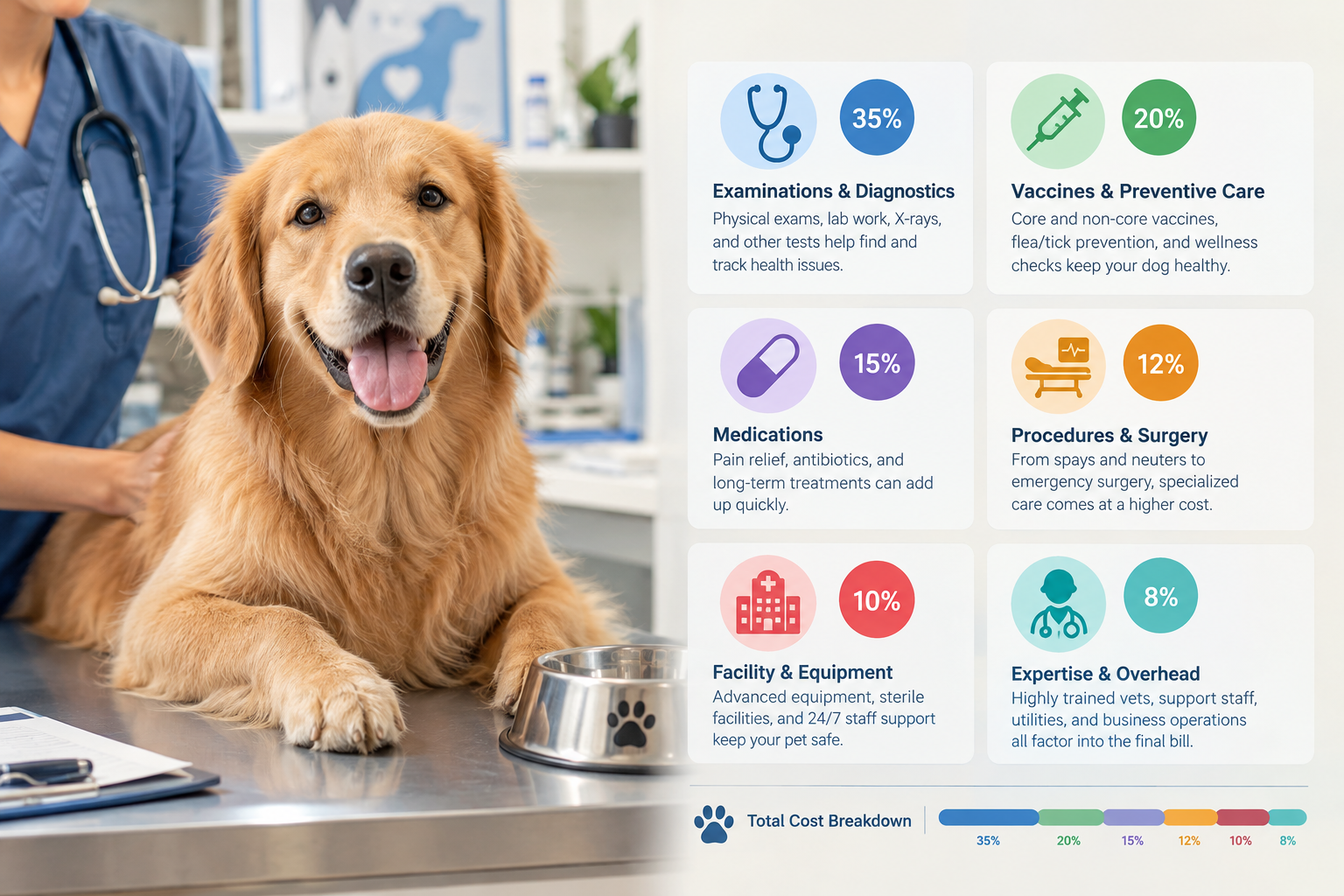
A single routine visit can involve a veterinarian, a registered veterinary technician, an assistant, a receptionist, a practice manager, a medical records system, sterilized instruments, cleaning between patients, inventory control and a follow-up phone call. Industry analysis from Covetrus on 2026 veterinary trends lists rising operating costs, pharmaceutical prices, consumables and client affordability as the defining pressures of the year. A clinic cannot automate a physical exam, a blood draw or an anesthetic recovery. The labor stays.
Then there is the kit. A general practice in 2026 may run digital radiography, an ultrasound, an in-house blood analyser, dental radiography and anesthetic monitoring. The purchase price is only the start. Clinics also pay for maintenance contracts, software subscriptions, calibration, depreciation and staff training on every machine. Referral hospitals add CT, MRI, endoscopy, oxygen cages, blood products and intensive care.
And dogs are living longer, which changes what medicine they need. Older dogs get arthritis, kidney disease, heart disease, endocrine disorders and cancer. Bloomberg Intelligence analyst Ann-Hunter van Kirk linked continued pet health spending to rising pet life expectancy and younger owners’ spending habits in Bloomberg’s March 2026 report on vet pricing. Longer lives mean more years of treatable disease. That is good news with an invoice attached.
Why Are Vets So Expensive Now Compared With Five Years Ago?
Why are vets so expensive now in particular? Three forces stacked up: above-average inflation in veterinary services, a shortage of clinical staff, and ownership consolidation that standardizes pricing across groups of clinics.
5.7%
US veterinarian services price rise, year to August 2026 (BLS CPI release, Sept 11 2026)
$41.0bn
US vet care and related product sales in 2025, with $42.4bn projected for 2026 (APPA, 2026)
Veterinarians graduating from US vet schools each year, a figure that may lag demand (2026 report cited by WHIO)
£500
UK threshold above which practices must give a written estimate, effective Sept 23 2026 (CMA reforms)
Staffing is the quiet engine here. When clinics compete for scarce veterinarians and technicians, wages, recruitment fees, overtime and retention bonuses all climb. Those costs appear in the exam fee because there is nowhere else to put them.
Consolidation is the part owners argue about most. A September 2026 New York Post report on rising vet bills attributes higher prices to corporate ownership, staffing shortages, advanced medical technology and higher supplies and facility costs. Corporate or private equity ownership does not prove any single clinic is overcharging. Independent practices face the same wage and supply bills. What larger groups can do is set prices centrally, add regional administration and standardize which diagnostics get recommended. That is why ownership disclosure became part of the UK reform package.
Demand has not collapsed either. The American Pet Products Association reported $158 billion in US pet spending in 2025, up 3.7%, and projects $165 billion for 2026. Morgan Stanley’s 2026 pet industry outlook notes owners have become more selective under inflation while still protecting vet care in the household budget. Owner frustration is real and well documented. A long r/dogs thread titled Costs of owning a dog just keeps going up and up has owners comparing rising fees across clinics and regions. Treat that as shared experience, not data. It is useful for one thing: you are reading the invoice correctly.
What’s Included in a Vet Bill Breakdown? The 6 Hidden Costs
A vet bill is unbundled. Each line is a separate cost center, which is why a “quick visit” can produce six charges. Below are the six that surprise owners most, and what each one is actually paying for.
1. The exam or consultation fee
This pays for the veterinarian’s clinical time, the technician’s time, the medical record, and the share of rent, utilities, insurance, licensing and software that every appointment carries. It is not a room-booking charge. Ask whether a recheck within a set window carries a reduced fee, because many clinics have one and few advertise it.
2. Diagnostics, and why dog blood tests cost what they do
A blood panel is not one test. It is a sample draw, a centrifuge, reagent cartridges with expiry dates, a calibrated analyser under a service contract, a technician running it and a veterinarian interpreting it. Send-out labs add courier and external processing. In-house results cost more per sample but arrive in 20 minutes, which is the point in an urgent case.
3. Anesthesia and monitoring
On a dental or a lump removal, the anesthesia line is often larger than the procedure line. It covers pre-anesthetic assessment, an IV catheter and fluids, drugs dosed to weight, intubation, oxygen, a dedicated person watching blood pressure, oxygen saturation, ECG and temperature, plus warming and recovery supervision. Skipping monitoring is not a saving. It is a different risk.
4. Medication plus the dispensing fee
The dispensing fee covers pharmacy stock, controlled-drug storage, labelling, dose calculation and the legal responsibility attached to supplying a prescription drug for a named animal. Separate from the drug’s own cost.
5. The emergency or after-hours surcharge
You are paying for standby capacity: an overnight team, lighting, equipment and drugs held ready whether or not anyone walks through the door at 3am.
6. The overheads nobody lists
Sterilization cycles, biohazard and sharps disposal, PPE, cleaning between patients, practice management software, staff continuing education, clinical waste contracts and the phone call reporting results back to you. These rarely get their own line. They are inside every other line.
What Is the Average Cost of a Vet Visit for a Dog, and How Much Should You Budget Annually?
There is no single national average worth quoting with confidence, because fees vary by country, city, clinic ownership, dog size and whether anything is found during the exam. Anyone selling you a tidy average is rounding off the part that matters.
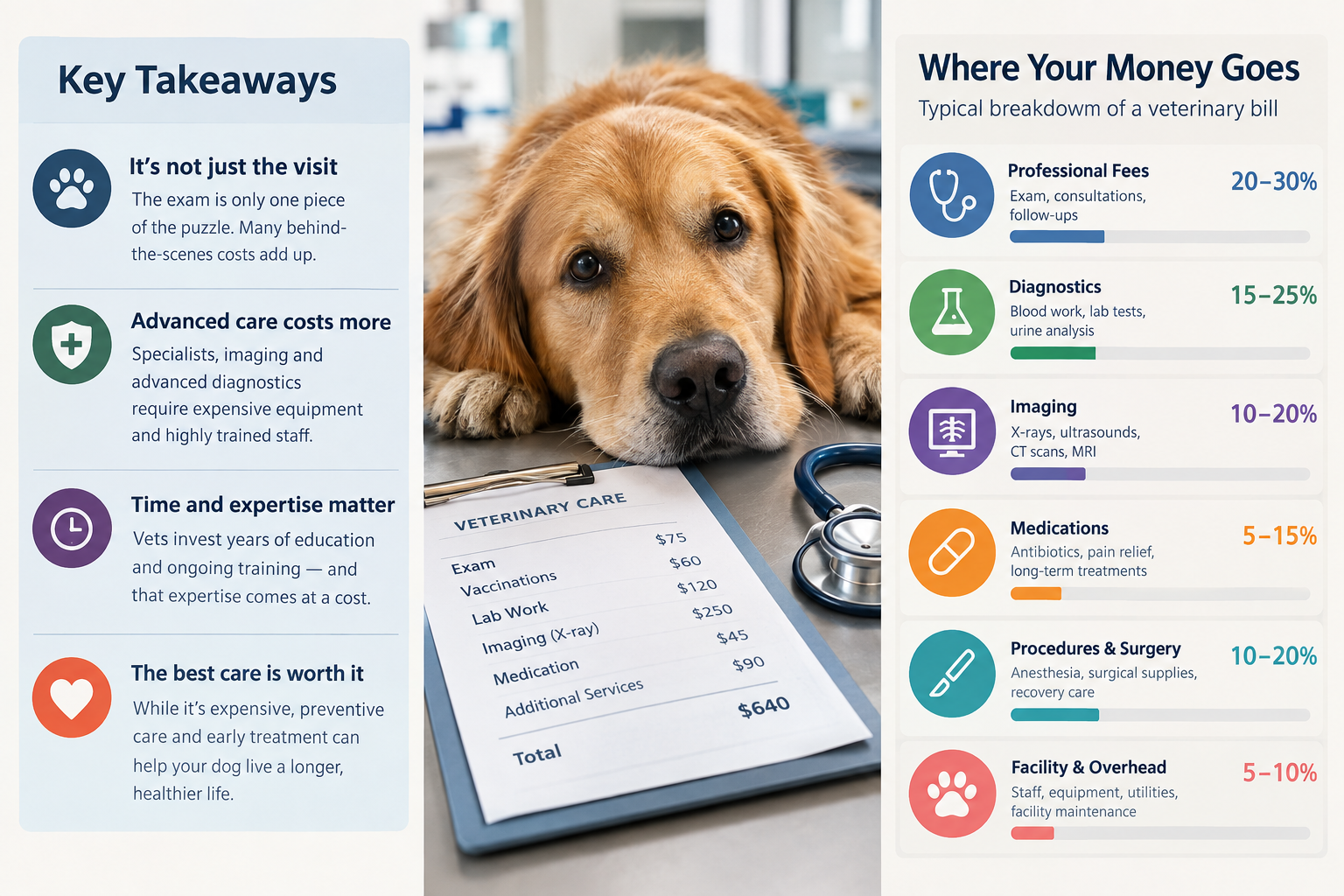
Here is a faster way to get a real number than reading a national estimate. Phone three clinics near you and ask four questions:
- What is your routine exam or consultation fee? 2What does an annual preventive visit include at your practice, vaccines and parasite prevention listed separately?
- What is your fee for a dental procedure under anesthesia for a dog my dog’s weight, as a written estimate range?
- Do you offer a wellness or preventive care plan, and what is excluded from it?
Write down the answers. That is your local baseline, and it beats any average.
For annual budgeting, build the number from the parts you can predict, then add a buffer for the part you cannot:
- Predictable: one or two preventive exams, vaccines due this year, year-round parasite prevention sized to your dog’s weight, and food.
- Semi-predictable: dental cleaning under anesthesia, which many dogs need periodically, plus senior bloodwork once a dog is older.
- Unpredictable: the torn nail, the limp, the eaten sock. This is the line that wrecks budgets.
A workable habit is a dedicated savings account with a standing transfer, set at whatever the quoted dental estimate divides into over twelve months. Dull. Effective. Food spending is also worth reviewing honestly, and our guide to whether premium dog food is actually worth the extra money compares the options without pretending the expensive bag solves everything.
Why Do Vets Charge So Much for Simple Procedures?
Because the procedure is usually the cheapest part. The preparation, drugs, monitoring, sterile instruments, staff time and follow-up are the expense, and they do not shrink just because the surgery itself takes eleven minutes.
Take a small lump removal. The visible part is a scalpel and a few sutures. The billed reality includes a pre-surgical exam, bloodwork to check the dog can process anesthetic drugs, an IV catheter, fluids, anesthetic drugs dosed by weight, intubation and oxygen, a technician monitoring vitals the whole time, a sterile instrument pack that has to be cleaned and autoclaved afterwards, pain relief to go home, a histopathology fee if the tissue is sent for analysis, and a recheck.
Common mistake: comparing the quote to the price of the same supply online. The suture material costs very little. The person qualified to place it, and the person watching the anesthetic machine while they do, cost the rest.
Decision rule: if a quote feels high for a simple job, ask for an itemized estimate rather than a total. If the itemized version shows a diagnostic you do not understand, ask the direct question: “Will this result change what we do today?” A good clinic answers that without irritation. If the answer is no, you can often defer it.
Why Are Emergency Vet Visits More Expensive?
Emergency hospitals charge more because they fund readiness, not just treatment. An overnight team, oxygen supply, blood products, intensive monitoring and surgical capacity must be staffed and stocked whether three patients arrive or thirty.
Night and weekend shifts also carry wage premiums, and emergency clinicians handle unstable patients that need continuous observation, repeat diagnostics and hospitalization. Nobody books an emergency, so the hospital cannot smooth its schedule the way a daytime practice can.
| Type of clinic | Best used for | Why the price sits where it does | What you control |
|---|---|---|---|
| General practice, daytime | Preventive care, chronic disease, planned surgery, dentals | Scheduled days, shared staff and equipment across many appointments | Book early, bundle issues into one visit, request written estimates |
| Veterinary urgent care | Same-day problems that are not life threatening | Extended hours without full intensive care overheads | Call first to confirm the case is suitable |
| 24/7 emergency and specialty hospital | Trauma, collapse, toxins, breathing trouble, overnight care | Overnight staffing, oxygen, blood products, continuous monitoring, referral equipment | Ask for a treatment plan with high and low estimate before admission |
| Nonprofit or shelter clinic | Vaccines, spay and neuter, basic care, means-tested help | Grants and donations offset costs; services are limited by design | Check eligibility rules and waiting times before relying on it |
| Veterinary teaching hospital | Complex or specialist cases, sometimes clinical trials | Supervised students lower some labor costs; advanced imaging raises others | Ask about trial enrolment and referral requirements |
Edge case worth planning for: find your nearest 24-hour hospital and save the number now, before you need it. Also worth knowing what sends dogs there in the first place. Our list of foods dogs cannot eat and the toxic items to keep off the floor covers a large share of avoidable midnight visits.
How Do Vet Prices Compare to Human Doctor Visits?
Vet bills often feel higher than human medical bills because you are comparing a full price with a co-pay. In most insured human systems, a third party pays the larger share of the real cost and you see only your portion. At the vet, you see the whole thing on one piece of paper.
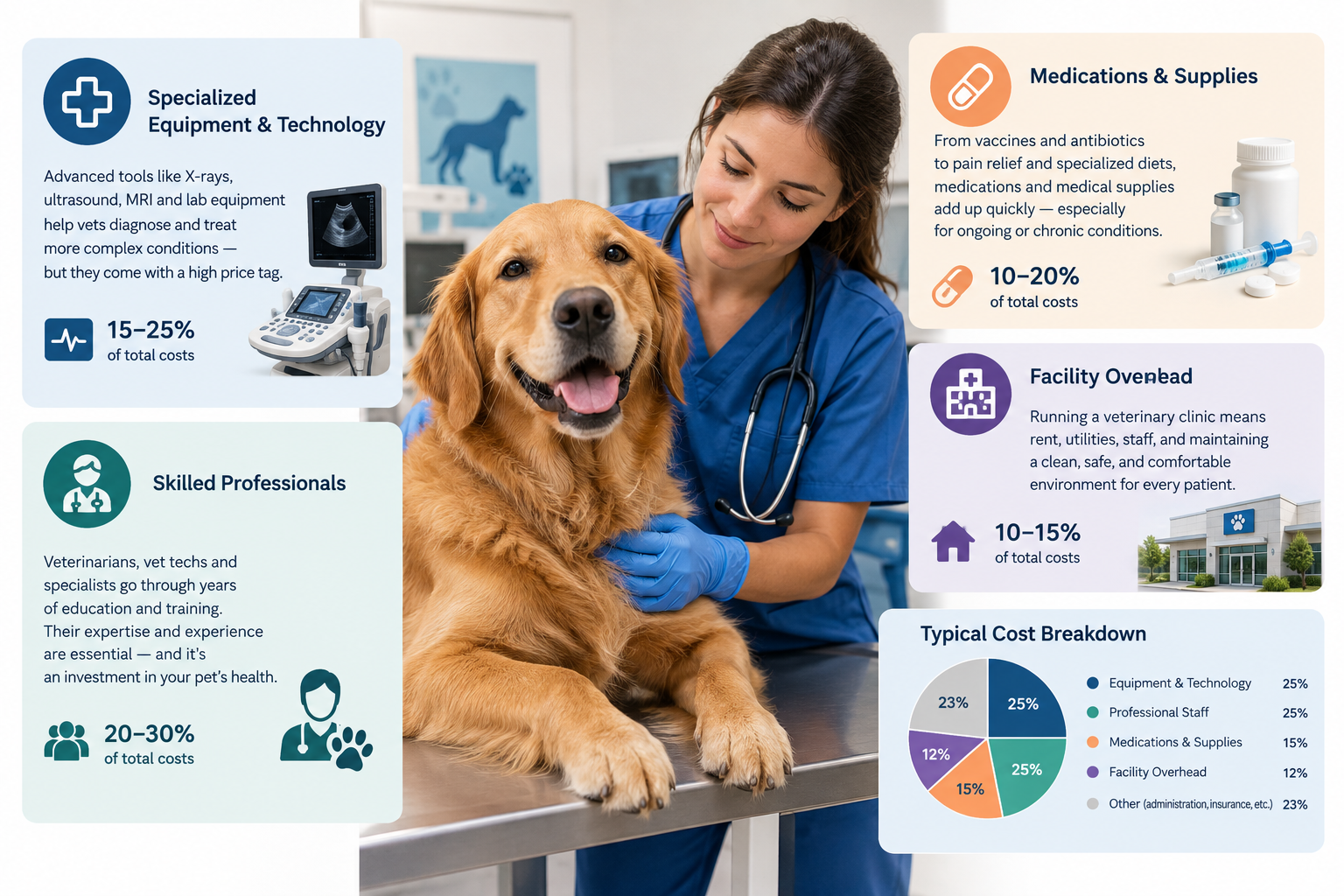
The underlying economics differ too. Human hospitals negotiate drug and device prices at enormous volume and spread fixed costs across far more patients per machine. A single general practice vet clinic may own one x-ray unit, one analyser and one anesthetic machine and use them across a comparatively small number of appointments per week.
What this does not mean: that vet care is cheap. It means the sticker shock partly comes from price visibility, not only from price level. Veterinary inflation is genuinely running hot, as the BLS figures show, and affordability pressure is real for households. A Los Angeles Times report on the pet care gap covers the widening distance between what vets recommend and what owners feel able to pay. Both things are true at once, and pretending otherwise helps nobody.
Why Is Pet Medication So Expensive, and What Is a Dispensing Fee?
A dispensing fee pays for the pharmacy function: stock holding, secure storage of controlled drugs, labelling, dose calculation by weight and the legal responsibility attached to supplying a prescription medicine for a specific animal. It is separate from the drug cost itself.
Clinic medication prices also include small-volume purchasing. A single practice buys nothing like the quantity a national pharmacy chain does. Meanwhile online pharmacies and big retailers have driven down prices on flea and tick products, antibiotics, anti-inflammatories and chronic medications. One industry interpretation, from BossPaws on rising vet bills in 2026, is that practices losing medication margin shift revenue into exam, diagnostic and procedure fees instead. Treat that as a plausible reading of the sector, not a universal accounting rule.
The practical move, available in most places:
- Ask for a written prescription and price-check an accredited online pharmacy, especially for long-term medication.
- Compare per-dose cost rather than pack price, because packs are sized differently.
- Ask whether a generic version of the same active ingredient is suitable.
- For chronic drugs, ask whether a longer supply reduces repeat dispensing fees.
UK owners got a hard cap in 2026. Following the Competition and Markets Authority investigation, UK government guidance on the vets reforms sets the maximum prescription fee at £21 for the first written prescription and £12.50 for each additional medication prescribed in the same consultation, adjusted annually for inflation. The stated aim is to make buying medication online practical rather than theoretical.
Do All Vets Charge the Same Prices, and How Do You Know If Yours Is Too Expensive?
No. Prices differ between clinics in the same city, sometimes substantially, because rent, wages, equipment, ownership structure and the level of care offered all differ. A higher fee is not automatically worse value, and a lower fee is not automatically a bargain.
Signals that a price is reasonable for what you are getting:
- You receive an itemized estimate before treatment, with a high and low range.
- The clinic explains which diagnostics change today’s plan and which are optional.
- You are told who owns the practice if you ask.
- Follow-up calls and results explanations are included rather than billed as surprises.
Signals worth questioning:
- Refusal to itemize, or an estimate given only as a single total.
- A long diagnostic list with no explanation of which test answers which question.
- Pressure to decide immediately on a non-urgent procedure.
The UK now mandates much of this. From September 23, 2026, the CMA’s veterinary market reforms require practices to publish fuller price information, disclose ownership, provide itemized bills and give written estimates for treatment expected to exceed £500. Owners elsewhere can ask for all four voluntarily. Most good clinics already say yes.
Compare the options before you need them, not during an emergency. Second opinions are normal for planned surgery and cost far less than the surgery.
How Much Does Pet Insurance Cost, and Is It Worth It?
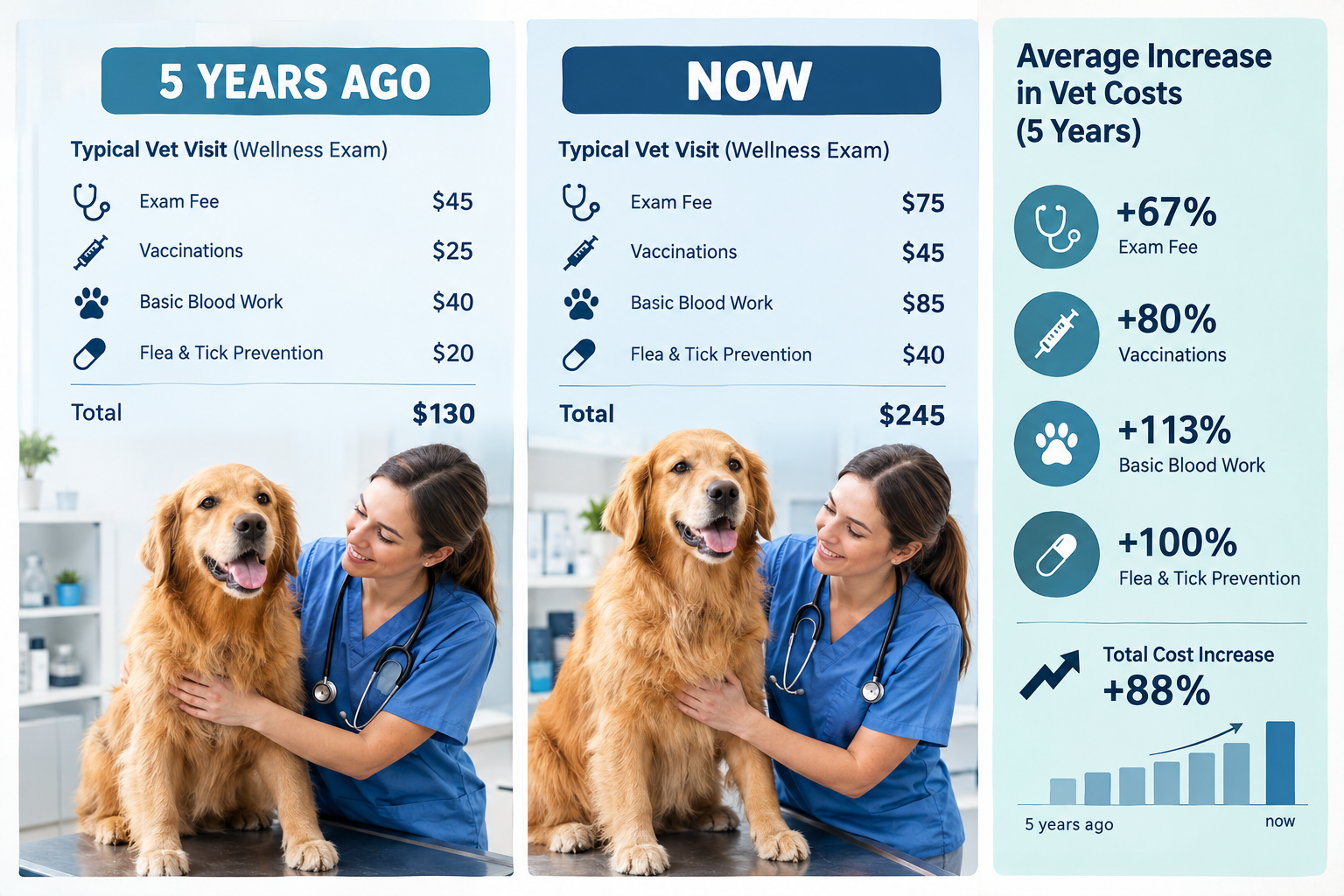
Pet insurance premiums vary too widely for a single honest average, because pricing depends on breed, age at enrolment, location, deductible, reimbursement percentage and annual limit. What the evidence supports is narrower: insurance converts an unpredictable large bill into a predictable monthly one, and it does not reduce the underlying cost of care.
Insurance tends to make sense if:
- You could not cover a four-figure emergency bill from savings within a week.
- Your dog is young and healthy now, so fewer conditions are excluded as pre-existing.
- Your breed has documented predispositions to expensive conditions such as hip dysplasia, intervertebral disc disease, or brachycephalic airway surgery.
Self-funding may suit you better if:
- You can maintain a dedicated savings buffer and genuinely leave it alone.
- Your dog is older with existing conditions that most policies will exclude anyway.
Before buying, check five things: what counts as pre-existing, whether the policy covers a condition for life or only for twelve months, the per-condition and annual limits, whether dental disease and behavior treatment are included, and how premiums rise with age. Ask for the policy wording, not the sales page. The exclusions are where the decision actually sits.
Can You Get Affordable Vet Care for Your Dog, and Are There Ways to Reduce Costs?
Yes, and most of the savings come from prevention, timing and asking better questions rather than from skipping care.
Before the visit
- Ask for a written estimate with a range on anything non-routine.
- Bundle concerns into one appointment instead of three.
- Book routine problems into normal hours rather than urgent slots.
- Bring a short written list of symptoms with dates. Faster history means less guesswork and fewer exploratory tests.
At the visit
- Ask which test changes today’s decision, and which can wait.
- Ask for a written prescription for long-term medication.
- Ask about staged plans: treat the most likely cause first, re-test only if it fails.
Between visits
- Keep your dog at a lean body condition. Weight-linked disease is one of the most expensive preventable categories in companion animal medicine, and our feeding guidance on portions, timing and water from vets explains how to do it without guesswork.
- Brush teeth. Dental disease treated early is cheaper than dental disease treated under anesthesia with extractions.
- Keep parasite prevention current year round.
- Train cooperative handling. A dog who tolerates nail trims, ear checks and restraint needs less sedation. Our practical puppy training guide covers the humane training basics that make handling easier later.
Lower-cost care routes
- Nonprofit and shelter clinics offering vaccines, spay and neuter and basic care, often means-tested.
- Veterinary teaching hospitals, sometimes with clinical trials that cover treatment costs.
- Mobile vaccine clinics for routine preventive items only.
- Wellness plans that spread preventive care monthly. Read what is excluded, because emergencies usually are.
If a diet change has been recommended for a diagnosed condition, do not substitute blindly to save money. Our overview of vet recommended dog food for specific health problems explains which therapeutic diets exist and where the claims end. For everyday feeding on a tight budget, budget dog food picks that still stack up is a better place to economize than on prevention.
What Can You Do If You Cannot Afford Vet Treatment?
Say it out loud at the start of the conversation, before treatment begins. Veterinary teams can only offer alternatives they know you need, and plans built around your actual budget work better than plans abandoned halfway.
Options to ask about, in rough order:
- A staged treatment plan. Stabilize now, diagnose in steps, spread costs across weeks where it is clinically safe.
- In-house payment arrangements. Not every clinic offers them. Ask rather than assume.
- Third-party medical credit. Products such as CareCredit or Scratchpay are used widely in the US. Check the interest rate after any promotional period, because deferred interest can be expensive.
- Charitable grants. US owners can look at RedRover Relief urgent care grants and The Pet Fund. UK owners on qualifying benefits can check PDSA pet help and advice. The ASPCA’s pet care costs page lists further regional assistance routes.
- Breed-specific rescue funds and condition-specific charities. Smaller, often faster, and less well known.
- Shelter clinics and teaching hospitals. Lower fees for some services, with eligibility rules and waiting lists.
One honest note about where the facts end: grant funds are limited, competitive, and usually need an estimate from your clinic before applying. Apply early. If a condition is terminal and treatment is out of reach, ask your vet directly about comfort-focused care and humane end-of-life options. That conversation is part of veterinary medicine too, and asking for it is not a failure of love or budget. Guidance here was checked October 2026.
Conclusion
Why are vets so expensive? Because the bill shows you the real cost of running a small hospital for a species with no national insurer behind it: skilled people, calibrated machines, drugs, sterile supplies, overnight readiness, and inflation running at 5.7% a year in US veterinary services as of August 2026. Some of that is unavoidable. Some of it, you can influence.
Three things to do this week:
- Phone three local clinics and record their exam fee and one procedure estimate. That is your actual baseline.
- Ask your current vet for a written prescription on any long-term medication and price-check an accredited online pharmacy.
- Set up a standing transfer into a dedicated pet savings account, even a small one, and find your nearest 24-hour emergency hospital before you need it.
Then, at the next appointment, ask the one question that saves the most money over a dog’s life: “Which of these tests changes what we do today?” It is a fair question. A good clinic will be glad you asked it.
FAQ
Why are emergency vets so expensive compared with my regular clinic? Emergency hospitals fund 24-hour readiness: overnight staff on premium wages, oxygen, blood products, intensive monitoring and surgical capacity held available whether patients arrive or not. They also treat unstable patients who need repeat diagnostics and hospitalization.
What is a vet dispensing fee, and can I avoid it? It covers pharmacy stock, secure storage, labelling, dose calculation and legal responsibility for supplying a prescription drug to a named animal. You can often reduce it by requesting a written prescription and buying from an accredited online pharmacy. In the UK, prescription fees are capped at £21 for the first item and £12.50 for each additional item in the same consultation.
Why are dog blood tests so expensive? A panel includes the sample draw, reagent cartridges with expiry dates, a calibrated analyser under a maintenance contract, technician time running it and veterinary interpretation. In-house testing costs more per sample than a send-out lab but returns results in minutes, which matters in urgent cases.
Is my vet too expensive, or is this just the price now? Check whether you are getting an itemized estimate, a clear explanation of which tests change the plan, and disclosed ownership. Then compare the same named procedure at two other local clinics. Differences between clinics in one city can be large, and a higher fee may reflect more included care.
Does private equity ownership mean a clinic charges more? Not automatically. Corporate groups can set prices centrally and carry extra administrative layers, which may raise fees, and a September 2026 New York Post report lists consolidation among the drivers of rising bills. Independent clinics face the same wage, drug and equipment inflation. Ask who owns the practice and compare itemized estimates rather than assuming.
How much should I set aside each month for vet care? Build it from your own quotes: divide your clinic’s written dental estimate by twelve, add the annual cost of preventive care and parasite prevention spread monthly, then add a buffer for unplanned visits. Local quotes beat national averages.
Is pet insurance worth it if my dog is already middle-aged? It can still help with future unrelated conditions, but anything already diagnosed will usually be excluded as pre-existing, and premiums rise with age. Read the exclusions and the per-condition limits before deciding between a policy and a dedicated savings account.