
Quick Answer
Pet insurance is expensive because it pays a percentage of a real veterinary bill, and veterinary bills keep climbing faster than general prices. The short answer to why is pet insurance so expensive comes down to five levers: veterinary cost inflation, your dog’s age, breed and size risk, your zip code, and the claim history of the whole pool of insured pets. According to the NAPHIA State of the Industry 2026 highlights, U.S. premium volume hit about $5.7 billion at year-end 2025, up 19.7% in a single year, while enrollment grew more slowly. Prices rose faster than the number of insured pets. That gap is the story.
This article explains how pricing works, not which policy to buy. It is general information, not financial advice.
Key Takeaways: Why Is Pet Insurance So Expensive?
- The policy pays a share of the bill, so insurer costs track vet prices. If a covered surgery moves from $4,000 to $5,000 at 80% reimbursement, the insurer’s payout moves from $3,200 to $4,000 with no change in your dog’s health.
- Average annual accident-and-illness premiums for dogs reached about $836 in 2025, roughly 11.5% higher than 2024, according to coverage of the NAPHIA 2026 report. That works out to around $70 a month on average.
- Adding wellness coverage roughly doubles it. Dog policies combining accident, illness and wellness averaged about $1,414 a year in 2025, near $118 a month.
- Age is repriced at every renewal. Senior dogs cost more to insure because claim frequency and claim size both rise with age.
- Rate increases are approved in bulk but applied unevenly. A state can approve one average increase while individual renewals move far above or below it.
- Higher deductibles and lower reimbursement rates genuinely cut the premium, and they shift more of a bad month onto you.
- Pre-existing conditions are excluded, not priced in. They raise your out-of-pocket risk rather than your premium.
- Switching insurers after a diagnosis usually backfires, because anything already documented becomes pre-existing at the new company.
What Are the 5 Reasons Pet Insurance Premiums Rise?
Premiums rise because of five rating and cost pressures working at once: veterinary inflation, your dog’s age, breed and size, your geographic location, and the loss experience of everyone else in the pool. Four of those five are outside your control. Knowing which is which tells you where negotiating actually works.
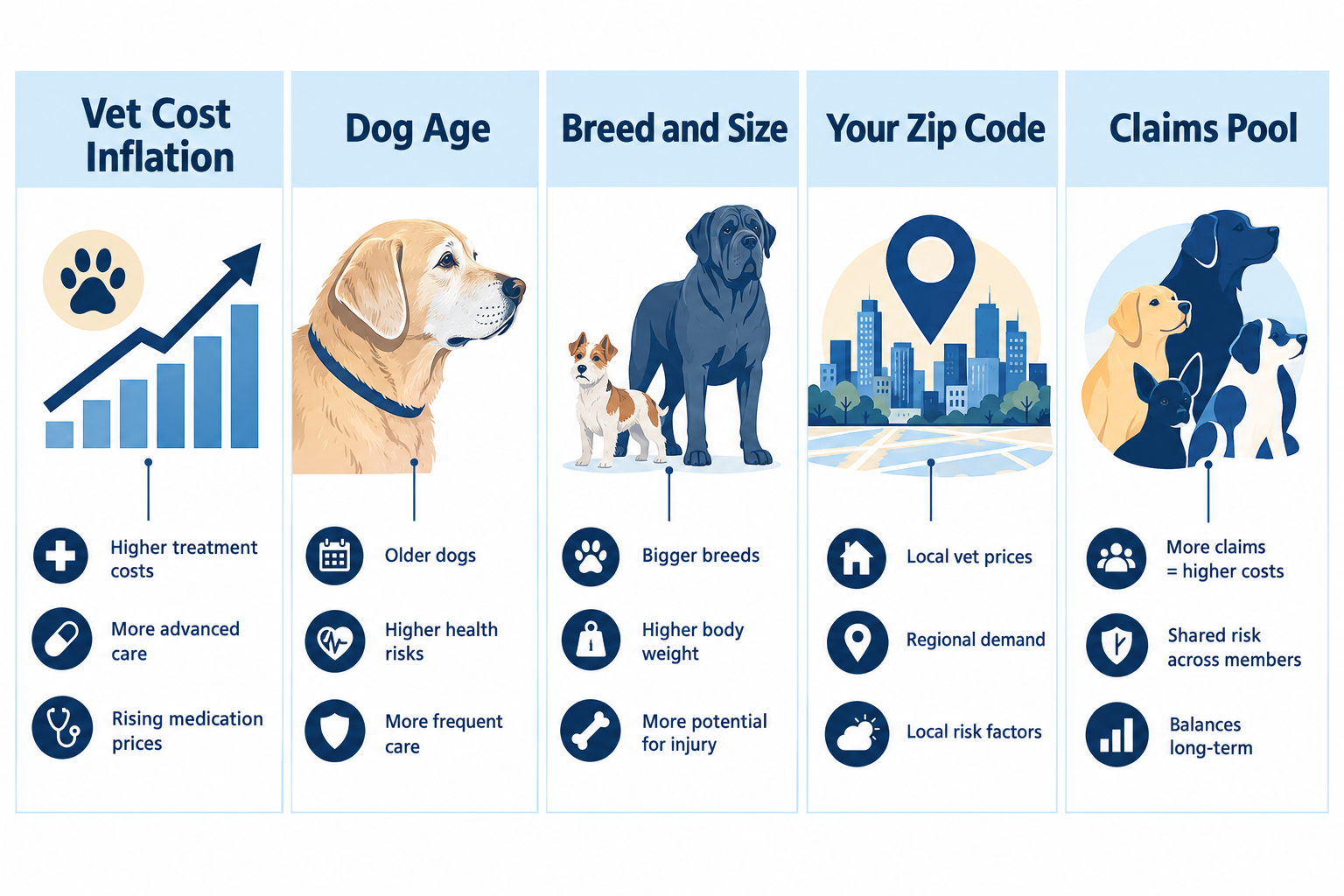
1. Veterinary cost inflation feeds straight into the premium
Veterinary care has been one of the faster-rising categories in household spending. U.S. Bureau of Labor Statistics consumer price data showed veterinarian services up 5.7% year over year in August 2026, with the broader pet services category up 4.8%, against overall CPI growth of 3.4%. Vet prices outran general prices.
That matters more for insurance than for most products, because the product is a percentage of a bill, not a fixed service. An industry analysis of veterinary cost inflation and rate adequacy describes the same mechanic: when the cost of a covered procedure rises, the insurer’s exposure rises with it, and the premium has to follow or the book stops paying for itself.
Add better medicine to that. MRI and CT imaging, board-certified specialists, orthopedic repair, oncology, round-the-clock intensive care. Treatments that barely existed in general practice a generation ago are now available in a lot of metro areas. Insurify’s reporting on renewal increases quoted industry figures attributing higher premiums to better diagnostics and more specialty care, along with medical cost inflation that looks a lot like the human health pattern. Julie Galante, chief insurance officer at Fetch Pet Insurance, pointed to rising veterinary costs, aging pets and owners choosing more advanced treatment.
Which is the uncomfortable part. The reason insurance got pricier is partly that your dog can now get an MRI.
2. Your dog is getting older, and age is repriced every year
Age is the single most predictable upward force on a dog policy. Older dogs claim more often and claim bigger. Most insurers rebuild your rate at renewal using your dog’s current age, so the price moves even in a year when nothing goes wrong and nobody files a claim.
That catches people out, because it feels like a penalty. It is not a penalty. It is the same policy priced for a different dog than the puppy you enrolled.
Practical consequence: enroll early if you are going to enroll at all. A policy bought at twelve months starts cheaper and keeps continuous coverage, which protects you from the pre-existing condition trap later. If you are still choosing a dog, size and build are worth thinking about alongside temperament, and our guide on how to pick a dog breed that fits your life covers the practical fit questions.
3. Breed and size carry different claim risk
Insurers rate by breed and adult weight because the claim data differs. Larger dogs cost more per claim: more anesthesia, more drug volume, more orthopedic hardware, more hospital time. Some breeds carry documented tendencies toward conditions that generate expensive, repeat claims.
Brachycephalic breeds are the obvious case. Airway surgery, heat sensitivity and anesthetic risk all show up in the pricing, which is one reason the French Bulldog’s popularity and its health debates keep landing in the same conversation. Giant breeds get rated up for size alone. If you are not sure which bracket your dog sits in, the large and giant breed weight chart sorts it out quickly.
One limit worth stating plainly: breed-level pricing is a population average. It does not predict your individual dog. Individual variation is real, and plenty of insured Frenchies never file an airway claim. The premium reflects the group, not the animal asleep on your floor.
4. Your zip code decides a surprising amount
Two identical four-year-old Labradors, same policy, same insurer, can be priced hundreds of dollars apart because one lives in a dense coastal metro and the other does not. Insurers rate by location because local vet pricing, specialist availability and emergency hospital rates vary enormously.
Urban areas with multiple 24-hour referral hospitals tend to produce higher average claims. More availability means more treatment pursued, at higher local prices. Rural zip codes often price lower, partly because the expensive options are a long drive away.
Decision rule: if you move, re-shop. Your location rating changed, and your current insurer applied its own version of that change without asking you.
5. The claims pool: what every other insured dog cost
Your premium is not just about your dog. It reflects the loss experience of the whole group you are pooled with. If claim severity rises across a state’s book of business, pricing follows for everyone in that book, including dogs that never cost the insurer a cent.
Pool size matters too. Market penetration for pet insurance in the U.S. remains low compared with human health or auto cover, and smaller pools absorb bad years less comfortably. North American enrollment reached 7.6 million insured pets by the end of 2025, up 8.5% from 7.03 million, according to NAPHIA’s industry data. Growing, still a minority of pets.
There is also an adverse selection pull. Owners who expect expenses are more likely to buy coverage, which raises average claim costs for everybody in the pool.
How Much Is Pet Insurance a Month for a Dog in 2026?
Average U.S. accident-and-illness cover for dogs ran about $836 a year in 2025, which is roughly $70 a month. Policies bundling wellness averaged near $1,414 a year, around $118 a month, based on the 2025 figures in the NAPHIA report coverage. Those are averages across all ages, breeds and zip codes, so a quote for a nine-year-old Rottweiler in a high-cost metro will sit well above them, and a quote for a one-year-old mixed breed terrier in a cheaper area can sit well below.
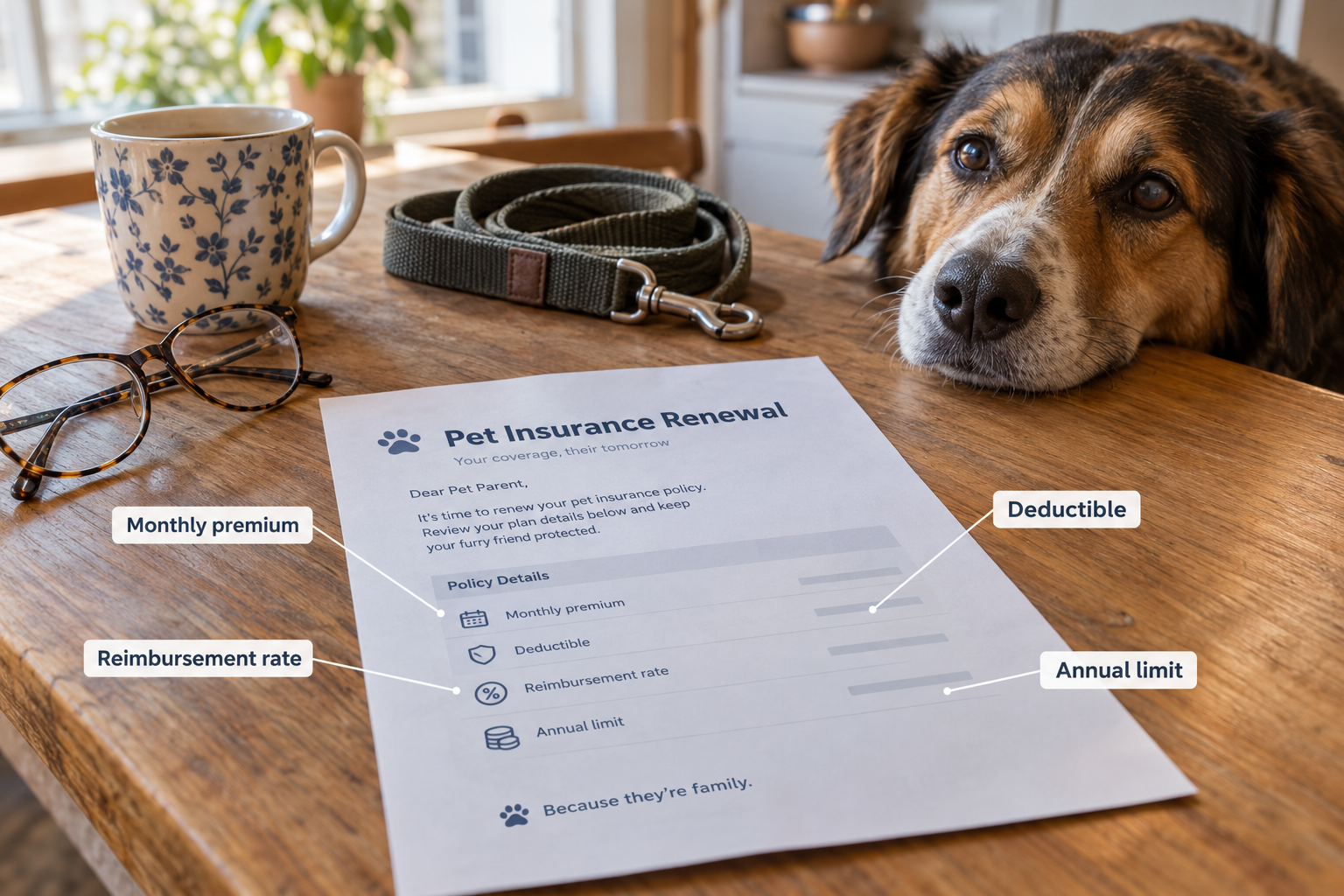
Three policy settings do most of the work on your monthly number. Here is how each one moves the price and the risk.
| Policy setting | Choice | Effect on premium | Who it suits |
|---|---|---|---|
| Annual deductible | Low vs high | Raising it is usually the biggest single premium cut available | Owners with savings who want cover for the five-figure event, not the $300 one |
| Reimbursement rate | 70%, 80% or 90% | Dropping from 90% to 70% lowers the monthly cost and roughly triples your share of a covered bill | 70% suits tight monthly budgets; 90% suits owners who could not fund 30% of a $9,000 surgery |
| Annual payout limit | Capped vs unlimited | Unlimited is the priciest structure; a cap trades price for a ceiling | Caps suit low-risk young dogs; unlimited suits breeds facing possible repeat orthopedic or oncology claims |
| Wellness add-on | Included vs declined | Dog policies with wellness averaged about $1,414 a year in 2025 against $836 for accident and illness alone | Mostly a payment plan for predictable care; declining it is often the cheaper route |
| Age at enrollment | Puppy vs senior start | Enrolling young locks in a lower starting rate and avoids later exclusions | Anyone planning to hold a policy long term |
Is $10,000 a year enough? For most dogs in most years, yes. It stops being enough in the years that matter: a cruciate repair on both knees, cancer treatment with chemotherapy, or a long intensive care stay after a road accident. If you choose a cap, choose it knowing which scenario it fails in.
Why Did My Pet Insurance Go Up So Much at Renewal?
Your renewal rose because three things changed at once: your dog got a year older, the insurer’s claim costs rose, and the insurer filed a new rate for your state that a regulator approved. None of those require you to have made a claim.
Rate filings are approved as an average, then applied per policy. That is the detail that explains the shock. A regulator can sign off on one statewide number while individual renewals land far above or below it, depending on age band, breed group, coverage tier and location.
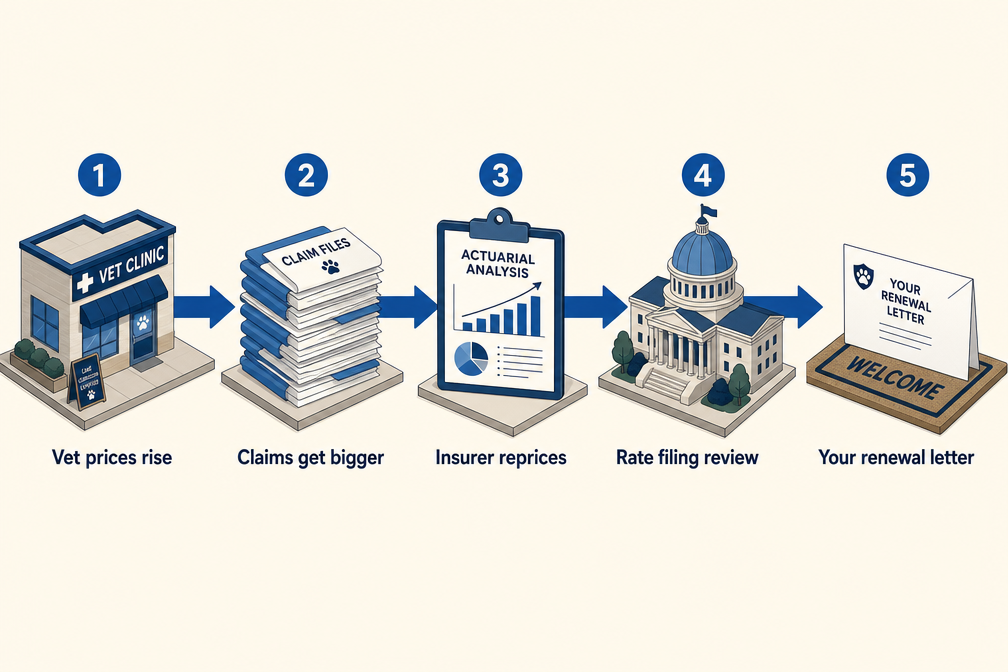
Other filings show the same pattern at larger scale. California also approved a 7.9% average increase for Independence American Insurance Company, which underwrites Figo and PetPartners programs, touching roughly 197,543 policyholders at renewal rather than immediately. In New Jersey, Lemonade filed for a 38.4% overall increase on September 2026 renewal business, below its own actuarial indication of 52.2%, with uncapped individual changes spanning 5.7% to 143.5% and a proposed 25% annual cap. A cap spreads the increase over several renewals. It does not cancel it.
Regulation helps with disclosure more than with price. The NAIC model framework for pet insurance recognizes that premiums can change with age, location and other rating factors, and state reviews test whether a rate is justified, not whether it feels affordable.
Common mistake: assuming your own claim caused the increase and switching insurers in protest. Insurify’s reporting notes that switching after a rate hike is often harder than it looks, because any condition already in your dog’s record becomes pre-existing at the new company.
Are Pre-Existing Conditions Why Pet Insurance Costs More?
No. Pre-existing conditions are excluded from cover rather than priced into your premium, so they raise your out-of-pocket risk instead of your monthly bill. The cost pressure comes from what insurers do pay for.
What counts as pre-existing is broader than most owners expect. It usually includes anything diagnosed, treated, or showing clinical signs before cover started or during the waiting period, even if it was never named in a diagnosis. A note in your file reading “intermittent hind limb lameness” from eighteen months ago can be enough to exclude a later cruciate claim.
- Curable versus incurable matters. Some insurers will cover a resolved condition again after a symptom-free period. Chronic conditions such as allergies, diabetes or arthritis are typically excluded for life.
- Waiting periods have teeth. Orthopedic conditions often carry longer waiting periods than illness in general.
- Enroll before the first vet visit you are slightly worried about, not after it.
Do Pet Insurance Companies Price Differently, and Which Are Most Affordable?
Yes, pricing differs substantially between companies, and there is no single cheapest insurer for all dogs. The same nine-year-old Beagle can get quotes that differ by more than half across providers, because each company uses its own rating factors, claim assumptions and policy structure.
Where companies actually differ:
- Rating method. Some price primarily on breed, age and zip code. Others, including Trupanion’s model, price closer to the cost of care for your specific pet and location.
- Limit structure. Unlimited annual payout costs more than a capped plan and protects differently.
- Deductible type. Annual deductibles versus per-condition deductibles change the math in a multi-problem year.
- How exam fees, prescription food, dental and behavioral therapy are treated. These exclusions are where quotes that look identical stop being identical.
- Renewal behavior. Two insurers with similar first-year pricing can diverge sharply by year four.
Decision rule: compare the options at a matched deductible, matched reimbursement rate and matched annual limit, or you are comparing nothing. Then check the exclusions list before the price.
For senior dogs specifically, the useful question is not who is cheapest but who will still enroll and renew. Some insurers cap new enrollment by age or restrict older dogs to accident-only cover. Continuous coverage from a younger age is usually worth more than a lower headline quote at ten.
Do Vets Charge Differently With and Without Pet Insurance?
In most cases, no. Veterinary practices generally charge the same fee regardless of whether you hold insurance, because pet insurance is a reimbursement product, not a negotiated network like human health insurance. You pay the clinic, then claim.
Two things complicate the picture:
- Direct pay exists but is limited. A minority of clinics work with insurers to bill them directly at checkout, which changes your cash flow, not the price of the procedure.
- Insurance can change what gets recommended and accepted. An insured owner may say yes to the MRI, the specialist referral, or the second surgical opinion more readily. That is better medicine for the dog and more claim cost for the pool, which circles back into next year’s premium.
There is a related owner behavior worth naming: some owners stay quiet about having insurance, worried about being steered toward costlier care. A more useful approach is to ask for a written estimate with options, then decide. Ask what each option changes for the prognosis, and ask what happens if you choose the cheaper route.
How Can I Reduce My Pet Insurance Without Losing Coverage?
Raise the deductible first, then check the annual limit, then drop the wellness add-on. Those three moves cut a premium without touching the part that actually protects you, which is accident and illness cover for a large unexpected bill.
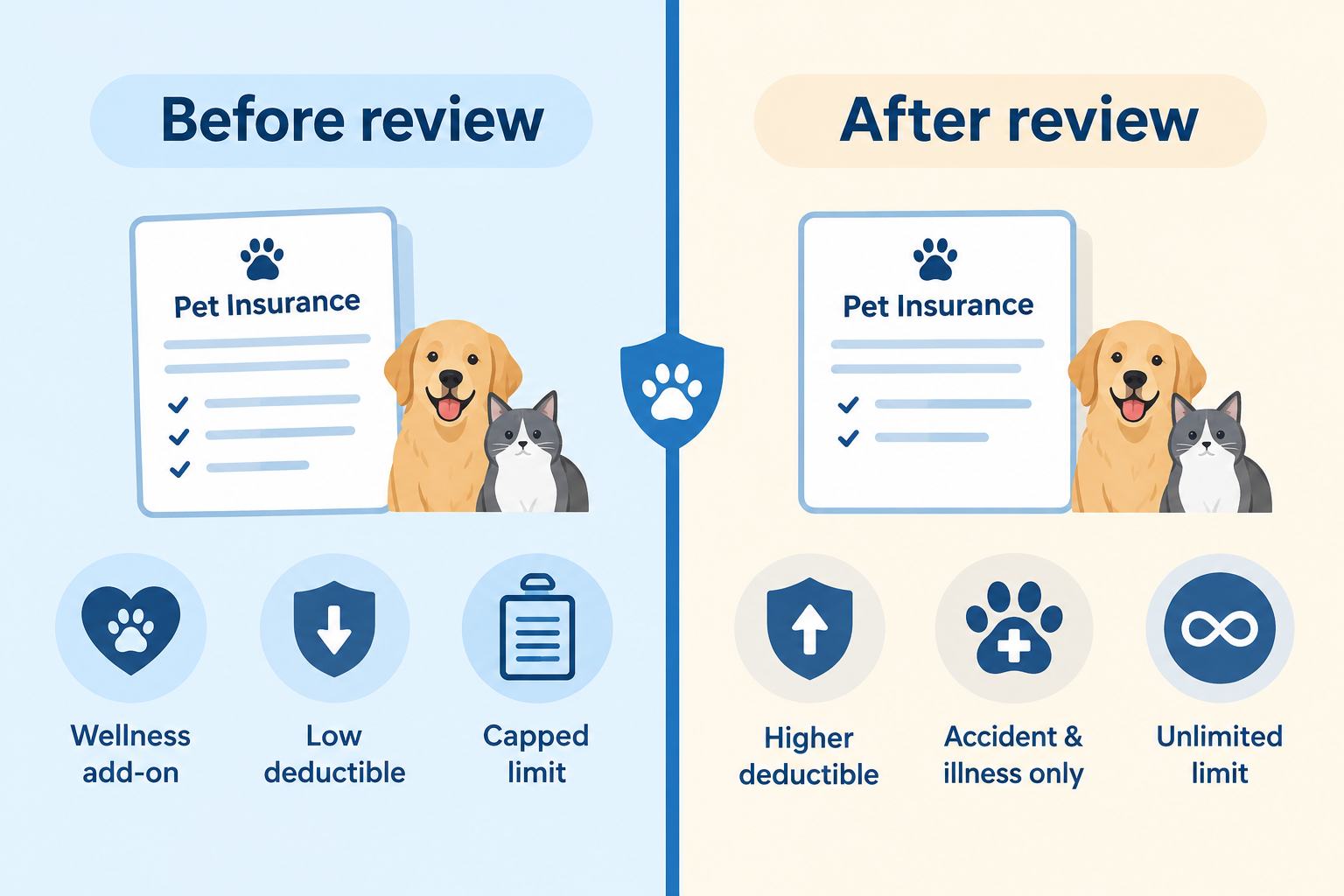
Specific steps, in the order worth trying:
- Increase the annual deductible. Usually the largest saving per dollar of risk transferred. Keep an emergency fund equal to the new deductible so the choice is real.
- Reconsider 90% reimbursement. Moving to 80% cuts the premium. Moving to 70% cuts it more and leaves you paying 30% of every covered bill, which on an $8,000 surgery is $2,400. Decide with that number in front of you.
- Drop wellness cover. Vaccines, dental cleanings and flea prevention are predictable. Paying for them through an insurance product adds administration to a cost you can budget directly.
- Ask about the discounts that exist. Multi-pet, annual payment instead of monthly, employer benefit programs, military and shelter adoption discounts. None are guaranteed, and all are worth asking for by name.
- Shop at renewal, with your dog’s medical record in hand. New quotes mean new exclusions. Switch only if your dog’s file is genuinely clean.
- Reduce the preventable claims. Secure trash, supervised chews, and a kitchen that does not hand out hazards. Our list of foods dogs cannot eat and why they are toxic covers the emergency room classics. Foreign body surgery and chocolate toxicity are among the most avoidable expensive claims there are.
Edge case: if your dog already has a chronic diagnosis, do not shop. Your existing policy is the only one that still covers it. Lower the premium inside that policy instead.
Is Pet Insurance Worth the Cost Compared With Paying Vet Bills Out of Pocket?
Pet insurance is worth it if a sudden $6,000 bill would force a decision you could not live with, and it is not worth it if you can reliably fund that bill from savings. The question is about your cash position, not about whether the product pays out on average.
Insurers price policies to collect more than they pay. That is how insurance works in every category. So on average, across all policyholders, buying cover costs more than self-funding. The value is in variance, not averages. One dog in the pool has a $14,000 year and the others subsidize it.
Choose insurance if:
- A four-figure emergency bill would go on a credit card or force you to decline treatment.
- Your dog is a large, giant or higher-risk breed with known orthopedic or airway tendencies.
- You want the decision at 2am to be medical rather than financial.
Choose self-funding if:
- You can set aside a monthly amount and leave it untouched for years, and you will actually do it.
- Your dog is already old enough or already diagnosed enough that useful cover is unavailable.
- You are comfortable setting a treatment ceiling in advance.
The honest version of self-funding: at around $70 a month, the 2025 dog average, a savings account reaches roughly $840 after a year and about $4,200 after five, with no interest assumed. That covers a lot of ordinary emergencies and not a cancer protocol in year two. Insurance pays from day one of cover. A savings plan pays from whenever you started.
If budget is the constraint, look at the whole spend, not only the premium. Owners sometimes pay a large premium and a large food bill at once, and our piece on whether premium dog food is actually worth paying more for is a fair place to check which of those two is doing more for your dog.
Is pet insurance a scam given how expensive it is?
No, but the complaints are usually about three real design features rather than fraud: pre-existing condition exclusions, annual repricing by age, and reimbursement after you have already paid the clinic. All three are disclosed in the policy wording, and all three surprise people anyway.
What separates a bad experience from a bad product is almost always the policy document. Read the exclusions, the waiting periods, the bilateral condition clause, and whether exam fees are covered. Then read how the company handles renewal pricing.
Which pets are the most expensive to insure?
Large and giant breed dogs, brachycephalic breeds, and senior pets of any kind. Dogs cost more than cats across the board: the 2025 averages were about $836 a year for dogs against $435 for cats on accident and illness cover.
Within dogs, the pricing pressure concentrates on adult weight and documented condition risk, which is why giant breeds tend to generate the highest quotes. Bigger dog, bigger drug doses, bigger implants, longer anesthesia.
FAQ
Why is pet insurance so expensive for senior dogs?
Claim frequency and claim size both rise with age, and insurers reprice age at each renewal. Some companies also restrict older dogs to accident-only cover or stop accepting new enrollments past a set age.
How much is pet insurance a month for a dog?
Average accident and illness cover for U.S. dogs was about $836 a year in 2025, roughly $70 a month. Wellness-inclusive dog policies averaged near $1,414 a year, about $118 a month. Your quote depends on age, breed, zip code and the deductible, reimbursement and limit you choose.
Can you get cheaper pet insurance with a higher deductible?
Yes. Raising the annual deductible is usually the single most effective way to cut the premium while keeping full accident and illness cover. Hold savings equal to the deductible so the trade is genuine.
Is $10,000 enough pet insurance?
For most dogs in most years, yes. It can fall short in a severe year involving bilateral orthopedic surgery, cancer treatment or extended intensive care. Match the limit to the worst case you want covered.
Does pet insurance cover pre-existing conditions?
Generally no. Conditions diagnosed, treated or showing signs before cover began or during the waiting period are excluded. Some insurers will reconsider a cured condition after a symptom-free period, but chronic conditions are usually excluded permanently.
Should I switch insurers when my premium jumps?
Only if your dog’s medical record is clean. Switching restarts waiting periods and makes any documented condition pre-existing at the new company. Reducing cover levels inside your current policy is often the safer saving.
Can my insurer raise my premium just because my dog claimed?
Most pet insurers price by rating factors and overall claim experience rather than by individual claim history, so premiums typically rise with age, location and statewide loss trends rather than as a direct penalty for one claim. Check your policy wording, since practices differ by company and state.
Is pet insurance worth it for dogs?
It is worth it when a sudden four-figure bill would force you to decline treatment. It is less compelling when you can self-fund reliably, or when your dog’s existing conditions would be excluded anyway.
Conclusion: A 10-Minute Renewal Checklist
Understanding why is pet insurance so expensive is useful mostly because it tells you which levers you still control. Vet inflation, your dog’s age, breed risk and your zip code are set. Your deductible, reimbursement rate, annual limit and add-ons are not.
Work through this the next time a renewal letter arrives:
- Find the percentage. Compare last year’s monthly premium with the new one and write down the increase.
- Call and ask what changed. Age band, state rate filing, coverage tier. Get the reason, not a summary.
- Request two alternative quotes from your current insurer: one with a higher deductible, one with a lower reimbursement rate.
- Check your annual limit against a realistic bad year for your dog’s age and breed.
- Decide on the wellness add-on, using last year’s actual routine care spending.
- Confirm whether your dog’s file now contains anything that would be pre-existing elsewhere. If it does, stay put and adjust inside the policy.
- Ask for every discount by name, including annual payment and multi-pet.
- Set up or top up an emergency fund equal to your new deductible.
Guidance and figures checked October 2026. Policy terms, rate filings and state rules change, so confirm the details with your insurer and your own vet before deciding. This is general information rather than financial advice.