
This post contains affiliate links. If you buy through one we may earn a commission at no extra cost to you. As an Amazon Associate I earn from qualifying purchases.
Quick answer
A coolaroo dog bed wins on price and airflow for indoor and shaded outdoor use, while the K&H Original Pet Cot wins on fabric durability for dogs that spend real time outside in sun and rain. Both are raise mesh cots that cost roughly $40 to $60 for a large size, and the right pick depends on where the bed lives, not just what it costs.
Key takeaways
- The Coolaroo Original large runs roughly $40 to $55 and uses a steel tube frame wrapped entirely in mesh fabric Coolaroo raise dog beds.
- The K&H Outdoor Elevated Dog Bed large runs a similar price band, around $40 to $60, with a heavier denier perimeter fabric around a mesh center.
- A coolaroo dog bed sits about 8 inches off the ground, enough clearance for air to move underneath on most floors and patios.
- Coolaroo’s HeatShield line adds a reflective fabric the brand claims feels up to 15°F cooler than standard mesh, a manufacturer claim rather than an independent lab result Coolaroo Pro HeatShield large.
- Kuranda’s chew-proof aluminum bed, rated to 250 pounds and priced around $180 to $200, is the step-up pick for heavy chewers Dogster chew-proof bed guide.
- Replacement covers are not guaranteed to be in stock for every size or brand, so check availability before buying, especially for Coolaroo The Spruce Pets dog bed cover guide.
- Neither brand had an active recall listed as of the most recent check. Verify directly with the CPSC recall search before buying secondhand.
Doggy Rank IQ Tool
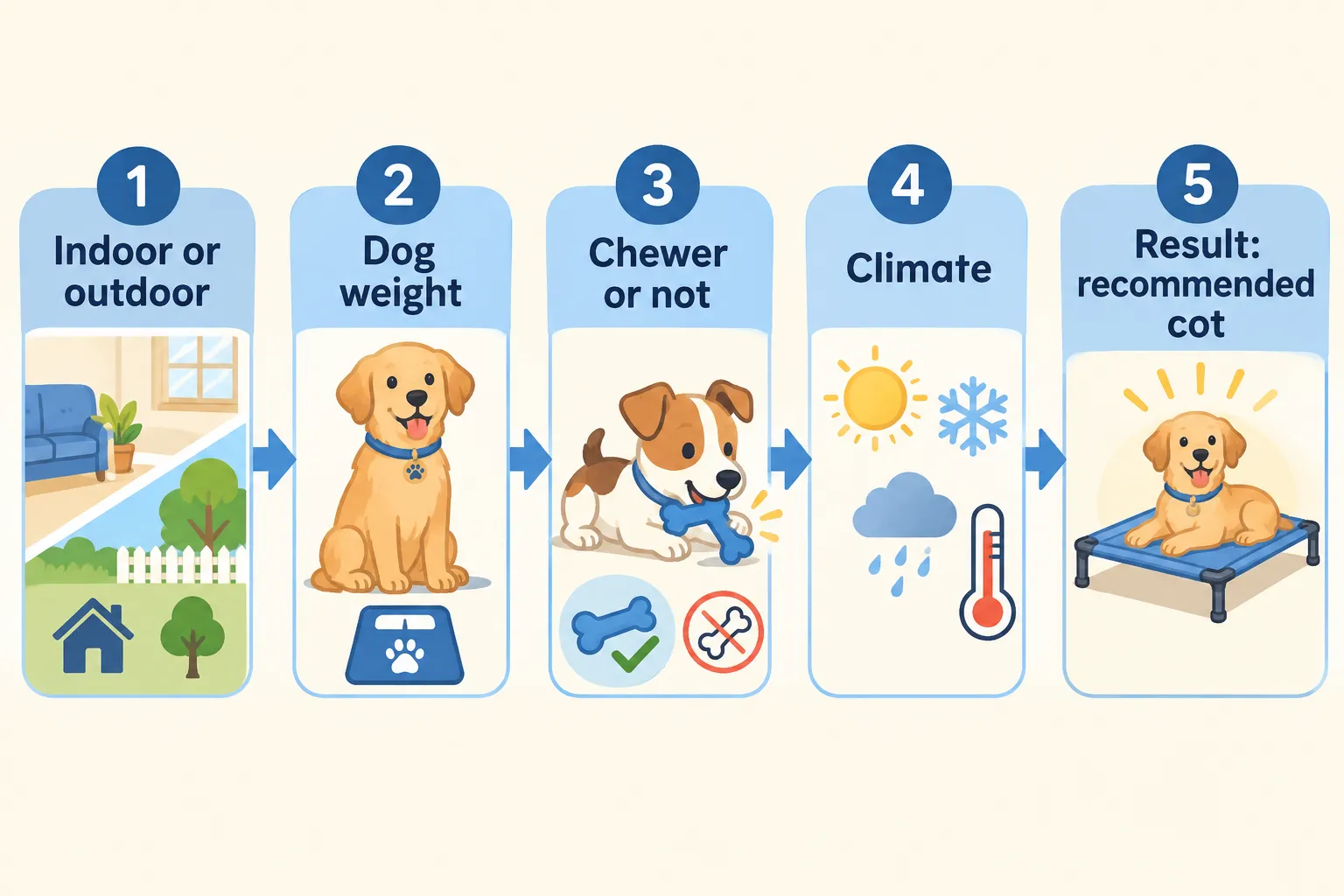
Coolaroo vs K&H Cot Use Case Picker

Both are mesh cots. Indoors or out, chewer or not, and your climate pick the winner and the spare parts.
Affiliate disclosure
This article contains affiliate links to Amazon. Purchases made through those links may earn a commission at no extra cost to the buyer.
What is a coolaroo dog bed and how does it work?
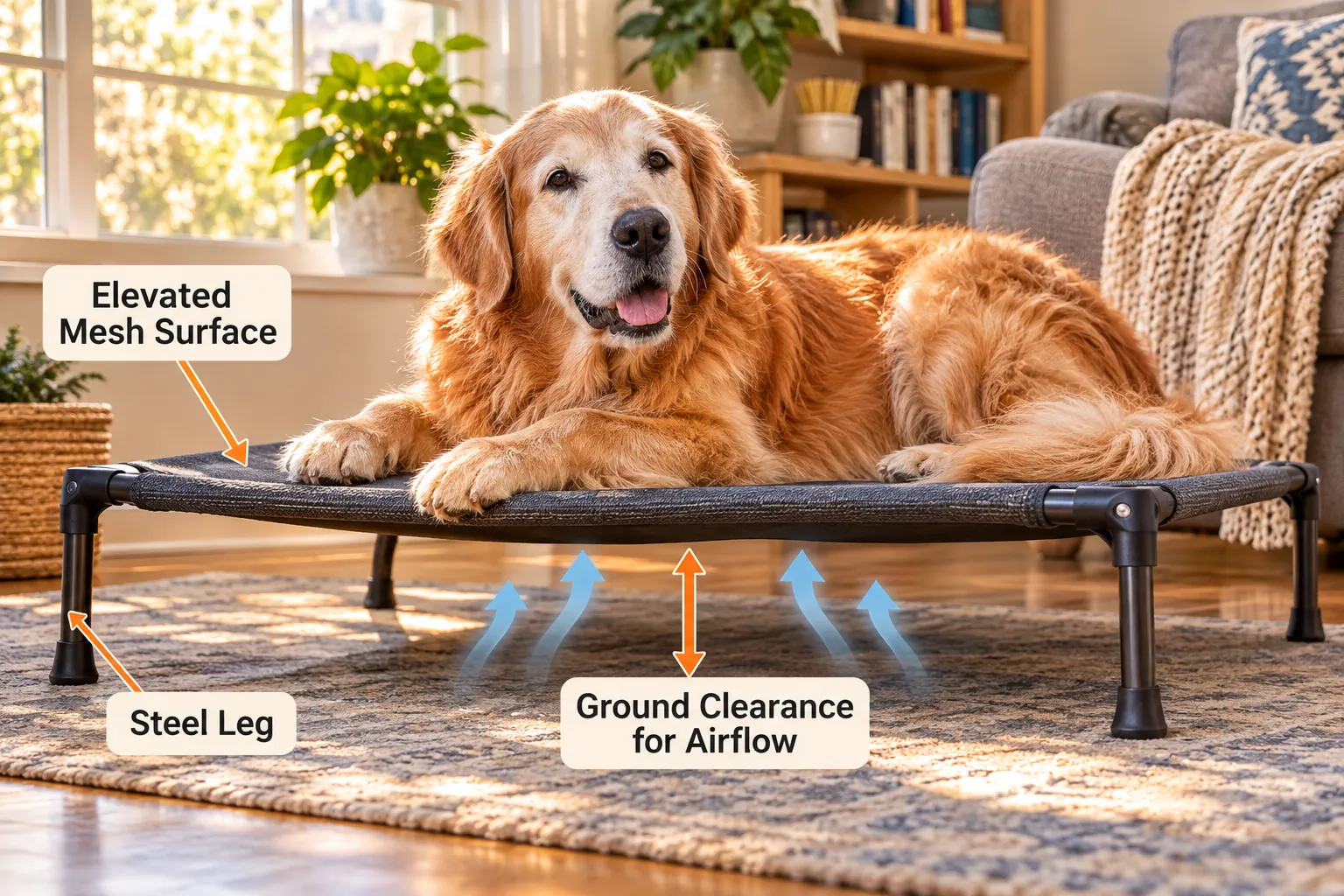
A coolaroo dog bed is an raise pet cot built from a powder-coated steel frame with a stretched mesh fabric panel that lifts a dog roughly 8 inches off the floor so air can move underneath. The design works because trapped body heat is the main reason dogs get uncomfortable on flat surfaces like tile, carpet, or a car floor.
When a dog lies directly on the ground, body heat has nowhere to go except back up into the fur and skin. A coolaroo dog bed changes that by suspending the dog’s weight in a hammock of breathable fabric, so warm air escapes downward and fresh air circulates from below. This is the same basic principle behind raise cots used by search and rescue teams and outdoor working dogs, where constant airflow matters more than cushioning.
Coolaroo sells its Original line in four sizes with 2026 starting prices around $34.99 for small, $39.99 for medium, $44.99 for large, and $49.99 for extra-large Coolaroo raise dog beds. Assembly takes about 10 minutes: slide the frame tubes together, then stretch the mesh fabric over the corner joints. No tools are required, and most owners can do it solo.
If you’re also working on reducing heat stress indoors, pairing a the Coolaroo with good airflow in the room (a fan, a shaded window spot, tile flooring) multiplies the cooling effect rather than relying on the bed alone.
Coolaroo dog bed vs regular dog bed: what’s the difference?
A regular dog bed (foam, pillow-style, or bolster) sits flat on the floor and relies on padding for comfort, while a the Coolaroo sits raise on a frame and relies on airflow instead of cushioning. The two solve different problems and are not interchangeable for every dog.
Foam and pillow beds trap heat against the body but offer real pressure relief for joints, hips, and pressure points. Elevated mesh cots like a the Coolaroo do the opposite: almost no cushioning, but constant air movement that keeps a dog cooler in warm rooms or on patios. Veterinary nutrition researcher Joseph Wakshlag has noted that roughly 4 to 5 inches of memory foam does more for pressure distribution than a bed marketed as orthopedic with only an inch of padding, a point worth remembering when comparing a mesh cot to a padded bed for an arthritic dog [NBC Select dog bed guide].
Decision rule: choose a regular padded bed if joint pain, surgery recovery, or advanced age is the primary concern. Choose a the Coolaroo if heat management, easy cleaning, and durability in warm climates matter more than cushioning. Some owners keep both and rotate seasonally, padded bed in winter, raise cot in summer.
How much does a coolaroo dog bed cost?
A the Coolaroo typically costs between $35 and $55 depending on size, with the large size most commonly priced around $40 to $55 as of 2026 Coolaroo raise dog beds. Premium versions with HeatShield cooling fabric cost more, often landing closer to $60 to $80 for a medium or large Coolaroo Pro HeatShield medium.
Price bands by size (approximate, check current retailer listings for exact pricing):
- Small: around $35
- Medium: around $40
- Large: around $45 to $55
- Extra-large: around $50 to $65
- HeatShield Pro line: add roughly $15 to $25 over standard mesh
For comparison, the K&H Outdoor Elevated Dog Bed sits in a nearly identical price band, around $40 to $60 for a large. Kuranda’s aluminum, chew-proof version costs significantly more, around $180 to $200, which only makes sense for dogs that have already destroyed a mesh cot Dogster chew-proof bed guide.
Common mistake: assuming the cheapest listing online is the correct size. Sellers sometimes list mismatched frame and fabric combinations at a discount. Confirm the exact dimensions and weight rating match the listing title before buying.
Best coolaroo dog bed size for my dog
The right size depends on your dog’s length when fully stretched out, not just their breed category or weight alone. Measure your dog from nose to tail base while lying flat, then add at least 4 inches of buffer on each end.
- Small (up to about 25 lbs, toy and small breeds): good for Chihuahuas, dachshunds, small terriers
- Medium (up to about 40 to 50 lbs): good for beagles, cocker spaniels, border collies
- Large (up to about 90 lbs): good for Labradors, German shepherds, golden retrievers
- Extra-large (90+ lbs): good for mastiffs, Great Danes, Saint Bernards, though always check the frame’s weight rating first
A the Coolaroo that’s too small will let paws, tails, or heads hang off the frame edges, which defeats some of the cooling benefit and puts stress on the mesh at points it isn’t designed to bear weight. A bed that’s too large wastes floor space and can feel less secure to smaller or anxious dogs. When in doubt, size up rather than down, since dogs generally adapt better to slightly roomier beds than cramped ones.
Coolaroo dog bed reviews: is it worth it?
Yes, for the right use case. Forbes Vetted named the Coolaroo Original its top pick for chew resistance, citing the tight weave mesh and the roughly 8-inch elevation that keeps a dog’s body off hot or cold flooring [Forbes Vetted cooling bed guide]. Dogster’s testing of raise dog beds also highlighted Coolaroo’s simplicity and low price as standout traits among budget cooling cots Dogster raise dog bed guide.
Owner feedback on retail platforms is generally positive for indoor and mild-climate outdoor use, with common praise for easy cleanup (a quick hose-down handles most messes) and lightweight frames that are simple to move between rooms or store flat. Chewy reviews of Coolaroo’s steel-framed raise bed line reflect a similar pattern: strong marks for comfort and cooling, with occasional complaints about fabric wear after a year or more of heavy daily use Chewy Coolaroo steel-framed bed reviews.
A the Coolaroo is worth buying if the goal is a lightweight, affordable cooling surface for a dog without destructive chewing habits. It’s a weaker fit for dogs that treat every new object as a chew toy, since the mesh, while UV resistant, is not marketed as chew proof.
Where can I buy coolaroo dog beds?
The Coolaroos are sold through Amazon, Chewy, and the Coolaroo brand’s own site, with Amazon generally offering the widest size selection and fastest shipping for Prime members Amazon Coolaroo raise pet bed listings. Chewy carries the standard steel-framed line as well as the HeatShield fabric replacement panels sold separately Chewy Coolaroo HeatShield fabric reviews.
Buying directly from Coolaroo’s website is useful when a specific color or the newest HeatShield Pro line is out of stock elsewhere, since the brand tends to list its full current catalog with accurate sizing charts Coolaroo raise dog beds. Pet specialty stores like PetSmart and Petco also stock select sizes in physical locations, useful if you want to check frame sturdiness in person before buying.
Coolaroo Original, large on Amazon is the most frequently restocked listing and a reasonable default starting point for most shoppers.
Coolaroo dog bed for large dogs: does it work?
Yes, with a caveat: the large and extra-large Coolaroo frames are built with thicker steel tubing to handle more weight, but fabric tension becomes the real limiting factor over time rather than the frame itself. A large the Coolaroo supports most dogs up to roughly 90 pounds when the mesh is properly tensioned and the frame is on a level surface.
Large and giant breed owners should watch two things specifically. First, confirm the exact weight rating listed for the size being purchased, since “large” labeling is not standardized industry-wide. Second, expect to retighten the mesh at the corners every few months with a heavier dog, since repeated pressure from a 70 to 90 pound dog stretches fabric faster than it does with a 20 pound dog. For dogs consistently over 90 pounds or dogs that put uneven pressure on one side (common with dogs that favor a joint), a heavier-duty frame like Kuranda’s aluminum design may hold tension longer.
Coolaroo vs gel cooling bed: which is better?
A the Coolaroo cools through airflow underneath the dog, while a gel cooling bed cools through a gel-infused pad that absorbs and disperses heat on contact, and the better choice depends on whether the dog needs active air circulation or passive surface cooling. Gel beds work well for dogs that prefer lying flat on the floor and won’t use an raise cot, since many senior or anxious dogs feel more secure low to the ground.
Elevated mesh cots have an advantage in genuinely hot climates or outdoor settings, since airflow keeps working as long as the dog is on the bed, with no recharge time needed. Gel pads can lose their cooling effect after extended contact as the gel absorbs body heat and needs time (or a cooler environment) to reset. A the Coolaroo also tends to be easier to clean outdoors, since mesh can be hosed off and air-dried quickly, while gel pads typically need to stay dry and are less tolerant of repeated wet cleaning.
Decision rule: choose an raise mesh cot for outdoor patios, warm climates, and dogs that like to stretch out. Choose a gel pad for dogs that prefer lying flat, for crates with limited interior height, or for apartments where an raise frame takes up more visual and physical space.
Can you wash a coolaroo dog bed? How to clean it
Yes. Most Coolaroo mesh fabric can be wiped down, hosed off, or spot cleaned with mild soap and water, then air dried flat before the dog uses it again. The steel frame can be wiped with a damp cloth and should be dried fully before storage to limit rust at the weld points.
Basic cleaning steps for a the Coolaroo:
- Remove loose hair and debris with a vacuum attachment or stiff brush.
- Hose down the mesh fabric outdoors, or wipe thoroughly indoors with a damp cloth and mild soap.
- Scrub the frame corners and joints where grime tends to collect.
- Let the bed air dry completely in a shaded, ventilated spot before reuse. Direct sun for extended drying periods can accelerate fabric fading over time.
- Retighten the mesh at the corners if it has loosened, which restores the taut hammock shape.
Avoid machine washing the fabric while it’s still attached to the frame, and avoid bleach, which can weaken mesh fibers faster than regular wear. If the fabric is removable on your specific model, check the care tag for machine-wash instructions, since this varies by Coolaroo product line.
Coolaroo dog bed durability: how long does it last?
A the Coolaroo used indoors typically lasts two to four years with normal use, while outdoor exposure to sun and rain can shorten that to one to two years before the mesh or frame shows significant wear. Durability depends heavily on dog size, chewing habits, and how often the bed sits in direct sun or standing water.
Chewy reviews of Coolaroo’s steel-framed raise bed note that most owners get solid use out of the product for well over a year before fabric stretching or minor tears appear, especially with dogs under 50 pounds Chewy Coolaroo steel-framed bed reviews. Heavier dogs, outdoor placement, and frequent moving of the bed (folding and unfolding for storage) all shorten the realistic lifespan.
Common mistake: expecting a $45 mesh cot to perform like a $200 chew-proof frame over several years of daily outdoor use. A the Coolaroo is built for a reasonable lifespan at a budget price point, not for indefinite outdoor exposure. For dogs who need something built for years of hard outdoor use, the K&H Outdoor Elevated Dog Bed or Kuranda’s aluminum option is the more realistic long-term choice.
Coolaroo dog bed outdoor use: will it fade?
Coolaroo’s mesh fabric is treated for UV resistance, which slows fading compared to untreated fabric, but prolonged direct sun exposure over multiple seasons will still lighten the color and gradually weaken fiber strength. This is normal wear rather than a defect, and it happens to nearly all outdoor fabric products over time.
To slow fading and extend the life of a the Coolaroo kept outside:
- Place the bed in partial shade rather than full sun whenever possible.
- Bring it indoors or under cover during extended rain or snow.
- Rotate the bed’s orientation occasionally so one side doesn’t bear all the sun exposure.
- Dry the frame fully after rain to limit rust at weld points.
If the bed lives outside year-round in a sunny, exposed location, the K&H Outdoor Elevated Dog Bed’s heavier denier perimeter fabric generally holds color and structural integrity longer than Coolaroo’s all-mesh design, based on consistent owner reporting across both product lines.
Is coolaroo dog bed good for senior dogs?
A the Coolaroo works well for senior dogs with healthy joints who need a cool, easy-to-clean surface, but it’s not an ideal fit for dogs with diagnosed arthritis or significant mobility limitations. The hammock shape of mesh cots offers no cushioning layer, which some stiff-jointed dogs find uncomfortable to climb onto or off of.
A review published by Mobius Pet Science in October 2026 found no strong evidence that trampoline-style raise cots improve arthritis outcomes specifically; their benefit lies in heat management and surface pressure relief for otherwise healthy joints, not in treating joint disease [Mobius Pet Science arthritis bed review]. This matters because some sellers market raise cots as orthopedic, which overstates what the design actually does.
Decision rule: choose a the Coolaroo for a senior dog that still moves comfortably and mainly needs a cooler resting spot. Choose a padded orthopedic bed with at least 4 inches of supportive foam for a senior dog with diagnosed hip or joint issues, following guidance similar to what veterinary nutrition researcher Joseph Wakshlag has described for pressure-point relief [NBC Select dog bed guide].
Coolaroo dog bed alternatives: other cooling options
The main alternatives to a the Coolaroo are the K&H Outdoor Elevated Dog Bed, Kuranda’s chew-proof aluminum cot, and gel-infused cooling pads, each suited to a different situation.
- K&H Outdoor Elevated Dog Bed: Best for dogs that spend significant time outside, thanks to its heavier denier perimeter fabric around a mesh center panel.
- Kuranda Chew Proof Aluminum: Best for determined chewers and dogs up to 250 pounds, since the fabric is locked into an aluminum frame channel rather than exposed at the edges Dogster chew-proof bed guide.
- Gel cooling pads: Best for dogs that prefer lying flat rather than on an raise frame, or for crate use where height is limited.
- Coolaroo HeatShield Pro line: A pricier option within the Coolaroo brand itself, using reflective fabric the company claims feels up to 15°F cooler on contact, worth considering for dogs that spend long hours outside in direct sun Coolaroo Pro HeatShield large.
If budget and simplicity matter most, a standard the Coolaroo remains the most accessible entry point among these alternatives.
Do coolaroo dog beds actually keep dogs cool in summer?
Yes, raise mesh cots like a the Coolaroo genuinely help dogs stay cooler by letting air circulate underneath the body instead of trapping heat against a flat surface. NBC Select recommended Coolaroo on this basis, noting that elevation allowing air movement under the dog is particularly useful in hot climates [NBC Select dog bed guide].
The cooling effect comes from basic airflow physics rather than any special chemical or gel technology in the standard mesh line. A dog lying on tile or carpet traps body heat against that surface; a dog lying on a the Coolaroo has air moving below the fabric on all sides, which noticeably reduces surface temperature compared to flat bedding. Coolaroo’s HeatShield fabric line adds an additional reflective layer that the company claims feels up to 15°F cooler than standard mesh, though that figure comes from the manufacturer and hasn’t been independently verified in a published lab test.
For households managing a dog’s overall temperature regulation and health, it’s also worth reading up on broader topics like superfoods for dogs and general wellness, since diet and hydration play a role in heat tolerance alongside bedding choices.
Matched-size cot comparison
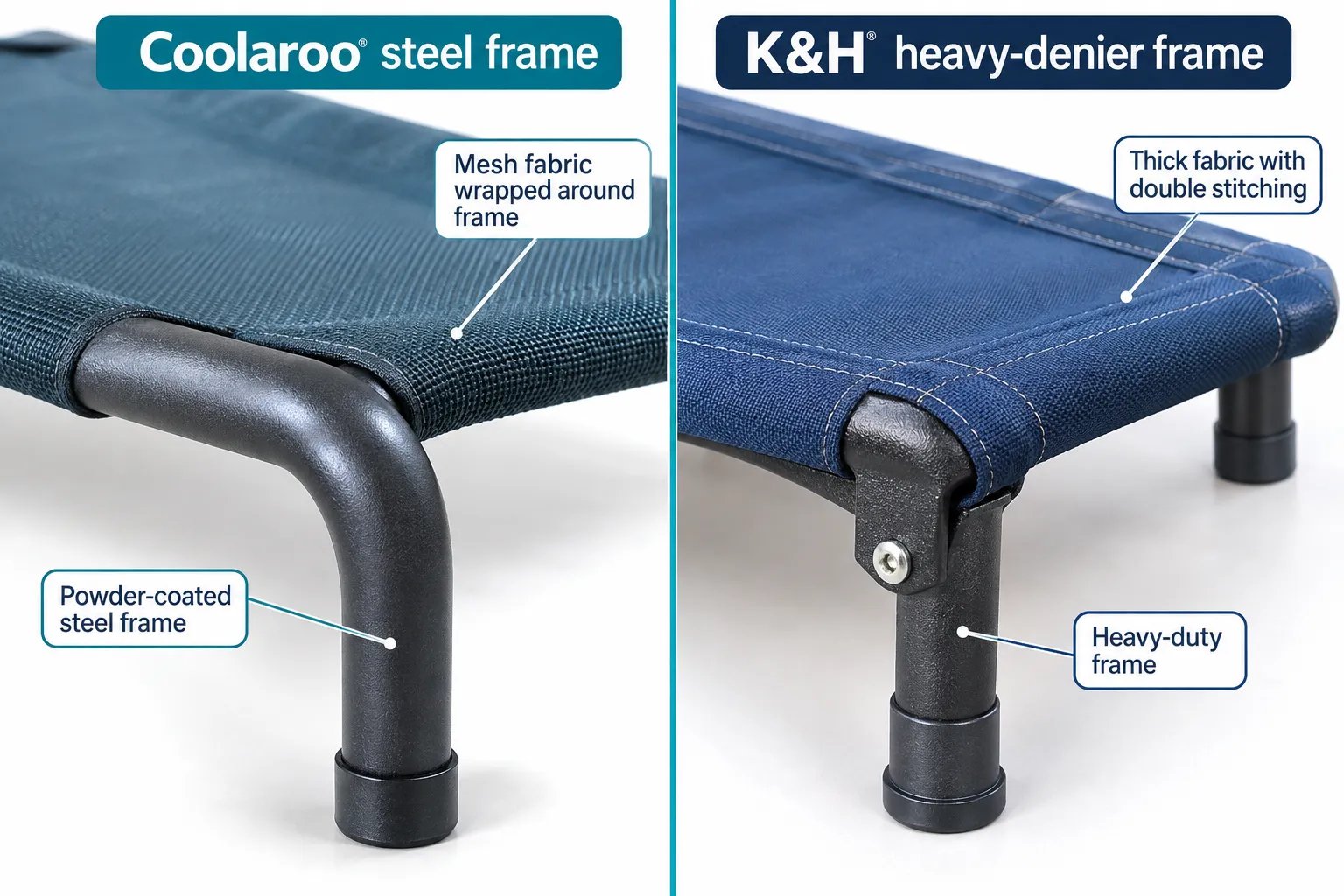
At matched large sizes, the Coolaroo Original and K&H Original Pet Cot differ mainly in fabric construction rather than footprint. Both roughly fit a 36 by 42-inch area in their large listings, though exact dimensions vary by retailer listing, so always check before buying.
The Coolaroo Original large uses the same mesh across the entire sleeping surface and frame perimeter, which keeps the bed lightweight and easy to hose off. The K&H Original Pet Cot large uses mesh only in the center, with a tougher woven fabric around the edges where paws and claws make the most contact. That edge fabric is the main reason K&H often outlasts Coolaroo in high-traffic outdoor settings, even though Coolaroo’s mesh carries strong UV resistance ratings.
Decision rule: choose Coolaroo at matched sizes if the bed stays mostly indoors or in a shaded, mild outdoor spot. Choose K&H if the bed sits on a deck, porch, or anywhere exposed to sun and moisture for the life of the product.
Who should skip either model
Owners of dogs with diagnosed joint disease or advanced arthritis should be cautious with any thin mesh cot, since neither Coolaroo nor K&H offers meaningful cushioning. A mesh cot supports the body in a hammock shape, which some stiff-jointed dogs find comfortable and others find harder to climb onto or off of.
Common mistake: buying an raise cot specifically to treat arthritis symptoms. As noted earlier, these cots help with heat and surface pressure management for healthy joints, not with managing diagnosed joint disease [Mobius Pet Science arthritis bed review].
Skip either model if the dog is a heavy fabric chewer, has mobility issues that make climbing onto an raise surface risky, or needs a bed with raised bolster sides for a sense of security while sleeping. For puppies still working through basic training fundamentals, it’s often worth waiting on an raise mesh bed until the destructive chewing phase passes.
Top 5 features that decide the purchase
- Fabric type and location. Coolaroo Original uses full mesh; K&H Original Pet Cot uses a mesh center with denier fabric edges.
- Frame material and coating. Coolaroo’s powder-coated steel resists rust reasonably well indoors but shows wear faster with constant outdoor moisture exposure.
- Weight rating. Always check the listing for the exact size being purchased, since larger frames carry higher capacity but fabric tension is the real limiting factor on a worn cot.
- Replacement cover availability. This is the detail most buyers miss until the fabric fails, covered in the FAQ below.
- Elevation height. Both sit around 7 to 8 inches off the ground, enough for airflow but not a step-free climb for a frail senior dog.
Comparison table
| Model | Price band | Frame | Best for |
|---|---|---|---|
| Coolaroo Original, large | Around $40 to $55 | Powder-coated steel, full mesh wrap | Indoor or shaded patio use |
| K&H Outdoor Elevated Dog Bed, large | Around $40 to $60 | Steel frame, denier-edge fabric | Deck, porch, year-round outdoor use |
| Kuranda Chew Proof Aluminum | Around $180 to $200 | Aluminum, fabric locked in frame channel | Heavy chewers, dogs up to 250 lbs |
Which pick fits which dog and owner (including a budget pick)
The budget pick is the Coolaroo Original, large, priced around $40 to $55 and ideal for an indoor senior dog that just needs a cool spot off the floor. The step-up pick is the K&H Outdoor Elevated Dog Bed, large, similarly priced but better built for a dog that spends real time outside.
- Indoor senior dog, mild chewer, budget matters: Coolaroo Original.
- Dog that lives partly outdoors, deck or patio regular: K&H Outdoor Elevated Dog Bed.
- Heavy chewer or 90+ pound dog with a history of destroying beds: Kuranda, despite the higher cost, because the fabric isn’t exposed at the edges.
- Apartment dweller with limited storage: Coolaroo’s lighter frame disassembles more easily for seasonal storage.
Compare the options against your actual routine rather than shelf price alone. A $15 difference matters far less than buying the wrong fabric type for where the bed actually lives.
Things to watch out for
Fabric tension loosens over time on both brands, especially with dogs over 60 pounds that shift position often. A sagging cot isn’t a defect so much as expected wear; retightening the fabric at the corners usually restores it for a while longer.
Outdoor exposure is the bigger long-term risk. Coolaroo’s steel frame can develop surface rust at weld points after a season or two of rain exposure, even with powder coating applied. K&H’s frame tends to hold up a bit longer outdoors by most owner reports, though neither brand markets itself as fully weatherproof.
Watch the stitching on K&H’s denier perimeter for loosening threads near the corners, which is often the first sign the cover needs replacing before a full tear develops. On Coolaroo, watch the mesh near the frame corners, where repeated stretching concentrates stress fastest.
Who should skip this
- Dogs recovering from surgery or with diagnosed hip dysplasia may do better on a low, padded bed than an raise hammock-style cot.
- Puppies in a destructive chewing phase will likely shred mesh fabric within weeks regardless of brand.
- Owners wanting one bed for life without ever replacing a cover should budget for Kuranda instead, since its fabric is far more chew resistant than either Coolaroo or K&H.
Honest drawback for Coolaroo: replacement covers aren’t consistently stocked for every size, meaning a torn cot sometimes means buying a new frame rather than a simple fabric swap. Honest drawback for K&H: its heavier fabric and frame weigh more, making it less convenient to move around for cleaning or seasonal storage.
For dogs who need more active supervision outdoors near bedding areas, it may also help to revisit basics like leash habits and safety when setting up an outdoor resting spot.
FAQ
Coolaroo vs K&H raise dog bed: which lasts longer? K&H’s Original Pet Cot generally lasts longer outdoors because of its heavier denier perimeter fabric. A the Coolaroo often lasts just as long or longer indoors, where its lighter mesh isn’t exposed to sun and rain.
Can you buy a replacement cover for the The Coolaroo? Replacement covers for Coolaroo aren’t consistently stocked across every size, so check current availability on the retailer page for your exact model before assuming one exists.
Does the K&H raise bed rust outdoors? The steel frame can show surface wear with prolonged outdoor moisture exposure, though owner reports generally describe it holding up longer than Coolaroo’s frame in constant outdoor conditions.
How much weight can each bed hold? Weight ratings vary by size, so always check the specific listing. A large Coolaroo and a large K&H aren’t guaranteed to carry the same capacity.
Which raise bed is easier to assemble? Both assemble without tools by sliding frame tubes together and stretching fabric over the corners. Most owners finish either one in under 10 minutes.
Are Coolaroo beds chew proof? No. Forbes Vetted rated the Coolaroo Original as chew-resistant due to its tight mesh, but no mesh cot is fully chew proof against a determined chewer.
Which bed is better for a hot climate? Both rely on elevation for airflow, and NBC Select recommended Coolaroo on that basis. Coolaroo’s HeatShield line adds a reflective fabric claimed to feel up to 15°F cooler, though that figure is a manufacturer claim rather than an independent test result.
Is a the Coolaroo safe for puppies? It can work for calm puppies past the chewing stage, but mesh fabric is an easy target for teething puppies, so many owners wait until the dog is past heavy chewing before investing in one.
Do the Coolaroos work indoors on carpet? Yes. Elevating the dog off carpet still allows airflow underneath, which helps in warm rooms even without tile or hardwood flooring beneath the cot.
What size the Coolaroo do I need for a 60 pound dog? Most 60 pound dogs fit a large Coolaroo Original, but measure your dog’s stretched-out length and compare it against the exact listing dimensions before ordering.