
Quick Answer
Yes, do dogs get jealous in a measurable way: lab studies show dogs push, pull, and physically intervene more when an owner pays attention to a rival dog than when the owner interacts with an object. Two experiments, a 2021 study in Psychological Science and a 2025 study in Scientific Reports, used leash-pull force and behavior coding to show this pattern holds up under controlled conditions, not just owner impressions. Whether that counts as the full human emotion of jealousy is still an open question among researchers.
Punchline
Do dogs get jealous in a way scientists can measure? Yes, but only for specific triggers under specific conditions, and the label “jealousy” covers more ground than most headlines admit.
Researchers can clock a leash-pull force in newtons. They can count how many times a dog snaps, paces, or shoves its body between a person and a rival. What they cannot do is ask the dog afterward how it felt. That gap between a measured response and an emotional label is the real story behind every “do dogs get jealous” headline you have seen.
Key Takeaways
- A 2021 study in Psychological Science found dogs pulled with an average force of 158.03 newtons when owners appeared to pet a hidden fake dog, versus 73.51 newtons toward a fleece cylinder, more than double.
- That study tested 18 dogs, 11 female, mean age 4.6 years, using 30-second trials.
- A 2025 study in Scientific Reports by Judit Abdai and colleagues tested 60 dogs and found the strongest jealousy-type response went toward a real dog, with a moving artificial agent producing an intermediate reaction.
- An earlier 2018 Scientific Reports paper and a widely cited 2014 study, both covered by PetMD, reported dogs showed more jealous-type behaviors, including snapping and pushing, toward a stuffed dog than toward a nonsocial object.
- 93.3% of dogs (14 of 15) in the 2021 study later sniffed the fake dog like a real animal, supporting the idea that the model registered as socially meaningful.
- The American Kennel Club notes experts remain cautious about equating this response with the full human experience of jealousy or envy.
- Resource guarding and jealousy-type attention-seeking look similar but call for different management, a distinction most roundup articles skip.
When to call the vet
Growling, snapping, or biting during attention-seeking moments is a behavior and safety issue, not just an emotional quirk. If a dog has ever made contact with teeth, or if growling is escalating week over week, talk to a vet or a certified trainer before trying home fixes. Sudden jealousy-type behavior in a previously relaxed dog can also signal pain, vision loss, or anxiety that deserves a medical check before you assume it is purely behavioral.
Do dogs get jealous
Do dogs get jealous the way a person does, complete with resentment and private brooding over a slight? Nobody can say for certain, because dogs cannot report their inner state. What researchers can say is that dogs get jealous in a behavioral sense: they act differently, and more intensely, when a rival gets attention than when an object does.
The question matters because “jealousy” gets used loosely. A dog pushing between a couple on the couch, a dog growling at a new puppy, and a dog whining when you pick up your phone all get filed under the same word. They may not be the same thing, and treating them the same can lead to the wrong fix.
The 2021 study built its test around three conditions that true jealousy should meet: the reaction should happen with a social rival and not an object, it should come from the interaction itself rather than the rival’s mere presence, and it should persist even when the dog cannot see what is happening. Dogs met all three conditions. That is a meaningfully stronger design than earlier claims based on owner surveys alone, including the oft-cited 2014 study that asked owners to rate their dogs’ reactions to a stuffed dog getting attention, as summarized by PetMD.
Where the evidence stops: force on a leash and sniffing behavior tell you a dog is aroused and treats a fake rival as socially relevant. Neither proves the dog feels betrayed or embarrassed the way a jealous person might. The researchers behind both the 2021 and 2025 papers were careful to frame their findings as jealous behavior, not a confirmed jealous emotion, a distinction echoed by the British Psychological Society’s research digest.
What does jealousy look like in dogs?
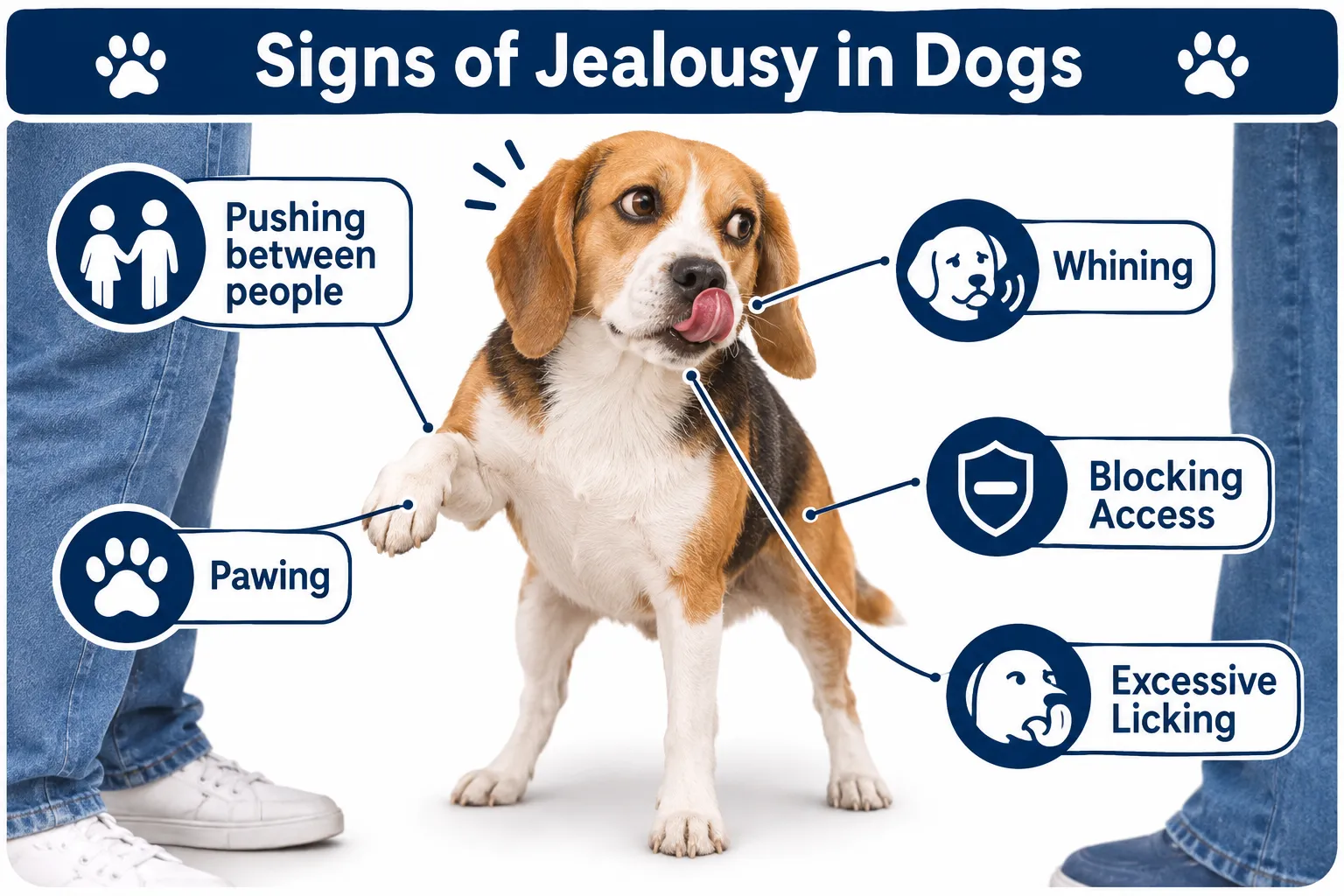
Jealousy-type behavior in dogs usually shows up as physical interference: pushing a body between the owner and the rival, pawing at the owner, whining, barking, or in more intense cases, snapping toward the rival. In the 2018 Scientific Reports study, these behaviors appeared far more often when owners gave affection to a realistic stuffed dog than to a nonsocial object like a bucket.
Common signs reported across studies and clinical observation include:
- Leaning or wedging the body between the owner and the rival
- Pawing, nosing, or nudging the owner’s hand or lap
- Whining or barking directed at the owner, not the rival
- Snapping or growling toward the rival (a more serious sign, covered in the vet-call guidance above)
- Attempting to physically block access, such as standing in a doorway
A dog that just leans in for pets when you sit near another dog is showing a mild version of this. A dog that stiffens, stares, and growls is showing something closer to guarding, which needs a different response (see the resource guarding section below).
How can I tell if my dog is jealous?
You can usually tell by watching what happens right when attention shifts to someone or something else, not before or after. If the behavior starts the moment you pet another dog, hold a baby, or hug a partner, and stops once you redirect attention back, that timing pattern matches the jealousy-type response seen in lab studies.
A simple home check: have a partner or friend sit next to you and give them a side hug or pat them on the back while your dog is in the room but not touching either of you. Note what the dog does in the next 15 to 30 seconds. Pushing in, whining, or pawing at you specifically (not at the other person) lines up with the attention-seeking pattern researchers measured. Ignoring the scene entirely suggests the trigger is not the one driving your dog’s day-to-day behavior.
Why do dogs get jealous?
The leading explanation is that jealousy-type behavior protects access to a valued resource, the owner’s attention and affection, which has real survival and social value for a social species. Dogs evolved alongside humans as cooperative animals, and attention from a caregiver often predicts food, play, and safety.
Researchers studying the 2021 Psychological Science experiment framed the response as consistent with a basic form of jealousy that functions to protect a valued social relationship, a concept also discussed in AKC’s coverage of jealousy and envy in dogs. The idea is not that dogs reason through “I am being replaced,” but that an evolved response pushes them to intervene when a bond they depend on looks threatened. That mechanism does not require complex self-awareness to work, which is part of why scientists hesitate to call it jealousy in the full human sense.
Can dogs feel jealous like humans do?
Dogs show behavior that looks like jealousy, but there is no current evidence that they experience the layered self-reflection involved in human jealousy, such as comparing their own worth to a rival’s. The AKC and most veterinary behaviorists describe this as a basic, more primal response rather than a complex social emotion.
Human jealousy often includes rumination, status comparison, and a narrative about fairness. Dogs cannot report any of that, and no behavioral test can currently detect it. What the evidence supports is a simpler claim: dogs respond with measurable arousal and interference behavior when attention goes to a rival instead of an object. Calling that “jealousy” is a useful shorthand, but it is not the same claim as saying dogs feel jealous exactly like humans do.
Doggy Rank IQ Tool
Jealous or Not Sorter

Describe the trigger and the behavior. You get the most likely read based on the two main experiments and a first step.
How to stop my dog from being jealous
The most reliable approach is to reward calm behavior near the trigger before the pushy behavior starts, rather than giving attention only after the dog demands it. Punishing a dog mid-shove or mid-whine tends to raise tension rather than resolve it, since none of the published studies on jealousy-type behavior tested or recommended corrections.
A practical sequence that trainers commonly recommend, and that lines up with general multi-pet household advice from the AKC:
- Catch the dog being calm near the trigger (partner, new pet, phone) and reward that calm state with a treat or quiet praise.
- Avoid rewarding the pushing-in behavior itself, even accidentally, by petting the dog the instant it wedges in.
- Give the dog its own predictable attention window earlier in the day, so the behavior is not the only route to affection.
- If growling or snapping is present, stop home training and bring in a certified trainer or vet behaviorist, per the vet-call guidance above.
- Keep sessions short and repeat consistently for two to four weeks before judging whether the plan is working.
A common mistake is punishing the whine or the nudge without addressing what triggers it. A dog that gets scolded for leaning in during a hug may simply learn to suppress the visible warning signs while the underlying tension stays the same.
Do all dog breeds get jealous equally?
No study has tested enough breeds to claim equal jealousy responses across all of them, and individual temperament, prior experience, and the specific bond with an owner likely matter more than breed alone. The 2021 and 2025 studies used mixed samples of pet dogs rather than breed-controlled groups, so breed-specific claims go beyond what the data supports.
Anecdotally, breeds bred for close human partnership, such as many working and companion breeds, are often described by owners as more attention-sensitive, but this has not been tested in a controlled jealousy model. If you are choosing a dog with a multi-pet or multi-person household in mind, general temperament guides like the best dogs for first-time owners roundup can help you think through social temperament, even though none of it is jealousy-specific research.
Is jealousy the same as possessiveness in dogs?
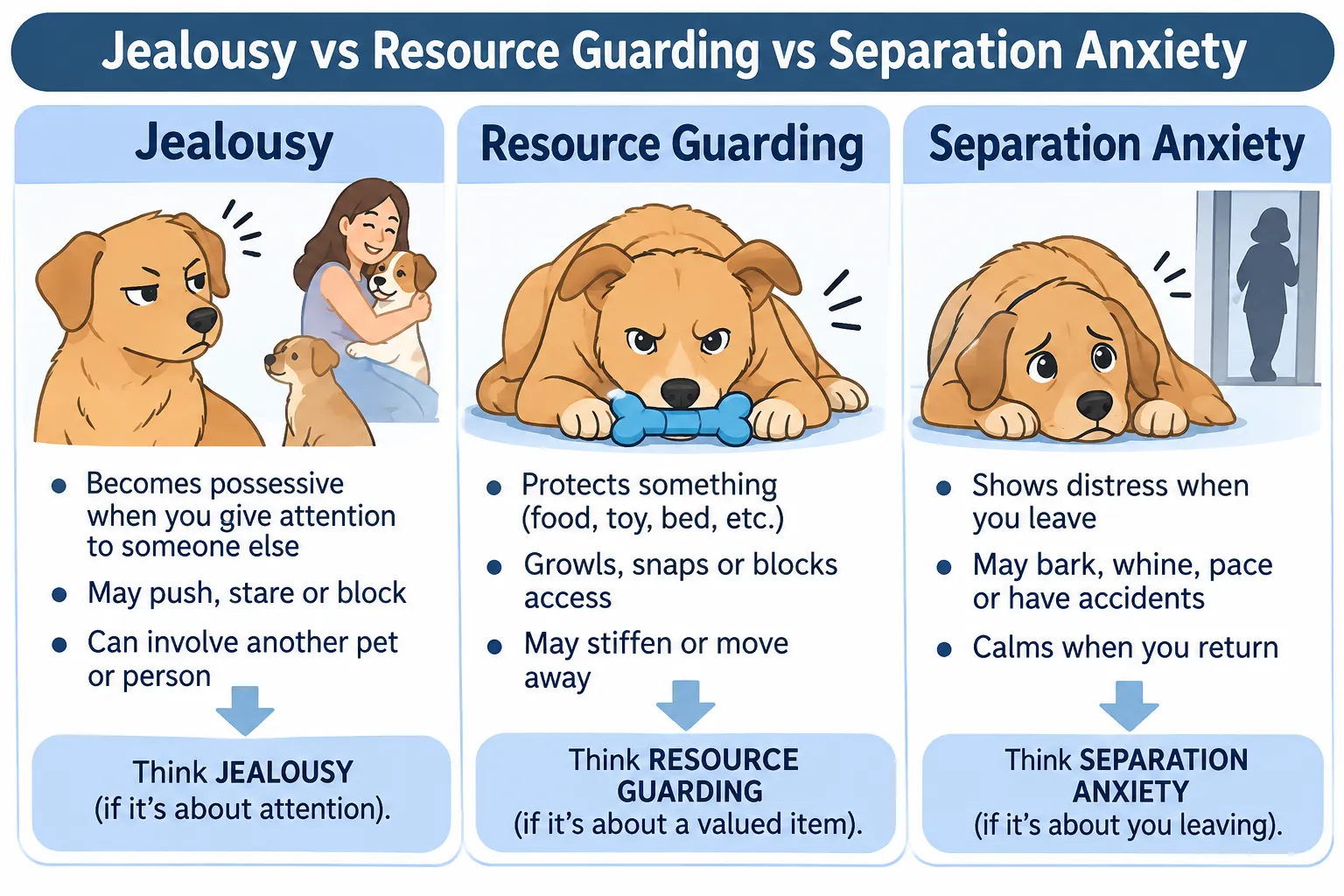
No. Jealousy-type behavior responds to another being getting the owner’s attention, while possessiveness, also called resource guarding, responds to the owner, food, a toy, or space being taken or approached. They often look similar (growling, stiff body, blocking) but the trigger and the fix differ.
A dog that growls only when another dog approaches its food bowl is guarding a resource, not reacting to lost attention. A dog that growls only when you pet another dog, and is fine with that same dog near its food, is showing the jealousy-type pattern. Mixing up the two matters because the management plans differ: resource guarding often calls for separate feeding stations and controlled approach distances, while jealousy-type behavior responds better to early calm-attention training described above.
Do puppies get jealous?
Puppies can show early versions of attention-seeking and interference behavior, but there is no published study specifically isolating jealousy-type responses in puppies under 12 months. Most of what is documented in puppies falls under general attention-seeking and litter-based competition rather than the adult jealousy model tested in the 2021 and 2025 studies.
In practice, a puppy that paws at you while you pet an older resident dog is displaying the building blocks of the same pattern adult dogs show, driven by competition for a limited resource (your attention). Early, consistent training that rewards calm waiting tends to prevent this from escalating as the puppy matures. If you are working through foundational training at this stage, the essential commands every puppy should learn guide covers the groundwork that also supports calm-attention training later.
Can dogs get jealous of a new pet?
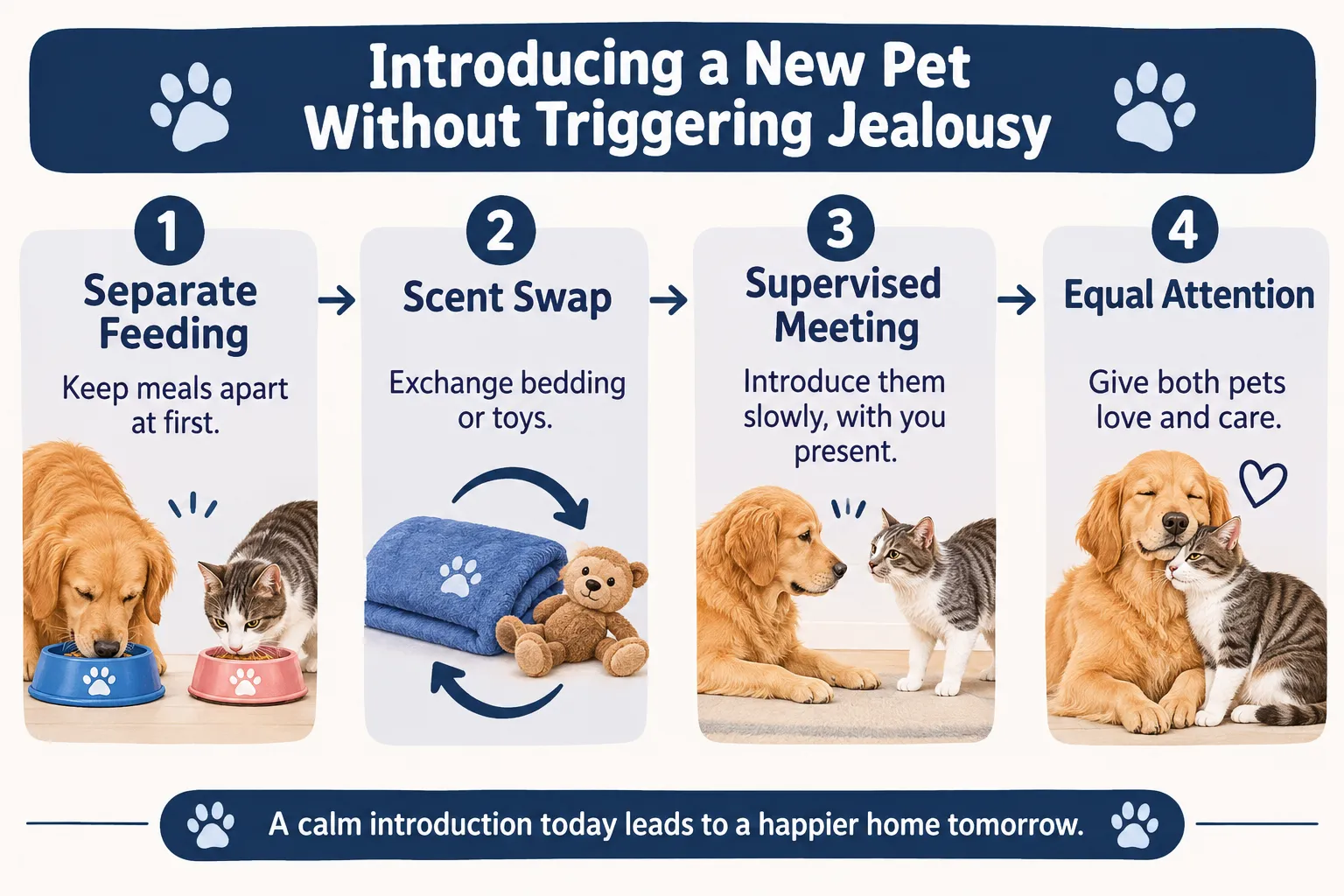
Yes, a new pet in the household is one of the most common real-world triggers reported by owners, and it fits the social-rival pattern tested in both the 2021 and 2025 studies. The response is usually strongest in the first few weeks, when the existing dog has not yet learned that the new pet does not eliminate its own access to attention and resources.
Signs to watch during an introduction period include pushing between the owner and new pet, increased whining when the new pet is held or petted, and in some cases mild resource guarding of the owner’s lap or favorite spot. A gradual introduction plan, separate initial feeding areas, and deliberately giving the resident dog one-on-one time each day tend to shorten this adjustment window. The multi-pet household guidance from AKC covers introduction pacing in more depth.
What’s the difference between dog jealousy and separation anxiety?
Jealousy-type behavior is triggered by another being receiving attention while the dog is present, while separation anxiety is triggered by the owner’s absence or departure, with no rival involved at all. A dog pacing and panting when you leave the house has separation anxiety; a dog pacing and panting only when you hold a baby while you are both home has something closer to jealousy-type arousal.
The two can look similar (pacing, panting, whining, inability to settle) which is why the trigger matters more than the behavior itself when deciding how to respond. If pacing and distress happen specifically around departures, doors closing, or being left alone, that points toward separation anxiety, covered in more depth in separation anxiety in dogs. If it happens specifically when attention shifts to a rival while you are present, that points toward jealousy-type behavior.
Do dogs get jealous of other dogs or just people?
Dogs show jealousy-type responses toward both other dogs and people who receive an owner’s attention, but the 2025 Scientific Reports study found the strongest reaction was reserved for a real dog rather than a human rival or an artificial agent. This suggests the social realism of the rival, not just the act of receiving attention, shapes how intense the response gets.
In that 2025 study, a moving artificial agent produced an intermediate response, stronger than a static object but weaker than a live dog, supporting the idea that dogs are responding to something closer to “a real competing animal” than to attention-getting in the abstract. For owners, this means a jealousy-type reaction to a new puppy in the house may be more intense than a reaction to, say, a friend visiting and getting a hug, though both can trigger some response.
Is it bad if my dog is jealous?
Mild jealousy-type behavior, like leaning in for pets or whining briefly when attention shifts, is not harmful and does not need to be treated as a problem on its own. It becomes a concern when it escalates to growling, snapping, or blocking access in a way that limits normal household activity or puts people or other pets at risk.
A decision rule that works for most households: if the behavior stays at the “pushy but soft” level (leaning, whining, pawing), manage it with early calm-attention training. If it escalates to stiffening, growling, or any snapping, treat it as a behavior and safety issue and involve a trainer or vet, per the guidance near the top of this article. Waiting to see if a growl resolves on its own is a common and risky mistake.
How long does dog jealousy typically last?
A single jealousy-type episode, such as a dog pushing in during a hug, usually resolves within seconds to a couple of minutes once the owner redirects attention or the rival interaction ends. As a recurring pattern tied to a specific household change, such as a new partner moving in or a new pet arriving, adjustment periods commonly run two to six weeks with consistent training, though no published study has measured this timeframe precisely.
If jealousy-type behavior around a specific new trigger has not eased at all after six to eight weeks of consistent calm-attention training, that is a reasonable point to bring in a certified trainer rather than continuing to wait it out.
Can you prevent jealousy in dogs?
You cannot eliminate the underlying response, since it appears tied to a dog’s basic drive to protect access to a valued relationship, but you can reduce how often and how intensely it shows up. Prevention works best when it starts before a known trigger arrives, such as a new baby or a new pet, rather than after problem behavior has already set in.
Practical prevention steps include gradually introducing new people or pets rather than all at once, maintaining the resident dog’s individual routine and attention time even as the household changes, and rewarding calm behavior near the new trigger from day one instead of waiting for pushiness to appear first. Dogs that already have strong basic obedience, including a reliable “place” or “settle” cue, tend to adjust faster because they have an alternative, rewarded behavior to fall back on instead of pushing in.
What did researchers measure when dogs appeared jealous?
Researchers measured physical behavior, not stated feelings, because dogs cannot self-report what they experience. In the 2021 trial, the primary measurement was peak leash-pulling force during 30-second windows while an owner petted a fake dog hidden behind a barrier.
The setup mattered as much as the result. Owners first ignored a nonsocial object, a fleece cylinder, then appeared to pet it. Dogs pulled with an average force of 73.51 newtons. When owners appeared to pet a hidden fake dog instead, average pull jumped to 158.03 newtons, more than double. A Bayesian analysis supported the difference, treated by the authors as decent evidence that dogs were responding to an interaction they could not directly see, a finding summarized by the University of Auckland’s coverage of the study.
A follow-up check mattered too: maybe dogs just wanted to see behind the barrier, nothing jealousy-specific about it. In a visible confirmation trial, pulling force averaged 112.15 newtons, with no meaningful difference from the hidden condition, which weakens the simple curiosity explanation.
Afterward, 14 of 15 dogs, 93.3%, sniffed the fake dog in a dog-directed way, suggesting the model registered as a plausible rival rather than a random prop. The 2025 Scientific Reports paper by Abdai, Laczi, Agostinho, and Miklósi tested 60 dogs with a moving artificial agent instead of a static fake dog, and found the strongest jealousy-type response still went to a real dog, with the artificial agent producing an intermediate reaction. The lesson for anyone asking do dogs get jealous of specific stand-ins: a rival has to look, move, and smell like a real dog to fully trigger the response.
Study setup comparison and low-risk management notes
| Study | Sample | Rival used | Key measure |
|---|---|---|---|
| Bastos et al., 2021 (Psychological Science) | 18 dogs, mean age 4.6 | Hidden fake dog vs fleece cylinder | Leash-pull force (newtons) |
| Abdai et al., 2025 (Scientific Reports) | 60 dogs, 3 groups of 20 | Moving artificial agent vs real dog | Interruption, vocalization, snapping |
| 2018 Scientific Reports / 2014 owner study | Household and observational design | Stuffed dog with sounds | Owner-reported and observed pushing, snapping |
A management note that applies across all three rows of this do dogs get jealous comparison: none of these studies tested punishment-based corrections, so none of them support using scolding to stop the behavior. A calmer, better-supported approach is to reward calm presence near the rival before pushing starts, which aligns with guidance in the separation anxiety coverage for related attention-driven behaviors.
Comparison table: Study setup comparison and low-risk management notes
| Scenario | Likely cause | Low-risk first step |
|---|---|---|
| Dog wedges between couple | Attention-seeking | Reward calm floor-lying nearby |
| Growls at new dog near owner | Resource guarding of owner | Separate feeding and greeting zones |
| Paces during baby’s crying | Anxiety, not jealousy | Build a settle mat routine away from noise |
| Noses your hand off the phone | Learned attention habit | Give a chew toy before screen time, not after demanding |
Choose the first step based on the behavior, not just the trigger. A dog that growls needs space and a trainer’s eyes more than a dog that just leans in for a pet.
Sourced stat cards
158.03 N
Average pull force toward hidden fake dog, 2021 study
93.3%
Dogs that sniffed the fake dog like a real one, 2021 study
60
Dogs tested in the 2025 artificial-agent study
4.6 yrs
Mean age of dogs in the 2021 leash-pull study
Things to watch out for
A dog pushing in for attention is not automatically a dog with a behavior problem. The mistake happens when owners either dismiss growling as “just jealousy” or punish every nudge as if it were aggression.
- Do not label every attention-seeking behavior as jealousy, since the 2025 study found real dogs provoke stronger responses than objects or artificial agents, meaning context changes the label.
- Do not confuse jealousy-type behavior with resource guarding, which involves protecting access to a person, food, or space and often needs a different management plan.
- Do not assume all breeds respond the same way. Individual variation, prior experience, and the specific relationship with the owner likely shape intensity, and no study claims to cover every breed equally.
- Do not scold a growl into silence. That risks removing a warning signal without fixing the underlying tension.
- Do not wait if snapping has already happened once. That crosses from behavior to safety, as noted in WebMD’s guidance on managing a jealous dog.
FAQ
Do dogs get jealous of new babies? Yes, a new baby is one of the most commonly reported triggers for jealousy-type behavior, since the baby absorbs a large share of the owner’s attention very suddenly. Gradual scent introduction, maintaining the dog’s routine, and giving dedicated one-on-one time each day tend to ease the adjustment.
Do dogs get jealous of cats? Dogs can show jealousy-type responses toward cats that receive an owner’s attention, though no study has specifically isolated dog-cat rivalry using the same leash-pull or behavior-coding methods used for dog-dog rivalry. Day-to-day owner reports suggest the pattern is similar: pushing in, whining, and occasional guarding.
Can two jealous dogs live together peacefully? Yes, with consistent management. Separate feeding areas, individual attention time, and reward-based training for calm behavior near each other allow most dogs, including ones that show jealousy-type behavior, to settle into a stable household routine within a few weeks.
Is growling always a sign of jealousy? No. Growling can signal jealousy-type arousal, resource guarding, fear, or pain, and the trigger context determines which it is. A vet check is a reasonable first step if growling is new or escalating.
Do dogs get jealous of toys? Dogs more often show resource guarding over toys (protecting access to the toy itself) rather than the attention-based jealousy pattern tested in these studies. If the growling happens around the toy regardless of who is nearby, it points to guarding rather than jealousy.
How do trainers typically address dog jealousy? Trainers generally recommend reward-based training that reinforces calm behavior near the trigger, combined with management steps like separate feeding and controlled introductions, rather than punishment. For growling or snapping, a certified trainer or vet behaviorist should be involved directly.
Does neutering or spaying affect jealousy-type behavior? There is no published study directly testing this using the jealousy paradigms described here, so no verified claim can be made either way.
Do dogs get jealous less as they age? There is no published longitudinal study tracking jealousy-type behavior across a dog’s lifespan, so any claim about age-related change would be an unverified assumption rather than a documented finding.
Editor’s take
Do dogs get jealous? The evidence supports a clear, narrow answer: dogs show a measurable jealousy-type response under specific experimental conditions, and two well-designed studies, backed by a 2018 study and owner-reported data going back to 2014, converge on the same basic pattern. Dogs react more strongly to a social rival getting attention than to an object, and the response holds up even when they cannot see the interaction directly. What the research does not support is the stronger claim that dogs experience jealousy with the same self-reflection and social comparison involved in human jealousy. For most households, the practical takeaway matters more than the philosophical one: watch the behavior, not just the label, manage triggers proactively, and treat growling or snapping as a safety conversation rather than a personality quirk.